

Playbill Collectibles : Playbill+memphis Price List
average value
-
low
-high
-Found 20 out of 56,978 items matching 'memphis'
Sold on eBay November 17th, 2024
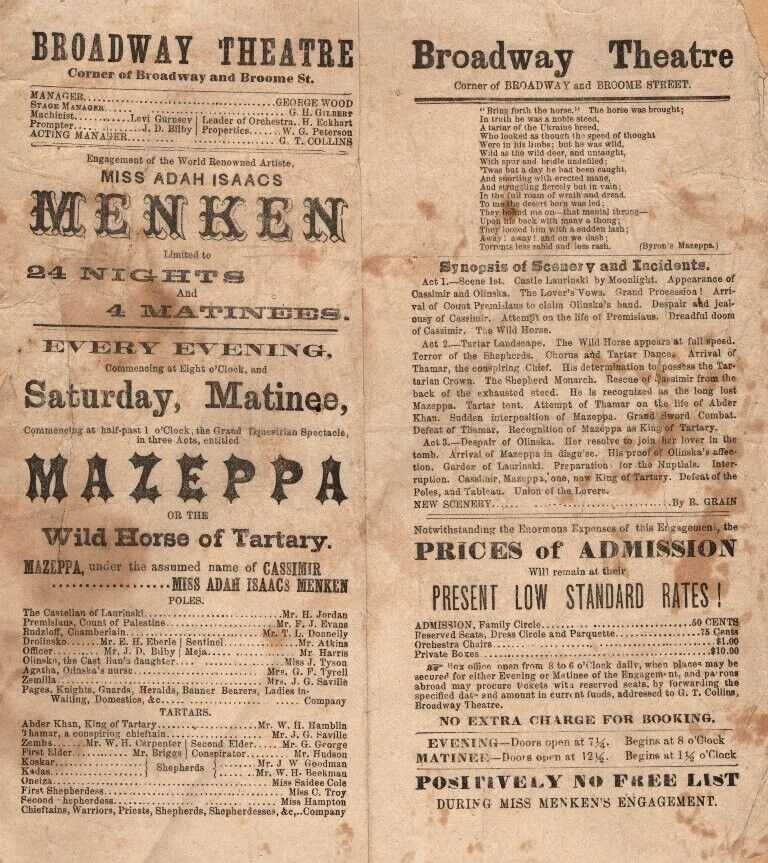
*ADAH ISSACS MENKEN IN LORD BYRON'S MAZEPPA RARE 1863 PLAY PROGRAM*
Audiences of the 1860s thought she was naked when she rode onstage on her horse wearing only flesh colored tights. She acted with the young Edwin Booth and befriended Walt Whitman. A rare original circa 1863 Broadway Theatre program for Adah Issacs Menken in her greatest and most sensational role in Lord Byron's Mazeppa. Dimensions nine by seven and a half inches lad down to a twelve by nine inch backing. Light wear otherwise good. See Adah Issacs Menken and Lord Byron's extraordinary biograpies below. Combined shipping discounts for multiple purchases. Credit cards accepted with Paypal. Inquiries always welcome. Please visit my other eBay items for more early theatre and historical autographs, photographs and programs and great singer, actor and actress cabinet photos and CDV's. From Wikipedia:Adah Isaacs Menken (June 15, 1835 – August 10, 1868) was an American actress, painter and poet, and was the highest earning actress of her time.[1] She was best known for her performance in the hippodrama Mazeppa, with a climax that featured her apparently nude and riding a horse on stage. After great success for a few years with the play in New York and San Francisco, she appeared in a production in London and Paris, from 1864 to 1866. After a brief trip back to the United States, she returned to Europe. She became ill within two years and died in Paris at the age of 33.[2]Menken told many versions of her origins, including her name, place of birth, ancestry, and religion, and historians have differed in their accounts. Most have said she was born a Louisiana Creole Catholic, with European and African ancestry. A celebrity who created sensational performances in the United States and Europe, she married several times and was also known for her affairs. She had two sons, both of whom died in infancy [3]Though she was better known as an actress, Menken sought to be known as a writer. She published about 20 essays, 100 poems, and a book of her collected poems, from 1855 to 1868 (the book was published posthumously). Early work was devoted to family and after her marriage, her poetry and essays featured Jewish themes. Beginning with work published after moving to New York, with which she changed her style, Menken expressed a wide range of emotions and ideas about women's place in the world. Her collection Infelicia went through several editions and was in print until 1902.Early life and of Menken's early life and origins vary considerably. In her "Some Notes of Her Life in Her Own Hand," published in The New York Times in 1868, Menken said she was born in Bordeaux, France, and lived in Cuba as a child before her family settled in New Orleans. There are many conflicting reports as to Menken's birth name, but she has been called Marie Rachel Adelaide de Vere Spenser and Adah Bertha Theodore, and Ed James, a journalist friend, wrote after her death: "Her real name was Adelaide McCord, and she was born at Milneburg, near New Orleans, on June 15, 1835."[4] Menken's birth year also varies, with some records stating 1835 and some stating 1832. [5] Elsewhere, in 1865, she wrote that her birth name was Dolores Adios Los Fiertes, and that she was the daughter of a French woman from New Orleans and a Spanish-Jewish man.[6] About 1940, the consensus of scholars was that her parents were Auguste Théodore, a free Black man, and Marie, a mixed-race Creole, and Adah was raised as a Catholic. She had a sister and a brother [6]Based on Menken's assertions of being a native of New Orleans, Wolf Mankowitz and others have studied Board of Health records for the city. They have concluded that Ada was born in the city as the legitimate daughter of Auguste Théodore, a free man of color (mixed race) and his wife Magdaleine Jean Louis Janneaux,[4][7] likely also a Louisiana Creole. Ada would have been raised as Catholic. However, in 1990, John Cofran, using census records, said that she was born as Ada C. McCord, in Memphis, Tennessee, in late 1830. He said she was the daughter of an Irish merchant, Richard McCord, and his wife Catherine [8][9] According to Cofran, her father died when she was young and her mother remarried. The family then moved from Memphis to New Orleans.Menken was said to have been a bright student; she became fluent in French and Spanish,[10] and was described as having a gift for languages.[6] As a child, Menken performed as a dancer in the ballet of the French Opera House in New Orleans. In her later childhood, she performed as a dancer in Havana, Cuba, where she was crowned "Queen of the Plaza [10]American as The French Spy, 1863After Cuba, Menken left dance for acting, and began working as an actress in Texas first. According to Gregory Eiselein, she gave Shakespeare readings, and wrote poems and sketches for The Liberty Gazette. She was married for the first time in Galveston County, in February 1855, to G. W. Kneass, a musician. The marriage had ended by sometime in 1856,[6] when she met and in 1856 married the man more generally considered her first husband, Alexander Isaac Menken, a musician who was from a prominent Reform Jewish family in Cincinnati, Ohio.[11]He began to act as her manager, and Ada Menken performed as an actress in the Midwest and Upper South, also giving literary readings. She received decent reviews, which noted her "reckless energy," and performed with men who became notable actors: Edwin Booth in Louisville, Kentucky, and James E. Murdoch in Nashville, Tennessee [12]In 1857, the couple moved to Cincinnati, where Menken created her Jewish roots, telling a reporter that she was born Jewish. She did study Judaism and stayed with the faith, although she never formally converted.[6] In this period, she published poetry and articles on Judaism in The Israelite in Cincinnati.[12] The newspaper was founded by Rabbi Isaac Mayer Wise, who was crucial to the Reform Judaism movement in the United States.[13] She also began to be published in the Jewish Messenger of New York.[6]Ada added an "h" to her first name and an "s" to Isaac, and by 1858 she billed herself as Adah Isaacs Menken. She eventually worked as an actress in New York and San Francisco, as well as in touring productions across the country.[14] She also became known for her poetry and painting. While none of her art was well received by major critics, she became a celebrity [11]At this time, Menken wore her wavy hair short, a highly unusual style for women of the time. She cultivated a bohemian and at times androgynous appearance. She deliberately created her image at a time when the growth of popular media helped to publicize it.[11]In 1859, Menken appeared on Broadway in New York City in the play The French Spy. Her work was not highly regarded by critics. The New York Times described her as "the worst actress on Broadway." The needed] said, "she is delightfully unhampered by the shackles of talent." Menken continued to perform small parts in New York, as well as reading Shakespeare in performance, and giving lectures.[4]Her third husband was John C. Heenan, a popular Irish-American prizefighter whom she married in 1859. Some time after their marriage, the press discovered she did not yet have a legal divorce from Menken and accused her of bigamy. She had expected Menken to handle the divorce, which he eventually did.As John Heenan was one of the most famous and popular figures in America, the press also accused Menken of marrying for his celebrity. She billed herself as Mrs. Heenan in Boston, Providence, Baltimore, and Philadelphia, using his name despite their divorce within a year of marriage.[11] They had a son, who died soon after birth.[10]While in New York, Menken met the poet Walt Whitman and some others of his bohemian circle. She was influenced by his work and began to write in a more confessional style while adhering to common sentimental conventions of the time. In 1860–61, she published 25 poems in the Sunday Mercury, an entertainment newspaper in New York. These were later collected with six more in her only book, Infelicia, published a few months after her death.[12] By publishing in a newspaper, she reached a larger audience than through women's magazines, including both men and women readers who might go to see her perform as an actress.[11]In 1860, Menken wrote a review titled "Swimming Against the Current," which praised Whitman's new edition of Leaves of Grass, saying he was "centuries ahead of his contemporaries [11][12][15] She identified with the controversial poet, and declared her bohemian identity through her support for him.[11] That year, Menken also wrote an article on the 1860 election, an unusual topic for a woman, which further added to her image.[11]When Menken met Charles Blondin, notable for crossing Niagara Falls on a tightrope, the two were quickly attracted to each other. She suggested she would marry him if they could perform a couple's act above the falls. Blondin refused, saying that he would be "distracted by her beauty."[10] The two had an affair, during which they conducted a vaudeville tour across the United States Mazeppa[edit]See also: Cultural legacy of MazeppaMenken in Mazeppa, 1866After it ended, she appealed to her business manager Jimmie Murdock to help her become recognized as a great actress. Murdock dissuaded Menken from that goal, as he knew she had little acting talent.[10] He offered her the "breeches role" (that of a man) of the noble Tartar in the hippodrama Mazeppa, based on the poem of that title by Lord Byron[1] (and ultimately on the life of Ivan Mazepa). At the climax of this hit, the Tartar was stripped of his clothing, tied to his horse, and sent off to his death.[16] The audiences were thrilled with the scene, although the production used a dummy strapped to a horse, which was led away by a handler giving sugar cubes. Menken wanted to perform the stunt herself.[9] Dressed in nude tights and riding a horse on stage, she appeared to be naked and caused a sensation.[9] New York audiences were shocked but still attended and made the play popular.Menken took the production of Mazeppa to San Francisco. Audiences again flocked to the show.[10][17] She became known across the country for this role, and San Francisco adopted her as its performer.In 1862, she married Robert Henry Newell, a humorist and editor of the Sunday Mercury in New York, who had recently published most of her poetry. They were together about three years. Next she wed James Paul Barkley, a gambler, in 1866, but soon returned without him to France, where she was performing. There she had their son, whom she named Louis Dudevant Victor Emanuel Barkley. The baby's godmother was the author George Sand (A. F. Lesser).[1] Louis died in infancy.[1]A previous version of Astley's Amphitheatre, showing the horse ringMenken arranged to play in a production of Mazeppa in London and France for much of 1864 to 1866. Controversy arose over her costume, and she responded to critics in the newspapers of London by saying that she was influenced by classical sculpture, and that her costume was more modest than those of ballet or burlesque. The show opened on October 3, 1864, at the Astley Theatre to "overflowing houses."[18] She was so well known that she was referred to as "the Menken," needing no other name.[11]Jokes and poems were printed about the controversy, and Punch wrote:[18]Here s half the town - if bills be true -To Astley's nightly thronging,To see the Menken throw asideAll to her sex belonging Stripping off woman's modesty,With woman's outward trappings -A barebacked jade on barebacked steed,In Cartlich's old strappings!(The last line refers to John Cartlich, equestrian performer [19])During this time of her greatest earning, she was generous to friends, theatre people in need, and charities.[1] While in Europe, the Menken continued to play to the American public as well, in terms of her image.[11] As usual, she attracted a crowd of male admirers, including such prominent figures as the writer Charles Dickens, the humorist Tom Hood, and the dramatist and novelist Charles Reade.[20]Later with Alexandre Dumas, 1866Playing in a sold-out run of Les pirates de la savane in Paris in 1866, Menken had an affair with the French novelist Alexandre Dumas, père, considered somewhat scandalous as he was more than twice her age. Returning to England in 1867, she struggled to attract audiences to Mazeppa and attendance fell off. During this time she had an affair with the English poet Algernon Charles Swinburne [1]She fell ill in London and was forced to stop performing, struggling with poverty as a result. Few realized that the glamorous star was ill until she collapsed during rehearsal and died a few weeks later.[4] She began preparing her poems for publication and moved back to Paris, where she died on August 10, 1868.[1] She had just written to a friend:I am lost to art and life. Yet, when all is said and done, have I not at my age tasted more of life than most women who live to be a hundred? It is fair, then, that I should go where old people go.[10]How long she had been a consumptive no one knew but, from what is known, she was dead at 33 – the flamelike quality that Dickens had called the “world’s delight” extinguished forever. They buried her in a corner of the little Jewish cemetery in Montparnasse, and on her grave stone are the words, “Thou Knowest,” an epitaph she had chosen from Swinburne, the poet who had said of her, “A woman who has such beautiful legs need not discuss poetry.”She was believed to have died of peritonitis and/or tuberculosis [10] Late twentieth century sources suggest she had cancer.[1] She was buried in Montparnasse Cemetery.[1] The inscription on her tomb reads "Thou knowest."[21]In 1862, Menken had written about her public and private personae:I have always believed myself to be possessed of two souls, one that lives on the surface of life, pleasing and pleased; the other as deep and as unfathomable as the ocean; a mystery to me and all who know me.[5]Her only book, Infelicia, a collection of 31 poems, was published several days after her death.Literary wanted to be known as a writer, but her work was overshadowed by her sensational stage career and private and public life. In total, she published about 20 essays, 100 poems and a book of her collected poems, from 1855 to 1868; the book was published posthumously. Her work was not received well by contemporary critics. George Merriam Hyde, one of the most respected critics of his day, refused to critique Menken's work, saying (privately) that "it would be an insult to himself and his profession".Van Wyck Brooks joked (in public) that "her work is the best example of unintentional wit and accidental humour".Her early work was devoted to family and romance. After her marriage to Menken and her study of Judaism, her poetry and essays for years into the 1860s featured Jewish themes. After her marriage and divorce from Heenan and meeting with writers in New York, she changed her style, adopting some influence from Walt Whitman. She was said to be the "first poet and the only woman poet before the twentieth century" to follow his lead in using free verse.[6] The New York Times reported that Walt Whitman had disassociated himself from Menken's work, implying he thought little of it.Beginning in New York, her poetry expressed a wider range of emotions related to relationships, sexuality, and also about women's struggle to find a place in the world. Her collection Infelicia went through several editions and was in print until 1902. In the late nineteenth century, critics were hard on women writers, and Menken's public notoriety caused even more critical scrutiny of her poems. Later critics (such as A. R. Lloyd in his book, The Great Prize Fight and Graham Gordon in his book Master of the Ring) generally dismiss her work as being devoid of talent. Admirers included Christina Rossetti and Joaquin Miller.George Gordon Byron (later Noel), 6th Baron Byron, FRS (22 January 1788 – 19 April 1824), commonly known simply as Lord Byron, was an English poet and a leading figure in the Romantic movement. Among his best-known works are the lengthy narrative poems Don Juan and Childe Harold's Pilgrimage, and the short lyric "She Walks in Beauty".Byron is regarded as one of the greatest British poets,[1] and remains widely read and influential. He travelled widely across Europe, especially in Italy where he lived for seven years. Later in life, Byron joined the Greek War of Independence fighting the Ottoman Empire, for which many Greeks revere him as a national hero.[2] He died in 1824 at the young age of 36 from a fever contracted while in Missolonghi. Often described as the most flamboyant and notorious of the major Romantics, Byron was both celebrated and castigated in life for his aristocratic excesses, including huge debts, numerous love affairs - with men as well as women, rumours of a scandalous liaison with his half-sister, and self-imposed exile [3]Manfred: A dramatic poem is a poem written in 1816–1817 by Lord Byron. It contains supernatural elements, in keeping with the popularity of the ghost story in England at the time. It is a typical example of a Romantic closet drama.Byron wrote this "metaphysical drama", as he called it, after his marriage failed in scandal amidst charges of sexual improprieties and an incestuous affair between Byron and his half-sister, Augusta Leigh. Attacked by the press and ostracised by London society, Byron fled England for Switzerland in 1816 and never returned. Because Manfred was written immediately after this, and because it regards a main character tortured by his own sense of guilt for an unmentionable offence, some critics consider it to be , or even confessional [1] The unnamed but forbidden nature of Manfred's relationship to Astarte is believed to represent Byron's relationship with his half-sister Augusta.Byron commenced this work in late 1816, only a few months after the famed ghost-story sessions which provided the initial impetus for Mary Shelley's Frankenstein. The supernatural references are made clear throughout the poem.Manfred was adapted musically by Robert Schumann in 1852, in a composition entitled Manfred: Dramatic Poem with music in Three Parts, and later by Pyotr Ilyich Tchaikovsky in his Manfred Symphony. Friedrich Nietzschewas impressed by the poem's depiction of a super-human being, and wrote some music for it.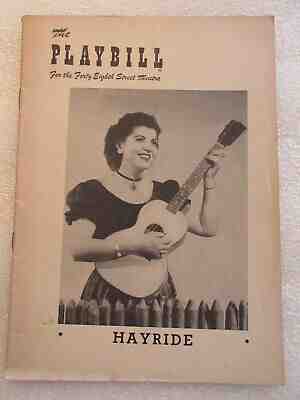
Sold on eBay Jul, 24th 2020
Lester Flatt "HAYRIDE" Earl Scruggs / Foggy Mountain Boys 1954 PLAYBILL rare
Lester Flatt "HAYRIDE" Earl Scruggs / Foggy Mountain Boys 1954 PLAYBILL rare This is a rare September 20th, 1954 playbill from nbsp;the nbsp;Original Broadway nbsp;production nbsp;of the Hillbilly, Folk musical "HAYRIDE" at the Forty-Eighth Street Theatre in New York City. The production opened September 13th, 1954 and closed October 2nd, 1954 after only 24 performances. The musical starred SUNSHINE SUE and featuredCOUSIN JOE MEMPHIS and ROSE, LESTER FLATT and EARL SCRUGGS and the FOGGY MOUNTAIN BOYS, PAUL WARREN, JAKE TULLOCH, CURLY SECHLER, The COON CREEK GIR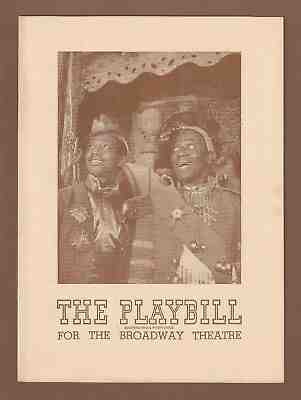
Sold on eBay Jun, 1st 2020
Bill "Bojangles" Robinson "MEMPHIS BOUND" Avon Long 1945 Broadway FLOP Playbill
This is a rare Thursday May 24th, 1945 (Opening Night)playbill from the Original Broadway nbsp;production of the DON WALKER and CLAY WARWICK musical comedy "MEMPHIS BOUND" at the Broadway Theatre in New York City. (The production opened May 24th, 1945 and closed after only 36 performances.) ..... Based on the GILBERT and SULLIVAN melodies from "H. M. S. Pinafore", the musical starredBILL "Bojangles" ROBINSON and featuredAVON LONG, SHEILA GUYS, IDA JAMES, THELMA CARPENTER, BILLY DANIELS, ADA BROWN, FRANK WILSON, ANN ROBINSON, EDITH WILSON and the DELT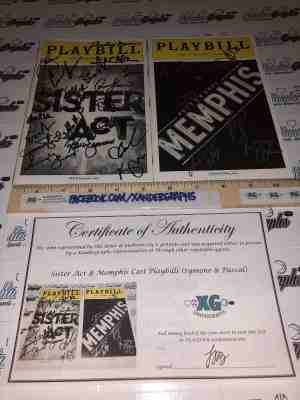
Sold on eBay Feb, 10th 2020
SISTER ACT & MEMPHIS CAST SIGNED THEATRE PLAYBILLS-COA ADAM PASCAL RAVEN SYMONE
BEAUTIFULLY SIGNED THEATRE PLAYBILLS BY:<br />CAST OF SISTER ACT (RAVEN SYMONE)CAST OF MEMPHIS (ADAM PASCAL)<br />YOU WILL RECEIVE EXACTLY WHAT IS PICTURED.<br />SIGNED IN-PERSON IN NEW YORK CITY OVER THE YEARS<br />COMES WITH PHOTO EMBOSSED CERTIFICATE SHOWN.<br />Condition of item: 10/10Quality of autograph: 10/10 <br />IF THESE ITEMS WERE TO EVER FAIL THIRD PARTY DNA JSA BECKETT ETC WE WILL REFUND YOUR PURCHASE PRICEAND RETURN SHIPPING!<br />$3.99 FIRST CLASS Shipping with delivery confirmation br /><br /><br /><br /><br /> <br />Posted with eBay Mob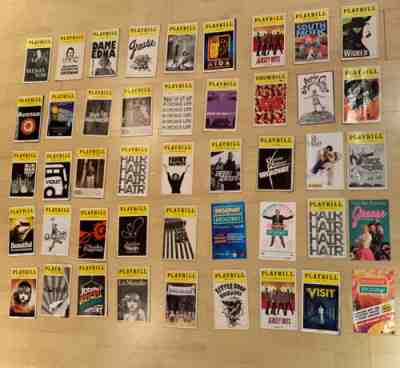
Sold on eBay Jul, 3rd 2020
Lot of 45 Playbills - Broadway, Off-Broadway, Regional and Other
Lot of 45 Playbills - Broadway, Off-Broadway, Regional and Otherthe condition of this lot ranges from very light wear to heavy wear and tear (including but not limited to bending creasing folding and water damage) please refer to photos for quality and let me know if you have any questions!<br />• irena’s vow - walter kerr theatre • rob becker’s defending the caveman - the helen hayes theatre • dame edna the royal tour - the booth theatre• grease - royale theatre• memphis - sam s. shubert theatre• aida - palace theatre• jersey boys - august wilson theatre • south pacific -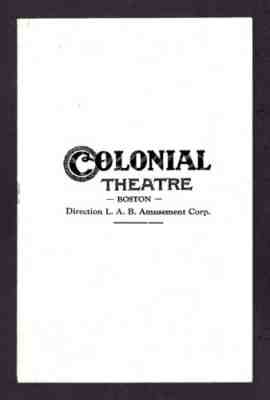
Sold on eBay Mar 3, 2023
Bill "Bojangles" Robinson "MEMPHIS BOUND" Avon Long 1945 FLOP Tryout Playbill
Find many great new & used options and get the best deals for Bill "Bojangles" Robinson "MEMPHIS BOUND" Avon Long 1945 FLOP Tryout Playbill at the best online prices at eBay! Free shipping for many products!
Sold on eBay May 8th, 2024
Joseph Hawthorn "LITTLE NEMO" Victor Herbert / Winsor McCay 1910 Memphis Program
This is a rare January 27th, 1910 program (playbill) from the three-night, Post-Broadway engagement of the VICTOR HERBERT and HARRY B. SMITH musical comedy "LITTLE NEMO" at the Lyceum Theatre in Memphis, Tennessee. (The Original Broadway production opened October 20th, 1908 at New York's New Amsterdam Theatre and ran for 111 performances before going on the road.) ..... Based on the famous cartoons of WINSOR McCAY, the musical starred MASTER GABRIEL in the title role and JOSEPH CAWTHORN as "Dr. Pill" and the cast included HARRY CLAY BLANEY, HARRY KELLY, W. W. BLACK, GEORGE A. NATANSON, DAVE ABRAHAMS, LOUIS HART, SIM COLLINS, EDWARD B. KRAMER, MAUDE CAMPBELL, AIMEE EHRLICH, NATALIE ALTE, QUEENIE VASSAR, MADELINE MARSHALL and MAY GUNDERMAN ..... CREDITS: Music by VICTOR HERBERT ("Cyrano de Bergerac", "Babes in Toyland", "Mlle. Modiste", "The Red Mill", "Naughty Marietta", "Sweethearts", "Ziegfeld Follies", "Sally", "Gypsy Lady"); Book and Lyrics by HARRY B. SMITH based on the famous cartoons of WINSOR McCAY; Orchestra conducted by MAX HIRSCHFELD; Sets designed by ERNEST ALBERT, JOHN YOUNG and the YOUNG BROTHERS; Costumes designed by F. RICHARD ANDERSON; Staged by HERBERT GRESHAM; Produced by KLAW and ERLANGER ..... DETAILS: The 24 page program measures 6" X 8 5/8" inches and includes beautiful cover graphics, production credits, cast list, synopsis of scenes and wonderful vintage advertising, but no cast photos or bios ..... CONDITION: (Please Note!) There is paper loss at the top of the back cover (last scanned image), small surface abrasions in the top right margin of the front cover, light creasing and moderate edge wear. Despite these flaws, this rare program will make a wonderful addition to the collection of any musical theatre aficionado or historian. This item will be carefully packaged in a protective, carded sleeve and backed by stiff cardboard.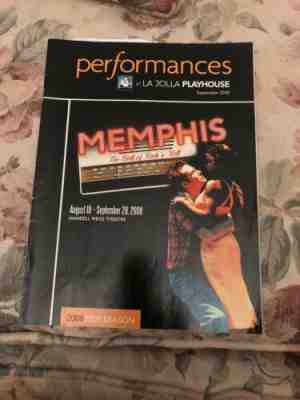
Sold on eBay May, 30th 2020
MEMPHIS LA JOLLA PLAYHOUSE PLAYBILL
MEMPHIS LA JOLLA PLAYHOUSE PLAYBILL. Shipped with USPS First Class Package.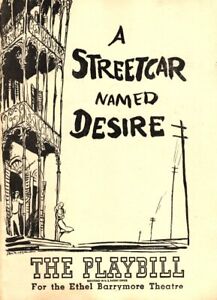
Sold on eBay November 14th, 2023
*GREAT AMERICAN PLAYWRIGHT TENNESSEE WILLIAMS 1949 STREETCAR PROGRAM BRANDO*
eBay A rare original March 1949 program for Tennessee Williams's brilliant play A Streetcar Named Desire with Marlon Brando, Jessica Tandy, Karl Malden, and Kim Hunter. Thirty two pages. Dimensions nine by six and a half inches. Light wear otherwise good. See Tennessee Williams's extraordinary biography and the story of the play below. Buyer pays first class insured shipping. Overseas shipping by Reistered Airmail. Shipping discounts for multiple purchases. Inquiries always welcome. Please visit my other eBay items for more early theatre, opera, film and historical autographs, photographs and programs and great actor and actress cabinet photos and CDV's. From Wikipedia: Thomas Lanier "Tennessee" Williams III (March 26, 1911– February 25, 1983) was an American playwright. Along with Eugene O'Neill and Arthur Miller, he is considered among the three foremost playwrights of 20th-century American drama.[1]After years of obscurity, at age 33 he became suddenly famous with the success of The Glass Menagerie (1944) in New York City.This play closely reflected his own unhappy family background. It was the first of a string of successes, including A Streetcar Named Desire (1947), Cat on a Hot Tin Roof (1955), and Sweet Bird of Youth(1959). With his later work, he attempted a new style that did not appeal to audiences. Increasing alcohol and drug dependence inhibited his creative expression. His drama A Streetcar Named Desire is often numbered on short lists of the finest American plays of the 20th century alongside Eugene O'Neill's Long Day's Journey into Night and Arthur Miller's Death of a Salesman [1]Much of Williams' most acclaimed work has been adapted for the cinema. He also wrote short stories, poetry, essays and a volume of memoirs. In 1979, four years before his death, Williams was inducted into the American Theater Hall of Fame.Thomas Lanier Williams III was born in Columbus, Mississippi, of English, Welsh, and Huguenot ancestry, the second child of Edwina Dakin (August 9, 1884 – June 1, 1980) and Cornelius Coffin "C. C." Williams (August 21, 1879 – March 27, 1957).[2] His father was a traveling shoe salesman who became alcoholic and was frequently away from home. His mother, Edwina, was the daughter of Rose O. Dakin, a music teacher, and the Reverend Walter Dakin, an Episcopal priest from Illinois who was assigned to a parish in Clarksdale, Mississippi, shortly after Williams' birth. Williams lived in his parsonage with his family for much of his early childhood and was close to his grandparents.He had two siblings, older sister Rose Isabel Williams and younger brother Walter Dakin Williams [4](1919[5]–2008) [6]As a young child Williams nearly died from a case of diphtheria that left him weak and virtually confined to his house during a period of recuperation that lasted a year. At least in part as a result of his illness, he was less robust as a child than his father wished. Cornelius Williams, a descendant of hearty East Tennessee pioneer stock, had a violent temper and was a man prone to use his fists. He regarded what he thought was his son's effeminacy with disdain. Edwina, locked in an unhappy marriage, focused her overbearing attention almost entirely on her frail young son.[7] Many critics and historians note that Williams drew from his own dysfunctional family in much of his writing.[1]When Williams was eight years old, his father was promoted to a job at the home office of the International Shoe Company in St. Louis, Missouri. His mother's continual search for what she considered to be an appropriate address, as well as his father's heavy drinking and loudly turbulent behavior, caused them to move numerous times around St. Louis. Williams attended Soldan High School, a setting he referred to in his play The Glass Menagerie.[8] Later he studied at University City High School.[9][10] At age 16, Williams won third prize (five dollars, = $70± in 2017) for an essay published in Smart Set, titled "Can a Good Wife Be a Good Sport?" A year later, his short story "The Vengeance of Nitocris" was published in the August 1928 issue of the magazine Weird Tales.[11]That same year he first visited Europe with his maternal grandfather Dakin EducationFrom 1929 to 1931, Williams attended the University of Missouri, in Columbia, where he enrolled in journalism classes.[12] He was bored by his classes and distracted by unrequited love for a girl. Soon he began entering his poetry, essays, stories, and plays in writing contests, hoping to earn extra income. His first submitted play was Beauty Is the Word (1930), followed by Hot Milk at Three in the Morning (1932).[13] As recognition for Beauty, a play about rebellion against religious upbringing, he became the first freshman to receive honorable mention in a writing competition [14]At University of Missouri, Williams joined the Alpha Tau Omega fraternity, but he did not fit in well with his fraternity brothers. According to Hale, the "brothers found him shy and socially backward, a loner who spent most of his time at the typewriter." After he failed a military training course in his junior year, his father pulled him out of school and put him to work at the International Shoe Company factory. Although Williams, then 21, hated the monotony, the job "forced him out of the pretentious gentility" of his upbringing, which had, according to Hale, "tinged him with [his mother's] snobbery and detachment from reality."[14] His dislike of his new nine-to-five routine drove him to write even more than before. He set himself a goal of writing one story a week, working on Saturday and Sunday, often late into the night. His mother recalled his intensity:Tom would go to his room with black coffee and cigarettes and I would hear the typewriter clicking away at night in the silent house. Some mornings when I walked in to wake him for work, I would find him sprawled fully dressed across the bed, too tired to remove his clothes [15]Overworked unhappy, and lacking any further success with his writing, by his twenty-fourth birthday Williams had suffered a nervous breakdown and left his job. He drew from memories of this period, and a particular factory co-worker, to create the character Stanley Kowalski in A Streetcar Named Desire.[14] By the mid-1930s his mother separated from his father, due to C.C.'s worsening alcoholism and abusive temper (part of his ear was bitten off in a poker game fight). They never divorced.In 1936, Williams enrolled at Washington University in St. Louis; while there, he wrote the play Me, Vashya (1937). In the autumn of 1937, he transferred to the University of Iowa, where he graduated with a B.A. in English in August 1938.[16] He later studied at the Dramatic Workshop of The New School in New York City. Speaking of his early days as a playwright and referring to an early collaborative play called Cairo, Shanghai, Bombay!, produced while he was a part of an amateur summer theater group in Memphis, Tennessee, Williams wrote, "The laughter ... enchanted me. Then and there the theatre and I found each other for better and for worse. I know it's the only thing that saved my life."[17] Around 1939, he adopted "Tennessee Williams" as his professional name.Literary influencesWilliams writings include mention of some of the poets and writers he most admired in his early years: Hart Crane, Arthur Rimbaud, Anton Chekhov (from the age of ten), William Shakespeare, Clarence Darrow, D. H. Lawrence, Katherine Mansfield, August Strindberg, William Faulkner, Thomas Wolfe, and Emily Dickinson. In later years he also referred to William Inge, James Joyce, and Ernest Hemingway; of Hemingway, he said "[his] great quality, aside from his prose style, is this fearless expression of brute nature [15]:xiCareerIn the late 1930s, as Williams struggled to gain production and an audience for his work, he worked at a string of menial jobs that included a notably disastrous stint as caretaker on a chicken ranch in Laguna Beach, California. In 1939, with the help of his agent Audrey Wood, he was awarded a $1,000 grant [2017 equivalent $17,000+] from the Rockefeller Foundation in recognition of his play Battle of Angels; it was produced in Boston in 1940, but poorly received.Using some of the Rockefeller funds, Williams moved to New Orleans in 1939 to write for the Works Progress Administration (WPA), a federally funded program begun by President Franklin D. Roosevelt created to put people to work. In addition to sponsoring construction and infrastructure projects, it hired many artists, musicians and writers, to create local cultural programs, to write state histories, and to create art for public buildings. It was critical to the survival of many such artists during the Great Depression. Williams lived for a time in New Orleans' French Quarter; first at 722 Toulouse Street, the setting of his 1977 play Vieux Carré. (The building is now part of The Historic New Orleans Collection )[18] The Rockefeller grant brought him to the attention of the Hollywood film industry and Williams received a six-month contract as a writer from the Metro Goldwyn Mayer film studio, earning $250 weekly.During the winter of 1944–45, his "memory play" The Glass Menagerie, developed from his 1943 short story "Portrait of a Girl in Glass", was successfully produced in Chicago and garnered good reviews. It moved to New York where it became an instant and enormous hit, and had a long Broadway run. It explores the lives of a young man named Tom, his disabled sister, Laura, and their controlling mother Amanda, who tries to make a match between Laura and a gentleman caller. Williams' use of his own familial relationships as inspiration for the play is clear. Elia Kazan (who directed many of Williams' greatest successes) said of Williams: "Everything in his life is in his plays, and everything in his plays is in his life."[19] The Glass Menagerie won the award for the best play of the season, the New York Drama Critics' Circle Award.The huge success of his next play, A Streetcar Named Desire in 1947 secured his reputation as a great playwright. Although widely celebrated and increasingly wealthy, Williams was still restless and insecure, always gripped by fear that he would not be able to replicate his success. During the late 1940s and 1950s, Williams began to travel widely with his partner Frank Merlo (1922 – September 21, 1963), often spending summers in Europe. To stimulate his writing he moved often, living in cities including New York, New Orleans, Key West, Rome, Barcelona, and London. Williams wrote, "Only some radical change can divert the downward course of my spirit, some startling new place or people to arrest the drift, the drag [20]Williams arriving at funeral services for Dylan Thomas, 1953Between 1948 and 1959 Williams had seven of his plays produced on Broadway: Summer and Smoke (1948), The Rose Tattoo (1951), Camino Real (1953), Cat on a Hot Tin Roof (1955), Orpheus Descending (1957), Garden District(1958), and Sweet Bird of Youth (1959). By 1959 he had earned two Pulitzer Prizes, three New York Drama Critics' Circle Awards, three Donaldson Awards, and a Tony Award.Williams' work reached wide audiences in the early 1950s when The Glass Menagerie and A Streetcar Named Desirewere adapted as motion pictures. Later plays also adapted for the screen included Cat on a Hot Tin Roof, The Rose Tattoo, Orpheus Descending, The Night of the Iguana, Sweet Bird of Youth, and Summer and Smoke.After the extraordinary successes of the 1940s and 1950s, he had more personal turmoil and theatrical failures in the 1960s and 1970s. Although he continued to write every day, the quality of his work suffered from his increasing alcohol and drug consumption, as well as occasional poor choices of collaborators [21] In 1963, his partner Frank Merlo died.Consumed by depression over the loss, and in and out of treatment facilities while under the control of his mother and younger brother Dakin, Williams spiraled downward. His plays Kingdom of Earth (1967), In the Bar of a Tokyo Hotel(1969), Small Craft Warnings (1973), The Two Character Play (also called Out Cry, 1973), The Red Devil Battery Sign(1976), Vieux Carré (1978), Clothes for a Summer Hotel (1980), and others were all box office failures. Relentlessly negative press notices wore down his spirit. His last play, A House Not Meant To Stand, was produced in Chicago in 1982. Despite largely positive reviews, it ran for only 40 performances Critics and audiences alike failed to appreciate Williams' new style and the approach to theater he developed during the 1970s. Williams said, "I've been working very hard since 1969 to make an artistic comeback there is no release short of death" (Spoto 335), and "I want to warn you, Elliot, the critics are out to get me. You'll see how vicious they are. They make comparisons with my earlier work, but I'm writing differently now" (Spoto 331). Leverich explains that Williams to the end was concerned with "the depths and origin of human feelings and motivations, the difference being that he had gone into a deeper, more obscure realm, which, of course, put the poet in him to the fore, and not the playwright who would bring much concern for audience and critical reaction" (xxiii).In addition to struggling with changing audience tastes, Williams had to deal with changes in the business model of the theatrical world. In the 1970s, free performances for charitable causes were becoming increasingly popular. The aging playwright found it a challenge to adapt to the times, although many of the changes in theater were due to his own legacy [citation needed] Despite the inferior quality of Williams's work compared to his creative peak 30 years earlier, he continued writing almost without a break.In 1974, Williams received the St. Louis Literary Award from the Saint Louis University Library Associates [22][23] In 1979, four years before his death, he was inducted into the American Theater Hall of Fame [24]Personal lifeThroughout his life Williams remained close to his sister Rose, who was diagnosed with schizophrenia as a young woman. In 1943, as her behavior became increasingly disturbing, she was subjected to a lobotomy. It required her to be for the rest of her life. As soon as he was financially able, Williams had her moved to a private institution just north of New York City, where he often visited her. He gave her a percentage interest in several of his most successful plays, the royalties from which were applied toward her care.[25][26] The devastating effects of Rose's illness may have contributed to Williams' alcoholism and his dependence on various combinations of amphetamines and barbiturates [27]After some early attempts at relationships with women, by the late 1930s Williams had finally accepted his homosexuality. In New York City he joined a gay social circle that included fellow writer and close friend Donald Windham (1920–2010) and his then partner Fred Melton. In the summer of 1940, Williams initiated an affair with Kip Kiernan (1918–1944), a young Canadian dancer he met in Provincetown, Massachusetts. When Kiernan left him to marry a woman, he was distraught. Kiernan's death four years later at age 26 was another heavy blow.On a 1945 visit to Taos, New Mexico, Williams met Pancho Rodríguez y González, a hotel clerk of Mexican heritage. Rodríguez was, by all accounts, a loving and loyal companion. But he was also prone to jealous rages and excessive drinking, and their relationship was tempestuous. In February I946 Rodríguez left New Mexico to join Williams in his New Orleans apartment. They lived and traveled together until late 1947, when Williams ended the affair. Rodríguez and Williams remained friends, however, and were in contact as late as the 1970s.Frank Merlo in Key West, 1950Williams spent the spring and summer of 1948 in Rome in the company of an Italian teenager, called "Rafaello" in Williams' Memoirs. He provided financial assistance to the younger man for several years afterward. Williams drew from this for his first novel, The Roman Spring of Mrs. Stone.235 E 58th Street, New York, New YorkTennessee Williams House, Key West, FloridaWhen he returned to New York that spring, Williams met and fell in love with Frank Merlo (1922–1963). An occasional actor of Sicilian heritage, he had served in the U.S. Navy in World War II. This was the enduring romantic relationship of Williams' life, and it lasted 14 years until infidelities and drug abuse on both sides ended it. Merlo, who had become Williams' personal secretary, took on most of the details of their domestic life. He provided a period of happiness and stability, acting as a balance to the playwright's frequent bouts with depression [28]Williams feared that, like his sister Rose, he would fall into insanity. His years with Merlo, in an apartment in Manhattan and a modest house in Key West, Florida, were Williams' happiest and most productive. Shortly after their breakup, Merlo was diagnosed with inoperable lung cancer. Williams returned to him and cared for him until his death on September 20, 1963.In the years following Merlo's death, Williams descended into a period of nearly catatonic depression and increasing drug use; this resulted in several and commitments to mental health facilities. He submitted to injections by Dr. Max Jacobson – known popularly as Dr. Feelgood – who used increasing amounts of amphetamines to overcome his depression. Jacobson combined these with prescriptions for the sedative Seconal to relieve his insomnia. During this time, influenced by his mother, a Roman Catholic convert, Williams joined the Catholic Church (though he later claimed that he never took his conversion seriously).[29] He was never truly able to recoup his earlier success, or to entirely overcome his dependence on prescription drugs.Edwina Dakin died in 1980 at the age of 95. Her health had begun failing during the early 1970s and she lived in a care facility from 1975 onward. Williams rarely saw his mother in her later years and retained a strong animosity toward her; friends described his reaction to her death as mixed [citation needed]As Williams grew older, he felt increasingly alone; he feared old age and losing his sexual appeal to younger gay men. In the 1970s, when he was in his 60s, Williams had a lengthy relationship with Robert Carroll, a Vietnam veteran and aspiring writer in his 20s. Williams had deep affection for Carroll and respect for what he saw as the younger man's talents. Along with Williams' sister Rose, Carroll was one of the two people who received a bequest in Williams' will [30]Williams described Carroll's behavior as a combination of "sweetness" and "beastliness". Because Carroll had a drug problem (as did Williams), friends such as Maria St. Just saw the relationship as "destructive". Williams wrote that Carroll played on his "acute loneliness" as an aging gay man. When the two men broke up in 1979, Williams called Carroll a "twerp", but they remained friends until Williams died four years later [31]DeathFirst page of the last will and testament of Tennessee WilliamsOn February 25, 1983, Williams was found dead at age 71 in his suite at the Hotel Elysée in New York. The Chief Medical Examiner of New York City, Elliot M. Gross, reported that Williams had choked to death from inhaling the plastic cap of a bottle of the type that might contain a nasal spray or eye solution.[32]He wrote in his will in 1972: "I, Thomas Lanier (Tennessee) Williams, being in sound mind upon this subject, and having declared this wish repeatedly to my close friends-do hereby state my desire to be buried at sea. More specifically, I wish to be buried at sea at as close a possible point as the American poet Hart Crane died by choice in the sea; this would be ascrnatible [sic], this geographic point, by the various books (biographical) upon his life and death. I wish to be sewn up in a canvas sack and dropped overboard, as stated above, as close as possible to where Hart Crane was given by himself to the great mother of life which is the sea: the Caribbean, specifically, if that fits the geography of his death. fits it [sic].".[33] But his brother Dakin Williams arranged for him to be buried at Calvary Cemetery, in St. Louis, Missouri, where his mother is buried [34]Williams left his literary rights to The University of the South in Sewanee, Tennessee, an Episcopal school, in honor of his maternal grandfather, Walter Dakin, an alumnus of the university. The funds support a creative writing program. When his sister Rose died in 1996 after many years in a mental institution, she bequeathed $7 million from her part of the Williams estate to The University of the South as well [35]Posthumous recognitionWilliams grave, Calvary Cemetery, St. Louis, MissouriFrom February 1 to July 21, 2011, to commemorate the 100th anniversary of his birth, the Harry Ransom Center at the University of Texas at Austin, the home of Williams' archive, exhibited 250 of his personal items. The exhibit, titled "Becoming Tennessee Williams," included a collection of Williams manuscripts, correspondence, photographs and artwork.[36] The Ransom Center holds the earliest and largest collections of Williams' papers, including all of his earliest manuscripts, the papers of his mother Edwina Williams, and those of his long-time agent Audrey Wood.[37]In late 2009, Williams was inducted into the Poets' Corner at the Cathedral of Saint John the Divine in New York. Performers and artists who took part in his induction included Vanessa Redgrave, playwright John Guare, Eli Wallach, Sylvia Miles, Gregory Mosher, and Ben Griessmeyer [38]The Tennessee Williams Theatre in Key West, Florida, is named for him. The Tennessee Williams Key West Exhibit on Truman Avenue houses rare Williams memorabilia, photographs, and pictures including his famous typewriter.At the time of his death, Williams had been working on a final play, In Masks Outrageous and Austere,[39] which attempted to reconcile certain forces and facts of his own life. This was a continuing theme in his work. As of September 2007, author Gore Vidal was completing the play, and Peter Bogdanovich was slated to direct its Broadway debut.[40] The play received its world premiere in New York City in April 2012, directed by David Schweizer and starring Shirley Knight as Babe.[41]The rectory of St. Paul's Episcopal Church in Columbus, Mississippi, where Williams's grandfather Dakin was rector at the time of Williams's birth, was moved to another location in 1993 for preservation. It was newly renovated in 2010 for use by the City of Columbus as the Tennessee Williams Welcome Center [42][43]Williams s literary legacy is represented by the literary agency headed by Georges Borchardt.In 1985, French author-composer Michel Berger wrote a song dedicated to Tennessee Williams, "Quelque chose de Tennessee" (Something of Tennessee), for Johnny Hallyday. It became one of the singer's most famous songs.Since 1986, the Tennessee Williams New Orleans Literary Festival has been held annually in New Orleans, Louisiana, in commemoration of the playwright. The festival takes place at the end of March to coincide with Williams's birthday [44]Since 2016, St. Louis, Missouri has held an annual Tennessee Williams' Festival, featuring a main production and related events such as literary discussions and new plays inspired by his work. In 2018 the festival produced A Streetcar Named Desire.The U.S. Postal Service honored Williams on a stamp in 1994 as part of its literary arts series.Williams is honored with a star on the St. Louis Walk of Fame [45]WorksCharacters in his plays are often seen as representations of his family members. Laura Wingfield in The Glass Menagerie was understood to be modeled on his sister Rose. Some biographers believed that the character of Blanche DuBois in A Streetcar Named Desire is also based on her.Amanda Wingfield in The Glass Menagerie was generally taken to represent Williams' mother, Edwina. Characters such as Tom Wingfield in The Glass Menagerie and Sebastian in Suddenly, Last Summer were understood to represent Williams himself. In addition, he used a lobotomy as a motif in Suddenly, Last Summer.The Pulitzer Prize for Drama was awarded to A Streetcar Named Desire in 1948 and to Cat on a Hot Tin Roof in 1955. These two plays were later adapted as highly successful films, by noted directors Elia Kazan (Streetcar), with whom Williams developed a very close artistic relationship, and Richard Brooks (Cat). Both plays included references to elements of Williams's life such as homosexuality, mental instability, and alcoholism Although The Flowering Peach by Clifford Odets was the preferred choice of the Pulitzer Prize jury in 1955, and Cat on a Hot Tin Roof was at first considered the weakest of the five shortlisted nominees, Joseph Pulitzer Jr., chairman of the Board, had seen Cat on a Hot Tin Roof and thought it worthy of the drama prize. The Board went along with him after considerable discussion [46]Williams wrote The Parade, or Approaching the End of a Summer when he was 29, and worked on it sporadically throughout his life. A semi autobiographical depiction of his 1940 romance with Kip Kiernan in Provincetown, Massachusetts, it was produced for the first time on October 1, 2006, in Provincetown by the Shakespeare on the Cape production company. This was part of the First Annual Provincetown Tennessee Williams Festival.His last play went through many drafts as he was trying to reconcile what would be the end of his life.[38] There are many versions of it, but it is referred to as In Masks Outrageous and Austere PlaysApprentice playsCandles to the Sun (1936)Fugitive Kind (1937)Spring Storm (1937)Me Vaysha (1937)Not About Nightingales (1938)Battle of Angels (1940)I Rise in Flame, Cried the Phoenix (1941)You Touched Me (1945)Stairs to the Roof (1947)Major playsVivien Leigh as Blanche DuBois in the film version of A Streetcar Named Desire(1951)The Glass Menagerie (1944)A Streetcar Named Desire (1947)Summer and Smoke (1948)The Rose Tattoo (1951)Camino Real (1953)Cat on a Hot Tin Roof (1955)Orpheus Descending (1957)Suddenly Last Summer (1958)Sweet Bird of Youth (1959)Period of Adjustment (1960)The Night of the Iguana (1961)The Eccentricities of a Nightingale (1962, rewriting of Summer and Smoke)The Milk Train Doesn't Stop Here Anymore (1963)The Mutilated (1965)The Seven Descents of Myrtle (1968, aka Kingdom of Earth)In the Bar of a Tokyo Hotel (1969)Will Mr. Merriweather Return from Memphis? (1969)Small Craft Warnings (1972)The Two-Character Play (1973)Out Cry (1973, rewriting of The Two-Character Play)The Red Devil Battery Sign (1975)This Is (An Entertainment) (1976)Vieux Carré (1977)A Lovely Sunday for Creve Coeur (1979)Clothes for a Summer Hotel (1980)The Notebook of Trigorin (1980)Something Cloudy, Something Clear (1981)A House Not Meant to Stand (1982)In Masks Outrageous and Austere (1983)NovelsThe Roman Spring of Mrs. Stone (1950, adapted into a film in 1961, and again in 2003)Moise and the World of Reason and teleplaysThe Glass Menagerie (1950)A Streetcar Named Desire (1951)The Rose Tattoo (1955)Baby Doll (1956)Suddenly, Last Summer (1959)The Fugitive Kind (1959)Ten Blocks on the Camino Real (1966)Boom! (1968)The Loss of a Teardrop Diamond (2009; screenplay from 1957)Short storiesThe Vengeance of Nitocris (1928)The Field of Blue Children (1939)Oriflamme (1944)The Resemblance Between a Violin Case and a Coffin (1951)Hard Candy: A Book of Stories (1954)Three Players of a Summer Game and Other Stories (1960)The Knightly Quest: a Novella and Four Short Stories (1966)One Arm and Other Stories (1967)"One Arm""The Malediction The Poet""Chronicle of a Demise""Desire and the Black Masseur Portrait of a Girl in Glass""The Important Thing""The Angel in the Alcove""The Field of Blue Children""The Night of the Iguana""The Yellow Bird"Eight Mortal Ladies Possessed: a Book of Stories (1974)Tent Worms (1980)It Happened the day the Sun Rose, and Other Stories (1981), published by Sylvester & OrphanosOne-act playsMain article: List of one-act plays by Tennessee wrote over 70 one-act plays during his lifetime. The one-acts explored many of the same themes that dominated his longer works. Williams' major collections are published by New Directions in New York City.American Blues (1948)Mister Paradise and Other One-Act Plays (2005)Dragon Country: a book of one-act plays (1970)The Traveling Companion and Other Plays (2008)The Magic Tower and Other One-Act Plays (2011)At Liberty (1939)The Magic Tower (1936)Me, Vashya (1937)Curtains for the Gentleman (1936)In Our Profession (1938)Every Twenty Minutes (1938)Honor the Living (1937)The Case of the Crushed Petunias (1941)Moony's Kid Don't Cry (1936)The Dark Room (1939)The Pretty Trap (1944)Interior: Panic (1946)Kingdom of Earth (1967)I Never Get Dressed Till After Dark on Sundays (1973)Some Problems for the Moose Lodge (1980)27 Wagons Full of Cotton and Other Plays (1946 and wild...» (introduction) (1953)27 Wagons Full of Cotton (1946 and 1953)The Purification (1946 and 1953)The Lady of Larkspur Lotion (1946 and 1953)The Last of My Solid Gold Watches (1946 and 1953)Portrait of a Madonna (1946 and 1953)Auto da Fé (1946 and 1953)Lord Byron's Love Letter (1946 and 1953)The Strangest Kind of Romance (1946 and 1953)The Long Goodbye (1946 and 1953)At Liberty (1946)Moony's Kid Don't Cry (1946)Hello from Bertha (1946 and 1953)This Property Is Condemned (1946 and 1953)Talk to Me Like the Rain and Let Me Listen... (1953)Something Unspoken (1953)Now the Cats with Jeweled Claws and Other One-Act Plays (2016)A Recluse and His Guest (1982)Now the Cats with Jeweled Claws (1981)Steps Must Be Gentle (1980)Ivan's Widow (1982)This Is the Peaceable Kingdom (1981)Aimez vous Ionesco? (c.1975)The Demolition Downtown (1971)Lifeboat Drill (1979)Once in a Lifetime (1939)The Strange Play (1939)The Theatre of Tennessee Williams, Volume VIThe Theatre of Tennessee Williams, Volume VIIPoetryIn the Winter of Cities (1956)Androgyne Mon Amour (1977)Selected worksGussow, Mel and Holditch, Kenneth, eds. Tennessee Williams, Plays 1937–1955 (Library of America, 2000) ISBN 978 1 883011 86 4 Spring StormNot About of AngelsI Rise in Flame, Cried the PhoenixFrom 27 Wagons Full of Cotton (1946)27 Wagons Full of CottonThe Lady of Larkspur LotionThe Last of My Solid Gold WatchesPortrait of a MadonnaAuto da FéLord Byron's Love LetterThis Property Is CondemnedThe Glass MenagerieA Streetcar Named DesireSummer and SmokeThe Rose TattooCamino RealFrom 27 Wagons Full of Cotton (1953) Something Wild"Talk to Me Like the Rain and Let Me ListenSomething UnspokenCat on a Hot Tin RoofGussow, Mel and Holditch, Kenneth, eds. Tennessee Williams, Plays 1957–1980 (Library of America, 2000) ISBN 978 1 883011 87 1 Orpheus DescendingSuddenly Last SummerSweet Bird of YouthPeriod of AdjustmentThe Night of the IguanaThe Eccentricities of a NightingaleThe Milk Train Doesn't Stop Here AnymoreThe of Earth (The Seven Descents of Myrtle)Small Craft WarningsOut CryVieux CarréA Lovely Sunday for Creve Coeur"Crazy Night [47]Tennessee Williams: Memoirs (New Directions Publishing Corporation, 2006) ISBN 978 0 811216 69 2A Streetcar Named Desire is a play written by Tennessee Williams and first performed on Broadway on December 3, 1947.[1] The play dramatizes the experiences of Blanche DuBois, a former Southern belle who, after encountering a series of personal losses, leaves her privileged background to move into a shabby apartment in New Orleans rented by her younger sister and brother in law Williams most popular work, A Streetcar Named Desire is one of the most critically acclaimed plays of the twentieth century.[1] It still ranks among his most performed plays, and has inspired many adaptations in other forms, notably a critically acclaimed film that was released in 1951.[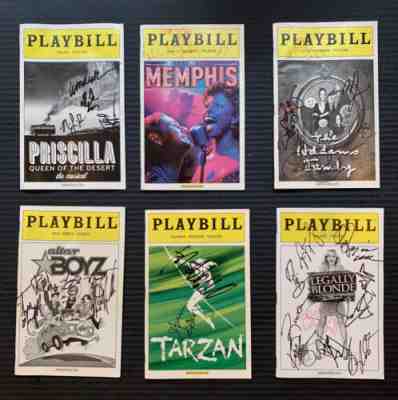
Sold on eBay Jun, 23rd 2020
Lot of 6 Signed Broadway Playbills; Legally Blonde, Priscilla, Tarzan &more
Lot of 6 Signed Broadway Playbills<br />• Priscilla Queen of the Desert signed by Nick Adams• Memphis signed by several cast members • The Addams Family signed by Caralee Carmello and many other cast members • Altar Boyz signed by the entire cast (Off Broadway) Disney’s Tarzan signed by Josh Strickland and Jenn Gambatese• Legally Blonde signed by many cast members including Bailey Hanks<br />please refer to photos for quality and please let me know if you have any questions! :)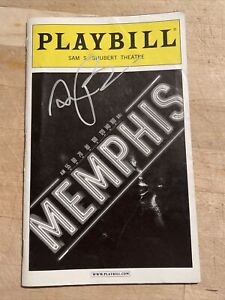
Sold on eBay December 5th, 2023
ADAM PASCAL Autographed MEMPHIS May 2012 Broadway SIGNED Playbill! (Roger/RENT)
eBay Applause Shop is dedicated to helping find joyful new homes for Playbills and other Broadway memorabilia, with a significant focus on charitable giving. We are all grateful to all who have helped us in our efforts — including you!In addition to the charity denoted here, We are making contributions as often as possible to additional arts, civil rights, racial equality, and lgbtqai+ causes.Please note that the USPS is experiencing systematic delays due to bureaucratic changes. You can track your package (including sent date) through this listing once it’s sold, and we do everything in our power to get it to you fast.We highly recommend that you bid carefully. Due to misuse of the feature and lost revenue in the past, we can no longer cancel bids within the last 12 hours of the auction or after the auction has ended.Please look at all photos for details on condition, cast members, inserts, etc. Refunds are only available in the rare case that an item has been significantly misrepresented. We always do our best to present the most accurate photos possible of the item.Everyone involved with Applause Shop is delighted for the item listed here to find a new home where it can be truly loved.If there are specific Playbills you’d like to see us list, please feel free to message us and we can check our stock Thanks Laura (on all socials)Founder of Applause Shop
Sold on eBay Jul, 7th 2020
PLAYBILLS Lot of 23 with Binder NYC Theatre with some tickets
PLAYBILL / Tickets Lot in Binder. 23 Playbills - nice condition (5 with tickets) in binder . Back cover of binder has remnants of white paint spots - I did not attempt to clean it.Nice bookBuyer gets all shown Includes: nbsp; The marvelous wonderettes, God of carnage, After Miss Julie, A steady rain, A little night music, Memphis, Present laughter, Sondheim, Everyday Rapture, A little night music, The addams Family, Metropolitan Opera May 2010, Million dollar quartet, Fences, The glass Menagerie, Promises Promises, Million dollar quartet, La Cage aux folles, Brief encounter, Mrs. Warren'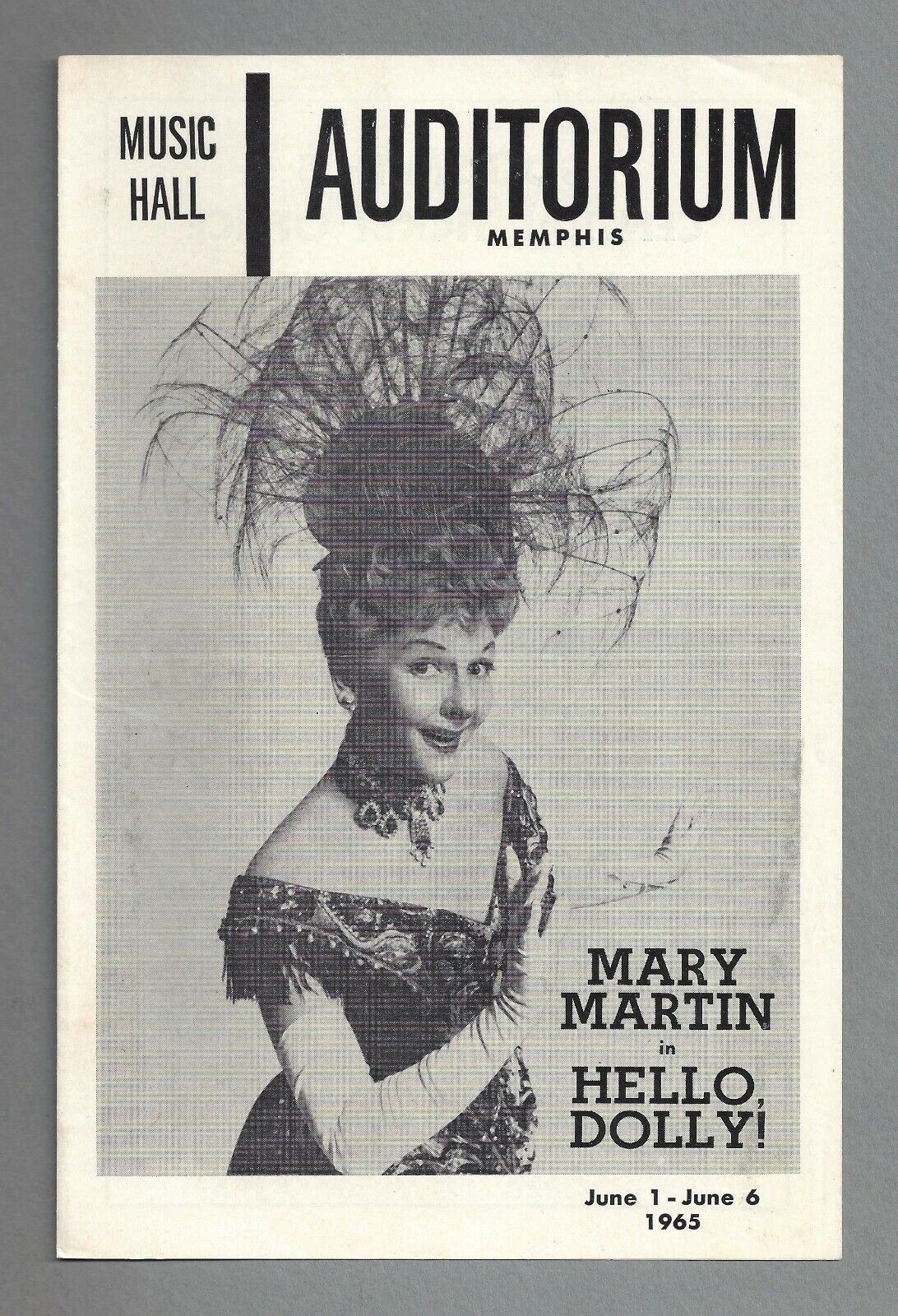
Sold on eBay February 12th, 2025
Mary Martin "HELLO DOLLY" Jerry Herman / Gower Champion 1965 Memphis Playbill
This is a rare June 1st, 1965 playbill from the one-week, National Tour engagement of the JERRY HERMAN and MICHAEL STEWART musical comedy hit "HELLO, DOLLY!" at the Music Hall Auditorium in Memphis, Tennessee. (The Original Broadway production opened January 16th, 1964 at the St. James Theatre in New York City and ran for 2844 performances while simultaneously playing on the road.) ..... During the exceptionally long Broadway run, nine different actresses played the role of "Mrs. Dolly Gallagher Levi", created by the legendary CAROL CHANNING. Her first replacement was GINGER ROGERS (1966) followed by MARTHA RAYE (1967), BETTY GRABLE (1967), BIBI OSTERWALD (1967), PEARL BAILEY (1967), THELMA CARPENTER (1969), PHYLLIS DILLER (1969) and finally ETHEL MERMAN (1970). Several prominent actresses took the show on the road including MARY MARTIN, BETTY GRABLE, GINGER ROGERS, DOROTHY LAMOUR, EVE ARDEN and YVONNE DE CARLO ..... The Memphis engagement starred MARY MARTIN as "Mrs. Dolly Gallagher Levi" and featured LORING SMITH, MARILYNN LOVELL, COCO RAMIREZ, JOHNNY BEECHER, BEVERLEE WEIR, MARK ALDEN, ROBERT HOCKNELL, JUDITH DRAKE, SKEDGE MILLER and CARLETON CARPENTER ..... Side Note: Beginning in April of 1965, MARY MARTIN crisscrossed the U.S. and Canada in "Hello, Dolly!" for five months before taking the show across the Pacific. The production played briefly in Hawaii and then, starting on October 10th, 1965, played the war zone in South Vietnam before touring U.S. military installations in Japan. Martin then flew to London and opened the West End production on December 2nd, 1965 ..... CREDITS: Music and Lyrics by JERRY HERMAN ("Milk and Honey", "Mame", "Mack and Mabel", "La Cage Aux Folles" and "Dear World"); Book by MICHAEL STEWART based on the "Matchmaker" by THORNTON WILDER; Sets designed by OLIVER SMITH; Costumes designed by FREDDY WITTOP; Directed and Choreographed by GOWER CHAMPION; Produced by DAVID MERRICK ..... DETAILS: The eight page playbill measures 5 1/2" X 8 1/2" inches and includes full production credits, cast list, synopsis of scenes, list of musical numbers and bios of each of the leading actors but with the exception of the front cover, no cast photos ..... CONDITION: With the exception of handwritten notations on the back cover and light edge wear, this playbill is in excellent condition and will make a wonderful addition to the collection of any musical theatre aficionado or historian. This item will be carefully packaged in a protective, carded sleeve and backed by stiff cardboard.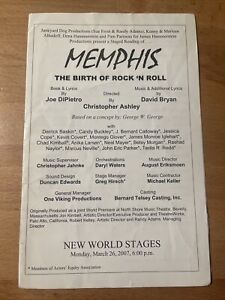
Sold on eBay August 22nd, 2023
MEMPHIS PreBroadway Musical READING Program MONTEGO GLOVER James Monroe Iglehart
Applause Shop is dedicated to finding joyful new homes for Playbills and other Broadway memorabilia, with a significant focus on charitable giving. We are all grateful to all who have helped us in our efforts — including you!In addition to the charity denoted here, We are making contributions as often as possible to additional arts, civil rights, racial equality, and lgbtqai+ causes.Please note that the USPS is experiencing systematic delays due to bureaucratic changes. You can track your package (including sent date) through this listing once it’s sold, and we do everything in our power to get it to you fast.We highly recommend that you bid & buy carefully. Due to misuse of the feature and lost revenue in the past, we can no longer cancel bids within the last 12 hours of the auction or after the auction has ended.Please look at all photos for details on condition, cast members, inserts, etc. Refunds are only available in the rare case that an item has been significantly misrepresented. We always do our best to present the most accurate photos possible of the item.Combined shipping is available for items purchased within one week of each other. For combined shipping, please request an invoice when all auctions have ended, and pay for the items together. (Note: combined shipping may not be available outside the US.)Everyone involved with Applause Shop is delighted for the item listed here to find a new home where it can be truly loved.If there are specific Playbills you’d like to see us list, please feel free to message us and we can check our stock Thanks Laura (on all socials)Founder of Applause Shop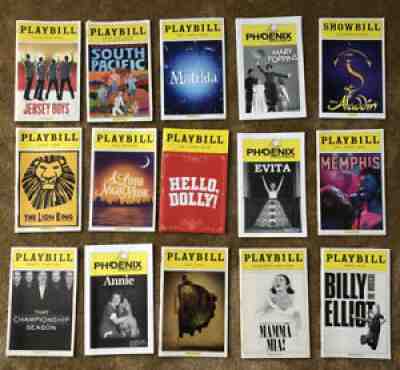
Sold on eBay Aug 06, 2021
Lot of Playbills Mary Poppins Aladdin jersey boys South Pacific Elvita Memphis
You will receive the play books that you see in photoEvita Matilda May 2013 the lion king March 2008, Memphis April 2010, South Pacific April 2008, the jersey boys December 2005 Aladdin 2014 Mary Poppins, a little night music April 2010, Billy Elliot March 2009, Mamma Mia November 2005, Lestat April 2006 Annie that championship season February 2011 hello dolly May 2017 Condition is very good.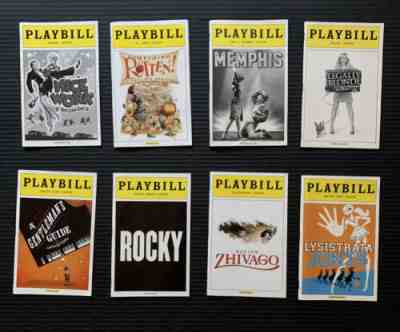
Sold on eBay Jun, 25th 2020
Lot of 8 Broadway Playbills; Legally Blonde, Something Rotten, Rocky, Memphis
Lot Of 8 Broadway Playbills <br />• Nice Work If You Can Get It• Something Rotten• Memphis• Legally Blonde• A Gentleman’s Guide to Love and Murder• Rocky• Doctor Zhivago• Lysistrata Jones<br />please let me know if you have any questions and please refer to the photos for quality! :)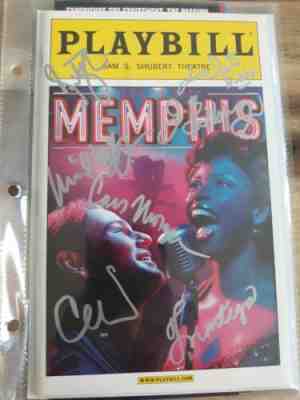
Sold on eBay Aug, 30th 2020
MEMPHIS the musical OBC SIGNED playbill. CHAD KIMBALL, MONTEGO GLOVER & CAST
AWESOME, CAST SIGNED , MEMPHIS the musical OBC signed playbill. Signed by CHAD KIMBALL ( COME FROM AWAY), MONTWGO GLOVER, JANES IGLEHART ( TONY WINNUNG GENIE FROM ALADDIN ) AND CAST. Obtained when I lived in NY. This is in EXCELLENT shape! It has been in my Playbill binder in a protective sleeve. Will pass ANY process! Get it now at a great price! PAYMENT: Paypal only w/i 24 hrs. SHIPPING:FREE! USPS First Class Package. I typically ship w/i 3 days of payment. USA ONLY
Sold on eBay Feb 05, 2022
64th Annual TONY AWARDS "Memphis" Scarlett Johansson 2010 Red Carpet Pass
(Red ) and SCARLETT JOHANSSON (. Among those honored at the 2009-2010 Tony's with acting awards were DOUGLAS HODGE (. CONDITION: With the exception of heavy creasing on the right side, this rare Tony Awards Red Carpet Pass is in excellent condition and will make a wonderful addition to the collection of any theatre aficionado or historian. ).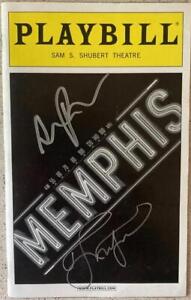
Sold on eBay November 4th, 2023
Adam Pascal & Montego Glover Signed Brand New Memphis Playbill Autographed 2012
eBay Adam Pascal and Montego Glover Signed Brand New Playbill from Memphis starring Adam Pascal Montego Glover Nancy Opel Derick Baskin Music by David Bryan and Lyrics by Joe DiPietro and David Bryan ** This Playbill was Signed by Adam Pascal and Montego Glover after a Show in New York. The Signature’s by Adam Pascal and Montego Glover are on the front cover. They have signed in Silver Thick Marker. This is a Adam Pascal and Montego Glover Signed Brand New Playbill from Memphis . The stars of this new production of the Musical are Adam Pascal and Montego Glover . The Playbill is in Excellent Condition. No rips or tears. The Playbill is dated from May 2012 . Directed by Christopher Ashley and Choreographed by Sergio Trujillo. Adam Pascal & Montego Glover Signed Brand New Memphis Playbill Autographed 2012 Adam Pascal & Montego Glover Signed Brand New Memphis Playbill Autographed 2012 Click images to enlarge Description ** Adam Pascal and Montego Glover Signed Brand New Playbill from Memphis starring Adam Pascal Montego Glover Nancy Opel Derick Baskin Music by David Bryan and Lyrics by Joe DiPietro and David Bryan ** This Playbill was Signed by Adam Pascal and Montego Glover after a Show in New York. The Signature’s by Adam Pascal and Montego Glover are on the front cover. They have signed in Silver Thick Marker. This is an Adam Pascal and Montego Glover Signed Brand New Playbill from Memphis . The stars of this new production of the Musical are Adam Pascal and Montego Glover . There are some light crease marks on the front cover. The Playbill is in Very Good Condition. No rips or tears. The Playbill is dated from May 2012 . Directed by Christopher Ashley and Choreographed by Sergio Trujillo. Some of Cast included Adam Pascal Montego Glover James Monroe Iglehart John Jellison Derick Baskin J. Bernard Calloway Jermaine R. Rembert. Kevin Massey David McDonald Preston W. Dugger III Bryan Langlitz Andy Mills Nancy Opel Justin Patterson Jamison Scott Antoine L. Smith Tyrone A. Jackson, Candice Monet McCall.. I have thousands of Playbills please email me with any requests.**** United States shipping is by purchasers choice of First Class for $5.00 or Priority Mail with Delivery Confirmation For $9.00. Outside the United States please add for global Air. Please vist Scarlett’s Shop for More Playbills & Collectibles Terms of Sale If making returns please email me first. It would be a big help if items are returned 30 day once they are received by you. Contact Us You can email me through ebay. Most emails are returned in 24 hours. Pictures sell!Auctiva offers Free Image Hosting and Editing.300+ Listing Templates Auctiva gets you noticed!The complete eBay Selling Solution. Track Page Views WithAuctiva's Counter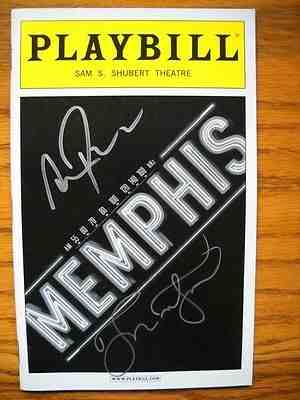
Sold on eBay Mar, 5th 2020