

*EDWIN & JOHN WILKES BOOTH BROTHER IN LAW SLEEPER CLARKE RARE 1860 BROADSIDE*
*EDWIN & JOHN WILKES BOOTH BROTHER IN LAW SLEEPER CLARKE RARE 1860 BROADSIDE*
SOLD $99.99 Sold: Jul 28, 2023 on eBayOriginal Listing Description
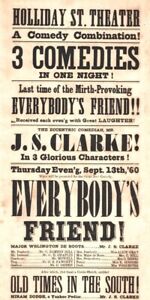
He was the brother in law of Edwin and John Wilkes Booth and one of the finest comic actors of his generation. A rare original 1860 Holiday Street, Baltimore close to the Booth homes broadside for John Sleeper Clarke in three plays, Everybody's Friend, Old TImes in the South, and The Hypocrite. Dimensions sixteen by five and a half inches. Rare this early. Light wear otherwise good. See Sleeper Clarke and the Booth family's extraordinary biographies below.Shipping discounts for multiple purchases. Credit cards accepted with Paypal. Inquiries always welcome. Please visit my other eBay items for more early theatre and historical autographs, photographs and programs and great singer, actor and actress cabinet photos and CDV's.From Wikipedia:John Sleeper Clarke (September 3, 1833 – September 24, 1899) was a 19th-century American comedian and actor.He was born in Baltimore, Maryland to George W. Sleeper and Georgianna Sleeper (née Clarke), and was educated for the law. In his boyhood he was a schoolmate of Edwin Booth who was born in the same year as he, and with whom he engaged in amateur dramatic readings as members of the Baltimore Thespian Club.[1][2]He made his first appearance in Boston as Frank Hardy in Paul Pry in 1851, at the Howard Athenæum.[3] The next year he went to Philadelphia. Clarke's first appearance in New York City was made at the Metropolitan Theatre – afterward called the Winter Garden – on May 15, 1855, as Dickory in The Spectre Bridegroom,[4] but it was not until he returned in 1861–1862 to the same theatre that he made a conspicuous mark. In 1859 he became part of the Booth family when he married Asia Booth, daughter of Junius Brutus Booth, and sister of John Wilkes Booth. Clarke was associated with his brother-in-law Edwin Booth in the management of the Winter Garden Theatre in New York, the Walnut Street Theatre in Philadelphia and the Boston Theatre [3]Following the 1865 assassination of US president Abraham Lincoln by Clarke's brother-in-law, John Wilkes Booth, Clarke came into the possession of two letters, from his wife, written by the assassin. He turned them over to the Philadelphia Inquirer, which printed one of the two letters. His actions led to his arrest and imprisonment in the Capitol Prison in Washington D.C. for a month. Once released, he notified his pregnant wife that they must divorce. He wanted to distance himself professionally from the name of Booth.[5] She refused to divorce him, even as their relationship grew increasingly strained. However, they remained married in name only. "..He lives a free going bachelor life and does what he likes.." wrote Asia to her brother Edwin. She died May 16, 1888, at the age of 52.In August 1865, just months after the assassination, Asia gave birth to twins Creston and Lilian.[6]In 1867, Clarke moved his family to London, where Asia became a poet and a writer. Clarke made his first appearance at the St James's Theatre as Major Wellington de Boots in Stirling Coyne's Everybody's Friend, rewritten for him and called The Widow's Hunt. At the Princess's in February 1868, he was Salem Scudder in a revival of The Octoroon, and later, at the Strand, was the first Young Gosling in Fox versus Goose. On July 26, 1869, he was the first Babington Jones in John Brougham's Among the Breakers. At the same house he also played Toodles, Dr. Pangloss in The Heir at Law, and other parts.[3] His success was so great that he remained in England for the rest of his life, except for four visits to America [1]Among his favorite parts were Timothy Toodle in William E. Burton's The Toodles, which ran for 200 nights at the Strand Theatre, and two roles from plays by George Colman "the Younger": Dr. Pangloss in The Heir at Law, and Dr. Ollapod in The Poor Gentleman. At the beginning of his career Clarke wished to play tragedy, but he later turned to comic roles.[1] He managed several London theatres, including the Haymarket, where he preceded the Bancrofts. He retired in 1889.Death and legacyClarke died suddenly, in London, in his sixty-seventh year, on September 24, 1899.[1] Four days later, his remains were interred at Teddington Cemetery[7] in what is now the London Borough of Richmond upon Thames. Among the mourners were Mr. and Mrs. Clement Scott, Charles Hawtrey, the staff of the Strand Theatre, and Clarke's two sons, Creston and Wilfred. Many beautiful wreaths were placed upon the coffin.[8]He and his wife Asia had nine children. Their sons Creston and Wilfred went on to become actors.The Booth family was an English American theatrical family of the 19th century. Its most famous and well known members were Edwin Booth, one of the leading actors of his day, and John Wilkes Booth, who assassinated Abraham Lincoln.The patriarch was Junius Brutus Booth, a London-born lawyer's son who eventually became an actor after he attended a production of Othello at the Covent Garden theatre. The prospects of fame, fortune, and freedom were very appealing to young Booth, and he displayed remarkable talent from an early age, deciding on a career in the theatre by the age of 17. He performed roles in several small theaters throughout England, and joined a tour of the Low Countries in 1814, returning the following year to make his London debut.Booth abandoned his wife and their young son in 1821 and ran off to the United States with Mary Ann Holmes, a London flower girl. They settled on some 150 acres in Harford County near Baltimore and started a family; they had 10 children, six of whom survived to adulthood [1][2]Junius Sr. and Edwin toured in California during the Gold Rush.[citation needed] Edwin bought an interest in the Winter Garden Theatre at 667 Broadway in New York City together with his brother-in-law John Sleeper Clarke. The brothers John Wilkes, Edwin, and Junius Brutus, Jr. performed there in the play Julius Caesar at a benefit in 1864, the only time they were seen together on a stage, playing Mark Antony, Brutus, and Cassius, respectively Junius Brutus Booth (1796–1852) brought his mistress Mary Ann Holmes, who bore him 10 children, to the United States.He also wrote many letters in fits of drunken anger and madness to President Andrew Jackson threatening assassination. He requested that two prisoners who had been sentenced to death for piracy, named De Ruiz and De Soto, be pardoned, else: "I will cut your throat whilst you are sleeping." This letter would later be recanted by Junius, stating, "May god preserve General Jackson and this happy republic [4]Junius Brutus Booth Jr. (1821–1883) was married to Agnes Booth. Junius Jr. never achieved the same fame as his brothers, but his third wife Agnes was popular.Their son Sydney Barton Booth (1877–1937) was an actor well into the era of modern film [5]Edwin Thomas Booth (1833–1893) came to be the foremost American Shakespearean actor of his day. He founded The Players, a New York City actors' club which continues to the present day.Edwin's grandson Edwin Booth Grossman was a painter of some note.Asia Frigga Booth (1835–1888) married John Sleeper Clarke, an actor/comedian who was briefly imprisoned in the aftermath of the assassination. They then emigrated to Britain, where he became a successful theatre manager.Creston Clarke[6] and Wilfred Clarke,[7] sons of John and Asia, were noted actors in their day.John Wilkes Booth (1838–1865) was a popular young star in less serious fare than his brothers.A Confederate sympathizer during the American Civil War, during a play attended by Abraham Lincoln, Booth took advantage of his access to the theatre to invade the President's box and assassinate the President. He was killed 12 days later by Union soldier Boston Corbett.
Note: This item has been sold and is no longer available. This page serves as a historical price reference for Playbill collectors and appraisers.
Original Listing Description
He was the brother in law of Edwin and John Wilkes Booth and one of the finest comic actors of his generation. A rare original 1860 Holiday Street, Baltimore close to the Booth homes broadside for John Sleeper Clarke in three plays, Everybody's Friend, Old TImes in the South, and The Hypocrite. Dimensions sixteen by five and a half inches. Rare this early. Light wear otherwise good. See Sleeper Clarke and the Booth family's extraordinary biographies below.Shipping discounts for multiple purchases. Credit cards accepted with Paypal. Inquiries always welcome. Please visit my other eBay items for more early theatre and historical autographs, photographs and programs and great singer, actor and actress cabinet photos and CDV's.From Wikipedia:John Sleeper Clarke (September 3, 1833 – September 24, 1899) was a 19th-century American comedian and actor.He was born in Baltimore, Maryland to George W. Sleeper and Georgianna Sleeper (née Clarke), and was educated for the law. In his boyhood he was a schoolmate of Edwin Booth who was born in the same year as he, and with whom he engaged in amateur dramatic readings as members of the Baltimore Thespian Club.[1][2]He made his first appearance in Boston as Frank Hardy in Paul Pry in 1851, at the Howard Athenæum.[3] The next year he went to Philadelphia. Clarke's first appearance in New York City was made at the Metropolitan Theatre – afterward called the Winter Garden – on May 15, 1855, as Dickory in The Spectre Bridegroom,[4] but it was not until he returned in 1861–1862 to the same theatre that he made a conspicuous mark. In 1859 he became part of the Booth family when he married Asia Booth, daughter of Junius Brutus Booth, and sister of John Wilkes Booth. Clarke was associated with his brother-in-law Edwin Booth in the management of the Winter Garden Theatre in New York, the Walnut Street Theatre in Philadelphia and the Boston Theatre [3]Following the 1865 assassination of US president Abraham Lincoln by Clarke's brother-in-law, John Wilkes Booth, Clarke came into the possession of two letters, from his wife, written by the assassin. He turned them over to the Philadelphia Inquirer, which printed one of the two letters. His actions led to his arrest and imprisonment in the Capitol Prison in Washington D.C. for a month. Once released, he notified his pregnant wife that they must divorce. He wanted to distance himself professionally from the name of Booth.[5] She refused to divorce him, even as their relationship grew increasingly strained. However, they remained married in name only. "..He lives a free going bachelor life and does what he likes.." wrote Asia to her brother Edwin. She died May 16, 1888, at the age of 52.In August 1865, just months after the assassination, Asia gave birth to twins Creston and Lilian.[6]In 1867, Clarke moved his family to London, where Asia became a poet and a writer. Clarke made his first appearance at the St James's Theatre as Major Wellington de Boots in Stirling Coyne's Everybody's Friend, rewritten for him and called The Widow's Hunt. At the Princess's in February 1868, he was Salem Scudder in a revival of The Octoroon, and later, at the Strand, was the first Young Gosling in Fox versus Goose. On July 26, 1869, he was the first Babington Jones in John Brougham's Among the Breakers. At the same house he also played Toodles, Dr. Pangloss in The Heir at Law, and other parts.[3] His success was so great that he remained in England for the rest of his life, except for four visits to America [1]Among his favorite parts were Timothy Toodle in William E. Burton's The Toodles, which ran for 200 nights at the Strand Theatre, and two roles from plays by George Colman "the Younger": Dr. Pangloss in The Heir at Law, and Dr. Ollapod in The Poor Gentleman. At the beginning of his career Clarke wished to play tragedy, but he later turned to comic roles.[1] He managed several London theatres, including the Haymarket, where he preceded the Bancrofts. He retired in 1889.Death and legacyClarke died suddenly, in London, in his sixty-seventh year, on September 24, 1899.[1] Four days later, his remains were interred at Teddington Cemetery[7] in what is now the London Borough of Richmond upon Thames. Among the mourners were Mr. and Mrs. Clement Scott, Charles Hawtrey, the staff of the Strand Theatre, and Clarke's two sons, Creston and Wilfred. Many beautiful wreaths were placed upon the coffin.[8]He and his wife Asia had nine children. Their sons Creston and Wilfred went on to become actors.The Booth family was an English American theatrical family of the 19th century. Its most famous and well known members were Edwin Booth, one of the leading actors of his day, and John Wilkes Booth, who assassinated Abraham Lincoln.The patriarch was Junius Brutus Booth, a London-born lawyer's son who eventually became an actor after he attended a production of Othello at the Covent Garden theatre. The prospects of fame, fortune, and freedom were very appealing to young Booth, and he displayed remarkable talent from an early age, deciding on a career in the theatre by the age of 17. He performed roles in several small theaters throughout England, and joined a tour of the Low Countries in 1814, returning the following year to make his London debut.Booth abandoned his wife and their young son in 1821 and ran off to the United States with Mary Ann Holmes, a London flower girl. They settled on some 150 acres in Harford County near Baltimore and started a family; they had 10 children, six of whom survived to adulthood [1][2]Junius Sr. and Edwin toured in California during the Gold Rush.[citation needed] Edwin bought an interest in the Winter Garden Theatre at 667 Broadway in New York City together with his brother-in-law John Sleeper Clarke. The brothers John Wilkes, Edwin, and Junius Brutus, Jr. performed there in the play Julius Caesar at a benefit in 1864, the only time they were seen together on a stage, playing Mark Antony, Brutus, and Cassius, respectively Junius Brutus Booth (1796–1852) brought his mistress Mary Ann Holmes, who bore him 10 children, to the United States.He also wrote many letters in fits of drunken anger and madness to President Andrew Jackson threatening assassination. He requested that two prisoners who had been sentenced to death for piracy, named De Ruiz and De Soto, be pardoned, else: "I will cut your throat whilst you are sleeping." This letter would later be recanted by Junius, stating, "May god preserve General Jackson and this happy republic [4]Junius Brutus Booth Jr. (1821–1883) was married to Agnes Booth. Junius Jr. never achieved the same fame as his brothers, but his third wife Agnes was popular.Their son Sydney Barton Booth (1877–1937) was an actor well into the era of modern film [5]Edwin Thomas Booth (1833–1893) came to be the foremost American Shakespearean actor of his day. He founded The Players, a New York City actors' club which continues to the present day.Edwin's grandson Edwin Booth Grossman was a painter of some note.Asia Frigga Booth (1835–1888) married John Sleeper Clarke, an actor/comedian who was briefly imprisoned in the aftermath of the assassination. They then emigrated to Britain, where he became a successful theatre manager.Creston Clarke[6] and Wilfred Clarke,[7] sons of John and Asia, were noted actors in their day.John Wilkes Booth (1838–1865) was a popular young star in less serious fare than his brothers.A Confederate sympathizer during the American Civil War, during a play attended by Abraham Lincoln, Booth took advantage of his access to the theatre to invade the President's box and assassinate the President. He was killed 12 days later by Union soldier Boston Corbett.
Note: This item has been sold and is no longer available. This page serves as a historical price reference for Playbill collectors and appraisers.