

*CHARLES DICKENS & WILKIE COLLINS RARE ORIGINAL 1871 NO THOROUGHFARE PROGRAM*
*CHARLES DICKENS & WILKIE COLLINS RARE ORIGINAL 1871 NO THOROUGHFARE PROGRAM*
SOLD $199.99 Sold: Feb 25, 2024 on eBayOriginal Listing Description
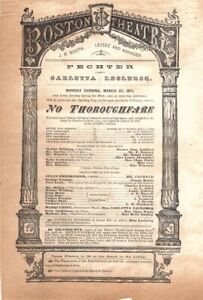
An rare and extraordinary original museum quality MArch 1871 program for Charles Dickens and Wilkie Collins's play No Thoroughfaare at the Boston Theatre, managed by Junius Brutus Booth Jr. Dimensions ten nine a half by six and a half inches. Light wear otherwise good. See Charles Dickens and Wilkie Collins's extraordinary biographies below. Ships USPS insured in USA and Global Priority overseas. Shipping discounts for multiple purchases. Inquiries always welcome. Please visit my other eBay items for more early theatre, opera, film, and historical autographs, photographs, programs and broadsides and great actor and actress cabinet photos and CDV's. From Wikipedia: Charles John Huffam Dickens (/7 February 1812 – 9 June 1870) was an English writer and social critic. He created some of the world's best-known fictional characters and is regarded by many as the greatest novelist of the Victorian era.[1] His works enjoyed unprecedented popularity during his lifetime, and by the 20th century critics and scholars had recognised him as a literary genius. His novels and short stories enjoy lasting popularity [2][3]Born in Portsmouth, Dickens left school to work in a factory when his father was incarcerated in a debtors' prison. Despite his lack of formal education, he edited a weekly journal for 20 years, wrote 15 novels, five novellas, hundreds of short stories and non-fiction articles, lectured and performed readings extensively, was an indefatigable letter writer, and campaigned vigorously for children's rights, education, and other social reforms Dickens s literary success began with the 1836 serial publication of The Pickwick Papers. Within a few years he had become an international literary celebrity, famous for his humour, satire, and keen observation of character and society. His novels, most published in monthly or weekly instalments, pioneered the serial publication of narrative fiction, which became the dominant Victorian mode for novel publication [4][5] Cliffhanger endings in his serial publications kept readers in suspense.[6] The installment format allowed Dickens to evaluate his audience's reaction, and he often modified his plot and character development based on such feedback.[5] For example, when his wife's chiropodist expressed distress at the way Miss Mowcher in David Copperfield seemed to reflect her disabilities, Dickens improved the character with positive features.[7] His plots were carefully constructed, and he often wove elements from topical events into his narratives.[8] Masses of the illiterate poor chipped in ha'pennies to have each new monthly episode read to them, opening up and inspiring a new class of readers [9]Dickens was regarded as the literary colossus of his age.[10] His 1843 novella, A Christmas Carol, remains popular and continues to inspire adaptations in every artistic genre. Oliver Twist and Great Expectations are also frequently adapted, and, like many of his novels, evoke images of early Victorian London. His 1859 novel, A Tale of Two Cities, set in London and Paris, is his best-known work of historical fiction. Dickens has been praised by fellow writers—from Leo Tolstoy to George Orwell and G. K. his realism, comedy, prose style, unique characterisations and social criticism. On the other hand, Oscar Wilde, Henry James, and Virginia Woolfcomplained of a lack of psychological depth, loose writing, and a vein of saccharine sentimentalism. The term Dickensian is used to describe something that is reminiscent of Dickens and his writings, such as poor social conditions or comically repulsive characters William Wilkie Collins (8 January 1824 – 23 September 1889) was an English novelist and playwright known especially for The Woman in White (1859), a mystery novel and early sensation novel, and for The Moonstone (1868), which established many of the ground rules of the modern detective novel and is also perhaps the earliest clear example of the police procedural genre [1][2]Born to the London painter William Collins and his wife, Harriet Geddes, he moved with them to Italy when he was twelve, living there and in France for two years, learning both Italian and French. He worked initially as a tea merchant. After Antonina, his first novel, was published in 1850, Collins met Charles Dickens, who became his friend and mentor. Some of Collins' work appeared in Dickens' journals Household Words and All the Year Round. They also collaborated on drama and fiction. Collins gained financial stability and an international following by the 1860s, but in the 1870s and 1880s, after becoming addicted to the opium he took for his gout, the quality of both his health and his writing declined Collins criticised the institution of marriage. He had relationships with two women: widow Caroline Graves – living with her for most of his life, treating her daughter as his – and the younger Martha Rudd, with whom he had three children.
Note: This item has been sold and is no longer available. This page serves as a historical price reference for Playbill collectors and appraisers.
Original Listing Description
An rare and extraordinary original museum quality MArch 1871 program for Charles Dickens and Wilkie Collins's play No Thoroughfaare at the Boston Theatre, managed by Junius Brutus Booth Jr. Dimensions ten nine a half by six and a half inches. Light wear otherwise good. See Charles Dickens and Wilkie Collins's extraordinary biographies below. Ships USPS insured in USA and Global Priority overseas. Shipping discounts for multiple purchases. Inquiries always welcome. Please visit my other eBay items for more early theatre, opera, film, and historical autographs, photographs, programs and broadsides and great actor and actress cabinet photos and CDV's. From Wikipedia: Charles John Huffam Dickens (/7 February 1812 – 9 June 1870) was an English writer and social critic. He created some of the world's best-known fictional characters and is regarded by many as the greatest novelist of the Victorian era.[1] His works enjoyed unprecedented popularity during his lifetime, and by the 20th century critics and scholars had recognised him as a literary genius. His novels and short stories enjoy lasting popularity [2][3]Born in Portsmouth, Dickens left school to work in a factory when his father was incarcerated in a debtors' prison. Despite his lack of formal education, he edited a weekly journal for 20 years, wrote 15 novels, five novellas, hundreds of short stories and non-fiction articles, lectured and performed readings extensively, was an indefatigable letter writer, and campaigned vigorously for children's rights, education, and other social reforms Dickens s literary success began with the 1836 serial publication of The Pickwick Papers. Within a few years he had become an international literary celebrity, famous for his humour, satire, and keen observation of character and society. His novels, most published in monthly or weekly instalments, pioneered the serial publication of narrative fiction, which became the dominant Victorian mode for novel publication [4][5] Cliffhanger endings in his serial publications kept readers in suspense.[6] The installment format allowed Dickens to evaluate his audience's reaction, and he often modified his plot and character development based on such feedback.[5] For example, when his wife's chiropodist expressed distress at the way Miss Mowcher in David Copperfield seemed to reflect her disabilities, Dickens improved the character with positive features.[7] His plots were carefully constructed, and he often wove elements from topical events into his narratives.[8] Masses of the illiterate poor chipped in ha'pennies to have each new monthly episode read to them, opening up and inspiring a new class of readers [9]Dickens was regarded as the literary colossus of his age.[10] His 1843 novella, A Christmas Carol, remains popular and continues to inspire adaptations in every artistic genre. Oliver Twist and Great Expectations are also frequently adapted, and, like many of his novels, evoke images of early Victorian London. His 1859 novel, A Tale of Two Cities, set in London and Paris, is his best-known work of historical fiction. Dickens has been praised by fellow writers—from Leo Tolstoy to George Orwell and G. K. his realism, comedy, prose style, unique characterisations and social criticism. On the other hand, Oscar Wilde, Henry James, and Virginia Woolfcomplained of a lack of psychological depth, loose writing, and a vein of saccharine sentimentalism. The term Dickensian is used to describe something that is reminiscent of Dickens and his writings, such as poor social conditions or comically repulsive characters William Wilkie Collins (8 January 1824 – 23 September 1889) was an English novelist and playwright known especially for The Woman in White (1859), a mystery novel and early sensation novel, and for The Moonstone (1868), which established many of the ground rules of the modern detective novel and is also perhaps the earliest clear example of the police procedural genre [1][2]Born to the London painter William Collins and his wife, Harriet Geddes, he moved with them to Italy when he was twelve, living there and in France for two years, learning both Italian and French. He worked initially as a tea merchant. After Antonina, his first novel, was published in 1850, Collins met Charles Dickens, who became his friend and mentor. Some of Collins' work appeared in Dickens' journals Household Words and All the Year Round. They also collaborated on drama and fiction. Collins gained financial stability and an international following by the 1860s, but in the 1870s and 1880s, after becoming addicted to the opium he took for his gout, the quality of both his health and his writing declined Collins criticised the institution of marriage. He had relationships with two women: widow Caroline Graves – living with her for most of his life, treating her daughter as his – and the younger Martha Rudd, with whom he had three children.
Note: This item has been sold and is no longer available. This page serves as a historical price reference for Playbill collectors and appraisers.