

*EDDIE CANTOR FRED & ADEL6E ASTAIRE RARE LARGE 1914 VAUDEVILLE BROADSIDE *
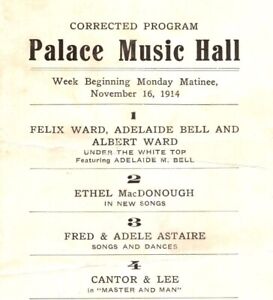
*EDDIE CANTOR FRED & ADEL6E ASTAIRE RARE LARGE 1914 VAUDEVILLE BROADSIDE *
SOLD $99.99 Sold: Mar 10, 2024 on eBayOriginal Listing Description
A rare large original 1914 broadside type program for Eddie Cantor with Cantor and Lee and the amazing brother and sister team of Fred and Adele Astaire at the Palace Music Hall. Dimensions fifteen by four inches. Light wear and light folds otherwise good. See Eddie Cantor and Fred Astaire's extraordinary biographies below.Shipping discounts for buyers of multiple items. Credit cards accepted with Paypal. Inquiries always welcome. Please visit my other eBay items for more early theatre and historical autographs, broadsides, photographs and programs and great actor and actress cabinet photos and CDV's. From Wikipedia:Eddie Cantor (born Isidore January 31, 1892 – October 10, 1964) was an American comedian, actor, dancer, singer, songwriter, film producer, screenwriter and author.[3] Familiar to Broadway, radio, movie, and early television audiences, this "Apostle of Pep" was regarded almost as a family member by millions because his top-rated radio shows revealed intimate stories and amusing anecdotes about his wife, Ida, and five daughters. Some of his hits include "Makin' Whoopee", "Ida (Sweet as Apple Cider)", "If You Knew Susie", "Ma! He's Making Eyes at Me", “Mandy”, "My Baby Just Cares for Me”, "Margie", and "How Ya Gonna Keep 'em Down on the Farm (After They've Seen Paree)?" He also wrote a few songs, including "Merrily We Roll Along", the Merrie Melodies Warner Bros. cartoon theme.His eye-rolling song-and-dance routines eventually led to his nickname "Banjo Eyes". In 1933, artist Frederick J. Garner caricatured Cantor with large round eyes resembling the drum-like pot of a banjo. Cantor's eyes became his trademark, often exaggerated in illustrations, and leading to his appearance on Broadway in the musical Banjo Eyes (1941).His charity and humanitarian work was extensive. He helped to develop the March of Dimes and is credited with coining its name. Cantor was awarded an honorary Oscar in 1956 for distinguished service to the film industry.Early lifeReports and accounts of Cantor's early life often conflict with one another. What is known is that he was born in New York City, the son of Mechel Iskowitz (also Michael), an amateur violinist, and his wife Meta Kantrowitz Iskowitz (also Maite), a young Jewish couple from Russia.[4] It is generally accepted that he was born in 1892, though the day is subject to debate, with either January 31 or Rosh Hashanah, which was on September 10 or September 11, being reported [5][6][7] Although it was reported Cantor was an orphan, his mother dying in childbirth and his father of pneumonia, official records say otherwise; Meta died from complications of tuberculosis in July 1894 and the fate of Mechel is unclear, as no death certificate exists for him. There is also discrepancy as to his name; both his 1957 autobiography and The New York Times obituary for Cantor report his birth name as Isidore Iskowitch, although some articles published after the 20th century give his birth name as Edward (a nickname given him by his future wife, Ida, in 1913) or Israel Itzkowitz [8][5] His grandmother, Esther Kantrowitz (died January 29, 1917), took custody of him, and referred to him as Izzy and Itchik, both diminutives for Isidor, and his last name, due to a clerical error, was thought to be Kantrowitz and shortened to Kanter.[5] No birth certificate existed for him, though this is not unusual for someone born in New York in the 19th century StageSaloon songs to vaudevilleBy his early teens, Cantor began winning talent contests at local theaters and started appearing on stage. One of his earliest paying jobs was doubling as a waiter and performer, singing for tips at Carey Walsh's Coney Island saloon, where a young Jimmy Durante accompanied him on piano. He made his first public appearance in Vaudeville in 1907 at New York's Clinton Music Hall. In 1912, he was the only performer over the age of 20 to appear in Gus Edwards's Kid Kabaret, where he created his first blackface character "Jefferson". He later toured with Al Lee as the team Cantor and Lee. Critical praise from that show got the attention of Broadway's top producer Florenz Ziegfeld, who gave Cantor a spot in the Ziegfeld rooftop post-show, Midnight Frolic (1917) [5]BroadwayA year later, Cantor made his Broadway debut in the Ziegfeld Follies of 1917. He continued in the Follies until 1927,[9] a period considered the best years of the long-running revue. For several years, Cantor co-starred in an act with pioneer comedian Bert Williams, both appearing in blackface; Cantor played Williams's fresh-talking son. Other co-stars with Cantor during his time in the Follies included Will Rogers, Marilyn Miller, Fanny Brice, and W.C. Fields.[10] He moved on to stardom in book musicals, starting with Kid Boots (1923) and Whoopee! (1928).[9] On tour with Banjo Eyes, he romanced the unknown Jacqueline Susann, who had a small part in the show and who became the best-selling author of Valley of the Dolls. Banjo Eyes successful Broadway run was cut short when Cantor suffered a major heart attack, the first of several that would plague his later years.Fred Astaire (born Frederick Austerlitz;[1] May 10, 1899 – June 22, 1987) was an American actor, dancer, singer, choreographer, and television presenter. He is widely considered the most influential dancer in the history of film.[2]His stage and subsequent film and television careers spanned a total of 76 years. He starred in more than 10 Broadway and West End musicals, made 31 musical films, four television specials, and issued numerous recordings. As a dancer, his most outstanding traits were his uncanny sense of rhythm, perfectionism, and innovation. His most memorable dancing partnership was with Ginger Rogers, with whom he co-starred in a series of ten Hollywood musicals, including Top Hat (1935), Swing Time (1936), and Shall We Dance (1937).[3] Among his other most notable films where Astaire gained popularity and took the genre of tap dancing to a new level include Holiday Inn (1944), Easter Parade (1948), The Band Wagon (1953), Funny Face (1957), and Silk Stockings (1957). The American Film Institute named Astaire the fifth-greatest male star of Classic Hollywood cinema.Fred Astaire was born Frederick Austerlitz on May 10, 1899, in Omaha, Nebraska, the son of Johanna "Ann" (née Geilus; 1878–1975) and Friedrich "Fritz" Emanuel Austerlitz, in the US: Frederic Austerlitz (1868–1923) [1][6][7][8] Astaire's mother was born in the US to Lutheran German immigrants from East Prussia and Alsace. Astaire's father was born in Linz, Austria to Roman Catholic parents who had converted from Judaism [1][9][10][11]Astaire s father, Fritz Austerlitz, arrived in New York City at the age of 25 on October 26, 1893, at Ellis Island.[12] Fritz was seeking work in the brewing trade and moved to Omaha, Nebraska, where he was employed by the Storz Brewing Company. Astaire's mother dreamed of escaping Omaha by her children's talents. Astaire's older sister, Adele, was an instinctive dancer and singer early in her childhood. Johanna planned a "brother and sister act", common in vaudeville at the time, for her two children. Although Fred refused dance lessons at first, he easily mimicked his older sister's steps and took up piano, accordion, and clarinet.When their father lost his job, the family moved to New York City in January 1905 to launch the show business careers of the children. They began training at the Alviene Master School of the Theatre and Academy of Cultural Arts.[13] Fred and Adele's mother suggested they change their name to "Astaire", as she felt "Austerlitz" was reminiscent of the Battle of Austerlitz. Family legend attributes the name to an uncle surnamed L Astaire [14]They were taught dance, speaking, and singing in preparation for developing an act. Their first act was called Juvenile Artists Presenting an Electric Musical Toe-Dancing Novelty. Fred wore a top hat and tails in the first half and a lobster outfit in the second. In an interview, Astaire's daughter, Ava Astaire McKenzie, observed that they often put Fred in a top hat to make him look taller.[15] In November 1905, the goofy act debuted in Keyport, New Jersey at a "tryout theater". The local paper wrote, "the Astaires are the greatest child act in vaudeville [16]As a result of their father's salesmanship, Fred and Adele landed a major contract and played the Orpheum Circuit in the Midwest, Western and some Southern cities in the US. Soon Adele grew to at least three inches taller than Fred, and the pair began to look incongruous. The family decided to take a two-year break from show business to let time take its course and to avoid trouble from the Gerry Society and the child labor laws of the time. In 1912, Fred became an Episcopalian [17] The career of the Astaire siblings resumed with mixed fortunes, though with increasing skill and polish, as they began to incorporate tap dancing into their routines. Astaire's dancing was inspired by Bill "Bojangles" Robinson and John "Bubbles" Sublett.[18] From vaudeville dancer Aurelio Coccia, they learned the tango, waltz, and other ballroom dances popularized by Vernon and Irene Castle. Some sources[19] state that the Astaire siblings appeared in a 1915 film titled Fanchon, the Cricket, starring Mary Pickford, but the Astaires have consistently denied this [20][21][22]By age 14, Fred had taken on the musical for their act.[13] He first met George Gershwin, who was working as a song plugger for Jerome H. Remick's music publishing company, in 1916.[23] Fred had already been hunting for new music and dance ideas. Their chance meeting was to affect the careers of both artists profoundly. Astaire was always on the lookout for new steps on the circuit and was starting to demonstrate his ceaseless quest for novelty and perfection 1917–1933: Stage career on Broadway and in LondonFred and Adele Astaire in 1921The Astaires broke into Broadway in 1917 with Over the Top, a patriotic revue, and performed for U.S. and Allied troops at this time as well. They followed up with several more shows. Of their work in The Passing Show of 1918, Heywood Broun wrote: "In an evening in which there was an abundance of good dancing, Fred Astaire stood out ... He and his partner, Adele Astaire, made the show pause early in the evening with a beautiful loose-limbed dance [24]Adele s sparkle and humor drew much of the attention, owing in part to Fred's careful preparation and sharp supporting choreography. She still set the tone of their act. But by this time, Astaire's dancing skill was beginning to outshine his sister's.During the 1920s, Fred and Adele appeared on Broadway and the London stage. They won popular acclaim with the theater crowd on both sides of the Atlantic in shows such as Jerome Kern's The Bunch and Judy (1922), George and Ira Gershwin's Lady, Be Good (1924), and Funny Face (1927) and later in The Band Wagon (1931). Astaire's tap dancing was recognized by then as among the best. For example, Robert Benchley wrote in 1930, "I don't think that I will plunge the nation into war by stating that Fred is the greatest tap-dancer in the world."[25] Whilst in London, Fred studied piano at the Guildhall School of Music alongside his friend and colleague Noël Coward;[26], and in 1926, was one of the judges at the 'Charleston (dance) Championship of the World ' competition at the Royal Albert Hall, where Lew Grade was declared the winner.fter the close of Funny Face, the Astaires went to Hollywood for a screen test (now lost) at Paramount Pictures, but Paramount deemed them unsuitable for films.They split in 1932 when Adele married her first husband, Lord Charles Cavendish, the second son of the 9th Duke of Devonshire. Fred went on to achieve success on his own on Broadway and in London with Gay Divorce (later made into the film The Gay Divorcee) while considering offers from Hollywood. The end of the partnership was traumatic for Astaire but stimulated him to expand his range.Free of the brother-sister constraints of the former pairing and working with new partner Claire Luce, Fred created a romantic partnered dance to Cole Porter's "Night and Day", which had been written for Gay Divorce. Luce stated that she had to encourage him to take a more romantic approach: "Come on, Fred, I'm not your sister, you know."[25]: 6 The success of the stage play was credited to this number, and when recreated in The Gay Divorcee (1934), the film version of the play, it ushered in a new era in filmed dance.[25]: 23, 26, 61 Recently, film footage taken by Fred Stone of Astaire performing in Gay Divorce with Luce's successor, Dorothy Stone, in New York in 1933 was uncovered by dancer and historian Betsy Baytos and now represents the earliest known performance footage of Astaire [27]1933–1939: Astaire and Ginger Rogers at RKOGinger Rogers and Fred Astaire in Top Hat (1935)According to Hollywood folklore, a screen test report on Astaire for RKO Radio Pictures, now lost along with the test, is reported to have read: "Can't sing. Can't act. Balding. Can dance a little." The producer of the pictures, Pandro S. Berman, claimed he had never heard the story in the 1930s and that it only emerged years afterward.[25]: 7 Astaire later clarified, insisting that the report had read: "Can't act. Slightly bald. Also dances."[28] In any case, the test was clearly disappointing, and David O. Selznick, who had signed Astaire to RKO and commissioned the test, stated in a memo, "I am uncertain about the man, but I feel, in spite of his enormous ears and bad chin line, that his charm is so tremendous that it comes through even on this wretched test."[25]: 7 However, this did not affect RKO's plans for Astaire. They lent him for a few days to MGM in 1933 for his significant Hollywood debut in the successful musical film Dancing Lady. In the movie, he appeared as himself dancing with Joan Crawford. On his return to RKO, he got fifth billing after fourth billed Ginger Rogers in the 1933 Dolores del Río vehicle Flying Down to Rio. In a review, Variety magazine attributed its massive success to Astaire's presence:The main point of Flying Down to Rio is the screen promise of Fred Astaire ... He's assuredly a bet after this one, for he's distinctly likable on the screen, the mike is kind to his voice and as a dancer, he remains in a class by himself. The latter observation will be no news to the profession, which has long admitted that Astaire starts dancing where the others stop hoofing [29][25]: 7 Having already been linked to his sister Adele on stage, Astaire was initially very reluctant to become part of another dance team. He wrote his agent, "I don't mind making another picture with her, but as for this 'team' idea, it's 'out!' I've just managed to live down one partnership and I don't want to be bothered with anymore."[25]: 8 However, he was persuaded by the apparent public appeal of the pairing. The partnership, and the choreography of Astaire and Hermes Pan, helped make dancing an important element of the Hollywood film musical.Astaire and Rogers made nine films together at RKO. These included Flying Down to Rio (1933), The Gay Divorcee (1934), Roberta (1935, in which Astaire also demonstrates his oft-overlooked piano skills with a spirited solo on "I Won't Dance"), Top Hat (1935), Follow the Fleet (1936), Swing Time (1936), Shall We Dance (1937), Carefree (1938), and The Story of Vernon and Irene Castle (1939). Six out of the nine musicals became the biggest moneymakers for RKO; all of the films brought a certain prestige and artistry that all studios coveted at the time. Their partnership elevated them both to stardom; as Katharine Hepburn reportedly said, "He gives her class and she gives him sex appeal."[30]: 134 Astaire received a percentage of the films' profits, something scarce in actors' contracts at that time InnovationsAstaire revolutionized dance on film by having complete autonomy over its presentation [31] He is credited with two important innovations in early film musicals.[25]: 23, 26 First, he insisted that a closely tracking dolly camera film a dance routine in as few shots as possible, typically with just four to eight cuts, while holding the dancers in full view at all times. This gave the illusion of an almost stationary camera filming an entire dance in a single shot. Astaire famously quipped: "Either the camera will dance, or I will."[25]: 420 Astaire maintained this policy from The Gay Divorcee in 1934 until his last film musical Finian's Rainbow in 1968, when director Francis Ford Coppola overruled him [32]Astaire s style of dance sequences allowed the viewer to follow the dancers and choreography in their entirety. This style differed strikingly from those in the Busby Berkeley musicals. Those musicals' sequences were filled with extravagant aerial shots, dozens of cuts for quick takes, and zooms on areas of the body such as a chorus row of arms or legs [33]Astaire s second innovation involved the context of the dance; he was adamant that all song and dance routines be integral to the plotlines of the film. Instead of using dance as a spectacle as Busby Berkeley did, Astaire used it to move the plot along. Typically, an Astaire picture would include at least three standard dances. One would be a solo performance by Astaire, which he termed his "sock solo". Another would be a partnered comedy dance routine. Finally, he would include a partnered romantic dance routine [34]Assessment of the Rogers partnershipAn RKO publicity still of Astaire and Rogers dancing to "Smoke Gets in Your Eyes" in Roberta (1935)Dance commentators Arlene Croce,[30]: 6 Hannah Hyam[35]: 146–147 and John Mueller[25]: 8, 9 consider Rogers to have been Astaire's greatest dance partner, a view shared[36] by Hermes Pan and Stanley Donen.[36] Film critic Pauline Kael adopts a more neutral stance,[37] while Time magazine film critic Richard Schickel writes "The nostalgia surrounding tends to bleach out other partners [38]Mueller sums up Rogers's abilities as follows:Rogers was outstanding among Astaire's partners not because she was superior to others as a dancer, but because, as a skilled, intuitive actress, she was cagey enough to realize that acting did not stop when dancing began ... the reason so many women have fantasized about dancing with Fred Astaire is that Ginger Rogers conveyed the impression that dancing with him is the most thrilling experience imaginable [25]According to Astaire, "Ginger had never danced with a partner before Flying Down to Rio. She faked it an awful lot. She couldn't tap and she couldn't do this and that ... but Ginger had style and talent and improved as she went along. She got so that after a while everyone else who danced with me looked wrong."[39] On p. 162 of his book Ginger: Salute to a Star, author Dick Richards quotes Astaire saying to Raymond Rohauer, curator of the New York Gallery of Modern Art, "Ginger was brilliantly effective. She made everything work for her. Actually, she made things very fine for both of us and she deserves most of the credit for our success."In 1976, British talk-show host Sir Michael Parkinson asked Astaire who his favorite dancing partner was on Parkinson. At first, Astaire refused to answer. But, ultimately, he said "Excuse me, I must say Ginger was certainly, uh, uh, the one. You know, the most effective partner I had. Everyone knows [40]Rogers described Astaire's uncompromising standards extending to the whole production: "Sometimes he'll think of a new line of dialogue or a new angle for the story ... they never know what time of night he'll call up and start ranting about a fresh idea ... No loafing on the job on an Astaire picture, and no cutting corners."[25]: 16 Despite their success, Astaire was unwilling to have his career tied exclusively to any partnership. He negotiated with RKO to strike out on his own with A Damsel in Distress in 1937 with an inexperienced, non-dancing Joan Fontaine, unsuccessfully as it turned out. He returned to make two more films with Rogers, Carefree (1938) and The Story of Vernon and Irene Castle (1939). While both films earned respectable gross incomes, they both lost money because of increased production costs,[25]: 410 and Astaire left RKO, after being labeled "box office poison" by the Independent Theatre Owners of America. Astaire was reunited with Rogers in 1949 at MGM for their final outing, The Barkleys of Broadway, the only one of their films together to be shot in Technicolor 1940–1947: Holiday Inn, early left RKO in 1939 to freelance and pursue new film opportunities, with mixed though generally successful outcomes. Throughout this period, Astaire continued to value the input of choreographic collaborators. Unlike the 1930s when he worked almost exclusively with Hermes Pan, he tapped the talents of other choreographers to innovate continually. His first post-Ginger dance partner was the redoubtable Eleanor Powell, considered the most exceptional female tap-dancer of her generation. They starred in Broadway Melody of 1940, in which they performed a celebrated extended dance routine to Cole Porter's "Begin the Beguine". In his autobiography Steps in Time, Astaire remarked, "She 'put 'em down' like a man, no ricky ticky sissy stuff with Ellie. She really knocked out a tap dance in a class by herself."[41]He played alongside Bing Crosby in Holiday Inn (1942) and later Blue Skies (1946). But, in spite of the enormous financial success of both, he was reportedly dissatisfied with roles where he lost the girl to Crosby. The former film is memorable for his virtuoso solo dance to "Let's Say it with Firecrackers". The latter film featured "Puttin' On the Ritz", an innovative song-and-dance routine indelibly associated with him. Other partners during this period included Paulette Goddard in Second Chorus (1940), in which he dance-conducted the Artie Shaw orchestra.With Rita Hayworth in You Were Never Lovelier (1942)He made two pictures with Rita Hayworth. The first film, You'll Never Get Rich (1941), catapulted Hayworth to stardom. In the movie, Astaire integrated for the third time Latin American dance idioms into his style (the first being with Ginger Rogers in "The Carioca" number from Flying Down to Rio (1933) and the second, again with Rogers, was the "Dengozo" dance from The Story of Vernon and Irene Castle (1939)). His second film with Hayworth, You Were Never Lovelier (1942), was equally successful. It featured a duet to Kern's "I'm Old Fashioned", which became the centerpiece of Jerome Robbins's 1983 New York City Ballet tribute to Astaire. He next appeared opposite the seventeen year old Joan Leslie in the wartime drama The Sky's the Limit (1943). In it, he introduced Arlen and Mercer's "One for My Baby" while dancing on a bar counter in a dark and troubled routine. Astaire choreographed this film alone and achieved modest box office success. It represented a notable departure for Astaire from his usual charming, happy-go-lucky screen persona, and confused contemporary critics.His next partner, Lucille Bremer, was featured in two lavish vehicles, both directed by Vincente Minnelli. The fantasy Yolanda and the Thief (1945) featured an avant-garde surrealistic ballet. In the musical revue Ziegfeld Follies (1945), Astaire danced with Gene Kelly to the Gershwin song "The Babbit and the Bromide", a song Astaire had introduced with his sister Adele back in 1927. While Follies was a hit, Yolanda bombed at the box office.Always insecure and believing his career was beginning to falter, Astaire surprised his audiences by announcing his retirement during the production of his next film Blue Skies (1946). He nominated "Puttin' on the Ritz" as his farewell dance. After announcing his retirement in 1946, Astaire concentrated on his horse-racing interests and in 1947 founded the Fred Astaire Dance Studios, which he subsequently sold in 1966 1948–1957: MGM films and second retirementIn Daddy Long Legs (1955)Astaire's retirement did not last long. Astaire returned to the big screen to replace an injured Gene Kelly in Easter Parade (1948) opposite Judy Garland, Ann Miller, and Peter Lawford. He followed up with a final reunion with Rogers (replacing Judy Garland) in The Barkleys of Broadway (1949). Both of these films revived Astaire's popularity and in 1950 he starred in two musicals. Three Little Words with Vera-Ellen and Red Skelton was for MGM. Let's Dance with Betty Hutton was on loan-out to Paramount. While Three Little Words did quite well at the box office, Let's Dance was a financial disappointment. Royal Wedding (1951) with Jane Powell and Peter Lawford proved to be very successful, but The Belle of New York (1952) with Vera-Ellen was a critical and box-office disaster. The Band Wagon (1953) received rave reviews from critics and drew huge crowds. But because of its high cost, it failed to make a profit on its first release.Soon after, Astaire, like the other remaining stars at MGM, was let go from his contract because of the advent of television and the downsizing of film production. In 1954, Astaire was about to start work on a new musical, Daddy Long Legs (1955) with Leslie Caron at 20th Century Fox. Then, his wife Phyllis became ill and suddenly died of lung cancer. Astaire was so bereaved that he wanted to shut down the picture and offered to pay the production costs out of his pocket. However, Johnny Mercer, the film's composer, and Fox studio executives convinced him that work would be the best thing for him. Daddy Long Legs only did moderately well at the box office. His next film for Paramount, Funny Face (1957), teamed him with Audrey Hepburn and Kay Thompson. Despite the sumptuousness of the production and the good reviews from critics, it failed to make back its cost. Similarly, Astaire's next project – his final musical at MGM, Silk Stockings (1957), in which he co-starred with Cyd Charisse – also lost money at the box office Afterward Astaire announced that he was retiring from dancing in the film. His legacy at this point was 30 musical films in 25 years.
Note: This item has been sold and is no longer available. This page serves as a historical price reference for Playbill collectors and appraisers.
Original Listing Description
A rare large original 1914 broadside type program for Eddie Cantor with Cantor and Lee and the amazing brother and sister team of Fred and Adele Astaire at the Palace Music Hall. Dimensions fifteen by four inches. Light wear and light folds otherwise good. See Eddie Cantor and Fred Astaire's extraordinary biographies below.Shipping discounts for buyers of multiple items. Credit cards accepted with Paypal. Inquiries always welcome. Please visit my other eBay items for more early theatre and historical autographs, broadsides, photographs and programs and great actor and actress cabinet photos and CDV's. From Wikipedia:Eddie Cantor (born Isidore January 31, 1892 – October 10, 1964) was an American comedian, actor, dancer, singer, songwriter, film producer, screenwriter and author.[3] Familiar to Broadway, radio, movie, and early television audiences, this "Apostle of Pep" was regarded almost as a family member by millions because his top-rated radio shows revealed intimate stories and amusing anecdotes about his wife, Ida, and five daughters. Some of his hits include "Makin' Whoopee", "Ida (Sweet as Apple Cider)", "If You Knew Susie", "Ma! He's Making Eyes at Me", “Mandy”, "My Baby Just Cares for Me”, "Margie", and "How Ya Gonna Keep 'em Down on the Farm (After They've Seen Paree)?" He also wrote a few songs, including "Merrily We Roll Along", the Merrie Melodies Warner Bros. cartoon theme.His eye-rolling song-and-dance routines eventually led to his nickname "Banjo Eyes". In 1933, artist Frederick J. Garner caricatured Cantor with large round eyes resembling the drum-like pot of a banjo. Cantor's eyes became his trademark, often exaggerated in illustrations, and leading to his appearance on Broadway in the musical Banjo Eyes (1941).His charity and humanitarian work was extensive. He helped to develop the March of Dimes and is credited with coining its name. Cantor was awarded an honorary Oscar in 1956 for distinguished service to the film industry.Early lifeReports and accounts of Cantor's early life often conflict with one another. What is known is that he was born in New York City, the son of Mechel Iskowitz (also Michael), an amateur violinist, and his wife Meta Kantrowitz Iskowitz (also Maite), a young Jewish couple from Russia.[4] It is generally accepted that he was born in 1892, though the day is subject to debate, with either January 31 or Rosh Hashanah, which was on September 10 or September 11, being reported [5][6][7] Although it was reported Cantor was an orphan, his mother dying in childbirth and his father of pneumonia, official records say otherwise; Meta died from complications of tuberculosis in July 1894 and the fate of Mechel is unclear, as no death certificate exists for him. There is also discrepancy as to his name; both his 1957 autobiography and The New York Times obituary for Cantor report his birth name as Isidore Iskowitch, although some articles published after the 20th century give his birth name as Edward (a nickname given him by his future wife, Ida, in 1913) or Israel Itzkowitz [8][5] His grandmother, Esther Kantrowitz (died January 29, 1917), took custody of him, and referred to him as Izzy and Itchik, both diminutives for Isidor, and his last name, due to a clerical error, was thought to be Kantrowitz and shortened to Kanter.[5] No birth certificate existed for him, though this is not unusual for someone born in New York in the 19th century StageSaloon songs to vaudevilleBy his early teens, Cantor began winning talent contests at local theaters and started appearing on stage. One of his earliest paying jobs was doubling as a waiter and performer, singing for tips at Carey Walsh's Coney Island saloon, where a young Jimmy Durante accompanied him on piano. He made his first public appearance in Vaudeville in 1907 at New York's Clinton Music Hall. In 1912, he was the only performer over the age of 20 to appear in Gus Edwards's Kid Kabaret, where he created his first blackface character "Jefferson". He later toured with Al Lee as the team Cantor and Lee. Critical praise from that show got the attention of Broadway's top producer Florenz Ziegfeld, who gave Cantor a spot in the Ziegfeld rooftop post-show, Midnight Frolic (1917) [5]BroadwayA year later, Cantor made his Broadway debut in the Ziegfeld Follies of 1917. He continued in the Follies until 1927,[9] a period considered the best years of the long-running revue. For several years, Cantor co-starred in an act with pioneer comedian Bert Williams, both appearing in blackface; Cantor played Williams's fresh-talking son. Other co-stars with Cantor during his time in the Follies included Will Rogers, Marilyn Miller, Fanny Brice, and W.C. Fields.[10] He moved on to stardom in book musicals, starting with Kid Boots (1923) and Whoopee! (1928).[9] On tour with Banjo Eyes, he romanced the unknown Jacqueline Susann, who had a small part in the show and who became the best-selling author of Valley of the Dolls. Banjo Eyes successful Broadway run was cut short when Cantor suffered a major heart attack, the first of several that would plague his later years.Fred Astaire (born Frederick Austerlitz;[1] May 10, 1899 – June 22, 1987) was an American actor, dancer, singer, choreographer, and television presenter. He is widely considered the most influential dancer in the history of film.[2]His stage and subsequent film and television careers spanned a total of 76 years. He starred in more than 10 Broadway and West End musicals, made 31 musical films, four television specials, and issued numerous recordings. As a dancer, his most outstanding traits were his uncanny sense of rhythm, perfectionism, and innovation. His most memorable dancing partnership was with Ginger Rogers, with whom he co-starred in a series of ten Hollywood musicals, including Top Hat (1935), Swing Time (1936), and Shall We Dance (1937).[3] Among his other most notable films where Astaire gained popularity and took the genre of tap dancing to a new level include Holiday Inn (1944), Easter Parade (1948), The Band Wagon (1953), Funny Face (1957), and Silk Stockings (1957). The American Film Institute named Astaire the fifth-greatest male star of Classic Hollywood cinema.Fred Astaire was born Frederick Austerlitz on May 10, 1899, in Omaha, Nebraska, the son of Johanna "Ann" (née Geilus; 1878–1975) and Friedrich "Fritz" Emanuel Austerlitz, in the US: Frederic Austerlitz (1868–1923) [1][6][7][8] Astaire's mother was born in the US to Lutheran German immigrants from East Prussia and Alsace. Astaire's father was born in Linz, Austria to Roman Catholic parents who had converted from Judaism [1][9][10][11]Astaire s father, Fritz Austerlitz, arrived in New York City at the age of 25 on October 26, 1893, at Ellis Island.[12] Fritz was seeking work in the brewing trade and moved to Omaha, Nebraska, where he was employed by the Storz Brewing Company. Astaire's mother dreamed of escaping Omaha by her children's talents. Astaire's older sister, Adele, was an instinctive dancer and singer early in her childhood. Johanna planned a "brother and sister act", common in vaudeville at the time, for her two children. Although Fred refused dance lessons at first, he easily mimicked his older sister's steps and took up piano, accordion, and clarinet.When their father lost his job, the family moved to New York City in January 1905 to launch the show business careers of the children. They began training at the Alviene Master School of the Theatre and Academy of Cultural Arts.[13] Fred and Adele's mother suggested they change their name to "Astaire", as she felt "Austerlitz" was reminiscent of the Battle of Austerlitz. Family legend attributes the name to an uncle surnamed L Astaire [14]They were taught dance, speaking, and singing in preparation for developing an act. Their first act was called Juvenile Artists Presenting an Electric Musical Toe-Dancing Novelty. Fred wore a top hat and tails in the first half and a lobster outfit in the second. In an interview, Astaire's daughter, Ava Astaire McKenzie, observed that they often put Fred in a top hat to make him look taller.[15] In November 1905, the goofy act debuted in Keyport, New Jersey at a "tryout theater". The local paper wrote, "the Astaires are the greatest child act in vaudeville [16]As a result of their father's salesmanship, Fred and Adele landed a major contract and played the Orpheum Circuit in the Midwest, Western and some Southern cities in the US. Soon Adele grew to at least three inches taller than Fred, and the pair began to look incongruous. The family decided to take a two-year break from show business to let time take its course and to avoid trouble from the Gerry Society and the child labor laws of the time. In 1912, Fred became an Episcopalian [17] The career of the Astaire siblings resumed with mixed fortunes, though with increasing skill and polish, as they began to incorporate tap dancing into their routines. Astaire's dancing was inspired by Bill "Bojangles" Robinson and John "Bubbles" Sublett.[18] From vaudeville dancer Aurelio Coccia, they learned the tango, waltz, and other ballroom dances popularized by Vernon and Irene Castle. Some sources[19] state that the Astaire siblings appeared in a 1915 film titled Fanchon, the Cricket, starring Mary Pickford, but the Astaires have consistently denied this [20][21][22]By age 14, Fred had taken on the musical for their act.[13] He first met George Gershwin, who was working as a song plugger for Jerome H. Remick's music publishing company, in 1916.[23] Fred had already been hunting for new music and dance ideas. Their chance meeting was to affect the careers of both artists profoundly. Astaire was always on the lookout for new steps on the circuit and was starting to demonstrate his ceaseless quest for novelty and perfection 1917–1933: Stage career on Broadway and in LondonFred and Adele Astaire in 1921The Astaires broke into Broadway in 1917 with Over the Top, a patriotic revue, and performed for U.S. and Allied troops at this time as well. They followed up with several more shows. Of their work in The Passing Show of 1918, Heywood Broun wrote: "In an evening in which there was an abundance of good dancing, Fred Astaire stood out ... He and his partner, Adele Astaire, made the show pause early in the evening with a beautiful loose-limbed dance [24]Adele s sparkle and humor drew much of the attention, owing in part to Fred's careful preparation and sharp supporting choreography. She still set the tone of their act. But by this time, Astaire's dancing skill was beginning to outshine his sister's.During the 1920s, Fred and Adele appeared on Broadway and the London stage. They won popular acclaim with the theater crowd on both sides of the Atlantic in shows such as Jerome Kern's The Bunch and Judy (1922), George and Ira Gershwin's Lady, Be Good (1924), and Funny Face (1927) and later in The Band Wagon (1931). Astaire's tap dancing was recognized by then as among the best. For example, Robert Benchley wrote in 1930, "I don't think that I will plunge the nation into war by stating that Fred is the greatest tap-dancer in the world."[25] Whilst in London, Fred studied piano at the Guildhall School of Music alongside his friend and colleague Noël Coward;[26], and in 1926, was one of the judges at the 'Charleston (dance) Championship of the World ' competition at the Royal Albert Hall, where Lew Grade was declared the winner.fter the close of Funny Face, the Astaires went to Hollywood for a screen test (now lost) at Paramount Pictures, but Paramount deemed them unsuitable for films.They split in 1932 when Adele married her first husband, Lord Charles Cavendish, the second son of the 9th Duke of Devonshire. Fred went on to achieve success on his own on Broadway and in London with Gay Divorce (later made into the film The Gay Divorcee) while considering offers from Hollywood. The end of the partnership was traumatic for Astaire but stimulated him to expand his range.Free of the brother-sister constraints of the former pairing and working with new partner Claire Luce, Fred created a romantic partnered dance to Cole Porter's "Night and Day", which had been written for Gay Divorce. Luce stated that she had to encourage him to take a more romantic approach: "Come on, Fred, I'm not your sister, you know."[25]: 6 The success of the stage play was credited to this number, and when recreated in The Gay Divorcee (1934), the film version of the play, it ushered in a new era in filmed dance.[25]: 23, 26, 61 Recently, film footage taken by Fred Stone of Astaire performing in Gay Divorce with Luce's successor, Dorothy Stone, in New York in 1933 was uncovered by dancer and historian Betsy Baytos and now represents the earliest known performance footage of Astaire [27]1933–1939: Astaire and Ginger Rogers at RKOGinger Rogers and Fred Astaire in Top Hat (1935)According to Hollywood folklore, a screen test report on Astaire for RKO Radio Pictures, now lost along with the test, is reported to have read: "Can't sing. Can't act. Balding. Can dance a little." The producer of the pictures, Pandro S. Berman, claimed he had never heard the story in the 1930s and that it only emerged years afterward.[25]: 7 Astaire later clarified, insisting that the report had read: "Can't act. Slightly bald. Also dances."[28] In any case, the test was clearly disappointing, and David O. Selznick, who had signed Astaire to RKO and commissioned the test, stated in a memo, "I am uncertain about the man, but I feel, in spite of his enormous ears and bad chin line, that his charm is so tremendous that it comes through even on this wretched test."[25]: 7 However, this did not affect RKO's plans for Astaire. They lent him for a few days to MGM in 1933 for his significant Hollywood debut in the successful musical film Dancing Lady. In the movie, he appeared as himself dancing with Joan Crawford. On his return to RKO, he got fifth billing after fourth billed Ginger Rogers in the 1933 Dolores del Río vehicle Flying Down to Rio. In a review, Variety magazine attributed its massive success to Astaire's presence:The main point of Flying Down to Rio is the screen promise of Fred Astaire ... He's assuredly a bet after this one, for he's distinctly likable on the screen, the mike is kind to his voice and as a dancer, he remains in a class by himself. The latter observation will be no news to the profession, which has long admitted that Astaire starts dancing where the others stop hoofing [29][25]: 7 Having already been linked to his sister Adele on stage, Astaire was initially very reluctant to become part of another dance team. He wrote his agent, "I don't mind making another picture with her, but as for this 'team' idea, it's 'out!' I've just managed to live down one partnership and I don't want to be bothered with anymore."[25]: 8 However, he was persuaded by the apparent public appeal of the pairing. The partnership, and the choreography of Astaire and Hermes Pan, helped make dancing an important element of the Hollywood film musical.Astaire and Rogers made nine films together at RKO. These included Flying Down to Rio (1933), The Gay Divorcee (1934), Roberta (1935, in which Astaire also demonstrates his oft-overlooked piano skills with a spirited solo on "I Won't Dance"), Top Hat (1935), Follow the Fleet (1936), Swing Time (1936), Shall We Dance (1937), Carefree (1938), and The Story of Vernon and Irene Castle (1939). Six out of the nine musicals became the biggest moneymakers for RKO; all of the films brought a certain prestige and artistry that all studios coveted at the time. Their partnership elevated them both to stardom; as Katharine Hepburn reportedly said, "He gives her class and she gives him sex appeal."[30]: 134 Astaire received a percentage of the films' profits, something scarce in actors' contracts at that time InnovationsAstaire revolutionized dance on film by having complete autonomy over its presentation [31] He is credited with two important innovations in early film musicals.[25]: 23, 26 First, he insisted that a closely tracking dolly camera film a dance routine in as few shots as possible, typically with just four to eight cuts, while holding the dancers in full view at all times. This gave the illusion of an almost stationary camera filming an entire dance in a single shot. Astaire famously quipped: "Either the camera will dance, or I will."[25]: 420 Astaire maintained this policy from The Gay Divorcee in 1934 until his last film musical Finian's Rainbow in 1968, when director Francis Ford Coppola overruled him [32]Astaire s style of dance sequences allowed the viewer to follow the dancers and choreography in their entirety. This style differed strikingly from those in the Busby Berkeley musicals. Those musicals' sequences were filled with extravagant aerial shots, dozens of cuts for quick takes, and zooms on areas of the body such as a chorus row of arms or legs [33]Astaire s second innovation involved the context of the dance; he was adamant that all song and dance routines be integral to the plotlines of the film. Instead of using dance as a spectacle as Busby Berkeley did, Astaire used it to move the plot along. Typically, an Astaire picture would include at least three standard dances. One would be a solo performance by Astaire, which he termed his "sock solo". Another would be a partnered comedy dance routine. Finally, he would include a partnered romantic dance routine [34]Assessment of the Rogers partnershipAn RKO publicity still of Astaire and Rogers dancing to "Smoke Gets in Your Eyes" in Roberta (1935)Dance commentators Arlene Croce,[30]: 6 Hannah Hyam[35]: 146–147 and John Mueller[25]: 8, 9 consider Rogers to have been Astaire's greatest dance partner, a view shared[36] by Hermes Pan and Stanley Donen.[36] Film critic Pauline Kael adopts a more neutral stance,[37] while Time magazine film critic Richard Schickel writes "The nostalgia surrounding tends to bleach out other partners [38]Mueller sums up Rogers's abilities as follows:Rogers was outstanding among Astaire's partners not because she was superior to others as a dancer, but because, as a skilled, intuitive actress, she was cagey enough to realize that acting did not stop when dancing began ... the reason so many women have fantasized about dancing with Fred Astaire is that Ginger Rogers conveyed the impression that dancing with him is the most thrilling experience imaginable [25]According to Astaire, "Ginger had never danced with a partner before Flying Down to Rio. She faked it an awful lot. She couldn't tap and she couldn't do this and that ... but Ginger had style and talent and improved as she went along. She got so that after a while everyone else who danced with me looked wrong."[39] On p. 162 of his book Ginger: Salute to a Star, author Dick Richards quotes Astaire saying to Raymond Rohauer, curator of the New York Gallery of Modern Art, "Ginger was brilliantly effective. She made everything work for her. Actually, she made things very fine for both of us and she deserves most of the credit for our success."In 1976, British talk-show host Sir Michael Parkinson asked Astaire who his favorite dancing partner was on Parkinson. At first, Astaire refused to answer. But, ultimately, he said "Excuse me, I must say Ginger was certainly, uh, uh, the one. You know, the most effective partner I had. Everyone knows [40]Rogers described Astaire's uncompromising standards extending to the whole production: "Sometimes he'll think of a new line of dialogue or a new angle for the story ... they never know what time of night he'll call up and start ranting about a fresh idea ... No loafing on the job on an Astaire picture, and no cutting corners."[25]: 16 Despite their success, Astaire was unwilling to have his career tied exclusively to any partnership. He negotiated with RKO to strike out on his own with A Damsel in Distress in 1937 with an inexperienced, non-dancing Joan Fontaine, unsuccessfully as it turned out. He returned to make two more films with Rogers, Carefree (1938) and The Story of Vernon and Irene Castle (1939). While both films earned respectable gross incomes, they both lost money because of increased production costs,[25]: 410 and Astaire left RKO, after being labeled "box office poison" by the Independent Theatre Owners of America. Astaire was reunited with Rogers in 1949 at MGM for their final outing, The Barkleys of Broadway, the only one of their films together to be shot in Technicolor 1940–1947: Holiday Inn, early left RKO in 1939 to freelance and pursue new film opportunities, with mixed though generally successful outcomes. Throughout this period, Astaire continued to value the input of choreographic collaborators. Unlike the 1930s when he worked almost exclusively with Hermes Pan, he tapped the talents of other choreographers to innovate continually. His first post-Ginger dance partner was the redoubtable Eleanor Powell, considered the most exceptional female tap-dancer of her generation. They starred in Broadway Melody of 1940, in which they performed a celebrated extended dance routine to Cole Porter's "Begin the Beguine". In his autobiography Steps in Time, Astaire remarked, "She 'put 'em down' like a man, no ricky ticky sissy stuff with Ellie. She really knocked out a tap dance in a class by herself."[41]He played alongside Bing Crosby in Holiday Inn (1942) and later Blue Skies (1946). But, in spite of the enormous financial success of both, he was reportedly dissatisfied with roles where he lost the girl to Crosby. The former film is memorable for his virtuoso solo dance to "Let's Say it with Firecrackers". The latter film featured "Puttin' On the Ritz", an innovative song-and-dance routine indelibly associated with him. Other partners during this period included Paulette Goddard in Second Chorus (1940), in which he dance-conducted the Artie Shaw orchestra.With Rita Hayworth in You Were Never Lovelier (1942)He made two pictures with Rita Hayworth. The first film, You'll Never Get Rich (1941), catapulted Hayworth to stardom. In the movie, Astaire integrated for the third time Latin American dance idioms into his style (the first being with Ginger Rogers in "The Carioca" number from Flying Down to Rio (1933) and the second, again with Rogers, was the "Dengozo" dance from The Story of Vernon and Irene Castle (1939)). His second film with Hayworth, You Were Never Lovelier (1942), was equally successful. It featured a duet to Kern's "I'm Old Fashioned", which became the centerpiece of Jerome Robbins's 1983 New York City Ballet tribute to Astaire. He next appeared opposite the seventeen year old Joan Leslie in the wartime drama The Sky's the Limit (1943). In it, he introduced Arlen and Mercer's "One for My Baby" while dancing on a bar counter in a dark and troubled routine. Astaire choreographed this film alone and achieved modest box office success. It represented a notable departure for Astaire from his usual charming, happy-go-lucky screen persona, and confused contemporary critics.His next partner, Lucille Bremer, was featured in two lavish vehicles, both directed by Vincente Minnelli. The fantasy Yolanda and the Thief (1945) featured an avant-garde surrealistic ballet. In the musical revue Ziegfeld Follies (1945), Astaire danced with Gene Kelly to the Gershwin song "The Babbit and the Bromide", a song Astaire had introduced with his sister Adele back in 1927. While Follies was a hit, Yolanda bombed at the box office.Always insecure and believing his career was beginning to falter, Astaire surprised his audiences by announcing his retirement during the production of his next film Blue Skies (1946). He nominated "Puttin' on the Ritz" as his farewell dance. After announcing his retirement in 1946, Astaire concentrated on his horse-racing interests and in 1947 founded the Fred Astaire Dance Studios, which he subsequently sold in 1966 1948–1957: MGM films and second retirementIn Daddy Long Legs (1955)Astaire's retirement did not last long. Astaire returned to the big screen to replace an injured Gene Kelly in Easter Parade (1948) opposite Judy Garland, Ann Miller, and Peter Lawford. He followed up with a final reunion with Rogers (replacing Judy Garland) in The Barkleys of Broadway (1949). Both of these films revived Astaire's popularity and in 1950 he starred in two musicals. Three Little Words with Vera-Ellen and Red Skelton was for MGM. Let's Dance with Betty Hutton was on loan-out to Paramount. While Three Little Words did quite well at the box office, Let's Dance was a financial disappointment. Royal Wedding (1951) with Jane Powell and Peter Lawford proved to be very successful, but The Belle of New York (1952) with Vera-Ellen was a critical and box-office disaster. The Band Wagon (1953) received rave reviews from critics and drew huge crowds. But because of its high cost, it failed to make a profit on its first release.Soon after, Astaire, like the other remaining stars at MGM, was let go from his contract because of the advent of television and the downsizing of film production. In 1954, Astaire was about to start work on a new musical, Daddy Long Legs (1955) with Leslie Caron at 20th Century Fox. Then, his wife Phyllis became ill and suddenly died of lung cancer. Astaire was so bereaved that he wanted to shut down the picture and offered to pay the production costs out of his pocket. However, Johnny Mercer, the film's composer, and Fox studio executives convinced him that work would be the best thing for him. Daddy Long Legs only did moderately well at the box office. His next film for Paramount, Funny Face (1957), teamed him with Audrey Hepburn and Kay Thompson. Despite the sumptuousness of the production and the good reviews from critics, it failed to make back its cost. Similarly, Astaire's next project – his final musical at MGM, Silk Stockings (1957), in which he co-starred with Cyd Charisse – also lost money at the box office Afterward Astaire announced that he was retiring from dancing in the film. His legacy at this point was 30 musical films in 25 years.
Note: This item has been sold and is no longer available. This page serves as a historical price reference for Playbill collectors and appraisers.