

*1926 RACE RELATIONS DAVID BELASCO COLOR LULU BELLE HERALD SHELDON & MACARTHUR*
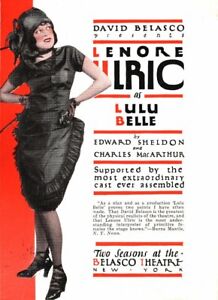
*1926 RACE RELATIONS DAVID BELASCO COLOR LULU BELLE HERALD SHELDON & MACARTHUR*
SOLD $79.99 Sold: Apr 22, 2024 on eBayOriginal Listing Description
A magnificent circa 1926 color herald for David Belasco's production of Edward Sheldon and Charles MacArthur's play or race relations Lulu Belle with the great Lenore Ulric. Excellent condition. This is one of the finest theatrical heralds I've ever seen. Dimensions seven by five inches. See David Belasco's extraordinary biography and thee story of the play. Shipping discounts for multiple purchases. Inquiries always welcome. Please visit my other eBay items for more early theatre, opera, film and historical autographs, photographs and programs and great actor and actress cabinet photos and CDV's. From Wikipedia:David Belasco (July 25, 1853 – May 14, 1931) was an American theatrical producer, impresario, director, and playwright.[1] He was the first writer to adapt the short story Madame Butterfly for the stage, and he launched the theatrical career of many actors, including James O'Neill, Mary Pickford, Lenore Ulric and Barbara Stanwyck. Belasco pioneered many innovative new forms of stage lighting and special effects in order to create realism and naturalism David Belasco was born in San Francisco, California, the son of Abraham H. Belasco (1830–1911) and Reyna Belasco (née Nunes, 1830–1899), Sephardic Jews who had moved from London’s Spanish and Portuguese Jewish community during the California Gold Rush.[3]:13 He began working in a San Francisco theater doing a variety of routine jobs, such as call boy, script copier or as an extra in small parts.[3]:14 He received his first experience as a stage manager while on the road. He said, "We used to play in any place we could hire or get into—a hall, a big dining room, an empty barn; any place that would take us."[3]:14From late 1873 to early 1874, he worked as an actor, director, and secretary at Piper's Opera House in Virginia City, Nevada, where he found "more reckless women and desperadoes to the square foot…than anywhere else in the world". His developmental years as a supporting player in Virginia City colored his thoughts eventually helping him to conceive realistic stage settings.[4] He said that while there, seeing "people die under such peculiar circumstances" made him "all the more particular in regard to the psychology of dying on the stage. I think I was one of the first to bring naturalness to bear in death scenes, and my varied Virginia City experiences did much to help me toward this. Later I was to go deeper into such studies." His recollections of that time were published in Hearst's Magazine in 1914.[5] By March 1874, he was back at work in San Francisco, eventually managing Thomas Maguire's Baldwin Theater. When Maguire lost the theater in 1882, Belasco relocated to the East Coast bringing his practical western experiences with him. The West allowed him to develop his talents as not only a performer, but in progressive production design and execution.[6]A gifted playwright, Belasco went to New York City in 1882 where he worked as stage manager for the Madison Square Theatre (starting with Young Mrs. Winthrop), and then the old Lyceum Theatre while writing plays. By 1895, he was so successful that he was considered America's most distinguished playwright and producer CareerBelasco in 1873During his long creative career, stretching between 1884 and 1930, Belasco either wrote, directed, or produced more than 100 Broadway plays, including Hearts of Oak, The Heart of Maryland, and Du Barry, making him the most powerful personality on the New York City theater scene. He also helped establish careers for dozens of notable stage performers, many of whom went on to work in films.Among them were Leslie Carter, dubbed "The American Sarah Bernhardt,"[7] whose association with Belasco skyrocketed her to theatrical fame after her roles in Zaza (1898) and Madame Du Barry (1901).[7] Ina Claire's lead in Polly with a Past (1917) and The Gold Diggers (1919) similarly propelled her career.[7] Belasco wrote a lead part for 18-year-old Maude Adams in his new play Men and Women (1890), which ran for 200 performances [7]Other stars whose careers he helped launch included Jeanne Eagels, who would later achieve immortality as Sadie Thompson in Rain (1923), which played for 340 performances [8] Belasco discovered and managed the careers of Lenore Ulric[9] and David Warfield, both of whom became major stars on Broadway. He launched the career of Barbara Stanwyck, and was responsible for changing her name.[7]Belasco is perhaps most famous for having adapted the short story Madame Butterfly into a play with the same name and for penning The Girl of the Golden West for the stage, both of which were adapted as operas by Giacomo Puccini (Madama Butterfly 1904—twice, after revision) and La fanciulla del West (1910). More than forty motion pictures have been made from the many plays he authored.To me, David Belasco was like the King of England, Julius Caesar and Napoleon rolled into one.Mary Pickford[7]Many prominent performers of the late 19th and early 20th centuries sought the opportunity to work with Belasco; among them were D. W. Griffith, Helen Hayes, Lillian Gish, Mary Pickford[7] and Cecil B. DeMille.[7] DeMille's father had been close friends with Belasco, and after DeMille graduated from the American Academy of Dramatic Arts, he began his stage career under Belasco's guidance.[10] DeMille's later methods of handling actors, using dramatic lighting and directing films, were modeled after Belasco's staging techniques [7]Pickford appeared in his plays The Warrens of Virginia at the first Belasco Theatre in 1907 and A Good Little Devil in 1913. The two remained in touch after Pickford began working in Hollywood; Belasco appeared with her in the 1914 film adaptation of A Good Little Devil. He is credited as giving Pickford her stage name as well. He also worked with Lionel Barrymore, who starred in his play Laugh, Clown, Laugh opposite Lucille Kahn, whose Broadway career Belasco launched. Belasco was a member of The Lambs from 1893 to 1931 MarriageDavid Belasco was married to Cecilia Loverich for over fifty years; they had two daughters, Reina (who was married to producer Morris Gest) and Augusta DeathBelasco died in 1931 at the age of 77 in Manhattan.[1] He was interred in the Linden Hill Jewish Cemetery on Metropolitan Avenue in Ridgewood, Queens [11][12]Influence on American theatrePoster for The Heart of Maryland with Maurice Barrymore and Mrs. Leslie CarterBelasco demanded a natural acting style, and to complement that, he developed stage settings with authentic lighting effects to enhance his plays. His productions inspired several generations of theatre lighting designers [13]:29Belasco s contributions to modern stage and lighting techniques were originally not appreciated as much as those of his European counterparts, such as André Antoine and Constantin Stanislavski, however today he is regarded as "one of the first significant directorial figures in the history of the American theatre," writes theatre historian Lise-Lone Marker [3]:xiBelasco s monogramHe brought a new standard of naturalism to the American stage as the first to develop modern stage lighting along with the use of colored lights, via motorized color changing wheels, to evoke mood and setting [3]:xi[13] America's earliest stage lighting manufacturer, Kliegl Brothers, began by serving the specialized needs of producers and directors such as Belasco and Florenz Ziegfeld [13]:157 With regard to these modern lighting effects, Belasco is best remembered for his production of Girl of the Golden West (1905), with the play opening to a spectacular sunset which lasted five minutes before any dialogue started [13]:29Belasco became one of the first directors to eschew the use of traditional footlights in favor of lights concealed below floor level, thereby hidden from the audience. His lighting assistant, Louis Hartmann, realised Belasco's design ideas.[13]:29 He also used follow spots to further create realism and often tailored his lighting configurations to complement the complexions and hair of the actors.[13]:135 He ordered a specially made 1000-watt lamp developed just for his own productions, and was the only director to have one for the first two years after its introduction (1914–1915) [13]:135In his own theatres, the dressing rooms were equipped with lamps of several colors, allowing the performers to see how their makeup looked under different lighting conditions Supposedly he put appropriate scents to set scenes in the ventilation of the theaters, while his sets paid great attention to detail, and sometimes spilled out into the audience area. In one play, for instance, an operational laundromat was built onstage. In The Governor's Lady, there was a reproduction of a Childs Restaurant kitchen where actors actually cooked and prepared food during the play.Childs Restaurant Scene in The Governor's LadyHe is even said to have purchased a room in a flophouse, cut it out of the building, brought it to his theater, cut out one wall and presented it as the set for a production. Belasco's original scripts were often filled with long, specific descriptions of props and set dressings. He has not been noted for producing unusually naturalistic scenarios Belasco also embraced existing theatre technology and sought to expand on it. Both of Belasco's New York theatres were built on the cutting edge of their era's technology. When Belasco took over the Republic Theatre he drilled a new basement level to accommodate his machinery; the Stuyvesant Theatre was specially constructed with enormous amounts of flyspace, hydraulics systems and lighting rigs. The basement of the Stuyvesant contained a working machine shop, where Belasco and his team experimented with lighting and other special effects. Many of the innovations developed in the Belasco shop were sold to other producers.F. Scott Fitzgerald references Belasco's reputation for realism in The Great Gatsby when he has a drunken visitor in the library of Gatsby's mansion exclaim in amazement that the books are genuine: "See!" he cried triumphantly. "It's a bona-fide piece of printed matter. It fooled me. This fella's a regular Belasco. It's a triumph. What thoroughness! What realism! Knew when to stop, too—didn't cut the pages [14]TheatresSee also: Belasco TheatreSee also: The BelascoThe first Belasco Theatre in New York was located at 229 West 42nd Street, between 7th and 8th Avenues, in the Times Square district of Manhattan. Belasco took over management of the theater and completely remodeled it in 1902, only two years after it was constructed as the Theatre Republic by Oscar Hammerstein (the grandfather of the famous lyricist). He gave up the theater in 1910 and it was renamed the Republic. Under various owners, it went through a tumultuous period as a burlesque venue, hosted second-run and, eventually, pornographic films and fell into a period of neglect before being rehabilitated and reopened as the New Victory Theater in 1995.The second Belasco Theatre is located at 111 West 44th Street, between 6th and 7th Avenues, only a few blocks away from the New Victory. It was constructed in 1907 as the Stuyvesant Theatre and renamed after Belasco in 1910. The theater was built to Belasco's wishes, with Tiffany lighting and ceiling panels, rich woodwork and murals. His business office and private apartment were also housed there. The Belasco is still in operation as a Broadway venue with much of the original decor intact. In 2010 it underwent a massive US $14.5 million restoration, which strove to renovate and restore the theater to the condition it was in when David Belasco was alive [15]Belasco Theatres also existed in several other cities. In Los Angeles, the first Belasco Theatre was located at 337 S. Main St. The theater, which hosted the Belasco Stock Company, opened in 1904 and was operated by David Belasco's brother, Frederick. This theater was renamed twice: as the Republic in about 1913 and as the Follies, circa 1919. The theater eventually became a burlesque venue in the 1940s, fell into sharp decline, and was demolished in May 1974 [16][17]The second, and perhaps more well known theatre in Los Angeles, The Belasco is located at 1050 S. Hill St in Downtown Los Angeles. The theatre, which was built by Morgan, Walls & Clements, opened in 1926, and was managed by Edward Belasco, another of David's brothers. Many Hollywood stars with theatrical roots, as well as Broadway stars who were visiting the West Coast, appeared at the theatre.[18] The theater declined after the death of Edward Belasco in 1937. After closing altogether in the early 1950s, the theater was used as a church for several decades.[19] In 2010 - 2011, the theater underwent an extensive restoration, and is currently in operation as a nightclub and convention venue.[20]The Shubert-Belasco Theatre, located in Washington, D.C., was purchased by Belasco in September 1905. Originally built in 1895 as the Lafayette Square Opera House, at 717 Madison Place, across from the White House, the theater was razed in 1962 and replaced by the U.S. Court of Claims building [21]Selected playsHearts of Oak (1879), by James A. Herne and David BelascoLa Belle Russe (1882), by David BelascoMay Blossom (1884), by David BelascoLord Chumley (1888), by Henry Churchill de Mille and David BelascoMen and Women (1890), by Henry Churchill de Mille and David BelascoThe Girl I Left Behind Me (1893), by Franklin Fyles and David BelascoPawn Ticket No. 210 (1894), by Clay M. Greene and David BelascoThe Heart of Maryland (1895), by David BelascoZaza (1898), by David Belasco (based on the play Zaza by Pierre Berton and Charles Simon [fr])Madame Butterfly (1900), by David Belasco (based on the short story Madame Butterfly by John Luther Long)Du Barry (1901), by David BelascoThe Auctioneer Kitty Bellairs (1903), by David Belasco (based on the novel The Bath Comedy by Agnes Castle and Egerton Castle)The Music Master (1904), by Charles KleinAdrea (1905), by David Belasco and John Luther LongThe Girl of the Golden West (1905), by David BelascoRose of the Rancho (1906), by Richard Walton Tully and David BelascoThe Warrens of Virginia (1907), by William C. deMilleThe Fighting Hope (1908), by William J. HurlbutThe Easiest Way (1909), by Eugene WalterThe Lily (1909), by David Belasco (based on the play Le Lys by Pierre Wolff and Gaston Leroux)Just a Wife (1910), by Eugene WalterThe Woman (1911), by William C. deMilleThe Return of Peter Grimm (1911), by David BelascoThe Governor's Lady (1912), by Alice BradleyThe Case of Becky (1912), by Edward LockeA Good Little Devil (1913), by Austin Strong (based on the play Un bon petit diable by Rosemonde Gérard and Maurice Rostand)Seven Chances (1916), by Roi Cooper MegrueTiger Rose (1917), by Willard MackThe Gold Diggers (1919), by Avery HopwoodThe Son-Daughter (1919), by George Scarborough and David BelascoKiki (1921), by David Belasco (based on the play Kiki by André Picard [fr])Shore Leave (1922), by Hubert OsborneLaugh, Clown, Laugh (1923), by Tom Cushing and David Belasco (based on the play Ridi, pagliaccio! by Fausto Maria Martini [it])Ladies of the Evening (1924), by Milton Herbert GropperThe Dove (1925), by Willard Mack (based on a story by Gerald Beaumont)Lulu Belle (1926), by Charles MacArthur and Edward SheldonTonight or Never (1930), by Fanny Hatton and Frederic Hatton (based on the play Ma este vagy soha by Lili Hatvany Chumley, directed by James Kirkwood (1914, based on the play Lord Chumley)La Belle Russe [it], directed by William J. Hanley (1914, based on the play La Belle Russe)Men and Women, directed by James Kirkwood (1914, based on the play Men and Women)Rose of the Rancho, directed by Cecil B. DeMille (1914, based on the play Rose of the Rancho)The Girl of the Golden West, directed by Cecil B. DeMille (1915, based on the play The Girl of the Golden West)The Girl I Left Behind Me [it], directed by Lloyd B. Carleton (1915, based on the play The Girl I Left Behind Me)DuBarry, directed by Edoardo Bencivenga (1915, based on the play Du Barry)The Heart of Maryland, directed by Herbert Brenon (1915, based on the play The Heart of Maryland)May Blossom, directed by Allan Dwan (1915, based on the play May Blossom)The Case of Becky, directed by Frank Reicher (1915, based on the play The Case of Becky)Madame Butterfly, directed by Sidney Olcott (1915, based on the play Madame Butterfly)Zaza, directed by Edwin S. Porter and Hugh Ford (1915, based on the play Zaza)Sweet Kitty Bellairs, directed by James Young (1916, based on the play Sweet Kitty Bellairs)La Belle Russe, directed by Charles Brabin (1919, based on the play La Belle Russe)Harakiri, directed by Fritz Lang (Germany, 1919, based on the play Madame Butterfly)The Heart of Maryland, directed by Tom Terriss (1921, based on the play The Heart of Maryland)The Case of Becky, directed by Chester M. Franklin (1921, based on the play The Case of Becky)Pawn Ticket 210, directed by Scott R. Dunlap (1922, based on the play Pawn Ticket No. 210)The Girl of the Golden West, directed by Edwin Carewe (1923, based on the play The Girl of the Golden West)Zaza, directed by Allan Dwan (1923, based on the play Zaza)Tiger Rose, directed by Sidney Franklin (1923, based on the play Tiger Rose)Forty Winks, directed by Paul Iribe and Frank Urson (1925, based on the play Lord Chumley)Seven Chances, directed by Buster Keaton (1925, based on the play Seven Chances)Men and Women, directed by William C. deMille (1925, based on the play Men and Women)Kiki, directed by Clarence Brown (1926, based on the play Kiki)The Lily, directed by Victor Schertzinger (1926, based on the play The Lily)The Return of Peter Grimm, directed by Victor Schertzinger (1926, based on the play The Return of Peter Grimm)The Music Master, directed by Allan Dwan (1927, based on the play The Music Master)The Heart of Maryland, directed by Lloyd Bacon (1927, based on the play The Heart of Maryland)Laugh, Clown, Laugh, directed by Herbert Brenon (1928, based on the play Laugh, Clown, Laugh)Ladies of Leisure, directed by Frank Capra (1930, based on the play Ladies of the Evening)Sweet Kitty Bellairs, directed by Alfred E. Green (1930, based on the play Sweet Kitty Bellairs)Du Barry, Woman of Passion, directed by Sam Taylor (1930, based on the play Du Barry)The Girl of the Golden West, directed by John Francis Dillon (1930, based on the play The Girl of the Golden West)Kiki, directed by Sam Taylor (1931, based on the play Kiki)Tonight or Never, directed by Mervyn LeRoy (1931, based on the play Tonight or Never)Girl of the Rio, directed by Herbert Brenon (1932, based on the play The Dove)The Hatchet Man, directed by William A. Wellman (1932, based on the play The Honorable Mr. Wong)The Son-Daughter, directed by Clarence Brown (1932, based on the play The Son Daughter)Madame Butterfly, directed by Marion Gering (1932, based on the play Madame Butterfly)The Return of Peter Grimm, directed by George Nicholls Jr. (1935, based on the play The Return of Peter Grimm)Rose of the Rancho, directed by Marion Gering (1936, based on the play Rose of the Rancho)Follow the Fleet, directed by Mark Sandrich (1936, based on the play Shore Leave)The Girl of the Golden West, directed by Robert Z. Leonard (1938, based on the play The Girl of the Golden West)Zaza, directed by George Cukor (1939, based on the play Zaza)Lulu Belle, directed by Leslie Fenton (1948, based on the play Lulu Belle)Madame Butterfly, directed by Carmine Gallone (Italy, 1954, based on the opera Madama Butterfly, directed by Frédéric Mitterrand (France, 1995, based on the opera Madama Good Little Devil, directed by Edwin S. Porter (1914, Famous Players Film Company)Rose of the Rancho, directed by Cecil B. DeMille (1914, Jesse L. Lasky Feature Play Co.)The Girl of the Golden West, directed by Cecil B. DeMille (1915, Jesse L. Lasky Feature Play Co.)The Warrens of Virginia, directed by Cecil B. DeMille (1915, Jesse L. Lasky Feature Play Co.)The Governor's Lady, directed by George Melford (1915, Jesse L. Lasky Feature Play Co.)The Woman, directed by George Melford (1915, Jesse L. Lasky Feature Play Co.)The Fighting Hope, directed by George Melford (1915, Jesse L. Lasky Feature Play Co.)The Case of Becky, directed by Frank Reicher (1915, Jesse L. Lasky Feature Play Co.)Her Accidental Husband, directed by Dallas M. Fitzgerald (1923, Belasco Productions, Inc.)The Gold Diggers, directed by Harry Beaumont (1923, Warner Bros.)Tiger Rose, directed by Sidney Franklin (1923, Warner Bros.)Welcome Stranger, directed by James Young (1924, Belasco Productions, Inc.)Friendly Enemies, directed by George Melford (1925, Belasco Productions, Inc.)Fifth Avenue, directed by Robert G. Vignola (1926, Belasco Productions, Inc.)The Prince of Pilsen, directed by Paul Powell (1926, Belasco Productions, Inc.)Lulu Belle is a 1948 American drama musical romance film directed by Leslie Fenton and starring Dorothy Lamour.[1] The film was an adaption of a sensational 1926 hit play by Charles MacArthur and Edward Sheldon,[2][3] about a mulatto songstress, a "man-trap" who bewitched powerful men in New Orleans. This convoluted but heavily Code-sanitized film version of the play was about a Caucasian songbird who could not be true to her boxer beau. Although the film offered a change of pace for its star, Dorothy Lamour, it was not a success at the box office PlotFamous Broadway singer Lulu Belle (Dorothy Lamour) and Harry Randolph (Otto Kruger), her rich suitor, are found shot and severely wounded in her dressing room one night after the show. They are discovered by Lulu's best friend, Molly Benson (Glenda Farrell), and taken unconscious to the hospital [4]Lulu s ex-husband, George Davis (George Montgomery), is accused of the shooting, since he has been previously convicted of attempted murder of another man who got too close to Lulu. During George's interrogation he tells the story of how he met Lulu for the first time. She was performing in a dodgy place called the Natchez Café, and he was so taken with her that he left his fiancée and law practice to elope with her to New Orleans. They lived a wild life of luxury for awhile until his money ran out. She left for another man, high-stakes gambler Mark Brady (Albert Dekker) to support her expensive lifestyle. George realizes that Lulu is bad news and leaves her. It doesn't take long before they get back together again. Lulu is offered a job by Mark, as a singer at a club he is starting, and George starts drinking heavily to drown his sorrows. He tries to get Molly to help stop Lulu's way of life. Lulu wants to divorce him to set him free. That night a wealthy man named Harry Randolph comes to visit the club with his wife (Charlotte Wynters). He is immediately smitten with Lulu, and decides to help her become a star on Broadway.George picks a fight with boxer Butch and is beaten black and blue. George manages to stick a fork in Butch's eye and put an end to his fighting career. For this he is convicted and sentenced to prison. Lulu goes with Randolph, her new benefactor, to New York and Broadway. Randolph puts a lot of money and effort into building Lulu's career and a theater. After five years of working close together, Randolph asks Lulu to marry him. Lulu finds out that George has been released from prison and asks him to come her apartment. Mark turns up later in the evening at the theater and tries to force Lulu to come back with him, but she refuses. George meets Lulu right after the show that night and is sucked into her beam of charm again, when she proclaims her love for him. They decide to start a new life together. Without hesitation, Lulu tells Randolph that she won't marry him and he is upset. Then comes the night of the shooting Returning to the present, police commissioner Dixon (Addison Richards) gathers all the persons involved in the story, including Mrs. Randolph, at the dying Randolph's bedside. He asks Randolph to tell them who the shooter was, and he reveals it was his wife. George is vindicated and freed of all charges. He stays by Lulu's side long enough to make sure she will recover, then returns to his hometown alone.Edward Brewster (Ned) Sheldon (Chicago, Illinois, February 4, 1886 – April 1, 1946, New York City) was an American dramatist. His plays include Salvation Nell (1908) and Romance (1913), which was made into a motion picture with Greta Garbo.After becoming ill at age 29 with crippling rheumatoid arthritis, which eventually claimed his sight (around 1930), Sheldon became a source of emotional and creative support for his many friends, notably Minnie Maddern Fiske (he wrote Salvation Nell for her), Julia Marlowe, John Barrymore (his closest friend and confidante), Thornton Wilder, Alexander Woollcott, Anne Morrow Lindbergh, Ruth Gordon, Helen Hayes. While in hospital his advice was received by those in the theatrical profession as gospel. Actress and librettist Dorothy Donnelly formed a close friendship with Sheldon, and after he became bedridden often assisted with transcribing, editing, and supporting his work.In May 1915 Sheldon narrowly missed sailing on the Lusitania's infamous last voyage. He had been asked by theater impresario Charles Frohman to accompany him to England. A Harvard classmate of Sheldon's was getting married on May 11 and asked Sheldon to be best man. Sheldon then declined Frohman's offer.A 1936 lawsuit against Metro Goldwyn Mayer for copyright infringement claimed that the script MGM used for the 1932 motion picture Letty Lynton plagiarized material from the play Dishonored Lady by Sheldon and Margaret Ayer Barnes. The film is still unavailable today because of this lawsuit.His life is detailed in The Man Who Lived Twice by Eric Wollencott Barnes. In this biography Barnes states that Sheldon was in love all his adult life with Doris Keane, the actress who starred in Romance in 1913.Minnie Maddern Fiske and Frederick Perry in The High Road (1912)Basil Sydney and Doris Keane in the film Romance Nell (1908), made into the 1915, 1921, and 1931 motion pictures of the same nameThe Nigger (1909), made into the 1915 motion picture of the same name (aka The New Governor or The Mystery of Morrow's Rest) produced by William FoxThe Boss (1911), made into the 1915 motion picture of the same nameThe High Road (1912), made into the 1915 motion picture of the same nameRomance (1913), notable for its London run of 1,049 performances. Made into a 1920 silent film by United Artists starring Doris Keane, the actress who appeared in the role on stage. Also made into a 1930 motion picture starring Greta Garbo. Produced in New York as a musical, My Romance, with music by Sigmund Romberg and book and lyrics by Rowland Leigh, in 1948.The Song of Songs (1914), dramatization of the novel by Hermann Sudermann, made into films in 1918 (The Song of Songs), 1924 (Lily of the Dust), and in 1933 (The Song of Songs, starring Marlene Dietrich, Brian Aherne, and Lionel Atwill)The Garden of Paradise (1914), from "The Little Mermaid" by Hans Christian AndersenThe Call of Her People (1916), a silent film for Ethel Barrymore, from Sheldon's own play Egypt.The Jest (1919), adaptation from the Italian of Sem BenelliThe Czarina (1922), adaptation of the Hungarian play by Melchior Lengyel and Lajos Bíró, made into the 1924 silent Forbidden Paradise with Pola Negri.Bewitched (1924), with Sidney HowardLulu Belle (1926), with Charles MacArthur, starring Lenore Ulric; made into the 1948 motion picture of the same name, starring Dorothy LamourJenny (1929), with Margaret Ayer Lady (1930), with Barnes, made into the 1947 motion picture of the same name, starring Hedy Lamarr and directed by Robert Stevenson (alternate title Sins Lenore Ulric (born Lenore Ulrich, July 21, 1892 – December 30, 1970) was a star of the Broadway stage and Hollywood films of the silent-film and early sound era.Discovered in 1913 by theater director David Belasco, who would go on to manage her stage career, she was noted for portraying fiery, hot-blooded women of the typical vamp of Ulrich was born on July 21, 1892 to Franz Xavier Ulrich, who was a United States Army hospital steward, and Ida Ulrich (née Engenhart) [1][2] Both of her parents were first generation German Americans [3] Franz reportedly named his daughter Lenore due to his fondness for the Edgar Allan Poe poem, "The Raven".[1] She later dropped the "h" from her surname.[1] She had four sisters, Isabel, Francis, Alma, and Florence, and a brother, Roy Richard [4][5][6] She left school after completing 3rd grade.[7]As a young girl, Lenore obtained a job with a stock company in Milwaukee, Wisconsin. She played with stock companies in Grand Rapids, Michigan and Chicago, Illinois. She worked briefly as a film actress for Essanay Studios and joined another stock company in Schenectady, New York. She found work in The First Man (1911), A Polished Burglar (1911), Kilmeny (1915), and The Better Woman (1915).She specialized in playing sultry, impassioned women.[8] In 1915, she went to work for Pallas Pictures starring in several silent pictures, such as Frozen Justice and The Intrigue, that survive today at the Library of Congress [9][10]BroadwayCaricature by Ralph Barton, 1925Ulric was discovered by theatrical producer David Belasco who first saw her in The Bird of Paradise in 1913, after Ulric wrote to him requesting that he see her on stage.[10] Belasco, who would go on "fishing trips" to find new stage talents, recalled that it was often a long time between "bites," but he enjoyed the sport as he sometimes would "hook a big one [11]:367After watching her on stage, he asked her to audition at his playhouse. He watched her perform while he sat incognito in one of the theater's seats. "After twenty minutes," he said, "I knew I was watching a very talented and unusual young woman."[11]:369 He then offered her the leading role in The Heart of Wetona [11]:369[8] He recalled: "Among the biggest I have ever landed is, I believe, little Miss Ulric: I think she will grow bigger every season she is before the public [11]:367Biographer William Winter called her a "born actress," someone who Belasco hoped would fulfill the theater's need for talent. Winter also notes that no one in her family had ever been involved in acting, adding: "She resorted to the dramatic calling not through mere vanity, the impulse of personal exhibition, or the acquisitive hope of profit, but because her natural vocation is acting [11]:367Ulric in The Son-Daughter (1919)Under Belasco's management during most of her stage career, Ulric played a variety of female roles. Among them was her portrayal of Rose, a French-Canadian orphan, in Tiger Rose (1917). Winter says that Ulric's personality traits allowed her to play the role realistically as written:Miss Lenore Ulric, who acts the part, is possessed of exceptional natural advantages —youth; a handsome face; abundant hair; expressive eyes, dark and beautiful; a slender, lithe figure; a sympathetic voice; strong, attractive personality, and an engaging manner. Her temperament is intense, her nature passionate, her style direct and simple. Her acting reveals force of character, experience, observation, thought, sensibility, ardor, definite purpose, and unusual command of the mechanics of art...She is an admirable listener, an excellent speaker...The disposition she exhibits in this performance seems altogether childlike and lovely. Under Belasco's sagacious direction, she should go far.[11]:469She acted in numerous plays at the Belasco Theater, all under the direction of Belasco. She played in The Son-Daughter (1919), a play about China by Belasco and George Scarborough, which ran for 223 performances. She played a Parisian street urchin in Kiki (1921), a seductress in The Harem (1924), and in one of Ulric's biggest hits for Belasco, the 1926 Lulu Belle, where she played a prostitute, a genre that spawned several Broadway hits in the 1920s.[1] In 1928 she starred in Mima. Other stars who played at the Belasco during that period included Lionel Barrymore and Katharine Cornell [12]:28Success goes to women who are interesting. Nothing else matters. I don't believe even beauty matters.Lenore Ulric[13]After seeing Ulric in some of her plays, British producer Charles Cochrane cabled David Belasco with an "urgent request" that he be granted the privilege of presenting Ulric at one of his London playhouses.[14] During that time, however, Belasco had been writing a new version of Camille for Ulric to star in. According to one critic, "Miss Ulric's youth fits her peculiarly for the part, while her undisputed genius as an emotional actress justifies the prediction that she would be the greatest Camille who has ever been seen upon the stage."[14]In 1947 she returned to the Belasco Theater after doing seven films in Hollywood, beginning with a leading role in a revival of Antony and Cleopatra, alongside Eli Wallach, Maureen Stapleton and Charlton Heston.[12]:173 She told a critic, "I certainly never really left the theater."[1] Belasco had managed her stage career until shortly before his death.[1] In a tribute to Belasco, she said:All of us who were with him depended upon him so much that we'd just flounder around and say, "What do I do now?" He was a good soldier, a hard worker, and a great director [1]During the height of her stage career, Ulric was considered one of the American theater's "great stars."[1] She was noted for portraying fiery, hot-blooded women of the typical "femme fatale."[1] According to the New York Times, theater-goers would go to her plays just to see her, while the play in which she appeared was secondary. Ulric's "name in white lights blazing on the playhouse marquee was always more compelling" than the play itself [1]Hollywood and return to theaterLenore came to Hollywood in 1929 and appeared in Frozen Justice and South Sea Rose. She signed with Fox Film Corporation to make several films with an approximate salary of $650,000. Frozen Justice was directed by Allan Dwan. Some of the scenes were filmed in Alaska. She was successful in a supporting role in Camille, starring Greta Garbo. Ulric returned to Broadway in 1940, acting in The Fifth Column by Ernest Hemingway and again in 1947, in a revival of Antony and Cleopatra Personal lifeUlric had been married only once, to actor Sidney Blackmer from 1929 to 1939. She accepted some of the blame for their divorce:I don't think I'm comfortable to live with. I have a temper. I'm difficult. I'm too quick and too impulsive. And men have a right to be comfortable [1]She died of heart failure in Rockland State Hospital, Orangeburg, New York on December 30, 1970, aged 78.Charles Gordon MacArthur (November 5, 1895 – April 21, 1956) was an American playwright, screenwriter and 1935 winner of the Academy Award for Best Story.MacArthur was born in Scranton, Pennsylvania, the sixth of seven children of stern evangelist William Telfer MacArthur and Georgiana Welsted MacArthur.[1] He early developed a passion for reading. Declining to follow his father into ministry, he moved to the Midwest and soon became a successful reporter in Chicago, working for the Chicago Tribune and Chicago Daily News. MacArthur joined the United States Army for World War I, and served in France as a private assigned to Battery F, 149th Field Artillery, a unit of the 42nd Division.[2] He recounted his wartime experience in 1919's A Bug's-Eye View of the War.[3] After the war, he wrote several short stories, two of which, "Hang It All" (1921) and "Rope" (1923), were published in H. L. Mencken's The Smart Set magazine.[1] Eventually he settled in New York City, where he turned to playwriting MacArthur is best known for his plays in collaboration with Ben Hecht, Ladies and Gentlemen (filmed as Perfect Strangers), Twentieth Century and the frequently filmed The Front Page, which was based in part on MacArthur's experiences at the City News Bureau of Chicago. MacArthur also co-wrote, with Edward Sheldon, the play Lulu Belle, which was staged in 1926 by David Belasco MacArthur was friends with members of the Algonquin Round Table. He shared an apartment with Robert Benchley and had an affair with Dorothy Parker.His second marriage was to the stage and screen actress Helen Hayes, from 1928 until his death. They lived in Nyack, New York. He was preceded in death by his daughter, Mary, who died of polio in 1949 at the age of 19. The shock of her death hastened MacArthur's own, according to those who knew him.Their adopted son, James MacArthur, was also an actor, best known for playing Danny Williams on the American television series Hawaii Five-O.His brother, John D. MacArthur, was an insurance company owner and executive, and founded the John D. and Catherine T. MacArthur Foundation, the benefactor of the MacArthur Fellowships Awards and Award for Best Writing, Original Story - The Scoundrel (shared with Ben Hecht) Writing, Screenplay - Wuthering Heights (shared with Ben Hecht) in 1940Best Writing, Original Story - Rasputin and the Empress in 1934In 1983, MacArthur was posthumously inducted into the American Theater Hall of Fame.[4]Film was portrayed by Matthew Broderick in the 1994 film Mrs. Parker and the Vicious Circle [5]Selected Song (1946), (with Ben Hecht)Ladies and Gentlemen (1939), (with Ben Hecht), made into the 1950 film Perfect StrangersSpring Tonic, made into the 1935 movie of the same nameJohnny on a SpotJumbo, (with Ben Hecht), made into the 1935 musical play Jumbo and the 1962 film musical Billy Rose's JumboTwentieth Century (with Ben Hecht), made into the 1934 film Twentieth CenturyThe Front Page (1928), with Ben Hecht, made into the 1931, 1945, and 1974 motion pictures of the same name, the 1940 film His Girl Friday, and the 1988 movie Switching ChannelsLulu Belle (1926), (with Edward Heights (1939)Gunga Din (1939)Angels with Dirty Faces (1938) of Gamblers (1937), aka Czar of the Slot Machines the Rich (1936)The Scoundrel (1935)Barbary Coast (1935)Once in a Blue Moon (1935)Crime Without Passion (1934) (also directed by him and Ben Hecht)Topaze (1933)Freaks (1932) and the Empress (1932)The Unholy Garden (1931)Quick Millions (1931) Divers (1931)New Adventures of Get Rich Quick Wallingford (1931)The Sin of Madelon Claudet (1931)Paid (1930)Way for a Sailor (1930)King of Jazz (1930) the Kid (1930)The Girl Said No (1930)
Note: This item has been sold and is no longer available. This page serves as a historical price reference for Playbill collectors and appraisers.
Original Listing Description
A magnificent circa 1926 color herald for David Belasco's production of Edward Sheldon and Charles MacArthur's play or race relations Lulu Belle with the great Lenore Ulric. Excellent condition. This is one of the finest theatrical heralds I've ever seen. Dimensions seven by five inches. See David Belasco's extraordinary biography and thee story of the play. Shipping discounts for multiple purchases. Inquiries always welcome. Please visit my other eBay items for more early theatre, opera, film and historical autographs, photographs and programs and great actor and actress cabinet photos and CDV's. From Wikipedia:David Belasco (July 25, 1853 – May 14, 1931) was an American theatrical producer, impresario, director, and playwright.[1] He was the first writer to adapt the short story Madame Butterfly for the stage, and he launched the theatrical career of many actors, including James O'Neill, Mary Pickford, Lenore Ulric and Barbara Stanwyck. Belasco pioneered many innovative new forms of stage lighting and special effects in order to create realism and naturalism David Belasco was born in San Francisco, California, the son of Abraham H. Belasco (1830–1911) and Reyna Belasco (née Nunes, 1830–1899), Sephardic Jews who had moved from London’s Spanish and Portuguese Jewish community during the California Gold Rush.[3]:13 He began working in a San Francisco theater doing a variety of routine jobs, such as call boy, script copier or as an extra in small parts.[3]:14 He received his first experience as a stage manager while on the road. He said, "We used to play in any place we could hire or get into—a hall, a big dining room, an empty barn; any place that would take us."[3]:14From late 1873 to early 1874, he worked as an actor, director, and secretary at Piper's Opera House in Virginia City, Nevada, where he found "more reckless women and desperadoes to the square foot…than anywhere else in the world". His developmental years as a supporting player in Virginia City colored his thoughts eventually helping him to conceive realistic stage settings.[4] He said that while there, seeing "people die under such peculiar circumstances" made him "all the more particular in regard to the psychology of dying on the stage. I think I was one of the first to bring naturalness to bear in death scenes, and my varied Virginia City experiences did much to help me toward this. Later I was to go deeper into such studies." His recollections of that time were published in Hearst's Magazine in 1914.[5] By March 1874, he was back at work in San Francisco, eventually managing Thomas Maguire's Baldwin Theater. When Maguire lost the theater in 1882, Belasco relocated to the East Coast bringing his practical western experiences with him. The West allowed him to develop his talents as not only a performer, but in progressive production design and execution.[6]A gifted playwright, Belasco went to New York City in 1882 where he worked as stage manager for the Madison Square Theatre (starting with Young Mrs. Winthrop), and then the old Lyceum Theatre while writing plays. By 1895, he was so successful that he was considered America's most distinguished playwright and producer CareerBelasco in 1873During his long creative career, stretching between 1884 and 1930, Belasco either wrote, directed, or produced more than 100 Broadway plays, including Hearts of Oak, The Heart of Maryland, and Du Barry, making him the most powerful personality on the New York City theater scene. He also helped establish careers for dozens of notable stage performers, many of whom went on to work in films.Among them were Leslie Carter, dubbed "The American Sarah Bernhardt,"[7] whose association with Belasco skyrocketed her to theatrical fame after her roles in Zaza (1898) and Madame Du Barry (1901).[7] Ina Claire's lead in Polly with a Past (1917) and The Gold Diggers (1919) similarly propelled her career.[7] Belasco wrote a lead part for 18-year-old Maude Adams in his new play Men and Women (1890), which ran for 200 performances [7]Other stars whose careers he helped launch included Jeanne Eagels, who would later achieve immortality as Sadie Thompson in Rain (1923), which played for 340 performances [8] Belasco discovered and managed the careers of Lenore Ulric[9] and David Warfield, both of whom became major stars on Broadway. He launched the career of Barbara Stanwyck, and was responsible for changing her name.[7]Belasco is perhaps most famous for having adapted the short story Madame Butterfly into a play with the same name and for penning The Girl of the Golden West for the stage, both of which were adapted as operas by Giacomo Puccini (Madama Butterfly 1904—twice, after revision) and La fanciulla del West (1910). More than forty motion pictures have been made from the many plays he authored.To me, David Belasco was like the King of England, Julius Caesar and Napoleon rolled into one.Mary Pickford[7]Many prominent performers of the late 19th and early 20th centuries sought the opportunity to work with Belasco; among them were D. W. Griffith, Helen Hayes, Lillian Gish, Mary Pickford[7] and Cecil B. DeMille.[7] DeMille's father had been close friends with Belasco, and after DeMille graduated from the American Academy of Dramatic Arts, he began his stage career under Belasco's guidance.[10] DeMille's later methods of handling actors, using dramatic lighting and directing films, were modeled after Belasco's staging techniques [7]Pickford appeared in his plays The Warrens of Virginia at the first Belasco Theatre in 1907 and A Good Little Devil in 1913. The two remained in touch after Pickford began working in Hollywood; Belasco appeared with her in the 1914 film adaptation of A Good Little Devil. He is credited as giving Pickford her stage name as well. He also worked with Lionel Barrymore, who starred in his play Laugh, Clown, Laugh opposite Lucille Kahn, whose Broadway career Belasco launched. Belasco was a member of The Lambs from 1893 to 1931 MarriageDavid Belasco was married to Cecilia Loverich for over fifty years; they had two daughters, Reina (who was married to producer Morris Gest) and Augusta DeathBelasco died in 1931 at the age of 77 in Manhattan.[1] He was interred in the Linden Hill Jewish Cemetery on Metropolitan Avenue in Ridgewood, Queens [11][12]Influence on American theatrePoster for The Heart of Maryland with Maurice Barrymore and Mrs. Leslie CarterBelasco demanded a natural acting style, and to complement that, he developed stage settings with authentic lighting effects to enhance his plays. His productions inspired several generations of theatre lighting designers [13]:29Belasco s contributions to modern stage and lighting techniques were originally not appreciated as much as those of his European counterparts, such as André Antoine and Constantin Stanislavski, however today he is regarded as "one of the first significant directorial figures in the history of the American theatre," writes theatre historian Lise-Lone Marker [3]:xiBelasco s monogramHe brought a new standard of naturalism to the American stage as the first to develop modern stage lighting along with the use of colored lights, via motorized color changing wheels, to evoke mood and setting [3]:xi[13] America's earliest stage lighting manufacturer, Kliegl Brothers, began by serving the specialized needs of producers and directors such as Belasco and Florenz Ziegfeld [13]:157 With regard to these modern lighting effects, Belasco is best remembered for his production of Girl of the Golden West (1905), with the play opening to a spectacular sunset which lasted five minutes before any dialogue started [13]:29Belasco became one of the first directors to eschew the use of traditional footlights in favor of lights concealed below floor level, thereby hidden from the audience. His lighting assistant, Louis Hartmann, realised Belasco's design ideas.[13]:29 He also used follow spots to further create realism and often tailored his lighting configurations to complement the complexions and hair of the actors.[13]:135 He ordered a specially made 1000-watt lamp developed just for his own productions, and was the only director to have one for the first two years after its introduction (1914–1915) [13]:135In his own theatres, the dressing rooms were equipped with lamps of several colors, allowing the performers to see how their makeup looked under different lighting conditions Supposedly he put appropriate scents to set scenes in the ventilation of the theaters, while his sets paid great attention to detail, and sometimes spilled out into the audience area. In one play, for instance, an operational laundromat was built onstage. In The Governor's Lady, there was a reproduction of a Childs Restaurant kitchen where actors actually cooked and prepared food during the play.Childs Restaurant Scene in The Governor's LadyHe is even said to have purchased a room in a flophouse, cut it out of the building, brought it to his theater, cut out one wall and presented it as the set for a production. Belasco's original scripts were often filled with long, specific descriptions of props and set dressings. He has not been noted for producing unusually naturalistic scenarios Belasco also embraced existing theatre technology and sought to expand on it. Both of Belasco's New York theatres were built on the cutting edge of their era's technology. When Belasco took over the Republic Theatre he drilled a new basement level to accommodate his machinery; the Stuyvesant Theatre was specially constructed with enormous amounts of flyspace, hydraulics systems and lighting rigs. The basement of the Stuyvesant contained a working machine shop, where Belasco and his team experimented with lighting and other special effects. Many of the innovations developed in the Belasco shop were sold to other producers.F. Scott Fitzgerald references Belasco's reputation for realism in The Great Gatsby when he has a drunken visitor in the library of Gatsby's mansion exclaim in amazement that the books are genuine: "See!" he cried triumphantly. "It's a bona-fide piece of printed matter. It fooled me. This fella's a regular Belasco. It's a triumph. What thoroughness! What realism! Knew when to stop, too—didn't cut the pages [14]TheatresSee also: Belasco TheatreSee also: The BelascoThe first Belasco Theatre in New York was located at 229 West 42nd Street, between 7th and 8th Avenues, in the Times Square district of Manhattan. Belasco took over management of the theater and completely remodeled it in 1902, only two years after it was constructed as the Theatre Republic by Oscar Hammerstein (the grandfather of the famous lyricist). He gave up the theater in 1910 and it was renamed the Republic. Under various owners, it went through a tumultuous period as a burlesque venue, hosted second-run and, eventually, pornographic films and fell into a period of neglect before being rehabilitated and reopened as the New Victory Theater in 1995.The second Belasco Theatre is located at 111 West 44th Street, between 6th and 7th Avenues, only a few blocks away from the New Victory. It was constructed in 1907 as the Stuyvesant Theatre and renamed after Belasco in 1910. The theater was built to Belasco's wishes, with Tiffany lighting and ceiling panels, rich woodwork and murals. His business office and private apartment were also housed there. The Belasco is still in operation as a Broadway venue with much of the original decor intact. In 2010 it underwent a massive US $14.5 million restoration, which strove to renovate and restore the theater to the condition it was in when David Belasco was alive [15]Belasco Theatres also existed in several other cities. In Los Angeles, the first Belasco Theatre was located at 337 S. Main St. The theater, which hosted the Belasco Stock Company, opened in 1904 and was operated by David Belasco's brother, Frederick. This theater was renamed twice: as the Republic in about 1913 and as the Follies, circa 1919. The theater eventually became a burlesque venue in the 1940s, fell into sharp decline, and was demolished in May 1974 [16][17]The second, and perhaps more well known theatre in Los Angeles, The Belasco is located at 1050 S. Hill St in Downtown Los Angeles. The theatre, which was built by Morgan, Walls & Clements, opened in 1926, and was managed by Edward Belasco, another of David's brothers. Many Hollywood stars with theatrical roots, as well as Broadway stars who were visiting the West Coast, appeared at the theatre.[18] The theater declined after the death of Edward Belasco in 1937. After closing altogether in the early 1950s, the theater was used as a church for several decades.[19] In 2010 - 2011, the theater underwent an extensive restoration, and is currently in operation as a nightclub and convention venue.[20]The Shubert-Belasco Theatre, located in Washington, D.C., was purchased by Belasco in September 1905. Originally built in 1895 as the Lafayette Square Opera House, at 717 Madison Place, across from the White House, the theater was razed in 1962 and replaced by the U.S. Court of Claims building [21]Selected playsHearts of Oak (1879), by James A. Herne and David BelascoLa Belle Russe (1882), by David BelascoMay Blossom (1884), by David BelascoLord Chumley (1888), by Henry Churchill de Mille and David BelascoMen and Women (1890), by Henry Churchill de Mille and David BelascoThe Girl I Left Behind Me (1893), by Franklin Fyles and David BelascoPawn Ticket No. 210 (1894), by Clay M. Greene and David BelascoThe Heart of Maryland (1895), by David BelascoZaza (1898), by David Belasco (based on the play Zaza by Pierre Berton and Charles Simon [fr])Madame Butterfly (1900), by David Belasco (based on the short story Madame Butterfly by John Luther Long)Du Barry (1901), by David BelascoThe Auctioneer Kitty Bellairs (1903), by David Belasco (based on the novel The Bath Comedy by Agnes Castle and Egerton Castle)The Music Master (1904), by Charles KleinAdrea (1905), by David Belasco and John Luther LongThe Girl of the Golden West (1905), by David BelascoRose of the Rancho (1906), by Richard Walton Tully and David BelascoThe Warrens of Virginia (1907), by William C. deMilleThe Fighting Hope (1908), by William J. HurlbutThe Easiest Way (1909), by Eugene WalterThe Lily (1909), by David Belasco (based on the play Le Lys by Pierre Wolff and Gaston Leroux)Just a Wife (1910), by Eugene WalterThe Woman (1911), by William C. deMilleThe Return of Peter Grimm (1911), by David BelascoThe Governor's Lady (1912), by Alice BradleyThe Case of Becky (1912), by Edward LockeA Good Little Devil (1913), by Austin Strong (based on the play Un bon petit diable by Rosemonde Gérard and Maurice Rostand)Seven Chances (1916), by Roi Cooper MegrueTiger Rose (1917), by Willard MackThe Gold Diggers (1919), by Avery HopwoodThe Son-Daughter (1919), by George Scarborough and David BelascoKiki (1921), by David Belasco (based on the play Kiki by André Picard [fr])Shore Leave (1922), by Hubert OsborneLaugh, Clown, Laugh (1923), by Tom Cushing and David Belasco (based on the play Ridi, pagliaccio! by Fausto Maria Martini [it])Ladies of the Evening (1924), by Milton Herbert GropperThe Dove (1925), by Willard Mack (based on a story by Gerald Beaumont)Lulu Belle (1926), by Charles MacArthur and Edward SheldonTonight or Never (1930), by Fanny Hatton and Frederic Hatton (based on the play Ma este vagy soha by Lili Hatvany Chumley, directed by James Kirkwood (1914, based on the play Lord Chumley)La Belle Russe [it], directed by William J. Hanley (1914, based on the play La Belle Russe)Men and Women, directed by James Kirkwood (1914, based on the play Men and Women)Rose of the Rancho, directed by Cecil B. DeMille (1914, based on the play Rose of the Rancho)The Girl of the Golden West, directed by Cecil B. DeMille (1915, based on the play The Girl of the Golden West)The Girl I Left Behind Me [it], directed by Lloyd B. Carleton (1915, based on the play The Girl I Left Behind Me)DuBarry, directed by Edoardo Bencivenga (1915, based on the play Du Barry)The Heart of Maryland, directed by Herbert Brenon (1915, based on the play The Heart of Maryland)May Blossom, directed by Allan Dwan (1915, based on the play May Blossom)The Case of Becky, directed by Frank Reicher (1915, based on the play The Case of Becky)Madame Butterfly, directed by Sidney Olcott (1915, based on the play Madame Butterfly)Zaza, directed by Edwin S. Porter and Hugh Ford (1915, based on the play Zaza)Sweet Kitty Bellairs, directed by James Young (1916, based on the play Sweet Kitty Bellairs)La Belle Russe, directed by Charles Brabin (1919, based on the play La Belle Russe)Harakiri, directed by Fritz Lang (Germany, 1919, based on the play Madame Butterfly)The Heart of Maryland, directed by Tom Terriss (1921, based on the play The Heart of Maryland)The Case of Becky, directed by Chester M. Franklin (1921, based on the play The Case of Becky)Pawn Ticket 210, directed by Scott R. Dunlap (1922, based on the play Pawn Ticket No. 210)The Girl of the Golden West, directed by Edwin Carewe (1923, based on the play The Girl of the Golden West)Zaza, directed by Allan Dwan (1923, based on the play Zaza)Tiger Rose, directed by Sidney Franklin (1923, based on the play Tiger Rose)Forty Winks, directed by Paul Iribe and Frank Urson (1925, based on the play Lord Chumley)Seven Chances, directed by Buster Keaton (1925, based on the play Seven Chances)Men and Women, directed by William C. deMille (1925, based on the play Men and Women)Kiki, directed by Clarence Brown (1926, based on the play Kiki)The Lily, directed by Victor Schertzinger (1926, based on the play The Lily)The Return of Peter Grimm, directed by Victor Schertzinger (1926, based on the play The Return of Peter Grimm)The Music Master, directed by Allan Dwan (1927, based on the play The Music Master)The Heart of Maryland, directed by Lloyd Bacon (1927, based on the play The Heart of Maryland)Laugh, Clown, Laugh, directed by Herbert Brenon (1928, based on the play Laugh, Clown, Laugh)Ladies of Leisure, directed by Frank Capra (1930, based on the play Ladies of the Evening)Sweet Kitty Bellairs, directed by Alfred E. Green (1930, based on the play Sweet Kitty Bellairs)Du Barry, Woman of Passion, directed by Sam Taylor (1930, based on the play Du Barry)The Girl of the Golden West, directed by John Francis Dillon (1930, based on the play The Girl of the Golden West)Kiki, directed by Sam Taylor (1931, based on the play Kiki)Tonight or Never, directed by Mervyn LeRoy (1931, based on the play Tonight or Never)Girl of the Rio, directed by Herbert Brenon (1932, based on the play The Dove)The Hatchet Man, directed by William A. Wellman (1932, based on the play The Honorable Mr. Wong)The Son-Daughter, directed by Clarence Brown (1932, based on the play The Son Daughter)Madame Butterfly, directed by Marion Gering (1932, based on the play Madame Butterfly)The Return of Peter Grimm, directed by George Nicholls Jr. (1935, based on the play The Return of Peter Grimm)Rose of the Rancho, directed by Marion Gering (1936, based on the play Rose of the Rancho)Follow the Fleet, directed by Mark Sandrich (1936, based on the play Shore Leave)The Girl of the Golden West, directed by Robert Z. Leonard (1938, based on the play The Girl of the Golden West)Zaza, directed by George Cukor (1939, based on the play Zaza)Lulu Belle, directed by Leslie Fenton (1948, based on the play Lulu Belle)Madame Butterfly, directed by Carmine Gallone (Italy, 1954, based on the opera Madama Butterfly, directed by Frédéric Mitterrand (France, 1995, based on the opera Madama Good Little Devil, directed by Edwin S. Porter (1914, Famous Players Film Company)Rose of the Rancho, directed by Cecil B. DeMille (1914, Jesse L. Lasky Feature Play Co.)The Girl of the Golden West, directed by Cecil B. DeMille (1915, Jesse L. Lasky Feature Play Co.)The Warrens of Virginia, directed by Cecil B. DeMille (1915, Jesse L. Lasky Feature Play Co.)The Governor's Lady, directed by George Melford (1915, Jesse L. Lasky Feature Play Co.)The Woman, directed by George Melford (1915, Jesse L. Lasky Feature Play Co.)The Fighting Hope, directed by George Melford (1915, Jesse L. Lasky Feature Play Co.)The Case of Becky, directed by Frank Reicher (1915, Jesse L. Lasky Feature Play Co.)Her Accidental Husband, directed by Dallas M. Fitzgerald (1923, Belasco Productions, Inc.)The Gold Diggers, directed by Harry Beaumont (1923, Warner Bros.)Tiger Rose, directed by Sidney Franklin (1923, Warner Bros.)Welcome Stranger, directed by James Young (1924, Belasco Productions, Inc.)Friendly Enemies, directed by George Melford (1925, Belasco Productions, Inc.)Fifth Avenue, directed by Robert G. Vignola (1926, Belasco Productions, Inc.)The Prince of Pilsen, directed by Paul Powell (1926, Belasco Productions, Inc.)Lulu Belle is a 1948 American drama musical romance film directed by Leslie Fenton and starring Dorothy Lamour.[1] The film was an adaption of a sensational 1926 hit play by Charles MacArthur and Edward Sheldon,[2][3] about a mulatto songstress, a "man-trap" who bewitched powerful men in New Orleans. This convoluted but heavily Code-sanitized film version of the play was about a Caucasian songbird who could not be true to her boxer beau. Although the film offered a change of pace for its star, Dorothy Lamour, it was not a success at the box office PlotFamous Broadway singer Lulu Belle (Dorothy Lamour) and Harry Randolph (Otto Kruger), her rich suitor, are found shot and severely wounded in her dressing room one night after the show. They are discovered by Lulu's best friend, Molly Benson (Glenda Farrell), and taken unconscious to the hospital [4]Lulu s ex-husband, George Davis (George Montgomery), is accused of the shooting, since he has been previously convicted of attempted murder of another man who got too close to Lulu. During George's interrogation he tells the story of how he met Lulu for the first time. She was performing in a dodgy place called the Natchez Café, and he was so taken with her that he left his fiancée and law practice to elope with her to New Orleans. They lived a wild life of luxury for awhile until his money ran out. She left for another man, high-stakes gambler Mark Brady (Albert Dekker) to support her expensive lifestyle. George realizes that Lulu is bad news and leaves her. It doesn't take long before they get back together again. Lulu is offered a job by Mark, as a singer at a club he is starting, and George starts drinking heavily to drown his sorrows. He tries to get Molly to help stop Lulu's way of life. Lulu wants to divorce him to set him free. That night a wealthy man named Harry Randolph comes to visit the club with his wife (Charlotte Wynters). He is immediately smitten with Lulu, and decides to help her become a star on Broadway.George picks a fight with boxer Butch and is beaten black and blue. George manages to stick a fork in Butch's eye and put an end to his fighting career. For this he is convicted and sentenced to prison. Lulu goes with Randolph, her new benefactor, to New York and Broadway. Randolph puts a lot of money and effort into building Lulu's career and a theater. After five years of working close together, Randolph asks Lulu to marry him. Lulu finds out that George has been released from prison and asks him to come her apartment. Mark turns up later in the evening at the theater and tries to force Lulu to come back with him, but she refuses. George meets Lulu right after the show that night and is sucked into her beam of charm again, when she proclaims her love for him. They decide to start a new life together. Without hesitation, Lulu tells Randolph that she won't marry him and he is upset. Then comes the night of the shooting Returning to the present, police commissioner Dixon (Addison Richards) gathers all the persons involved in the story, including Mrs. Randolph, at the dying Randolph's bedside. He asks Randolph to tell them who the shooter was, and he reveals it was his wife. George is vindicated and freed of all charges. He stays by Lulu's side long enough to make sure she will recover, then returns to his hometown alone.Edward Brewster (Ned) Sheldon (Chicago, Illinois, February 4, 1886 – April 1, 1946, New York City) was an American dramatist. His plays include Salvation Nell (1908) and Romance (1913), which was made into a motion picture with Greta Garbo.After becoming ill at age 29 with crippling rheumatoid arthritis, which eventually claimed his sight (around 1930), Sheldon became a source of emotional and creative support for his many friends, notably Minnie Maddern Fiske (he wrote Salvation Nell for her), Julia Marlowe, John Barrymore (his closest friend and confidante), Thornton Wilder, Alexander Woollcott, Anne Morrow Lindbergh, Ruth Gordon, Helen Hayes. While in hospital his advice was received by those in the theatrical profession as gospel. Actress and librettist Dorothy Donnelly formed a close friendship with Sheldon, and after he became bedridden often assisted with transcribing, editing, and supporting his work.In May 1915 Sheldon narrowly missed sailing on the Lusitania's infamous last voyage. He had been asked by theater impresario Charles Frohman to accompany him to England. A Harvard classmate of Sheldon's was getting married on May 11 and asked Sheldon to be best man. Sheldon then declined Frohman's offer.A 1936 lawsuit against Metro Goldwyn Mayer for copyright infringement claimed that the script MGM used for the 1932 motion picture Letty Lynton plagiarized material from the play Dishonored Lady by Sheldon and Margaret Ayer Barnes. The film is still unavailable today because of this lawsuit.His life is detailed in The Man Who Lived Twice by Eric Wollencott Barnes. In this biography Barnes states that Sheldon was in love all his adult life with Doris Keane, the actress who starred in Romance in 1913.Minnie Maddern Fiske and Frederick Perry in The High Road (1912)Basil Sydney and Doris Keane in the film Romance Nell (1908), made into the 1915, 1921, and 1931 motion pictures of the same nameThe Nigger (1909), made into the 1915 motion picture of the same name (aka The New Governor or The Mystery of Morrow's Rest) produced by William FoxThe Boss (1911), made into the 1915 motion picture of the same nameThe High Road (1912), made into the 1915 motion picture of the same nameRomance (1913), notable for its London run of 1,049 performances. Made into a 1920 silent film by United Artists starring Doris Keane, the actress who appeared in the role on stage. Also made into a 1930 motion picture starring Greta Garbo. Produced in New York as a musical, My Romance, with music by Sigmund Romberg and book and lyrics by Rowland Leigh, in 1948.The Song of Songs (1914), dramatization of the novel by Hermann Sudermann, made into films in 1918 (The Song of Songs), 1924 (Lily of the Dust), and in 1933 (The Song of Songs, starring Marlene Dietrich, Brian Aherne, and Lionel Atwill)The Garden of Paradise (1914), from "The Little Mermaid" by Hans Christian AndersenThe Call of Her People (1916), a silent film for Ethel Barrymore, from Sheldon's own play Egypt.The Jest (1919), adaptation from the Italian of Sem BenelliThe Czarina (1922), adaptation of the Hungarian play by Melchior Lengyel and Lajos Bíró, made into the 1924 silent Forbidden Paradise with Pola Negri.Bewitched (1924), with Sidney HowardLulu Belle (1926), with Charles MacArthur, starring Lenore Ulric; made into the 1948 motion picture of the same name, starring Dorothy LamourJenny (1929), with Margaret Ayer Lady (1930), with Barnes, made into the 1947 motion picture of the same name, starring Hedy Lamarr and directed by Robert Stevenson (alternate title Sins Lenore Ulric (born Lenore Ulrich, July 21, 1892 – December 30, 1970) was a star of the Broadway stage and Hollywood films of the silent-film and early sound era.Discovered in 1913 by theater director David Belasco, who would go on to manage her stage career, she was noted for portraying fiery, hot-blooded women of the typical vamp of Ulrich was born on July 21, 1892 to Franz Xavier Ulrich, who was a United States Army hospital steward, and Ida Ulrich (née Engenhart) [1][2] Both of her parents were first generation German Americans [3] Franz reportedly named his daughter Lenore due to his fondness for the Edgar Allan Poe poem, "The Raven".[1] She later dropped the "h" from her surname.[1] She had four sisters, Isabel, Francis, Alma, and Florence, and a brother, Roy Richard [4][5][6] She left school after completing 3rd grade.[7]As a young girl, Lenore obtained a job with a stock company in Milwaukee, Wisconsin. She played with stock companies in Grand Rapids, Michigan and Chicago, Illinois. She worked briefly as a film actress for Essanay Studios and joined another stock company in Schenectady, New York. She found work in The First Man (1911), A Polished Burglar (1911), Kilmeny (1915), and The Better Woman (1915).She specialized in playing sultry, impassioned women.[8] In 1915, she went to work for Pallas Pictures starring in several silent pictures, such as Frozen Justice and The Intrigue, that survive today at the Library of Congress [9][10]BroadwayCaricature by Ralph Barton, 1925Ulric was discovered by theatrical producer David Belasco who first saw her in The Bird of Paradise in 1913, after Ulric wrote to him requesting that he see her on stage.[10] Belasco, who would go on "fishing trips" to find new stage talents, recalled that it was often a long time between "bites," but he enjoyed the sport as he sometimes would "hook a big one [11]:367After watching her on stage, he asked her to audition at his playhouse. He watched her perform while he sat incognito in one of the theater's seats. "After twenty minutes," he said, "I knew I was watching a very talented and unusual young woman."[11]:369 He then offered her the leading role in The Heart of Wetona [11]:369[8] He recalled: "Among the biggest I have ever landed is, I believe, little Miss Ulric: I think she will grow bigger every season she is before the public [11]:367Biographer William Winter called her a "born actress," someone who Belasco hoped would fulfill the theater's need for talent. Winter also notes that no one in her family had ever been involved in acting, adding: "She resorted to the dramatic calling not through mere vanity, the impulse of personal exhibition, or the acquisitive hope of profit, but because her natural vocation is acting [11]:367Ulric in The Son-Daughter (1919)Under Belasco's management during most of her stage career, Ulric played a variety of female roles. Among them was her portrayal of Rose, a French-Canadian orphan, in Tiger Rose (1917). Winter says that Ulric's personality traits allowed her to play the role realistically as written:Miss Lenore Ulric, who acts the part, is possessed of exceptional natural advantages —youth; a handsome face; abundant hair; expressive eyes, dark and beautiful; a slender, lithe figure; a sympathetic voice; strong, attractive personality, and an engaging manner. Her temperament is intense, her nature passionate, her style direct and simple. Her acting reveals force of character, experience, observation, thought, sensibility, ardor, definite purpose, and unusual command of the mechanics of art...She is an admirable listener, an excellent speaker...The disposition she exhibits in this performance seems altogether childlike and lovely. Under Belasco's sagacious direction, she should go far.[11]:469She acted in numerous plays at the Belasco Theater, all under the direction of Belasco. She played in The Son-Daughter (1919), a play about China by Belasco and George Scarborough, which ran for 223 performances. She played a Parisian street urchin in Kiki (1921), a seductress in The Harem (1924), and in one of Ulric's biggest hits for Belasco, the 1926 Lulu Belle, where she played a prostitute, a genre that spawned several Broadway hits in the 1920s.[1] In 1928 she starred in Mima. Other stars who played at the Belasco during that period included Lionel Barrymore and Katharine Cornell [12]:28Success goes to women who are interesting. Nothing else matters. I don't believe even beauty matters.Lenore Ulric[13]After seeing Ulric in some of her plays, British producer Charles Cochrane cabled David Belasco with an "urgent request" that he be granted the privilege of presenting Ulric at one of his London playhouses.[14] During that time, however, Belasco had been writing a new version of Camille for Ulric to star in. According to one critic, "Miss Ulric's youth fits her peculiarly for the part, while her undisputed genius as an emotional actress justifies the prediction that she would be the greatest Camille who has ever been seen upon the stage."[14]In 1947 she returned to the Belasco Theater after doing seven films in Hollywood, beginning with a leading role in a revival of Antony and Cleopatra, alongside Eli Wallach, Maureen Stapleton and Charlton Heston.[12]:173 She told a critic, "I certainly never really left the theater."[1] Belasco had managed her stage career until shortly before his death.[1] In a tribute to Belasco, she said:All of us who were with him depended upon him so much that we'd just flounder around and say, "What do I do now?" He was a good soldier, a hard worker, and a great director [1]During the height of her stage career, Ulric was considered one of the American theater's "great stars."[1] She was noted for portraying fiery, hot-blooded women of the typical "femme fatale."[1] According to the New York Times, theater-goers would go to her plays just to see her, while the play in which she appeared was secondary. Ulric's "name in white lights blazing on the playhouse marquee was always more compelling" than the play itself [1]Hollywood and return to theaterLenore came to Hollywood in 1929 and appeared in Frozen Justice and South Sea Rose. She signed with Fox Film Corporation to make several films with an approximate salary of $650,000. Frozen Justice was directed by Allan Dwan. Some of the scenes were filmed in Alaska. She was successful in a supporting role in Camille, starring Greta Garbo. Ulric returned to Broadway in 1940, acting in The Fifth Column by Ernest Hemingway and again in 1947, in a revival of Antony and Cleopatra Personal lifeUlric had been married only once, to actor Sidney Blackmer from 1929 to 1939. She accepted some of the blame for their divorce:I don't think I'm comfortable to live with. I have a temper. I'm difficult. I'm too quick and too impulsive. And men have a right to be comfortable [1]She died of heart failure in Rockland State Hospital, Orangeburg, New York on December 30, 1970, aged 78.Charles Gordon MacArthur (November 5, 1895 – April 21, 1956) was an American playwright, screenwriter and 1935 winner of the Academy Award for Best Story.MacArthur was born in Scranton, Pennsylvania, the sixth of seven children of stern evangelist William Telfer MacArthur and Georgiana Welsted MacArthur.[1] He early developed a passion for reading. Declining to follow his father into ministry, he moved to the Midwest and soon became a successful reporter in Chicago, working for the Chicago Tribune and Chicago Daily News. MacArthur joined the United States Army for World War I, and served in France as a private assigned to Battery F, 149th Field Artillery, a unit of the 42nd Division.[2] He recounted his wartime experience in 1919's A Bug's-Eye View of the War.[3] After the war, he wrote several short stories, two of which, "Hang It All" (1921) and "Rope" (1923), were published in H. L. Mencken's The Smart Set magazine.[1] Eventually he settled in New York City, where he turned to playwriting MacArthur is best known for his plays in collaboration with Ben Hecht, Ladies and Gentlemen (filmed as Perfect Strangers), Twentieth Century and the frequently filmed The Front Page, which was based in part on MacArthur's experiences at the City News Bureau of Chicago. MacArthur also co-wrote, with Edward Sheldon, the play Lulu Belle, which was staged in 1926 by David Belasco MacArthur was friends with members of the Algonquin Round Table. He shared an apartment with Robert Benchley and had an affair with Dorothy Parker.His second marriage was to the stage and screen actress Helen Hayes, from 1928 until his death. They lived in Nyack, New York. He was preceded in death by his daughter, Mary, who died of polio in 1949 at the age of 19. The shock of her death hastened MacArthur's own, according to those who knew him.Their adopted son, James MacArthur, was also an actor, best known for playing Danny Williams on the American television series Hawaii Five-O.His brother, John D. MacArthur, was an insurance company owner and executive, and founded the John D. and Catherine T. MacArthur Foundation, the benefactor of the MacArthur Fellowships Awards and Award for Best Writing, Original Story - The Scoundrel (shared with Ben Hecht) Writing, Screenplay - Wuthering Heights (shared with Ben Hecht) in 1940Best Writing, Original Story - Rasputin and the Empress in 1934In 1983, MacArthur was posthumously inducted into the American Theater Hall of Fame.[4]Film was portrayed by Matthew Broderick in the 1994 film Mrs. Parker and the Vicious Circle [5]Selected Song (1946), (with Ben Hecht)Ladies and Gentlemen (1939), (with Ben Hecht), made into the 1950 film Perfect StrangersSpring Tonic, made into the 1935 movie of the same nameJohnny on a SpotJumbo, (with Ben Hecht), made into the 1935 musical play Jumbo and the 1962 film musical Billy Rose's JumboTwentieth Century (with Ben Hecht), made into the 1934 film Twentieth CenturyThe Front Page (1928), with Ben Hecht, made into the 1931, 1945, and 1974 motion pictures of the same name, the 1940 film His Girl Friday, and the 1988 movie Switching ChannelsLulu Belle (1926), (with Edward Heights (1939)Gunga Din (1939)Angels with Dirty Faces (1938) of Gamblers (1937), aka Czar of the Slot Machines the Rich (1936)The Scoundrel (1935)Barbary Coast (1935)Once in a Blue Moon (1935)Crime Without Passion (1934) (also directed by him and Ben Hecht)Topaze (1933)Freaks (1932) and the Empress (1932)The Unholy Garden (1931)Quick Millions (1931) Divers (1931)New Adventures of Get Rich Quick Wallingford (1931)The Sin of Madelon Claudet (1931)Paid (1930)Way for a Sailor (1930)King of Jazz (1930) the Kid (1930)The Girl Said No (1930)
Note: This item has been sold and is no longer available. This page serves as a historical price reference for Playbill collectors and appraisers.