

*DRACULA BELA LUGOSI BRAM STOKER RARE 1927 BROADWAY PROGRAM*
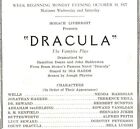
*DRACULA BELA LUGOSI BRAM STOKER RARE 1927 BROADWAY PROGRAM*
SOLD $79.99 Sold: Jul 21, 2024 on eBayOriginal Listing Description
A rare original 1927 cast sheet program for Bela Lugosi starring on Broadway, years before the film, in Bram Stoker's Dracula. Dimensions nine and a half by four and a half inches, clipped from a larger program. Light wear otherwise good. See Bram Stoker and Bela Lugosi's extraordinary biographies below. Shipping discounts for multiple purchases. Inquiries always welcome. Please visit my other eBay items for more early theatre, opera, film and historical autographs, photographs and programs and great actor and actress cabinet photos and CDV's. From "Bram" Stoker (8 November 1847 – 20 April 1912) was an Irish author, best known today for his 1897 Gothic horror novel Dracula. During his lifetime, he was better known as the personal assistant of actor Sir Henry Irving and business manager of the Lyceum Theatre, which Irving owned.Stoker was born on 8 November 1847 at 15 Marino Crescent, Clontarf, on the northside of Dublin, Ireland.[1] His parents were Abraham Stoker (1799–1876) from Dublin and Charlotte Mathilda Blake Thornley (1818–1901), who was raised in County Sligo.[2] Stoker was the third of seven children, the eldest of whom was Sir Thornley Stoker, 1st Bt.[3] Abraham and Charlotte were members of the Church of Ireland Parish of Clontarf and attended the parish church with their children, who were baptised there,[4] and Abraham was a senior civil servant.Stoker was bedridden with an unknown illness until he started school at the age of seven, when he made a complete recovery. Of this time, Stoker wrote, "I was naturally thoughtful, and the leisure of long illness gave opportunity for many thoughts which were fruitful according to their kind in later years." He was educated in a private school run by the Rev. William Woods.[5]After his recovery, he grew up without further serious illnesses, even excelling as an athlete at Trinity College, Dublin, which he attended from 1864 to 1870. He graduated with a BA in 1870, and pursued his MA in 1875. Though he later in life recalled graduating "with honours in mathematics", this appears to have been a mistake.[6] He was named University Athlete, participating in multiple sports, including playing rugby for Dublin University. He was auditor of the College Historical Society (the Hist) and president of the University Philosophical Society (he remains the only student in Trinity's history to hold both positions), where his first paper was on Sensationalism in Fiction and Society.Early careerStoker became interested in the theatre while a student through his friend Dr. Maunsell. While working for the Irish Civil Service, he became the theatre critic for the Dublin Evening Mail,[7] which was co-owned by Sheridan Le Fanu, an author of Gothic tales. Theatre critics were held in low esteem, but he attracted notice by the quality of his reviews. In December 1876, he gave a favourable review of Henry Irving's Hamlet at the Theatre Royal in Dublin. Irving invited Stoker for dinner at the Shelbourne Hotel where he was staying, and they became friends. Stoker also wrote stories, and "Crystal Cup" was published by the London Society in 1872, followed by "The Chain of Destiny" in four parts in The Shamrock. In 1876, while a civil servant in Dublin, Stoker wrote the non-fiction book The Duties of Clerks of Petty Sessions in Ireland (published 1879) which remained a standard work.[5] Furthermore, he possessed an interest in art, and was a founder of the Dublin Sketching Club in 1879.Lyceum TheatreBram Stoker's former home, Kildare Street, DublinIn 1878, Stoker married Florence Balcombe, daughter of Lieutenant Colonel James Balcombe of 1 Marino Crescent. She was a celebrated beauty whose former suitor had been Oscar Wilde.[8] Stoker had known Wilde from his student days, having proposed him for membership of the university's Philosophical Society while he was president. Wilde was upset at Florence's decision, but Stoker later resumed the acquaintanceship and after Wilde's fall visited him on the Continent [9]The first edition cover of DraculaThe Stokers moved to London, where Stoker became acting manager and then business manager of Irving's Lyceum Theatre, London, a post he held for 27 years. On 31 December 1879, Bram and Florence's only child was born, a son whom they christened Irving Noel Thornley Stoker. The collaboration with Henry Irving was important for Stoker and through him he became involved in London's high society, where he met James Abbott McNeill Whistler and Sir Arthur Conan Doyle (to whom he was distantly related). Working for Irving, the most famous actor of his time, and managing one of the most successful theatres in London made Stoker a notable if busy man. He was dedicated to Irving and his memoirs show he idolised him. In London, Stoker also met Hall Caine, who became one of his closest friends – he dedicated Dracula to him.In the course of Irving's tours, Stoker travelled the world, although he never visited Eastern Europe, a setting for his most famous novel. Stoker enjoyed the United States, where Irving was popular. With Irving he was invited twice to the White House, and knew William McKinley and Theodore Roosevelt. Stoker set two of his novels in America, and used Americans as characters, the most notable being Quincey Morris. He also met one of his literary idols, Walt Whitman.Bram Stoker in Cruden BaySlains Castle, Cruden Bay. The early chapters of Dracula were written in Cruden Bay, and Slains Castle possibly provided visual inspiration for Bram Stoker during the writing phase.Stoker was a regular visitor to Cruden Bay in Scotland between 1893 and 1910. His month-long holidays to the Aberdeenshire coastal village provided a large portion of available time for writing his books. Two novels were set in Cruden Bay: The Watter's Mou' (1895) and The Mystery of the Sea (1902). He started writing Dracula here in 1895 while in residence at the Kilmarnock Arms Hotel. The guest book with his signatures from 1894 and 1895 still survives. The nearby Slains Castle (also known as New Slains Castle) is linked with Bram Stoker and plausibly provided the visual palette for the descriptions of Castle Dracula during the writing phase. A distinctive room in Slains Castle, the octagonal hall, matches the description of the octagonal room in Castle Dracula [10]WritingsBram Stoker Commemorative Plaque, Whitby, EnglandStoker visited the English coastal town of Whitby in 1890, and that visit was said to be part of the inspiration for Dracula. He began writing novels while working as manager for Irving and secretary and director of London's Lyceum Theatre, beginning with The Snake's Pass in 1890 and Dracula in 1897. During this period, Stoker was part of the literary staff of The Daily Telegraph in London, and he wrote other fiction, including the horror novels The Lady of the Shroud (1909) and The Lair of the White Worm (1911).[11] He published his Personal Reminiscences of Henry Irving in 1906, after Irving's death, which proved successful,[5] and managed productions at the Prince of Wales Theatre.Before writing Dracula, Stoker met Ármin Vámbéry, a Hungarian Jewish writer and traveller (born in Szent-György, Kingdom of Hungary now Svätý Jur, Slovakia). Dracula likely emerged from Vámbéry's dark stories of the Carpathian mountains.[12] Stoker then spent several years researching Central and East European folklore and mythological stories of vampires.The 1972 book In Search of Dracula by Radu Florescu and Raymond McNally claimed that the Count in Stoker's novel was based on Vlad III Dracula.[13] At most however, Stoker borrowed only the name and "scraps of miscellaneous information" about Romanian history, according to one expert, Elizabeth Miller; further, there are no comments about Vlad III in the author's working notes [14][15][16]Dracula is an epistolary novel, written as a collection of realistic but completely fictional diary entries, telegrams, letters, ship's logs, and newspaper clippings, all of which added a level of detailed realism to the story, a skill which Stoker had developed as a newspaper writer. At the time of its publication, Dracula was considered a straightforward horror novel" based on imaginary creations of supernatural life.[11] "It gave form to a universal fantasy ... and became a part of popular culture [11]Stoker was a deeply private man, but his almost sexless marriage, intense adoration of Walt Whitman, Henry Irving and Hall Caine, and shared interests with Oscar Wilde, as well as the homoerotic aspects of Dracula have led to scholarly speculation that he was a repressed homosexual who used his fiction as an outlet for his sexual frustrations [17] In 1912, he demanded imprisonment of all homosexual authors in Britain: it has been suggested that this was due to self-loathing and to disguise his own vulnerability [18] Possibly fearful, and inspired by the monstrous image and threat of otherness that the press coverage of his friend Oscar's trials generated, Stoker began writing Dracula only weeks after Wilde's conviction [18][19]According to the Encyclopedia of World Biography, Stoker's stories are today included in the categories of "horror fiction", "romanticized Gothic" stories, and melodrama [11] They are classified alongside other "works of popular fiction" such as Mary Shelley's Frankenstein [20]:394 which also used the "myth-making" and story-telling method of having multiple narrators telling the same tale from different perspectives. According to historian Jules Zanger, this leads the reader to the assumption that "they can't all be lying".[21]The original 541-page typescript of Dracula was believed to have been lost until it was found in a barn in northwestern Pennsylvania in the early 1980s.[22] It consisted of typed sheets with many emendations and handwritten on the title page was "THE UN-DEAD." The author's name was shown at the bottom as Bram Stoker. Author Robert Latham remarked: "the most famous horror novel ever published, its title changed at the last minute."[20] The typescript was purchased by Microsoft co-founder Paul Allen.Stoker's inspirations for the story, in addition to Whitby, may have included a visit to Slains Castle in Aberdeenshire, a visit to the crypts of St. Michan's Church in Dublin, and the novella Carmilla by Sheridan Le Fanu [23]Stoker s original research notes for the novel are kept by the Rosenbach Museum and Library in Philadelphia. A facsimile edition of the notes was created by Elizabeth Miller and Robert Eighteen-Bisang in 1998.Stoker at The London LibraryStoker was a member of The London Library and it is here that he conducted much of the research for Dracula.[24] In 2018, the Library discovered some of the books that Stoker used for his research, complete with notes and marginalia [25]DeathUrn which contains Stoker's ashes in Golders Green suffering a number of strokes, Stoker died at No. 26 St George's Square, London on 20 April 1912.[26] Some biographers attribute the cause of death to overwork,[27] others to tertiary syphilis.[28] Bram Stoker's death certificate named the cause of death as "Locomotor ataxia 6 months", presumed to be a reference to syphilis [29][30] He was cremated, and his ashes were placed in a display urn at Golders Green Crematorium in north London. The ashes of Irving Noel Stoker, the author's son, were added to his father's urn following his death in 1961. The original plan had been to keep his parents' ashes together, but after Florence Stoker's death, her ashes were scattered at the Gardens of Rest.Beliefs and was raised a Protestant in the Church of Ireland. He was a strong supporter of the Liberal Party and took a keen interest in Irish affairs.[5] As a "philosophical home ruler", he supported Home Rule for Ireland brought about by peaceful means. He remained an ardent monarchist who believed that Ireland should remain within the British Empire, an entity that he saw as a force for good. He was an admirer of Prime Minister William Ewart Gladstone, whom he knew personally, and supported his plans for Ireland [31]Stoker believed in progress and took a keen interest in science and science-based medicine. Some of Stoker's novels represent early examples of science fiction, such as The Lady of the Shroud (1909). He had a writer's interest in the occult, notably mesmerism, but despised fraud and believed in the superiority of the scientific method over superstition. Stoker counted among his friends J.W. Brodie-Innis, a member of the Hermetic Order of the Golden Dawn, and hired member Pamela Colman Smith as an artist for the Lyceum Theatre, but no evidence suggests that Stoker ever joined the Order himself [32][33][34] Although Irving was an active Freemason, no evidence has been found of Stoker taking part in Masonic activities in London.[35] The Grand Lodge of Ireland also has no record of his membership [36]PosthumousThe short story collection Dracula's Guest and Other Weird Stories was published in 1914 by Stoker's widow, Florence Stoker, who was also his literary executrix. The first film adaptation of Dracula was F. W. Murnau's Nosferatu, released in 1922, with Max Schreck starring as Count Orlok. Florence Stoker eventually sued the filmmakers, and was represented by the attorneys of the British Incorporated Society of Authors. Her chief legal complaint was that she had neither been asked for permission for the adaptation nor paid any royalty. The case dragged on for some years, with Mrs. Stoker demanding the destruction of the negative and all prints of the film. The suit was finally resolved in the widow's favour in July 1925. A single print of the film survived, however, and it has become well known. The first authorised film version of Dracula did not come about until almost a decade later when Universal Studios released Tod Browning's Dracula starring Bela Lugosi.Dacre StokerCanadian writer Dacre Stoker, a great grandnephew of Bram Stoker, decided to write "a sequel that bore the Stoker name" to "reestablish creative control over" the original novel, with encouragement from screenwriter Ian Holt, because of the Stokers' frustrating history with Dracula's copyright. In 2009, Dracula: The Un-Dead was released, written by Dacre Stoker and Ian Holt. Both writers "based [their work] on Bram Stoker's own handwritten notes for characters and plot threads excised from the original edition" along with their own research for the sequel. This also marked Dacre Stoker's writing debut [37][38]In spring 2012, Dacre Stoker (in collaboration with Elizabeth Miller) presented the "lost" Dublin Journal written by Bram Stoker, which had been kept by his great-grandson Noel Dobbs. Stoker's diary entries shed a light on the issues that concerned him before his London years. A remark about a boy who caught flies in a bottle might be a clue for the later development of the Renfield character in Dracula [39]CommemorationsOn 8 November 2012, Stoker was honoured with a Google Doodle on Google's homepage commemorating the 165th anniversary of his birth [40][41]An annual festival takes place in Dublin, the birthplace of Bram Stoker, in honour of his literary achievements. The 2014 Bram Stoker Festival encompassed literary, film, family, street, and outdoor events, and ran from 24–27 October in Dublin.[42][43] The festival is supported by the Bram Stoker Estate[44] and funded by Dublin City Council and Fáilte Ireland.Béla Ferenc Dezs? Blaskó (Hungarian: [?be?l? ?f?r?nt?s ?d??ø? ?bl??ko?]; October 20, 1882 – August 16, 1956), known professionally as Bela Lugosi ( l???o?si ; Hungarian: [?lu?o?i]), was a actor, best remembered for portraying Count Dracula in the 1931 horror film classic Dracula, Ygor in Son of Frankenstein (1939) and his roles in many other horror films from 1931 through 1956.[1]Lugosi began acting on the Hungarian stage in 1902. After playing in 172 productions in his native Hungary, Lugosi moved on to appear in Hungarian silent films in 1917. He had to suddenly emigrate to Germany after the failed Hungarian Communist Revolution of 1919 because of his former socialist activities (organizing a stage actors' union), leaving his first wife in the process. He acted in several films in Weimar Germany, before arriving in New Orleans as a seaman on a merchant ship, then making his way north to New York City and Ellis Island.In 1927, he starred as Count Dracula in a Broadway adaptation of Bram Stoker's novel, moving with the play to the West Coast in 1928 and settling down in Hollywood.[2] He later starred in the 1931 film version of Dracula directed by Tod Browning and produced by Universal Pictures. Through the 1930s, he occupied an important niche in horror films, but his notoriety as Dracula and thick Hungarian accent greatly limited the roles offered to him, and he unsuccessfully tried for years to avoid typecasting.He co-starred in a number of films with Boris Karloff, who was able to demand top billing. To his frustration, Lugosi, a charter member of the American Screen Actors Guild, was increasingly restricted to mad scientist roles because of his inability to speak English more clearly. He was kept employed by the studios principally so that they could put his name on the posters. Among his teamings with Karloff, he performed major roles only in The Black Cat (1934), The Raven (1935), and Son of Frankenstein (1939); even in The Raven, Karloff received top billing despite Lugosi performing the lead role.By this time, Lugosi had been receiving regular medication for sciatic neuritis, and he became addicted to doctor prescribed morphine and methadone. This drug dependence (and his gradually worsening alcoholism) was becoming apparent to producers, and after 1948's Abbott and Costello Meet Frankenstein, the offers dwindled to parts in low-budget films; some of these were directed by Ed Wood, including a brief appearance in Wood's Plan 9 from Outer Space (released posthumously in 1957).[3]Lugosi married five times and had one son, Bela G. Lugosi (with his fourth wife, Lillian).
Note: This item has been sold and is no longer available. This page serves as a historical price reference for Playbill collectors and appraisers.
Original Listing Description
A rare original 1927 cast sheet program for Bela Lugosi starring on Broadway, years before the film, in Bram Stoker's Dracula. Dimensions nine and a half by four and a half inches, clipped from a larger program. Light wear otherwise good. See Bram Stoker and Bela Lugosi's extraordinary biographies below. Shipping discounts for multiple purchases. Inquiries always welcome. Please visit my other eBay items for more early theatre, opera, film and historical autographs, photographs and programs and great actor and actress cabinet photos and CDV's. From "Bram" Stoker (8 November 1847 – 20 April 1912) was an Irish author, best known today for his 1897 Gothic horror novel Dracula. During his lifetime, he was better known as the personal assistant of actor Sir Henry Irving and business manager of the Lyceum Theatre, which Irving owned.Stoker was born on 8 November 1847 at 15 Marino Crescent, Clontarf, on the northside of Dublin, Ireland.[1] His parents were Abraham Stoker (1799–1876) from Dublin and Charlotte Mathilda Blake Thornley (1818–1901), who was raised in County Sligo.[2] Stoker was the third of seven children, the eldest of whom was Sir Thornley Stoker, 1st Bt.[3] Abraham and Charlotte were members of the Church of Ireland Parish of Clontarf and attended the parish church with their children, who were baptised there,[4] and Abraham was a senior civil servant.Stoker was bedridden with an unknown illness until he started school at the age of seven, when he made a complete recovery. Of this time, Stoker wrote, "I was naturally thoughtful, and the leisure of long illness gave opportunity for many thoughts which were fruitful according to their kind in later years." He was educated in a private school run by the Rev. William Woods.[5]After his recovery, he grew up without further serious illnesses, even excelling as an athlete at Trinity College, Dublin, which he attended from 1864 to 1870. He graduated with a BA in 1870, and pursued his MA in 1875. Though he later in life recalled graduating "with honours in mathematics", this appears to have been a mistake.[6] He was named University Athlete, participating in multiple sports, including playing rugby for Dublin University. He was auditor of the College Historical Society (the Hist) and president of the University Philosophical Society (he remains the only student in Trinity's history to hold both positions), where his first paper was on Sensationalism in Fiction and Society.Early careerStoker became interested in the theatre while a student through his friend Dr. Maunsell. While working for the Irish Civil Service, he became the theatre critic for the Dublin Evening Mail,[7] which was co-owned by Sheridan Le Fanu, an author of Gothic tales. Theatre critics were held in low esteem, but he attracted notice by the quality of his reviews. In December 1876, he gave a favourable review of Henry Irving's Hamlet at the Theatre Royal in Dublin. Irving invited Stoker for dinner at the Shelbourne Hotel where he was staying, and they became friends. Stoker also wrote stories, and "Crystal Cup" was published by the London Society in 1872, followed by "The Chain of Destiny" in four parts in The Shamrock. In 1876, while a civil servant in Dublin, Stoker wrote the non-fiction book The Duties of Clerks of Petty Sessions in Ireland (published 1879) which remained a standard work.[5] Furthermore, he possessed an interest in art, and was a founder of the Dublin Sketching Club in 1879.Lyceum TheatreBram Stoker's former home, Kildare Street, DublinIn 1878, Stoker married Florence Balcombe, daughter of Lieutenant Colonel James Balcombe of 1 Marino Crescent. She was a celebrated beauty whose former suitor had been Oscar Wilde.[8] Stoker had known Wilde from his student days, having proposed him for membership of the university's Philosophical Society while he was president. Wilde was upset at Florence's decision, but Stoker later resumed the acquaintanceship and after Wilde's fall visited him on the Continent [9]The first edition cover of DraculaThe Stokers moved to London, where Stoker became acting manager and then business manager of Irving's Lyceum Theatre, London, a post he held for 27 years. On 31 December 1879, Bram and Florence's only child was born, a son whom they christened Irving Noel Thornley Stoker. The collaboration with Henry Irving was important for Stoker and through him he became involved in London's high society, where he met James Abbott McNeill Whistler and Sir Arthur Conan Doyle (to whom he was distantly related). Working for Irving, the most famous actor of his time, and managing one of the most successful theatres in London made Stoker a notable if busy man. He was dedicated to Irving and his memoirs show he idolised him. In London, Stoker also met Hall Caine, who became one of his closest friends – he dedicated Dracula to him.In the course of Irving's tours, Stoker travelled the world, although he never visited Eastern Europe, a setting for his most famous novel. Stoker enjoyed the United States, where Irving was popular. With Irving he was invited twice to the White House, and knew William McKinley and Theodore Roosevelt. Stoker set two of his novels in America, and used Americans as characters, the most notable being Quincey Morris. He also met one of his literary idols, Walt Whitman.Bram Stoker in Cruden BaySlains Castle, Cruden Bay. The early chapters of Dracula were written in Cruden Bay, and Slains Castle possibly provided visual inspiration for Bram Stoker during the writing phase.Stoker was a regular visitor to Cruden Bay in Scotland between 1893 and 1910. His month-long holidays to the Aberdeenshire coastal village provided a large portion of available time for writing his books. Two novels were set in Cruden Bay: The Watter's Mou' (1895) and The Mystery of the Sea (1902). He started writing Dracula here in 1895 while in residence at the Kilmarnock Arms Hotel. The guest book with his signatures from 1894 and 1895 still survives. The nearby Slains Castle (also known as New Slains Castle) is linked with Bram Stoker and plausibly provided the visual palette for the descriptions of Castle Dracula during the writing phase. A distinctive room in Slains Castle, the octagonal hall, matches the description of the octagonal room in Castle Dracula [10]WritingsBram Stoker Commemorative Plaque, Whitby, EnglandStoker visited the English coastal town of Whitby in 1890, and that visit was said to be part of the inspiration for Dracula. He began writing novels while working as manager for Irving and secretary and director of London's Lyceum Theatre, beginning with The Snake's Pass in 1890 and Dracula in 1897. During this period, Stoker was part of the literary staff of The Daily Telegraph in London, and he wrote other fiction, including the horror novels The Lady of the Shroud (1909) and The Lair of the White Worm (1911).[11] He published his Personal Reminiscences of Henry Irving in 1906, after Irving's death, which proved successful,[5] and managed productions at the Prince of Wales Theatre.Before writing Dracula, Stoker met Ármin Vámbéry, a Hungarian Jewish writer and traveller (born in Szent-György, Kingdom of Hungary now Svätý Jur, Slovakia). Dracula likely emerged from Vámbéry's dark stories of the Carpathian mountains.[12] Stoker then spent several years researching Central and East European folklore and mythological stories of vampires.The 1972 book In Search of Dracula by Radu Florescu and Raymond McNally claimed that the Count in Stoker's novel was based on Vlad III Dracula.[13] At most however, Stoker borrowed only the name and "scraps of miscellaneous information" about Romanian history, according to one expert, Elizabeth Miller; further, there are no comments about Vlad III in the author's working notes [14][15][16]Dracula is an epistolary novel, written as a collection of realistic but completely fictional diary entries, telegrams, letters, ship's logs, and newspaper clippings, all of which added a level of detailed realism to the story, a skill which Stoker had developed as a newspaper writer. At the time of its publication, Dracula was considered a straightforward horror novel" based on imaginary creations of supernatural life.[11] "It gave form to a universal fantasy ... and became a part of popular culture [11]Stoker was a deeply private man, but his almost sexless marriage, intense adoration of Walt Whitman, Henry Irving and Hall Caine, and shared interests with Oscar Wilde, as well as the homoerotic aspects of Dracula have led to scholarly speculation that he was a repressed homosexual who used his fiction as an outlet for his sexual frustrations [17] In 1912, he demanded imprisonment of all homosexual authors in Britain: it has been suggested that this was due to self-loathing and to disguise his own vulnerability [18] Possibly fearful, and inspired by the monstrous image and threat of otherness that the press coverage of his friend Oscar's trials generated, Stoker began writing Dracula only weeks after Wilde's conviction [18][19]According to the Encyclopedia of World Biography, Stoker's stories are today included in the categories of "horror fiction", "romanticized Gothic" stories, and melodrama [11] They are classified alongside other "works of popular fiction" such as Mary Shelley's Frankenstein [20]:394 which also used the "myth-making" and story-telling method of having multiple narrators telling the same tale from different perspectives. According to historian Jules Zanger, this leads the reader to the assumption that "they can't all be lying".[21]The original 541-page typescript of Dracula was believed to have been lost until it was found in a barn in northwestern Pennsylvania in the early 1980s.[22] It consisted of typed sheets with many emendations and handwritten on the title page was "THE UN-DEAD." The author's name was shown at the bottom as Bram Stoker. Author Robert Latham remarked: "the most famous horror novel ever published, its title changed at the last minute."[20] The typescript was purchased by Microsoft co-founder Paul Allen.Stoker's inspirations for the story, in addition to Whitby, may have included a visit to Slains Castle in Aberdeenshire, a visit to the crypts of St. Michan's Church in Dublin, and the novella Carmilla by Sheridan Le Fanu [23]Stoker s original research notes for the novel are kept by the Rosenbach Museum and Library in Philadelphia. A facsimile edition of the notes was created by Elizabeth Miller and Robert Eighteen-Bisang in 1998.Stoker at The London LibraryStoker was a member of The London Library and it is here that he conducted much of the research for Dracula.[24] In 2018, the Library discovered some of the books that Stoker used for his research, complete with notes and marginalia [25]DeathUrn which contains Stoker's ashes in Golders Green suffering a number of strokes, Stoker died at No. 26 St George's Square, London on 20 April 1912.[26] Some biographers attribute the cause of death to overwork,[27] others to tertiary syphilis.[28] Bram Stoker's death certificate named the cause of death as "Locomotor ataxia 6 months", presumed to be a reference to syphilis [29][30] He was cremated, and his ashes were placed in a display urn at Golders Green Crematorium in north London. The ashes of Irving Noel Stoker, the author's son, were added to his father's urn following his death in 1961. The original plan had been to keep his parents' ashes together, but after Florence Stoker's death, her ashes were scattered at the Gardens of Rest.Beliefs and was raised a Protestant in the Church of Ireland. He was a strong supporter of the Liberal Party and took a keen interest in Irish affairs.[5] As a "philosophical home ruler", he supported Home Rule for Ireland brought about by peaceful means. He remained an ardent monarchist who believed that Ireland should remain within the British Empire, an entity that he saw as a force for good. He was an admirer of Prime Minister William Ewart Gladstone, whom he knew personally, and supported his plans for Ireland [31]Stoker believed in progress and took a keen interest in science and science-based medicine. Some of Stoker's novels represent early examples of science fiction, such as The Lady of the Shroud (1909). He had a writer's interest in the occult, notably mesmerism, but despised fraud and believed in the superiority of the scientific method over superstition. Stoker counted among his friends J.W. Brodie-Innis, a member of the Hermetic Order of the Golden Dawn, and hired member Pamela Colman Smith as an artist for the Lyceum Theatre, but no evidence suggests that Stoker ever joined the Order himself [32][33][34] Although Irving was an active Freemason, no evidence has been found of Stoker taking part in Masonic activities in London.[35] The Grand Lodge of Ireland also has no record of his membership [36]PosthumousThe short story collection Dracula's Guest and Other Weird Stories was published in 1914 by Stoker's widow, Florence Stoker, who was also his literary executrix. The first film adaptation of Dracula was F. W. Murnau's Nosferatu, released in 1922, with Max Schreck starring as Count Orlok. Florence Stoker eventually sued the filmmakers, and was represented by the attorneys of the British Incorporated Society of Authors. Her chief legal complaint was that she had neither been asked for permission for the adaptation nor paid any royalty. The case dragged on for some years, with Mrs. Stoker demanding the destruction of the negative and all prints of the film. The suit was finally resolved in the widow's favour in July 1925. A single print of the film survived, however, and it has become well known. The first authorised film version of Dracula did not come about until almost a decade later when Universal Studios released Tod Browning's Dracula starring Bela Lugosi.Dacre StokerCanadian writer Dacre Stoker, a great grandnephew of Bram Stoker, decided to write "a sequel that bore the Stoker name" to "reestablish creative control over" the original novel, with encouragement from screenwriter Ian Holt, because of the Stokers' frustrating history with Dracula's copyright. In 2009, Dracula: The Un-Dead was released, written by Dacre Stoker and Ian Holt. Both writers "based [their work] on Bram Stoker's own handwritten notes for characters and plot threads excised from the original edition" along with their own research for the sequel. This also marked Dacre Stoker's writing debut [37][38]In spring 2012, Dacre Stoker (in collaboration with Elizabeth Miller) presented the "lost" Dublin Journal written by Bram Stoker, which had been kept by his great-grandson Noel Dobbs. Stoker's diary entries shed a light on the issues that concerned him before his London years. A remark about a boy who caught flies in a bottle might be a clue for the later development of the Renfield character in Dracula [39]CommemorationsOn 8 November 2012, Stoker was honoured with a Google Doodle on Google's homepage commemorating the 165th anniversary of his birth [40][41]An annual festival takes place in Dublin, the birthplace of Bram Stoker, in honour of his literary achievements. The 2014 Bram Stoker Festival encompassed literary, film, family, street, and outdoor events, and ran from 24–27 October in Dublin.[42][43] The festival is supported by the Bram Stoker Estate[44] and funded by Dublin City Council and Fáilte Ireland.Béla Ferenc Dezs? Blaskó (Hungarian: [?be?l? ?f?r?nt?s ?d??ø? ?bl??ko?]; October 20, 1882 – August 16, 1956), known professionally as Bela Lugosi ( l???o?si ; Hungarian: [?lu?o?i]), was a actor, best remembered for portraying Count Dracula in the 1931 horror film classic Dracula, Ygor in Son of Frankenstein (1939) and his roles in many other horror films from 1931 through 1956.[1]Lugosi began acting on the Hungarian stage in 1902. After playing in 172 productions in his native Hungary, Lugosi moved on to appear in Hungarian silent films in 1917. He had to suddenly emigrate to Germany after the failed Hungarian Communist Revolution of 1919 because of his former socialist activities (organizing a stage actors' union), leaving his first wife in the process. He acted in several films in Weimar Germany, before arriving in New Orleans as a seaman on a merchant ship, then making his way north to New York City and Ellis Island.In 1927, he starred as Count Dracula in a Broadway adaptation of Bram Stoker's novel, moving with the play to the West Coast in 1928 and settling down in Hollywood.[2] He later starred in the 1931 film version of Dracula directed by Tod Browning and produced by Universal Pictures. Through the 1930s, he occupied an important niche in horror films, but his notoriety as Dracula and thick Hungarian accent greatly limited the roles offered to him, and he unsuccessfully tried for years to avoid typecasting.He co-starred in a number of films with Boris Karloff, who was able to demand top billing. To his frustration, Lugosi, a charter member of the American Screen Actors Guild, was increasingly restricted to mad scientist roles because of his inability to speak English more clearly. He was kept employed by the studios principally so that they could put his name on the posters. Among his teamings with Karloff, he performed major roles only in The Black Cat (1934), The Raven (1935), and Son of Frankenstein (1939); even in The Raven, Karloff received top billing despite Lugosi performing the lead role.By this time, Lugosi had been receiving regular medication for sciatic neuritis, and he became addicted to doctor prescribed morphine and methadone. This drug dependence (and his gradually worsening alcoholism) was becoming apparent to producers, and after 1948's Abbott and Costello Meet Frankenstein, the offers dwindled to parts in low-budget films; some of these were directed by Ed Wood, including a brief appearance in Wood's Plan 9 from Outer Space (released posthumously in 1957).[3]Lugosi married five times and had one son, Bela G. Lugosi (with his fourth wife, Lillian).
Note: This item has been sold and is no longer available. This page serves as a historical price reference for Playbill collectors and appraisers.