

*EDWIN BOOTH & HELENA MODJESKA RARE 1890 MERCHANT OF VENICE PROGRAM*
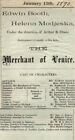
*EDWIN BOOTH & HELENA MODJESKA RARE 1890 MERCHANT OF VENICE PROGRAM*
SOLD $49.99 Sold: Jul 21, 2024 on eBayOriginal Listing Description
A rare large original January 1890 program for Edwin Booth and Helena Modjeska in The Merchant of Venice. Dimensions six and a half by three and a half inches, trimmed from a larger program with complete cast list. Mounted to a twelve by nine and a half inch Victorian album page with two unrelated programs. Edgewear and small loss to backing otherwise good.See Edwin Booth, Helena Modjeska, and the Booth family's extraordinary biographies below.Shipping discounts for multiple purchases. Credit cards accepted with Paypal. Inquiries always welcome. Please visit my other eBay items for more early theatre and historical autographs, photographs and programs and great singer, actor, and actress cabinet photos and CDV's.From Wikipedia:The Booth family was an English American theatrical family of the 19th century. Its most famous and well known members were Edwin Booth, one of the leading actors of his day, and John Wilkes Booth, who assassinated Abraham Lincoln.The patriarch was Junius Brutus Booth, a London-born lawyer's son who eventually became an actor after he attended a production of Othello at the Covent Garden theatre. The prospects of fame, fortune, and freedom were very appealing to young Booth, and he displayed remarkable talent from an early age, deciding on a career in the theatre by the age of 17. He performed roles in several small theaters throughout England, and joined a tour of the Low Countries in 1814, returning the following year to make his London debut.Booth abandoned his wife and their young son in 1821 and ran off to the United States with Mary Ann Holmes, a London flower girl. They settled on some 150 acres in Harford County near Baltimore and started a family; they had 10 children, six of whom survived to adulthood [1][2]Junius Sr. and Edwin toured in California during the Gold Rush.[citation needed] Edwin bought an interest in the Winter Garden Theatre at 667 Broadway in New York City together with his brother-in-law John Sleeper Clarke. The brothers John Wilkes, Edwin, and Junius Brutus, Jr. performed there in the play Julius Caesar at a benefit in 1864, the only time they were seen together on a stage, playing Mark Antony, Brutus, and Cassius, respectively Junius Brutus Booth (1796–1852) brought his mistress Mary Ann Holmes, who bore him 10 children, to the United States.He also wrote many letters in fits of drunken anger and madness to President Andrew Jackson threatening assassination. He requested that two prisoners who had been sentenced to death for piracy, named De Ruiz and De Soto, be pardoned, else: "I will cut your throat whilst you are sleeping." This letter would later be recanted by Junius, stating, "May god preserve General Jackson and this happy republic [4]Junius Brutus Booth Jr. (1821–1883) was married to Agnes Booth. Junius Jr. never achieved the same fame as his brothers, but his third wife Agnes was popular.Their son Sydney Barton Booth (1877–1937) was an actor well into the era of modern film [5]Edwin Thomas Booth (1833–1893) came to be the foremost American Shakespearean actor of his day. He founded The Players, a New York City actors' club which continues to the present day.Edwin's grandson Edwin Booth Grossman was a painter of some note.Asia Frigga Booth (1835–1888) married John Sleeper Clarke, an actor/comedian who was briefly imprisoned in the aftermath of the assassination. They then emigrated to Britain, where he became a successful theatre manager.Creston Clarke[6] and Wilfred Clarke,[7] sons of John and Asia, were noted actors in their day.John Wilkes Booth (1838–1865) was a popular young star in less serious fare than his brothers.A Confederate sympathizer during the American Civil War, during a play attended by Abraham Lincoln, Booth took advantage of his access to the theatre to invade the President's box and assassinate the President. He was killed 12 days later by Union soldier Boston CorbettEdwin Thomas Booth (November 13, 1833 – June 7, 1893) was an American actor who toured throughout the United States and the major capitals of Europe, performing Shakespearean plays. In 1869, he founded Booth's Theatre in New York.[2] Some theatrical historians consider him the greatest American actor, and the greatest Prince Hamlet, of the 19th century.[3] His achievements are often overshadowed by his relationship with his younger brother, actor John Wilkes Booth, who assassinated President Abraham Lincoln.Booth was born in Bel Air, Maryland, into the Anglo-American theatrical Booth family. He was the son of the famous actor, Junius Brutus Booth, an Englishman, who named Edwin after Edwin Forrest and Thomas Flynn, two of Junius' colleagues. He was the elder brother of John Wilkes Booth, himself a successful actor who gained notoriety as the assassin of President Lincoln.Nora Titone, in her book My Thoughts Be Bloody, recounts how the shame and ambition of Junius Brutus Booth's three actor sons, Junius Brutus Booth, Jr. (who never achieved the stage stardom of his two younger actor brothers), Edwin Booth, and John Wilkes Booth, spurred them to strive, as rivals, for achievement and acclaim—Edwin a Unionist, and John Wilkes, a Confederate and the assassin of Abraham Lincoln [4]CareerIn early appearances, Booth usually performed alongside his father, making his stage debut as Tressel or Tressil in Colley Cibber's version of Richard III in Boston on September 10, 1849. His first appearance in New York City was in the character of Wilford in The Iron Chest, which he played at the National Theatre in Chatham Street, on the 27th of September 1850. A year later, on the illness of the father, the son took his place in the character of Richard III.[5]After his father's death in 1852, Booth went on a worldwide tour, visiting Australia and Hawaii, and finally gaining acclaim of his own during an engagement in Sacramento, California, in 1856.[6]Before his brother assassinated Lincoln, Edwin had appeared with his two brothers, John Wilkes and Junius Brutus Booth Jr., in Julius Caesar in 1864.[7] John Wilkes played Marc Antony, Edwin played Brutus, and Junius played Cassius.[8] It was a benefit performance, and the only time that the three brothers appeared together on the same stage.[9] The funds were used to erect a statue of William Shakespeare that still stands in Central Park just south of the Promenade. Immediately afterwards, Edwin Booth began a production of Hamlet on the same stage, which came to be known as the "hundred nights Hamlet", setting a record that lasted until John Barrymore broke the record in 1922, playing the title character for 101 performances From 1863 to 1867, Booth managed the Winter Garden Theatre in New York City, mostly staging Shakespearean tragedies. In 1863, he bought the Walnut Street Theatre in Philadelphia [10]After John Wilkes Booth's assassination of President Lincoln in April 1865, the infamy associated with the Booth name forced Edwin Booth to abandon the stage for many months. Edwin, who had been feuding with John Wilkes before the assassination, disowned him afterward, refusing to have John's name spoken in his house.[11] He made his return to the stage at the Winter Garden Theatre in January 1866, playing the title role in Hamlet,[6] which would eventually become his signature role.Acting styleEdwin's acting style was distinctly different from that of his father. While the senior Booth was, like his contemporaries Edmund Kean and William Charles Macready, strong and bombastic, favoring characters such as Richard III, Edwin played more naturalistically with a quiet, more thoughtful delivery, tailored to roles like Hamlet.Later lifeBooth was married to Mary Devlin from 1860 to 1863, the year of her death. They had one daughter, Edwina, born on December 9, 1861, in London. He later remarried, wedding his acting partner Mary McVicker in 1869, and became a widower again in 1881.Edwin Booth with daughter Edwina, circa 1864Portrait of Edwin Booth by John Singer Sargent, 1890, which hung at The Players clubhouse. Now in the collection of the Amon Carter Museum of American Art.In 1869, Edwin acquired his brother John's body after repeatedly writing to President Andrew Johnson pleading for it. Johnson finally released the remains, and Edwin had them buried, unmarked, in the family plot at Green Mount Cemetery in Baltimore.In 1888, Booth founded The Players, a private club for performing, literary, and visual artists and their supporters, and dedicated his home on Gramercy Park to it.His final performance was, fittingly, in his signature role of Hamlet, in 1891 at the Brooklyn Academy of Music.Robert Lincoln rescueEdwin Booth saved Abraham Lincoln's son,[12] Robert, from serious injury or even death. The incident occurred on a train platform in Jersey City, New Jersey. The exact date of the incident is uncertain, but it is believed to have taken place in late 1864 or early 1865. Robert Lincoln recalled the incident in a 1909 letter to Richard Watson Gilder, editor of The Century Magazine.The incident occurred while a group of passengers were late at night purchasing their sleeping car places from the conductor who stood on the station platform at the entrance of the car. The platform was about the height of the car floor, and there was of course a narrow space between the platform and the car body. There was some crowding, and I happened to be pressed by it against the car body while waiting my turn. In this situation the train began to move, and by the motion I was twisted off my feet, and had dropped somewhat, with feet downward, into the open space, and was personally helpless, when my coat collar was vigorously seized and I was quickly pulled up and out to a secure footing on the platform. Upon turning to thank my rescuer I saw it was Edwin Booth, whose face was of course well known to me, and I expressed my gratitude to him, and in doing so, called him by name.Booth did not know the identity of the man whose life he had saved until some months later, when he received a letter from a friend, Colonel Adam Badeau, who was an officer on the staff of General Ulysses S. Grant. Badeau had heard the story from Robert Lincoln, who had since joined the Union Army and was also serving on Grant's staff. In the letter, Badeau gave his compliments to Booth for the heroic deed. The fact that he had saved the life of Abraham Lincoln's son was said to have been of some comfort to Edwin Booth following his brother's assassination of the president Statue of Booth as Hamlet, Gramercy Park by Edmond T. Quinn, circa 1916Booth's TheatreBooth's Theatre Playbill of his Richard III circa 1872In 1867, a fire damaged the Winter Garden Theatre, resulting in the building's subsequent demolition. Afterwards, Booth built his own theatre, an elaborate structure called Booth's Theatre in Manhattan, which opened on February 3, 1869, with a production of Romeo and Juliet starring Booth as Romeo, and Mary McVicker as Juliet. Elaborate productions followed, but the theatre never became a profitable or even stable financial venture. The panic of 1873 caused the final bankruptcy of Booth's Theatre in 1874. After the bankruptcy, Booth went on another worldwide tour, eventually regaining his fortune DeathEdwin Booth had a small stroke in 1891, which precipitated his decline. He suffered another stroke in April 1893 and died June 7, 1893, in his apartment in The Players clubhouse. He was buried next to his first wife at Mount Auburn Cemetery in Cambridge, Massachusetts. His bedroom in the club has been kept untouched since his death.[13] The New York Times reported his death [14]Exhumation requestIn December 2010, descendants of Edwin Booth reported that they obtained permission to exhume the Shakespearean actor's body to obtain DNA samples to compare with a sample of his brother John's DNA to refute the rumor he had escaped after the assassination. However, Bree Harvey, a spokesperson from the Mount Auburn Cemetery in Cambridge, Massachusetts, where Edwin Booth is buried, denied reports that the family had contacted them and requested to exhume Edwin's body.[15] The family hopes to obtain DNA samples from artifacts belonging to John Wilkes, or from remains such as vertebrae stored at the National Museum of Health and Medicine in Maryland [16][17] On March 30, 2013, museum spokesperson Carol Johnson announced that the family's request to extract DNA from the vertebrae had been rejected [18]DramatizationsA number of modern dramatizations have been made of Edwin Booth's life, on both stage and screen. One of the best known is the 1955 film Prince of Players written by Moss Hart, based loosely on the popular book of that name by Eleanor Ruggles. It was directed by Philip Dunne and stars Richard Burton and Raymond Massey as Edwin and Junius Brutus Booth, Sr., with Charles Bickford and Eva Le Gallienne, the latter of whom plays Gertrude to Burton's Hamlet. The film depicts events in Booth's life well before, and then surrounding, the assassination of Lincoln by Booth's younger brother.[19]The opening scenes of Prince of Players are very similar to scenes in the earlier 1946 John Ford western My Darling Clementine. In that movie, the character of Granville Thorndyke (as acted by Alan Mowbray) is an obvious nod to Booth's father Junius, and the scenes portray essentially the same sequence where the great actor has to be retrieved from a bar and dragged back to the theatre where he is overdue to give a performance in front of a restless audience [20][21]The Brothers BOOTH!, by W. Stuart McDowell, which focuses on the relationships of the three Booth brothers leading up to the assassination of Lincoln, was workshopped and given a series of staged readings featuring David Strathairn, David Dukes, Angela Goethals, Maryann Plunkett, and Stephen Lang at the New Harmony Project,[22] and at The Guthrie Theatre Lab in Minneapolis, and later presented in New York at the Players' Club, the Second Stage Theatre, and the Boston Athenaeum. It was given its first fully staged professional production at the Bristol Riverside Theatre outside Philadelphia in 1992 [23][24][25] A second play by the same name, The Brothers Booth, which focuses on "the world of the 1860s theatre and its leading family"[26] was written by Marshell Bradley and staged in New York at the Perry Street Theatre in 2004.Oliver Ingraham Lay: Edwin Booth as Hamlet, 1887Austin Pendleton's play, Booth, which depicts the early years of the brothers Edwin, Junius, and John Wilkes Booth and their father, was produced off Broadway at the York Theatre, starring Frank Langella as Junius Brutus Booth, Sr. In a review, the play was called "a psychodrama about the legendary theatrical family of the 19th century" by The New York Times.[27] Pendleton had adapted this version from his earlier work, Booth Is Back, produced at Long Wharf Theatre in New Haven, Connecticut, in the 1991-1992 season.The Tragedian, by playwright and actor Rodney Lee Rogers, is a one-man show about Booth that was produced by PURE Theatre of Charleston, South Carolina, in 2007. It was revived for inclusion in the Piccolo Spoleto Arts Festival in May and June 2008.[28]A play by Luigi Creatore called Error of the Moon played off-Broadway on Theatre Row in New York City from August 13 to October 10, 2010. The play is a fictionalized account of Booth's life, hinging on the personal, professional, and political tensions between brothers Edwin and John Wilkes, leading up to the assassination of Lincoln.[29]In 1959, the actor Robert McQueeney played Booth in the episode "The Man Who Loved Lincoln" on the ABC/Warner Brothers western television series, Colt .45, starring Wayde Preston as the fictitious undercover agent Christopher Colt, who in the story line is assigned to protect Booth from a death threat.[30]In 1960, the anthology series television series Death Valley Days broadcast "His Brother's Keeper", in which Booth visits a small town after the Lincoln assassination, with one of the town's influential citizens trying to have him run out of town.In 1966, Martin Landau played Edwin Booth in the episode "This Stage of Fools" of the NBC western television series, Branded, starring Chuck Connors as Jason McCord. In the story line, McCord takes a job as the bodyguard to the actor Edwin Booth, brother of the presidential assassin, John Wilkes Booth [31][32]In 2013, Will Forte played Edwin Booth in the "Washington, D.C." episode of the Comedy Central's series, Drunk History, created by Derek Waters.In 2014, Edwin Booth was played by Gordon Tanner in The Pinkertons episode, "The Play's the Thing" (S1:E3). In the episode, both the "Hundred nights Hamlet" and Edwin's rescue of Robert Lincoln are mentioned LegacyGrave of Edwin BoothBooth left a considerable estate upon his death. He left charitable bequests that furthered the development of the acting profession and the treatment of mental illness. He left bequests of $5,000 each (almost $150,000 in 2021 dollars) to the Actor's' Fund, the Actors' Association of Friendship of the City of New York (Edwin Forrest Lodge), The Actors' Association of Friendship of the City of Philadelphia (Shakespeare Lodge), the Asylum Fund of New York and the Home for Incurables (West Farms, New York).[33] Other examples of his legacy include:The Players still exists in its original clubhouse at 16 Gramercy Park South in Manhattan.[34] A statue of Booth as Hamlet, by Edmond T. Quinn, has been the centerpiece of the private Gramercy Park since 1916. It can be seen by the public through the south gate of the park.Booth left a few recordings of his voice preserved on wax cylinder. One of them can be heard on the Naxos Records set Great Historical Shakespeare Recordings and Other Miscellany.[35] Another place to hear his preserved voice is on the site shown here [3:34][36] Booth's voice is barely audible with all the surface noise, but what can be deciphered reveals it to have been rich and deep.Memorials of Booth can still be found around Bel Air, Maryland. In front of the courthouse is a fountain dedicated to his memory. Inside the post office is a portrait of him. Also, his family's home, Tudor Hall, still stands and was bought in 2006 by Harford County, Maryland, to become a museum.A chamber in Mammoth Cave in Kentucky is called "Booth's Amphitheatre" – so called because Booth entertained visitors there.The Springer Opera House in Columbus, Georgia, is said to be haunted by the ghost of Edwin Booth Broadway s Booth Theatre was the first, and remains the oldest, Broadway theatre to be named in honor of an actor.Stephen Sondheim's musical Assassins mentions Edwin in "The Ballad of Booth" with the lyrics: "Your brother made you jealous, John/You couldn't fill his shoes."Helena Modrzejewska (Polish pronunciation: born Jadwiga Benda, 12 October 1840 – 8 April 1909), known professionally as Helena Modjeska, was a renowned Polish actress who specialized in Shakespearean and tragic roles.Helena Modjeska was born in Kraków, Poland, on 12 October 1840.[1][2] Her name was recorded at birth as Jadwiga Benda, but she was later baptized Helena Opid, being given her godfather's surname [1]Modrzejewska as Barbara Radziwi??ówna 1865The question of her origins is a complicated one. Modjeska's mother was Józefa (Misel) Benda, the widow of a prosperous Kraków merchant, Szymon Benda.[3] In her autobiography, Modjeska claimed that her father was a musician named Michael Opid.[4] While it is true that the Benda family did employ a music teacher named Michal Opid, who later stood as Helena's godfather, Opid was not the father of Józefa Benda's two youngest children [3]There is evidence to suggest that Helena and her older brother Adolf were the results of an affair between Józefa and Prince W?adys?aw Sanguszko, a wealthy and influential Polish nobleman.[1][3] Helena also had a younger sister, Josephine, and several half-brothers from Józefa's first marriage. Helena and Josephine were primarily raised by their great-aunt Teresa.Also glossed over in Modjeska's autobiography were the details concerning her first marriage, to her former guardian, Gustave Sinnmayer (known in Poland as Gustaw Zimajer). Gustave was an actor and the director of a second-rate provincial theater troupe.[5] The date of Modjeska's marriage to Gustave is uncertain. She discovered many years later that they had never been legally married, as he was still married to his first wife when they wed.[6] Together the couple had two children, a son Rudolf (later renamed Ralph Modjeski), and a daughter Marylka, who died in infancy [7]Gustaw Zimajer used the stage name "Gustaw Modrzejewski [8] It was the feminine version of this name that Modjeska adopted when she made her stage debut in 1861 as Helena Modrzejewska [9] Later, when acting abroad, she used a simplified version of her name ("Modjeska"), which was easier for English speaking audiences to pronounce [10]Modrzejewska as Adam Kazanowski in The Court of Prince W?adys?aw, 1867In her early Polish acting career, Modrzejewska played at Bochnia, Nowy S?cz, Przemy?l, Rzeszów and Brze?any. In 1862 she appeared for the first time in Lwów, playing in her first Romantic drama, as "Skierka" in Juliusz S?owacki's Balladyna. From 1863 she appeared at Stanis?awów and Czerniowce, in plays by S?owacki.In 1865 Zimajer tried to get her a contract with Viennese theaters, but the plan came to naught due to her poor knowledge of the German language. Later that year Helena left Zimajer, taking their son Rudolf, and returning to Kraków.[11] Once there she accepted a four-year theatrical engagement. In 1868 she began appearing in Warsaw; during her eight years there, she consolidated her status as a theater star. Her half-brothers Józef and Feliks Benda were also well regarded actors in Poland.An incident illustrates the circumstances under which Polish society then labored. At one of Modrzejewska's Warsaw performances, seventeen secondary school pupils presented her with a bouquet of flowers tied with a ribbon in the red-and-white Polish national colors. The pupils were accused by the Russian Imperial authorities of conducting a patriotic demonstration. They were expelled from their school and banned from admission to any other school. One of the pupils, Ignacy Neufeld, subsequently shot himself; Modrzejewska attended his funeral [12]Ch?apowski[edit]On September 12, 1868, Modjeska married a Polish nobleman, Karol Bo?enta Ch?apowski [1][13] Best known in America as "Count Bozenta," he was not a count. His family belonged to the untitled landed gentry (ziemia?stwo). In the United States he adopted the stage name "Count Bozenta" as a ploy to gain publicity. "Bozenta" was easier for an English speaking audience to pronounce than Ch?apowski [14]At the time of their marriage, Ch?apowski was employed as the editor of a liberal nationalist newspaper, Kraj (The Country), which was owned by Adam Sapieha and a Mr. Sammelson.[15] Modjeska wrote that their home "became the center of the artistic and literary world [of Kraków]." Poets, authors, politicians, artists, composers and other actors frequented Modjeska's salon [15]Emigration[edit]Modrzejewska in Alexandre Dumas, fils', Camille, 1878In July 1876, after spending more than a decade as the reigning diva of the Polish national theater, for reasons both personal and political, Modjeska and her husband chose to emigrate to the United States.[16]My husband's only desire was to take me away from my surroundings and give me perfect rest from my work ... Our friends used to talk about the new country, the new life, new scenery, and the possibility of settling down somewhere in the land of freedom, away from the daily vexations to which each Pole was exposed in Russian or Prussian Poland. Henryk Sienkiewicz was the first to advocate emigration. Little by little others followed him, and soon five of them expressed the desire to seek adventures in the jungles of the virgin land. My husband, seeing the eagerness of the young men, conceived the idea of forming a colony in California on the model of the Brook Farm. The project was received with acclamation [17]Once in America, Modjeska and her husband purchased a ranch near Anaheim, California. Julian Sypniewski, ?ucjan Paprowski, and Henryk Sienkiewicz (winner of the Nobel Prize for literature in 1905), were among the friends who had accompanied them to California. It was during this period that Sienkiewicz wrote his Charcoal Sketches (Szkice w?glem). Originally the artists Stanis?aw Witkiewicz (father of Stanis?aw Ignacy Witkiewicz) and Adam Chmielowski (the future St. Albert) were also to have come with Modjeska's group, but they changed their plans.Modjeska intended to abandon her career and envisioned herself living "a life of toil under the blue skies of California, among the hills, riding on horseback with a gun over my shoulder."[17] The reality proved less cinematic. None of the colonists knew the first thing about ranching or farming, and they could barely speak English.[18] The utopian experiment failed, the colonists went their separate ways, and Modjeska returned to the stage, reprising the Shakespearean roles that she had performed in Poland.[1][19] Perhaps the best account of daily life on the ranch is Theodore Payne's memoir, Life on the Modjeska Ranch in the Gay Nineties American career[edit]Modjeska ca. 1879Helena Modrzejewska. Portrait by Tadeusz Ajdukiewicz, 1880.On 20 August 1877 Modjeska debuted at the California Theatre in San Francisco in an English version of Ernest Legouvé's Adrienne Lecouvreur. She was seen by theatrical agent Harry J. Sargent who signed her for a tour on the east coast where she made her New York debut.[20][21] She then spent three years abroad (1879–82), mainly in London, attempting to improve her English, before returning to the stage in America.[22] In 1880, she visited the Lizard Peninsula in Cornwall and on hearing that the parish church of Ruan Minor was in need of an organ she collaborated with Mr J Forbes Robertson to put on a performance. Romeo and Juliet was performed on a temporary stage in the vicarage garden and watched by many local people. A resident of Penzance and soon to be, member of parliament for the St Ives constituency, Charles Campbell Ross played the part of Friar Laurence [23]Despite her accent and imperfect command of English, she achieved great success.[24] During her career, she played nine Shakespearean heroines, Marguerite Gautier in Camille, and Schiller's Maria Stuart. In 1883, the year she obtained American citizenship, she produced Henrik Ibsen's A Doll's House in Louisville, Kentucky, the first Ibsen play staged in the United States. In the 1880s and 1890s, she had a reputation as the leading female interpreter of Shakespeare on the American stage.[25]In 1893 Modjeska was invited to speak to a women's conference at the Chicago World's Fair, and described the situation of Polish women in the Russian and Prussian-ruled parts of dismembered Poland. This led to a tsarist ban on her traveling in Russian territory [26]Modjeska suffered a stroke and partially was paralyzed in 1897, but recovered and soon returned to the stage, continuing to perform for several additional years [27]During her last stay in Poland, from 31 October 1902 to 28 April 1903, she appeared on the stage in Lwów, Pozna?, and her native Kraków.On 2 May 1905, she gave a jubilee performance in New York City. Then she toured for two years and ended her acting career, afterward only appearing sporadically in support of charitable causes.Modjeska died at Newport Beach, California on 8 April 1909, aged 68, from Bright's disease.[28] Her remains were sent to Kraków to be buried in the family plot at the Rakowicki Cemetery.Her autobiography Memories and Impressions of Helena Modjeska was published posthumously in 1910. A Polish translation ran the same year in the Kraków newspaper Czas (Time). The last Polish edition of the book appeared in 1957 Modrzejewska s son, Rudolf Modrzejewski (Ralph Modjeski), was a civil engineer who gained fame as a designer of bridges.
Note: This item has been sold and is no longer available. This page serves as a historical price reference for Playbill collectors and appraisers.
Original Listing Description
A rare large original January 1890 program for Edwin Booth and Helena Modjeska in The Merchant of Venice. Dimensions six and a half by three and a half inches, trimmed from a larger program with complete cast list. Mounted to a twelve by nine and a half inch Victorian album page with two unrelated programs. Edgewear and small loss to backing otherwise good.See Edwin Booth, Helena Modjeska, and the Booth family's extraordinary biographies below.Shipping discounts for multiple purchases. Credit cards accepted with Paypal. Inquiries always welcome. Please visit my other eBay items for more early theatre and historical autographs, photographs and programs and great singer, actor, and actress cabinet photos and CDV's.From Wikipedia:The Booth family was an English American theatrical family of the 19th century. Its most famous and well known members were Edwin Booth, one of the leading actors of his day, and John Wilkes Booth, who assassinated Abraham Lincoln.The patriarch was Junius Brutus Booth, a London-born lawyer's son who eventually became an actor after he attended a production of Othello at the Covent Garden theatre. The prospects of fame, fortune, and freedom were very appealing to young Booth, and he displayed remarkable talent from an early age, deciding on a career in the theatre by the age of 17. He performed roles in several small theaters throughout England, and joined a tour of the Low Countries in 1814, returning the following year to make his London debut.Booth abandoned his wife and their young son in 1821 and ran off to the United States with Mary Ann Holmes, a London flower girl. They settled on some 150 acres in Harford County near Baltimore and started a family; they had 10 children, six of whom survived to adulthood [1][2]Junius Sr. and Edwin toured in California during the Gold Rush.[citation needed] Edwin bought an interest in the Winter Garden Theatre at 667 Broadway in New York City together with his brother-in-law John Sleeper Clarke. The brothers John Wilkes, Edwin, and Junius Brutus, Jr. performed there in the play Julius Caesar at a benefit in 1864, the only time they were seen together on a stage, playing Mark Antony, Brutus, and Cassius, respectively Junius Brutus Booth (1796–1852) brought his mistress Mary Ann Holmes, who bore him 10 children, to the United States.He also wrote many letters in fits of drunken anger and madness to President Andrew Jackson threatening assassination. He requested that two prisoners who had been sentenced to death for piracy, named De Ruiz and De Soto, be pardoned, else: "I will cut your throat whilst you are sleeping." This letter would later be recanted by Junius, stating, "May god preserve General Jackson and this happy republic [4]Junius Brutus Booth Jr. (1821–1883) was married to Agnes Booth. Junius Jr. never achieved the same fame as his brothers, but his third wife Agnes was popular.Their son Sydney Barton Booth (1877–1937) was an actor well into the era of modern film [5]Edwin Thomas Booth (1833–1893) came to be the foremost American Shakespearean actor of his day. He founded The Players, a New York City actors' club which continues to the present day.Edwin's grandson Edwin Booth Grossman was a painter of some note.Asia Frigga Booth (1835–1888) married John Sleeper Clarke, an actor/comedian who was briefly imprisoned in the aftermath of the assassination. They then emigrated to Britain, where he became a successful theatre manager.Creston Clarke[6] and Wilfred Clarke,[7] sons of John and Asia, were noted actors in their day.John Wilkes Booth (1838–1865) was a popular young star in less serious fare than his brothers.A Confederate sympathizer during the American Civil War, during a play attended by Abraham Lincoln, Booth took advantage of his access to the theatre to invade the President's box and assassinate the President. He was killed 12 days later by Union soldier Boston CorbettEdwin Thomas Booth (November 13, 1833 – June 7, 1893) was an American actor who toured throughout the United States and the major capitals of Europe, performing Shakespearean plays. In 1869, he founded Booth's Theatre in New York.[2] Some theatrical historians consider him the greatest American actor, and the greatest Prince Hamlet, of the 19th century.[3] His achievements are often overshadowed by his relationship with his younger brother, actor John Wilkes Booth, who assassinated President Abraham Lincoln.Booth was born in Bel Air, Maryland, into the Anglo-American theatrical Booth family. He was the son of the famous actor, Junius Brutus Booth, an Englishman, who named Edwin after Edwin Forrest and Thomas Flynn, two of Junius' colleagues. He was the elder brother of John Wilkes Booth, himself a successful actor who gained notoriety as the assassin of President Lincoln.Nora Titone, in her book My Thoughts Be Bloody, recounts how the shame and ambition of Junius Brutus Booth's three actor sons, Junius Brutus Booth, Jr. (who never achieved the stage stardom of his two younger actor brothers), Edwin Booth, and John Wilkes Booth, spurred them to strive, as rivals, for achievement and acclaim—Edwin a Unionist, and John Wilkes, a Confederate and the assassin of Abraham Lincoln [4]CareerIn early appearances, Booth usually performed alongside his father, making his stage debut as Tressel or Tressil in Colley Cibber's version of Richard III in Boston on September 10, 1849. His first appearance in New York City was in the character of Wilford in The Iron Chest, which he played at the National Theatre in Chatham Street, on the 27th of September 1850. A year later, on the illness of the father, the son took his place in the character of Richard III.[5]After his father's death in 1852, Booth went on a worldwide tour, visiting Australia and Hawaii, and finally gaining acclaim of his own during an engagement in Sacramento, California, in 1856.[6]Before his brother assassinated Lincoln, Edwin had appeared with his two brothers, John Wilkes and Junius Brutus Booth Jr., in Julius Caesar in 1864.[7] John Wilkes played Marc Antony, Edwin played Brutus, and Junius played Cassius.[8] It was a benefit performance, and the only time that the three brothers appeared together on the same stage.[9] The funds were used to erect a statue of William Shakespeare that still stands in Central Park just south of the Promenade. Immediately afterwards, Edwin Booth began a production of Hamlet on the same stage, which came to be known as the "hundred nights Hamlet", setting a record that lasted until John Barrymore broke the record in 1922, playing the title character for 101 performances From 1863 to 1867, Booth managed the Winter Garden Theatre in New York City, mostly staging Shakespearean tragedies. In 1863, he bought the Walnut Street Theatre in Philadelphia [10]After John Wilkes Booth's assassination of President Lincoln in April 1865, the infamy associated with the Booth name forced Edwin Booth to abandon the stage for many months. Edwin, who had been feuding with John Wilkes before the assassination, disowned him afterward, refusing to have John's name spoken in his house.[11] He made his return to the stage at the Winter Garden Theatre in January 1866, playing the title role in Hamlet,[6] which would eventually become his signature role.Acting styleEdwin's acting style was distinctly different from that of his father. While the senior Booth was, like his contemporaries Edmund Kean and William Charles Macready, strong and bombastic, favoring characters such as Richard III, Edwin played more naturalistically with a quiet, more thoughtful delivery, tailored to roles like Hamlet.Later lifeBooth was married to Mary Devlin from 1860 to 1863, the year of her death. They had one daughter, Edwina, born on December 9, 1861, in London. He later remarried, wedding his acting partner Mary McVicker in 1869, and became a widower again in 1881.Edwin Booth with daughter Edwina, circa 1864Portrait of Edwin Booth by John Singer Sargent, 1890, which hung at The Players clubhouse. Now in the collection of the Amon Carter Museum of American Art.In 1869, Edwin acquired his brother John's body after repeatedly writing to President Andrew Johnson pleading for it. Johnson finally released the remains, and Edwin had them buried, unmarked, in the family plot at Green Mount Cemetery in Baltimore.In 1888, Booth founded The Players, a private club for performing, literary, and visual artists and their supporters, and dedicated his home on Gramercy Park to it.His final performance was, fittingly, in his signature role of Hamlet, in 1891 at the Brooklyn Academy of Music.Robert Lincoln rescueEdwin Booth saved Abraham Lincoln's son,[12] Robert, from serious injury or even death. The incident occurred on a train platform in Jersey City, New Jersey. The exact date of the incident is uncertain, but it is believed to have taken place in late 1864 or early 1865. Robert Lincoln recalled the incident in a 1909 letter to Richard Watson Gilder, editor of The Century Magazine.The incident occurred while a group of passengers were late at night purchasing their sleeping car places from the conductor who stood on the station platform at the entrance of the car. The platform was about the height of the car floor, and there was of course a narrow space between the platform and the car body. There was some crowding, and I happened to be pressed by it against the car body while waiting my turn. In this situation the train began to move, and by the motion I was twisted off my feet, and had dropped somewhat, with feet downward, into the open space, and was personally helpless, when my coat collar was vigorously seized and I was quickly pulled up and out to a secure footing on the platform. Upon turning to thank my rescuer I saw it was Edwin Booth, whose face was of course well known to me, and I expressed my gratitude to him, and in doing so, called him by name.Booth did not know the identity of the man whose life he had saved until some months later, when he received a letter from a friend, Colonel Adam Badeau, who was an officer on the staff of General Ulysses S. Grant. Badeau had heard the story from Robert Lincoln, who had since joined the Union Army and was also serving on Grant's staff. In the letter, Badeau gave his compliments to Booth for the heroic deed. The fact that he had saved the life of Abraham Lincoln's son was said to have been of some comfort to Edwin Booth following his brother's assassination of the president Statue of Booth as Hamlet, Gramercy Park by Edmond T. Quinn, circa 1916Booth's TheatreBooth's Theatre Playbill of his Richard III circa 1872In 1867, a fire damaged the Winter Garden Theatre, resulting in the building's subsequent demolition. Afterwards, Booth built his own theatre, an elaborate structure called Booth's Theatre in Manhattan, which opened on February 3, 1869, with a production of Romeo and Juliet starring Booth as Romeo, and Mary McVicker as Juliet. Elaborate productions followed, but the theatre never became a profitable or even stable financial venture. The panic of 1873 caused the final bankruptcy of Booth's Theatre in 1874. After the bankruptcy, Booth went on another worldwide tour, eventually regaining his fortune DeathEdwin Booth had a small stroke in 1891, which precipitated his decline. He suffered another stroke in April 1893 and died June 7, 1893, in his apartment in The Players clubhouse. He was buried next to his first wife at Mount Auburn Cemetery in Cambridge, Massachusetts. His bedroom in the club has been kept untouched since his death.[13] The New York Times reported his death [14]Exhumation requestIn December 2010, descendants of Edwin Booth reported that they obtained permission to exhume the Shakespearean actor's body to obtain DNA samples to compare with a sample of his brother John's DNA to refute the rumor he had escaped after the assassination. However, Bree Harvey, a spokesperson from the Mount Auburn Cemetery in Cambridge, Massachusetts, where Edwin Booth is buried, denied reports that the family had contacted them and requested to exhume Edwin's body.[15] The family hopes to obtain DNA samples from artifacts belonging to John Wilkes, or from remains such as vertebrae stored at the National Museum of Health and Medicine in Maryland [16][17] On March 30, 2013, museum spokesperson Carol Johnson announced that the family's request to extract DNA from the vertebrae had been rejected [18]DramatizationsA number of modern dramatizations have been made of Edwin Booth's life, on both stage and screen. One of the best known is the 1955 film Prince of Players written by Moss Hart, based loosely on the popular book of that name by Eleanor Ruggles. It was directed by Philip Dunne and stars Richard Burton and Raymond Massey as Edwin and Junius Brutus Booth, Sr., with Charles Bickford and Eva Le Gallienne, the latter of whom plays Gertrude to Burton's Hamlet. The film depicts events in Booth's life well before, and then surrounding, the assassination of Lincoln by Booth's younger brother.[19]The opening scenes of Prince of Players are very similar to scenes in the earlier 1946 John Ford western My Darling Clementine. In that movie, the character of Granville Thorndyke (as acted by Alan Mowbray) is an obvious nod to Booth's father Junius, and the scenes portray essentially the same sequence where the great actor has to be retrieved from a bar and dragged back to the theatre where he is overdue to give a performance in front of a restless audience [20][21]The Brothers BOOTH!, by W. Stuart McDowell, which focuses on the relationships of the three Booth brothers leading up to the assassination of Lincoln, was workshopped and given a series of staged readings featuring David Strathairn, David Dukes, Angela Goethals, Maryann Plunkett, and Stephen Lang at the New Harmony Project,[22] and at The Guthrie Theatre Lab in Minneapolis, and later presented in New York at the Players' Club, the Second Stage Theatre, and the Boston Athenaeum. It was given its first fully staged professional production at the Bristol Riverside Theatre outside Philadelphia in 1992 [23][24][25] A second play by the same name, The Brothers Booth, which focuses on "the world of the 1860s theatre and its leading family"[26] was written by Marshell Bradley and staged in New York at the Perry Street Theatre in 2004.Oliver Ingraham Lay: Edwin Booth as Hamlet, 1887Austin Pendleton's play, Booth, which depicts the early years of the brothers Edwin, Junius, and John Wilkes Booth and their father, was produced off Broadway at the York Theatre, starring Frank Langella as Junius Brutus Booth, Sr. In a review, the play was called "a psychodrama about the legendary theatrical family of the 19th century" by The New York Times.[27] Pendleton had adapted this version from his earlier work, Booth Is Back, produced at Long Wharf Theatre in New Haven, Connecticut, in the 1991-1992 season.The Tragedian, by playwright and actor Rodney Lee Rogers, is a one-man show about Booth that was produced by PURE Theatre of Charleston, South Carolina, in 2007. It was revived for inclusion in the Piccolo Spoleto Arts Festival in May and June 2008.[28]A play by Luigi Creatore called Error of the Moon played off-Broadway on Theatre Row in New York City from August 13 to October 10, 2010. The play is a fictionalized account of Booth's life, hinging on the personal, professional, and political tensions between brothers Edwin and John Wilkes, leading up to the assassination of Lincoln.[29]In 1959, the actor Robert McQueeney played Booth in the episode "The Man Who Loved Lincoln" on the ABC/Warner Brothers western television series, Colt .45, starring Wayde Preston as the fictitious undercover agent Christopher Colt, who in the story line is assigned to protect Booth from a death threat.[30]In 1960, the anthology series television series Death Valley Days broadcast "His Brother's Keeper", in which Booth visits a small town after the Lincoln assassination, with one of the town's influential citizens trying to have him run out of town.In 1966, Martin Landau played Edwin Booth in the episode "This Stage of Fools" of the NBC western television series, Branded, starring Chuck Connors as Jason McCord. In the story line, McCord takes a job as the bodyguard to the actor Edwin Booth, brother of the presidential assassin, John Wilkes Booth [31][32]In 2013, Will Forte played Edwin Booth in the "Washington, D.C." episode of the Comedy Central's series, Drunk History, created by Derek Waters.In 2014, Edwin Booth was played by Gordon Tanner in The Pinkertons episode, "The Play's the Thing" (S1:E3). In the episode, both the "Hundred nights Hamlet" and Edwin's rescue of Robert Lincoln are mentioned LegacyGrave of Edwin BoothBooth left a considerable estate upon his death. He left charitable bequests that furthered the development of the acting profession and the treatment of mental illness. He left bequests of $5,000 each (almost $150,000 in 2021 dollars) to the Actor's' Fund, the Actors' Association of Friendship of the City of New York (Edwin Forrest Lodge), The Actors' Association of Friendship of the City of Philadelphia (Shakespeare Lodge), the Asylum Fund of New York and the Home for Incurables (West Farms, New York).[33] Other examples of his legacy include:The Players still exists in its original clubhouse at 16 Gramercy Park South in Manhattan.[34] A statue of Booth as Hamlet, by Edmond T. Quinn, has been the centerpiece of the private Gramercy Park since 1916. It can be seen by the public through the south gate of the park.Booth left a few recordings of his voice preserved on wax cylinder. One of them can be heard on the Naxos Records set Great Historical Shakespeare Recordings and Other Miscellany.[35] Another place to hear his preserved voice is on the site shown here [3:34][36] Booth's voice is barely audible with all the surface noise, but what can be deciphered reveals it to have been rich and deep.Memorials of Booth can still be found around Bel Air, Maryland. In front of the courthouse is a fountain dedicated to his memory. Inside the post office is a portrait of him. Also, his family's home, Tudor Hall, still stands and was bought in 2006 by Harford County, Maryland, to become a museum.A chamber in Mammoth Cave in Kentucky is called "Booth's Amphitheatre" – so called because Booth entertained visitors there.The Springer Opera House in Columbus, Georgia, is said to be haunted by the ghost of Edwin Booth Broadway s Booth Theatre was the first, and remains the oldest, Broadway theatre to be named in honor of an actor.Stephen Sondheim's musical Assassins mentions Edwin in "The Ballad of Booth" with the lyrics: "Your brother made you jealous, John/You couldn't fill his shoes."Helena Modrzejewska (Polish pronunciation: born Jadwiga Benda, 12 October 1840 – 8 April 1909), known professionally as Helena Modjeska, was a renowned Polish actress who specialized in Shakespearean and tragic roles.Helena Modjeska was born in Kraków, Poland, on 12 October 1840.[1][2] Her name was recorded at birth as Jadwiga Benda, but she was later baptized Helena Opid, being given her godfather's surname [1]Modrzejewska as Barbara Radziwi??ówna 1865The question of her origins is a complicated one. Modjeska's mother was Józefa (Misel) Benda, the widow of a prosperous Kraków merchant, Szymon Benda.[3] In her autobiography, Modjeska claimed that her father was a musician named Michael Opid.[4] While it is true that the Benda family did employ a music teacher named Michal Opid, who later stood as Helena's godfather, Opid was not the father of Józefa Benda's two youngest children [3]There is evidence to suggest that Helena and her older brother Adolf were the results of an affair between Józefa and Prince W?adys?aw Sanguszko, a wealthy and influential Polish nobleman.[1][3] Helena also had a younger sister, Josephine, and several half-brothers from Józefa's first marriage. Helena and Josephine were primarily raised by their great-aunt Teresa.Also glossed over in Modjeska's autobiography were the details concerning her first marriage, to her former guardian, Gustave Sinnmayer (known in Poland as Gustaw Zimajer). Gustave was an actor and the director of a second-rate provincial theater troupe.[5] The date of Modjeska's marriage to Gustave is uncertain. She discovered many years later that they had never been legally married, as he was still married to his first wife when they wed.[6] Together the couple had two children, a son Rudolf (later renamed Ralph Modjeski), and a daughter Marylka, who died in infancy [7]Gustaw Zimajer used the stage name "Gustaw Modrzejewski [8] It was the feminine version of this name that Modjeska adopted when she made her stage debut in 1861 as Helena Modrzejewska [9] Later, when acting abroad, she used a simplified version of her name ("Modjeska"), which was easier for English speaking audiences to pronounce [10]Modrzejewska as Adam Kazanowski in The Court of Prince W?adys?aw, 1867In her early Polish acting career, Modrzejewska played at Bochnia, Nowy S?cz, Przemy?l, Rzeszów and Brze?any. In 1862 she appeared for the first time in Lwów, playing in her first Romantic drama, as "Skierka" in Juliusz S?owacki's Balladyna. From 1863 she appeared at Stanis?awów and Czerniowce, in plays by S?owacki.In 1865 Zimajer tried to get her a contract with Viennese theaters, but the plan came to naught due to her poor knowledge of the German language. Later that year Helena left Zimajer, taking their son Rudolf, and returning to Kraków.[11] Once there she accepted a four-year theatrical engagement. In 1868 she began appearing in Warsaw; during her eight years there, she consolidated her status as a theater star. Her half-brothers Józef and Feliks Benda were also well regarded actors in Poland.An incident illustrates the circumstances under which Polish society then labored. At one of Modrzejewska's Warsaw performances, seventeen secondary school pupils presented her with a bouquet of flowers tied with a ribbon in the red-and-white Polish national colors. The pupils were accused by the Russian Imperial authorities of conducting a patriotic demonstration. They were expelled from their school and banned from admission to any other school. One of the pupils, Ignacy Neufeld, subsequently shot himself; Modrzejewska attended his funeral [12]Ch?apowski[edit]On September 12, 1868, Modjeska married a Polish nobleman, Karol Bo?enta Ch?apowski [1][13] Best known in America as "Count Bozenta," he was not a count. His family belonged to the untitled landed gentry (ziemia?stwo). In the United States he adopted the stage name "Count Bozenta" as a ploy to gain publicity. "Bozenta" was easier for an English speaking audience to pronounce than Ch?apowski [14]At the time of their marriage, Ch?apowski was employed as the editor of a liberal nationalist newspaper, Kraj (The Country), which was owned by Adam Sapieha and a Mr. Sammelson.[15] Modjeska wrote that their home "became the center of the artistic and literary world [of Kraków]." Poets, authors, politicians, artists, composers and other actors frequented Modjeska's salon [15]Emigration[edit]Modrzejewska in Alexandre Dumas, fils', Camille, 1878In July 1876, after spending more than a decade as the reigning diva of the Polish national theater, for reasons both personal and political, Modjeska and her husband chose to emigrate to the United States.[16]My husband's only desire was to take me away from my surroundings and give me perfect rest from my work ... Our friends used to talk about the new country, the new life, new scenery, and the possibility of settling down somewhere in the land of freedom, away from the daily vexations to which each Pole was exposed in Russian or Prussian Poland. Henryk Sienkiewicz was the first to advocate emigration. Little by little others followed him, and soon five of them expressed the desire to seek adventures in the jungles of the virgin land. My husband, seeing the eagerness of the young men, conceived the idea of forming a colony in California on the model of the Brook Farm. The project was received with acclamation [17]Once in America, Modjeska and her husband purchased a ranch near Anaheim, California. Julian Sypniewski, ?ucjan Paprowski, and Henryk Sienkiewicz (winner of the Nobel Prize for literature in 1905), were among the friends who had accompanied them to California. It was during this period that Sienkiewicz wrote his Charcoal Sketches (Szkice w?glem). Originally the artists Stanis?aw Witkiewicz (father of Stanis?aw Ignacy Witkiewicz) and Adam Chmielowski (the future St. Albert) were also to have come with Modjeska's group, but they changed their plans.Modjeska intended to abandon her career and envisioned herself living "a life of toil under the blue skies of California, among the hills, riding on horseback with a gun over my shoulder."[17] The reality proved less cinematic. None of the colonists knew the first thing about ranching or farming, and they could barely speak English.[18] The utopian experiment failed, the colonists went their separate ways, and Modjeska returned to the stage, reprising the Shakespearean roles that she had performed in Poland.[1][19] Perhaps the best account of daily life on the ranch is Theodore Payne's memoir, Life on the Modjeska Ranch in the Gay Nineties American career[edit]Modjeska ca. 1879Helena Modrzejewska. Portrait by Tadeusz Ajdukiewicz, 1880.On 20 August 1877 Modjeska debuted at the California Theatre in San Francisco in an English version of Ernest Legouvé's Adrienne Lecouvreur. She was seen by theatrical agent Harry J. Sargent who signed her for a tour on the east coast where she made her New York debut.[20][21] She then spent three years abroad (1879–82), mainly in London, attempting to improve her English, before returning to the stage in America.[22] In 1880, she visited the Lizard Peninsula in Cornwall and on hearing that the parish church of Ruan Minor was in need of an organ she collaborated with Mr J Forbes Robertson to put on a performance. Romeo and Juliet was performed on a temporary stage in the vicarage garden and watched by many local people. A resident of Penzance and soon to be, member of parliament for the St Ives constituency, Charles Campbell Ross played the part of Friar Laurence [23]Despite her accent and imperfect command of English, she achieved great success.[24] During her career, she played nine Shakespearean heroines, Marguerite Gautier in Camille, and Schiller's Maria Stuart. In 1883, the year she obtained American citizenship, she produced Henrik Ibsen's A Doll's House in Louisville, Kentucky, the first Ibsen play staged in the United States. In the 1880s and 1890s, she had a reputation as the leading female interpreter of Shakespeare on the American stage.[25]In 1893 Modjeska was invited to speak to a women's conference at the Chicago World's Fair, and described the situation of Polish women in the Russian and Prussian-ruled parts of dismembered Poland. This led to a tsarist ban on her traveling in Russian territory [26]Modjeska suffered a stroke and partially was paralyzed in 1897, but recovered and soon returned to the stage, continuing to perform for several additional years [27]During her last stay in Poland, from 31 October 1902 to 28 April 1903, she appeared on the stage in Lwów, Pozna?, and her native Kraków.On 2 May 1905, she gave a jubilee performance in New York City. Then she toured for two years and ended her acting career, afterward only appearing sporadically in support of charitable causes.Modjeska died at Newport Beach, California on 8 April 1909, aged 68, from Bright's disease.[28] Her remains were sent to Kraków to be buried in the family plot at the Rakowicki Cemetery.Her autobiography Memories and Impressions of Helena Modjeska was published posthumously in 1910. A Polish translation ran the same year in the Kraków newspaper Czas (Time). The last Polish edition of the book appeared in 1957 Modrzejewska s son, Rudolf Modrzejewski (Ralph Modjeski), was a civil engineer who gained fame as a designer of bridges.
Note: This item has been sold and is no longer available. This page serves as a historical price reference for Playbill collectors and appraisers.