

Tribute Dinner / GEORGE BERNARD SHAW / Town Hall Club 1930 New York City Program
Tribute Dinner / GEORGE BERNARD SHAW / Town Hall Club 1930 New York City Program
SOLD $79.99 Sold: Feb 16, 2025 on eBayOriginal Listing Description
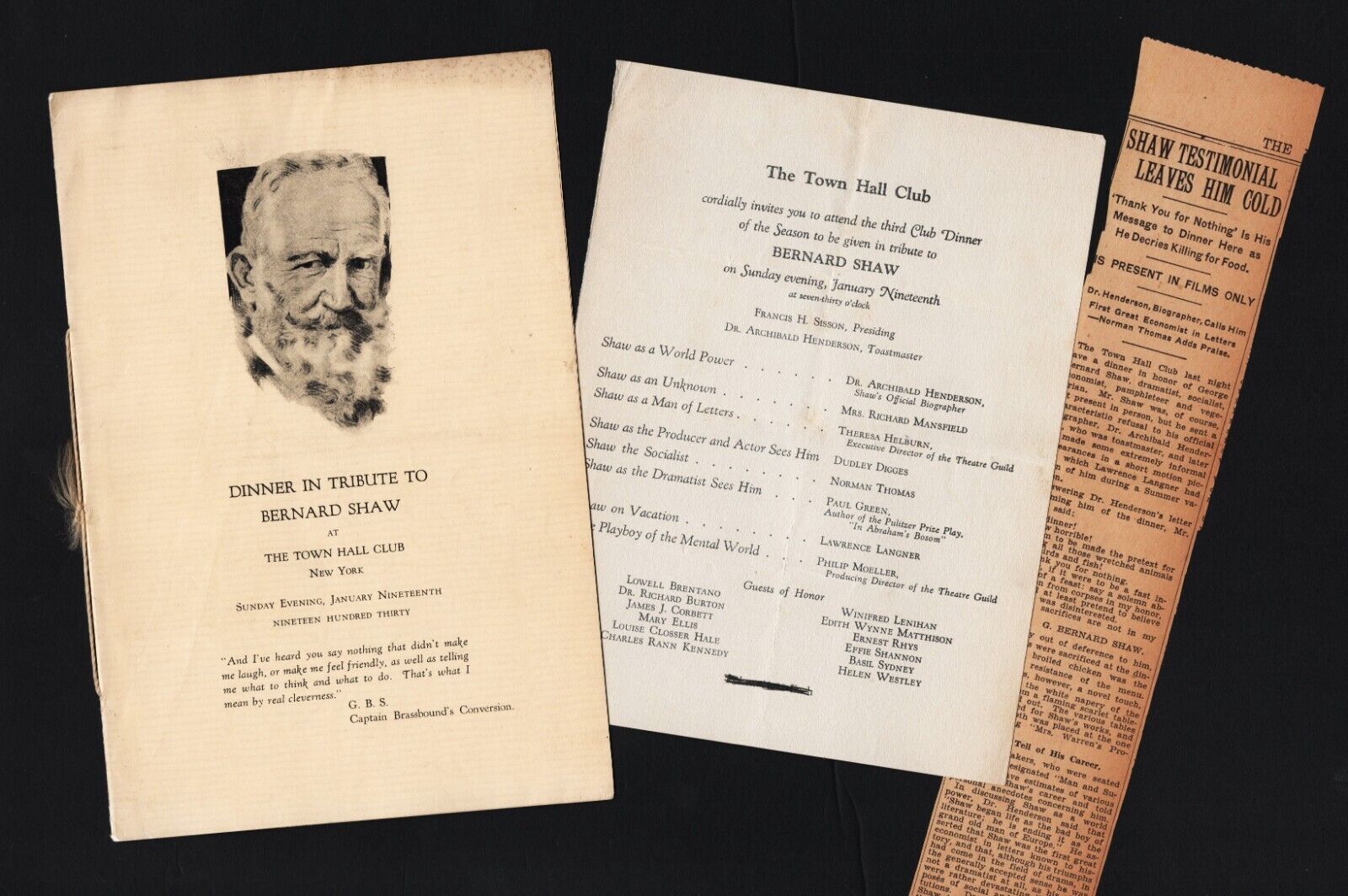
This is a rare program from the Dinner In Tribute to BERNARD SHAW at the Town Hall in New York City on Sunday evening, January 19th, 1930. Among the evening's speakers were Dr. Archibald Henderson, Mrs. Richard Mansfield, Theresa Helburn, Norman Thomas, Paul Green, Philip Moeller and Lawrence Langner ..... Biographical note: GEORGE BERNARD SHAW (July 26, 1856 – November 2nd, 1950) was born in Dublin, Ireland, the son of a civil servant. Although he was best known for drama, he was also proficient in the areas journalism, music literary criticism. He began his literary career as a novelist. Shaw’s works concerned themselves mostly with prevailing social problems, specifically with what he saw as the exploitation of the working middle class. Shaw attended various schools throughout his youth but always harbored an animosity towards schools and teachers. He is quoted as saying that “Schools and schoolmasters, as we have them today, are not popular as places of education and teachers, but rather prisons and turnkeys in which children are kept to prevent them disturbing and chaperoning their parents”. In his personal life, Shaw was an avid Socialist and a member of the Fabian society. In 1898 he married fellow Fabian member and Irish heiress Charlotte Payne-Townsend. He was the first person to be awarded the Nobel prize for Literature as well as an Oscar (for his work on "Pygmalion", which was an adaptation of his play of the same name). He wrote 60 plays, most of which deal with social themes such as marriage, religion, class government and health care. Among his more prominent works were "Arms and the Man", "Mrs. Warren’s Profession", "Candida", "You Can Never Tell", "The Devil’s Disciple", "Caesar and Cleopatra", "Captain Brassbound’s Conversion", "Man and Superman", "Major Barbara", "The Doctor’s Dilemma", "Misalliance", "Androcles and the Lion", "Pygmalion", "Heartbreak House", "Back to Methuselah", "Saint Joan", "The Apple Cart" and "Too True to be Good". Two of his greatest influences were Henrik Ibsen and Henry Fielding. Ibsen’s plays and Fielding’s expulsion from playwriting inspired him to write his own plays on the social injustices of the world around him, including the late nineteenth century censorship of plays, continued from Prime Minister Walpole’s rein in the mid 1740's. The Lord Chamberlain’s Examiner of Plays especially irked him: “A gentleman who robs, insults, and suppresses me as irresistibly as if he were the Tsar of Russia and I the meanest of his subjects… But I must submit [my play] in order to obtain from him an insolent and insufferable document, which I cannot read without boiling of the blood, certifying that in his opinion — his opinion!– my play ‘does not in its general tendency contain anything immoral or otherwise improper for the stage,’ and that the Lord Chamberlain therefore ‘allows’ its performance (confound his impudence!).” George Bernard Shaw died at the age of 94 due to injuries incurred from falling while pruning a tree. (Reprinted in part from the British Literature Wiki site) ..... The production opened September 14th, 1925 at the Guild Theatre, transferred on October 19th, 1925 to the 49th Street Theatre and settled into the Garrick Theatre on December 2nd, 1925, running for a combined 180 performances.) ..... DETAILS: The eight page program measures 6 1/8" X 9 1/8" inches and includes the evening's program details and list of attendees with table assignments. The single page program lists the speakers, their topics and the list of Guests of Honor ..... BONUS: Includes a newspaper clipping with a recap of the evening, noting that Bernard Shaw was not in attendance ..... CONDITION: With the exception of minor creasing to both programs, soiling to the covers and moderate edge wear, this rare set is in excellent condition and will make a wonderful addition to the collection of any theatre aficionado or historian. These items will be carefully packaged in a protective, carded sleeve and backed by stiff cardboard.
Note: This item has been sold and is no longer available. This page serves as a historical price reference for Playbill collectors and appraisers.
Original Listing Description
This is a rare program from the Dinner In Tribute to BERNARD SHAW at the Town Hall in New York City on Sunday evening, January 19th, 1930. Among the evening's speakers were Dr. Archibald Henderson, Mrs. Richard Mansfield, Theresa Helburn, Norman Thomas, Paul Green, Philip Moeller and Lawrence Langner ..... Biographical note: GEORGE BERNARD SHAW (July 26, 1856 – November 2nd, 1950) was born in Dublin, Ireland, the son of a civil servant. Although he was best known for drama, he was also proficient in the areas journalism, music literary criticism. He began his literary career as a novelist. Shaw’s works concerned themselves mostly with prevailing social problems, specifically with what he saw as the exploitation of the working middle class. Shaw attended various schools throughout his youth but always harbored an animosity towards schools and teachers. He is quoted as saying that “Schools and schoolmasters, as we have them today, are not popular as places of education and teachers, but rather prisons and turnkeys in which children are kept to prevent them disturbing and chaperoning their parents”. In his personal life, Shaw was an avid Socialist and a member of the Fabian society. In 1898 he married fellow Fabian member and Irish heiress Charlotte Payne-Townsend. He was the first person to be awarded the Nobel prize for Literature as well as an Oscar (for his work on "Pygmalion", which was an adaptation of his play of the same name). He wrote 60 plays, most of which deal with social themes such as marriage, religion, class government and health care. Among his more prominent works were "Arms and the Man", "Mrs. Warren’s Profession", "Candida", "You Can Never Tell", "The Devil’s Disciple", "Caesar and Cleopatra", "Captain Brassbound’s Conversion", "Man and Superman", "Major Barbara", "The Doctor’s Dilemma", "Misalliance", "Androcles and the Lion", "Pygmalion", "Heartbreak House", "Back to Methuselah", "Saint Joan", "The Apple Cart" and "Too True to be Good". Two of his greatest influences were Henrik Ibsen and Henry Fielding. Ibsen’s plays and Fielding’s expulsion from playwriting inspired him to write his own plays on the social injustices of the world around him, including the late nineteenth century censorship of plays, continued from Prime Minister Walpole’s rein in the mid 1740's. The Lord Chamberlain’s Examiner of Plays especially irked him: “A gentleman who robs, insults, and suppresses me as irresistibly as if he were the Tsar of Russia and I the meanest of his subjects… But I must submit [my play] in order to obtain from him an insolent and insufferable document, which I cannot read without boiling of the blood, certifying that in his opinion — his opinion!– my play ‘does not in its general tendency contain anything immoral or otherwise improper for the stage,’ and that the Lord Chamberlain therefore ‘allows’ its performance (confound his impudence!).” George Bernard Shaw died at the age of 94 due to injuries incurred from falling while pruning a tree. (Reprinted in part from the British Literature Wiki site) ..... The production opened September 14th, 1925 at the Guild Theatre, transferred on October 19th, 1925 to the 49th Street Theatre and settled into the Garrick Theatre on December 2nd, 1925, running for a combined 180 performances.) ..... DETAILS: The eight page program measures 6 1/8" X 9 1/8" inches and includes the evening's program details and list of attendees with table assignments. The single page program lists the speakers, their topics and the list of Guests of Honor ..... BONUS: Includes a newspaper clipping with a recap of the evening, noting that Bernard Shaw was not in attendance ..... CONDITION: With the exception of minor creasing to both programs, soiling to the covers and moderate edge wear, this rare set is in excellent condition and will make a wonderful addition to the collection of any theatre aficionado or historian. These items will be carefully packaged in a protective, carded sleeve and backed by stiff cardboard.
Note: This item has been sold and is no longer available. This page serves as a historical price reference for Playbill collectors and appraisers.