

*HENRY IRVING ELLEN TERRY RARE ORIGINAL 1882 ROMEO AND JULIET PROGRAM*
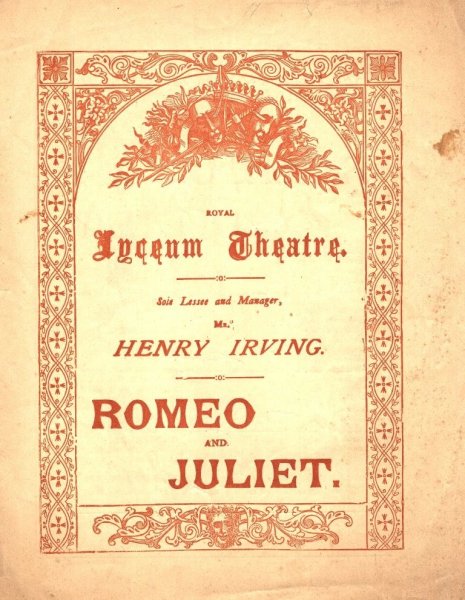
*HENRY IRVING ELLEN TERRY RARE ORIGINAL 1882 ROMEO AND JULIET PROGRAM*
SOLD $54.99 Sold: May 9, 2025 on eBayOriginal Listing Description
A rare original 1882 program for Henry Irving and Ellen Terry in Romeo and Juliet at the Royal Lyceum Theatre, London, with future stars William Terrisss and George Alexander among the cast. Future Dracula author Bram Stoker is prominently listed as Acting Manager. Four pages. Dimensions eight and a quarter by six and a half inches. Light wear and small repaired tears otherwise good. See Henry Irving and Ellen Terry's extraordinary biographies below. Shipping discounts for multiple purchases. Inquiries always welcome. Please visit my other eBay items for more early theatre, opera, film and historical autographs, photographs and programs and great actor and actress cabinet photos and CDV's. From Wikipedia:Sir Henry Irving (6 February 1838 - 13 October 1905), born John Henry Brodribb, sometimes known as J. H. Irving, was an English stage actor in the Victorian era, known as an actor-manager because he took complete responsibility (supervision of sets, lighting, direction, casting, as well as playing the leading roles) for season after season at the Lyceum Theatre, establishing himself and his company as representative of English classical theatre. In 1895 he became the first actor to be awarded a knighthood, indicating full acceptance into the higher circles of British society.Irving is widely acknowledged to be one of the inspirations for Count Dracula, the title character of the 1897 novel Dracula whose author, Bram Stoker, was business manager of the theatre.Irving was born to a working-class family in Keinton Mandeville in the county of Somerset.[1] W.H. Davies, the celebrated poet, was a cousin. Irving spent his childhood living with his aunt, Mrs Penberthy, at Halsetown in Cornwall. He competed in a recitation contest at a local Methodist chapel where he was bested by William Curnow, later the editor of The Sydney Morning Herald.[2] He attended City Commercial School for two years before going to work in the office of a law firm at age 13. When he saw Samuel Phelps play Hamlet soon after this, he sought lessons, letters of introduction, and work in a theatre in Sunderland in 1856, labouring against great odds until his 1871 success in The Bells in London set him apart from all the rest.He married Florence O'Callaghan on 15 July 1869 at St. Marylebone, London, but his personal life took second place to his professional life. On opening night of The Bells, 25 November 1871, Florence, who was pregnant with their second child, criticised his profession: "Are you going on making a fool of yourself like this all your life?" Irving exited their carriage at Hyde Park Corner, walked off into the night, and chose never to see her again. He maintained a discreet distance from his children as well, but became closer to them as they grew older. Florence Irving never divorced Irving, and once he had been knighted she styled herself "Lady Irving"; Irving never remarried.[3]Sir Henry Irving, as Hamlet, in an 1893 illustration from The Idler magazineHis elder son, Harry Brodribb Irving (1870-1919), usually known as "H B Irving", became a famous actor and later a theatre manager. His younger son, Laurence Irving (1871-1914), became a dramatist and later drowned, with his wife, in the sinking of the Empress of Ireland. H B married Dorothea Baird and they had a son, Laurence Irving (1897-1988), who became a well-known Hollywood art director and his grandfather's biographer.In November 1882 Irving became a Freemason, being initiated into the prestigious Jerusalem Lodge No 197 in London.[4] In 1887 he became a founder member and first Treasurer of the Savage Club Lodge No 2190,[5] a Lodge associated with London's Savage Club.He eventually took over the management of the Lyceum Theatre and brought actress Ellen Terry into partnership with him as Ophelia to his Hamlet, Lady Macbeth to his Macbeth, Portia to his Shylock, Beatrice to his Benedick, etc. Before joining the Lyceum, Terry had fled her first marriage and conceived two out-of-wedlock children with architect-designer Edward William Godwin, but regardless of how much and how often her behavior defied the strict morality expected by her Victorian audiences, she somehow remained popular. It could be said that Irving found his family in his professional company, which included his ardent supporter and manager Bram Stoker and Terry's two illegitimate children, Teddy and Edy.Whether Irving's long, spectacularly successful relationship with leading lady Ellen Terry was romantic as well as professional has been the subject of much historical speculation. Most of their correspondence was lost or burned by her descendants.[6] According to Michael Holroyd's book about Irving and Terry, A Strange Eventful History:Years later, when Irving was dead, Marguerite Steen asked Ellen whether she really had been Irving's lover, and she promptly answered: 'Of course I was. We were terribly in love for a while.' But at earlier periods in her life, when there were more people around to be offended, she said contradictory things.Terry's son Teddy, later known as Edward Gordon Craig, spent much of his childhood (from 1879, when he was 8, until 1897) indulged by Irving backstage at the Lyceum. Craig, who came to be regarded as something of a visionary for the theatre of the future, wrote an especially vivid, book-length tribute to Irving. ("Let me state at once, in clearest unmistakable terms, that I have never known of, or seen, or heard, a greater actor than was Irving.") George Bernard Shaw, at the time a theatre critic who was jealous of Irving's connection to Ellen Terry (whom Shaw himself wanted in his own plays), conceded Irving's genius after Irving died.Dame Alice Ellen Terry, GBE (27 February 1847[1] - 21 July 1928), known professionally as Ellen Terry,[2] was a renowned English actress of the late 19th and early 20th centuries.Born into a family of actors, Terry began performing as a child, acting in Shakespeare plays in London, and toured throughout the British provinces in her teens. At 16, she married the 46-year-old artist George Frederic Watts, but they separated within a year. She soon returned to the stage but began a relationship with the architect Edward William Godwin and retired from the stage for six years. She resumed acting in 1874 and was immediately acclaimed for her portrayal of roles in Shakespeare and other classics.In 1878 she joined Henry Irving's company as his leading lady, and for more than the next two decades she was considered the leading Shakespearean and comic actress in Britain. Two of her most famous roles were Portia in The Merchant of Venice and Beatrice in Much Ado About Nothing. She and Irving also toured with great success in America and Britain.In 1903 Terry took over management of London's Imperial Theatre, focusing on the plays of George Bernard Shaw and Henrik Ibsen. The venture was a financial failure, and Terry turned to touring and lecturing. She continued to find success on stage until 1920, while also appearing in films from 1916 to 1922. Her career lasted nearly seven decades.In 1875, Terry gave an acclaimed performance as Portia in The Merchant of Venice at the Prince of Wales's Theatre, produced by the Bancrofts. Oscar Wilde wrote a sonnet, upon seeing her in this role: "No woman Veronese looked upon/Was half so fair as thou whom I behold."[11] She recreated this role many times in her career until her last appearance as Portia at London's Old Vic Theatre in 1917.In 1876 she appeared as Lady Teazle in The School for Scandal, Blanche Haye in a revival of T. W. Robertson's Ours, and the title role in Olivia by William Gorman Wills at the Court Theatre (an adaptation of The Vicar of Wakefield), where she joined the company of John Hare. In November 1877 she married Charles Clavering Wardell Kelly (1839-1885), an actor/journalist she had met while appearing in Reade's plays, but they separated in 1881. After this, she finally reconciled with her parents, whom she had not seen since she began to live out-of-wedlock with Godwin.[5]In 1878 the 30-year-old Terry joined Henry Irving's company at the Lyceum Theatre as its leading lady at a generous salary, beginning with Ophelia opposite Irving's Hamlet. Soon she was regarded as the leading Shakespearean actress in Britain, and in partnership with Irving,[12] she reigned as such for over 20 years until they left the Lyceum in 1902.[3][13] Their 1879 production of The Merchant of Venice ran for an unusual 250 nights, and success followed success in the Shakespeare canon as well as in Tennyson, Bulwer-Lytton, Reade, Sardou, and plays by other contemporary playwrights, such as W. G. Wills, and other major plays.[4]In 1879 The Times said of Terry's acting in Paul Terrier's All is Vanity, or the Cynic's Defeat, "Miss Terry's Iris was a performance of inimitable charm, full of movement, ease, and laughter... the most exquisite harmony and natural grace... such an Iris might well have turned the head of Diogenes himself."[14] In 1880, at the Lyceum, she played the title role in an adaptation of King Rene's Daughter called Iolanthe. The Era wrote: "Nothing more winning and enchanting than the grace, and simplicity, and girlish sweetness of the blind Iolanthe as shown by Miss Ellen Terry has within our memory been seen upon the stage. The assumption was delightfully perfect. ... Exquisite ... exercise of the peculiarly fascinating powers of Miss Ellen Terry, who achieved an undoubted triumph ... and was cheered again and again".[15]As Katherine in Henry VIIIAmong her most celebrated roles with Irving were Ophelia, Pauline in The Lady of Lyons by Edward Bulwer-Lytton (1878), Portia (1879), Queen Henrietta Maria in William Gorman Wills's drama Charles I (1879), Desdemona in Othello (1881), Camma in Tennyson's short tragedy The Cup (1881), Beatrice in Much Ado About Nothing, another of her signature roles (1882 and often thereafter), Juliet in Romeo and Juliet (1882), Jeanette in The Lyons Mail by Charles Reade (1883), the title part in Reade's romantic comedy Nance Oldfield (1883), Viola in Twelfth Night (1884), Margaret in the long-running adaptation of Faust by Wills (1885), the title role in Olivia (1885, which she had played earlier at the Court Theatre), Lady Macbeth in Macbeth (1888, with incidental music by Arthur Sullivan[16]), Queen Katherine in Henry VIII (1892),[17] Cordelia in King Lear (1892), Rosamund de Clifford in Becket by Alfred Tennyson (1893), Guinevere in King Arthur by J. Comyns Carr, with incidental music by Sullivan (1895),[18] Imogen in Cymbeline (1896), the title character in Victorien Sardou and Emile Moreau's play Madame Sans-Gene (1897)[10] and Volumnia in Coriolanus (1901).Terry made her American debut in 1883, playing Queen Henrietta opposite Irving in Charles I. Among the other roles she portrayed on this and six subsequent North American tours with Irving were Jeanette, Ophelia, Beatrice, Viola, and her most famous role, Portia.[19][20] Her last role at the Lyceum was Portia in 1902, after which she toured in the British provinces with Irving and his company that autumn. Whether Irving's relationship with Terry was romantic as well as professional has been the subject of much speculation. According to Sir Michael Holroyd's book about Irving and Terry, A Strange Eventful History, after Irving's death, Terry stated that she and Irving had been lovers and that: "We were terribly in love for a while".[21] Irving was separated, but not divorced from his wife. Terry was separated from Wardell in 1881, and Irving was godfather to both her children. They travelled on holiday together, and Irving wrote tender letters to Terry.[5][22]In London, Terry lived in Earls Court with her children and pets during the 1880s, first in Longridge Road, then Barkston Gardens in 1889, but she kept country homes. In 1900, she bought her farmhouse in Small Hythe, Kent, where she lived for the rest of her life.[23] In 1889, her son joined the Lyceum company as an actor, appearing with the company until 1897, when he retired from the stage to study drawing and produce woodblock engravings. Her daughter Edith also played at the Lyceum for several years from 1887, but she eventually turned to stage direction and costume design, creating costumes for Terry, Lillie Langtry, and others early in the 20th century.Edward Henry Gordon Craig CH OBE (born Edward Godwin; 16 January 1872 - 29 July 1966), sometimes known as Gordon Craig, was an English modernist theatre practitioner; he worked as an actor, director and scenic designer, as well as developing an influential body of theoretical writings. Craig was the son of actress Dame Ellen Terry.The Gordon Craig Theatre, built in Stevenage (the town of his birth), was named in his honour in 1975.The illegitimate son of the architect Edward Godwin and the actress Ellen Terry,[1] Craig was born Edward Godwin on 16 January 1872 in Railway Street, Stevenage, in Hertfordshire, England, and baptised at age 16 as Edward Henry Gordon. He took the surname Craig by deed poll at age 21.[2]Craig spent much of his childhood backstage at the Lyceum Theatre, where his mother was the leading lady to actor Sir Henry Irving. Craig later wrote a vivid, book-length tribute to Irving. Craig's sister was Edith Craig.In 1893 Craig married Helen Mary (May) Gibson, with whom he had five children: Philip Carlisle (born 1894), Rosemary Nell (born 1894), Henry Edward Robin (born 1895), John (born 1896) and Peter (born 1897).[3]With his lover, the violinist Elena Fortuna Meo (1879-1957) he had three children: Ellen Gordon (1903-1904), Ellen Gordon ("Nelly"; 1904-1975) and Edward Anthony Carrick (1905-1998; an art director of British films).[3] With his lover, the dancer Isadora Duncan, he had a daughter, Deirdre Beatrice (1906-1913), who drowned at the age of seven with another of Duncan's children, Patrick Augustus, and their nanny.[3] With his lover, the poet Dorothy Nevile Lees, he had a son, Davidino Lees (1916-2004), a noted Italian photojournalist.[3] His granddaughter is the illustrator and author Helen Craig.[2]Craig lived in straitened circumstances in France for much of his life and was interned by German Occupation forces in 1942. He died at Vence, France, in 1966, aged 94.[2]Career[edit]Further information: Moscow Art Theatre production of HamletCraig as Hamlet, Olympic Theatre, 1897Craig asserted that the director was "the true artist of the theatre" and, controversially, suggested viewing actors as no more important than marionettes. He designed and built elaborately symbolic sets; for instance, a set composed of his patented movable screens for the Moscow Art Theatre production of Hamlet. He was also the editor and chief writer for the first international theatre magazine, The Mask.[4]He worked as an actor in the company of Sir Henry Irving, but became more interested in art, learning to carve wood under the tutelage of James Pryde and William Nicholson. His acting career ended in 1897, when he went into theatrical design.Craig's first productions, Purcell's Dido and Aeneas, Handel's Acis and Galatea (both inspired and conducted by his lifelong friend Martin Shaw, who founded the Purcell Operatic Society with him to produce them), and Ibsen's The Vikings at Helgeland, were produced in London. The production of Dido and Aeneas was a considerable success and highly influential in reviving interest in the music of Purcell, then so little known that three copies of The Times review were delivered to the theatre: one addressed to Mr Shaw, one to Mr Craig, and one to Mr Purcell. Craig concentrated on keeping his designs simple, so as to set-off the movements of the actors and of light, and introduced the idea of a "unified stage picture" that covered all the elements of design.After finding little financial success in Britain, Craig set out for Germany in 1904. While there, he wrote one of his most famous works, the essay The Art of the Theatre (later reprinted with the title On the Art of the Theatre). In 1908, Isadora Duncan introduced Craig to Konstantin Stanislavski, the founder of the Moscow Art Theatre, who invited him to direct their famous production of Hamlet with the company, which opened in December 1911. After settling in Italy, Craig created a school of theatrical design with support from Lord Howard de Walden, the Arena Goldoni in Florence. During World War I, he wrote a cycle of puppet plays, the Drama for Fools[5] and published a little theatre magazine, The Marionnette (1918).Craig was considered extremely difficult to work with and ultimately refused to direct or design any project over which he did not have complete artistic control. This led to his withdrawal from practical theatre production.[6] His later career is remarkable for how little he achieved after the age of forty, during a long period of over fifty years.He received an OBE and in 1958 was made a Companion of Honour.Ideas[edit]Caricature of Craig by Max Beerbohm from A Survey, published in 1921.Craig's idea of using neutral, mobile, non-representational screens as a staging device is probably his most famous scenographic concept. In 1910 Craig filed a patent which described in considerable technical detail a system of hinged and fixed flats that could be quickly arranged to cater for both internal and external scenes. He presented a set to William Butler Yeats for use at the Abbey Theatre in Ireland, who shared his symbolist aesthetic.[citation needed]Craig's second innovation was in stage lighting. Doing away with traditional footlights, Craig lit the stage from above, placing lights in the ceiling of the theatre. Colour and light also became central to Craig's stage conceptualizations.Under the play of this light, the background becomes a deep shimmering blue, apparently almost translucent, upon which the green and purple make a harmony of great richness.[7]The third remarkable aspect of Craig's experiments in theatrical form were his attempts to integrate design elements with his work with actors. His mise en scene sought to articulate the relationships in space between movement, sound, line, and colour. Craig promoted a theatre focused on the craft of the director - a theatre where action, words, colour and rhythm combine in dynamic dramatic form.[8]Ellen Terry by Craig, from The Dome"Dumas Papa" by Craig, 1899All of his life, Craig sought to capture "pure emotion" or "arrested development" in the plays on which he worked. Even during the years when he was not producing plays, Craig continued to make models, to conceive stage designs and to work on directorial plans that were never to reach performance. He believed that a director should approach a play with no preconceptions and he embraced this in his fading up from the minimum or blank canvas approach.[9]As an engraver and a classical artist, Craig found inspiration in puppets and masks. In his 1910 article "A Note on Masks," Craig expounds the virtue of using masks as a mechanism for capturing the audience's attention, imagination and soul. "There is only one actor - nay one man who has the soul of the dramatic poet, and who has ever served as the true and loyal interpreter of the poet," he proclaimed, and "this is the marionette."[10]On the Art of the Theatre (1911) is written as a dialogue between a Playgoer and a Stage Director, who examine the problems of the nature of stage directing. Craig argues that it was not dramatists, but rather performers who made the first works of drama, using action, words, line, colour and rhythm. Craig goes on to contend that only the director who seeks to interpret drama truly, and commits to training in all aspects of dramatic art, can restore the "Art of the Theatre."[11] Maintaining that the director should seek a faithful interpretation of the text, Craig argues that audiences go to the theatre to see, rather than to hear, plays. The design elements may transcend reality and function as symbols, he thought, thereby communicating a deeper meaning, rather than simply reflecting the real world.On 29 June 1908 the Polish theater director, playwright, and theoretician of drama Leon Schiller initiated a correspondence with Craig. Together with his letter Schiller sent Craig, in Florence, his essay, "Dwa teatry" ("Two Theaters"), translated into English by Madeline Meager. Craig responded immediately, accepting the essay for his magazine, The Mask.[12] This was the beginning of a productive collaboration between the two prominent theater directors, who introduced each other's theoretical writings to foreign readers.[13]Archive[edit]One of the largest collections of Edward Gordon Craig's papers is held at the Harry Ransom Center at the University of Texas at Austin. The 32-box collection includes Craig's diaries, essays, reviews, notes, manuscripts, financial records, and correspondence.[14] Over 130 personal photographs are present in the archive.[15] The Ransom Center's art holdings including some of Craig's woodblocks from the Cranach Press Hamlet as well as proof prints made during production of the book. The center's library holds over 300 books from Craig's personal collection.[16] In addition to the archive of Edward Gordon Craig, the Ransom Center holds important holdings relating to Craig's mother Ellen Terry, as well as the archive of his son Edward Carrick.
Note: This item has been sold and is no longer available. This page serves as a historical price reference for Playbill collectors and appraisers.
Original Listing Description
A rare original 1882 program for Henry Irving and Ellen Terry in Romeo and Juliet at the Royal Lyceum Theatre, London, with future stars William Terrisss and George Alexander among the cast. Future Dracula author Bram Stoker is prominently listed as Acting Manager. Four pages. Dimensions eight and a quarter by six and a half inches. Light wear and small repaired tears otherwise good. See Henry Irving and Ellen Terry's extraordinary biographies below. Shipping discounts for multiple purchases. Inquiries always welcome. Please visit my other eBay items for more early theatre, opera, film and historical autographs, photographs and programs and great actor and actress cabinet photos and CDV's. From Wikipedia:Sir Henry Irving (6 February 1838 - 13 October 1905), born John Henry Brodribb, sometimes known as J. H. Irving, was an English stage actor in the Victorian era, known as an actor-manager because he took complete responsibility (supervision of sets, lighting, direction, casting, as well as playing the leading roles) for season after season at the Lyceum Theatre, establishing himself and his company as representative of English classical theatre. In 1895 he became the first actor to be awarded a knighthood, indicating full acceptance into the higher circles of British society.Irving is widely acknowledged to be one of the inspirations for Count Dracula, the title character of the 1897 novel Dracula whose author, Bram Stoker, was business manager of the theatre.Irving was born to a working-class family in Keinton Mandeville in the county of Somerset.[1] W.H. Davies, the celebrated poet, was a cousin. Irving spent his childhood living with his aunt, Mrs Penberthy, at Halsetown in Cornwall. He competed in a recitation contest at a local Methodist chapel where he was bested by William Curnow, later the editor of The Sydney Morning Herald.[2] He attended City Commercial School for two years before going to work in the office of a law firm at age 13. When he saw Samuel Phelps play Hamlet soon after this, he sought lessons, letters of introduction, and work in a theatre in Sunderland in 1856, labouring against great odds until his 1871 success in The Bells in London set him apart from all the rest.He married Florence O'Callaghan on 15 July 1869 at St. Marylebone, London, but his personal life took second place to his professional life. On opening night of The Bells, 25 November 1871, Florence, who was pregnant with their second child, criticised his profession: "Are you going on making a fool of yourself like this all your life?" Irving exited their carriage at Hyde Park Corner, walked off into the night, and chose never to see her again. He maintained a discreet distance from his children as well, but became closer to them as they grew older. Florence Irving never divorced Irving, and once he had been knighted she styled herself "Lady Irving"; Irving never remarried.[3]Sir Henry Irving, as Hamlet, in an 1893 illustration from The Idler magazineHis elder son, Harry Brodribb Irving (1870-1919), usually known as "H B Irving", became a famous actor and later a theatre manager. His younger son, Laurence Irving (1871-1914), became a dramatist and later drowned, with his wife, in the sinking of the Empress of Ireland. H B married Dorothea Baird and they had a son, Laurence Irving (1897-1988), who became a well-known Hollywood art director and his grandfather's biographer.In November 1882 Irving became a Freemason, being initiated into the prestigious Jerusalem Lodge No 197 in London.[4] In 1887 he became a founder member and first Treasurer of the Savage Club Lodge No 2190,[5] a Lodge associated with London's Savage Club.He eventually took over the management of the Lyceum Theatre and brought actress Ellen Terry into partnership with him as Ophelia to his Hamlet, Lady Macbeth to his Macbeth, Portia to his Shylock, Beatrice to his Benedick, etc. Before joining the Lyceum, Terry had fled her first marriage and conceived two out-of-wedlock children with architect-designer Edward William Godwin, but regardless of how much and how often her behavior defied the strict morality expected by her Victorian audiences, she somehow remained popular. It could be said that Irving found his family in his professional company, which included his ardent supporter and manager Bram Stoker and Terry's two illegitimate children, Teddy and Edy.Whether Irving's long, spectacularly successful relationship with leading lady Ellen Terry was romantic as well as professional has been the subject of much historical speculation. Most of their correspondence was lost or burned by her descendants.[6] According to Michael Holroyd's book about Irving and Terry, A Strange Eventful History:Years later, when Irving was dead, Marguerite Steen asked Ellen whether she really had been Irving's lover, and she promptly answered: 'Of course I was. We were terribly in love for a while.' But at earlier periods in her life, when there were more people around to be offended, she said contradictory things.Terry's son Teddy, later known as Edward Gordon Craig, spent much of his childhood (from 1879, when he was 8, until 1897) indulged by Irving backstage at the Lyceum. Craig, who came to be regarded as something of a visionary for the theatre of the future, wrote an especially vivid, book-length tribute to Irving. ("Let me state at once, in clearest unmistakable terms, that I have never known of, or seen, or heard, a greater actor than was Irving.") George Bernard Shaw, at the time a theatre critic who was jealous of Irving's connection to Ellen Terry (whom Shaw himself wanted in his own plays), conceded Irving's genius after Irving died.Dame Alice Ellen Terry, GBE (27 February 1847[1] - 21 July 1928), known professionally as Ellen Terry,[2] was a renowned English actress of the late 19th and early 20th centuries.Born into a family of actors, Terry began performing as a child, acting in Shakespeare plays in London, and toured throughout the British provinces in her teens. At 16, she married the 46-year-old artist George Frederic Watts, but they separated within a year. She soon returned to the stage but began a relationship with the architect Edward William Godwin and retired from the stage for six years. She resumed acting in 1874 and was immediately acclaimed for her portrayal of roles in Shakespeare and other classics.In 1878 she joined Henry Irving's company as his leading lady, and for more than the next two decades she was considered the leading Shakespearean and comic actress in Britain. Two of her most famous roles were Portia in The Merchant of Venice and Beatrice in Much Ado About Nothing. She and Irving also toured with great success in America and Britain.In 1903 Terry took over management of London's Imperial Theatre, focusing on the plays of George Bernard Shaw and Henrik Ibsen. The venture was a financial failure, and Terry turned to touring and lecturing. She continued to find success on stage until 1920, while also appearing in films from 1916 to 1922. Her career lasted nearly seven decades.In 1875, Terry gave an acclaimed performance as Portia in The Merchant of Venice at the Prince of Wales's Theatre, produced by the Bancrofts. Oscar Wilde wrote a sonnet, upon seeing her in this role: "No woman Veronese looked upon/Was half so fair as thou whom I behold."[11] She recreated this role many times in her career until her last appearance as Portia at London's Old Vic Theatre in 1917.In 1876 she appeared as Lady Teazle in The School for Scandal, Blanche Haye in a revival of T. W. Robertson's Ours, and the title role in Olivia by William Gorman Wills at the Court Theatre (an adaptation of The Vicar of Wakefield), where she joined the company of John Hare. In November 1877 she married Charles Clavering Wardell Kelly (1839-1885), an actor/journalist she had met while appearing in Reade's plays, but they separated in 1881. After this, she finally reconciled with her parents, whom she had not seen since she began to live out-of-wedlock with Godwin.[5]In 1878 the 30-year-old Terry joined Henry Irving's company at the Lyceum Theatre as its leading lady at a generous salary, beginning with Ophelia opposite Irving's Hamlet. Soon she was regarded as the leading Shakespearean actress in Britain, and in partnership with Irving,[12] she reigned as such for over 20 years until they left the Lyceum in 1902.[3][13] Their 1879 production of The Merchant of Venice ran for an unusual 250 nights, and success followed success in the Shakespeare canon as well as in Tennyson, Bulwer-Lytton, Reade, Sardou, and plays by other contemporary playwrights, such as W. G. Wills, and other major plays.[4]In 1879 The Times said of Terry's acting in Paul Terrier's All is Vanity, or the Cynic's Defeat, "Miss Terry's Iris was a performance of inimitable charm, full of movement, ease, and laughter... the most exquisite harmony and natural grace... such an Iris might well have turned the head of Diogenes himself."[14] In 1880, at the Lyceum, she played the title role in an adaptation of King Rene's Daughter called Iolanthe. The Era wrote: "Nothing more winning and enchanting than the grace, and simplicity, and girlish sweetness of the blind Iolanthe as shown by Miss Ellen Terry has within our memory been seen upon the stage. The assumption was delightfully perfect. ... Exquisite ... exercise of the peculiarly fascinating powers of Miss Ellen Terry, who achieved an undoubted triumph ... and was cheered again and again".[15]As Katherine in Henry VIIIAmong her most celebrated roles with Irving were Ophelia, Pauline in The Lady of Lyons by Edward Bulwer-Lytton (1878), Portia (1879), Queen Henrietta Maria in William Gorman Wills's drama Charles I (1879), Desdemona in Othello (1881), Camma in Tennyson's short tragedy The Cup (1881), Beatrice in Much Ado About Nothing, another of her signature roles (1882 and often thereafter), Juliet in Romeo and Juliet (1882), Jeanette in The Lyons Mail by Charles Reade (1883), the title part in Reade's romantic comedy Nance Oldfield (1883), Viola in Twelfth Night (1884), Margaret in the long-running adaptation of Faust by Wills (1885), the title role in Olivia (1885, which she had played earlier at the Court Theatre), Lady Macbeth in Macbeth (1888, with incidental music by Arthur Sullivan[16]), Queen Katherine in Henry VIII (1892),[17] Cordelia in King Lear (1892), Rosamund de Clifford in Becket by Alfred Tennyson (1893), Guinevere in King Arthur by J. Comyns Carr, with incidental music by Sullivan (1895),[18] Imogen in Cymbeline (1896), the title character in Victorien Sardou and Emile Moreau's play Madame Sans-Gene (1897)[10] and Volumnia in Coriolanus (1901).Terry made her American debut in 1883, playing Queen Henrietta opposite Irving in Charles I. Among the other roles she portrayed on this and six subsequent North American tours with Irving were Jeanette, Ophelia, Beatrice, Viola, and her most famous role, Portia.[19][20] Her last role at the Lyceum was Portia in 1902, after which she toured in the British provinces with Irving and his company that autumn. Whether Irving's relationship with Terry was romantic as well as professional has been the subject of much speculation. According to Sir Michael Holroyd's book about Irving and Terry, A Strange Eventful History, after Irving's death, Terry stated that she and Irving had been lovers and that: "We were terribly in love for a while".[21] Irving was separated, but not divorced from his wife. Terry was separated from Wardell in 1881, and Irving was godfather to both her children. They travelled on holiday together, and Irving wrote tender letters to Terry.[5][22]In London, Terry lived in Earls Court with her children and pets during the 1880s, first in Longridge Road, then Barkston Gardens in 1889, but she kept country homes. In 1900, she bought her farmhouse in Small Hythe, Kent, where she lived for the rest of her life.[23] In 1889, her son joined the Lyceum company as an actor, appearing with the company until 1897, when he retired from the stage to study drawing and produce woodblock engravings. Her daughter Edith also played at the Lyceum for several years from 1887, but she eventually turned to stage direction and costume design, creating costumes for Terry, Lillie Langtry, and others early in the 20th century.Edward Henry Gordon Craig CH OBE (born Edward Godwin; 16 January 1872 - 29 July 1966), sometimes known as Gordon Craig, was an English modernist theatre practitioner; he worked as an actor, director and scenic designer, as well as developing an influential body of theoretical writings. Craig was the son of actress Dame Ellen Terry.The Gordon Craig Theatre, built in Stevenage (the town of his birth), was named in his honour in 1975.The illegitimate son of the architect Edward Godwin and the actress Ellen Terry,[1] Craig was born Edward Godwin on 16 January 1872 in Railway Street, Stevenage, in Hertfordshire, England, and baptised at age 16 as Edward Henry Gordon. He took the surname Craig by deed poll at age 21.[2]Craig spent much of his childhood backstage at the Lyceum Theatre, where his mother was the leading lady to actor Sir Henry Irving. Craig later wrote a vivid, book-length tribute to Irving. Craig's sister was Edith Craig.In 1893 Craig married Helen Mary (May) Gibson, with whom he had five children: Philip Carlisle (born 1894), Rosemary Nell (born 1894), Henry Edward Robin (born 1895), John (born 1896) and Peter (born 1897).[3]With his lover, the violinist Elena Fortuna Meo (1879-1957) he had three children: Ellen Gordon (1903-1904), Ellen Gordon ("Nelly"; 1904-1975) and Edward Anthony Carrick (1905-1998; an art director of British films).[3] With his lover, the dancer Isadora Duncan, he had a daughter, Deirdre Beatrice (1906-1913), who drowned at the age of seven with another of Duncan's children, Patrick Augustus, and their nanny.[3] With his lover, the poet Dorothy Nevile Lees, he had a son, Davidino Lees (1916-2004), a noted Italian photojournalist.[3] His granddaughter is the illustrator and author Helen Craig.[2]Craig lived in straitened circumstances in France for much of his life and was interned by German Occupation forces in 1942. He died at Vence, France, in 1966, aged 94.[2]Career[edit]Further information: Moscow Art Theatre production of HamletCraig as Hamlet, Olympic Theatre, 1897Craig asserted that the director was "the true artist of the theatre" and, controversially, suggested viewing actors as no more important than marionettes. He designed and built elaborately symbolic sets; for instance, a set composed of his patented movable screens for the Moscow Art Theatre production of Hamlet. He was also the editor and chief writer for the first international theatre magazine, The Mask.[4]He worked as an actor in the company of Sir Henry Irving, but became more interested in art, learning to carve wood under the tutelage of James Pryde and William Nicholson. His acting career ended in 1897, when he went into theatrical design.Craig's first productions, Purcell's Dido and Aeneas, Handel's Acis and Galatea (both inspired and conducted by his lifelong friend Martin Shaw, who founded the Purcell Operatic Society with him to produce them), and Ibsen's The Vikings at Helgeland, were produced in London. The production of Dido and Aeneas was a considerable success and highly influential in reviving interest in the music of Purcell, then so little known that three copies of The Times review were delivered to the theatre: one addressed to Mr Shaw, one to Mr Craig, and one to Mr Purcell. Craig concentrated on keeping his designs simple, so as to set-off the movements of the actors and of light, and introduced the idea of a "unified stage picture" that covered all the elements of design.After finding little financial success in Britain, Craig set out for Germany in 1904. While there, he wrote one of his most famous works, the essay The Art of the Theatre (later reprinted with the title On the Art of the Theatre). In 1908, Isadora Duncan introduced Craig to Konstantin Stanislavski, the founder of the Moscow Art Theatre, who invited him to direct their famous production of Hamlet with the company, which opened in December 1911. After settling in Italy, Craig created a school of theatrical design with support from Lord Howard de Walden, the Arena Goldoni in Florence. During World War I, he wrote a cycle of puppet plays, the Drama for Fools[5] and published a little theatre magazine, The Marionnette (1918).Craig was considered extremely difficult to work with and ultimately refused to direct or design any project over which he did not have complete artistic control. This led to his withdrawal from practical theatre production.[6] His later career is remarkable for how little he achieved after the age of forty, during a long period of over fifty years.He received an OBE and in 1958 was made a Companion of Honour.Ideas[edit]Caricature of Craig by Max Beerbohm from A Survey, published in 1921.Craig's idea of using neutral, mobile, non-representational screens as a staging device is probably his most famous scenographic concept. In 1910 Craig filed a patent which described in considerable technical detail a system of hinged and fixed flats that could be quickly arranged to cater for both internal and external scenes. He presented a set to William Butler Yeats for use at the Abbey Theatre in Ireland, who shared his symbolist aesthetic.[citation needed]Craig's second innovation was in stage lighting. Doing away with traditional footlights, Craig lit the stage from above, placing lights in the ceiling of the theatre. Colour and light also became central to Craig's stage conceptualizations.Under the play of this light, the background becomes a deep shimmering blue, apparently almost translucent, upon which the green and purple make a harmony of great richness.[7]The third remarkable aspect of Craig's experiments in theatrical form were his attempts to integrate design elements with his work with actors. His mise en scene sought to articulate the relationships in space between movement, sound, line, and colour. Craig promoted a theatre focused on the craft of the director - a theatre where action, words, colour and rhythm combine in dynamic dramatic form.[8]Ellen Terry by Craig, from The Dome"Dumas Papa" by Craig, 1899All of his life, Craig sought to capture "pure emotion" or "arrested development" in the plays on which he worked. Even during the years when he was not producing plays, Craig continued to make models, to conceive stage designs and to work on directorial plans that were never to reach performance. He believed that a director should approach a play with no preconceptions and he embraced this in his fading up from the minimum or blank canvas approach.[9]As an engraver and a classical artist, Craig found inspiration in puppets and masks. In his 1910 article "A Note on Masks," Craig expounds the virtue of using masks as a mechanism for capturing the audience's attention, imagination and soul. "There is only one actor - nay one man who has the soul of the dramatic poet, and who has ever served as the true and loyal interpreter of the poet," he proclaimed, and "this is the marionette."[10]On the Art of the Theatre (1911) is written as a dialogue between a Playgoer and a Stage Director, who examine the problems of the nature of stage directing. Craig argues that it was not dramatists, but rather performers who made the first works of drama, using action, words, line, colour and rhythm. Craig goes on to contend that only the director who seeks to interpret drama truly, and commits to training in all aspects of dramatic art, can restore the "Art of the Theatre."[11] Maintaining that the director should seek a faithful interpretation of the text, Craig argues that audiences go to the theatre to see, rather than to hear, plays. The design elements may transcend reality and function as symbols, he thought, thereby communicating a deeper meaning, rather than simply reflecting the real world.On 29 June 1908 the Polish theater director, playwright, and theoretician of drama Leon Schiller initiated a correspondence with Craig. Together with his letter Schiller sent Craig, in Florence, his essay, "Dwa teatry" ("Two Theaters"), translated into English by Madeline Meager. Craig responded immediately, accepting the essay for his magazine, The Mask.[12] This was the beginning of a productive collaboration between the two prominent theater directors, who introduced each other's theoretical writings to foreign readers.[13]Archive[edit]One of the largest collections of Edward Gordon Craig's papers is held at the Harry Ransom Center at the University of Texas at Austin. The 32-box collection includes Craig's diaries, essays, reviews, notes, manuscripts, financial records, and correspondence.[14] Over 130 personal photographs are present in the archive.[15] The Ransom Center's art holdings including some of Craig's woodblocks from the Cranach Press Hamlet as well as proof prints made during production of the book. The center's library holds over 300 books from Craig's personal collection.[16] In addition to the archive of Edward Gordon Craig, the Ransom Center holds important holdings relating to Craig's mother Ellen Terry, as well as the archive of his son Edward Carrick.
Note: This item has been sold and is no longer available. This page serves as a historical price reference for Playbill collectors and appraisers.