

Playbill Collectibles : Playbill+feet Price List
average value
-
low
-high
-Found 20 out of 56,978 items matching 'feet'
Sold on eBay February 4th, 2024
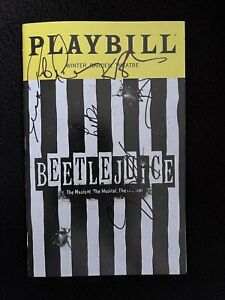
Beetlejuice Playbill 2019 Signed Alex Brightman Sophia Anne Caruso Rob McClure +
eBay This Beetlejuice Playbill from 5/2019 features the signatures of just the main principal cast members Alex Brightman, Sophia Anne Caruso, Rob McClure, Kerry Butler and Leslie Kritzer. It is a must-have for any fan of the hit Broadway musical. The playbill showcases the information about the cast and crew, as well as the show's music and creative team.With a focus on the theatre industry and specifically the Playbill object type, this item is perfect for collectors and enthusiasts alike. This unique piece of entertainment memorabilia is a great addition to any collection and since there are very few of these available for purchase. Minor flaws to this new program would be page ends are a bit scuffed. NOTE: If you saw the show or you are familiar with it then you may remember or know that at the end there was a release of green fluorescent like streamers. The last two images are mine, taken by me at the end of the show from the back of the house at The Winter Garden Theatre. They show the green streamers hanging over theatre seats, on the floor and in the hands of audience members. The third image is mine taken of the streamer I picked up after the show (about eighteen feet long) which I will include in the sale of this singned Playbill) ?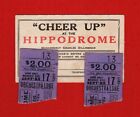
Sold on eBay June 4th, 2024
Magician HARRY HOUDINI at the New York Hippodrome "CHEER UP" 1917 Ticket Stubs
This is a rare ticket envelope with two attached ticket stubs from the September 17th, 1917 evening performance of the musical extravaganza "CHEER UP" at the New York Hippodrome in New York City. (The patriotic variety show opened at the enormous Hippodrome on August 23rd, 1917 and ran for 456 performances.) ..... The highlight of the show was legendary illusionist HARRY HOUDINI (1874 – 1926) who thrilled a packed house nightly for nineteen weeks, the longest engagement of his career. Easily out-doing anyone else in the industry, Houdini chose a much more stunning illusion than pulling a rabbit out of a hat. He made one of the Power's 10,000 lb. elephants disappear. His “Vanishing Elephant” illusion featured the world’s largest stage as well as a troupe of trained elephants. The illusion called for only a huge cabinet, an elephant, and a team of twelve, strong men. Houdini began with a cabinet, he described as “about eight feet square, twenty six inches off the floor.” All parts of the cabinets were shown to the audience and the elephant was walked inside. Once inside the cabinet, the doors and curtains were closed. Once reopened, the cabinet was empty, the elephant vanished ..... DETAILS: This rare ticket envelope measures 4 1/4" X 2 5/8" inches and has the show's title on the front and advertising for New York's Hotel Breslin on the backside. The two ticket stubs measure approx. 1 1/2" X 2" inches ..... CONDITION: (Please Note!) The tickets are glued to the front of the envelope, there are surface abrasions and glue residue on the backside of the ticket stubs and a chipped edge and tape residue on the envelope flap. Despite these flaws, this rare set will make a wonderful addition to the collection of any theatre aficionado or magic historian. This item will be carefully packaged in a protective, carded sleeve and backed by stiff cardboard.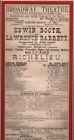
Sold on eBay August 18th, 2024
*EDWIN BOOTH RARE LARGE 1891 DOUBLE MATTED FAREWELL TO THE STAGE BROADSIDE*
A rare large original March 21, 1891 broadside, handsomely double matted for display in black and red, for Edwin Booth's final stage engagement in Manhattan. Booth retired from the stage two weeks later at the Brooklyn Academy of Music. Lawrence Barrett is billed as sharing the stage with Booth, but alas, he didn't. He died the day before on March 20. This was probably the last bill to list Lawrence Barrett. Booth carried on without his partner for the next two weeks and then ended his illustrious stage career. Dimensions seventeen by eight inches, with broadside twelve and a half by four and a half inches. Light wear otherwise fine. An extraordinary display piece of the greatest actor America has ever known. See Edwin Booth and and the Booth family's extraordinary biographies below.Shipping discounts for multiple purchases. Credit cards accepted with Paypal. Inquiries always welcome. Please visit my other eBay items for more early theatre and historical autographs, photographs and programs and great singer, actor, and actress cabinet photos and CDV's.From Wikipedia:The Booth family was an English American theatrical family of the 19th century. Its most famous and well known members were Edwin Booth, one of the leading actors of his day, and John Wilkes Booth, who assassinated Abraham Lincoln.The patriarch was Junius Brutus Booth, a London-born lawyer's son who eventually became an actor after he attended a production of Othello at the Covent Garden theatre. The prospects of fame, fortune, and freedom were very appealing to young Booth, and he displayed remarkable talent from an early age, deciding on a career in the theatre by the age of 17. He performed roles in several small theaters throughout England, and joined a tour of the Low Countries in 1814, returning the following year to make his London debut.Booth abandoned his wife and their young son in 1821 and ran off to the United States with Mary Ann Holmes, a London flower girl. They settled on some 150 acres in Harford County near Baltimore and started a family; they had 10 children, six of whom survived to adulthood [1][2]Junius Sr. and Edwin toured in California during the Gold Rush.[citation needed] Edwin bought an interest in the Winter Garden Theatre at 667 Broadway in New York City together with his brother-in-law John Sleeper Clarke. The brothers John Wilkes, Edwin, and Junius Brutus, Jr. performed there in the play Julius Caesar at a benefit in 1864, the only time they were seen together on a stage, playing Mark Antony, Brutus, and Cassius, respectively Junius Brutus Booth (1796–1852) brought his mistress Mary Ann Holmes, who bore him 10 children, to the United States.He also wrote many letters in fits of drunken anger and madness to President Andrew Jackson threatening assassination. He requested that two prisoners who had been sentenced to death for piracy, named De Ruiz and De Soto, be pardoned, else: "I will cut your throat whilst you are sleeping." This letter would later be recanted by Junius, stating, "May god preserve General Jackson and this happy republic [4]Junius Brutus Booth Jr. (1821–1883) was married to Agnes Booth. Junius Jr. never achieved the same fame as his brothers, but his third wife Agnes was popular.Their son Sydney Barton Booth (1877–1937) was an actor well into the era of modern film [5]Edwin Thomas Booth (1833–1893) came to be the foremost American Shakespearean actor of his day. He founded The Players, a New York City actors' club which continues to the present day.Edwin's grandson Edwin Booth Grossman was a painter of some note.Asia Frigga Booth (1835–1888) married John Sleeper Clarke, an actor/comedian who was briefly imprisoned in the aftermath of the assassination. They then emigrated to Britain, where he became a successful theatre manager.Creston Clarke[6] and Wilfred Clarke,[7] sons of John and Asia, were noted actors in their day.John Wilkes Booth (1838–1865) was a popular young star in less serious fare than his brothers.A Confederate sympathizer during the American Civil War, during a play attended by Abraham Lincoln, Booth took advantage of his access to the theatre to invade the President's box and assassinate the President. He was killed 12 days later by Union soldier Boston CorbettEdwin Thomas Booth (November 13, 1833 – June 7, 1893) was an American actor who toured throughout the United States and the major capitals of Europe, performing Shakespearean plays. In 1869, he founded Booth's Theatre in New York.[2] Some theatrical historians consider him the greatest American actor, and the greatest Prince Hamlet, of the 19th century.[3] His achievements are often overshadowed by his relationship with his younger brother, actor John Wilkes Booth, who assassinated President Abraham Lincoln.Booth was born in Bel Air, Maryland, into the Anglo-American theatrical Booth family. He was the son of the famous actor, Junius Brutus Booth, an Englishman, who named Edwin after Edwin Forrest and Thomas Flynn, two of Junius' colleagues. He was the elder brother of John Wilkes Booth, himself a successful actor who gained notoriety as the assassin of President Lincoln.Nora Titone, in her book My Thoughts Be Bloody, recounts how the shame and ambition of Junius Brutus Booth's three actor sons, Junius Brutus Booth, Jr. (who never achieved the stage stardom of his two younger actor brothers), Edwin Booth, and John Wilkes Booth, spurred them to strive, as rivals, for achievement and acclaim—Edwin a Unionist, and John Wilkes, a Confederate and the assassin of Abraham Lincoln [4]CareerIn early appearances, Booth usually performed alongside his father, making his stage debut as Tressel or Tressil in Colley Cibber's version of Richard III in Boston on September 10, 1849. His first appearance in New York City was in the character of Wilford in The Iron Chest, which he played at the National Theatre in Chatham Street, on the 27th of September 1850. A year later, on the illness of the father, the son took his place in the character of Richard III.[5]After his father's death in 1852, Booth went on a worldwide tour, visiting Australia and Hawaii, and finally gaining acclaim of his own during an engagement in Sacramento, California, in 1856.[6]Before his brother assassinated Lincoln, Edwin had appeared with his two brothers, John Wilkes and Junius Brutus Booth Jr., in Julius Caesar in 1864.[7] John Wilkes played Marc Antony, Edwin played Brutus, and Junius played Cassius.[8] It was a benefit performance, and the only time that the three brothers appeared together on the same stage.[9] The funds were used to erect a statue of William Shakespeare that still stands in Central Park just south of the Promenade. Immediately afterwards, Edwin Booth began a production of Hamlet on the same stage, which came to be known as the "hundred nights Hamlet", setting a record that lasted until John Barrymore broke the record in 1922, playing the title character for 101 performances From 1863 to 1867, Booth managed the Winter Garden Theatre in New York City, mostly staging Shakespearean tragedies. In 1863, he bought the Walnut Street Theatre in Philadelphia [10]After John Wilkes Booth's assassination of President Lincoln in April 1865, the infamy associated with the Booth name forced Edwin Booth to abandon the stage for many months. Edwin, who had been feuding with John Wilkes before the assassination, disowned him afterward, refusing to have John's name spoken in his house.[11] He made his return to the stage at the Winter Garden Theatre in January 1866, playing the title role in Hamlet,[6] which would eventually become his signature role.Acting styleEdwin's acting style was distinctly different from that of his father. While the senior Booth was, like his contemporaries Edmund Kean and William Charles Macready, strong and bombastic, favoring characters such as Richard III, Edwin played more naturalistically with a quiet, more thoughtful delivery, tailored to roles like Hamlet.Later lifeBooth was married to Mary Devlin from 1860 to 1863, the year of her death. They had one daughter, Edwina, born on December 9, 1861, in London. He later remarried, wedding his acting partner Mary McVicker in 1869, and became a widower again in 1881.Edwin Booth with daughter Edwina, circa 1864Portrait of Edwin Booth by John Singer Sargent, 1890, which hung at The Players clubhouse. Now in the collection of the Amon Carter Museum of American Art.In 1869, Edwin acquired his brother John's body after repeatedly writing to President Andrew Johnson pleading for it. Johnson finally released the remains, and Edwin had them buried, unmarked, in the family plot at Green Mount Cemetery in Baltimore.In 1888, Booth founded The Players, a private club for performing, literary, and visual artists and their supporters, and dedicated his home on Gramercy Park to it.His final performance was, fittingly, in his signature role of Hamlet, in 1891 at the Brooklyn Academy of Music.Robert Lincoln rescueEdwin Booth saved Abraham Lincoln's son,[12] Robert, from serious injury or even death. The incident occurred on a train platform in Jersey City, New Jersey. The exact date of the incident is uncertain, but it is believed to have taken place in late 1864 or early 1865. Robert Lincoln recalled the incident in a 1909 letter to Richard Watson Gilder, editor of The Century Magazine.The incident occurred while a group of passengers were late at night purchasing their sleeping car places from the conductor who stood on the station platform at the entrance of the car. The platform was about the height of the car floor, and there was of course a narrow space between the platform and the car body. There was some crowding, and I happened to be pressed by it against the car body while waiting my turn. In this situation the train began to move, and by the motion I was twisted off my feet, and had dropped somewhat, with feet downward, into the open space, and was personally helpless, when my coat collar was vigorously seized and I was quickly pulled up and out to a secure footing on the platform. Upon turning to thank my rescuer I saw it was Edwin Booth, whose face was of course well known to me, and I expressed my gratitude to him, and in doing so, called him by name.Booth did not know the identity of the man whose life he had saved until some months later, when he received a letter from a friend, Colonel Adam Badeau, who was an officer on the staff of General Ulysses S. Grant. Badeau had heard the story from Robert Lincoln, who had since joined the Union Army and was also serving on Grant's staff. In the letter, Badeau gave his compliments to Booth for the heroic deed. The fact that he had saved the life of Abraham Lincoln's son was said to have been of some comfort to Edwin Booth following his brother's assassination of the president Statue of Booth as Hamlet, Gramercy Park by Edmond T. Quinn, circa 1916Booth's TheatreBooth's Theatre Playbill of his Richard III circa 1872In 1867, a fire damaged the Winter Garden Theatre, resulting in the building's subsequent demolition. Afterwards, Booth built his own theatre, an elaborate structure called Booth's Theatre in Manhattan, which opened on February 3, 1869, with a production of Romeo and Juliet starring Booth as Romeo, and Mary McVicker as Juliet. Elaborate productions followed, but the theatre never became a profitable or even stable financial venture. The panic of 1873 caused the final bankruptcy of Booth's Theatre in 1874. After the bankruptcy, Booth went on another worldwide tour, eventually regaining his fortune DeathEdwin Booth had a small stroke in 1891, which precipitated his decline. He suffered another stroke in April 1893 and died June 7, 1893, in his apartment in The Players clubhouse. He was buried next to his first wife at Mount Auburn Cemetery in Cambridge, Massachusetts. His bedroom in the club has been kept untouched since his death.[13] The New York Times reported his death [14]Exhumation requestIn December 2010, descendants of Edwin Booth reported that they obtained permission to exhume the Shakespearean actor's body to obtain DNA samples to compare with a sample of his brother John's DNA to refute the rumor he had escaped after the assassination. However, Bree Harvey, a spokesperson from the Mount Auburn Cemetery in Cambridge, Massachusetts, where Edwin Booth is buried, denied reports that the family had contacted them and requested to exhume Edwin's body.[15] The family hopes to obtain DNA samples from artifacts belonging to John Wilkes, or from remains such as vertebrae stored at the National Museum of Health and Medicine in Maryland [16][17] On March 30, 2013, museum spokesperson Carol Johnson announced that the family's request to extract DNA from the vertebrae had been rejected [18]DramatizationsA number of modern dramatizations have been made of Edwin Booth's life, on both stage and screen. One of the best known is the 1955 film Prince of Players written by Moss Hart, based loosely on the popular book of that name by Eleanor Ruggles. It was directed by Philip Dunne and stars Richard Burton and Raymond Massey as Edwin and Junius Brutus Booth, Sr., with Charles Bickford and Eva Le Gallienne, the latter of whom plays Gertrude to Burton's Hamlet. The film depicts events in Booth's life well before, and then surrounding, the assassination of Lincoln by Booth's younger brother.[19]The opening scenes of Prince of Players are very similar to scenes in the earlier 1946 John Ford western My Darling Clementine. In that movie, the character of Granville Thorndyke (as acted by Alan Mowbray) is an obvious nod to Booth's father Junius, and the scenes portray essentially the same sequence where the great actor has to be retrieved from a bar and dragged back to the theatre where he is overdue to give a performance in front of a restless audience [20][21]The Brothers BOOTH!, by W. Stuart McDowell, which focuses on the relationships of the three Booth brothers leading up to the assassination of Lincoln, was workshopped and given a series of staged readings featuring David Strathairn, David Dukes, Angela Goethals, Maryann Plunkett, and Stephen Lang at the New Harmony Project,[22] and at The Guthrie Theatre Lab in Minneapolis, and later presented in New York at the Players' Club, the Second Stage Theatre, and the Boston Athenaeum. It was given its first fully staged professional production at the Bristol Riverside Theatre outside Philadelphia in 1992 [23][24][25] A second play by the same name, The Brothers Booth, which focuses on "the world of the 1860s theatre and its leading family"[26] was written by Marshell Bradley and staged in New York at the Perry Street Theatre in 2004.Oliver Ingraham Lay: Edwin Booth as Hamlet, 1887Austin Pendleton's play, Booth, which depicts the early years of the brothers Edwin, Junius, and John Wilkes Booth and their father, was produced off Broadway at the York Theatre, starring Frank Langella as Junius Brutus Booth, Sr. In a review, the play was called "a psychodrama about the legendary theatrical family of the 19th century" by The New York Times.[27] Pendleton had adapted this version from his earlier work, Booth Is Back, produced at Long Wharf Theatre in New Haven, Connecticut, in the 1991-1992 season.The Tragedian, by playwright and actor Rodney Lee Rogers, is a one-man show about Booth that was produced by PURE Theatre of Charleston, South Carolina, in 2007. It was revived for inclusion in the Piccolo Spoleto Arts Festival in May and June 2008.[28]A play by Luigi Creatore called Error of the Moon played off-Broadway on Theatre Row in New York City from August 13 to October 10, 2010. The play is a fictionalized account of Booth's life, hinging on the personal, professional, and political tensions between brothers Edwin and John Wilkes, leading up to the assassination of Lincoln.[29]In 1959, the actor Robert McQueeney played Booth in the episode "The Man Who Loved Lincoln" on the ABC/Warner Brothers western television series, Colt .45, starring Wayde Preston as the fictitious undercover agent Christopher Colt, who in the story line is assigned to protect Booth from a death threat.[30]In 1960, the anthology series television series Death Valley Days broadcast "His Brother's Keeper", in which Booth visits a small town after the Lincoln assassination, with one of the town's influential citizens trying to have him run out of town.In 1966, Martin Landau played Edwin Booth in the episode "This Stage of Fools" of the NBC western television series, Branded, starring Chuck Connors as Jason McCord. In the story line, McCord takes a job as the bodyguard to the actor Edwin Booth, brother of the presidential assassin, John Wilkes Booth [31][32]In 2013, Will Forte played Edwin Booth in the "Washington, D.C." episode of the Comedy Central's series, Drunk History, created by Derek Waters.In 2014, Edwin Booth was played by Gordon Tanner in The Pinkertons episode, "The Play's the Thing" (S1:E3). In the episode, both the "Hundred nights Hamlet" and Edwin's rescue of Robert Lincoln are mentioned LegacyGrave of Edwin BoothBooth left a considerable estate upon his death. He left charitable bequests that furthered the development of the acting profession and the treatment of mental illness. He left bequests of $5,000 each (almost $150,000 in 2021 dollars) to the Actor's' Fund, the Actors' Association of Friendship of the City of New York (Edwin Forrest Lodge), The Actors' Association of Friendship of the City of Philadelphia (Shakespeare Lodge), the Asylum Fund of New York and the Home for Incurables (West Farms, New York).[33] Other examples of his legacy include:The Players still exists in its original clubhouse at 16 Gramercy Park South in Manhattan.[34] A statue of Booth as Hamlet, by Edmond T. Quinn, has been the centerpiece of the private Gramercy Park since 1916. It can be seen by the public through the south gate of the park.Booth left a few recordings of his voice preserved on wax cylinder. One of them can be heard on the Naxos Records set Great Historical Shakespeare Recordings and Other Miscellany.[35] Another place to hear his preserved voice is on the site shown here [3:34][36] Booth's voice is barely audible with all the surface noise, but what can be deciphered reveals it to have been rich and deep.Memorials of Booth can still be found around Bel Air, Maryland. In front of the courthouse is a fountain dedicated to his memory. Inside the post office is a portrait of him. Also, his family's home, Tudor Hall, still stands and was bought in 2006 by Harford County, Maryland, to become a museum.A chamber in Mammoth Cave in Kentucky is called "Booth's Amphitheatre" – so called because Booth entertained visitors there.The Springer Opera House in Columbus, Georgia, is said to be haunted by the ghost of Edwin Booth Broadway s Booth Theatre was the first, and remains the oldest, Broadway theatre to be named in honor of an actor.Stephen Sondheim's musical Assassins mentions Edwin in "The Ballad of Booth" with the lyrics: "Your brother made you jealous, John/You couldn't fill his shoes."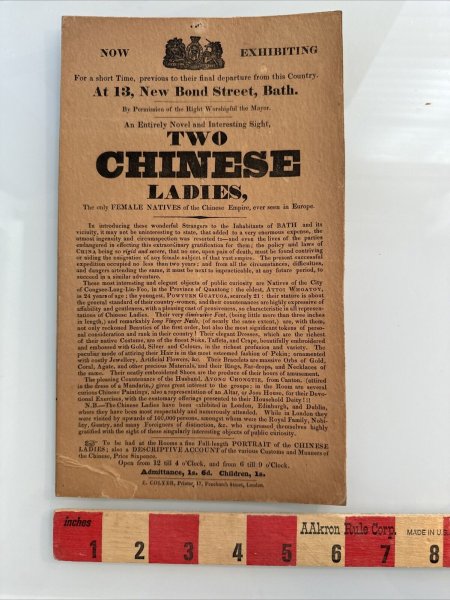
Sold on eBay April 17th, 2025
ORIGINAL 19th C Broadside Natural Curiosity Museum Freaks History Exhibition
A rare broadside of an exhibition in bath England in the 19 century exhibiting to Chinese ladies. Must've been at a time when they were a few Chinese in England. There's talk of their diminutive feet their remarkably long fingernails their dress and jewelry.. It has been laid down on card at one point as shown. Thanks for looking! Cheers, Sophie.
Sold on eBay January 15th, 2025
*BOWERY THEATRE EARLY AMERICAN THEATRE RARE LARGE 1874 STAGE BROADSIDE*
A rare original large 1874 Bowery Theatre, New York broadside for Macbeth, Metamora, Richard II, and other plays. Dimensions twenty two by eight and a quarter eighths inches. Edgewear, small tears, and archival repairs otherwise good. Shipping discounts for multiple purchases. Inquiries always welcome. Please visit my other eBay items for more early theatre, opera, film and historical autographs, photographs and programs and great actor and actress cabinet photos and CDV's. From Wikipedia: The Bowery Theatre was a playhouse on the Bowery in the Lower East Side of Manhattan, New York City. Although it was founded by rich families to compete with the upscale Park Theatre, the Bowery saw its most successful period under the populist, pro-American management of Thomas Hamblin in the 1830s and 1840s. By the 1850s, the theatre came to cater to immigrant groups such as the Irish, Germans, and Chinese. It burned down four times in 17 years, a fire in 1929 destroying it for good. Although the theatre's name changed several times (Thalia Theatre, Fay's Bowery Theatre, etc.), it was generally referred to as the "Bowery Theatre".By the mid-1820s, wealthy settler families in the new ward that was made fashionable by the opening of Lafayette Street, parallel to the Bowery, wanted easy access to fashionable high-class European drama, then only available at thePark Theatre. Under the leadership of Henry Astor, they formed the New York Association and bought the land where Astor's Bull's Head Tavern stood,[1] facing the neighborhood and occupying the area between Elizabeth, Canal (then called Walker), and Bayard streets.[2] They hired architect Ithiel Town to design the new venue.Some notable investors included Samuel Laurence Gouverneur, son-in-law to President James Monroe, and James Alexander Hamilton, son of Alexander Hamilton.[3]The new playhouse, with its Neoclassical design,[4] was more opulent than the Park, and it seated 3,500 people, making it the biggest theatre in the United States at the time.[5] Frances Trollope compared it to the Park Theatre as "superior in beauty; it is indeed as pretty a theatre as I ever entered, perfect as to size and proportion, elegantly decorated, and the scenery and machinery equal to any in London [6]The Bowery Theatre opened on 22 October 1826 under the name New York Theatre, with the comedy The Road to Ruin, by Thomas Holcroft, under the management of Charles A. Gilfert. New York Mayor Philip Hone spoke at the opening ceremony, imploring the theatre's intended upper-class audience: "It is therefore incumbent upon those whose standing in society enables them to control the opinions and direct the judgment of others, to encourage, by their countenance and support, a well-regulated theatre."[7] Its first few seasons were devoted to ballet, opera, and high drama. The theatre was by this time quite fashionable, and the northward expansion of Manhattan gave the theatre access to a large patronage. The theatre burnt out in 1828, but was rebuilt behind the same facade and reopened under the name Bowery Theatre.[8] Gilfert's understanding of advertising was keen, but in 1829 the owners fired him.Hamblin's tenureThe owners hired Thomas Hamblin and James H. Hackett in August 1830 to manage the theatre. A month later, Hackett left Hamblin in complete control. After the Bowery burned down later that year, Hamblin rebuilt. He then took the theatre in a decidedly different direction for what would be its most innovative and successful period.American theatres stratified in the Jacksonian Era, and the Bowery emerged as the home of American nativists and populist causes, placing it in direct contrast to the Park Theatre's cultivated image of traditional European high culture. This was partially the result of an anti-British theatre riot at the Park; Hamblin renamed the playhouse "theAmerican Theatre, Bowery" in reaction. Hamblin hired unknown American actors and playwrights and allowed them to play for long runs of up to a month. Before 1843, earlyblackface performers such as George Washington Dixon and Thomas D. Rice played there frequently, and acts such as J. B. Booth, Edwin Forrest, Louisa Lane Drew, andFrank Chanfrau also gained renown on the Bowery's stage. George L. Fox and hispantomime became the most popular act at the Bowery until after the Civil War. Bowery productions also debuted or popularized a number of new character types, including the Bowery B'hoy, the Yankee, the Frontiersman, and the blackface Negro.The pro-Americanism of the Bowery's audience came to a head during the Farren Riots of 1834. Farren,[9] the Bowery's British-born stage manager, had reportedly made anti-American comments and fired an American actor. Protesters reacted by attacking the homes, businesses, and churches of abolitionists and blacks in New York City and then storming the theatre on 9 July. Farren apologized for his comments, and George Washington Dixon sang popular songs to quell the rioters.Hamblin defied conventions of theatre as high culture by booking productions that appealed to working-class patrons and by advertising them extensively according to Gilfert's model. Animal acts, blackface minstrel shows, and melodrama enjoyed the most frequent billings, and hybrid forms, such as melodramas about dogs saving their human masters, became unprecedented successes. Spectacular productions with advanced visual effects, including water and fire, featured prominently. Hamblin also innovated by using gas lighting in lieu of candles and kerosene lamps. The Bowery Theatre earned the nickname "The Slaughterhouse" for its low-class offerings, and terms like "Bowery melodrama" and "Bowery actors" were coined to characterize the new type of theatre.[10]In the spring of 1834, Hamblin began buying shares in the theatre from the New York Association; he had enough to control the enterprise completely within 18 months. By the time the Bowery burned again in September 1836, it was the most popular playhouse in New York City,[11] despite steep increases in competition (the Bowery Amphitheatre was right across the street). Visual spectacle had become such an integral part of its appeal that Hamblin claimed $5,000 in wardrobe losses from the fire.[12] Hamblin bought out the remaining shares in the theatre and rented the site to W. E. Dinneford and Thomas Flynn, who rebuilt. When this interim Bowery burned down in February 1838, Hamblin replaced it with a bigger and more opulent structure, which opened in May 1839.Through Hamblin's actions, working-class theatre emerged as a form in its own right, and melodrama became the most popular form of American theatre. Low-class patrons such as Bowery b'hoys and g'hals predominated in the audience. The Spirit of the Times described the Bowery's patrons:“By reasonable computation there were about 300 persons on the stage and wings in fatigue with side arms—a few jolly tars, and a number of 'apple-munching urchins.' The scene was indescribably ludicrous. Booth played [Richard III] in his best style, and was really anxious to make a hit, but the confusion incidental to such a crowd on the stage, occasioned constant and most humorous interruptions. It was every thing or any thing, but a tragedy. In the scene with Lady Anne, a scene so much admired for its address, the gallery spectators amused themselves by throwing pennies and silver pieces on the stage, which occasioned an immense scramble among the boys, and they frequently ran between King Richard and Lady Anne, to snatch a stray copper. In the tent scene, so solemn and so impressive, several curious amateurs went up to the table, took up the crown, poised the heavy sword, and examined all the regalia with great care, while Richard was in agony from the terrible dream; and when the scene changed, discovering the ghosts of King Henry, Lady Anne and children, it was difficult to select them from the crowd who thrust their faces and persons among the Royal shadows.The Battle of Bosworth Field capped the climax—the audience mingled with the soldiers and raced across the stage, to the shouts of the people, the roll of the drums and the bellowing of the trumpets; and when the fight between Richard and Richmond came on, they made a ring round the combattants to see fair play, and kept them at if for nearly a quarter of an hour by "Shrewsberry clock [13]”Some sources even suggest that patrons engaged in sexual behavior in the lobbies and boxes.[14] Understandably, Hamblin was careful to remain in this crowd's good graces. For example, he regularly offered use of the Bowery Theatre for the annual firemen's ball. Only the Chatham Garden Theatre boasted a rowdier audience [15]Profits were harder to come by in the 1840s, as more playhouses sprung up in New York. Hamblin staged more effects-driven melodrama and later increased bookings of circus acts, minstrel shows, and other variety entertainments. The Bowery burned down once more in April 1845.[16] This time, Hamblin had fire insurance, and he rebuilt with an eye toward appealing to a more upscale patronage and to staging more spectacular melodrama. The theatre now seated 4,000 and with a stage 126 feet (38 m) square, secured its place as one of the largest playhouses in the world.[5] The architect and builder of the new theatre was J. M. Trimble.[17] Hamblin left the management to A. W. Jackson, though Jackson and later managers largely upheld Hamblin's emphasis on melodrama and visual splendor. Hamblin died in January 1853, and the theatre remained in his family until 1867.Successful plays of Hamblin's tenure included:The Elephant of Siam and the Fire Fiend by Samuel Beazley, which featured the elephant Mademoiselle D'Jeck and ran for 18 consecutive performances in early 1831 [18]Mazeppa Or, The Wild Horse of Ukraine, which debuted on July 22, 1833 and had 43 consecutive performances, an astounding feat for its time.[18]Nick of the Woods, adapted by Louisa Honor de Medina from the popular novel, debuted in February 1838, and reappeared after a theatre fire in May 1839 starringJoseph Proctor.Putnam, the Iron Son of '76 by Nathaniel Bannister. This play debuted on August 5, 1844 and ran for 78 consecutive performances [19][20]Later managementBy the middle of the 19th century, immigrant groups, notably the Irish, began populating the Bowery neighborhood. They came to form a significant portion of the Bowery's audience, mostly in the low-price gallery section. In order to cater to them, the theatre offered plays by James Pilgrim and other Irish playwrights. Meanwhile, the Bowery emerged as the theatrical center for New York's Lower East Side.Germans Gustav Amberg, Heinrich Conried, and Mathilde Cottrelly converted the Bowery into the Thalia Theatre in 1879, offering primarily German theatre during their ownership. In 1891, Yiddish theatre became the predominant attraction. Italian vaudeville succeeded this, followed by Chinese vaudeville.In 1894, Maria Roda addressed a large rally at the Thalia Theater celebrating Emma Goldman's release from prison. Although Roda spoke in Italian and Goldman understood none of it, she was moved by Roda's charismatic presence. She wrote, "Maria's strange beauty and the music of her speech roused the whole assembly to tensest enthusiasm. Maria proved a veritable ray of sunlight to me." She then pledged to become Maria Roda's "teacher, friend, comrade [21] Fay s Bowery Theatre" burned down on 5 June 1929 under Chinese management and was never rebuilt.
Sold on eBay December 11th, 2023
INTO THE WOODS BROADWAY CAST NYC 1988 STEPHEN SONDHEIM BARBARA BRYNE PLAYBILL.
eBay INTO THE WOODS BROADWAY CAST NYC 1988 STEPHEN SONDHEIM JAMES LAPINE MARTIN BECK.A Narrator introduces four characters: Cinderella, who wishes to attend the King's festival; Jack who wishes his cow, Milky White, would give milk; a Baker; and his Wife, both of whom wish to have a child. Cinderella's step-family mocks her wish while Jack's mother condemns Jack for never listening and how she wishes to be wealthy. Little Red Ridinghood appears at the bakery wishing for bread and sweets to bring to her grandmother's house. They give her a loaf of bread and allow her to take some sweets; she ends up taking more than they offered. Cinderella's stepmother puts a pot of lentils into the fireplace for Cinderella to clean up, promising that only then, they will let her go to the festival. She calls birds from the skies to help her clean up which they do. Meanwhile, an ugly old witch appears at the bakery revealing to the baker and his wife that they are infertile because of a spell she placed on the baker's father many years ago. She tells them that when the baker's mother was pregnant, she craved vegetables so his father stole them from witch's garden. He stole supposedly normal beans which turned out to be magic. Because she had lost the beans, the witch's mother turned her ugly and in return, the witch stole their daughter, Rapunzel, and placed the spell. She explains that the only way to lift the spell is to find four ingredients in the woods: a cow as white as milk, a cape as red as blood, hair as yellow as corn, and a slipper as pure as gold and bring them to her in three days before midnight. She hurries off and Cinderella's step-family prepares to leave for the festival. Cinderella asks if she can go, but her stepmother points out that, while she picked up the lentils, she is dirty from the ashes. They leave and even Cinderella's father barely acknowledges her existence. All begin the journey into the woods: Jack to sell his beloved cow; Cinderella to her mother's grave; Little Red to her grandmother's house; and the Baker, refusing his Wife's help, to find the ingredients. Cinderella receives a gown and golden slippers from her mother's spirit after wishing she could live a life in the palace. A Mysterious Man mocks Jack for valuing his cow more than a "sack of beans". Little Red meets a hungry Wolf who persuades her to take a longer path and admire the beauty, with his own thoughts of eating both her and her grandmother. The Baker, secretly followed by his Wife, meets Jack. They convince Jack that the beans found in the Baker's father's jacket are magic, trade them for the cow and Jack bids Milky White a tearful farewell. The Baker feels guilty about their deceit, but his wife reassures him. The Witch has raised Rapunzel in a tall tower accessible only by climbing Rapunzel's long, golden hair; a Prince spies Rapunzel and plans to meet her. The Baker, in pursuit of the red cape, slays the Wolf and rescues Little Red and her grandmother. In return, Little Red gives him her cape, and reflects on her experiences. Jack's Mother tosses his beans aside, which grow into an enormous stalk, and sends him to bed without food. Cinderella flees the Festival, pursued by another Prince, and the Baker's Wife hides her; asked about the ball, Cinderella is unimpressed. Spotting Cinderella's gold slippers, the Baker's Wife chases her and loses Milky White. The characters recite morals as the day ends. Jack describes his adventure climbing the beanstalk. He gives the Baker gold stolen from the giants to buy back his cow, and returns up the beanstalk to find more; the Mysterious Man questions the Baker's price of a child, and steals the money. Cinderella's Prince and Rapunzel's Prince, who are brothers, compare their unobtainable amours. The Baker's Wife overhears their talk of a girl with golden hair. She fools Rapunzel and takes a piece of her hair. The Mysterious Man returns Milky White to the Baker. The Baker's Wife again fails to seize Cinderella's slippers. The Baker admits they must work together. Jack arrives with a hen that lays golden eggs, but Milky White keels over dead as midnight chimes. The Witch discovers the Prince's visits and demands Rapunzel stay sheltered from the world. She refuses, and the Witch cuts off Rapunzel's hair and banishes her. The Mysterious Man gives the Baker money for another cow. Jack meets Little Red, now sporting a wolf skin cape and knife. He brags about his adventures in the sky, and mentions a golden Giant's harp. She skeptically goads him into returning to the Giant's home to retrieve it. Cinderella, torn between staying with her Prince or escaping, leaves him a slipper as a clue, and trades shoes with the Baker's Wife. The Baker arrives with another cow; they now have all four items. A great crash is heard, and Jack's mother reports a dead Giant in her backyard, which no one seems to care about. Jack returns with a magic harp. The Witch discovers the new cow is useless, and resurrects Milky White, who is fed the ingredients but fails to give milk. The Witch explains Rapunzel's hair will not work, and the Mysterious Man offers corn silk instead; Milky White produces the potion. The Witch reveals the Mysterious Man is the Baker's father, and she drinks – he falls dead, the curse is broken, and the Witch regains her youth and beauty. Cinderella's Prince seeks the girl who fits the slipper; the desperate stepsisters mutilate their feet. Cinderella succeeds and becomes his bride. Rapunzel bears twins and is found by her Prince. The Witch finds her, and attempts to claim her back, but the Witch's powers are gone. At Cinderella's wedding, her stepsisters are blinded by birds, and the Baker's Wife, very pregnant, thanks Cinderella for her help. Congratulating themselves on living happily, the characters fail to notice another beanstalk growing.
Sold on eBay Apr 08, 2021
ON YOUR FEET Cast Josh Segarra, Ana Villafane Signed Opening Night Playbill
This was an amazing cast so to have such a large collection of signatures on an Opening Night Playbill is a really wonderful item! The Playbill does have flaws that I have tried to highlight in detail images.
Sold on eBay Jan, 27th 2020
ON YOUR FEET Emilio Estefan & Gloria Estefan Signed Playbill SUPER RARE
<br /><br /><br /><br /><br /><br /><br /><br /><br /><br /><br /><br /><br /><br /><br /><br /><br /><br /><br /><br /><br /><br /><br /><br /><br /><br /> ON YOUR FEET Emilio Estefan & Gloria Estefan Signed Playbill SUPER RARE Click images to enlarge Description This fantastic item was generously donated by the Broadway company of On Your Feet.<br /> <br /> This is a Playbill from On Your Feet that has been autographed by Emilio and Gloria Estefan. Glor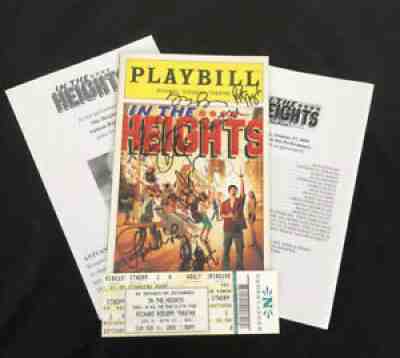
Sold on eBay Apr 07, 2021
Signed IN THE HEIGHTS Playbill- RARE - Lin Manuel Miranda, Christopher Jackson
SIGNED IN THE HEIGHTS PLAYBILL. R obin De Jesus (The Boys in the Band, RENT). L in Manuel-Miranda (Hamilton, Disney Moana). A ndrea Burns (On Your Feet, Beauty and the Beast, Songs for a New World).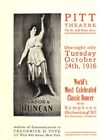
Sold on eBay May 5th, 2024
*LEGENDARY DANCER ISADORA DUNCAN RARE 1916 DANCE PROGRAM*
A rare large original 1916 dance program for the legendary Isadora Duncan. Four pages. Dimensions ten and three quarters by five and a half inches. Light wear otherwise good. See Isadora Duncan's extraordinary biography below. Shipping discounts for multiple purchases. Inquiries always welcome. Please visit my other eBay items for more early ballet and dance memorabilia, early theatre, opera, film, magic, and historical autographs, photographs, programs and broadsides, and great actor and actress cabinet photos and CDV's.From Isadora Duncan (May 26, 1877 or May 27, 1878[a] – September 14, 1927) was an American and French dancer who performed to acclaim throughout Europe. Born in California, she lived in Western Europe and the Soviet Union from the age of 22 until her death at age 50, when her scarf became entangled in the wheels and axle of the car in which she was riding.Isadora Duncan was born in San Francisco, the youngest of the four children of Joseph Charles Duncan (1819–1898), a banker, mining engineer and connoisseur of the arts, and Mary Isadora Gray (1849–1922). Her brothers were Augustin Duncan and Raymond Duncan;[2] her sister, Elizabeth Duncan, was also a dancer.[3][4] Soon after Isadora's birth, her father was exposed to illegal bank dealings, and the family became extremely poor.[2]Her parents divorced when she was an infant,[5] and her mother moved with her family to Oakland, California, where she worked as a seamstress and piano teacher. From ages six to ten, Isadora attended school, but she dropped out, finding it constricting. As her family was very poor, she and her three siblings earned money by teaching dance to local children.[2]In 1896, Duncan became part of Augustin Daly's theater company in New York, but she soon became disillusioned with the form and craved a different environment with less of a hierarchy.[6] Her father, along with his third wife and their daughter, died in 1898 when the British passenger steamer SS Mohegan ran aground off the coast of Cornwall [7]WorkPhoto by Arnold Genthe of Duncan performing barefoot during her 1915–1918 American tourAbraham Walkowitz's Isadora Duncan #29, one of many works of art she inspired.Duncan began her dancing career at a very early age by giving lessons in her home to neighbourhood children, and this continued through her teenage years.[8] Her novel approach to dance was evident in these early classes, in which she "followed [her] fantasy and improvised, teaching any pretty thing that came into [her] head".[9] A desire to travel brought her to Chicago, where she auditioned for many theater companies, finally finding a place in Augustin Daly's company. This took her to New York City where her unique vision of dance clashed with the popular pantomimes of theater companies.[10] In New York, Duncan took some classes with Marie Bonfanti but was quickly disappointed in ballet routine.Feeling unhappy and unappreciated in America, Duncan moved to London in 1898. She performed in the drawing rooms of the wealthy, taking inspiration from the Greek vases and bas-reliefs in the British Museum.[11][12] The earnings from these engagements enabled her to rent a studio, allowing her to develop her work and create larger performances for the stage.[13] From London, she traveled to Paris, where she was inspired by the Louvre and the Exposition Universelle of 1900.[14]In 1902, Loie Fuller invited Duncan to tour with her. This took Duncan all over Europe as she created new works using her innovative technique,[15] which emphasized natural movement in contrast to the rigidity of tradition ballet.[16] She spent most of the rest of her life touring Europe and the Americas in this fashion.[17] Despite mixed reaction from critics, Duncan became quite popular for her distinctive style and inspired many visual artists, such as Antoine Bourdelle, Auguste Rodin, Arnold Rönnebeck, and Abraham Walkowitz, to create works based on her.[18]Duncan disliked the commercial aspects of public performance, such as touring and contracts, because she felt they distracted her from her real mission, namely the creation of beauty and the education of the young.[citation needed] To achieve her mission, she opened schools to teach young women her philosophy of dance. The first was established in 1904 in Berlin Grunewald Germany. This institution was the birthplace of the "Isadorables" (Anna, Maria-Theresa, Irma, Liesel, Gretel, and Erika[19]), Duncan's protégées who would continue her legacy.[20] Duncan legally adopted all six girls in 1919, and they took her last name.[21] After about a decade in Berlin, Duncan established a school in Paris that was shortly closed because of the outbreak of World War I.[22]In 1910, Duncan met the occultist Aleister Crowley at a party, an episode recounted by Crowley in his Confessions [23] He refers to Duncan as "Lavinia King", and used the same invented name for her in his novel Moonchild. Crowley wrote of Duncan that she "has this gift of gesture in a very high degree. Let the reader study her dancing, if possible in private than in public, and learn the superb unconsciousness — which is magical consciousness — with which she suits the action to the melody."[24] Crowley was, in fact, more attracted to Duncan's bohemian companion Mary Dempsey (a.k.a. Mary D'Este or Desti), with whom he had an affair. Desti had come to Paris in 1901 where she soon met Duncan, and the two became inseparable. Desti, who also appeared in Moonchild (as "Lisa la Giuffria") and became a member of Crowley's occult order,[b] later wrote a memoir of her experiences with Duncan.[25]In 1911, the French fashion designer Paul Poiret rented a mansion — Pavillon du Butard in La Celle Saint Cloud — and threw lavish parties, including one of the more famous grandes fêtes, La fête de Bacchus on June 20, 1912, re-creating the Bacchanalia hosted by Louis XIV at Versailles. Isadora Duncan, wearing a Greek evening gown designed by Poiret,[26] danced on tables among 300 guests; 900 bottles of champagne were consumed until the first light of day.[26]Duncan c. 1916–1918Duncan said to have posed for the photographer Eadweard Muybridge,[27] placed an emphasis on "evolutionary" dance motion, insisting that each movement was born from the one that preceded it, that each movement gave rise to the next, and so on in organic succession. Her dancing defined the force of progress, change, abstraction and liberation. In France, as elsewhere, Duncan delighted her audience.[28]In 1914, Duncan moved to the United States and transferred her school there. A townhouse on Gramercy Park was provided for its use, and its studio was nearby, on the northeast corner of 23rd Street and Fourth Avenue (now Park Avenue South).[29] Otto Kahn, the head of Kuhn, Loeb & Co., gave Duncan use of the very modern Century Theatre at West 60th Street and Central Park West for her performances and productions, which included a staging of Oedipus Rex that involved almost all of Duncan's extended entourage and friends.[30] During her time in New York, Duncan posed for a number of studies by the photographer Arnold Genthe.Duncan had been due to leave the United States in 1915 aboard the RMS Lusitania on its ill-fated voyage, but historians believe her financial situation at the time drove her to choose a more modest crossing.[31] In 1921, Duncan's leftist sympathies took her to the Soviet Union, where she founded a school in Moscow. However, the Soviet government's failure to follow through on promises to support her work caused her to return to the West and leave the school to her protégée Irma.[32] In 1924, Duncan composed a dance routine called Varshavianka to the tune of the Polish revolutionary song known in English as Whirlwinds of Danger [33]Philosophy and techniqueDuncan in a Greek-inspired pose and wearing her signature Greek tunic. She took inspiration from the classical Greek arts and combined them with an American athleticism to form a new philosophy of dance, in opposition to the rigidity of traditional ballet.Breaking with convention, Duncan imagined she had traced dance to its roots as a sacred art.[34] She developed from this notion a style of free and natural movements inspired by the classical Greek arts, folk dances, social dances, nature and natural forces as well as an approach to the new American athleticism which included skipping, running, jumping, leaping and tossing [citation needed]Duncan's philosophy of dance moved away from rigid ballet technique and towards what she perceived as natural movement. To restore dance to a high art form instead of merely entertainment, she strove to connect emotions and movement: "I spent long days and nights in the studio seeking that dance which might be the divine expression of the human spirit through the medium of the body's movement."[35] She believed dance was meant to encircle all that life had to offer—joy and sadness. Duncan took inspiration from ancient Greece and combined it with an American love of freedom. Her movement was feminine and arose from the deepest feelings in her body. This is exemplified in her revolutionary costume of a white Greek tunic and bare feet. Inspired by Greek forms, her tunics also allowed a freedom of movement that corseted ballet costumes and pointe shoes did not.[36] Costumes were not the only inspiration Duncan took from Greece: she was also inspired by ancient Greek art, and utilized some of its forms in her movement (see image) [37]Duncan wrote of American dancing: "let them come forth with great strides, leaps and bounds, with lifted forehead and far-spread arms, to dance."[38] Her focus on natural movement emphasized steps, such as skipping, outside of codified ballet technique. Duncan also cited the sea as an early inspiration for her movement.[39] Also, she believed movement originated from the solar plexus, which she thought was the source of all movement.[35] It is this philosophy and new dance technique that garnered Duncan the title of the creator of modern dance.Photo studies of Isadora Duncan made in New York by Arnold Genthe during her visits to America in 1915–1918 Personal lifeDuncan with her children Deirdre and Patrick, in 1913In both professional and private life, Duncan flouted traditional mores and morality. She was bisexual[40] and an atheist,[41] and alluded to her communism during her last United States tour, in 1922–23: she waved a red scarf and bared her breast on stage in Boston, proclaiming, "This is red! So am I!"[42]Duncan bore two children, both out of wedlock. The first, Deirdre Beatrice (born September 24, 1906), by theatre designer Gordon Craig, and the second, Patrick Augustus (born May 1, 1910),[43] by Paris Singer, one of the many sons of sewing machine magnate Isaac Singer. Both children drowned in the care of their nanny in 1913 when their runaway car went into the Seine [43]Following the accident, Duncan spent several months recuperating in Corfu with her brother and sister. She then spent several weeks at the Viareggio seaside resort with the actress Eleonora Duse. The fact that Duse had just left a relationship with the rebellious and epicene young feminist Lina Poletti fueled speculation as to the nature of Duncan and Duse's relationship, but there has never been any indication that the two were involved romantically [44]Duncan and Sergei YeseninIn her autobiography, Duncan relates that she begged a young Italian stranger, the sculptor Romano Romanelli,[45] to sleep with her because she was desperate for another baby. She became pregnant by him, and gave birth to a son on August 13, 1914; the infant died shortly after birth [46][47]In 1921, after the end of the Russian Revolution, Duncan moved to Moscow where she met the acclaimed poet Sergei Yesenin, who was 18 years her junior. On May 2, 1922, they married, and Yesenin accompanied her on a tour of Europe and the United States. However, the marriage was brief, and in May 1923 he left Duncan and returned to Moscow. Two years later, on December 28, 1925, Yesenin was found dead in his room in the Hotel Angleterre in St Petersburg in an apparent suicide [48]Duncan had a relationship with the poet and playwright Mercedes de Acosta, as documented in numerous revealing letters they wrote to each other.[49] In one, Duncan wrote, "Mercedes, lead me with your little strong hands and I will follow you – to the top of a mountain. To the end of the world. Wherever you wish."[50]Later lifeBy the late 1920s, Duncan's performing career had dwindled, and she became as notorious for her financial woes, scandalous love life and all too frequent public drunkenness as for her contributions to the arts. She spent her final years moving between Paris and the Mediterranean, running up debts at hotels. She spent short periods in apartments rented on her behalf by a decreasing number of friends and supporters, many of whom attempted to assist her in writing an autobiography. They hoped it might be successful enough to support her.[citation needed] In a reminiscent sketch, Zelda Fitzgerald wrote how she and F. Scott Fitzgerald, her husband, sat in a Paris cafe watching a somewhat drunk Duncan. He would speak of how memorable it was, but what Zelda recalled was that while all eyes were watching Duncan, Zelda was able to steal the salt and pepper shakers from the table.[51]In his book Isadora, an Intimate Portrait, Sewell Stokes, who met Duncan in the last years of her life, describes her extravagant waywardness. Duncan's autobiography My Life was published in 1927. The Australian composer Percy Grainger called Isadora's autobiography a "life-enriching masterpiece [52]DeathDuncan s tomb at Père Lachaise CemeteryOn the night of September 14, 1927, in Nice, France, Duncan was a passenger in an Amilcar CGSS automobile owned by Benoît Falchetto, a French-Italian mechanic. She wore a long, flowing, hand-painted silk scarf, created by the Russian-born artist Roman Chatov, a gift from her friend Mary Desti, the mother of American film director Preston Sturges. Desti, who saw Duncan off, had asked her to wear a cape in the open-air vehicle because of the cold weather, but she would only agree to wear the scarf.[53] As they departed, she reportedly said to Desti and some companions, "Adieu, mes amis. Je vais à la gloire !" ("Farewell, my friends. I go to glory!"); but according to the American novelist Glenway Wescott, Desti later told him that Duncan's actual parting words were, "Je vais à l'amour" ("I am off to love"). Desti considered this embarrassing, as it suggested that she and Falchetto were going to her hotel for a tryst.Her silk scarf, draped around her neck, became entangled around the open-spoked wheels and rear axle, pulling her from the open car and breaking her neck.[1] Desti said she called out to warn Duncan about the scarf almost immediately after the car left. Desti brought Duncan to the hospital, where she was pronounced dead.[53]As The New York Times noted in its obituary, Duncan "met a tragic death at Nice on the Riviera." "According to dispatches from Nice, Duncan was hurled in an extraordinary manner from an open automobile in which she was riding and instantly killed by the force of her fall to the stone pavement."[57] Other sources noted that she was almost decapitated by the sudden tightening of the scarf around her neck.[58] The accident gave rise to Gertrude Stein's mordant remark that "affectations can be dangerous".[59] At the time of her death, Duncan was a Soviet citizen. Her will was the first of a Soviet citizen's to be probated in the U.S.[60]Duncan was cremated, and her ashes were placed next to those of her children[61] in the columbarium at Père Lachaise Cemetery in Paris.[62] On the headstone of her grave is inscribed École du Ballet de l'Opéra de Paris ("Ballet School of the Opera of Paris ) LegacyDuncan is known as "The Mother of Dance". While her schools in Europe did not last long, Duncan's work had impact in the art and her style is still danced based upon the instruction of Maria-Theresa Duncan,[63] Anna Duncan,[64] and Irma Duncan,[65] three of her six adopted daughters. The adoption process was never verified, but all six of Isadora's dancers did change their last name to Duncan. Through her sister, Elizabeth, Duncan's approach was adopted by Jarmila Je?ábková from Prague where her legacy persists.[66] By 1913 she was already being celebrated. When the Théâtre des Champs Élysées was built, Duncan's likeness was carved in its bas-relief over the entrance by sculptor Antoine Bourdelle and included in painted murals of the nine muses by Maurice Denis in the auditorium. In 1987, she was inducted into the National Museum of Dance and Hall of Fame.Anna, Lisa,[67] Theresa and Irma, pupils of Isadora Duncan's first school, carried on the aesthetic and pedagogical principles of Isadora's work in New York and Paris. Choreographer and dancer Julia Levien was also instrumental in furthering Duncan's work through the formation of the Duncan Dance Guild in the 1950s and the establishment of the Duncan Centenary Company in 1977 [68]Another means by which Duncan's dance techniques were carried forth was in the formation of the Isadora Duncan Heritage Society, by Mignon Garland, who had been taught dance by two of Duncan's key students. Garland was such a fan that she later lived in a building erected at the same site and address as Duncan, attached a commemorative plaque near the entrance, which is still there as of 2016. Garland also succeeded in having San Francisco rename an alley on the same block from Adelaide Place to Isadora Duncan Lane.[69][70]In medicine, the Isadora Duncan Syndrome refers to injury or death consequent to entanglement of neckwear with a wheel or other machinery [71]In popular cultureDuncan has attracted literary and artistic attention from the 1920s to the present, in novels, film, ballet, theatre, music, and poetry.Duncan has been portrayed in novels including Aleister Crowley's Moonchild (as 'Lavinia King'), published in 1923,[72] and Upton Sinclair's World's End (1940) and Between Two Worlds (1941), the first two novels in his Pulitzer Prize winning Lanny Budd series.[73] She is also the subject of Amelia Gray's novel Isadora (2017).[74] Two characters in the A Series of Unfortunate Events series of novels are named after her, Isadora Quagmire and Duncan Quagmire [75]Among the films featuring Duncan are:The 1966 BBC biopic by Kenneth Russell, Isadora Duncan, the Biggest Dancer in the World, which was introduced by Duncan's biographer, Sewell Stokes, Duncan was played by Vivian Pickles.[76]The 1968 film Isadora, nominated for the Palme d'Or at Cannes, stars Vanessa Redgrave as Duncan. The film was based in part of Duncan's autobiography. Redgrave was nominated for the Academy Award for Best Actress for her performance as Duncan [76][77]Archival footage of Duncan was used in the 1985 popular documentary That's Dancing [78][79]A 1989 documentary, Isadora Duncan: Movement from the Soul, was nominated for the Grand Jury Prize at the 1989 Sundance Film Festival [80]Ballets based on Duncan include:In 1976 Frederick Ashton created a short ballet entitled Five Brahms Waltzes in the Manner of Isadora Duncan for Lynn Seymour of the Royal Ballet, in which "Ashton fused Duncan's style with an imprint of his own"; Marie Rambert claimed after seeing it that it was exactly as she remembered Duncan dancing.[81]In 1981, she was the subject of a ballet, Isadora, written and choreographed by the Royal Ballet's Kenneth MacMillan, and performed at Covent Garden.[82]On the theatre stage, Duncan is portrayed in:A 1991 stage play When She Danced by Martin Sherman about Duncan's later years, won the Evening Standard Award for Vanessa Redgrave as Best Actress.[83]In 2016, Lily-Rose Depp portrayed Duncan in The Dancer, a French biographical musical drama of dancer Loie Fuller [84]Duncan is featured in music in:The popular 1970s TV sitcom Maude mentions her in its theme song: "Isadora was the first bra burner Ain t ya glad she showed up?"Celia Cruz recorded a track titled Isadora Duncan with the Fania All-Stars for the album Cross Over released in 1979.[85]Rock musician Vic Chesnutt included a song about Duncan on his debut album Little.[86]Rock band Burden of a day included a song about Duncan on their album the poem Fever 103 by Sylvia Plath, the speaker alludes to Isadora's scarves.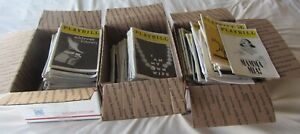
Sold on eBay February 17th, 2024
Huge lot of 186 BROADWAY PLAYBILLS from the 2000's only - UNIQUE PLAYBILLS
*** HUGE PRICE REDUCTION ***You're looking a HUGE lot of 186 of random official BROADWAY PLAYBILLS from the 2000's only (2000 through 2007). All of these playbills have www playbill com written on the front cover and cover theater all over America, but mostly in the NYC area. These playbills are unique for the theatre and years of issue. In other words, there are no exact duplicates, but plays from the same theater for a different date with different cover and contents. Some have black & white cover pages while other have colorized cover pages. These programs are used, but in good vintage condition overall. Some of the programs are in better condition than others (none of them is complete beat up). The programs have imperfections such as: corner dings, creases, fold marks, writing (like a date on the show), sticker on cover page (with date), staple marks (from ticket stub), clear tape on corner of cover page, very small insignificant tears, minor cover page/spine wear, discoloration or staining due to age, and other similar imperfections. See pictures. Other minor flaws may be present. What you see is what you get. A few of these programs may come with original inserts. To be sold as a lot only. Great starter collection or opportunity to add to your playbill collection Here s a link to my UPS, USPS or FedEx Ground shipping within Continental US. Priority Mail international shipping is $150.Please ask any questions before making a purchase. Thanks and good luck! Complete list of programs in partially alphabetical order:1.) Address Unknown (Promenade, July 2004)2.) Alive On Broadway (Helen Hayes, August 2006)3.) Almost Heaven - Songs Of John Denver (Promenade, December 2005)4.) Altar Boyz (Dodger Stages, December 2005)5.) All Shook Up (Palace, April 2005)6.) Allergists Wife, The (Ethel Barrymore, July 2001)7.) Apple Tree, The (New York City Center, May 2005)8.) Assassins (Roundabout Studio 54, June 2004)9.) Awake And Sing! (Belasco, March 2006)10 )Barefoot In The Park (Cort, February 2006)11.)Bash! (City Center, November 2003)12.)Bash! (City Center, November 2004)13.)Beauty And The Beast (Lunt-Fontanne, June 2001)14.)Bells Are Ringing (Plymouth, March 2001)15.)Big River The Adventures Of Huckleberry Finn (American Airlines, July 2003)16.)Birdie Blue (Second Stage, July 2005)17.)Bklyn The Musical (Gerald Schoenfeld, June 2005)18.)Bklyn The Musical (Plymouth, September 2004)19.)Blonde In The Thunderbird, The (Brooks Atkinson, July 2005)20 )Bloomer Girl (City Center, March 2001)21.)Blue (Roundabout At The Gramercy, June 2001)22.)Blue Man Group (Astor Place, January 2004)23.)Boy From Oz, The (Imperial, June 2004)24 )Brooklyn Boy (Manhattan At The Biltmore, January 2005)25.)Burn This (Signature At The Union Square, September 2002)26.)Bye Bye Birdie (City Center, May 2004)27 )Can Can (City Center, February 2004)28 )Carnival (City Center, February 2002)29 )Caroline Or Change (Eugene O'Neill, September 2004)30 )Chicago The Musical (Shubert, February 2002)31 )Chicago The Musical (Ambassador, May 2006)32.)Chitty Chitty Bang Bang (Hilton, July 2005)33.)Chorus Line, A (Gerald Schoenfeld, June 2007)34.)Chorus Line, A (Curran, August 2006)35.)Class Act, A (Ambassador, June 2001)36 )Company (Ethel Barrymore, June 2007)37 )Company (Etehl Barrymore, November 2006) colorized38 )Connecticut Yankee (City Center, February 2001)39 )Constant Wife, The (Roundabout, June (Shubert, 2002)41 )Copenhagen (Royale, 2001)42 )Curtains (Al Hirschfeld, June 2007)43.)Dance Of The Vampires (Minksoff, February 2002)44.)Day In The Death Of Joe Egg, A (American Airlines, 2003)45 )Democracy (Brooks Atkinson, March 2003)46.)Deuce (Music Box, April 2007)47.)Devil And Daniel Webster (City Center, March 2001)48.)Dirty Rotten Scoundrels (Imperial, February 2005)49.)Dirty Rotten Scoundrels (Imperial, January 2006)50.)Dirty Tricks (Public, October 2004)51.)Doubt (Walter Kerr, January 2006)52 )Dracula (Belasco, January 2005)53.)Drowsy Chaperone (Marquis, May 2006)54 )Dracula (Belasco, September 2004)55.)Hedda Gabler (Ambassador, December 2001)56.)Henry And Mudge (Lucille Lortel, December 2006)57.)High Fidelity (Imperial, December 2006)58 )History Boys, The (Broadhurst, July 2006)59.)House Of Flowers (City Center, February 2003)60.)Hot Feet (Hilton, June 2006)61.)I am My Own Wife (Lyceum, May 2004)62.)I Just Stopped By To See The Man (Steppenwolf Mainstage, November 2002)63.)In My Life (Music Box, November 2005)64 )Jacques Brel Is Alive And Well And Living In Paris (Zipper, July 2006)65.)Jane Eyre The Musical (Brooks Atkinson, February 2001)66.)Jersey Boys (August Wilson, August 2006)67.)Jersey Boys (Curran, January 2007)68 )Journey s End (Belasco, March 2007)69.)Julius Caesar (Belasco, March 2005)70.)Kismet (New York City Center, February 2006)71.)Kiss Me Kate (Martin Beck, January 2001)72.)Fame Becomes Me (Bernard B. Jacobs, October 2006)73.)Fat Pig (MCC, December 2004)74.)Fatal Attraction: A Greek Tragedy (East 13th Street, July 2005)75.)Festen (Music Box, March 2006)76 )Fiction (Roundabout, August 2004)77 )Fiddler On The Roof (Minskoff, June 2004)78.)Five By Tenn (Manhattan Theatre Club, November 2004)79.)Flower Drum Song (Virginia, March 2003)80.)Flower Drum Song (Virginia, October 2002) colorized81 )Follies (Belasco, May 2001)82.)Fran's Bed (Playwrights Horizon, September 2005)83.)Frozen (Circle In The Square, August 2004)84 )Fortune s Fool (Music Box, May 2002)85.)45 Seconds From Broadway (Richard Rodgers, December 2001)86.)42nd Street (Ford Center For The Performing Arts, May 2001)87.)Full Monty, The (Eugene O'Neill, November 2001)88.)Gem Of The Ocean (Walter Kerr, February 2005)89.)Glen Garry & Glen Ross (Royale, April 2005)90.)Glan Garry & Glen Ross (Bernard B. Jacobs, May 2005)91.)Goat, The Or Who Is Sylvia? (Golden, November 2002)92.)God Of Hell, The (Actors Studio Drama, October 2004)93 )Golda s Balcony (Helen Hayes, October 2003)94.)Golden Boy (City Center, March 2002)95.)Good Vibrations (Eugene O'Neill, April 2005)96 )Graduate The (Plymouth, March 2002)97.)Grey Gardens (Walter Kerr, March 2007)98.)Gypsy (Sam S. Shubert, May 2003) colorized99 )Gypsy (Sam S. Shubert, March 2004)100.)Hair (City Center, May 2001)101 )Hairspray (Neil Simon, August 2003)102.)La Cage Aux Folles (Marquis, Februrary 2005)103.)Last Days Of Judas Iscariot, The (Labyrinth Theater Company, March 2005)104.)Last Easter (Lucille Lortel, September 2004)105.)Les Miserables (Imperial, March 2003)106 )Lestat (Palace, May 2006)107 )Lieutenant Of Inishmore, The (Lyceum, June 2006)108.)Light In The Piazza (Lincoln Center, June 2005)109 )Little Mermaid, The (National, December 2007)110 )Little Murders (City Center, January 2001)111 )Little Shop Of Horrors (Virginia, November 2003)112 )Little Women The Musical (Virginia, March 2005)113 )Little Women The Musical (Virginia, December 2004) colorized114 )Lost Highway (Little Shubert, May 2003)115.)Mamma Mia! (Cadillac Winter Garden, June 2003)116.)Man Of La Mancha (Martin Beck, February 2003)117.)Mary Poppins The New Musical (New Amsterdam, January 2007)118.)Match (Plymouth, March 2004)119 )McReele (Roundabout At Laura Pels, April 2005)120 )Metamorphoses (Circle In The Square, January 2003)121.)Monty Python's Spamalot (Sam S. Shubert, May 2006)122 )Moonlight And Magnolias (Manhattan Theatre Club, March 2005)123.)Moon For The Misbegotten, A (Brooks Atkinson, April 2007)124 )Movin Out (Richard Rodgers, November 2005)125.)New Moon, The (City Center, March 2003)126.)No Strings (City Center, May 2003)127 )Noises Off (Brooks Atkinson, July 2002)128.)Odd Couple, The (Brooks Atkinson, October 2005)129 )Oklahoma (Gershwin, July 2002)130.)On A Clear Day You Can See Forever (City Center, February 2000)131.)On Golden Pond (Cort, April 2005)132.)On The Mountain (Playwrights, February 2005)133.)110 In The Shade (Roundabout Studio 54, April 2007)134 )Pajama Game, The (Roundabout American Airlines, May 2006)135 )Pardon My English (City Center, April 2004)136 )Picasso A (Manhattan NY City Center Stage II, May 2005)137 )Pillowman The (Booth, March 2005)138.)Play About The Baby, The (Century Center, February 2001)139 )Private Lives (Richard Rodgers, April 2002)140 )Producers The (St. James, January 2002)141 )Producers The (St. James, July 2003)142.)Proof (Shubert, March 2002)143.)Proof (Walter Kerr, March 2001)144.)Proof (Manhattan Theatre Club, June 2000)145 )Prymate (Longacre, April 2004)146 )Rabbit Hole (Manhattan Biltmore, February 2006)147 )Reckless (Manhattan Biltmore, November 2004)148 )Rodney s Wife (Playwrights, November 2004)149 )Romance (Atlantic Theater Company, March 2005)150 )Search For Signs Of Intelligent Life In The Universe, The (Booth, January 2001)151 )Seascape (Booth, November 2005)152.)700 Sundays (Broadhurst, March 2005)153.)Shape Of Things, The (Promenade, November 2001)154 )Shockheaded Peter (Little Shubert, May 2005)155.)Sly Fox (Ethel Barrymore, April 2004)156 )Souvenir (Lyceum, December 2005)157 )Spelling Bee (Second Stage, February 2005)158 )Spelling Bee (Post Street Theatre San Francisco, May 2006) colorized159 )Some Girl(s) (MCC Theater At The Lucille Lortel, May 2006)160 )Streetcar Named Desire, A (Roundabout Stage 54, June 2005)161 )Sweeney Todd - The Demon Barber Of Fleet Street (Eugene O'Neill, June 2006)162.)Sweet Charity (Al Hirschfield, April 2005)163.)Talk Radio (Longacre, February 2007)164 )Tarzan (Richard Rodgers, April 2006)165 )Tennessee Williams' The Glass Menagerie (Ethel Barrymore, April 2005)166.)Times They Are A-Changin', The (Brooks Atkinson, October 2006)167.)This is How It Goes (Public, March 2005)168 )Thoroughly Modern Millie (Marquis, June 2002)169.)Thou Shalt Not (Plymouth, December 2001)170.)Three Days Of Rain (Bernard B. Jacobs, June 2006)171.)Three Penny Opera, The (Roundabout Studio 54, April 2006)172.)Time Of Your Life, The (Steppenwolf Mainstage, September 2002)173.)Touch Of The Poet, A (Roundabout Studio 54, January 2006)174.)Tree Grows In Brooklyn, A (City Center, February 2005)175.)TW And Only, The (Helen Hayes, November 2006)176 )Urinetown The Musical (Henry Miller, 2002)177.)White Chocolate (Century Center For The Performing Arts, November 2004)178.)White Christmas (Orpheum, December 2005)179 )Whoopi (Lyceum, November 2004)180 )Wonderful Town (City Center, May 2000)181 )Wonderful Town (Al Hirschfeld, February 2004)182 )Wonderful Town (Al Hirschfeld, January 2005)183.)Woman In White, The (Marquis, January 2006)184.)Who's Afraid Of Virginia Woolf? (Longacre, March 2005)185.)Who's Afraid Of Virginia Woolf? (Golden Gate, May 2007)186.)Who's Afraid Of Virginia Woolf? (Longacre, August 2005)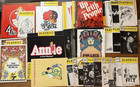
Sold on eBay March 20th, 2025
Vintage Lot Of 48 Playbills And Souvenir Programs Theater Broadway 1960’s-90’s
Vintage lot of 47 playbills and souvenir programs. Most are in Good condition. There is a stain on the Evita cover and some fading on grand hotel cover. See photos. 1. Man of La Mancha Playbill - Anta Washington Square - February 1967 2. Your Own Thing - Evergreen Showcard - Orpheum Theater - 1968 3. Walking Happy Playbill - Lunt Fontanne theater - February 19674. Aint Supposed To Die A Natural Death Playbill - Ambassador Theater - April 1972 - Melvin Van Peebles5. The Prime of Miss Jean Brodie Playbill - Helen Hayes Theater - October 1968 6. The Happy Time Playbill - The Broadway Theater - March 1968 - Robert Goulet 7. Titanic Playbill - Lunt-Fontanne Theater - June 19978. Beatlemania Playbill - Shubert Theater - May 19789. Oklahoma Playbill - Palace Theater - July 1980 10. Rodgers and Hammerstein's Oklahoma! flyer/ticket order form (*2 copies)11. Skyscraper Playbill - Lunt-Fontanne Theater - January 196612. Funny Feet Playbill - Lamb's Theater - June 1987 13. Into the Woods Playbill - Martin Beck Theater - May 1989 - Stephen Sondheim14. Barry Manilow at the Gershwin Playbill - Gershwin Theater - May 198915. Jesus Christ Superstar - On Stage the Ampitheater Universal City - Summer 197216. Mame Playbill - Winter Garden Theater - March 1968 - Angela Lansbury17. Peter Pan - Flyer - Ticket Order Form - Sandy Duncan (*3 copies)18. Sticks and Bones - Golden Theater - Flyer - Ticket Order Form 19. 42nd Street Playbill - Majestic Theater - December 1981 - Jerry Orbach - cover is torn along the fold, still attached but loose20. 42nd Street Souvenir Program 21. Sugar Babies Playbill - Mark Hellinger Theater - May 1980 - Mickey Rooney & Ann Miller22. Sugar Babies The Burlesque Musical - Souvenir Program - *2 copies 23. Two Gentlemen of Verona Playbill - St James Theater - April 1972 - Galt MacDermot24. Two Gentlemen of Verona A Grand New Musical Souvenir Program - The New York Shakespeare Festival 25. Annie Playbill - Alvin Theater - May 198026. Annie A New Musical Souvenir Program - *2 copies27. They're Playing Our Song Playbill - Imperial theater - August 198028. They're Playing Our Song Souvenir Program29. Performing Arts Magazine - April 1977 - Bubbling Brown Sugar30. Up With the People 1971 Souvenir Program31. Do I Hear a Waltz A New Musical Souvenir Program - Elizabeth Allen and Sergio Franchi32. Promises, Promises A New Musical Souvenir Program - Jerry Orbach Burt Bacharach 33. Ain't Misbehavin' The New Fats Waller Musical Show 1978 Souvenir Program34. Follies A New Musical Souvenir Program 197135. Evita Souvenir Program 1979 - Stain on front cover36. The Limeliters An Introduction Souvenir Program 37. The Limeliters Souvenir Program - A Study in Calculated Audience Brainwashing and Manipulation38. Lena Horne: The Lady and Her Music Souvenir Program 39. Dancin' Souvenir Program 1978 Bob Fosse - *2 copies40. Grand Hotel The Musical Souvenir Program - John Schneider Jane Krakowski 1989-1990 - fading on cover41. A Chorus Line Souvenir Program A New York Shakespeare Festival Production Joseph Papp42. Apocalypse Now United Artists program - photos / cast & filming info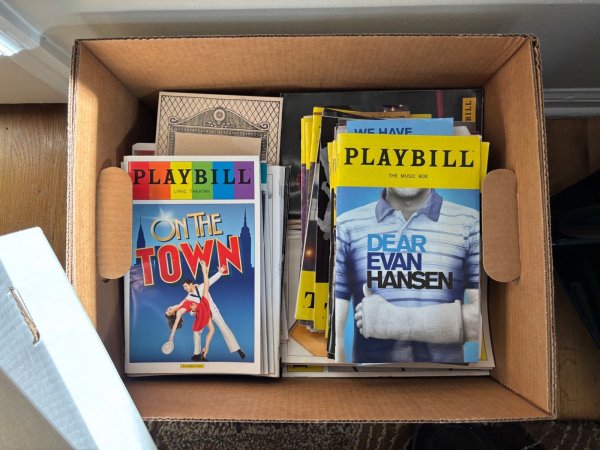
Sold on eBay April 9th, 2025
Lot of over 175 Playbills (or selection thereof - make an offer for some)
This is a lot of over 175 different playbills (with duplicates over 200) ranging from 1987 to 2024 ......All are complete (some with flaws: a bent cover, a couple we got caught in the rain, a little bit of writing on them or some with staple holes from the tickets) ..... but otherwise in pristine shape The list is below .....The ones with asterisks are not official Playbills - but what they used in those productions (similar)A couple have autographs - one of the Blue Man Group's even has a blue lipstick kiss on itShuffle Along has the faux original play programIf interested in a selection of these, make an offer listing which ones/how many and we can most likely work something out1987: Big River, Starlight Express1989: Cats1990: Phantom of the Opera1992: Blue Man Group Tubes1993: Miss Saigon, Phantom of the Opera1995: Blue Man Group Tubes, Show Boat, Tommy1996: Defending the Caveman, A Funny Thing Happened on the Way to the Forum1997: Beauty & the Beast, Bring in da Noise, Chicago, The King & I1999: Cabaret*, Over the River & Through the Woods, Ragtime*2000: Aida, Jitney, Kiss Me Kate, Saturday Night Fever, The Tale of the Allergist's Wife, Tallulah Hallelujah, The Wild Party2001: Blast, A Class Act, Contact, Dallas Symphony Orchestra @ Carnegie Hall*, The Dinner Party, 45 Seconds from Broadway, 42nd Street*, The Full Monty, Hedda Gabler, The Music Man, Rent, The Phantom of the Opera, The Producers, A Thousand Clowns2002: Aida, Dance of the Vampires, Flower Drum Song, Frankie & Johnny in the Clair de Lune, The Graduate, I'm Not Rappaport, The Lion King, Mamma Mia, Oklahoma, Thoroughly Modern Millie, Urinetown2003: Arlo Guthrie @ Carnegie Hall, Golda's Balcony, La Boheme (Met Opera), Little Shop of Horrors, Mamma Mia, Man of La Mancha, Movin' Out, Nobody Don't Like Yogi, Say Goodnight Gracie, Wicked2004: Avenue Q, Bklyn the Musical, The Boy from Oz, Dracula, Elton John @ Radio City Music Hall*, Fiddler on the Roof, From Door to Door, The Immigrant, Josh Groban @ Radio City Music Hall*, Modern Orthodox, Sleeping Beauty (NYC Ballet)2005: Dirty Rotten Scoundrels, Madama Butterfly (NYC Opera), The Odd Couple, On Golden Pond, 700 Sundays, Spamalot, Sweet Charity2006: The History Boys, Jay Johnson: The Two & Only, Jersey Boys, Jewtopia, Tarzan, The Three Penny Opera, The Wedding Singer2007: Curtains, Cyrano de Bergerac, Gazillion Bubble Show, The Pirate Queen, Rent2008: Gypsy, The Lion King, South Pacific, A Tale of Two Cities, Young Frankenstein2009: Billy Elliot, Blue Man Group, Finian's Rainbow, Hair, Irena's Vow, Romeo & Juliet (NYC Ballet), West Side Story2010: The Addams Family, Promises Promises2011: Arlo Guthrie (Carnegie Hall), Cactus Flower, Cinderella (American Ballet Theatre), War Horse, The Whipping Man, Wonderland2012: Arlo Guthrie & Pete Seeger (Carnegie Hall), The Book of Mormon, Peter & the Star Catcher, The Phantom of the Opera, Wicked2013: Ann, Kinky Boots, Matilda, Moses in Egypt (NYC Opera), Pippin, Rodgers & Hammerstein's Cinderella, The Trip to Bountiful, Vanya & Sonia & Marsha & Spike2014: The Bridges of Madison County, Handle with Care, If/Then, Once, Rocky, Wicked, Wiesenthal2015: Allegiance, The Audience, The Elephant Man, Honeymoon in Vegas, It Shoulda Been You, It's Only a Play, On the Town, The Phantom of the Opera, Rockette's NY Spring Spectacular*2016: An American in Paris, Beautiful, A Bronx Tale, Cagney, The Curious Incident of the Dog in the Night-Time, Fiddler on the Roof, The Great Comet of 1812, Kinky Boots, On Your Feet, Ruthless, Shuffle Along, Something Rotten2017: Anastasia, The Band's Visit, Hamilton, Hello Dolly, The Play that Goes Wrong, The Red Shoes(NYC Center), School of Rock, This One's for the Girls, War Paint2018: Come From Away, My Fair Lady, Frozen, Gloria A Life, Hamilton, King Kong, Rocktopia, SpongeBob Square Pants, Waitress2019: Dear Evan Hansen, Fall for Dance (NYC Center), Fiddler on the Roof (Yiddish)*, Kiss Me Kate, Rock of Ages, Wicked2022: A Beautiful Noise, Dear Evan Hansen, Funny Girl, Moulin Rouge2023: Aladdin, Camelot, Harmony, Leopoldstadt, Parade, The Play that Goes Wrong, Rock & Roll Man2024: Kimberly Akimbo, The Notebook, The Outsiders, Prayer for the French Republic, Suffs, Water for Elephants, A Wonderful World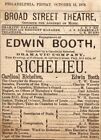
Sold on eBay September 15th, 2024
*EDWIN BOOTH AND HIS NIECE MARIAN BOOTH RARE 1878 PROGRAM*
A rare large original 1878 program clip for Edwin Booth sharing the stage with his niece Marian Booth, the daughter of Booth's brother Junius Brutus Booth II, in Bulwer Lytton's play Richielieu. perhaps his greatest non Shakespearean role. Memorabilia of Booth acting with his niece is exceptionally rare. Dimensions four and thre quarters by three and a half inches, laid down to a slighly larger Victorian album page. Light wear otherwise fine. See Edwin Booth and and the Booth family's extraordinary biographies below.Shipping discounts for multiple purchases. Credit cards accepted with Paypal. Inquiries always welcome. Please visit my other eBay items for more early theatre and historical autographs, photographs and programs and great singer, actor, and actress cabinet photos and CDV's.From Wikipedia:The Booth family was an English American theatrical family of the 19th century. Its most famous and well known members were Edwin Booth, one of the leading actors of his day, and John Wilkes Booth, who assassinated Abraham Lincoln.The patriarch was Junius Brutus Booth, a London-born lawyer's son who eventually became an actor after he attended a production of Othello at the Covent Garden theatre. The prospects of fame, fortune, and freedom were very appealing to young Booth, and he displayed remarkable talent from an early age, deciding on a career in the theatre by the age of 17. He performed roles in several small theaters throughout England, and joined a tour of the Low Countries in 1814, returning the following year to make his London debut.Booth abandoned his wife and their young son in 1821 and ran off to the United States with Mary Ann Holmes, a London flower girl. They settled on some 150 acres in Harford County near Baltimore and started a family; they had 10 children, six of whom survived to adulthood [1][2]Junius Sr. and Edwin toured in California during the Gold Rush.[citation needed] Edwin bought an interest in the Winter Garden Theatre at 667 Broadway in New York City together with his brother-in-law John Sleeper Clarke. The brothers John Wilkes, Edwin, and Junius Brutus, Jr. performed there in the play Julius Caesar at a benefit in 1864, the only time they were seen together on a stage, playing Mark Antony, Brutus, and Cassius, respectively Junius Brutus Booth (1796–1852) brought his mistress Mary Ann Holmes, who bore him 10 children, to the United States.He also wrote many letters in fits of drunken anger and madness to President Andrew Jackson threatening assassination. He requested that two prisoners who had been sentenced to death for piracy, named De Ruiz and De Soto, be pardoned, else: "I will cut your throat whilst you are sleeping." This letter would later be recanted by Junius, stating, "May god preserve General Jackson and this happy republic [4]Junius Brutus Booth Jr. (1821–1883) was married to Agnes Booth. Junius Jr. never achieved the same fame as his brothers, but his third wife Agnes was popular.Their son Sydney Barton Booth (1877–1937) was an actor well into the era of modern film [5]Edwin Thomas Booth (1833–1893) came to be the foremost American Shakespearean actor of his day. He founded The Players, a New York City actors' club which continues to the present day.Edwin's grandson Edwin Booth Grossman was a painter of some note.Asia Frigga Booth (1835–1888) married John Sleeper Clarke, an actor/comedian who was briefly imprisoned in the aftermath of the assassination. They then emigrated to Britain, where he became a successful theatre manager.Creston Clarke[6] and Wilfred Clarke,[7] sons of John and Asia, were noted actors in their day.John Wilkes Booth (1838–1865) was a popular young star in less serious fare than his brothers.A Confederate sympathizer during the American Civil War, during a play attended by Abraham Lincoln, Booth took advantage of his access to the theatre to invade the President's box and assassinate the President. He was killed 12 days later by Union soldier Boston CorbettEdwin Thomas Booth (November 13, 1833 – June 7, 1893) was an American actor who toured throughout the United States and the major capitals of Europe, performing Shakespearean plays. In 1869, he founded Booth's Theatre in New York.[2] Some theatrical historians consider him the greatest American actor, and the greatest Prince Hamlet, of the 19th century.[3] His achievements are often overshadowed by his relationship with his younger brother, actor John Wilkes Booth, who assassinated President Abraham Lincoln.Booth was born in Bel Air, Maryland, into the Anglo-American theatrical Booth family. He was the son of the famous actor, Junius Brutus Booth, an Englishman, who named Edwin after Edwin Forrest and Thomas Flynn, two of Junius' colleagues. He was the elder brother of John Wilkes Booth, himself a successful actor who gained notoriety as the assassin of President Lincoln.Nora Titone, in her book My Thoughts Be Bloody, recounts how the shame and ambition of Junius Brutus Booth's three actor sons, Junius Brutus Booth, Jr. (who never achieved the stage stardom of his two younger actor brothers), Edwin Booth, and John Wilkes Booth, spurred them to strive, as rivals, for achievement and acclaim—Edwin a Unionist, and John Wilkes, a Confederate and the assassin of Abraham Lincoln [4]CareerIn early appearances, Booth usually performed alongside his father, making his stage debut as Tressel or Tressil in Colley Cibber's version of Richard III in Boston on September 10, 1849. His first appearance in New York City was in the character of Wilford in The Iron Chest, which he played at the National Theatre in Chatham Street, on the 27th of September 1850. A year later, on the illness of the father, the son took his place in the character of Richard III.[5]After his father's death in 1852, Booth went on a worldwide tour, visiting Australia and Hawaii, and finally gaining acclaim of his own during an engagement in Sacramento, California, in 1856.[6]Before his brother assassinated Lincoln, Edwin had appeared with his two brothers, John Wilkes and Junius Brutus Booth Jr., in Julius Caesar in 1864.[7] John Wilkes played Marc Antony, Edwin played Brutus, and Junius played Cassius.[8] It was a benefit performance, and the only time that the three brothers appeared together on the same stage.[9] The funds were used to erect a statue of William Shakespeare that still stands in Central Park just south of the Promenade. Immediately afterwards, Edwin Booth began a production of Hamlet on the same stage, which came to be known as the "hundred nights Hamlet", setting a record that lasted until John Barrymore broke the record in 1922, playing the title character for 101 performances From 1863 to 1867, Booth managed the Winter Garden Theatre in New York City, mostly staging Shakespearean tragedies. In 1863, he bought the Walnut Street Theatre in Philadelphia [10]After John Wilkes Booth's assassination of President Lincoln in April 1865, the infamy associated with the Booth name forced Edwin Booth to abandon the stage for many months. Edwin, who had been feuding with John Wilkes before the assassination, disowned him afterward, refusing to have John's name spoken in his house.[11] He made his return to the stage at the Winter Garden Theatre in January 1866, playing the title role in Hamlet,[6] which would eventually become his signature role.Acting styleEdwin's acting style was distinctly different from that of his father. While the senior Booth was, like his contemporaries Edmund Kean and William Charles Macready, strong and bombastic, favoring characters such as Richard III, Edwin played more naturalistically with a quiet, more thoughtful delivery, tailored to roles like Hamlet.Later lifeBooth was married to Mary Devlin from 1860 to 1863, the year of her death. They had one daughter, Edwina, born on December 9, 1861, in London. He later remarried, wedding his acting partner Mary McVicker in 1869, and became a widower again in 1881.Edwin Booth with daughter Edwina, circa 1864Portrait of Edwin Booth by John Singer Sargent, 1890, which hung at The Players clubhouse. Now in the collection of the Amon Carter Museum of American Art.In 1869, Edwin acquired his brother John's body after repeatedly writing to President Andrew Johnson pleading for it. Johnson finally released the remains, and Edwin had them buried, unmarked, in the family plot at Green Mount Cemetery in Baltimore.In 1888, Booth founded The Players, a private club for performing, literary, and visual artists and their supporters, and dedicated his home on Gramercy Park to it.His final performance was, fittingly, in his signature role of Hamlet, in 1891 at the Brooklyn Academy of Music.Robert Lincoln rescueEdwin Booth saved Abraham Lincoln's son,[12] Robert, from serious injury or even death. The incident occurred on a train platform in Jersey City, New Jersey. The exact date of the incident is uncertain, but it is believed to have taken place in late 1864 or early 1865. Robert Lincoln recalled the incident in a 1909 letter to Richard Watson Gilder, editor of The Century Magazine.The incident occurred while a group of passengers were late at night purchasing their sleeping car places from the conductor who stood on the station platform at the entrance of the car. The platform was about the height of the car floor, and there was of course a narrow space between the platform and the car body. There was some crowding, and I happened to be pressed by it against the car body while waiting my turn. In this situation the train began to move, and by the motion I was twisted off my feet, and had dropped somewhat, with feet downward, into the open space, and was personally helpless, when my coat collar was vigorously seized and I was quickly pulled up and out to a secure footing on the platform. Upon turning to thank my rescuer I saw it was Edwin Booth, whose face was of course well known to me, and I expressed my gratitude to him, and in doing so, called him by name.Booth did not know the identity of the man whose life he had saved until some months later, when he received a letter from a friend, Colonel Adam Badeau, who was an officer on the staff of General Ulysses S. Grant. Badeau had heard the story from Robert Lincoln, who had since joined the Union Army and was also serving on Grant's staff. In the letter, Badeau gave his compliments to Booth for the heroic deed. The fact that he had saved the life of Abraham Lincoln's son was said to have been of some comfort to Edwin Booth following his brother's assassination of the president Statue of Booth as Hamlet, Gramercy Park by Edmond T. Quinn, circa 1916Booth's TheatreBooth's Theatre Playbill of his Richard III circa 1872In 1867, a fire damaged the Winter Garden Theatre, resulting in the building's subsequent demolition. Afterwards, Booth built his own theatre, an elaborate structure called Booth's Theatre in Manhattan, which opened on February 3, 1869, with a production of Romeo and Juliet starring Booth as Romeo, and Mary McVicker as Juliet. Elaborate productions followed, but the theatre never became a profitable or even stable financial venture. The panic of 1873 caused the final bankruptcy of Booth's Theatre in 1874. After the bankruptcy, Booth went on another worldwide tour, eventually regaining his fortune DeathEdwin Booth had a small stroke in 1891, which precipitated his decline. He suffered another stroke in April 1893 and died June 7, 1893, in his apartment in The Players clubhouse. He was buried next to his first wife at Mount Auburn Cemetery in Cambridge, Massachusetts. His bedroom in the club has been kept untouched since his death.[13] The New York Times reported his death [14]Exhumation requestIn December 2010, descendants of Edwin Booth reported that they obtained permission to exhume the Shakespearean actor's body to obtain DNA samples to compare with a sample of his brother John's DNA to refute the rumor he had escaped after the assassination. However, Bree Harvey, a spokesperson from the Mount Auburn Cemetery in Cambridge, Massachusetts, where Edwin Booth is buried, denied reports that the family had contacted them and requested to exhume Edwin's body.[15] The family hopes to obtain DNA samples from artifacts belonging to John Wilkes, or from remains such as vertebrae stored at the National Museum of Health and Medicine in Maryland [16][17] On March 30, 2013, museum spokesperson Carol Johnson announced that the family's request to extract DNA from the vertebrae had been rejected [18]DramatizationsA number of modern dramatizations have been made of Edwin Booth's life, on both stage and screen. One of the best known is the 1955 film Prince of Players written by Moss Hart, based loosely on the popular book of that name by Eleanor Ruggles. It was directed by Philip Dunne and stars Richard Burton and Raymond Massey as Edwin and Junius Brutus Booth, Sr., with Charles Bickford and Eva Le Gallienne, the latter of whom plays Gertrude to Burton's Hamlet. The film depicts events in Booth's life well before, and then surrounding, the assassination of Lincoln by Booth's younger brother.[19]The opening scenes of Prince of Players are very similar to scenes in the earlier 1946 John Ford western My Darling Clementine. In that movie, the character of Granville Thorndyke (as acted by Alan Mowbray) is an obvious nod to Booth's father Junius, and the scenes portray essentially the same sequence where the great actor has to be retrieved from a bar and dragged back to the theatre where he is overdue to give a performance in front of a restless audience [20][21]The Brothers BOOTH!, by W. Stuart McDowell, which focuses on the relationships of the three Booth brothers leading up to the assassination of Lincoln, was workshopped and given a series of staged readings featuring David Strathairn, David Dukes, Angela Goethals, Maryann Plunkett, and Stephen Lang at the New Harmony Project,[22] and at The Guthrie Theatre Lab in Minneapolis, and later presented in New York at the Players' Club, the Second Stage Theatre, and the Boston Athenaeum. It was given its first fully staged professional production at the Bristol Riverside Theatre outside Philadelphia in 1992 [23][24][25] A second play by the same name, The Brothers Booth, which focuses on "the world of the 1860s theatre and its leading family"[26] was written by Marshell Bradley and staged in New York at the Perry Street Theatre in 2004.Oliver Ingraham Lay: Edwin Booth as Hamlet, 1887Austin Pendleton's play, Booth, which depicts the early years of the brothers Edwin, Junius, and John Wilkes Booth and their father, was produced off Broadway at the York Theatre, starring Frank Langella as Junius Brutus Booth, Sr. In a review, the play was called "a psychodrama about the legendary theatrical family of the 19th century" by The New York Times.[27] Pendleton had adapted this version from his earlier work, Booth Is Back, produced at Long Wharf Theatre in New Haven, Connecticut, in the 1991-1992 season.The Tragedian, by playwright and actor Rodney Lee Rogers, is a one-man show about Booth that was produced by PURE Theatre of Charleston, South Carolina, in 2007. It was revived for inclusion in the Piccolo Spoleto Arts Festival in May and June 2008.[28]A play by Luigi Creatore called Error of the Moon played off-Broadway on Theatre Row in New York City from August 13 to October 10, 2010. The play is a fictionalized account of Booth's life, hinging on the personal, professional, and political tensions between brothers Edwin and John Wilkes, leading up to the assassination of Lincoln.[29]In 1959, the actor Robert McQueeney played Booth in the episode "The Man Who Loved Lincoln" on the ABC/Warner Brothers western television series, Colt .45, starring Wayde Preston as the fictitious undercover agent Christopher Colt, who in the story line is assigned to protect Booth from a death threat.[30]In 1960, the anthology series television series Death Valley Days broadcast "His Brother's Keeper", in which Booth visits a small town after the Lincoln assassination, with one of the town's influential citizens trying to have him run out of town.In 1966, Martin Landau played Edwin Booth in the episode "This Stage of Fools" of the NBC western television series, Branded, starring Chuck Connors as Jason McCord. In the story line, McCord takes a job as the bodyguard to the actor Edwin Booth, brother of the presidential assassin, John Wilkes Booth [31][32]In 2013, Will Forte played Edwin Booth in the "Washington, D.C." episode of the Comedy Central's series, Drunk History, created by Derek Waters.In 2014, Edwin Booth was played by Gordon Tanner in The Pinkertons episode, "The Play's the Thing" (S1:E3). In the episode, both the "Hundred nights Hamlet" and Edwin's rescue of Robert Lincoln are mentioned LegacyGrave of Edwin BoothBooth left a considerable estate upon his death. He left charitable bequests that furthered the development of the acting profession and the treatment of mental illness. He left bequests of $5,000 each (almost $150,000 in 2021 dollars) to the Actor's' Fund, the Actors' Association of Friendship of the City of New York (Edwin Forrest Lodge), The Actors' Association of Friendship of the City of Philadelphia (Shakespeare Lodge), the Asylum Fund of New York and the Home for Incurables (West Farms, New York).[33] Other examples of his legacy include:The Players still exists in its original clubhouse at 16 Gramercy Park South in Manhattan.[34] A statue of Booth as Hamlet, by Edmond T. Quinn, has been the centerpiece of the private Gramercy Park since 1916. It can be seen by the public through the south gate of the park.Booth left a few recordings of his voice preserved on wax cylinder. One of them can be heard on the Naxos Records set Great Historical Shakespeare Recordings and Other Miscellany.[35] Another place to hear his preserved voice is on the site shown here [3:34][36] Booth's voice is barely audible with all the surface noise, but what can be deciphered reveals it to have been rich and deep.Memorials of Booth can still be found around Bel Air, Maryland. In front of the courthouse is a fountain dedicated to his memory. Inside the post office is a portrait of him. Also, his family's home, Tudor Hall, still stands and was bought in 2006 by Harford County, Maryland, to become a museum.A chamber in Mammoth Cave in Kentucky is called "Booth's Amphitheatre" – so called because Booth entertained visitors there.The Springer Opera House in Columbus, Georgia, is said to be haunted by the ghost of Edwin Booth Broadway s Booth Theatre was the first, and remains the oldest, Broadway theatre to be named in honor of an actor.Stephen Sondheim's musical Assassins mentions Edwin in "The Ballad of Booth" with the lyrics: "Your brother made you jealous, John/You couldn't fill his shoes."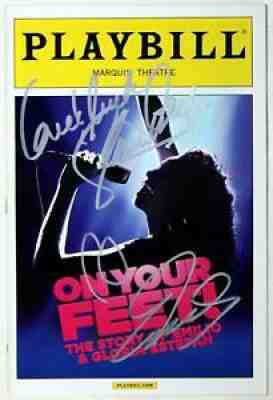
Sold on eBay Dec 06, 2021
ON YOUR FEET Emilio Estefan & Gloria Estefan Signed Playbill SUPER RARE
On Your Feetthat has been autographed by Emilio and Gloria Estefan. Gloria and Emilio signed a VERY limited number of these Playbills in support of BC/EFA so this is a great opportunity to own a very rare item from these two amazing artists.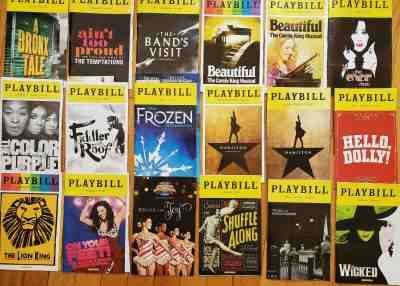
Sold on eBay Jul, 7th 2020
NYC BROADWAY PLAYBILL LOT of 18 THEATRE PROGRAMS 17 WITH TICKETS 2015 to PRESENT
BROADWAY PLAYBILL LOT of 18, 17 WITH TICKETS. From 2015 to present. All in excellent condition.<br />A Bronx Tale 9/2017Ain't Too Proud 1/2020The Band's Visit 3/2019Beautiful the Carole King Musical 6/2015 - NO TICKET - 3/2016 with ticketThe Cher Show 12/2018The Color Purple 2/2016Fiddler on the Roof 5/2016Frozen 5/2018Hamilton 8/2015 - 2/2020Hello Dolly 8/2017 - Bette MidlerThe Lion King 6/2016On Your Feet 7/2016Radio City Christmas Spectacular 12/2015 - with 3D glassesShuffle Along 5/2016To Kill a Mockingbird 2/2019 - Jeff DanielsWicked 2/2018<br />Shipping will be sent out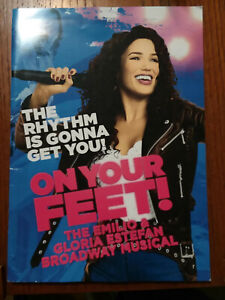
Sold on eBay December 27th, 2023
On Your Feet! The Emilio & Gloria Estefan Broadway Musical - RARE photo book!
eBay EXCELLENT CONDITION! Rare and hard-to-find photo book / tour book / concert program for the Broadway Musical based on Gloria and Emilio Estefan. Packed with photos from the show but also personal and family photos of the Estefans. Mild cover wear and a few bends in the book, but this is otherwise a clean solid copy. Prompt FREE shipping of your order, with tracking included!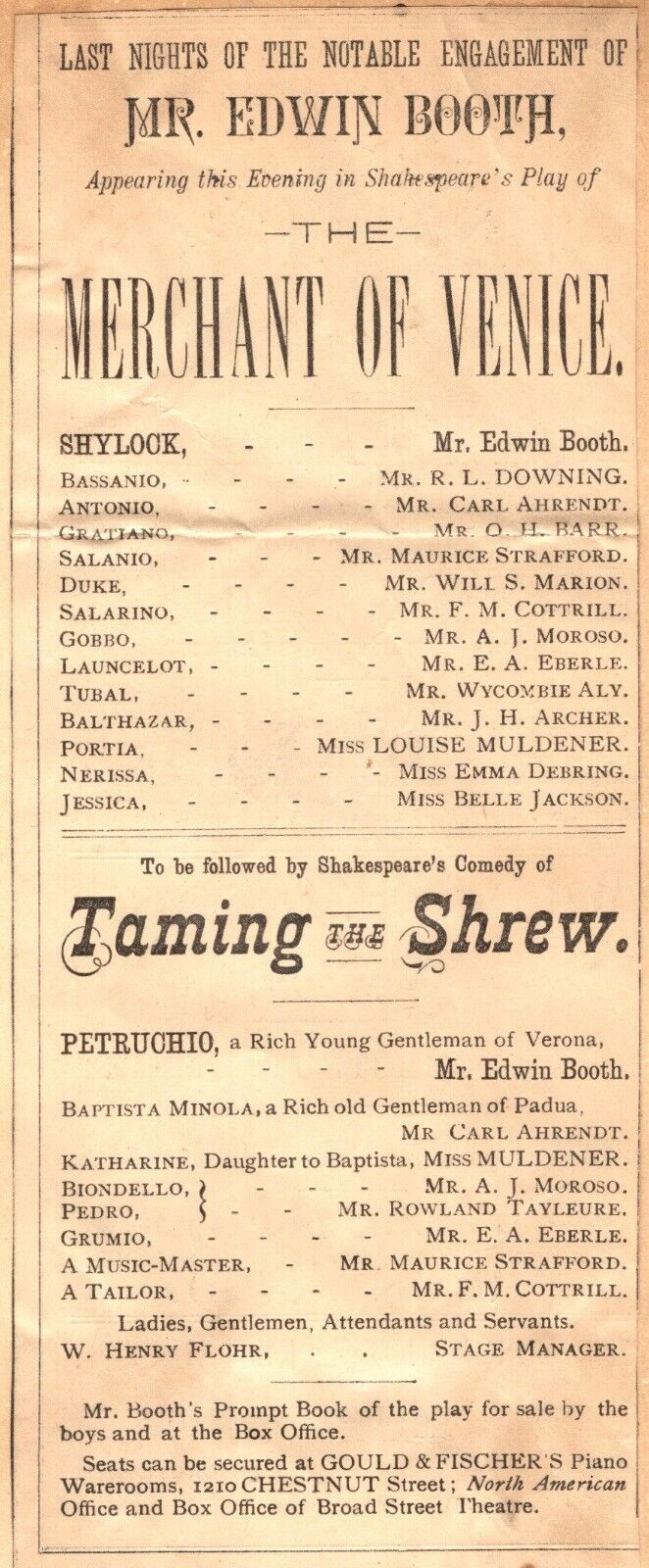
Sold on eBay January 12th, 2025
*EDWIN BOOTH 1878 MERCHANT OF VENICE & TAMING OF THE SHREW PROGRAM*
A rare large original 1878 program clip for Edwin Booth in a double bill as Shylock in The Merchant of Venice and Petruchio in Taming of the Shrew. Dimensions seven by three inches, laid down to a slighly larger Victorian album page. Light wear otherwise fine. See Edwin Booth and and the Booth family's extraordinary biographies below.Shipping discounts for multiple purchases. Credit cards accepted with Paypal. Inquiries always welcome. Please visit my other eBay items for more early theatre and historical autographs, photographs and programs and great singer, actor, and actress cabinet photos and CDV's.From Wikipedia:The Booth family was an English American theatrical family of the 19th century. Its most famous and well known members were Edwin Booth, one of the leading actors of his day, and John Wilkes Booth, who assassinated Abraham Lincoln.The patriarch was Junius Brutus Booth, a London-born lawyer's son who eventually became an actor after he attended a production of Othello at the Covent Garden theatre. The prospects of fame, fortune, and freedom were very appealing to young Booth, and he displayed remarkable talent from an early age, deciding on a career in the theatre by the age of 17. He performed roles in several small theaters throughout England, and joined a tour of the Low Countries in 1814, returning the following year to make his London debut.Booth abandoned his wife and their young son in 1821 and ran off to the United States with Mary Ann Holmes, a London flower girl. They settled on some 150 acres in Harford County near Baltimore and started a family; they had 10 children, six of whom survived to adulthood [1][2]Junius Sr. and Edwin toured in California during the Gold Rush.[citation needed] Edwin bought an interest in the Winter Garden Theatre at 667 Broadway in New York City together with his brother-in-law John Sleeper Clarke. The brothers John Wilkes, Edwin, and Junius Brutus, Jr. performed there in the play Julius Caesar at a benefit in 1864, the only time they were seen together on a stage, playing Mark Antony, Brutus, and Cassius, respectively Junius Brutus Booth (1796–1852) brought his mistress Mary Ann Holmes, who bore him 10 children, to the United States.He also wrote many letters in fits of drunken anger and madness to President Andrew Jackson threatening assassination. He requested that two prisoners who had been sentenced to death for piracy, named De Ruiz and De Soto, be pardoned, else: "I will cut your throat whilst you are sleeping." This letter would later be recanted by Junius, stating, "May god preserve General Jackson and this happy republic [4]Junius Brutus Booth Jr. (1821–1883) was married to Agnes Booth. Junius Jr. never achieved the same fame as his brothers, but his third wife Agnes was popular.Their son Sydney Barton Booth (1877–1937) was an actor well into the era of modern film [5]Edwin Thomas Booth (1833–1893) came to be the foremost American Shakespearean actor of his day. He founded The Players, a New York City actors' club which continues to the present day.Edwin's grandson Edwin Booth Grossman was a painter of some note.Asia Frigga Booth (1835–1888) married John Sleeper Clarke, an actor/comedian who was briefly imprisoned in the aftermath of the assassination. They then emigrated to Britain, where he became a successful theatre manager.Creston Clarke[6] and Wilfred Clarke,[7] sons of John and Asia, were noted actors in their day.John Wilkes Booth (1838–1865) was a popular young star in less serious fare than his brothers.A Confederate sympathizer during the American Civil War, during a play attended by Abraham Lincoln, Booth took advantage of his access to the theatre to invade the President's box and assassinate the President. He was killed 12 days later by Union soldier Boston CorbettEdwin Thomas Booth (November 13, 1833 – June 7, 1893) was an American actor who toured throughout the United States and the major capitals of Europe, performing Shakespearean plays. In 1869, he founded Booth's Theatre in New York.[2] Some theatrical historians consider him the greatest American actor, and the greatest Prince Hamlet, of the 19th century.[3] His achievements are often overshadowed by his relationship with his younger brother, actor John Wilkes Booth, who assassinated President Abraham Lincoln.Booth was born in Bel Air, Maryland, into the Anglo-American theatrical Booth family. He was the son of the famous actor, Junius Brutus Booth, an Englishman, who named Edwin after Edwin Forrest and Thomas Flynn, two of Junius' colleagues. He was the elder brother of John Wilkes Booth, himself a successful actor who gained notoriety as the assassin of President Lincoln.Nora Titone, in her book My Thoughts Be Bloody, recounts how the shame and ambition of Junius Brutus Booth's three actor sons, Junius Brutus Booth, Jr. (who never achieved the stage stardom of his two younger actor brothers), Edwin Booth, and John Wilkes Booth, spurred them to strive, as rivals, for achievement and acclaim—Edwin a Unionist, and John Wilkes, a Confederate and the assassin of Abraham Lincoln [4]CareerIn early appearances, Booth usually performed alongside his father, making his stage debut as Tressel or Tressil in Colley Cibber's version of Richard III in Boston on September 10, 1849. His first appearance in New York City was in the character of Wilford in The Iron Chest, which he played at the National Theatre in Chatham Street, on the 27th of September 1850. A year later, on the illness of the father, the son took his place in the character of Richard III.[5]After his father's death in 1852, Booth went on a worldwide tour, visiting Australia and Hawaii, and finally gaining acclaim of his own during an engagement in Sacramento, California, in 1856.[6]Before his brother assassinated Lincoln, Edwin had appeared with his two brothers, John Wilkes and Junius Brutus Booth Jr., in Julius Caesar in 1864.[7] John Wilkes played Marc Antony, Edwin played Brutus, and Junius played Cassius.[8] It was a benefit performance, and the only time that the three brothers appeared together on the same stage.[9] The funds were used to erect a statue of William Shakespeare that still stands in Central Park just south of the Promenade. Immediately afterwards, Edwin Booth began a production of Hamlet on the same stage, which came to be known as the "hundred nights Hamlet", setting a record that lasted until John Barrymore broke the record in 1922, playing the title character for 101 performances From 1863 to 1867, Booth managed the Winter Garden Theatre in New York City, mostly staging Shakespearean tragedies. In 1863, he bought the Walnut Street Theatre in Philadelphia [10]After John Wilkes Booth's assassination of President Lincoln in April 1865, the infamy associated with the Booth name forced Edwin Booth to abandon the stage for many months. Edwin, who had been feuding with John Wilkes before the assassination, disowned him afterward, refusing to have John's name spoken in his house.[11] He made his return to the stage at the Winter Garden Theatre in January 1866, playing the title role in Hamlet,[6] which would eventually become his signature role.Acting styleEdwin's acting style was distinctly different from that of his father. While the senior Booth was, like his contemporaries Edmund Kean and William Charles Macready, strong and bombastic, favoring characters such as Richard III, Edwin played more naturalistically with a quiet, more thoughtful delivery, tailored to roles like Hamlet.Later lifeBooth was married to Mary Devlin from 1860 to 1863, the year of her death. They had one daughter, Edwina, born on December 9, 1861, in London. He later remarried, wedding his acting partner Mary McVicker in 1869, and became a widower again in 1881.Edwin Booth with daughter Edwina, circa 1864Portrait of Edwin Booth by John Singer Sargent, 1890, which hung at The Players clubhouse. Now in the collection of the Amon Carter Museum of American Art.In 1869, Edwin acquired his brother John's body after repeatedly writing to President Andrew Johnson pleading for it. Johnson finally released the remains, and Edwin had them buried, unmarked, in the family plot at Green Mount Cemetery in Baltimore.In 1888, Booth founded The Players, a private club for performing, literary, and visual artists and their supporters, and dedicated his home on Gramercy Park to it.His final performance was, fittingly, in his signature role of Hamlet, in 1891 at the Brooklyn Academy of Music.Robert Lincoln rescueEdwin Booth saved Abraham Lincoln's son,[12] Robert, from serious injury or even death. The incident occurred on a train platform in Jersey City, New Jersey. The exact date of the incident is uncertain, but it is believed to have taken place in late 1864 or early 1865. Robert Lincoln recalled the incident in a 1909 letter to Richard Watson Gilder, editor of The Century Magazine.The incident occurred while a group of passengers were late at night purchasing their sleeping car places from the conductor who stood on the station platform at the entrance of the car. The platform was about the height of the car floor, and there was of course a narrow space between the platform and the car body. There was some crowding, and I happened to be pressed by it against the car body while waiting my turn. In this situation the train began to move, and by the motion I was twisted off my feet, and had dropped somewhat, with feet downward, into the open space, and was personally helpless, when my coat collar was vigorously seized and I was quickly pulled up and out to a secure footing on the platform. Upon turning to thank my rescuer I saw it was Edwin Booth, whose face was of course well known to me, and I expressed my gratitude to him, and in doing so, called him by name.Booth did not know the identity of the man whose life he had saved until some months later, when he received a letter from a friend, Colonel Adam Badeau, who was an officer on the staff of General Ulysses S. Grant. Badeau had heard the story from Robert Lincoln, who had since joined the Union Army and was also serving on Grant's staff. In the letter, Badeau gave his compliments to Booth for the heroic deed. The fact that he had saved the life of Abraham Lincoln's son was said to have been of some comfort to Edwin Booth following his brother's assassination of the president Statue of Booth as Hamlet, Gramercy Park by Edmond T. Quinn, circa 1916Booth's TheatreBooth's Theatre Playbill of his Richard III circa 1872In 1867, a fire damaged the Winter Garden Theatre, resulting in the building's subsequent demolition. Afterwards, Booth built his own theatre, an elaborate structure called Booth's Theatre in Manhattan, which opened on February 3, 1869, with a production of Romeo and Juliet starring Booth as Romeo, and Mary McVicker as Juliet. Elaborate productions followed, but the theatre never became a profitable or even stable financial venture. The panic of 1873 caused the final bankruptcy of Booth's Theatre in 1874. After the bankruptcy, Booth went on another worldwide tour, eventually regaining his fortune DeathEdwin Booth had a small stroke in 1891, which precipitated his decline. He suffered another stroke in April 1893 and died June 7, 1893, in his apartment in The Players clubhouse. He was buried next to his first wife at Mount Auburn Cemetery in Cambridge, Massachusetts. His bedroom in the club has been kept untouched since his death.[13] The New York Times reported his death [14]Exhumation requestIn December 2010, descendants of Edwin Booth reported that they obtained permission to exhume the Shakespearean actor's body to obtain DNA samples to compare with a sample of his brother John's DNA to refute the rumor he had escaped after the assassination. However, Bree Harvey, a spokesperson from the Mount Auburn Cemetery in Cambridge, Massachusetts, where Edwin Booth is buried, denied reports that the family had contacted them and requested to exhume Edwin's body.[15] The family hopes to obtain DNA samples from artifacts belonging to John Wilkes, or from remains such as vertebrae stored at the National Museum of Health and Medicine in Maryland [16][17] On March 30, 2013, museum spokesperson Carol Johnson announced that the family's request to extract DNA from the vertebrae had been rejected [18]DramatizationsA number of modern dramatizations have been made of Edwin Booth's life, on both stage and screen. One of the best known is the 1955 film Prince of Players written by Moss Hart, based loosely on the popular book of that name by Eleanor Ruggles. It was directed by Philip Dunne and stars Richard Burton and Raymond Massey as Edwin and Junius Brutus Booth, Sr., with Charles Bickford and Eva Le Gallienne, the latter of whom plays Gertrude to Burton's Hamlet. The film depicts events in Booth's life well before, and then surrounding, the assassination of Lincoln by Booth's younger brother.[19]The opening scenes of Prince of Players are very similar to scenes in the earlier 1946 John Ford western My Darling Clementine. In that movie, the character of Granville Thorndyke (as acted by Alan Mowbray) is an obvious nod to Booth's father Junius, and the scenes portray essentially the same sequence where the great actor has to be retrieved from a bar and dragged back to the theatre where he is overdue to give a performance in front of a restless audience [20][21]The Brothers BOOTH!, by W. Stuart McDowell, which focuses on the relationships of the three Booth brothers leading up to the assassination of Lincoln, was workshopped and given a series of staged readings featuring David Strathairn, David Dukes, Angela Goethals, Maryann Plunkett, and Stephen Lang at the New Harmony Project,[22] and at The Guthrie Theatre Lab in Minneapolis, and later presented in New York at the Players' Club, the Second Stage Theatre, and the Boston Athenaeum. It was given its first fully staged professional production at the Bristol Riverside Theatre outside Philadelphia in 1992 [23][24][25] A second play by the same name, The Brothers Booth, which focuses on "the world of the 1860s theatre and its leading family"[26] was written by Marshell Bradley and staged in New York at the Perry Street Theatre in 2004.Oliver Ingraham Lay: Edwin Booth as Hamlet, 1887Austin Pendleton's play, Booth, which depicts the early years of the brothers Edwin, Junius, and John Wilkes Booth and their father, was produced off Broadway at the York Theatre, starring Frank Langella as Junius Brutus Booth, Sr. In a review, the play was called "a psychodrama about the legendary theatrical family of the 19th century" by The New York Times.[27] Pendleton had adapted this version from his earlier work, Booth Is Back, produced at Long Wharf Theatre in New Haven, Connecticut, in the 1991-1992 season.The Tragedian, by playwright and actor Rodney Lee Rogers, is a one-man show about Booth that was produced by PURE Theatre of Charleston, South Carolina, in 2007. It was revived for inclusion in the Piccolo Spoleto Arts Festival in May and June 2008.[28]A play by Luigi Creatore called Error of the Moon played off-Broadway on Theatre Row in New York City from August 13 to October 10, 2010. The play is a fictionalized account of Booth's life, hinging on the personal, professional, and political tensions between brothers Edwin and John Wilkes, leading up to the assassination of Lincoln.[29]In 1959, the actor Robert McQueeney played Booth in the episode "The Man Who Loved Lincoln" on the ABC/Warner Brothers western television series, Colt .45, starring Wayde Preston as the fictitious undercover agent Christopher Colt, who in the story line is assigned to protect Booth from a death threat.[30]In 1960, the anthology series television series Death Valley Days broadcast "His Brother's Keeper", in which Booth visits a small town after the Lincoln assassination, with one of the town's influential citizens trying to have him run out of town.In 1966, Martin Landau played Edwin Booth in the episode "This Stage of Fools" of the NBC western television series, Branded, starring Chuck Connors as Jason McCord. In the story line, McCord takes a job as the bodyguard to the actor Edwin Booth, brother of the presidential assassin, John Wilkes Booth [31][32]In 2013, Will Forte played Edwin Booth in the "Washington, D.C." episode of the Comedy Central's series, Drunk History, created by Derek Waters.In 2014, Edwin Booth was played by Gordon Tanner in The Pinkertons episode, "The Play's the Thing" (S1:E3). In the episode, both the "Hundred nights Hamlet" and Edwin's rescue of Robert Lincoln are mentioned LegacyGrave of Edwin BoothBooth left a considerable estate upon his death. He left charitable bequests that furthered the development of the acting profession and the treatment of mental illness. He left bequests of $5,000 each (almost $150,000 in 2021 dollars) to the Actor's' Fund, the Actors' Association of Friendship of the City of New York (Edwin Forrest Lodge), The Actors' Association of Friendship of the City of Philadelphia (Shakespeare Lodge), the Asylum Fund of New York and the Home for Incurables (West Farms, New York).[33] Other examples of his legacy include:The Players still exists in its original clubhouse at 16 Gramercy Park South in Manhattan.[34] A statue of Booth as Hamlet, by Edmond T. Quinn, has been the centerpiece of the private Gramercy Park since 1916. It can be seen by the public through the south gate of the park.Booth left a few recordings of his voice preserved on wax cylinder. One of them can be heard on the Naxos Records set Great Historical Shakespeare Recordings and Other Miscellany.[35] Another place to hear his preserved voice is on the site shown here [3:34][36] Booth's voice is barely audible with all the surface noise, but what can be deciphered reveals it to have been rich and deep.Memorials of Booth can still be found around Bel Air, Maryland. In front of the courthouse is a fountain dedicated to his memory. Inside the post office is a portrait of him. Also, his family's home, Tudor Hall, still stands and was bought in 2006 by Harford County, Maryland, to become a museum.A chamber in Mammoth Cave in Kentucky is called "Booth's Amphitheatre" – so called because Booth entertained visitors there.The Springer Opera House in Columbus, Georgia, is said to be haunted by the ghost of Edwin Booth Broadway s Booth Theatre was the first, and remains the oldest, Broadway theatre to be named in honor of an actor.Stephen Sondheim's musical Assassins mentions Edwin in "The Ballad of Booth" with the lyrics: "Your brother made you jealous, John/You couldn't fill his shoes."
Sold on eBay July 21st, 2024
*EDWIN BOOTH & HELENA MODJESKA RARE 1890 MERCHANT OF VENICE PROGRAM*
A rare large original January 1890 program for Edwin Booth and Helena Modjeska in The Merchant of Venice. Dimensions six and a half by three and a half inches, trimmed from a larger program with complete cast list. Mounted to a twelve by nine and a half inch Victorian album page with two unrelated programs. Edgewear and small loss to backing otherwise good.See Edwin Booth, Helena Modjeska, and the Booth family's extraordinary biographies below.Shipping discounts for multiple purchases. Credit cards accepted with Paypal. Inquiries always welcome. Please visit my other eBay items for more early theatre and historical autographs, photographs and programs and great singer, actor, and actress cabinet photos and CDV's.From Wikipedia:The Booth family was an English American theatrical family of the 19th century. Its most famous and well known members were Edwin Booth, one of the leading actors of his day, and John Wilkes Booth, who assassinated Abraham Lincoln.The patriarch was Junius Brutus Booth, a London-born lawyer's son who eventually became an actor after he attended a production of Othello at the Covent Garden theatre. The prospects of fame, fortune, and freedom were very appealing to young Booth, and he displayed remarkable talent from an early age, deciding on a career in the theatre by the age of 17. He performed roles in several small theaters throughout England, and joined a tour of the Low Countries in 1814, returning the following year to make his London debut.Booth abandoned his wife and their young son in 1821 and ran off to the United States with Mary Ann Holmes, a London flower girl. They settled on some 150 acres in Harford County near Baltimore and started a family; they had 10 children, six of whom survived to adulthood [1][2]Junius Sr. and Edwin toured in California during the Gold Rush.[citation needed] Edwin bought an interest in the Winter Garden Theatre at 667 Broadway in New York City together with his brother-in-law John Sleeper Clarke. The brothers John Wilkes, Edwin, and Junius Brutus, Jr. performed there in the play Julius Caesar at a benefit in 1864, the only time they were seen together on a stage, playing Mark Antony, Brutus, and Cassius, respectively Junius Brutus Booth (1796–1852) brought his mistress Mary Ann Holmes, who bore him 10 children, to the United States.He also wrote many letters in fits of drunken anger and madness to President Andrew Jackson threatening assassination. He requested that two prisoners who had been sentenced to death for piracy, named De Ruiz and De Soto, be pardoned, else: "I will cut your throat whilst you are sleeping." This letter would later be recanted by Junius, stating, "May god preserve General Jackson and this happy republic [4]Junius Brutus Booth Jr. (1821–1883) was married to Agnes Booth. Junius Jr. never achieved the same fame as his brothers, but his third wife Agnes was popular.Their son Sydney Barton Booth (1877–1937) was an actor well into the era of modern film [5]Edwin Thomas Booth (1833–1893) came to be the foremost American Shakespearean actor of his day. He founded The Players, a New York City actors' club which continues to the present day.Edwin's grandson Edwin Booth Grossman was a painter of some note.Asia Frigga Booth (1835–1888) married John Sleeper Clarke, an actor/comedian who was briefly imprisoned in the aftermath of the assassination. They then emigrated to Britain, where he became a successful theatre manager.Creston Clarke[6] and Wilfred Clarke,[7] sons of John and Asia, were noted actors in their day.John Wilkes Booth (1838–1865) was a popular young star in less serious fare than his brothers.A Confederate sympathizer during the American Civil War, during a play attended by Abraham Lincoln, Booth took advantage of his access to the theatre to invade the President's box and assassinate the President. He was killed 12 days later by Union soldier Boston CorbettEdwin Thomas Booth (November 13, 1833 – June 7, 1893) was an American actor who toured throughout the United States and the major capitals of Europe, performing Shakespearean plays. In 1869, he founded Booth's Theatre in New York.[2] Some theatrical historians consider him the greatest American actor, and the greatest Prince Hamlet, of the 19th century.[3] His achievements are often overshadowed by his relationship with his younger brother, actor John Wilkes Booth, who assassinated President Abraham Lincoln.Booth was born in Bel Air, Maryland, into the Anglo-American theatrical Booth family. He was the son of the famous actor, Junius Brutus Booth, an Englishman, who named Edwin after Edwin Forrest and Thomas Flynn, two of Junius' colleagues. He was the elder brother of John Wilkes Booth, himself a successful actor who gained notoriety as the assassin of President Lincoln.Nora Titone, in her book My Thoughts Be Bloody, recounts how the shame and ambition of Junius Brutus Booth's three actor sons, Junius Brutus Booth, Jr. (who never achieved the stage stardom of his two younger actor brothers), Edwin Booth, and John Wilkes Booth, spurred them to strive, as rivals, for achievement and acclaim—Edwin a Unionist, and John Wilkes, a Confederate and the assassin of Abraham Lincoln [4]CareerIn early appearances, Booth usually performed alongside his father, making his stage debut as Tressel or Tressil in Colley Cibber's version of Richard III in Boston on September 10, 1849. His first appearance in New York City was in the character of Wilford in The Iron Chest, which he played at the National Theatre in Chatham Street, on the 27th of September 1850. A year later, on the illness of the father, the son took his place in the character of Richard III.[5]After his father's death in 1852, Booth went on a worldwide tour, visiting Australia and Hawaii, and finally gaining acclaim of his own during an engagement in Sacramento, California, in 1856.[6]Before his brother assassinated Lincoln, Edwin had appeared with his two brothers, John Wilkes and Junius Brutus Booth Jr., in Julius Caesar in 1864.[7] John Wilkes played Marc Antony, Edwin played Brutus, and Junius played Cassius.[8] It was a benefit performance, and the only time that the three brothers appeared together on the same stage.[9] The funds were used to erect a statue of William Shakespeare that still stands in Central Park just south of the Promenade. Immediately afterwards, Edwin Booth began a production of Hamlet on the same stage, which came to be known as the "hundred nights Hamlet", setting a record that lasted until John Barrymore broke the record in 1922, playing the title character for 101 performances From 1863 to 1867, Booth managed the Winter Garden Theatre in New York City, mostly staging Shakespearean tragedies. In 1863, he bought the Walnut Street Theatre in Philadelphia [10]After John Wilkes Booth's assassination of President Lincoln in April 1865, the infamy associated with the Booth name forced Edwin Booth to abandon the stage for many months. Edwin, who had been feuding with John Wilkes before the assassination, disowned him afterward, refusing to have John's name spoken in his house.[11] He made his return to the stage at the Winter Garden Theatre in January 1866, playing the title role in Hamlet,[6] which would eventually become his signature role.Acting styleEdwin's acting style was distinctly different from that of his father. While the senior Booth was, like his contemporaries Edmund Kean and William Charles Macready, strong and bombastic, favoring characters such as Richard III, Edwin played more naturalistically with a quiet, more thoughtful delivery, tailored to roles like Hamlet.Later lifeBooth was married to Mary Devlin from 1860 to 1863, the year of her death. They had one daughter, Edwina, born on December 9, 1861, in London. He later remarried, wedding his acting partner Mary McVicker in 1869, and became a widower again in 1881.Edwin Booth with daughter Edwina, circa 1864Portrait of Edwin Booth by John Singer Sargent, 1890, which hung at The Players clubhouse. Now in the collection of the Amon Carter Museum of American Art.In 1869, Edwin acquired his brother John's body after repeatedly writing to President Andrew Johnson pleading for it. Johnson finally released the remains, and Edwin had them buried, unmarked, in the family plot at Green Mount Cemetery in Baltimore.In 1888, Booth founded The Players, a private club for performing, literary, and visual artists and their supporters, and dedicated his home on Gramercy Park to it.His final performance was, fittingly, in his signature role of Hamlet, in 1891 at the Brooklyn Academy of Music.Robert Lincoln rescueEdwin Booth saved Abraham Lincoln's son,[12] Robert, from serious injury or even death. The incident occurred on a train platform in Jersey City, New Jersey. The exact date of the incident is uncertain, but it is believed to have taken place in late 1864 or early 1865. Robert Lincoln recalled the incident in a 1909 letter to Richard Watson Gilder, editor of The Century Magazine.The incident occurred while a group of passengers were late at night purchasing their sleeping car places from the conductor who stood on the station platform at the entrance of the car. The platform was about the height of the car floor, and there was of course a narrow space between the platform and the car body. There was some crowding, and I happened to be pressed by it against the car body while waiting my turn. In this situation the train began to move, and by the motion I was twisted off my feet, and had dropped somewhat, with feet downward, into the open space, and was personally helpless, when my coat collar was vigorously seized and I was quickly pulled up and out to a secure footing on the platform. Upon turning to thank my rescuer I saw it was Edwin Booth, whose face was of course well known to me, and I expressed my gratitude to him, and in doing so, called him by name.Booth did not know the identity of the man whose life he had saved until some months later, when he received a letter from a friend, Colonel Adam Badeau, who was an officer on the staff of General Ulysses S. Grant. Badeau had heard the story from Robert Lincoln, who had since joined the Union Army and was also serving on Grant's staff. In the letter, Badeau gave his compliments to Booth for the heroic deed. The fact that he had saved the life of Abraham Lincoln's son was said to have been of some comfort to Edwin Booth following his brother's assassination of the president Statue of Booth as Hamlet, Gramercy Park by Edmond T. Quinn, circa 1916Booth's TheatreBooth's Theatre Playbill of his Richard III circa 1872In 1867, a fire damaged the Winter Garden Theatre, resulting in the building's subsequent demolition. Afterwards, Booth built his own theatre, an elaborate structure called Booth's Theatre in Manhattan, which opened on February 3, 1869, with a production of Romeo and Juliet starring Booth as Romeo, and Mary McVicker as Juliet. Elaborate productions followed, but the theatre never became a profitable or even stable financial venture. The panic of 1873 caused the final bankruptcy of Booth's Theatre in 1874. After the bankruptcy, Booth went on another worldwide tour, eventually regaining his fortune DeathEdwin Booth had a small stroke in 1891, which precipitated his decline. He suffered another stroke in April 1893 and died June 7, 1893, in his apartment in The Players clubhouse. He was buried next to his first wife at Mount Auburn Cemetery in Cambridge, Massachusetts. His bedroom in the club has been kept untouched since his death.[13] The New York Times reported his death [14]Exhumation requestIn December 2010, descendants of Edwin Booth reported that they obtained permission to exhume the Shakespearean actor's body to obtain DNA samples to compare with a sample of his brother John's DNA to refute the rumor he had escaped after the assassination. However, Bree Harvey, a spokesperson from the Mount Auburn Cemetery in Cambridge, Massachusetts, where Edwin Booth is buried, denied reports that the family had contacted them and requested to exhume Edwin's body.[15] The family hopes to obtain DNA samples from artifacts belonging to John Wilkes, or from remains such as vertebrae stored at the National Museum of Health and Medicine in Maryland [16][17] On March 30, 2013, museum spokesperson Carol Johnson announced that the family's request to extract DNA from the vertebrae had been rejected [18]DramatizationsA number of modern dramatizations have been made of Edwin Booth's life, on both stage and screen. One of the best known is the 1955 film Prince of Players written by Moss Hart, based loosely on the popular book of that name by Eleanor Ruggles. It was directed by Philip Dunne and stars Richard Burton and Raymond Massey as Edwin and Junius Brutus Booth, Sr., with Charles Bickford and Eva Le Gallienne, the latter of whom plays Gertrude to Burton's Hamlet. The film depicts events in Booth's life well before, and then surrounding, the assassination of Lincoln by Booth's younger brother.[19]The opening scenes of Prince of Players are very similar to scenes in the earlier 1946 John Ford western My Darling Clementine. In that movie, the character of Granville Thorndyke (as acted by Alan Mowbray) is an obvious nod to Booth's father Junius, and the scenes portray essentially the same sequence where the great actor has to be retrieved from a bar and dragged back to the theatre where he is overdue to give a performance in front of a restless audience [20][21]The Brothers BOOTH!, by W. Stuart McDowell, which focuses on the relationships of the three Booth brothers leading up to the assassination of Lincoln, was workshopped and given a series of staged readings featuring David Strathairn, David Dukes, Angela Goethals, Maryann Plunkett, and Stephen Lang at the New Harmony Project,[22] and at The Guthrie Theatre Lab in Minneapolis, and later presented in New York at the Players' Club, the Second Stage Theatre, and the Boston Athenaeum. It was given its first fully staged professional production at the Bristol Riverside Theatre outside Philadelphia in 1992 [23][24][25] A second play by the same name, The Brothers Booth, which focuses on "the world of the 1860s theatre and its leading family"[26] was written by Marshell Bradley and staged in New York at the Perry Street Theatre in 2004.Oliver Ingraham Lay: Edwin Booth as Hamlet, 1887Austin Pendleton's play, Booth, which depicts the early years of the brothers Edwin, Junius, and John Wilkes Booth and their father, was produced off Broadway at the York Theatre, starring Frank Langella as Junius Brutus Booth, Sr. In a review, the play was called "a psychodrama about the legendary theatrical family of the 19th century" by The New York Times.[27] Pendleton had adapted this version from his earlier work, Booth Is Back, produced at Long Wharf Theatre in New Haven, Connecticut, in the 1991-1992 season.The Tragedian, by playwright and actor Rodney Lee Rogers, is a one-man show about Booth that was produced by PURE Theatre of Charleston, South Carolina, in 2007. It was revived for inclusion in the Piccolo Spoleto Arts Festival in May and June 2008.[28]A play by Luigi Creatore called Error of the Moon played off-Broadway on Theatre Row in New York City from August 13 to October 10, 2010. The play is a fictionalized account of Booth's life, hinging on the personal, professional, and political tensions between brothers Edwin and John Wilkes, leading up to the assassination of Lincoln.[29]In 1959, the actor Robert McQueeney played Booth in the episode "The Man Who Loved Lincoln" on the ABC/Warner Brothers western television series, Colt .45, starring Wayde Preston as the fictitious undercover agent Christopher Colt, who in the story line is assigned to protect Booth from a death threat.[30]In 1960, the anthology series television series Death Valley Days broadcast "His Brother's Keeper", in which Booth visits a small town after the Lincoln assassination, with one of the town's influential citizens trying to have him run out of town.In 1966, Martin Landau played Edwin Booth in the episode "This Stage of Fools" of the NBC western television series, Branded, starring Chuck Connors as Jason McCord. In the story line, McCord takes a job as the bodyguard to the actor Edwin Booth, brother of the presidential assassin, John Wilkes Booth [31][32]In 2013, Will Forte played Edwin Booth in the "Washington, D.C." episode of the Comedy Central's series, Drunk History, created by Derek Waters.In 2014, Edwin Booth was played by Gordon Tanner in The Pinkertons episode, "The Play's the Thing" (S1:E3). In the episode, both the "Hundred nights Hamlet" and Edwin's rescue of Robert Lincoln are mentioned LegacyGrave of Edwin BoothBooth left a considerable estate upon his death. He left charitable bequests that furthered the development of the acting profession and the treatment of mental illness. He left bequests of $5,000 each (almost $150,000 in 2021 dollars) to the Actor's' Fund, the Actors' Association of Friendship of the City of New York (Edwin Forrest Lodge), The Actors' Association of Friendship of the City of Philadelphia (Shakespeare Lodge), the Asylum Fund of New York and the Home for Incurables (West Farms, New York).[33] Other examples of his legacy include:The Players still exists in its original clubhouse at 16 Gramercy Park South in Manhattan.[34] A statue of Booth as Hamlet, by Edmond T. Quinn, has been the centerpiece of the private Gramercy Park since 1916. It can be seen by the public through the south gate of the park.Booth left a few recordings of his voice preserved on wax cylinder. One of them can be heard on the Naxos Records set Great Historical Shakespeare Recordings and Other Miscellany.[35] Another place to hear his preserved voice is on the site shown here [3:34][36] Booth's voice is barely audible with all the surface noise, but what can be deciphered reveals it to have been rich and deep.Memorials of Booth can still be found around Bel Air, Maryland. In front of the courthouse is a fountain dedicated to his memory. Inside the post office is a portrait of him. Also, his family's home, Tudor Hall, still stands and was bought in 2006 by Harford County, Maryland, to become a museum.A chamber in Mammoth Cave in Kentucky is called "Booth's Amphitheatre" – so called because Booth entertained visitors there.The Springer Opera House in Columbus, Georgia, is said to be haunted by the ghost of Edwin Booth Broadway s Booth Theatre was the first, and remains the oldest, Broadway theatre to be named in honor of an actor.Stephen Sondheim's musical Assassins mentions Edwin in "The Ballad of Booth" with the lyrics: "Your brother made you jealous, John/You couldn't fill his shoes."Helena Modrzejewska (Polish pronunciation: born Jadwiga Benda, 12 October 1840 – 8 April 1909), known professionally as Helena Modjeska, was a renowned Polish actress who specialized in Shakespearean and tragic roles.Helena Modjeska was born in Kraków, Poland, on 12 October 1840.[1][2] Her name was recorded at birth as Jadwiga Benda, but she was later baptized Helena Opid, being given her godfather's surname [1]Modrzejewska as Barbara Radziwi??ówna 1865The question of her origins is a complicated one. Modjeska's mother was Józefa (Misel) Benda, the widow of a prosperous Kraków merchant, Szymon Benda.[3] In her autobiography, Modjeska claimed that her father was a musician named Michael Opid.[4] While it is true that the Benda family did employ a music teacher named Michal Opid, who later stood as Helena's godfather, Opid was not the father of Józefa Benda's two youngest children [3]There is evidence to suggest that Helena and her older brother Adolf were the results of an affair between Józefa and Prince W?adys?aw Sanguszko, a wealthy and influential Polish nobleman.[1][3] Helena also had a younger sister, Josephine, and several half-brothers from Józefa's first marriage. Helena and Josephine were primarily raised by their great-aunt Teresa.Also glossed over in Modjeska's autobiography were the details concerning her first marriage, to her former guardian, Gustave Sinnmayer (known in Poland as Gustaw Zimajer). Gustave was an actor and the director of a second-rate provincial theater troupe.[5] The date of Modjeska's marriage to Gustave is uncertain. She discovered many years later that they had never been legally married, as he was still married to his first wife when they wed.[6] Together the couple had two children, a son Rudolf (later renamed Ralph Modjeski), and a daughter Marylka, who died in infancy [7]Gustaw Zimajer used the stage name "Gustaw Modrzejewski [8] It was the feminine version of this name that Modjeska adopted when she made her stage debut in 1861 as Helena Modrzejewska [9] Later, when acting abroad, she used a simplified version of her name ("Modjeska"), which was easier for English speaking audiences to pronounce [10]Modrzejewska as Adam Kazanowski in The Court of Prince W?adys?aw, 1867In her early Polish acting career, Modrzejewska played at Bochnia, Nowy S?cz, Przemy?l, Rzeszów and Brze?any. In 1862 she appeared for the first time in Lwów, playing in her first Romantic drama, as "Skierka" in Juliusz S?owacki's Balladyna. From 1863 she appeared at Stanis?awów and Czerniowce, in plays by S?owacki.In 1865 Zimajer tried to get her a contract with Viennese theaters, but the plan came to naught due to her poor knowledge of the German language. Later that year Helena left Zimajer, taking their son Rudolf, and returning to Kraków.[11] Once there she accepted a four-year theatrical engagement. In 1868 she began appearing in Warsaw; during her eight years there, she consolidated her status as a theater star. Her half-brothers Józef and Feliks Benda were also well regarded actors in Poland.An incident illustrates the circumstances under which Polish society then labored. At one of Modrzejewska's Warsaw performances, seventeen secondary school pupils presented her with a bouquet of flowers tied with a ribbon in the red-and-white Polish national colors. The pupils were accused by the Russian Imperial authorities of conducting a patriotic demonstration. They were expelled from their school and banned from admission to any other school. One of the pupils, Ignacy Neufeld, subsequently shot himself; Modrzejewska attended his funeral [12]Ch?apowski[edit]On September 12, 1868, Modjeska married a Polish nobleman, Karol Bo?enta Ch?apowski [1][13] Best known in America as "Count Bozenta," he was not a count. His family belonged to the untitled landed gentry (ziemia?stwo). In the United States he adopted the stage name "Count Bozenta" as a ploy to gain publicity. "Bozenta" was easier for an English speaking audience to pronounce than Ch?apowski [14]At the time of their marriage, Ch?apowski was employed as the editor of a liberal nationalist newspaper, Kraj (The Country), which was owned by Adam Sapieha and a Mr. Sammelson.[15] Modjeska wrote that their home "became the center of the artistic and literary world [of Kraków]." Poets, authors, politicians, artists, composers and other actors frequented Modjeska's salon [15]Emigration[edit]Modrzejewska in Alexandre Dumas, fils', Camille, 1878In July 1876, after spending more than a decade as the reigning diva of the Polish national theater, for reasons both personal and political, Modjeska and her husband chose to emigrate to the United States.[16]My husband's only desire was to take me away from my surroundings and give me perfect rest from my work ... Our friends used to talk about the new country, the new life, new scenery, and the possibility of settling down somewhere in the land of freedom, away from the daily vexations to which each Pole was exposed in Russian or Prussian Poland. Henryk Sienkiewicz was the first to advocate emigration. Little by little others followed him, and soon five of them expressed the desire to seek adventures in the jungles of the virgin land. My husband, seeing the eagerness of the young men, conceived the idea of forming a colony in California on the model of the Brook Farm. The project was received with acclamation [17]Once in America, Modjeska and her husband purchased a ranch near Anaheim, California. Julian Sypniewski, ?ucjan Paprowski, and Henryk Sienkiewicz (winner of the Nobel Prize for literature in 1905), were among the friends who had accompanied them to California. It was during this period that Sienkiewicz wrote his Charcoal Sketches (Szkice w?glem). Originally the artists Stanis?aw Witkiewicz (father of Stanis?aw Ignacy Witkiewicz) and Adam Chmielowski (the future St. Albert) were also to have come with Modjeska's group, but they changed their plans.Modjeska intended to abandon her career and envisioned herself living "a life of toil under the blue skies of California, among the hills, riding on horseback with a gun over my shoulder."[17] The reality proved less cinematic. None of the colonists knew the first thing about ranching or farming, and they could barely speak English.[18] The utopian experiment failed, the colonists went their separate ways, and Modjeska returned to the stage, reprising the Shakespearean roles that she had performed in Poland.[1][19] Perhaps the best account of daily life on the ranch is Theodore Payne's memoir, Life on the Modjeska Ranch in the Gay Nineties American career[edit]Modjeska ca. 1879Helena Modrzejewska. Portrait by Tadeusz Ajdukiewicz, 1880.On 20 August 1877 Modjeska debuted at the California Theatre in San Francisco in an English version of Ernest Legouvé's Adrienne Lecouvreur. She was seen by theatrical agent Harry J. Sargent who signed her for a tour on the east coast where she made her New York debut.[20][21] She then spent three years abroad (1879–82), mainly in London, attempting to improve her English, before returning to the stage in America.[22] In 1880, she visited the Lizard Peninsula in Cornwall and on hearing that the parish church of Ruan Minor was in need of an organ she collaborated with Mr J Forbes Robertson to put on a performance. Romeo and Juliet was performed on a temporary stage in the vicarage garden and watched by many local people. A resident of Penzance and soon to be, member of parliament for the St Ives constituency, Charles Campbell Ross played the part of Friar Laurence [23]Despite her accent and imperfect command of English, she achieved great success.[24] During her career, she played nine Shakespearean heroines, Marguerite Gautier in Camille, and Schiller's Maria Stuart. In 1883, the year she obtained American citizenship, she produced Henrik Ibsen's A Doll's House in Louisville, Kentucky, the first Ibsen play staged in the United States. In the 1880s and 1890s, she had a reputation as the leading female interpreter of Shakespeare on the American stage.[25]In 1893 Modjeska was invited to speak to a women's conference at the Chicago World's Fair, and described the situation of Polish women in the Russian and Prussian-ruled parts of dismembered Poland. This led to a tsarist ban on her traveling in Russian territory [26]Modjeska suffered a stroke and partially was paralyzed in 1897, but recovered and soon returned to the stage, continuing to perform for several additional years [27]During her last stay in Poland, from 31 October 1902 to 28 April 1903, she appeared on the stage in Lwów, Pozna?, and her native Kraków.On 2 May 1905, she gave a jubilee performance in New York City. Then she toured for two years and ended her acting career, afterward only appearing sporadically in support of charitable causes.Modjeska died at Newport Beach, California on 8 April 1909, aged 68, from Bright's disease.[28] Her remains were sent to Kraków to be buried in the family plot at the Rakowicki Cemetery.Her autobiography Memories and Impressions of Helena Modjeska was published posthumously in 1910. A Polish translation ran the same year in the Kraków newspaper Czas (Time). The last Polish edition of the book appeared in 1957 Modrzejewska s son, Rudolf Modrzejewski (Ralph Modjeski), was a civil engineer who gained fame as a designer of bridges.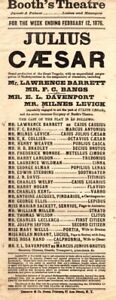
Sold on eBay April 8th, 2024