

Playbill Collectibles : Playbill+festival Price List
average value
-
low
-high
-Found 20 out of 56,978 items matching 'festival'
Sold on eBay Feb 04, 2023
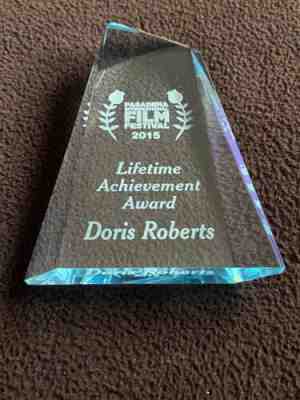
Doris Roberts Personal Pasadena International Film Festival Lifetime Award 2015
This EXTREMELY RARE one of a kind item was purchased at the Doris Roberts Estate Sale December 2016. This award was given to her and reads â??Pasadena International Film Festival 2015 Lifetime Achievement Award Doris Robertsâ? Refer to the image of the Estate Sale Companyâ??s description of the the sale. Also refer to the images that are mine and was taken by me in her home at the sale for the authentication of the award being sold amongst others on the table. If you have any questions please donâ??t hesitate in contacting me. This item is bought and sold AS IS. Ships by Priority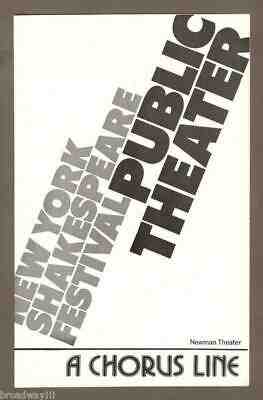
Sold on eBay Dec, 26th 2019
Michael Bennett (Signed) "A CHORUS LINE" Donna McKechnie 1975 Off-Broadway
This is a rare autographed May 1975 program (playbill) from the Original Off-Broadway production nbsp;of nbsp;the legendary MARVIN HAMLISCH, EDWARD KLEBAN, JAMES KIRKWOOD, NICHOLAS DANTE and MICHAEL BENNETTmusical "A CHORUS LINE which played the Public Theatre's Newman Theatre in New York City ;(Originally part of the New York Shakespeare Festival season, the production nbsp;played 41 previews beginningApril 15th, 1975, before officially openingMay 21st, 1975 at the Public's Newman Theatre. Plans werequickly made to move to New York's
Sold on eBay August 18th, 2024
*EDWIN BOOTH RARE LARGE 1891 DOUBLE MATTED FAREWELL TO THE STAGE BROADSIDE*
A rare large original March 21, 1891 broadside, handsomely double matted for display in black and red, for Edwin Booth's final stage engagement in Manhattan. Booth retired from the stage two weeks later at the Brooklyn Academy of Music. Lawrence Barrett is billed as sharing the stage with Booth, but alas, he didn't. He died the day before on March 20. This was probably the last bill to list Lawrence Barrett. Booth carried on without his partner for the next two weeks and then ended his illustrious stage career. Dimensions seventeen by eight inches, with broadside twelve and a half by four and a half inches. Light wear otherwise fine. An extraordinary display piece of the greatest actor America has ever known. See Edwin Booth and and the Booth family's extraordinary biographies below.Shipping discounts for multiple purchases. Credit cards accepted with Paypal. Inquiries always welcome. Please visit my other eBay items for more early theatre and historical autographs, photographs and programs and great singer, actor, and actress cabinet photos and CDV's.From Wikipedia:The Booth family was an English American theatrical family of the 19th century. Its most famous and well known members were Edwin Booth, one of the leading actors of his day, and John Wilkes Booth, who assassinated Abraham Lincoln.The patriarch was Junius Brutus Booth, a London-born lawyer's son who eventually became an actor after he attended a production of Othello at the Covent Garden theatre. The prospects of fame, fortune, and freedom were very appealing to young Booth, and he displayed remarkable talent from an early age, deciding on a career in the theatre by the age of 17. He performed roles in several small theaters throughout England, and joined a tour of the Low Countries in 1814, returning the following year to make his London debut.Booth abandoned his wife and their young son in 1821 and ran off to the United States with Mary Ann Holmes, a London flower girl. They settled on some 150 acres in Harford County near Baltimore and started a family; they had 10 children, six of whom survived to adulthood [1][2]Junius Sr. and Edwin toured in California during the Gold Rush.[citation needed] Edwin bought an interest in the Winter Garden Theatre at 667 Broadway in New York City together with his brother-in-law John Sleeper Clarke. The brothers John Wilkes, Edwin, and Junius Brutus, Jr. performed there in the play Julius Caesar at a benefit in 1864, the only time they were seen together on a stage, playing Mark Antony, Brutus, and Cassius, respectively Junius Brutus Booth (1796–1852) brought his mistress Mary Ann Holmes, who bore him 10 children, to the United States.He also wrote many letters in fits of drunken anger and madness to President Andrew Jackson threatening assassination. He requested that two prisoners who had been sentenced to death for piracy, named De Ruiz and De Soto, be pardoned, else: "I will cut your throat whilst you are sleeping." This letter would later be recanted by Junius, stating, "May god preserve General Jackson and this happy republic [4]Junius Brutus Booth Jr. (1821–1883) was married to Agnes Booth. Junius Jr. never achieved the same fame as his brothers, but his third wife Agnes was popular.Their son Sydney Barton Booth (1877–1937) was an actor well into the era of modern film [5]Edwin Thomas Booth (1833–1893) came to be the foremost American Shakespearean actor of his day. He founded The Players, a New York City actors' club which continues to the present day.Edwin's grandson Edwin Booth Grossman was a painter of some note.Asia Frigga Booth (1835–1888) married John Sleeper Clarke, an actor/comedian who was briefly imprisoned in the aftermath of the assassination. They then emigrated to Britain, where he became a successful theatre manager.Creston Clarke[6] and Wilfred Clarke,[7] sons of John and Asia, were noted actors in their day.John Wilkes Booth (1838–1865) was a popular young star in less serious fare than his brothers.A Confederate sympathizer during the American Civil War, during a play attended by Abraham Lincoln, Booth took advantage of his access to the theatre to invade the President's box and assassinate the President. He was killed 12 days later by Union soldier Boston CorbettEdwin Thomas Booth (November 13, 1833 – June 7, 1893) was an American actor who toured throughout the United States and the major capitals of Europe, performing Shakespearean plays. In 1869, he founded Booth's Theatre in New York.[2] Some theatrical historians consider him the greatest American actor, and the greatest Prince Hamlet, of the 19th century.[3] His achievements are often overshadowed by his relationship with his younger brother, actor John Wilkes Booth, who assassinated President Abraham Lincoln.Booth was born in Bel Air, Maryland, into the Anglo-American theatrical Booth family. He was the son of the famous actor, Junius Brutus Booth, an Englishman, who named Edwin after Edwin Forrest and Thomas Flynn, two of Junius' colleagues. He was the elder brother of John Wilkes Booth, himself a successful actor who gained notoriety as the assassin of President Lincoln.Nora Titone, in her book My Thoughts Be Bloody, recounts how the shame and ambition of Junius Brutus Booth's three actor sons, Junius Brutus Booth, Jr. (who never achieved the stage stardom of his two younger actor brothers), Edwin Booth, and John Wilkes Booth, spurred them to strive, as rivals, for achievement and acclaim—Edwin a Unionist, and John Wilkes, a Confederate and the assassin of Abraham Lincoln [4]CareerIn early appearances, Booth usually performed alongside his father, making his stage debut as Tressel or Tressil in Colley Cibber's version of Richard III in Boston on September 10, 1849. His first appearance in New York City was in the character of Wilford in The Iron Chest, which he played at the National Theatre in Chatham Street, on the 27th of September 1850. A year later, on the illness of the father, the son took his place in the character of Richard III.[5]After his father's death in 1852, Booth went on a worldwide tour, visiting Australia and Hawaii, and finally gaining acclaim of his own during an engagement in Sacramento, California, in 1856.[6]Before his brother assassinated Lincoln, Edwin had appeared with his two brothers, John Wilkes and Junius Brutus Booth Jr., in Julius Caesar in 1864.[7] John Wilkes played Marc Antony, Edwin played Brutus, and Junius played Cassius.[8] It was a benefit performance, and the only time that the three brothers appeared together on the same stage.[9] The funds were used to erect a statue of William Shakespeare that still stands in Central Park just south of the Promenade. Immediately afterwards, Edwin Booth began a production of Hamlet on the same stage, which came to be known as the "hundred nights Hamlet", setting a record that lasted until John Barrymore broke the record in 1922, playing the title character for 101 performances From 1863 to 1867, Booth managed the Winter Garden Theatre in New York City, mostly staging Shakespearean tragedies. In 1863, he bought the Walnut Street Theatre in Philadelphia [10]After John Wilkes Booth's assassination of President Lincoln in April 1865, the infamy associated with the Booth name forced Edwin Booth to abandon the stage for many months. Edwin, who had been feuding with John Wilkes before the assassination, disowned him afterward, refusing to have John's name spoken in his house.[11] He made his return to the stage at the Winter Garden Theatre in January 1866, playing the title role in Hamlet,[6] which would eventually become his signature role.Acting styleEdwin's acting style was distinctly different from that of his father. While the senior Booth was, like his contemporaries Edmund Kean and William Charles Macready, strong and bombastic, favoring characters such as Richard III, Edwin played more naturalistically with a quiet, more thoughtful delivery, tailored to roles like Hamlet.Later lifeBooth was married to Mary Devlin from 1860 to 1863, the year of her death. They had one daughter, Edwina, born on December 9, 1861, in London. He later remarried, wedding his acting partner Mary McVicker in 1869, and became a widower again in 1881.Edwin Booth with daughter Edwina, circa 1864Portrait of Edwin Booth by John Singer Sargent, 1890, which hung at The Players clubhouse. Now in the collection of the Amon Carter Museum of American Art.In 1869, Edwin acquired his brother John's body after repeatedly writing to President Andrew Johnson pleading for it. Johnson finally released the remains, and Edwin had them buried, unmarked, in the family plot at Green Mount Cemetery in Baltimore.In 1888, Booth founded The Players, a private club for performing, literary, and visual artists and their supporters, and dedicated his home on Gramercy Park to it.His final performance was, fittingly, in his signature role of Hamlet, in 1891 at the Brooklyn Academy of Music.Robert Lincoln rescueEdwin Booth saved Abraham Lincoln's son,[12] Robert, from serious injury or even death. The incident occurred on a train platform in Jersey City, New Jersey. The exact date of the incident is uncertain, but it is believed to have taken place in late 1864 or early 1865. Robert Lincoln recalled the incident in a 1909 letter to Richard Watson Gilder, editor of The Century Magazine.The incident occurred while a group of passengers were late at night purchasing their sleeping car places from the conductor who stood on the station platform at the entrance of the car. The platform was about the height of the car floor, and there was of course a narrow space between the platform and the car body. There was some crowding, and I happened to be pressed by it against the car body while waiting my turn. In this situation the train began to move, and by the motion I was twisted off my feet, and had dropped somewhat, with feet downward, into the open space, and was personally helpless, when my coat collar was vigorously seized and I was quickly pulled up and out to a secure footing on the platform. Upon turning to thank my rescuer I saw it was Edwin Booth, whose face was of course well known to me, and I expressed my gratitude to him, and in doing so, called him by name.Booth did not know the identity of the man whose life he had saved until some months later, when he received a letter from a friend, Colonel Adam Badeau, who was an officer on the staff of General Ulysses S. Grant. Badeau had heard the story from Robert Lincoln, who had since joined the Union Army and was also serving on Grant's staff. In the letter, Badeau gave his compliments to Booth for the heroic deed. The fact that he had saved the life of Abraham Lincoln's son was said to have been of some comfort to Edwin Booth following his brother's assassination of the president Statue of Booth as Hamlet, Gramercy Park by Edmond T. Quinn, circa 1916Booth's TheatreBooth's Theatre Playbill of his Richard III circa 1872In 1867, a fire damaged the Winter Garden Theatre, resulting in the building's subsequent demolition. Afterwards, Booth built his own theatre, an elaborate structure called Booth's Theatre in Manhattan, which opened on February 3, 1869, with a production of Romeo and Juliet starring Booth as Romeo, and Mary McVicker as Juliet. Elaborate productions followed, but the theatre never became a profitable or even stable financial venture. The panic of 1873 caused the final bankruptcy of Booth's Theatre in 1874. After the bankruptcy, Booth went on another worldwide tour, eventually regaining his fortune DeathEdwin Booth had a small stroke in 1891, which precipitated his decline. He suffered another stroke in April 1893 and died June 7, 1893, in his apartment in The Players clubhouse. He was buried next to his first wife at Mount Auburn Cemetery in Cambridge, Massachusetts. His bedroom in the club has been kept untouched since his death.[13] The New York Times reported his death [14]Exhumation requestIn December 2010, descendants of Edwin Booth reported that they obtained permission to exhume the Shakespearean actor's body to obtain DNA samples to compare with a sample of his brother John's DNA to refute the rumor he had escaped after the assassination. However, Bree Harvey, a spokesperson from the Mount Auburn Cemetery in Cambridge, Massachusetts, where Edwin Booth is buried, denied reports that the family had contacted them and requested to exhume Edwin's body.[15] The family hopes to obtain DNA samples from artifacts belonging to John Wilkes, or from remains such as vertebrae stored at the National Museum of Health and Medicine in Maryland [16][17] On March 30, 2013, museum spokesperson Carol Johnson announced that the family's request to extract DNA from the vertebrae had been rejected [18]DramatizationsA number of modern dramatizations have been made of Edwin Booth's life, on both stage and screen. One of the best known is the 1955 film Prince of Players written by Moss Hart, based loosely on the popular book of that name by Eleanor Ruggles. It was directed by Philip Dunne and stars Richard Burton and Raymond Massey as Edwin and Junius Brutus Booth, Sr., with Charles Bickford and Eva Le Gallienne, the latter of whom plays Gertrude to Burton's Hamlet. The film depicts events in Booth's life well before, and then surrounding, the assassination of Lincoln by Booth's younger brother.[19]The opening scenes of Prince of Players are very similar to scenes in the earlier 1946 John Ford western My Darling Clementine. In that movie, the character of Granville Thorndyke (as acted by Alan Mowbray) is an obvious nod to Booth's father Junius, and the scenes portray essentially the same sequence where the great actor has to be retrieved from a bar and dragged back to the theatre where he is overdue to give a performance in front of a restless audience [20][21]The Brothers BOOTH!, by W. Stuart McDowell, which focuses on the relationships of the three Booth brothers leading up to the assassination of Lincoln, was workshopped and given a series of staged readings featuring David Strathairn, David Dukes, Angela Goethals, Maryann Plunkett, and Stephen Lang at the New Harmony Project,[22] and at The Guthrie Theatre Lab in Minneapolis, and later presented in New York at the Players' Club, the Second Stage Theatre, and the Boston Athenaeum. It was given its first fully staged professional production at the Bristol Riverside Theatre outside Philadelphia in 1992 [23][24][25] A second play by the same name, The Brothers Booth, which focuses on "the world of the 1860s theatre and its leading family"[26] was written by Marshell Bradley and staged in New York at the Perry Street Theatre in 2004.Oliver Ingraham Lay: Edwin Booth as Hamlet, 1887Austin Pendleton's play, Booth, which depicts the early years of the brothers Edwin, Junius, and John Wilkes Booth and their father, was produced off Broadway at the York Theatre, starring Frank Langella as Junius Brutus Booth, Sr. In a review, the play was called "a psychodrama about the legendary theatrical family of the 19th century" by The New York Times.[27] Pendleton had adapted this version from his earlier work, Booth Is Back, produced at Long Wharf Theatre in New Haven, Connecticut, in the 1991-1992 season.The Tragedian, by playwright and actor Rodney Lee Rogers, is a one-man show about Booth that was produced by PURE Theatre of Charleston, South Carolina, in 2007. It was revived for inclusion in the Piccolo Spoleto Arts Festival in May and June 2008.[28]A play by Luigi Creatore called Error of the Moon played off-Broadway on Theatre Row in New York City from August 13 to October 10, 2010. The play is a fictionalized account of Booth's life, hinging on the personal, professional, and political tensions between brothers Edwin and John Wilkes, leading up to the assassination of Lincoln.[29]In 1959, the actor Robert McQueeney played Booth in the episode "The Man Who Loved Lincoln" on the ABC/Warner Brothers western television series, Colt .45, starring Wayde Preston as the fictitious undercover agent Christopher Colt, who in the story line is assigned to protect Booth from a death threat.[30]In 1960, the anthology series television series Death Valley Days broadcast "His Brother's Keeper", in which Booth visits a small town after the Lincoln assassination, with one of the town's influential citizens trying to have him run out of town.In 1966, Martin Landau played Edwin Booth in the episode "This Stage of Fools" of the NBC western television series, Branded, starring Chuck Connors as Jason McCord. In the story line, McCord takes a job as the bodyguard to the actor Edwin Booth, brother of the presidential assassin, John Wilkes Booth [31][32]In 2013, Will Forte played Edwin Booth in the "Washington, D.C." episode of the Comedy Central's series, Drunk History, created by Derek Waters.In 2014, Edwin Booth was played by Gordon Tanner in The Pinkertons episode, "The Play's the Thing" (S1:E3). In the episode, both the "Hundred nights Hamlet" and Edwin's rescue of Robert Lincoln are mentioned LegacyGrave of Edwin BoothBooth left a considerable estate upon his death. He left charitable bequests that furthered the development of the acting profession and the treatment of mental illness. He left bequests of $5,000 each (almost $150,000 in 2021 dollars) to the Actor's' Fund, the Actors' Association of Friendship of the City of New York (Edwin Forrest Lodge), The Actors' Association of Friendship of the City of Philadelphia (Shakespeare Lodge), the Asylum Fund of New York and the Home for Incurables (West Farms, New York).[33] Other examples of his legacy include:The Players still exists in its original clubhouse at 16 Gramercy Park South in Manhattan.[34] A statue of Booth as Hamlet, by Edmond T. Quinn, has been the centerpiece of the private Gramercy Park since 1916. It can be seen by the public through the south gate of the park.Booth left a few recordings of his voice preserved on wax cylinder. One of them can be heard on the Naxos Records set Great Historical Shakespeare Recordings and Other Miscellany.[35] Another place to hear his preserved voice is on the site shown here [3:34][36] Booth's voice is barely audible with all the surface noise, but what can be deciphered reveals it to have been rich and deep.Memorials of Booth can still be found around Bel Air, Maryland. In front of the courthouse is a fountain dedicated to his memory. Inside the post office is a portrait of him. Also, his family's home, Tudor Hall, still stands and was bought in 2006 by Harford County, Maryland, to become a museum.A chamber in Mammoth Cave in Kentucky is called "Booth's Amphitheatre" – so called because Booth entertained visitors there.The Springer Opera House in Columbus, Georgia, is said to be haunted by the ghost of Edwin Booth Broadway s Booth Theatre was the first, and remains the oldest, Broadway theatre to be named in honor of an actor.Stephen Sondheim's musical Assassins mentions Edwin in "The Ballad of Booth" with the lyrics: "Your brother made you jealous, John/You couldn't fill his shoes."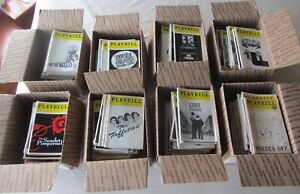
Sold on eBay February 17th, 2024
Huge lot of 317 BROADWAY PLAYBILLS from the 1990's to early 2000's
*** HUGE PRICE REDUCTION ***You're looking a HUGE lot of 317 of random official BROADWAY PLAYBILLS from the 1980's to early 2000's only. Dimension are roughly 8.5" x 5.5" in size. They cover theaters all over America, but mostly from the NYC area. These playbills are unique for the theatre and years of issue. In other words, there are no exact duplicates, but plays from the same theater for a different date with different cover and contents. Some have black & white cover pages while other have colorized cover pages. These programs are used, but in good vintage condition overall. Some of the programs are in better condition than others (none of them is complete beat up). The programs have imperfections such as: corner dings, creases, fold marks, writing (like a date on the show), sticker on cover page (with date), staple marks (from ticket stub), clear tape on corner of cover page, very small insignificant tears, minor cover page/spine wear, discoloration or staining due to age, and other similar imperfections. See pictures. Other minor flaws may be present. What you see is what you get. A few of these programs may come with original inserts. To be sold as a lot only. Great starter collection or opportunity to add to your playbill collection Here s a link to my UPS, USPS or FedEx Ground shipping within Continental US. Priority Mail international shipping is $300..Please ask any questions before making a purchase. Thanks and good luck! Complete list of programs in mostly alphabetical order:1.) After-Play (Theatre Four, March 1996)2.) Agnes Of God (Music Box, April 1982)3.) Ain't Misbehavin' (Ambassador, November 1988)4.) Alvin Ailey American Dance Theater (City Center, December 1998)5.) Amadeus (Broadhurst, June 1983)6.) Amy's View (Ethel Barrymore, May 1999)7.) And The World Goes 'Round (Westside, November 1991)8.) Annie (Uris, August 1982)9.) Annie Get Your Gun (Marquis, February 2000)10.)Annie Get Your Gun (Marquis, January 2000)11 )Anything Goes (Lincoln Center At The Vivian Beaumont, June 1988)12 )Anything Goes (Lincoln Center At The Vivian Beaumont, July 1989)13.)Arms And The Man (Roundabout, May 1989)14.)Arms And The Man (Circle In The Square, 19 )15 )Aspects Of Love (Broadhurst, May 1990)16.)Baby (Ethel Barrymore, May 1984) Centennial Edition17.)Baby (Ethel Barrymore, March 1984)18.)Beauty Queen Of Leenane (Walter Kerr, November 1998)19.)Beauty Queen Of Leenane (Atlantic, April 1998)20.)Beauty And The Beast (Palace, January 1997)21.)Beauty And The Beast (Wang, July 1998)22 )Benefactors (Brooks Atkinson, January 1986)23.)Best Little Whorehouse In Texas, The (Eugene O'Neill, May 1982)24.)Biloxi Blues (Neil Simon, November 1985)25.)Biloxi Blues (Neil Simon, 19??)26.)Black And Blue (Minkoff, December 1989)27.)Blood Brothers (Music Box, July 1993)28.)Blue Window (Manhattan Club, February 1996)29 )Breaking Legs (Promenade, February 1992)30 )Brighton Beach Memoirs (Neil Simon, 19 )31 )Brighton Beach Memoirs (46th Street, 19 )32 )Broadway Jukebox (John Houseman, August 1990)33 )Broadway (Imperial, February 1990)34 )Broadway (John Houseman, July 1992)35 )Broadway Sound (Broadhurst, December 1986)36 )Cabaret (Roundabout At Studio 54, 19??)37.)Caine Munity Court-Martial, The (Circle In The Square, June 1983)38 )Caretaker The (Circle In The Square, February 1986)39 )Carousel (Lincoln Center At The Vivian Beaumont, May 1994) 40.)Catskills On Broadway (Lunt-Fontanne, January 1992)41 )Catskills On Broadway (Lyric Opera House, 19??)42.)Cats (Winter Garden, January 2000)43 )Chairs The (John Golden, May 1998)44 )Chicago (Colonial, December 1997)45 )Chicago (Richard Rodgers, November 1996)46 )Checkmates (46th Street, November 1998)47.)Chorus Line, A (Shubert, December 1995)48.)City Of Angels (Virginia, April 1990)49.)Come Back To The 5 & Dime Jimmy Dean, Jimmy Dean (Martin Beck, March 1982)50.)Comedy Tonight (Lunt-Fontanne, December 1994)51 )Conversations With My Father (Royale, January 1993)52.)Corn Is Green, The (Lunt-Fontanne, September 1993)53.)Crazy For You (Shubert, October 1994)54.)Crazy For You (Shubert, July 1992) colorized55 )Crucible The (Belasco, 1992)56 )Current Events (Manhattan Theatre Club, May 2000)57.)Dance Theatre Of Harlem (City Center, January 1982)58 )Dancing At Lughnasa (Plymouth, April 1992)59.)Death Of A Salesman (Broadhurst, April 1994)60.)Death Of A Salesman (Eugene O'Neill. June 1999 61 )Devil s Disciple, The (Circle In The Square, January 1989)62.)Dinah Was (Gramercy, August 1998)63.)Dirty Rotten Scoundrels (Opera House, March 2000)64.)Do Black Patent Leather Shoes Really Reflect Up? (Wilbur, April 1985)65 )Doctor s Dilemma (Roundabout, January 1990)66.)Doll's House, A (Belasco, May 1997)67 )Doubles (Ritz, 1985)68 )Dreamgirls (Merriam, )69 )Dreamgirls (Imperial, March 1982)70 )Dresser The (Brooks Atkinson, March 1982)71 )Driving Miss Daisy (John Houseman, December 1989)72 )Exactly Like You (York, April 1999)73.)Evita (Shubert, November 1982)74.)Evita (Colonial, May 1994)75.)Evita (Broadway, October 1982)76 )Father The (Roundabout Criterion Center Stage Right, January 1996)77.)Fences (46th Street, December 1987)78.)Few Good Men, A (Music Box, November 1989)79 )Fiddler On The Roof (Gershwin, March 1991)80.)Five Guys Named Moe (Eugene O'Neill, March 1992)81 )Flowering Peach. The (Lyceum, March 1994)82.)Food Chain, The (Westside August 1995)83 )Forbidden Broadway Cleans Up Its Act! (Stardust, December 1998)84 )Forever Tango (Marquis, June 1998)85 )Forever Tango (Walter Kerr, January 1998)86.)84 Charis Cross Road (Nederlander, January 1983)87.)42nd Street (St. James, June 1988)88.)42nd Street (Shubert, June 1984)89.)42nd Street (Majestic, January 1982)90 )Footloose (Richard Rodgers, February 1999)91.)Fosse (Broadhurst, August 1999)92.)Four Dogs And A Bone (Lucille Lortel, June 1994)93 )Foxfire (Ethel Barrymore, November 1982)94 )Foxfire (Colonial, October 1982)95 )Frankie And Johnny In The Clair De Lune (Westside Arts, September 1988)96.)Fuddy Meers (Minetta Lane, February 2000)97 )Grandma Sylvia's Funeral (Soho Playhouse, January 1996)98.)G.B. Shaw's Getting Married (Circle In The Square, July 1991)99.)Ghosts (Brooks Atkinson, September 1982)100 )George M. Cohan's Give Me Regards To Broadway (Playhouse 91, July 1989)101.)Glass Menagerie, The (Roundabout Criterion Center Stage Right, November 1994)102.)Grand Hotel The Musical (Martin Beck, May 1991)103.)Gross Indecency The Three Trials Of Oscar Wilde (Minetta Lane (July 1998)104.)Guys And Dolls (Martin Beck, April 1993)105.)Guys In The Truck, The (New Apollo, June 1983)106.)H2$ (Richard Rodgers, December 1995)107.)Hay Fever (Music Box, March 1986)108.)Heidi Chronicles, The (Plymouth, April 1990)109.)Heidi Chronicles, The (Plymouth, May 1989)110 )Hello Dolly (Lunt-Fontanne, January 1996)111 )Hello Dolly (Lunt-Fontanne, October 1995)112 )Holiday Heart (Manhattan Club At City Center, April 1995)113 )Homecoming The (Roundabout Criterion Center Stage Right, October 1991)114 )Hurrah At Last (Gramercy, June 1999)115 )Harrigan 'N Hart (Longacre, 1994)116.)Ian McKellen Acting Shakespeare (Ritz, January 1984)117.)Ice Cream With Hot Fudge (New York Shakespeare Festival, April 1990)118.)Ideal Husband, An (Ethel Barrymore, December 1996)119 )Impossible Marriage (Roundabout Criterion Center Laura Pels, October 1998)120 )Inside Out (Cherry Lane, November 1994)121.)Into The Woods (Martin Beck, July 1988)122 )Irish And How They Got That Way (Wilbur, March 1998)123.)Is There Life After High School? (Ethel Barrymore, April 1982)124.)Isn't It Romance (Walnut Street, November 1985)125 )Jackie (Belasco, February 1998)126 )Jackie Mason (Neil Simon, January 1991)127 )Jackie Mason's The World According To Me! (Brooks Atkinson, January 1987)128 )Jake s Women (Neil Simon, August 1992)129 )Jacques Brel Is Alive & Well & Living Paris (Arden, ?)130.)Jeffrey (Minetta Lane, May 1993)131 )Jekyll & Hude (Plymouth, July 1997)132 )Jekyll & Hyde (Plymouth, May 1998)133 )Jerry s Girls (St. James, February 1986)134.)Joe Turner's Come And Gone (Ethel Barrymore. April 1988)135 )Joseph And The Amazing Technicolor Dreamcoat Royale, Januar 1982)136 ) Joseph And The Amazing Technicolor Dreamcoat (Minskoff, December 1993)137 )Joyicity (Actors' Playhouse, September 1982)138.)Judas Kiss, The (Broadhurst, June 1998)139.)June Moon (Variety Arts, February 1998)140.)Kat And The Kings (Cort, August 1999)141 )Kentucky Cycle, The (Royale, November 1993)142.)King And I, The (Neil Simon, May 1997)143.)King And I, The (Neil Simon, April 1996) colorized144 )Knife The (New York Shakespeare Festival Public Theater, March 1987)145.)King Lear by William Shakespeare (Roundabout, October 1990)146.)Kiss Me Kate (Martin Beck, January 2000)147.)Kiss Of The Spider Woman (Broadhurst, June 1994)148.)Labor Day (Manhattan Theatre Club, June 1998)149.)La Cage Aux Folles (Palace, 1985)150 )Legends (Shubert, August 1986)151.)Les Miserables (Broadway, February 1988)152.)Les Miserables (Imperial, January 1996)153.)Les Miserables (Colonial, ?)154.)Lettice & Lovage (Ethel Barrymore, September 1990)155 )Lieutenant Of Inishmore (Atlantic Theater Company, March 2006)156.)Life On The Third Rail (Theatre At Saint Peter's Church, October 1990)157 )Lighthouse The (Boston Shakespeare, November 1983)158 )Lillian (Ethel Barrymore, February 1986)159.)Lips Together Teeth Apart (Manhattan Theatre Club At City Center (December 1991)160 )Little Family Business, A (Martin Beck, November 1982)161 )Little Hotel On The Side, A (Belasco, February 1992)162 )Little Like Magic, A (Lyceum, October 1986)163 )Little Me (Roundabout Theatre Company Criterion Center Stage Right, December 1998)164.)Long Day's Journey Into Night (Broadhurst, May 1986)165.)Lost In Yonkers (Richard Rodgers, March 1992)166.)Love Letters (Promenade, September 1989)167.)Love Thy Neighbor (Booth, December 1996)168.)M. (Eugene O'Neill, December 1988)169.)Ma Rainey's Black Bottom (Cort, October 1984)170 )Machinal (New York Shakespear Festival Public Theater, October 1990)171.)Magic On Broadway (Lamb's, April 1997)172.)Mamma Mia! (Colonial, April 2003)173.)Man And Superman (Arden, October 1993)164.)Marie Christine (Lincoln Center At The Vivian Beaumont, December 1999)165 )Master Class (John Golden, October 1996)166 )Master Harold...And The Boys (Lyceum, August 1982)167 )Matchmaker The (Roundabout At The Haft Theater, July 1991)168.)Me And My Girl (Marquis, July 1987)169.)Medea (Longacre, June 1994)170 )Merchant Of Venice, The (46th Street, February 1990)171 )Merlin (Mark Hellinger, March 1983)172 )Misalliance (Roundabout Criterion Center Laura Pels, September 1997)173 )Misanthrope The (Circle In The Square, February 1983)174 )Miser The (Circle In The Square, December 1990)175.)Miss Saigon (Broadway, January 1998)176 )Mizlansky Zilansky Ar Schmucks (Manhattan Theatre Club, March 1998)177 )Moliere Comedies The School For Husbands The Imaginary Cuckold (Roundabout Criterion Center Stage Right, February 1995)178.)Molly Sweeney (Roundabout Criterion Center Laura Pels, May 1996)179.)Month In The Country, A (Roundabout Criterion Center Stage Right, May 1995)180.)Moon For The Misbegotten (Walter Kerr, May 2000)181 )Moonlight (Roundabout Criterion Center Laura Pels, December 1995)182.)Music Man, The (Neil Simon, June 2000)183.)Music Of The Night (Colonial, November 1996)184.)My One And Only (St. James, August 1983)185 )Mystery Of Edwin Drood, The (Imperial, January 1986)186 )National Theatre Magazine, The (NTM, December 1983)187 )National Theatre Magazine, The (NTM, January 1984)188 )National Theatre Magazine, The (NTM, November 1983)189 )National Theatre Magazine, The (NTM, March 1984)190 )National Theatre Magazine, The (NTM, September 1984)191 ) Night Mother (John Golden, July 1983)192.)Night And Her Stars (Manhattan Club At The American Place Theatre, April 1995)193.)Nine (46th Street, May 1983)194.)New England (Manhattan Theatre Club At City Center, December 1995)195.)No Man's Land (Roundabout Theatre Company Criterion Center Stage Right, March 1994)196.)Not About Nightingales (Circle In The Square, May 1999)197 )Noises Off (Brooks Atkinson, 1984)198 )Noises Off (Brooks Atkinson, May 1984) Centennial Edition199 )Nunsense (Charles Playhouse, ?)200.)Nunsense (Boston Shakespeare, November 1986)201 )Nunsense (Douglas Fairbanks, November 1991)202.)Only Thing Worse You Could Have Told Me..., The (Actor's Playhouse, June 1995)203.)Open Admissions (Music Box, February 1984)204 )Orpheus Descending (Neil Simon, December 1989)205 )Oedipus (Blue Light At CSC Theater, October 1998)206 )Othello (Winter Garden, January 1982)207.)Over The River And Through The Woods (John Houseman, July 1999)208.)Mo Show: Parallel Lives (Westside Arts, July 1989)209.)Park Your Car In Harvard Yard (Music Box, ?)210.)Passion (Plymouth, October 1994)211.)Penn & Teller Rot In Hell (John Houseman, August 1991)212.)Peter Nero And The Philly Pops (Academy Of Music, 1991)213 )Phantom Of The Opera (Majestic, September 1991)214 )Phantom Of The Opera (Wang, February 2001)215 )Phantom Of The Opera (Majestic, March 1997)216 )Philadelphia Here I Come (Roundabout Criterion Center Stage Right, October 1994)217.)Piano Lesson, The (Walter Kerr, May 1990)218 )Picnic (Roundabout Criterion Center Stage Right, April 1994)219.)Play Me A Country Song, A (Virginia, June 1982)220 )Plenty (Plymouth, February 1983)221 )Politically Correct (John Golden, July 1994)222.)Porgy And Bess (Radio City Music Hall, April 1983)223 )Pounding Nails (Minetta Lane, March 1994)224.)Power Plays (Promenade, October 1998)225 )Prelude To A Kiss (Helen Hayes, October 1990)226 )Present Laughter (Circle In The Square, July 1982)227 )Present Laughter (Walter Kerr, January 1997)228 )Present Laughter (Walter Kerr, February 1997)229 )Private Lives (Lunt-Fontanne, May 1983)230 )Privates On Parade (Roundabout, October 1989)231 )Producers The (Colonial, July 2003)232 )Price The (Roundabout Criterion Center Stage Right. July 1992)233.)Price Of Fame (Roundabout, June 1990)234.)Queen And The Rebels, The (Plymouth, October 1982)235 )Ragtime The Musical (Ford Center For The Performing Arts, January 2000)236 )Ragtime The Musical (Ford Center For The Performing Arts, November 1998)237.)Real Thing, The (Plymouth, 1984)238.)Red Diaper Baby (Actor's Playhouse, July 1992)239.)Rise Of David Levinsky, The (John Houseman, February 1987)240.)Road Show (Circle Repertory Company, June 1987)241.)Rose Tattoo, The (Circle In The Square, June 1995)242 )Salome (Circle In The Square, June 1992)243 )Scapin (Roundabout Criterion Center Laura Pels, December 1996) 244.)Scarlet Pimpernel, The (Minksoff, November 1998)245 )Scarlet Pimpernel, The (Minksoff, January 1998)246 )Search And Destroy (Circle In The Square, February 1992)247 )Search For intelligent Signs In The Universe, The (Plymouth, June 1986)248 )Secret Garden, The (St. James, February 1992)249 )Secret Rapture, The (New York Shakespeare Festival Public Theater, September 1989)250 )Shadowlands (Brooks Atkinson, January 1991)251 )Shakespeare For My Father (Helen Hayes, April 1993)252 )Shirley Valentine (Booth, November 1989)253.)Show Boat (Lyric Opera House, 1982)254.)Show Boat (Gershwin, September 1996)255.)Side Show (Richard Rodgers, January 1998)256 )Singin In The Rain (Gershwin, 1985)257 )Sisters Rosensweig, The (Ethel Barrymore. July 1993)258.)Six Degrees Of Separation (Lincoln Center At The Mitzi E. Newhouse (September 1990)259.)Six Degrees Of Separation (Lincoln Center At The Vivian Beaumont, January 1991)260 )Smokey Joe's Cafe The Songs Of Leiber And Stoller (Virginia, December 1998)261 )Smokey Joe's Cafe The Songs Of Leiber And Stoller (Virginia, August 1995)262 )Social Security (Ethel Barrymore, September 1986)263 )Someone Who'll Watch Over Me (Booth, February 1993)264 )Sophisticated Ladies (Lunt-Fontanne, June 1982)265.)Speed The Plow (Royale, August 1988)266.)Speed The Plow (Royale, November 1988)267.)Spunk (New York Shakespeare Festival Public Theater, April 1990)268 )Starlight Express (Gershwin, August 1987) colorized269 )Starlight Express (Gershwin, October 1987)270 )Street Corner Symphony (Brooks Atkinson, November 1987)271 )Strike Up The Band (City Center, February 1998)272 )Steaming (Brooks Atkinson, January 1993)273.)Stomp (Wilbur, November 1997)274.)Stomp (Orpheum, May 1994)275 )Student s Prince, The (Playhouse 91, February 1989)276 )Streetcar Named Desire, A (Ethel Barrymore, May 1992)277.)Suds The Rocking 60's Musical Soap Opera (Criterion, November 1988)278 )Summer And Smoke (Roundabout Criterion Center Stage Company, September 1996)279 )Taffetas (Village Gate Upstairs, February 1989)280.)Talk Radio (New York Shakespeare Festival Public Theater, May 1987)281.)Tap Dance Kid, The (Minskoff, 1985)282.)Tap Dance Kid, The (Broadhurst, February 1984)283 )Tempest The (Roundabout, October 1989)284 )Tenderloin (City Center, March 2000)285.)Texts For Nothing (Joseph Papp, ?)286.)Three Birds Alighting On A Field (Manhattan Theatre Club At City Center, February 1994) 287.)Three Days Of Rain (Manhattan Theatre Club, December 1997)288.)Three Tall Women (Promenade, April 1994)289.)Tis Pity She's A Whore (New York Shakespeare Festival Public Theater, April 1992)290 )Titanic (Lunt-Fontanne, May 1998)291.)Torch Song Trilogy (Little Theatre, July 1982)292.)Torch Song Trilogy (Helen Hayes, 1985)293 )Treatment The (Joseph Rapp, November 1993)294.)Tru (Booth, March 1990)295.)Twice Around The Park (Cort, November 1982)296.)Two Trains Running (Walter Kerr, June 1992)297.)Wake Of Jamey Foster, The (Eugene O'Neill, October 1982)298.)Water Engine, The (Atlantic, October 1999)299 )What s Wrong With This Picture? (Brooks Atkinson, December 1994)300 )Welcome To The Club (Music Box, April 1989)301 )Whoop Dee Doo (Actors' Playhouse, September 1993)302 )Whoopi Goldberg (Lyceum, 1984)303.)Who's Tommy (St. James, September 1993)304.)Woman Of The Year (Palace, August 1982)305.)Woman Of The Year (Palace, February 1982)306 )Wonderful Town (Al Hirschfeld, January 2004)307.)World According To Me, The (Brooks Atkinson, April 1987)308 )Unidentified Himan Remains And The True Nature Of Love (Orpheum, October 1991)309 )Vampire Lesbians Of Sodom And Sleeping Beauty Or Coma (Provincetown Playhouse, January 1989)310 )Victor Victoria (Marquis, January 1996)311.)View From The Bridge, A (Ambassador, April 1983)312 )Visit The (Roundabout Criterion Center Stage Right, January 1992)313.)Vita & Virginia (Union Square, January 1995)314.)Will Rogers Follies A Life In The Revue (Palace, June 1991)315 )Years The (Manhattan Theatre Club At City Center, January 1993)316.)You Can't Take It With You (Plymouth, April 1983)317.)You Never Can Tell (Circle In The Square, November 1986)318.)Your Arms Too Short To Box With God (Alvin, October 1982)319.)Zorba (Broadway, December 1983)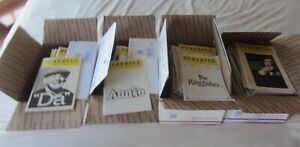
Sold on eBay February 4th, 2024
Huge lot of 229 BROADWAY PLAYBILLS from the 1970's to 1980's - UNIQUE PLAYBILLS
eBay *** HUGE PRICE REDUCTION ***You're looking a HUGE lot of 229 of random official BROADWAY PLAYBILLS from the 1970's to 1980's only. Dimension: 9" x 5.65" in size. They cover theaters all over America, but mostly from the NYC area. These playbills are unique for the theatre and years of issue. In other words, there are no exact duplicates, but plays from the same theater for a different date with different cover and contents. Some have black & white cover pages while other have colorized cover pages. These programs are used, but in good vintage condition overall. Some of the programs are in better condition than others (none of them is complete beat up). The programs have imperfections such as: corner dings, creases, fold marks, writing (like a date on the show), sticker on cover page (with date), staple marks (from ticket stub), clear tape on corner of cover page, very small insignificant tears, minor cover page/spine wear, discoloration or staining due to age, and other similar imperfections. See pictures. Other minor flaws may be present. What you see is what you get. A few of these programs may come with original inserts. To be sold as a lot only. Great starter collection or opportunity to add to your playbill collection Here s a link to my UPS, USPS or FedEx Ground shipping within Continental US. Priority Mail international shipping is $250..Please ask any questions before making a purchase. Thanks and good luck! Complete list of programs in partially alphabetical order:1.) Annie (Alvin, May 1977)2.) Alvin Ailey American Dance Theater (City Center, May 1979)3.) As You Like It (American Shakespare Theatre, ??)4.) Anna Christie (Imperial, May 1977)5.) American Millionaire, An (Circle In The City Square Joseph E. Levine, April 1974)6.) Amadeus (Broadhurst, December 1980)7.) All Over Town (Booth, January 1975)8.) Ah, Wilderness (Circle In The Square, October 1975)9.) Ain't Misbehavin' (Plymouth, May 1979)10.)Ain't Misbehavin' (Belasco, May 1981)11.)Ain't Misbehavin' (Longacre, December 1978)12.)Act, The (Majestic, December 1977)13.)Absurd Person Singular (Music Box, October 1974)14 )Brother To Dragons (Wilbur, September 1974)15 )Bubbling Brown Sugar (Anta, April 1976)16 )Brigadoon (Majestic, January 1981)17.)Bring Back Bride (Martin Beck, March 1981)18.)Bosoms And Neglect (Charles Playhouse, )19 )Blackstone (Majestic, June 1980)20.)Black Picture Show (New York Shakespeare Festival Lincoln Center Vivian Beaumont, January 1975)21.)Bette! Divine Madness (Majestic, November 1970)22 )Betrayal (Trafalgar, May 1980)23.)Best Little Whorehouse In Texas, The (Shubert, 1979)24.)Best Little Whorehouse In Texas, The (46th Street, January 1981)25.)Bent (New Apollo, May 1980)26.)Bed Before Yesterday, The (Colonial, ??)27.)Bacchae, The (Circle In The Square, October 1980)28.)Back Country (Wilbur, ??)29.)Bad Habits (Booth, August 1974)30 )Ballroom (Majestic, February 1979)31 )Ballroom (Majestic, November 1978)32.)Barnum (St. James, May 1980)33 )Beatlemania (Winter Gaeden, )34 )Beatlemania (Lunt-Fontanne, April 1979)35 )Bedroom Farce (Brooks Atkinson, July 1979)36 )Charlotte (Belasco, February 1980)37.)Club Champions Widow (Robert Lewis Acting Company, ??)38.)Can-Can (Minskoff, April 1981)39 )Candide (Broadway, July 1975)40.)Cat On A Hot Tin Roof (Anta, November 1974)41 )Chapter Twp (Imperial, January 1978)42 )Charlie And Algernon (Helen Hayes, September 1980)43 )Charles Aznavour On Broadway (Minskoff, October 1974)44.)Cherry Orchard, The (New York Shakespeare Festival Lincoln Center Vivian Beaumont, February 1977)45 )Chicago (46th Street, October 1975)46 )Children Of A Lesser God (Longacre, April 1980)47.)Chorus Line, A (Shubert, January 1979)48.)Chorus Line, A (Shubert, ??)49.)Chorus Line, A (Forrest, ??)50.)Clams On The Half Shell Revue (Minskoff, May 1975)51 )Clarence Darrow (Helen Hayes, April 1974)51.)Cold Storage (Lyceum, March 1978)52 )Copperfield (Anta, April 1981)53.)Comin' Uptown (Winter Garden, December 1979)54 )Crucible The (American Shakespeare. ??)55.)Crucifer Of Blood, The (Helen Hayes, November 1978)56 )Children Of A Lesser God (Longacre, August 1981)57.)Da (Morosco, December 1978)58 )Dancin (Ambassador, December 1981)59 )Dancin (Broadhurst, October 1978)60.)Day In Hollywood A Night In The Ukraine, A (John Golden, June 1980)61.)Day In Hollywood A Night In The Ukraine, A (Royale, July 1981)62.)Day In Hollywood A Night In The Ukraine, A (Royale, December 1980) colorized63 )Days In The Trees (Circle In The Square, October 1976)64.)Death Of A Salesman (Circle In The Square, July 1975)65 )Deathtrap (Music Box, June 1979)66 )Deathtrap (Wilbur, ??)67.)Dracula (Martin Beck, October 1977)68 )Dracula (Martin Beck, September 1979)69 )Dracula (Martin Beck, February 1978)70 )Dracula (Martin Beck, March 1979)71 )Dreamgirls (Shubert, November 1981)72 )Dreyfus In Rehearsal (Shubert, ??)73.)El Grande De Coca Cola (Plaza 9, July 1974)74 )Elephant Man, The (Booth, May 1981)75.)Equus (Plymouth, March 1976)76.)Equus (Helen Hayes, February 1977)77.)Equus (Wilbur, ??)78.)Eubie! (Ambassador, ??)79.)Evita (Broadway, December 1979)80.)Fifth Of July (New Apollo, August 1981)81.)Fifth Of July (New Apollo, October 1980)82.)First, The (Martin Beck, November 1981)83 )Filumena (Shubert, ??)84.)Filumena (St. James, February 1980)85.)First Monday In October (Majestic, November 1978)86.)42nd Street (Winter Garden, November 1980)87 )Frankenstein (Palace, December 1980)88.)Gemini (Little Theatre, June 1979)89 )Goodbye Fidel (New Ambassador, April 1980)90 )Gracious Living (Morris A. Mechanic, June 1978)91.)Gemini (Charles Playhouse, February 1980)92.)Gin Game, The (John Golden, September 1978)93.)Gin Game, The (John Golden, December 1977)94.)Glass Menagerie, The (Circle In The Square, January 1976)95 )Godspell (Promenade, January 1975)96.)Good Evening (Plymouth, May 1974)97.)Grand Tour, The (Palace, February 1979)98.)Guys And Dolls (Broadway, December 1976)99.)Guys And Dolls (Forrest, )100 )Heartaches Of A Pussycat (Anta, March 1980)101 )Hamlet (New York Shakespeare Festival Lincoln Center Vivian Beaumont, December 1975)102.)Home (Cort, December 1980)103.)I Love My Wife (Ethel Barrymore, May 1979)104.)I Love My Wide (Ethel Barrymore, April 1977)105.)I Ought To Be In Pictures (Eugene O'Neill, December 1980)106 )Iceman Cometh, The (Circle In The Square Joseph E. Levine, January 1974)107.)Ice Dancing (Minskoff, December 1978)108 )Iguana (Circle In The Square, November 1976)109 )Inspector General, The (Circle In The Square, October 1978)110.)In Two Keys (Ethel Barrymore, June 1974)111.)In Tow Keys (Shubert, ??)112.)I Have A Dream (Ambassador, October 1976)113.)I'm Getting My Act Together And Taking It On The Road (Walnut Street, ??)114.)In Praise Of Love (Morosco, January 1975)115.)Irene (Minskoff, January 1974)116.)Jesus Christ Superstar (Longacre, January 1978)117 )Joffrey The (City Center, November 1980)118.)King And I, The (Uris, May 1977)119.)King Of Hearts (Minskoff, October 1978)120.)Lady Audley's Secret (Wilbur, )121 )Liberace (Nanuet, ??)122.)Life, A (Morosco, November 1980)123.)Life & Adventures Of Nicholas Nickleby (Plymouth. October 1981)124.)Lenny (Charles Playhouse, ??)125.)Little Black Sheep (New York Shakespeare Festival Lincoln Center Vivian Beaumont, May 1975)126 )Little Foxes, The (Martin Beck, May 1981)127 )Lolita (Brooks Atkinson, March 1981)128 )London Assurance (Palace, December 1974)129.)Loose Ends (Circle In The Square, December 1979)130 )Lorelei (Palace, May 1974)131.)Lunch Hour (Ethel Barrymore, April 1981)132.)Magic Show, The (Cort, July 1976)133.)Mass Appeal (Booth, December 1981)134.)Man Of La Mancha (Palace, October 1977)135 )Martha Graham Dance Company (Mark Hellinger, ??)136.)Me And Bessie (Ambassador, October 1975)137 )Misanthrope The (St. James, May 1975)138.)Paul Robeson (Colonial, )139 )Morning s At Seven (Lyceum, September 1980)140 )Morning s At Seven (Lyceum, November 1981)141.)Most Happy Fella, The (Majestic, October 1979)142.)Mrs. Warren's Profession (New York Shakespeare Festival Lincoln Center Vivian Beaumont, March 1976)143 )Musical Chairs (Rialto, May 1980)144 )Musical Jubilee (St. James, January 1976)145.)My Fair Lady (St. James, June 1976)146.)My Fair Lady (Uris, August 1981)147.)My Fat Friend (Brooks Atkinson, November 1974)148.)My Fat Friend (Brooks Atkinson, March 1974)149.)Night And Day (Anta, November 1979)150.)1940 American Ballet Theatre 1977 (City Center 55th Street, January 1977)151 )1940 s Radio Hour, The (St. James, December 1979)152 )Norman Conquests, The (Morosco, April 1976)153 )Nureyev (Minskoff, April 1978)154 )Odyssey (Erlanger, ??)155.)Oh! Calcutta! (Edison, October 1978)156 )Oklahoma (Palace, March 1980)157.)On Golden Pond (New Apollo, March 1979)158.)On The Twentieth Century (St. James, February 1978)159 )Onward Victoria (Martin Beck, December 1980)160.)Once In A Lifetime (Circle In The Square, ??)161.)Over Here! (Shubert, December 1974)162 )Pacific Overtures (Winter Garden, June 1976)163.)Peter Pan (Lunt-Fontanne, November 1980)164.)Piaf (Plymouth, May 1981)165 )Prince Of Grand Street, The (Shubert, )166 )Kingfisher (Shubert, )167 )Kingfisher (Biltmore, April 1979)168 )Kingfisher (Morris A. Mechanic, October 1978)169.)Lend Me A Tenor (Royale, January 1980)170.)Lead People, The (Booth, October 1975)171.)Lady From The Sea, The (Circle In The Square, March 1976)172 )Pirate Of Penzance, The (Uris, July 1981)173 )Pippin (Imperial, January 1974)174 )Reggae (Biltmore, March 1980)175.)Rex (Shubert, ??)176.)Rich And Famous (Wilbur, ??)177.)Richard III (Cort, May 1979)178 )Richard III (New York Shakespeare Festival Lincoln Center Mitzi E. Newhouse, November 1974)179.)Ritz, The (Longacre, March 1975)180 )Roast The (Shubert, )181 )Romantic Comedy (Ethel Barrymore, November 1979)182 )Romantic Comedy (Colonial, ??)183.)Rose (Cort, March 1981)184.)Royal Family, The (Helen Hayes, January 1976)185.)Royal Family, The (Wilbur, ??)186.)Same Time, Next Year (Brooks Atkinson, September 1975)187 )Scapino (Circle In The Square Joseph E. Levine, July 1974)188 )Seascape (Shubert, February 1975)189 )Shadow Box, The (Morosco, September 1977)190 )Shenadndoah (Mark Hellinger, June 1977)191 )Sherlock Holmes (Broadhurst, January 1975)192 )Sherlock Holmes (Broadhurst, February 1975)193 )Sherlock Holmes (Broadhurst, July 1975)194 )Shirley Mac Laine (Palace, July 1976)195 )Shortchanged Review, The (New York Shakespeare Festival Lincoln Center Mitzi E. Newhouse, February 1976)196.)Side By Side By Sondheim (Music Box, February 1978)197.)Sly Fox (Morris A. Mechanic, November 1976)198.)Sly Fox (Broadhurst, May 1977)199 )Soloists Of The Royal Danish Ballet (City Center, June 1979)200.)Skin Of Our Teeth, The (Mark Hellinger, September 1975)201 )Sophisticated Ladies (Lunt-Fontanne, September 1982)202 )Spokesong (Circle In The Square, May 1979)203 )Streamers (New York Shakespeare Festival Lincoln Center Mitzi E. Newhouse, July 1976)204 )Strider (Helen Hayes, March 1980)205 )Strider (Helen Hayes, February 1980)206.)Sugar Babies (Colonial, ??)207.)Sugar Babies (Mark Hellinger, June 1982)208 )Survivor The (Morosco, February 1981)209.)Sweet Bird Of Youth (Harkness, January 1976)210 )Talley s Folly (Brooks Atkinson, March 1980)211.)Taste Of Honey, A (Century, August 1981)212.)Texas Trilogy, A (Broadhurst, October 1976)213 )They re Playing Our Song (Imperial, March 1981)214.)Three Penny Opera (New York Shakespeare Festival Lincoln Center Vivian Beaumont, May 1976)215 )Thieves (Shubert, ??)216.)13 Rue De L'Amour (Circle In The Square, May 1978)217 )Tribute (Brooks Atkinson, October 1978)218 )Together Again! (Charles Playhouse Stage 1, ??)219.)27 Wagons Full Of Cotton & Memory Of Two Monday's, A (Playhouse, February 1976)220 )Ulysses In Nighttown (Winter Garden, March 1974)221 )Wally s Cafe (Wilbur, April 1981)222 )Whoopee (Anta, June 1979)223.)Whose Life Is It Anyway? (Trafalgar, August 1979)224.)Who's Afraid Of Virginia Woolf? (Music Box, May 1976)225.)Who's Who In Hell (Colonial, ??)226.)Wiz, The (Majestic, ??)227.)Woman Of The Year (Palace, December 1981)228.)Woman Of The Year (Palace, April 1981)229.)Your Arms Too Short To Box With God (Lyceum, February 1977)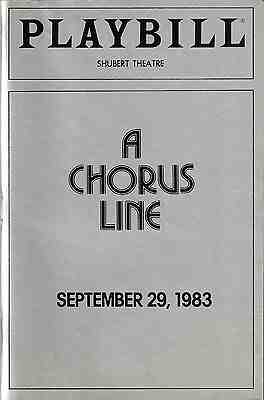
Sold on eBay May, 1st 2020
Donna McKechnie "A CHORUS LINE" James Kirkwood 1983 Record Breaking Playbill
This is a rare September 29th, 1983playbill from the Record Breaking 3,389th Performance of the Original Broadway production of nbsp;the nbsp;MARVIN HAMLISCH, EDWARD KLEBAN, JAMES KIRKWOOD, NICHOLAS DANTE and MICHAEL BENNETT musical "A CHORUS LINE" attheSam S. Shubert nbsp;Theatre nbsp;in New York City. (Originally part of the New York Shakespeare Festival season, the production openedApril 15th, 1975 at the Off-Broadway Newman Theatre and quickly made plans to move to New York's Sam S. ShubertTheatre on July 25th, 1975.) ..... "A Chorus Line"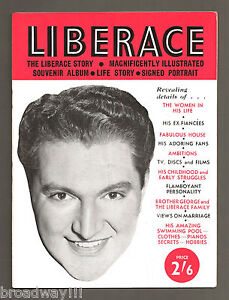
Sold on eBay September 12th, 2023
LIBERACE Live on Stage (Behind the Candelabra) 1950's London Souvenir Program
This is a rare 1950's souvenir program from the first international tour of "THE LIBERACE SHOW" in England. The show played the Royal Festival Hall, the London Palladium and in Manchester as the first part of a European tour ..... Biography: Born Wladziu Valentino Liberace on May 16th, 1919, into a musical family in Wisconsin, LIBERACE is best remembered for his extravagant costumes and trademark candelabra placed on top of his flashy pianos. His father, Salvatore Liberace, played the French horn and his mother, Frances Liberace (Zchowsky), played the piano. His siblings, George Liberace, Angie Liberace and Rudy Liberace, also had musical ability. Liberace's own extraordinary natural talent became evident when he learned to play the piano, by ear, at the age of four. Although Salvatore tried to discourage his son's interest in the piano, praises from Ignace Jan Paderewski, the famous Polish pianist, helped the young musician follow his musical dreams. As a teenager, Liberace earned wages playing popular tunes at movie theaters and speakeasies. Despite being proud of his son's accomplishments Salvatore strictly opposed Liberace's preference for popular music over the classics. He debuted as a soloist with the Chicago Symphony Orchestra, under the direction of Dr. Frederick Stock. At age 17, Liberace joined the Works Progress Administration Symphony Orchestra. He received a scholarship to attend the Wisconsin College of Music. In 1939, after a classical recital, Liberace's audience requested the popular tune, "Three Little Fishes". Liberace seized the opportunity and performed the tune with a semi-classical style which the audience loved. Soon, this unique style of playing the piano got Liberace bookings in large nightclubs. By 1940, Liberace was traveling with his custom-made piano, on top of which he would place his candelabrum. He then took Paderewski's advice and dropped Wladziu and Valentino to become simply Liberace. "South Sea Sinner" (1950), a movie with Shelley Winters, was Liberace's film debut in which he played a honky-tonk pianist. In 1952, "The Liberace Show", a syndicated television program, turned Liberace into a musical symbol. It began as a summertime replacement for "The Dinah Shore Show" (1951), but after two years, the show was one of the most popular on TV. It was carried by 217 American stations and could be seen in 20 foreign countries. Sold-out live appearances at Madison Square Garden enhanced the pianist's popularity even more. Soon, Liberace added flamboyant costumes and expensive ornaments to his already unique performances. His second movie, "Sincerely Yours" opened in 1955, and Liberace wrote his best-selling autobiography, "Liberace", in 1972. His first book, "Liberace Cooks", went into seven printings. In 1977, Liberace founded the non-profit "Liberace Foundation for the Performing and Creative Arts". The year 1978 brought the opening of "The Liberace Museum" in Las Vegas, Nevada, which serves as key funding for the Liberace Foundation. The profits from the museum provide scholarship money for financially needy college musicians. He continued performing until the fall of 1986, despite suffering from heart disease and emphysema during most of the 1980's. A closeted homosexual his entire life, Liberace was secretly diagnosed with AIDS sometime in 1986, which he also kept a secret from the public until the day he died. His last concert performance was at Radio City Music Hall on November 2nd, 1986. He passed away in his Palm Springs home on February 4th, 1987 at the age of 67. Liberace was portrayed by Michael Douglas in the highly publicized HBO film, "Behind the Candelabra" (2013) which co-starred Matt Damon ..... DETAILS: The oversized 24 page program measures 7 1/4" X 9 3/4" inches and includes "The Liberace Story" with bios and photos of LIBERACE and his brother GEORGE with details of "The Women in his Life", "His Ex-Fiancees" and "Views on Marriage" with snapshots of Liberace during his career into the mid-1950's and details on his hobbies, wardrobe, homes, swimming pool and foundation ..... CONDITION: With the exception of light creasing, this program is in excellent condition and will make a wonderful addition to the collection of any musical theatre aficionado or historian. This item will be carefully packaged in a protective sleeve and backed by stiff cardboard ..... SHIPPING DISCOUNTS: Check my "Other Items" for additional rare Broadway playbills and other theatre related memorabilia. Shipping discounts are available for multiple purchases when all items are combined into a single payment. Please wait for a revised invoice before sending payment ..... THANKS !!! Pay me securely with any major credit card through PayPal!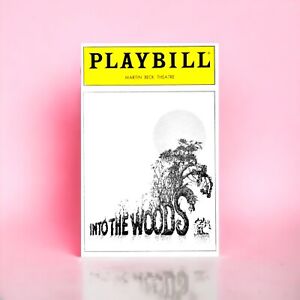
Sold on eBay December 11th, 2023
INTO THE WOODS BROADWAY CAST NYC 1988 STEPHEN SONDHEIM BARBARA BRYNE PLAYBILL.
eBay INTO THE WOODS BROADWAY CAST NYC 1988 STEPHEN SONDHEIM JAMES LAPINE MARTIN BECK.A Narrator introduces four characters: Cinderella, who wishes to attend the King's festival; Jack who wishes his cow, Milky White, would give milk; a Baker; and his Wife, both of whom wish to have a child. Cinderella's step-family mocks her wish while Jack's mother condemns Jack for never listening and how she wishes to be wealthy. Little Red Ridinghood appears at the bakery wishing for bread and sweets to bring to her grandmother's house. They give her a loaf of bread and allow her to take some sweets; she ends up taking more than they offered. Cinderella's stepmother puts a pot of lentils into the fireplace for Cinderella to clean up, promising that only then, they will let her go to the festival. She calls birds from the skies to help her clean up which they do. Meanwhile, an ugly old witch appears at the bakery revealing to the baker and his wife that they are infertile because of a spell she placed on the baker's father many years ago. She tells them that when the baker's mother was pregnant, she craved vegetables so his father stole them from witch's garden. He stole supposedly normal beans which turned out to be magic. Because she had lost the beans, the witch's mother turned her ugly and in return, the witch stole their daughter, Rapunzel, and placed the spell. She explains that the only way to lift the spell is to find four ingredients in the woods: a cow as white as milk, a cape as red as blood, hair as yellow as corn, and a slipper as pure as gold and bring them to her in three days before midnight. She hurries off and Cinderella's step-family prepares to leave for the festival. Cinderella asks if she can go, but her stepmother points out that, while she picked up the lentils, she is dirty from the ashes. They leave and even Cinderella's father barely acknowledges her existence. All begin the journey into the woods: Jack to sell his beloved cow; Cinderella to her mother's grave; Little Red to her grandmother's house; and the Baker, refusing his Wife's help, to find the ingredients. Cinderella receives a gown and golden slippers from her mother's spirit after wishing she could live a life in the palace. A Mysterious Man mocks Jack for valuing his cow more than a "sack of beans". Little Red meets a hungry Wolf who persuades her to take a longer path and admire the beauty, with his own thoughts of eating both her and her grandmother. The Baker, secretly followed by his Wife, meets Jack. They convince Jack that the beans found in the Baker's father's jacket are magic, trade them for the cow and Jack bids Milky White a tearful farewell. The Baker feels guilty about their deceit, but his wife reassures him. The Witch has raised Rapunzel in a tall tower accessible only by climbing Rapunzel's long, golden hair; a Prince spies Rapunzel and plans to meet her. The Baker, in pursuit of the red cape, slays the Wolf and rescues Little Red and her grandmother. In return, Little Red gives him her cape, and reflects on her experiences. Jack's Mother tosses his beans aside, which grow into an enormous stalk, and sends him to bed without food. Cinderella flees the Festival, pursued by another Prince, and the Baker's Wife hides her; asked about the ball, Cinderella is unimpressed. Spotting Cinderella's gold slippers, the Baker's Wife chases her and loses Milky White. The characters recite morals as the day ends. Jack describes his adventure climbing the beanstalk. He gives the Baker gold stolen from the giants to buy back his cow, and returns up the beanstalk to find more; the Mysterious Man questions the Baker's price of a child, and steals the money. Cinderella's Prince and Rapunzel's Prince, who are brothers, compare their unobtainable amours. The Baker's Wife overhears their talk of a girl with golden hair. She fools Rapunzel and takes a piece of her hair. The Mysterious Man returns Milky White to the Baker. The Baker's Wife again fails to seize Cinderella's slippers. The Baker admits they must work together. Jack arrives with a hen that lays golden eggs, but Milky White keels over dead as midnight chimes. The Witch discovers the Prince's visits and demands Rapunzel stay sheltered from the world. She refuses, and the Witch cuts off Rapunzel's hair and banishes her. The Mysterious Man gives the Baker money for another cow. Jack meets Little Red, now sporting a wolf skin cape and knife. He brags about his adventures in the sky, and mentions a golden Giant's harp. She skeptically goads him into returning to the Giant's home to retrieve it. Cinderella, torn between staying with her Prince or escaping, leaves him a slipper as a clue, and trades shoes with the Baker's Wife. The Baker arrives with another cow; they now have all four items. A great crash is heard, and Jack's mother reports a dead Giant in her backyard, which no one seems to care about. Jack returns with a magic harp. The Witch discovers the new cow is useless, and resurrects Milky White, who is fed the ingredients but fails to give milk. The Witch explains Rapunzel's hair will not work, and the Mysterious Man offers corn silk instead; Milky White produces the potion. The Witch reveals the Mysterious Man is the Baker's father, and she drinks – he falls dead, the curse is broken, and the Witch regains her youth and beauty. Cinderella's Prince seeks the girl who fits the slipper; the desperate stepsisters mutilate their feet. Cinderella succeeds and becomes his bride. Rapunzel bears twins and is found by her Prince. The Witch finds her, and attempts to claim her back, but the Witch's powers are gone. At Cinderella's wedding, her stepsisters are blinded by birds, and the Baker's Wife, very pregnant, thanks Cinderella for her help. Congratulating themselves on living happily, the characters fail to notice another beanstalk growing.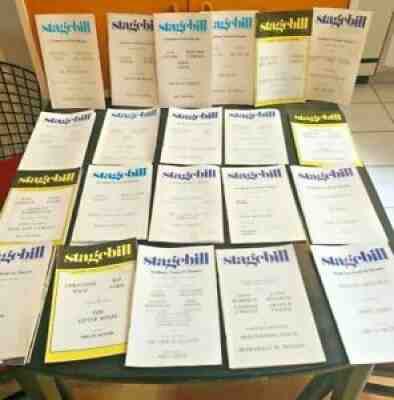
Sold on eBay Apr 10, 2021
Festival Academy Theatre Stagebills~RARE 1960s-1970s Legendary Performers
Find many great new & used options and get the best deals for Festival Academy Theatre Stagebills~RARE 1960s-1970s Legendary Performers at the best online prices at eBay! Free shipping for many products!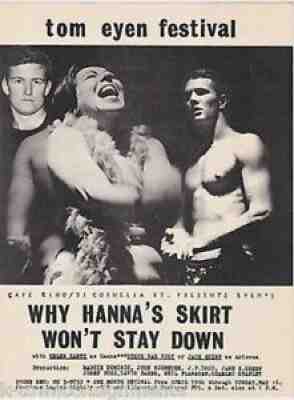
Sold on eBay Jan 23, 2021
Tom Eyen Festival Why Hannaâ??s Skirt Wonâ??t Stay Down Vintage Theatre Show Poster
CAFE CINCO - TOM EYEN FESTIVAL. WHY HANNA'S SKIRT WON'T STAY DOWN. GOOD CONDITION, W/ LIGHT CREASE & EDGE WEAR.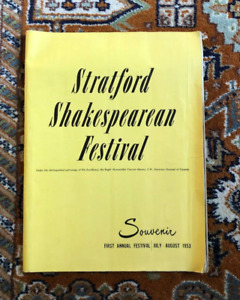
Sold on eBay February 26th, 2024
1ST Stratford Shakespearean Festival 1953 RICHARD II ALL'S WELL Guinness Guthrie
Today we have for sale:A Vintage Playbill / Program:A VERY SCARCE Playbill from the VERY FIRST STRATFORD SHAKESPEAREAN FESTIVAL IN CANADA: JULY/AUGUST 1953. 'RICHARD II' & 'ALL'S WELL THAT ENDS WELL.'WITH ALEC GUINNESS, IRENE WORTH, BETTY LEIGHTON, ROBERT GOODIER, et al.DIRECTED BY DR. TYRONE GUTHRIE. DESIGNED BY TANYA MOISEIWITSCH. GREAT PHOTOS THROUGHOUT.Lots of Photos and Information. FROM THE ESTATE OF THE LATE GEORGE SCHAEFER, PRODUCER & DIRECTOR. We love questions. We ship fast.If you want to combine shipping, put things into your cart, and get in touch with us. We can adjust your shipping costs.If you have any troubles, please don't leave negative feedback until we've tried to work things out. I'm sure we can. Thanks for looking.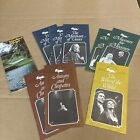
Sold on eBay July 25th, 2024
Stratford Festival 1976 Visitors Guide Program Lot Of 9 Canada
Stratford Festival 1976 Visitors Guide Program Lot Of 9 Canada . Ships for free lower 48 only. Thanks!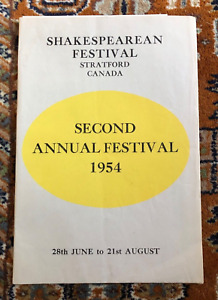
Sold on eBay February 10th, 2024
2ND Stratford Shakespearean Festival 1954 MEASURE & TAMING & REX Shatner Mason
eBay Today we have for sale:A Vintage Playbill / Program:A VERY SCARCE Playbill from the SECOND STRATFORD SHAKESPEAREAN FESTIVAL IN CANADA: JUNE-AUGUST 1954. 'MEASURE FOR MEASURE' & 'TAMING OF THE SHREW' & 'OEDIPUS REX'.TIPPED IN AS A RESERVATION SHEET AND A PRESS RELEASE. WITH JAMES MASON, WILLIAM SHATNER, FRANCES HYLAND, et al.DIRECTED BY DR. TYRONE GUTHRIE. "MEASURE" DIRECTED BY CECIL CLARK. ALL PLAYS DESIGNED BY TANYA MOISEIWITSCH. FROM THE ESTATE OF THE LATE GEORGE SCHAEFER, PRODUCER & DIRECTOR. We love questions. We ship fast.If you want to combine shipping, put things into your cart, and get in touch with us. We can adjust your shipping costs.If you have any troubles, please don't leave negative feedback until we've tried to work things out. I'm sure we can. Thanks for looking.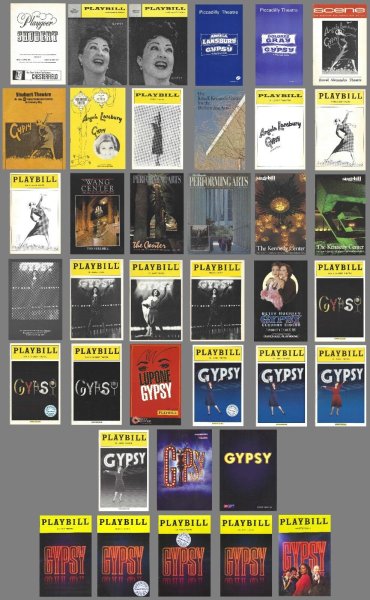
Sold on eBay April 14th, 2025
GYPSY - ULTIMATE Playbill Collection '59-'25 - SONDHEIM, LuPone, LANSBURY, Lavin
This is a MEGA collection of Playbills from various productions of GYPSY by Arthur Laurents, Jule Styne, and Stephen Sondheim. Includes an OPENING NIGHT Playbill from all FIVE Broadway REVIVAL productions!!! Also includes various UK productions and other rare treats! A great chance to own a HUGE slice of musical theater history! Gypsy (1959) {Out of Town Try-out} (Shubert Theatre, Philadelphia, PA) [Ethel Merman] - April 1959 Gypsy (1959) - Cover A (The Broadway Theatre) [Ethel Merman] - May 25, 1959 Gypsy (1959) - Cover B (Imperial Theatre) [Ethel Merman] - February 6, 1961 Gypsy (1973) - Cover A (Piccadilly Theatre, London) [Angela Lansbury] - August 1973 Gypsy (1973) - Cover B (Piccadilly Theatre, London) [Dolores Gray] - January 1974 Gypsy (revival) (1974) {Pre-Broadway} (The Royal Alexandra Theatre, Toronto, ON) [Angela Lansbury] - April 1974 Gypsy (revival) (1974) {Pre-Broadway} (Subert Theatre, Los Angeles) [Angela Lansbury]- - May 1974 Gypsy (revival) (1974) {Pre-Broadway} (Auditorium Theatre, Denver) [Angela Lansbury] - June 1974 Gypsy (revival) (1974) {Pre-Broadway} (The Forrest Theatre, Philadelphia) [Angela Lansbury] - July 1974 Gypsy (revival) (1974) {Pre-Broadway} (The John F. Kennedy Center for the Performing Arts Opera House, Washington D.C.) [Angela Lansbury] - August 1974 Gypsy (revival) (1974) {Pre-Broadway} (Boch Center Shubert Theatre, Boston) [Angela Lansbury] - September 1974 Gypsy (revival) (1974) {OPENING NIGHT!} (Winter Garden Theatre) [Angela Lansbury] - September 23, 1974 Gypsy (revival) (1974) (Winter Garden Theatre) [Angela Lansbury] - November 1974 Gypsy (revival 2) (1989) [Pre-Broadway] (The Wang Center for the Performing Arts, Boston) [Tyne Daly] - June 1989 Gypsy (revival 2) (1989) [Pre-Broadway] (Orange County Performing Arts Center, Costa Mesa) [Tyne Daly] - July 1989 Gypsy (revival 2) (1989) [Pre-Broadway] (Dorothy Chandler Pavilion, LA) [Tyne Daly] - July 1989 Gypsy (revival 2) (1989) - Cover A [Pre-Broadway] (Kennedy Center, Washington D.C.) [Tyne Daly] - August 1989 Gypsy (revival 2) (1989) - Cover B [Pre-Broadway] (Kennedy Center, Washington D.C.) [Tyne Daly] - September 1989 Gypsy (revival 2) (1989) [Pre-Broadway] (Benedum Center, Pittsburgh, PA) [Tyne Daly] - September 1989 Gypsy (revival 2) (1989) - Cover A {OPENING NIGHT!} (St. James Theatre) [Tyne Daly] - November 16, 1989 Gypsy (revival 2) (1989) - Cover A (St. James Theatre) [Tyne Daly] - December 1989 Gypsy (revival 2) (1989) - Cover B (St. James Theatre) [Linda Lavin] - December 1990 Gypsy (revival 2) (1989) - Cover C (Marquis Theatre) [Tyne Daly] - June 1991 Gypsy (1998) (Paper Mill Playhouse, Millburn, NJ) [Betty Buckley] - September 9 - October 25, 1998 Gypsy (revival 3) (2003) - Cover A (Shubert Theatre) [Bernadette Peters] - April 2003 Gypsy (revival 3) (2003) - {OPENING NIGHT w/ SEAL!} Cover A (Shubert Theatre) [Bernadette Peters] - May 1, 2003 Gypsy (revival 3) (2003) - Cover B (Shubert Theatre) [Bernadette Peters] - February 2004 Gypsy (2007) (NY City Center Encores!) [Patti LuPone] - July 2007 Gypsy (revival 4) (2008) - Cover A {OPENING NIGHT w/ SEAL!} (St. James Theatre) [Patti LuPone] - March 27, 2008 Gypsy (revival 4) (2008) - Cover A (St. James Theatre) [Patti LuPone] - April 2008 Gypsy (revival 4) (2008) - Cover B (St. James Theatre) [Patti LuPone] - August 2008 Gypsy (revival 4) (2008) - Cover C (St. James Theatre) [Patti LuPone] - September 2008 Gypsy (2014) (Chichester Festival Theatre, London) [Imelda Staunton] - October 2014 Gypsy (2015) (Savoy Theatre, London) [Imelda Staunton] - September 2015 Gypsy (revival 5) (2024) - Cover A {FIRST PREVIEW!} (Majestic Theatre) [Audra McDonald] - November 2024 Gypsy (revival 5) (2024) - Cover A {OPENING NIGHT w/SEAL - Theater Edition!} (Majestic Theatre) [Audra McDonald] - December 19, 2024 Gypsy (revival 5) (2024) - Cover A {OPENING NIGHT w/SEAL - Playbill.com Edition!} (Majestic Theatre) [Audra McDonald] - December 19, 2024 Gypsy (revival 5) (2024) - Cover A {OPENING NIGHT!} (Majestic Theatre) [Audra McDonald] - December 19, 2024 Gypsy (revival 5) (2024) - Cover B (Majestic Theatre) [Audra McDonald] - March 2025 Photos are scans of the covers of the actual Playbills you will be receiving! Check my other auctions for other Playbill and Playbill bundles. I will combine shipping on multiple item purchases!!!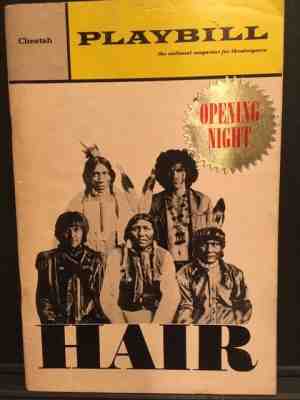
Sold on eBay Sep, 23rd 2020
Opening Night Playbill HAIR Cheetah Theater 1967 Off-Broadway w/Sticker
Extremely rare Opening Night Playbill of Hair The American Tribal Love-Rock Musical at the Off-Broadway Cheetah Theater December 22nd, 1967. This production ran for 45 performances at this theater before moving to Broadway in 1968.Produced by Joseph Papp for the The New York Shakespeare Festival Public Theater.Books and Lyrics by Gerome Ragni and James Rado. Music by Galt MacDermot.<br />Features Opening Night gold sticker with red lettering.<br />In VG condition considering it's age-no tears or dog ears. Slight rubbing to back cover. Pages tight, staples intact.<br />Please
Sold on eBay May 5th, 2024
*LEGENDARY DANCER ISADORA DUNCAN RARE 1916 DANCE PROGRAM*
A rare large original 1916 dance program for the legendary Isadora Duncan. Four pages. Dimensions ten and three quarters by five and a half inches. Light wear otherwise good. See Isadora Duncan's extraordinary biography below. Shipping discounts for multiple purchases. Inquiries always welcome. Please visit my other eBay items for more early ballet and dance memorabilia, early theatre, opera, film, magic, and historical autographs, photographs, programs and broadsides, and great actor and actress cabinet photos and CDV's.From Isadora Duncan (May 26, 1877 or May 27, 1878[a] – September 14, 1927) was an American and French dancer who performed to acclaim throughout Europe. Born in California, she lived in Western Europe and the Soviet Union from the age of 22 until her death at age 50, when her scarf became entangled in the wheels and axle of the car in which she was riding.Isadora Duncan was born in San Francisco, the youngest of the four children of Joseph Charles Duncan (1819–1898), a banker, mining engineer and connoisseur of the arts, and Mary Isadora Gray (1849–1922). Her brothers were Augustin Duncan and Raymond Duncan;[2] her sister, Elizabeth Duncan, was also a dancer.[3][4] Soon after Isadora's birth, her father was exposed to illegal bank dealings, and the family became extremely poor.[2]Her parents divorced when she was an infant,[5] and her mother moved with her family to Oakland, California, where she worked as a seamstress and piano teacher. From ages six to ten, Isadora attended school, but she dropped out, finding it constricting. As her family was very poor, she and her three siblings earned money by teaching dance to local children.[2]In 1896, Duncan became part of Augustin Daly's theater company in New York, but she soon became disillusioned with the form and craved a different environment with less of a hierarchy.[6] Her father, along with his third wife and their daughter, died in 1898 when the British passenger steamer SS Mohegan ran aground off the coast of Cornwall [7]WorkPhoto by Arnold Genthe of Duncan performing barefoot during her 1915–1918 American tourAbraham Walkowitz's Isadora Duncan #29, one of many works of art she inspired.Duncan began her dancing career at a very early age by giving lessons in her home to neighbourhood children, and this continued through her teenage years.[8] Her novel approach to dance was evident in these early classes, in which she "followed [her] fantasy and improvised, teaching any pretty thing that came into [her] head".[9] A desire to travel brought her to Chicago, where she auditioned for many theater companies, finally finding a place in Augustin Daly's company. This took her to New York City where her unique vision of dance clashed with the popular pantomimes of theater companies.[10] In New York, Duncan took some classes with Marie Bonfanti but was quickly disappointed in ballet routine.Feeling unhappy and unappreciated in America, Duncan moved to London in 1898. She performed in the drawing rooms of the wealthy, taking inspiration from the Greek vases and bas-reliefs in the British Museum.[11][12] The earnings from these engagements enabled her to rent a studio, allowing her to develop her work and create larger performances for the stage.[13] From London, she traveled to Paris, where she was inspired by the Louvre and the Exposition Universelle of 1900.[14]In 1902, Loie Fuller invited Duncan to tour with her. This took Duncan all over Europe as she created new works using her innovative technique,[15] which emphasized natural movement in contrast to the rigidity of tradition ballet.[16] She spent most of the rest of her life touring Europe and the Americas in this fashion.[17] Despite mixed reaction from critics, Duncan became quite popular for her distinctive style and inspired many visual artists, such as Antoine Bourdelle, Auguste Rodin, Arnold Rönnebeck, and Abraham Walkowitz, to create works based on her.[18]Duncan disliked the commercial aspects of public performance, such as touring and contracts, because she felt they distracted her from her real mission, namely the creation of beauty and the education of the young.[citation needed] To achieve her mission, she opened schools to teach young women her philosophy of dance. The first was established in 1904 in Berlin Grunewald Germany. This institution was the birthplace of the "Isadorables" (Anna, Maria-Theresa, Irma, Liesel, Gretel, and Erika[19]), Duncan's protégées who would continue her legacy.[20] Duncan legally adopted all six girls in 1919, and they took her last name.[21] After about a decade in Berlin, Duncan established a school in Paris that was shortly closed because of the outbreak of World War I.[22]In 1910, Duncan met the occultist Aleister Crowley at a party, an episode recounted by Crowley in his Confessions [23] He refers to Duncan as "Lavinia King", and used the same invented name for her in his novel Moonchild. Crowley wrote of Duncan that she "has this gift of gesture in a very high degree. Let the reader study her dancing, if possible in private than in public, and learn the superb unconsciousness — which is magical consciousness — with which she suits the action to the melody."[24] Crowley was, in fact, more attracted to Duncan's bohemian companion Mary Dempsey (a.k.a. Mary D'Este or Desti), with whom he had an affair. Desti had come to Paris in 1901 where she soon met Duncan, and the two became inseparable. Desti, who also appeared in Moonchild (as "Lisa la Giuffria") and became a member of Crowley's occult order,[b] later wrote a memoir of her experiences with Duncan.[25]In 1911, the French fashion designer Paul Poiret rented a mansion — Pavillon du Butard in La Celle Saint Cloud — and threw lavish parties, including one of the more famous grandes fêtes, La fête de Bacchus on June 20, 1912, re-creating the Bacchanalia hosted by Louis XIV at Versailles. Isadora Duncan, wearing a Greek evening gown designed by Poiret,[26] danced on tables among 300 guests; 900 bottles of champagne were consumed until the first light of day.[26]Duncan c. 1916–1918Duncan said to have posed for the photographer Eadweard Muybridge,[27] placed an emphasis on "evolutionary" dance motion, insisting that each movement was born from the one that preceded it, that each movement gave rise to the next, and so on in organic succession. Her dancing defined the force of progress, change, abstraction and liberation. In France, as elsewhere, Duncan delighted her audience.[28]In 1914, Duncan moved to the United States and transferred her school there. A townhouse on Gramercy Park was provided for its use, and its studio was nearby, on the northeast corner of 23rd Street and Fourth Avenue (now Park Avenue South).[29] Otto Kahn, the head of Kuhn, Loeb & Co., gave Duncan use of the very modern Century Theatre at West 60th Street and Central Park West for her performances and productions, which included a staging of Oedipus Rex that involved almost all of Duncan's extended entourage and friends.[30] During her time in New York, Duncan posed for a number of studies by the photographer Arnold Genthe.Duncan had been due to leave the United States in 1915 aboard the RMS Lusitania on its ill-fated voyage, but historians believe her financial situation at the time drove her to choose a more modest crossing.[31] In 1921, Duncan's leftist sympathies took her to the Soviet Union, where she founded a school in Moscow. However, the Soviet government's failure to follow through on promises to support her work caused her to return to the West and leave the school to her protégée Irma.[32] In 1924, Duncan composed a dance routine called Varshavianka to the tune of the Polish revolutionary song known in English as Whirlwinds of Danger [33]Philosophy and techniqueDuncan in a Greek-inspired pose and wearing her signature Greek tunic. She took inspiration from the classical Greek arts and combined them with an American athleticism to form a new philosophy of dance, in opposition to the rigidity of traditional ballet.Breaking with convention, Duncan imagined she had traced dance to its roots as a sacred art.[34] She developed from this notion a style of free and natural movements inspired by the classical Greek arts, folk dances, social dances, nature and natural forces as well as an approach to the new American athleticism which included skipping, running, jumping, leaping and tossing [citation needed]Duncan's philosophy of dance moved away from rigid ballet technique and towards what she perceived as natural movement. To restore dance to a high art form instead of merely entertainment, she strove to connect emotions and movement: "I spent long days and nights in the studio seeking that dance which might be the divine expression of the human spirit through the medium of the body's movement."[35] She believed dance was meant to encircle all that life had to offer—joy and sadness. Duncan took inspiration from ancient Greece and combined it with an American love of freedom. Her movement was feminine and arose from the deepest feelings in her body. This is exemplified in her revolutionary costume of a white Greek tunic and bare feet. Inspired by Greek forms, her tunics also allowed a freedom of movement that corseted ballet costumes and pointe shoes did not.[36] Costumes were not the only inspiration Duncan took from Greece: she was also inspired by ancient Greek art, and utilized some of its forms in her movement (see image) [37]Duncan wrote of American dancing: "let them come forth with great strides, leaps and bounds, with lifted forehead and far-spread arms, to dance."[38] Her focus on natural movement emphasized steps, such as skipping, outside of codified ballet technique. Duncan also cited the sea as an early inspiration for her movement.[39] Also, she believed movement originated from the solar plexus, which she thought was the source of all movement.[35] It is this philosophy and new dance technique that garnered Duncan the title of the creator of modern dance.Photo studies of Isadora Duncan made in New York by Arnold Genthe during her visits to America in 1915–1918 Personal lifeDuncan with her children Deirdre and Patrick, in 1913In both professional and private life, Duncan flouted traditional mores and morality. She was bisexual[40] and an atheist,[41] and alluded to her communism during her last United States tour, in 1922–23: she waved a red scarf and bared her breast on stage in Boston, proclaiming, "This is red! So am I!"[42]Duncan bore two children, both out of wedlock. The first, Deirdre Beatrice (born September 24, 1906), by theatre designer Gordon Craig, and the second, Patrick Augustus (born May 1, 1910),[43] by Paris Singer, one of the many sons of sewing machine magnate Isaac Singer. Both children drowned in the care of their nanny in 1913 when their runaway car went into the Seine [43]Following the accident, Duncan spent several months recuperating in Corfu with her brother and sister. She then spent several weeks at the Viareggio seaside resort with the actress Eleonora Duse. The fact that Duse had just left a relationship with the rebellious and epicene young feminist Lina Poletti fueled speculation as to the nature of Duncan and Duse's relationship, but there has never been any indication that the two were involved romantically [44]Duncan and Sergei YeseninIn her autobiography, Duncan relates that she begged a young Italian stranger, the sculptor Romano Romanelli,[45] to sleep with her because she was desperate for another baby. She became pregnant by him, and gave birth to a son on August 13, 1914; the infant died shortly after birth [46][47]In 1921, after the end of the Russian Revolution, Duncan moved to Moscow where she met the acclaimed poet Sergei Yesenin, who was 18 years her junior. On May 2, 1922, they married, and Yesenin accompanied her on a tour of Europe and the United States. However, the marriage was brief, and in May 1923 he left Duncan and returned to Moscow. Two years later, on December 28, 1925, Yesenin was found dead in his room in the Hotel Angleterre in St Petersburg in an apparent suicide [48]Duncan had a relationship with the poet and playwright Mercedes de Acosta, as documented in numerous revealing letters they wrote to each other.[49] In one, Duncan wrote, "Mercedes, lead me with your little strong hands and I will follow you – to the top of a mountain. To the end of the world. Wherever you wish."[50]Later lifeBy the late 1920s, Duncan's performing career had dwindled, and she became as notorious for her financial woes, scandalous love life and all too frequent public drunkenness as for her contributions to the arts. She spent her final years moving between Paris and the Mediterranean, running up debts at hotels. She spent short periods in apartments rented on her behalf by a decreasing number of friends and supporters, many of whom attempted to assist her in writing an autobiography. They hoped it might be successful enough to support her.[citation needed] In a reminiscent sketch, Zelda Fitzgerald wrote how she and F. Scott Fitzgerald, her husband, sat in a Paris cafe watching a somewhat drunk Duncan. He would speak of how memorable it was, but what Zelda recalled was that while all eyes were watching Duncan, Zelda was able to steal the salt and pepper shakers from the table.[51]In his book Isadora, an Intimate Portrait, Sewell Stokes, who met Duncan in the last years of her life, describes her extravagant waywardness. Duncan's autobiography My Life was published in 1927. The Australian composer Percy Grainger called Isadora's autobiography a "life-enriching masterpiece [52]DeathDuncan s tomb at Père Lachaise CemeteryOn the night of September 14, 1927, in Nice, France, Duncan was a passenger in an Amilcar CGSS automobile owned by Benoît Falchetto, a French-Italian mechanic. She wore a long, flowing, hand-painted silk scarf, created by the Russian-born artist Roman Chatov, a gift from her friend Mary Desti, the mother of American film director Preston Sturges. Desti, who saw Duncan off, had asked her to wear a cape in the open-air vehicle because of the cold weather, but she would only agree to wear the scarf.[53] As they departed, she reportedly said to Desti and some companions, "Adieu, mes amis. Je vais à la gloire !" ("Farewell, my friends. I go to glory!"); but according to the American novelist Glenway Wescott, Desti later told him that Duncan's actual parting words were, "Je vais à l'amour" ("I am off to love"). Desti considered this embarrassing, as it suggested that she and Falchetto were going to her hotel for a tryst.Her silk scarf, draped around her neck, became entangled around the open-spoked wheels and rear axle, pulling her from the open car and breaking her neck.[1] Desti said she called out to warn Duncan about the scarf almost immediately after the car left. Desti brought Duncan to the hospital, where she was pronounced dead.[53]As The New York Times noted in its obituary, Duncan "met a tragic death at Nice on the Riviera." "According to dispatches from Nice, Duncan was hurled in an extraordinary manner from an open automobile in which she was riding and instantly killed by the force of her fall to the stone pavement."[57] Other sources noted that she was almost decapitated by the sudden tightening of the scarf around her neck.[58] The accident gave rise to Gertrude Stein's mordant remark that "affectations can be dangerous".[59] At the time of her death, Duncan was a Soviet citizen. Her will was the first of a Soviet citizen's to be probated in the U.S.[60]Duncan was cremated, and her ashes were placed next to those of her children[61] in the columbarium at Père Lachaise Cemetery in Paris.[62] On the headstone of her grave is inscribed École du Ballet de l'Opéra de Paris ("Ballet School of the Opera of Paris ) LegacyDuncan is known as "The Mother of Dance". While her schools in Europe did not last long, Duncan's work had impact in the art and her style is still danced based upon the instruction of Maria-Theresa Duncan,[63] Anna Duncan,[64] and Irma Duncan,[65] three of her six adopted daughters. The adoption process was never verified, but all six of Isadora's dancers did change their last name to Duncan. Through her sister, Elizabeth, Duncan's approach was adopted by Jarmila Je?ábková from Prague where her legacy persists.[66] By 1913 she was already being celebrated. When the Théâtre des Champs Élysées was built, Duncan's likeness was carved in its bas-relief over the entrance by sculptor Antoine Bourdelle and included in painted murals of the nine muses by Maurice Denis in the auditorium. In 1987, she was inducted into the National Museum of Dance and Hall of Fame.Anna, Lisa,[67] Theresa and Irma, pupils of Isadora Duncan's first school, carried on the aesthetic and pedagogical principles of Isadora's work in New York and Paris. Choreographer and dancer Julia Levien was also instrumental in furthering Duncan's work through the formation of the Duncan Dance Guild in the 1950s and the establishment of the Duncan Centenary Company in 1977 [68]Another means by which Duncan's dance techniques were carried forth was in the formation of the Isadora Duncan Heritage Society, by Mignon Garland, who had been taught dance by two of Duncan's key students. Garland was such a fan that she later lived in a building erected at the same site and address as Duncan, attached a commemorative plaque near the entrance, which is still there as of 2016. Garland also succeeded in having San Francisco rename an alley on the same block from Adelaide Place to Isadora Duncan Lane.[69][70]In medicine, the Isadora Duncan Syndrome refers to injury or death consequent to entanglement of neckwear with a wheel or other machinery [71]In popular cultureDuncan has attracted literary and artistic attention from the 1920s to the present, in novels, film, ballet, theatre, music, and poetry.Duncan has been portrayed in novels including Aleister Crowley's Moonchild (as 'Lavinia King'), published in 1923,[72] and Upton Sinclair's World's End (1940) and Between Two Worlds (1941), the first two novels in his Pulitzer Prize winning Lanny Budd series.[73] She is also the subject of Amelia Gray's novel Isadora (2017).[74] Two characters in the A Series of Unfortunate Events series of novels are named after her, Isadora Quagmire and Duncan Quagmire [75]Among the films featuring Duncan are:The 1966 BBC biopic by Kenneth Russell, Isadora Duncan, the Biggest Dancer in the World, which was introduced by Duncan's biographer, Sewell Stokes, Duncan was played by Vivian Pickles.[76]The 1968 film Isadora, nominated for the Palme d'Or at Cannes, stars Vanessa Redgrave as Duncan. The film was based in part of Duncan's autobiography. Redgrave was nominated for the Academy Award for Best Actress for her performance as Duncan [76][77]Archival footage of Duncan was used in the 1985 popular documentary That's Dancing [78][79]A 1989 documentary, Isadora Duncan: Movement from the Soul, was nominated for the Grand Jury Prize at the 1989 Sundance Film Festival [80]Ballets based on Duncan include:In 1976 Frederick Ashton created a short ballet entitled Five Brahms Waltzes in the Manner of Isadora Duncan for Lynn Seymour of the Royal Ballet, in which "Ashton fused Duncan's style with an imprint of his own"; Marie Rambert claimed after seeing it that it was exactly as she remembered Duncan dancing.[81]In 1981, she was the subject of a ballet, Isadora, written and choreographed by the Royal Ballet's Kenneth MacMillan, and performed at Covent Garden.[82]On the theatre stage, Duncan is portrayed in:A 1991 stage play When She Danced by Martin Sherman about Duncan's later years, won the Evening Standard Award for Vanessa Redgrave as Best Actress.[83]In 2016, Lily-Rose Depp portrayed Duncan in The Dancer, a French biographical musical drama of dancer Loie Fuller [84]Duncan is featured in music in:The popular 1970s TV sitcom Maude mentions her in its theme song: "Isadora was the first bra burner Ain t ya glad she showed up?"Celia Cruz recorded a track titled Isadora Duncan with the Fania All-Stars for the album Cross Over released in 1979.[85]Rock musician Vic Chesnutt included a song about Duncan on his debut album Little.[86]Rock band Burden of a day included a song about Duncan on their album the poem Fever 103 by Sylvia Plath, the speaker alludes to Isadora's scarves.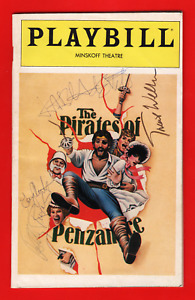
Sold on eBay December 10th, 2023
Robby Benson (Signed) "PIRATES OF PENZANCE" Treat Williams 1981 Playbill
eBay This is a rare autographed September 1981 playbill from the New York Shakespeare Festival production of the WILLIAM S. GILBERT and ARTHUR SULLIVAN classic "THE PIRATES OF PENZANCE" at the Minskoff Theatre in New York City. (The Original Broadway production opened December 31st, 1879 at New York's Fifth Avenue Theatre. This revival opened January 8th, 1981 at the Uris Theatre, moved to the Minskoff Theatre on August 12th, 1981 and closed November 29th, 1982 after 787 performances.) ..... The musical starred ROBBY BENSON, ESTELLE PARSONS, GEORGE ROSE and TREAT WILLIAMS and the cast included TONY AZITO, KARLA DE VITO, STEPHEN HANAN, MARCIE SHAW, WENDY WOLFE and LAURIE BEECHMAN ..... Note: The front cover was signed by cast members ROBBY BENSON, TREAT WILLIAMS, TONY AZITO and KARLA DE VITO and will be accompanied by a Certificate of Authenticity ..... CREDITS: Book and Lyrics by W. S. GILBERT; Music by ARTHUR SULLIVAN; Musical Adaptation by WILLIAM ELLIOTT; Sets designed by BOB SHAW and WILFORD LEACH; Costumes designed by PATRICIA McGOURTY; Choreographed by GRACIELA DANIELE; Directed by WILFORD LEACH; Produced by JOSEPH PAPP and the NEW YORK SHAKESPEARE FESTIVAL ..... DETAILS: The 92 page playbill measures 5 5/8" X 9" inches and includes full production credits, cast list, musical numbers, program notes, individual photos, bios and a chronology of Gilbert and Sullivan, five production photos and bios of each of the leading actors and members of the creative team ..... BONUS: Includes a three page article about the show's move to the Minskoff Theatre with one additional photo ..... CONDITION: With the exception of creasing at the bottom edge, light soiling to the back cover and moderate edge wear, this playbill is in excellent condition and will make a wonderful addition to the collection of any musical theatre aficionado or historian. This item will be carefully packaged in a protective, carded sleeve and backed by stiff cardboard.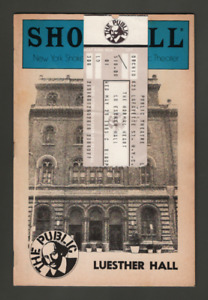
Sold on eBay December 17th, 2023
Larry Kramer "THE NORMAL HEART" Brad Davis / Joseph Papp 1985 Playbill / Ticket
eBay This is a rare May 20th, 1985 "Showbill" playbill (with an original ticket stub) from the opening weeks of the Original Off-Broadway production of the LARRY KRAMER play "THE NORMAL HEART" at the Public's LuEsther Hall in New York City. (The production opened April 21st, 1985 at the Public's LuEsther Hall, moved to the larger Public Anspacher Theatre on June 4th, 1985 and ran for 294 performances.) ..... Produced by The New York Shakespeare Festival Public Theater, "THE NORMAL HEART" was the first production to deal openly with the then controversial subject of AIDS. The cast included BRAD DAVIS, PHILLIP RICHARD ALLEN, DAVID ALLEN BROOKS, WILLIAM DeACUTIS, ROBERT DORFMAN, LAWRENCE LOTT, D. W. MOFFETT, MICHAEL SANTORO and CONCETTA TOMEI ..... CREDITS: Book by LARRY KRAMER; Sets designed by EUGENE LEE and KEITH RAYWOOD; Costumes designed by BILL WALKER; Directed by MICHAEL LINDSAY-HOGG; Produced by JOSEPH PAPP and THE NEW YORK SHAKESPEARE FESTIVAL ..... DETAILS: The 44 page playbill measures 5 5/8" X 8 1/2" inches and includes full production credits, cast list, synopsis of scenes and bios of each of the leading actors and members of the creative team as well as one production photo. Includes a ticket stub from the May 29th, 1985 evening performance stapled to the front cover ..... BONUS: Also includes a printed insert with opinions from RODGER McFARLANE, Executive Director of New York's Gay Men's Health Crisis (last two scanned images) ..... CONDITION: With the exception of staple holes in the ticket stub and the insert and slight discoloration to some pages, this rare playbill is in excellent condition and will make a wonderful addition to the collection of any theatre aficionado or historian. This item will be carefully packaged in a protective, carded sleeve and backed by stiff cardboard.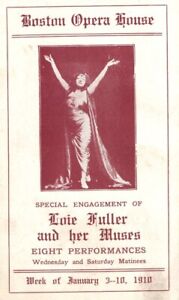
Sold on eBay September 17th, 2023
*LEGENDARY DANCER LOIE FULLER & HER MUSES RARE 1910 DANCE PROGRAM*
A rare large original 1910 dance program for the legendary Loie Fuller and Her Muses at the Boston Opera House. Isadora Duncan. Ten pages. Dimensions nine and a quarter by three and three quarters inches. Light wear otherwise good. See Loie Fuller's extraordinary biography below. Shipping discounts for multiple purchases. Inquiries always welcome. Please visit my other eBay items for more early ballet and dance memorabilia, early theatre, opera, film, magic, and historical autographs, photographs, programs and broadsides, and great actor and actress cabinet photos and CDV's.From Wikipedia:Loie Fuller (/?lo?i/;[1] born Marie Louise Fuller; January 15, 1862 – January 1, 1928), also known as Louie Fuller and Loïe Fuller, was an American dancer and a pioneer modern dance and theatrical lighting techniques Early life and debutMarie Louise Fuller was born on January 15, 1862 in Fullersburg, Illinois, on a remote farm conveniently linked to Chicago by a newly constructed plank road. When Fuller was two, her parents Reuben Fuller and Delilah Eaton moved to Chicago and opened a boarding house. Fuller's parents took her to the Progressive Lyceum, a hub of Freethought, on Sunday mornings [2]Fuller debuted on the stage as a toddler, performing a variety of dramatic and dance roles in Chicago. Her dramatic debut at the age of four was at the Chicago Academy of Music, playing a young boy in Was He Right?.[3] Fuller's career as a child perfomer progressed with little formal training and much variety, as she experimented with dramatic reading, singing, and dance.[4] As a child, Fuller's family moved in and out of Chicago, with Fuller eventually securing a part in Buffalo Bill's touring act at the age of nineteen [2]Marie Louise Fuller changed her name to the more glamorous "Loïe" at the age of sixteen. An early free dance practitioner, Fuller developed her own natural movement and improvisation techniques. In multiple shows she experimented with a long skirt, choreographing its movements and playing with the ways it could reflect light.By 1891, Fuller combined her choreography with silk costumes illuminated by multi-coloured lighting of her own design, and created the Serpentine Dance.[5] After much difficulty finding someone willing to produce her work when she was primarily known as an actress, she was finally hired to perform her piece between acts of a comedy entitled Uncle Celestine, and received rave reviews [6]CareerPortrait of Fuller by Frederick Glasier, 1902Almost immediately, she was replaced by imitators (originally Minnie "Renwood" Bemis). In the hope of receiving serious artistic recognition that she was not getting in America, Fuller left for Europe in June 1892. She became one of the first of many American modern dancers who traveled to Europe to seek recognition. Her warm reception in Paris persuaded Fuller to remain in France, where she became one of the leading revolutionaries in the arts.[4]A regular performer at the Folies Bergère with works such as Fire Dance, Fuller became the embodiment of the Art Nouveau movement and was often identified with symbolism, as her work was seen as the perfect reciprocity between idea and symbol.[2] Fuller began adapting and expanding her costume and lighting, so that they became the principal element in her even more important than the actual choreography, especially as the length of the skirt was increased and became the central focus, while the body became mostly hidden within the depths of the fabric.[7] The choreography of the Serpentine Dance was filmed by multiple early filmmakers, including Auguste and Louis Lumière, but it is unclear whether the recordings depict Fuller herself [8][9]Table lamp: Dance of the Lily (Loie Fuller) - around 1901-Gilt bronze-Museum Wiesbaden-Raoul Larche (1860 1912)Fuller at the Folies Bergère, poster by PAL (Jean de Paléologue)Fuller s pioneering work attracted the attention, respect, and friendship of many French artists and scientists, including Jules Chéret, Henri de Toulouse Lautrec François-Raoul Larche, Henri-Pierre Roché, Auguste Rodin, Jean-Léon Gérôme, Franz von Stuck, Maurice Denis, Thomas Theodor Heine, Paul-Léon Jazet, Koloman Moser, Demétre Chiparus, Stéphane Mallarmé, and Marie Curie. Fuller was also a member of the Société astronomique de France (French Astronomical Society) [citation needed]Fuller patented many of her innovations in stage lighting, including the use of chemical compounds for creating color gel, and the application of chemical salts to luminescent lighting and garments [8]Fuller also sought legal protection for her choreography, but was less successful. Her lawsuit against imitator Minnie Renwood Bemis was decided in Bemis' favor, allowing Bemis' performances at Madison Square Garden to continue. The judge in the case ruled that Fuller's original choreography told no story and therefore could not be copyrighted [10][11] The precedent set by Fuller's case remained in place until the passage of the Copyright Act of 1976, which explicitly extended protection to nondramatic choreographic works.[12][13] Another notorious imitator was Lord Yarmouth, later 7th Marquess of Hertford, who performed the Serpentine Dance under the stage name of ‘Mademoiselle Roze’ [14][15]Fuller supported other pioneering performers, such as fellow United States-born dancer Isadora Duncan. Fuller helped Duncan ignite her European career in 1902 by sponsoring independent concerts in Vienna and Budapest [16]Loie Fuller's original stage name was "Louie". In modern French "L'ouïe" is the word for a sense of hearing. When Fuller reached Paris she gained a nickname which was a pun on Louie L ou e She was renamed "Loïe" - this nickname is a corruption of the early or Medieval French "L'oïe", a precursor to "L'ouïe", which means "receptiveness" or understanding She was also referred to by the nickname "Lo Lo Fuller [citation needed]A dancer (not Fuller) performing Fuller's serpentine dance in a 1902 film directed by Segundo de ChomónPersonal lifeFuller met her romantic partner of over 30 years, Gab Sorère, in the mid-1890s. Sorère was born Gabrielle Bloch, the daughter of wealthy French bankers, in 1870, and eventually took the name Gab Sorère in 1920. Bloch first saw Fuller perform at the age of 14, and by 1898 Fuller and Bloch were living together [17]Fuller and Bloch's relationship initially yattracted some attention in the press, as Bloch dressed exclusively in menswear, and was 8 years Fuller's junior. The press coverage of their relationship declined over time, focusing more on Fuller's mother, and allowing Bloch and Fuller to live a relatively unbothered life.[18]Fuller met Crown Princess Marie of Romania, later to become Queen Marie, in 1902, at a performance in Bucharest. Marie and Fuller became close, and maintained an extensive correspondence as close friends. Their relationship was the subject of scandalous rumors,[19] alleging that Fuller and Queen Marie were lovers.[20] Fuller, through a connection at the United States embassy in Paris, played a role in arranging a United States loan for Romania during World War I.[citation needed]Later, during the period when the future Carol II of Romania was alienated from the Romanian royal family and living in Paris with his mistress Magda Lupescu, she befriended them; they were unaware of her connection to Carol's mother Marie. Fuller initially advocated to Marie on behalf of the couple, but later schemed unsuccessfully with Marie to separate Carol from Lupescu.[21] With Queen Marie and American businessman Samuel Hill, Fuller helped found the Maryhill Museum of Art in rural Washington state, which has permanent exhibits about her career [22]Later life and deathFuller occasionally returned to America to stage performances by her students, the "Fullerets" or Muses, but spent the end of her life in Paris. She died of pneumonia at the age of 65 on January 1, 1928, in Paris, two weeks shy of her 66th birthday. She was cremated and buried in the columbarium of the Père-Lachaise cemetery (site No. 5382) in Paris [23]LegacyFuller depicted by Koloman Moser (1901)Fuller painted by Toulouse LautrecPoster featuring Fuller at the Folies Bergères by Jules ChéretAfter Fuller's death, her romantic partner of thirty years, Gab Sorère inherited the dance troupe as well as the laboratory Fuller had operated [24][17] Sorère took legal action against dancers who wrongfully used Fuller's fame to enhance their own careers[25] and produced both films and theatrical productions to honor Fuller's legacy as a visual effects artist [26]Fuller s work has been experiencing a resurgence of professional and public interest. Rhonda K. Garelick's 2009 study entitled Electric Salome demonstrates her centrality not only to dance, but also modernist performance [27] Sally R. Sommer has written extensively about Fuller's life and times[28] Marcia and Richard Current published a biography entitled Loie Fuller, Goddess of Light in 1997.[29] The philosopher Jacques Rancière devoted a chapter of Aisthesis, his history of modern aesthetics, to Fuller's 1893 performances in Paris, which he considers emblematic of Art Nouveau in their attempt to link artistic and technological invention.[30] Giovanni Lista compiled a 680-page book of Fuller-inspired art work and texts in Loïe Fuller, Danseuse de la Belle Epoque in 1994.[31] In the 1980s, Munich dancer Brygida Ochaim[32] revived Fuller's dances and techniques, also appearing in the Claude Chabrol film The Swindler.In 2016, Stéphanie Di Giusto directed the movie The Dancer about the life of Loïe Fuller, with actresses Soko as Loïe and Lily-Rose Depp as Isadora Duncan. Jody Sperling choreographed Soko's dances for the movie, served as creative consultant and was Soko's dance coach, training her in Fuller technique.[33] The movie premiered at the 2016 Cannes Film Festival [34]Fuller continues to be an influence on contemporary choreographers. Sperling, who re-imagines Fuller's genre from a contemporary perspective, has choreographed dozens of works inspired by Fuller and expanded Fuller's vocabulary and technique into the 21st century. Sperling's company Time Lapse Dance consists of six dancers all versed in Fuller-style technique and performance. Another is Ann Cooper Albright, who collaborated with a lighting designer on a series of works that drew inspiration from Fuller’s original lighting design patents.[35] Shela Xoregos choreographed a tribute, La Lo?e, a solo which shows several of Fuller's special effects [citation needed]Taylor Swift's 2018 Reputation Tour featured a segment dedicated to Fuller. During her performance of "Dress" each night on the tour, several dancers recreated the "Serpentine Dance."[36][37] In the reputation Stadium Tour concert film on Netflix, after “Dress” there is a message showing Taylor’s dedication to Fuller.[38]Into the 2019 film Radioactive Loie Fuller (Drew Jacoby) is a friend of the main character Marie Curie. The scientist envisions Fuller dancing in the green light of radium.[39] The dancer also introduces the Curies to a medium.Written worksFuller's memoir Quinze ans de ma vie was written in English, translated into French by Bojidar Karageorgevitch and published by F. Juven (Paris) in 1908 with an introduction by Anatole France.[40] She drafted her memoirs again in English a few years later, which were published under the title Fifteen Years of a Dancer's Life by H. Jenkins (London) in 1913.[41] The New York Public Library Jerome Robbins Dance Collection holds the nearly complete manuscript to the English edition and materials related to the French edition Fuller s autobiography is a first hand account, and she was known for being very adaptive in her story telling. There are seven highly dramatized versions of how she got her first silk skirt; however, the real story is unknown. As well as writing about inventing the Serpentine Dance, she also wrote extensively about her own theories of modern dance and motion.
Sold on eBay July 21st, 2024