

Playbill Collectibles : Playbill+garland Price List
average value
-
low
-high
-Found 20 out of 56,978 items matching 'garland'

Sold on eBay August 20th, 2023
Judy Garland Vintage Playbill, Program, Magazine, Ticket Stub, Memorabilia Lot
Up for auction is Judy Garland Vintage Playbill, Program, Magazine, Ticket Stub, Memorabilia Lot.These are pre-owned items in good condition for their age. They are obviously used and show some degree of wear. Please reference all pictures for full condition details.Ships USPS.Thanks for viewing and happy bidding Unfortunately we do not sell internationally If your registered address is in the US and either: 1)The delivery address for the item (entered by the buyer during checkout) is outside the US, or 2)The buyer's registered address is outside the US (regardless of the delivery address for the item), we will cancel the order and issue a full refund.***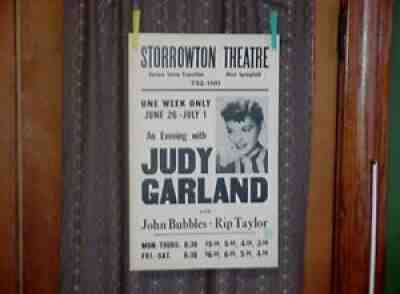
Sold on eBay Feb 07, 2021
"AN EVENING WITH JUDY GARLAND" WINDOW CARD STORROWTON THEATRE
AN EVENING WITH JUDY GARLAND WITH JOHN BUBBLES AND RIP TAYLOR, STORROWTON THEATRE, EASTERN STATES EXPOSITION, WEST SPRINGFIELD.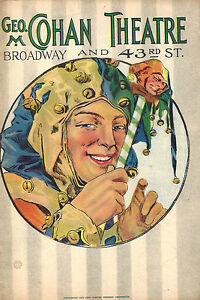
Sold on eBay August 2nd, 2023
George Gershwin "NINE FIFTEEN REVUE" Ruth Etting / Harold Arlen '30 FLOP Program
This is a rare February 11th, 1930 (Opening Night) playbill from the Original Broadway production of RUTH SELWYN's musical revue "NINE FIFTEEN REVUE" at George M. Cohan's Theatre in New York City. (The production opened February 11th, 1930 and closed after only seven performances.) ..... With musical staging by the legendary BUSBY BERKELY and boasting songs written by GEORGE GERSHWIN, VICTOR HERBERT, HAROLD ARLEN, RUDOLF FRIML, VINCENT YOUMANS, IRA GERSHWIN, KAY SWIFT and others, the revue starred RUTH ETTING, HARRY McNAUGHTON and FRED KEATING and featured JOE and PETE MICHON, PAUL KELLY, CHARLES LAWRENCE, HELEN GRAY, FRANCES SHELLY, LYNNE DORE, MARY MURRAY, GRACELLA and THEODORE, the LOVEY GIRLS, DIANNE ELLIS, MICHAEL TRIPP, WALLY CRISHAN, OSCAR RAGLAND, NAN BLACKSTONE, EARL OXFORD, JAMES HOWKINS, PEPPI LEDERER, LOUISE BARRETT, MARGARETE MERLE, RUTH SELWYN'S SPECIALTY GIRLS: LILLIAN OSTROM, JANE SHERMAN, MARY SAWYER, RUTH GORMLEY, TEDDY WATERS, PAT HASTINGS, THELMA TEMPLE and GINGER MEEHAN and DON VOORHEES and his Orchestra ..... Side Note: The musical introduced HAROLD ARLEN's first big hit, "GET HAPPY", which was performed by RUTH ETTING at the end of Act One (fourth scanned image). Today the song is most associated with Judy Garland, who performed it in her last MGM film Summer Stock (1950). Garland also sang this song with Barbra Streisand in a medley that also included "Happy Days Are Here Again" on "The Judy Garland Show" ..... CREDITS: Music and Lyrics by GEORGE GERSHWIN ("Girl Crazy", "Lady, Be Good!", "Oh, Kay!", "Funny Face", "Rosalie", "Strike Up the Band", "Of Thee I Sing", "Porgy and Bess", "George White's Scandals"), RUDOLF FRIML, VICTOR HERBERT ("Cyrano de Bergerac", "Babes in Toyland", "Mlle. Modiste", "The Red Mill", "Naughty Marietta", "Sweethearts", "Ziegfeld Follies", "Sally", "Gypsy Lady"), VINCENT YOUMANS, ROGER WOLFE KAHN, KAY SWIFT, PHILIP BROUGHTON, WILL B. JOHNSTONE, TED KOEHLER, HAROLD ARLEN ("You Said It", "Cotton Club Parade", "Life Begins at 8:40", "The Show is On", "Hooray for What", "Bloomer Girl", "St. Louis Woman", "House of Flowers", "Jamaica", "Saratoga" and the classic film "The Wizard of Oz"), RALPH RAINGER, RICHARD MYERS, NED LEHAK, MANNING SHERMAN, EDWARD ELISCU, PAUL JAMES, IRA GERSHWIN, IRVING CAESAR and others; Sketches by RING LARDNER, PAUL GERARD SMITH, EDDIE CANTOR, ANITA LOOS and JOHN EMERSON, GEOFFREY KERR, H. W. HANEMANN, ROBERT RISKIN and ADORIAN OTVOS; Sets designed by CLARKE ROBINSON; Costumes designed and executed by KIVIETTE; Orchestra conducted by DON VOORHEES; Dances and Ensembles by BUSBY BERKELEY; Ballets Directed by LEON LEONIDOFF; Sketches Staged by the Authors; Produced by RUTH SELWYN ..... DETAILS: The sixteen page program measures 5 1/4" X 7 7/8" inches and includes full production credits, cast list, scenes and musical numbers and wonderful vintage advertising, but no cast photos or bios ..... CONDITION: With the exception of the date written on the title page, a small spot on the front cover and light edge wear, this rare playbill is in excellent condition and will make a wonderful addition to the collection of any musical theatre aficionado or historian. This item will be carefully packaged in a protective, carded sleeve and backed by stiff cardboard. Pay me securely with any major credit card through PayPal!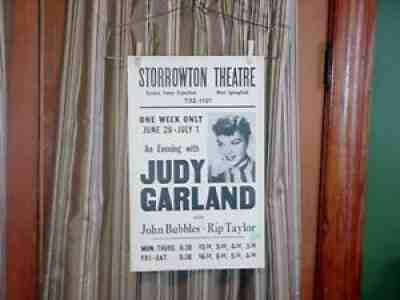
Sold on eBay Mar 28, 2021
"AN EVENING WITH JUDY GARLAND" WINDOW CARD STORROWTON THEATRE
AN EVENING WITH JUDY GARLAND WITH JOHN BUBBLES AND RIP TAYLOR, STORROWTON THEATRE, EASTERN STATES EXPOSITION, WEST SPRINGFIELD.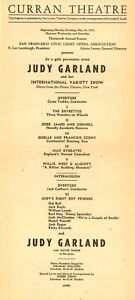
Sold on eBay February 6th, 2024
JUDY GARLAND 1952 CURRAN THEATRE IN SAN FRANCISCO / 1st PRINT HANDBILL / FLYER
eBay JUDY GARLAND 1952 CURRAN THEATRE HANDBILL GUARANTEED 100 PERCENT AUTHENTIC! THE HANDBILL: This is an Original 1st Printing Handbill / Flyer from the Judy Garland and her International Variety Show at the Curran Theatre in San Francisco, Calif. beginning Monday Evening on May 26, 1952. She did two matinees on Wednesday and Saturday. SIZE: 5 1/2 inches X 12 1/2 inches. CONDITION: Near Mint for its age. We have been full-time on eBay since Halloween 1998. We have more than 40,000 positive feedback and a 99.99 percent approval rating. We stand being everything we sell. If there is a problem, we will do everything we can to make it right. If we can't, don't worry. We also have a 30-day return policy and we will pay for the return postage. You can bid with confidence TheWyzyrd s Store Click on my store link below and you're there.Click below to... Shop At My Bargain Store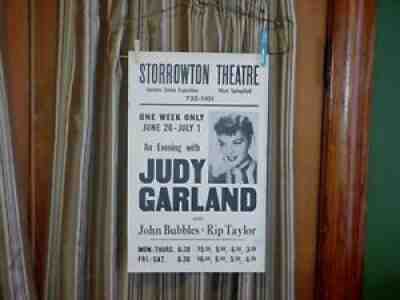
Sold on eBay Mar 21, 2021
"AN EVENING WITH JUDY GARLAND" WINDOW CARD STORROWTON THEATRE
AN EVENING WITH JUDY GARLAND WITH JOHN BUBBLES AND RIP TAYLOR, STORROWTON THEATRE, EASTERN STATES EXPOSITION, WEST SPRINGFIELD.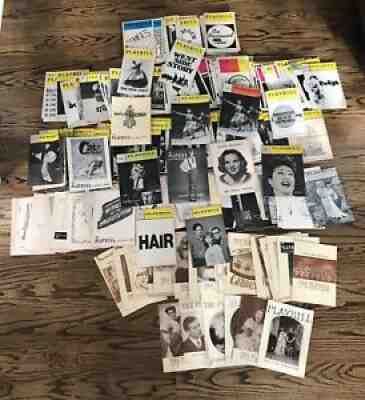
Sold on eBay Jan 04, 2021
200 + VINTAGE THEATRE PLAYBILLS AND PROGRAMS: BOOKS FROM THE 30â??s - 90â??s.
COLLECTORS DREAM! VINTAGE PRIVATE COLLECTION OF THEATRE PLAYBILLS AND PROGRAMS: Lot of 209 from 30â??s - 90â??s. Standouts include DEATH OF A SALESMAN, ANNIE, HAIR, INHERET THE WIND, JUDY GARLAND, THE MUSIC MAN and more! All but 1 are intact and in excellent condition. All have pencil marks at the top depicting the date of the playbill. Easily removed if need you wish to. Shipped with UPS.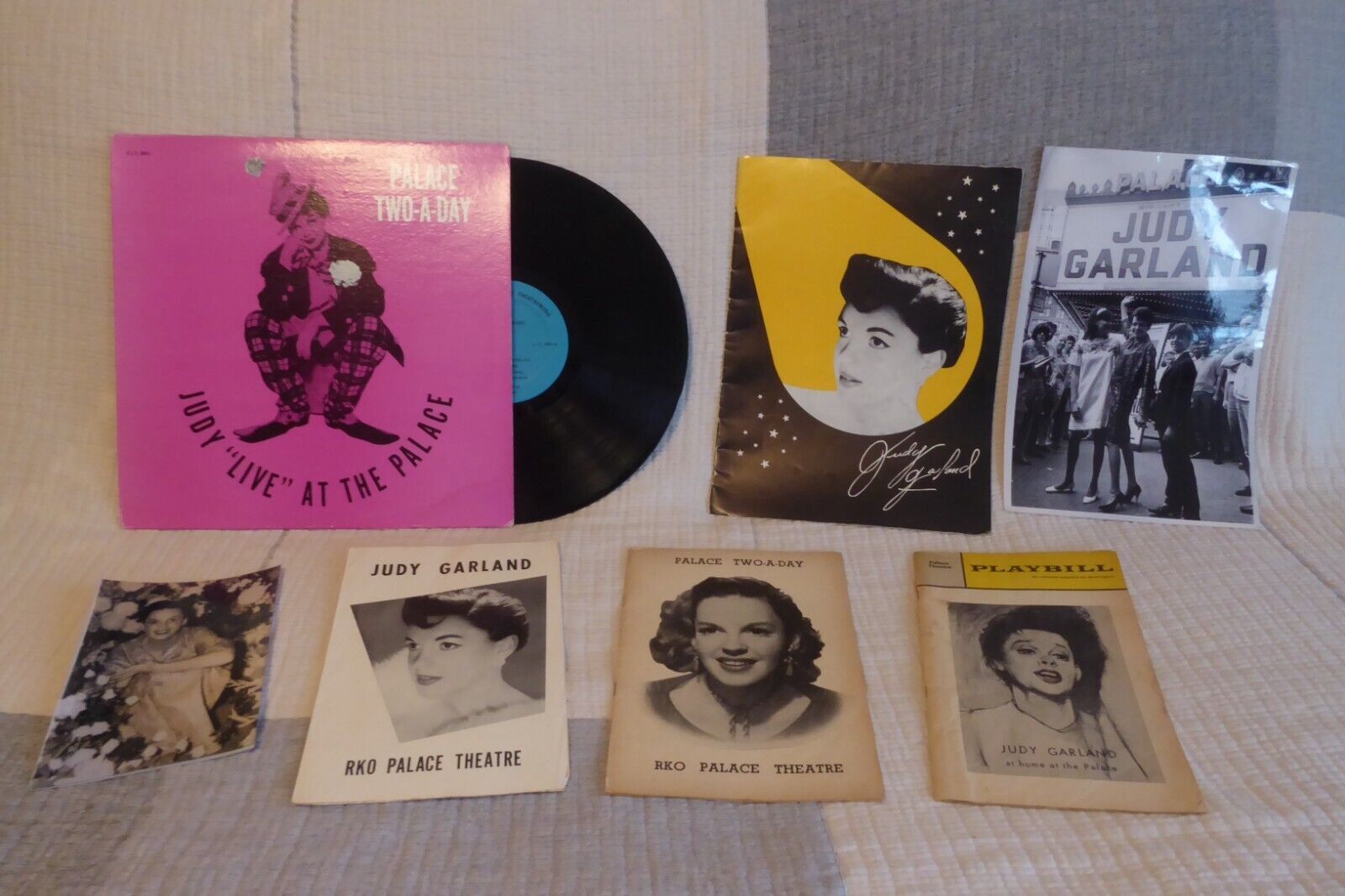
Sold on eBay April 2nd, 2025
Rare vintage Judy Garland memorabilia from the Palace Theatre in NYC /collection
Offered for sale is a collection of rare memorabilia straight from my display inside the Palace Theatre in NYC. These items are the first of three listings from this display.This collection is all Judy Garland memorabilia. I am selling them as a collection. I will not sell them individually. The winning bidder will receive everything shown, with the exception of the photograph of the showcase, which is there to show the items in the display. (The showcase was just emptied last week for reasons I will not go into here. Everything is personally owned by me).The items are as follows:1. A 33 lp of Judy Garland at the Palace. Cardboard case and record are in excellent condition. I've never played the record but it looks to be in excellent condition. (it was not in the display at the time I removed everything).2. The oldest playbill from 1951 Two -A-Day She was only 29 years old when she appeared at the Palace.3. Playbill from 1956. She was one of several people appearing. The comedian Alan King was also on the bill.4.Lobby program with the story of Judy Garland. Many pictures of her career including appearances at the Palace.5. 11 1/2 x 8 inch black and white photo of Judy Garland with two of her children (Lorna and John) outside the Palace where she was appearing.6. 5 x 7 photo of Judy Garland backstage with some of the hundreds of flowers from well wishers.Please see photos for details. I can't take pictures of every page of every program. They are being sold in 'as is' condition. Most are excellent. They were behind glass at the Palace.Ask any questions prior to bidding. There are no returns on these rare items.I am listing everything from my display in three different listings. If you are interested in more than one collection, please lmk and I can combine shipping charges. Everything will be well packed and sent either First Class, Priority or Media Mail depending on cost and where you live.The winning bidding will receive all 6 of the Judy Garland items shown.Shipping to verified addresses in the continental USA.Payment is expected within 2 days of the end of the sale.Thank you for looking and good luck!
Sold on eBay December 7th, 2023
Judy Garland Playbill Program at Greek Theatre Los Angeles 1957 Scarce
eBay Judy Garland Playbill Program at Greek Theatre Los Angeles 1957 Scarce Judy Garland Playbill Program at Greek Theatre Los Angeles 1957 Scarce Click images to enlarge Description ?Playbill program for the appearance of Judy Garland with opening acts Alan King, Giselle and Francois Szony, The Amin Brothers, and Sid Krofft at the Greek Theatre in Los Angeles from June 27 to July 7, 1957, 48 pages, 6 by 9 inches, in fine condition. Condition Notes: In fine condition. Payment Paypal Shipping Domestic shipping: Weight based Shipping Charges Domestic Carriers are: Usps Book Rate, Usps Priority Flat Rate shipping: Weight based Shipping Charges International Carriers are: Usps First-Class IntlI will ship to: United States, Worldwide Weight: 10 oz. Shipping and Handling: Please check eBay's Shipping & Payment tab Vendio Images: More than just a pretty image. 250+ Mobile Responsive & Active Content Free Listing Templates with Vendio Sales Manager. Vendio provides powerful selling automation for sellers of all sizes. Get business information that counts! - Vendio Counters are active content free.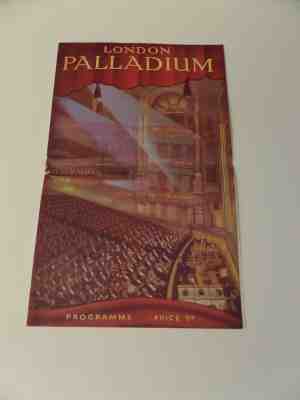
Sold on eBay Jul, 25th 2020
Judy Garland Signed 1951 London Palladium Program
This is a 1951 Judy Garland signed London Palladium program. It is also signed by Buddy Pepper her piano player to his parents. Judy Garland signing was to Bess & Dave "Wish you could have seen Buddy and me here" Love Judy I believe Bess & Dave were Buddy Pepper parents. <br />The program was folded for a long time in the middle and made the staple loose, and 1 set of pages are loose, but overall nice condition.<br /><br />US SHIPPING <br />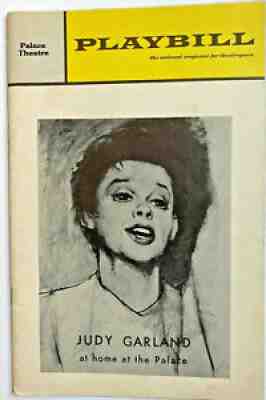
Sold on eBay Aug 10, 2021
JUDY GARLAND at home at the Palace Playbill Lorna & Joey Luft August 1967 RARE
The show also featured performances from tap dancer John Bubbles, juggler Francis Brunn, and Garland's "proteges," her children Joey and Lorna Luft. The listener will note that the show is enhanced and given a very human touch when the singer brings out her daughter Lorna and her son Joey to join her in three numbers.
Sold on eBay Sep 07, 2021
"Miss Show Business" JUDY GARLAND Concert with Alan King 1958 Chicago Program
Find many great new & used options and get the best deals for "Miss Show Business" JUDY GARLAND Concert with Alan King 1958 Chicago Program at the best online prices at eBay! Free shipping for many products!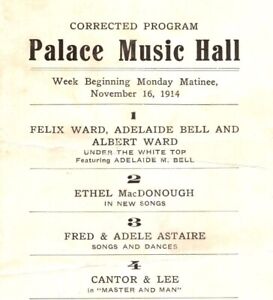
Sold on eBay March 10th, 2024
*EDDIE CANTOR FRED & ADEL6E ASTAIRE RARE LARGE 1914 VAUDEVILLE BROADSIDE *
A rare large original 1914 broadside type program for Eddie Cantor with Cantor and Lee and the amazing brother and sister team of Fred and Adele Astaire at the Palace Music Hall. Dimensions fifteen by four inches. Light wear and light folds otherwise good. See Eddie Cantor and Fred Astaire's extraordinary biographies below.Shipping discounts for buyers of multiple items. Credit cards accepted with Paypal. Inquiries always welcome. Please visit my other eBay items for more early theatre and historical autographs, broadsides, photographs and programs and great actor and actress cabinet photos and CDV's. From Wikipedia:Eddie Cantor (born Isidore January 31, 1892 – October 10, 1964) was an American comedian, actor, dancer, singer, songwriter, film producer, screenwriter and author.[3] Familiar to Broadway, radio, movie, and early television audiences, this "Apostle of Pep" was regarded almost as a family member by millions because his top-rated radio shows revealed intimate stories and amusing anecdotes about his wife, Ida, and five daughters. Some of his hits include "Makin' Whoopee", "Ida (Sweet as Apple Cider)", "If You Knew Susie", "Ma! He's Making Eyes at Me", “Mandy”, "My Baby Just Cares for Me”, "Margie", and "How Ya Gonna Keep 'em Down on the Farm (After They've Seen Paree)?" He also wrote a few songs, including "Merrily We Roll Along", the Merrie Melodies Warner Bros. cartoon theme.His eye-rolling song-and-dance routines eventually led to his nickname "Banjo Eyes". In 1933, artist Frederick J. Garner caricatured Cantor with large round eyes resembling the drum-like pot of a banjo. Cantor's eyes became his trademark, often exaggerated in illustrations, and leading to his appearance on Broadway in the musical Banjo Eyes (1941).His charity and humanitarian work was extensive. He helped to develop the March of Dimes and is credited with coining its name. Cantor was awarded an honorary Oscar in 1956 for distinguished service to the film industry.Early lifeReports and accounts of Cantor's early life often conflict with one another. What is known is that he was born in New York City, the son of Mechel Iskowitz (also Michael), an amateur violinist, and his wife Meta Kantrowitz Iskowitz (also Maite), a young Jewish couple from Russia.[4] It is generally accepted that he was born in 1892, though the day is subject to debate, with either January 31 or Rosh Hashanah, which was on September 10 or September 11, being reported [5][6][7] Although it was reported Cantor was an orphan, his mother dying in childbirth and his father of pneumonia, official records say otherwise; Meta died from complications of tuberculosis in July 1894 and the fate of Mechel is unclear, as no death certificate exists for him. There is also discrepancy as to his name; both his 1957 autobiography and The New York Times obituary for Cantor report his birth name as Isidore Iskowitch, although some articles published after the 20th century give his birth name as Edward (a nickname given him by his future wife, Ida, in 1913) or Israel Itzkowitz [8][5] His grandmother, Esther Kantrowitz (died January 29, 1917), took custody of him, and referred to him as Izzy and Itchik, both diminutives for Isidor, and his last name, due to a clerical error, was thought to be Kantrowitz and shortened to Kanter.[5] No birth certificate existed for him, though this is not unusual for someone born in New York in the 19th century StageSaloon songs to vaudevilleBy his early teens, Cantor began winning talent contests at local theaters and started appearing on stage. One of his earliest paying jobs was doubling as a waiter and performer, singing for tips at Carey Walsh's Coney Island saloon, where a young Jimmy Durante accompanied him on piano. He made his first public appearance in Vaudeville in 1907 at New York's Clinton Music Hall. In 1912, he was the only performer over the age of 20 to appear in Gus Edwards's Kid Kabaret, where he created his first blackface character "Jefferson". He later toured with Al Lee as the team Cantor and Lee. Critical praise from that show got the attention of Broadway's top producer Florenz Ziegfeld, who gave Cantor a spot in the Ziegfeld rooftop post-show, Midnight Frolic (1917) [5]BroadwayA year later, Cantor made his Broadway debut in the Ziegfeld Follies of 1917. He continued in the Follies until 1927,[9] a period considered the best years of the long-running revue. For several years, Cantor co-starred in an act with pioneer comedian Bert Williams, both appearing in blackface; Cantor played Williams's fresh-talking son. Other co-stars with Cantor during his time in the Follies included Will Rogers, Marilyn Miller, Fanny Brice, and W.C. Fields.[10] He moved on to stardom in book musicals, starting with Kid Boots (1923) and Whoopee! (1928).[9] On tour with Banjo Eyes, he romanced the unknown Jacqueline Susann, who had a small part in the show and who became the best-selling author of Valley of the Dolls. Banjo Eyes successful Broadway run was cut short when Cantor suffered a major heart attack, the first of several that would plague his later years.Fred Astaire (born Frederick Austerlitz;[1] May 10, 1899 – June 22, 1987) was an American actor, dancer, singer, choreographer, and television presenter. He is widely considered the most influential dancer in the history of film.[2]His stage and subsequent film and television careers spanned a total of 76 years. He starred in more than 10 Broadway and West End musicals, made 31 musical films, four television specials, and issued numerous recordings. As a dancer, his most outstanding traits were his uncanny sense of rhythm, perfectionism, and innovation. His most memorable dancing partnership was with Ginger Rogers, with whom he co-starred in a series of ten Hollywood musicals, including Top Hat (1935), Swing Time (1936), and Shall We Dance (1937).[3] Among his other most notable films where Astaire gained popularity and took the genre of tap dancing to a new level include Holiday Inn (1944), Easter Parade (1948), The Band Wagon (1953), Funny Face (1957), and Silk Stockings (1957). The American Film Institute named Astaire the fifth-greatest male star of Classic Hollywood cinema.Fred Astaire was born Frederick Austerlitz on May 10, 1899, in Omaha, Nebraska, the son of Johanna "Ann" (née Geilus; 1878–1975) and Friedrich "Fritz" Emanuel Austerlitz, in the US: Frederic Austerlitz (1868–1923) [1][6][7][8] Astaire's mother was born in the US to Lutheran German immigrants from East Prussia and Alsace. Astaire's father was born in Linz, Austria to Roman Catholic parents who had converted from Judaism [1][9][10][11]Astaire s father, Fritz Austerlitz, arrived in New York City at the age of 25 on October 26, 1893, at Ellis Island.[12] Fritz was seeking work in the brewing trade and moved to Omaha, Nebraska, where he was employed by the Storz Brewing Company. Astaire's mother dreamed of escaping Omaha by her children's talents. Astaire's older sister, Adele, was an instinctive dancer and singer early in her childhood. Johanna planned a "brother and sister act", common in vaudeville at the time, for her two children. Although Fred refused dance lessons at first, he easily mimicked his older sister's steps and took up piano, accordion, and clarinet.When their father lost his job, the family moved to New York City in January 1905 to launch the show business careers of the children. They began training at the Alviene Master School of the Theatre and Academy of Cultural Arts.[13] Fred and Adele's mother suggested they change their name to "Astaire", as she felt "Austerlitz" was reminiscent of the Battle of Austerlitz. Family legend attributes the name to an uncle surnamed L Astaire [14]They were taught dance, speaking, and singing in preparation for developing an act. Their first act was called Juvenile Artists Presenting an Electric Musical Toe-Dancing Novelty. Fred wore a top hat and tails in the first half and a lobster outfit in the second. In an interview, Astaire's daughter, Ava Astaire McKenzie, observed that they often put Fred in a top hat to make him look taller.[15] In November 1905, the goofy act debuted in Keyport, New Jersey at a "tryout theater". The local paper wrote, "the Astaires are the greatest child act in vaudeville [16]As a result of their father's salesmanship, Fred and Adele landed a major contract and played the Orpheum Circuit in the Midwest, Western and some Southern cities in the US. Soon Adele grew to at least three inches taller than Fred, and the pair began to look incongruous. The family decided to take a two-year break from show business to let time take its course and to avoid trouble from the Gerry Society and the child labor laws of the time. In 1912, Fred became an Episcopalian [17] The career of the Astaire siblings resumed with mixed fortunes, though with increasing skill and polish, as they began to incorporate tap dancing into their routines. Astaire's dancing was inspired by Bill "Bojangles" Robinson and John "Bubbles" Sublett.[18] From vaudeville dancer Aurelio Coccia, they learned the tango, waltz, and other ballroom dances popularized by Vernon and Irene Castle. Some sources[19] state that the Astaire siblings appeared in a 1915 film titled Fanchon, the Cricket, starring Mary Pickford, but the Astaires have consistently denied this [20][21][22]By age 14, Fred had taken on the musical for their act.[13] He first met George Gershwin, who was working as a song plugger for Jerome H. Remick's music publishing company, in 1916.[23] Fred had already been hunting for new music and dance ideas. Their chance meeting was to affect the careers of both artists profoundly. Astaire was always on the lookout for new steps on the circuit and was starting to demonstrate his ceaseless quest for novelty and perfection 1917–1933: Stage career on Broadway and in LondonFred and Adele Astaire in 1921The Astaires broke into Broadway in 1917 with Over the Top, a patriotic revue, and performed for U.S. and Allied troops at this time as well. They followed up with several more shows. Of their work in The Passing Show of 1918, Heywood Broun wrote: "In an evening in which there was an abundance of good dancing, Fred Astaire stood out ... He and his partner, Adele Astaire, made the show pause early in the evening with a beautiful loose-limbed dance [24]Adele s sparkle and humor drew much of the attention, owing in part to Fred's careful preparation and sharp supporting choreography. She still set the tone of their act. But by this time, Astaire's dancing skill was beginning to outshine his sister's.During the 1920s, Fred and Adele appeared on Broadway and the London stage. They won popular acclaim with the theater crowd on both sides of the Atlantic in shows such as Jerome Kern's The Bunch and Judy (1922), George and Ira Gershwin's Lady, Be Good (1924), and Funny Face (1927) and later in The Band Wagon (1931). Astaire's tap dancing was recognized by then as among the best. For example, Robert Benchley wrote in 1930, "I don't think that I will plunge the nation into war by stating that Fred is the greatest tap-dancer in the world."[25] Whilst in London, Fred studied piano at the Guildhall School of Music alongside his friend and colleague Noël Coward;[26], and in 1926, was one of the judges at the 'Charleston (dance) Championship of the World ' competition at the Royal Albert Hall, where Lew Grade was declared the winner.fter the close of Funny Face, the Astaires went to Hollywood for a screen test (now lost) at Paramount Pictures, but Paramount deemed them unsuitable for films.They split in 1932 when Adele married her first husband, Lord Charles Cavendish, the second son of the 9th Duke of Devonshire. Fred went on to achieve success on his own on Broadway and in London with Gay Divorce (later made into the film The Gay Divorcee) while considering offers from Hollywood. The end of the partnership was traumatic for Astaire but stimulated him to expand his range.Free of the brother-sister constraints of the former pairing and working with new partner Claire Luce, Fred created a romantic partnered dance to Cole Porter's "Night and Day", which had been written for Gay Divorce. Luce stated that she had to encourage him to take a more romantic approach: "Come on, Fred, I'm not your sister, you know."[25]: 6 The success of the stage play was credited to this number, and when recreated in The Gay Divorcee (1934), the film version of the play, it ushered in a new era in filmed dance.[25]: 23, 26, 61 Recently, film footage taken by Fred Stone of Astaire performing in Gay Divorce with Luce's successor, Dorothy Stone, in New York in 1933 was uncovered by dancer and historian Betsy Baytos and now represents the earliest known performance footage of Astaire [27]1933–1939: Astaire and Ginger Rogers at RKOGinger Rogers and Fred Astaire in Top Hat (1935)According to Hollywood folklore, a screen test report on Astaire for RKO Radio Pictures, now lost along with the test, is reported to have read: "Can't sing. Can't act. Balding. Can dance a little." The producer of the pictures, Pandro S. Berman, claimed he had never heard the story in the 1930s and that it only emerged years afterward.[25]: 7 Astaire later clarified, insisting that the report had read: "Can't act. Slightly bald. Also dances."[28] In any case, the test was clearly disappointing, and David O. Selznick, who had signed Astaire to RKO and commissioned the test, stated in a memo, "I am uncertain about the man, but I feel, in spite of his enormous ears and bad chin line, that his charm is so tremendous that it comes through even on this wretched test."[25]: 7 However, this did not affect RKO's plans for Astaire. They lent him for a few days to MGM in 1933 for his significant Hollywood debut in the successful musical film Dancing Lady. In the movie, he appeared as himself dancing with Joan Crawford. On his return to RKO, he got fifth billing after fourth billed Ginger Rogers in the 1933 Dolores del Río vehicle Flying Down to Rio. In a review, Variety magazine attributed its massive success to Astaire's presence:The main point of Flying Down to Rio is the screen promise of Fred Astaire ... He's assuredly a bet after this one, for he's distinctly likable on the screen, the mike is kind to his voice and as a dancer, he remains in a class by himself. The latter observation will be no news to the profession, which has long admitted that Astaire starts dancing where the others stop hoofing [29][25]: 7 Having already been linked to his sister Adele on stage, Astaire was initially very reluctant to become part of another dance team. He wrote his agent, "I don't mind making another picture with her, but as for this 'team' idea, it's 'out!' I've just managed to live down one partnership and I don't want to be bothered with anymore."[25]: 8 However, he was persuaded by the apparent public appeal of the pairing. The partnership, and the choreography of Astaire and Hermes Pan, helped make dancing an important element of the Hollywood film musical.Astaire and Rogers made nine films together at RKO. These included Flying Down to Rio (1933), The Gay Divorcee (1934), Roberta (1935, in which Astaire also demonstrates his oft-overlooked piano skills with a spirited solo on "I Won't Dance"), Top Hat (1935), Follow the Fleet (1936), Swing Time (1936), Shall We Dance (1937), Carefree (1938), and The Story of Vernon and Irene Castle (1939). Six out of the nine musicals became the biggest moneymakers for RKO; all of the films brought a certain prestige and artistry that all studios coveted at the time. Their partnership elevated them both to stardom; as Katharine Hepburn reportedly said, "He gives her class and she gives him sex appeal."[30]: 134 Astaire received a percentage of the films' profits, something scarce in actors' contracts at that time InnovationsAstaire revolutionized dance on film by having complete autonomy over its presentation [31] He is credited with two important innovations in early film musicals.[25]: 23, 26 First, he insisted that a closely tracking dolly camera film a dance routine in as few shots as possible, typically with just four to eight cuts, while holding the dancers in full view at all times. This gave the illusion of an almost stationary camera filming an entire dance in a single shot. Astaire famously quipped: "Either the camera will dance, or I will."[25]: 420 Astaire maintained this policy from The Gay Divorcee in 1934 until his last film musical Finian's Rainbow in 1968, when director Francis Ford Coppola overruled him [32]Astaire s style of dance sequences allowed the viewer to follow the dancers and choreography in their entirety. This style differed strikingly from those in the Busby Berkeley musicals. Those musicals' sequences were filled with extravagant aerial shots, dozens of cuts for quick takes, and zooms on areas of the body such as a chorus row of arms or legs [33]Astaire s second innovation involved the context of the dance; he was adamant that all song and dance routines be integral to the plotlines of the film. Instead of using dance as a spectacle as Busby Berkeley did, Astaire used it to move the plot along. Typically, an Astaire picture would include at least three standard dances. One would be a solo performance by Astaire, which he termed his "sock solo". Another would be a partnered comedy dance routine. Finally, he would include a partnered romantic dance routine [34]Assessment of the Rogers partnershipAn RKO publicity still of Astaire and Rogers dancing to "Smoke Gets in Your Eyes" in Roberta (1935)Dance commentators Arlene Croce,[30]: 6 Hannah Hyam[35]: 146–147 and John Mueller[25]: 8, 9 consider Rogers to have been Astaire's greatest dance partner, a view shared[36] by Hermes Pan and Stanley Donen.[36] Film critic Pauline Kael adopts a more neutral stance,[37] while Time magazine film critic Richard Schickel writes "The nostalgia surrounding tends to bleach out other partners [38]Mueller sums up Rogers's abilities as follows:Rogers was outstanding among Astaire's partners not because she was superior to others as a dancer, but because, as a skilled, intuitive actress, she was cagey enough to realize that acting did not stop when dancing began ... the reason so many women have fantasized about dancing with Fred Astaire is that Ginger Rogers conveyed the impression that dancing with him is the most thrilling experience imaginable [25]According to Astaire, "Ginger had never danced with a partner before Flying Down to Rio. She faked it an awful lot. She couldn't tap and she couldn't do this and that ... but Ginger had style and talent and improved as she went along. She got so that after a while everyone else who danced with me looked wrong."[39] On p. 162 of his book Ginger: Salute to a Star, author Dick Richards quotes Astaire saying to Raymond Rohauer, curator of the New York Gallery of Modern Art, "Ginger was brilliantly effective. She made everything work for her. Actually, she made things very fine for both of us and she deserves most of the credit for our success."In 1976, British talk-show host Sir Michael Parkinson asked Astaire who his favorite dancing partner was on Parkinson. At first, Astaire refused to answer. But, ultimately, he said "Excuse me, I must say Ginger was certainly, uh, uh, the one. You know, the most effective partner I had. Everyone knows [40]Rogers described Astaire's uncompromising standards extending to the whole production: "Sometimes he'll think of a new line of dialogue or a new angle for the story ... they never know what time of night he'll call up and start ranting about a fresh idea ... No loafing on the job on an Astaire picture, and no cutting corners."[25]: 16 Despite their success, Astaire was unwilling to have his career tied exclusively to any partnership. He negotiated with RKO to strike out on his own with A Damsel in Distress in 1937 with an inexperienced, non-dancing Joan Fontaine, unsuccessfully as it turned out. He returned to make two more films with Rogers, Carefree (1938) and The Story of Vernon and Irene Castle (1939). While both films earned respectable gross incomes, they both lost money because of increased production costs,[25]: 410 and Astaire left RKO, after being labeled "box office poison" by the Independent Theatre Owners of America. Astaire was reunited with Rogers in 1949 at MGM for their final outing, The Barkleys of Broadway, the only one of their films together to be shot in Technicolor 1940–1947: Holiday Inn, early left RKO in 1939 to freelance and pursue new film opportunities, with mixed though generally successful outcomes. Throughout this period, Astaire continued to value the input of choreographic collaborators. Unlike the 1930s when he worked almost exclusively with Hermes Pan, he tapped the talents of other choreographers to innovate continually. His first post-Ginger dance partner was the redoubtable Eleanor Powell, considered the most exceptional female tap-dancer of her generation. They starred in Broadway Melody of 1940, in which they performed a celebrated extended dance routine to Cole Porter's "Begin the Beguine". In his autobiography Steps in Time, Astaire remarked, "She 'put 'em down' like a man, no ricky ticky sissy stuff with Ellie. She really knocked out a tap dance in a class by herself."[41]He played alongside Bing Crosby in Holiday Inn (1942) and later Blue Skies (1946). But, in spite of the enormous financial success of both, he was reportedly dissatisfied with roles where he lost the girl to Crosby. The former film is memorable for his virtuoso solo dance to "Let's Say it with Firecrackers". The latter film featured "Puttin' On the Ritz", an innovative song-and-dance routine indelibly associated with him. Other partners during this period included Paulette Goddard in Second Chorus (1940), in which he dance-conducted the Artie Shaw orchestra.With Rita Hayworth in You Were Never Lovelier (1942)He made two pictures with Rita Hayworth. The first film, You'll Never Get Rich (1941), catapulted Hayworth to stardom. In the movie, Astaire integrated for the third time Latin American dance idioms into his style (the first being with Ginger Rogers in "The Carioca" number from Flying Down to Rio (1933) and the second, again with Rogers, was the "Dengozo" dance from The Story of Vernon and Irene Castle (1939)). His second film with Hayworth, You Were Never Lovelier (1942), was equally successful. It featured a duet to Kern's "I'm Old Fashioned", which became the centerpiece of Jerome Robbins's 1983 New York City Ballet tribute to Astaire. He next appeared opposite the seventeen year old Joan Leslie in the wartime drama The Sky's the Limit (1943). In it, he introduced Arlen and Mercer's "One for My Baby" while dancing on a bar counter in a dark and troubled routine. Astaire choreographed this film alone and achieved modest box office success. It represented a notable departure for Astaire from his usual charming, happy-go-lucky screen persona, and confused contemporary critics.His next partner, Lucille Bremer, was featured in two lavish vehicles, both directed by Vincente Minnelli. The fantasy Yolanda and the Thief (1945) featured an avant-garde surrealistic ballet. In the musical revue Ziegfeld Follies (1945), Astaire danced with Gene Kelly to the Gershwin song "The Babbit and the Bromide", a song Astaire had introduced with his sister Adele back in 1927. While Follies was a hit, Yolanda bombed at the box office.Always insecure and believing his career was beginning to falter, Astaire surprised his audiences by announcing his retirement during the production of his next film Blue Skies (1946). He nominated "Puttin' on the Ritz" as his farewell dance. After announcing his retirement in 1946, Astaire concentrated on his horse-racing interests and in 1947 founded the Fred Astaire Dance Studios, which he subsequently sold in 1966 1948–1957: MGM films and second retirementIn Daddy Long Legs (1955)Astaire's retirement did not last long. Astaire returned to the big screen to replace an injured Gene Kelly in Easter Parade (1948) opposite Judy Garland, Ann Miller, and Peter Lawford. He followed up with a final reunion with Rogers (replacing Judy Garland) in The Barkleys of Broadway (1949). Both of these films revived Astaire's popularity and in 1950 he starred in two musicals. Three Little Words with Vera-Ellen and Red Skelton was for MGM. Let's Dance with Betty Hutton was on loan-out to Paramount. While Three Little Words did quite well at the box office, Let's Dance was a financial disappointment. Royal Wedding (1951) with Jane Powell and Peter Lawford proved to be very successful, but The Belle of New York (1952) with Vera-Ellen was a critical and box-office disaster. The Band Wagon (1953) received rave reviews from critics and drew huge crowds. But because of its high cost, it failed to make a profit on its first release.Soon after, Astaire, like the other remaining stars at MGM, was let go from his contract because of the advent of television and the downsizing of film production. In 1954, Astaire was about to start work on a new musical, Daddy Long Legs (1955) with Leslie Caron at 20th Century Fox. Then, his wife Phyllis became ill and suddenly died of lung cancer. Astaire was so bereaved that he wanted to shut down the picture and offered to pay the production costs out of his pocket. However, Johnny Mercer, the film's composer, and Fox studio executives convinced him that work would be the best thing for him. Daddy Long Legs only did moderately well at the box office. His next film for Paramount, Funny Face (1957), teamed him with Audrey Hepburn and Kay Thompson. Despite the sumptuousness of the production and the good reviews from critics, it failed to make back its cost. Similarly, Astaire's next project – his final musical at MGM, Silk Stockings (1957), in which he co-starred with Cyd Charisse – also lost money at the box office Afterward Astaire announced that he was retiring from dancing in the film. His legacy at this point was 30 musical films in 25 years.
Sold on eBay February 15th, 2024
*RARE 1903 BROADWAY WIZARD OF OZ STAGE PROGRAM LAUGHLIN FAUST MONTGOMERY STONE*
An extraordinary original program clip circa 1903 for the famous Montgomery Stone Broadway and touring production of L. Frank Baum's classic The Wizard of Oz, which differed significantly from the Judy Garland-Billie Burke-Ray Bolger-Jack Haley-Bert Lahr film. Dimensions twelve by five and a half inches, trimmed from a larger program and pasted to an twelve and a half by nine inch Edwardian album page. Light wear at top and margins otherwise good. See the story of the early 1900s Broadway Wizard of Oz below. Buyer pays USPS insured shipping. Reduced postage for buyers of multiple items. Credit cards accepted with Paypal. Inquiries always welcome. Please visit my other eBay auctions and Buy It Now items for more early theatre, opera and historical autographs, photographs, broadsides and programs and great singer, actor and actress cabinet photos and CDV's. From Wikipedia:The Wizard of Oz was a 1902 musical extravaganza based on The Wonderful Wizard of Oz by L. Frank Baum, which was originally published in 1900. Much of the original music was by Paul Tietjens and has been mostly forgotten, although it was still well-remembered and in discussion at MGM in 1939 when the classic film version of the story was made.[1] Although Baum is the credited bookwriter, Glen MacDonough was hired on as jokewriter after Baum had finished the script.The show premiered at the Chicago Grand Opera House[2] on June 16, 1902 and later moved to the Majestic Theatre on Broadway on January 21, 1903, where it ran for 293 performances until December 31, 1904, followed by traveling tours of the original cast.[3] It starred Anna Laughlin as Dorothy Gale, Fred Stone as the Scarecrow, and David C. Montgomery as the Tin Woodman (who is called Niccolo Chopper in the musical; he had no name in the original book, but would be called Nick Chopper in the sequels). Arthur Hill played the Cowardly Lion, but in this version his role was reduced to a bit part. The Wicked Witch of the West is mentioned but does not appear in this version, and Toto is replaced by a cow named Imogene. An element from the show – the snowfall caused by the Good Witch of the North, which defeats the spell of the poppies that had put Dorothy and the Cowardly Lion to sleep – was later used in the classic 1939 movie. Other new characters in the piece are King Pastoria II and his girlfriend, Trixie Tryfle (a waitress), Cynthia Cynch (a lady lunatic), Sir Dashemoff Daily (the poet laureate), Sir Wiley Gyle, and General Riskitt. Dorothy Gale's surname was introduced in this version. It was not mentioned in the original novel, though it is mentioned in Ozma of Oz(1907).The main plot of the show, as recounted in newspapers of the time, is Pastoria's attempts to regain the throne from the Wizard of Oz. The original protagonists' search for the Wizard puts them on the wrong side of the law.Production and early revivalsIn rewriting Baum's 1901 script, Mitchell hired MacDonough to add topical humor. Baum described MacDonough as a New York joke writer in a letter to The Chicago Record-Herald, responding to criticism that the show "teemed with wild and woolly western puns and forced gags".[5] In a letter to The Chicago Tribune published June 26, 1904, Baum decried rumors that he was "heartbroken and ashamed" with the final product of the musical: "I acknowledge that I was unwise enough to express myself as dissatisfied with the handling of my play on its first production ... few authors of successful books are ever fully satisfied with the dramatization of their work. They discern great gaps in the original story that are probably never noticed by playgoers." He admitted to protesting several innovations, but ultimately concluded: "The people will have what pleases them, and not what the author happens to favor, and I believe that one of the reasons why Julian Mitchell is regarded as a great producer is that he faithfully tries to serve the great mass of playgoers – and usually succeeds [6]Fred Stone as the Scarecrow and David C. Montgomery as the Tin Woodman (1902)Most of the original songs were written by Paul Tietjens on Baum's lyrics, except for three: "The Guardian of the Gate" (although it was attributed to Tietjens), which was cut after only a few performances, "The Different Ways of Making Love" (wooing) and "It Happens Every Day" were composed by Nathaniel D. Mann. Mann later wrote the score for Baum's 1908 film/theatrical presentation, The Fairylogue and Radio-Plays. Most of Baum's songs related to the story in some way, as in operetta, but as performed, the play was more likevaudeville, and new songs by other songwriters were frequently substituted. In fact, the first song interpolated into the musical was "The Traveler and the Pie", a major number for the Scarecrow. Baum and Tietjens had written it for a play called The Octopus; or the Title Trust, which was never produced and possibly never completed. The song stayed in the show. James O'Dea and Edward Hutchinson wrote one of the show's most celebrated songs, "Sammy", in which Tryxie Tryfle sings of a lost love before King Pastoria, though the only surviving recording of the piece was sung by a man (Harry Macdonough).The witches are largely absent in this version; The Good Witch of the North appears, named Locasta, and The Wicked Witch of the East is a special effect. Toto, Dorothy's dog, was replaced by a cow named Imogene. The Wicked Witch of the West does not appear, and Glinda the Good Witch of the South, who had appeared only in Act Three, was written out by Mitchell in 1903. His re-write of that act was set in the Borderland that divides Oz and Glinda's Domain, as Dorothy and her friends try to escape Pastoria [citation needed]New characters include King Pastoria II, Oz's true king working as a Kansas motorman and his girlfriend, Trixie Tryfle, a waitress. There is also Cynthia Cynch, the Lady Lunatic, a prototype for Nimmie Amee, Nick (Niccolo) Chopper's girlfriend. Niccolo Chopper is renowned for his ability on the piccolo, the subject of one of her songs, and he is shown playing a piccolo in The Wonderful Wizard of Oz, the first Oz film made without Baum's input, which was highly influenced by the popular play. The Wizard was presented as various ethnic stock character stereotypes, depending upon who played him. He was assisted by Sir Wiley Gyle and General Riskitt. David L. Greene and Dick Martin erroneously captioned a picture of General Riskitt as "Sir Wiley Gyle" in The Oz Scrapbook, and Donald Abbott carried this mistake over into his illustrations for How the Wizard Saved Oz.The animals in the play, including the Cowardly Lion, did not speak, based on pantomime tradition. Although the lion costume was realistic, far more so than Bert Lahr's in the MGM film, his main purpose was a bit of comic relief and scaring off the villains on occasion. His quest for courage is completely omitted, much as the other characters' quests are deemphasized in favor of various comic routines. Ultimately, though, their desire to seek the Wizard's aid gets them caught on the wrong side of the revolution, jailed and ultimately scheduled for execution. In a deus ex machina, another tornado arrives to sweep Dorothy home from the chopping block.Many new plot twists are virtually pointless. In addition to a kiss of protection, Dorothy gets three wishes, one of which is wasted on a triviality. The second is used to bring the Scarecrow to life, and the third is used so she can learn the song Sir Dashemoff Daily (a trouser role) has written to his girlfriend, Carrie Barry. This song was written by Baum and Tietjens, but some programs credited the song to Glen MacDonough and A. Baldwin Sloane to make their connection to the play look greater [citation needed]Probably the biggest influence on the 1939 MGM film, aside from making the story into a musical (but not using the score created for the stage version), is the field of poppies sequence that ended Act I. In the novel, Baum imaginatively has a legion of field mice pull a cart with the Cowardly Lion out of the poppy field. This was deemed unfeasible (though the stage version of The Wiz created a variation, with the mice as anthropomorphic vice cops), and Baum, though he included it in the 1901 script, replaced the scene with that of the Snow Queen creating a storm that destroys the poppies, much as Glinda does in the 1939 movie. This concluded Act I with an elaborate dance known as "Winter Jubilation", which James Patrick Doyle plays on synthesizers on the album, Before the Rainbow: The Original Music of Oz.Cast of the production at East Texas State Normal College in 1921Because there were no cast albums in those days, theatre productions, including this production, often exceeded four hours in length because of multiple demands for encores, since many of the attendees knew they would never get to attend again. The most popular songs were often sung multiple times and this was often used to gauge whether a song should be retained or dropped. Two popular routines that were worked in include a sailing routine and a football routine, the latter parodying the level of violence in the sport, which had recently been lessened due to new regulations.The original cast included Anna Laughlin as Dorothy Gale, Fred Stone as the Scarecrow, David C. Montgomery as Nick Chopper (the Tin Man), Helen Byron as Cynthia Cynch, Bessie Wynn as Sir Dashemoff Daily, Gilbert Clayton as King Pastoria II, Bobby Gaylor as Oz, Arthur Hill as the Cowardly Lion, Grace Kimball as Tryxie Tryffle, and Edwin J. Stone as Imogene the cow. The second theatre to house the production was the New York Theatre. It went on the road playing as far away as the Opera House in Hot Springs National Park, Arkansas in 1904. By 1905, the New York production had been moved to the Academy of Music at 14th and Irving Place. Montgomery and Stone remained in the cast, but Dorothy was now played by Mona Desmond.[7] Marion Stanley took over the role of Trixie Tryfle, George B. Field played Sir Wiley Gyle, and Charles E. Mitchell became the Wizard. The Snow Queen was played by Bert Dean en travesti.The musical was revived as late as 1934, with Charles H. Pinkham in the role of the Scarecrow ReceptionThe New York Times' critic described the show as "the Darling of Mr. Belasco's Gods".[8] Leone Langdon-Key loved the scenery, but found Baum's script commonplace, commenting that many lines start with, "Well, wouldn't that..." and deplored Tietjens's "fondness for a lack of contrast and rhythms. She also claims that the story of Pastoria trying to regain the lost throne from the Wizard was "as readers of the story remember [9]Grand Duke Boris Vladimirovich of Russia gained considerable notoriety by drinking champagne from the satin slipper of one of the chorus girls during a 1902 trip to Chicago.
Sold on eBay August 23rd, 2023
*RARE 1904 BROADWAY WIZARD OF OZ STAGE PRODUCION SHEET MUSIC COVER*
An extraordinary original 1904 sheet music cover for the famous Montgomery Stone Broadway and touring production of L. Frank Baum's classic The Wizard of Oz, which differed significantly from the Judy Garland-Billie Burke-Ray Bolger-Jack Haley-Bert Lahr film. Dimensions eleven by eight and a half inches, dated by the buyer November 1904 and featuring a photo of David Montgonery, Anna Laughlin, and Fred Stone. Light wear otherwise good. See the story of the early 1900s Broadway Wizard of Oz below. Buyer pays USPS insured shipping. Reduced postage for buyers of multiple items. Credit cards accepted with Paypal. Inquiries always welcome. Please visit my other eBay auctions and Buy It Now items for more early theatre, opera and historical autographs, photographs, broadsides and programs and great singer, actor and actress cabinet photos and CDV's. From Wikipedia:The Wizard of Oz was a 1902 musical extravaganza based on The Wonderful Wizard of Oz by L. Frank Baum, which was originally published in 1900. Much of the original music was by Paul Tietjens and has been mostly forgotten, although it was still well-remembered and in discussion at MGM in 1939 when the classic film version of the story was made.[1] Although Baum is the credited bookwriter, Glen MacDonough was hired on as jokewriter after Baum had finished the script.The show premiered at the Chicago Grand Opera House[2] on June 16, 1902 and later moved to the Majestic Theatre on Broadway on January 21, 1903, where it ran for 293 performances until December 31, 1904, followed by traveling tours of the original cast.[3] It starred Anna Laughlin as Dorothy Gale, Fred Stone as the Scarecrow, and David C. Montgomery as the Tin Woodman (who is called Niccolo Chopper in the musical; he had no name in the original book, but would be called Nick Chopper in the sequels). Arthur Hill played the Cowardly Lion, but in this version his role was reduced to a bit part. The Wicked Witch of the West is mentioned but does not appear in this version, and Toto is replaced by a cow named Imogene. An element from the show – the snowfall caused by the Good Witch of the North, which defeats the spell of the poppies that had put Dorothy and the Cowardly Lion to sleep – was later used in the classic 1939 movie. Other new characters in the piece are King Pastoria II and his girlfriend, Trixie Tryfle (a waitress), Cynthia Cynch (a lady lunatic), Sir Dashemoff Daily (the poet laureate), Sir Wiley Gyle, and General Riskitt. Dorothy Gale's surname was introduced in this version. It was not mentioned in the original novel, though it is mentioned in Ozma of Oz(1907).The main plot of the show, as recounted in newspapers of the time, is Pastoria's attempts to regain the throne from the Wizard of Oz. The original protagonists' search for the Wizard puts them on the wrong side of the law.Production and early revivalsIn rewriting Baum's 1901 script, Mitchell hired MacDonough to add topical humor. Baum described MacDonough as a New York joke writer in a letter to The Chicago Record-Herald, responding to criticism that the show "teemed with wild and woolly western puns and forced gags".[5] In a letter to The Chicago Tribune published June 26, 1904, Baum decried rumors that he was "heartbroken and ashamed" with the final product of the musical: "I acknowledge that I was unwise enough to express myself as dissatisfied with the handling of my play on its first production ... few authors of successful books are ever fully satisfied with the dramatization of their work. They discern great gaps in the original story that are probably never noticed by playgoers." He admitted to protesting several innovations, but ultimately concluded: "The people will have what pleases them, and not what the author happens to favor, and I believe that one of the reasons why Julian Mitchell is regarded as a great producer is that he faithfully tries to serve the great mass of playgoers – and usually succeeds [6]Fred Stone as the Scarecrow and David C. Montgomery as the Tin Woodman (1902)Most of the original songs were written by Paul Tietjens on Baum's lyrics, except for three: "The Guardian of the Gate" (although it was attributed to Tietjens), which was cut after only a few performances, "The Different Ways of Making Love" (wooing) and "It Happens Every Day" were composed by Nathaniel D. Mann. Mann later wrote the score for Baum's 1908 film/theatrical presentation, The Fairylogue and Radio-Plays. Most of Baum's songs related to the story in some way, as in operetta, but as performed, the play was more likevaudeville, and new songs by other songwriters were frequently substituted. In fact, the first song interpolated into the musical was "The Traveler and the Pie", a major number for the Scarecrow. Baum and Tietjens had written it for a play called The Octopus; or the Title Trust, which was never produced and possibly never completed. The song stayed in the show. James O'Dea and Edward Hutchinson wrote one of the show's most celebrated songs, "Sammy", in which Tryxie Tryfle sings of a lost love before King Pastoria, though the only surviving recording of the piece was sung by a man (Harry Macdonough).The witches are largely absent in this version; The Good Witch of the North appears, named Locasta, and The Wicked Witch of the East is a special effect. Toto, Dorothy's dog, was replaced by a cow named Imogene. The Wicked Witch of the West does not appear, and Glinda the Good Witch of the South, who had appeared only in Act Three, was written out by Mitchell in 1903. His re-write of that act was set in the Borderland that divides Oz and Glinda's Domain, as Dorothy and her friends try to escape Pastoria [citation needed]New characters include King Pastoria II, Oz's true king working as a Kansas motorman and his girlfriend, Trixie Tryfle, a waitress. There is also Cynthia Cynch, the Lady Lunatic, a prototype for Nimmie Amee, Nick (Niccolo) Chopper's girlfriend. Niccolo Chopper is renowned for his ability on the piccolo, the subject of one of her songs, and he is shown playing a piccolo in The Wonderful Wizard of Oz, the first Oz film made without Baum's input, which was highly influenced by the popular play. The Wizard was presented as various ethnic stock character stereotypes, depending upon who played him. He was assisted by Sir Wiley Gyle and General Riskitt. David L. Greene and Dick Martin erroneously captioned a picture of General Riskitt as "Sir Wiley Gyle" in The Oz Scrapbook, and Donald Abbott carried this mistake over into his illustrations for How the Wizard Saved Oz.The animals in the play, including the Cowardly Lion, did not speak, based on pantomime tradition. Although the lion costume was realistic, far more so than Bert Lahr's in the MGM film, his main purpose was a bit of comic relief and scaring off the villains on occasion. His quest for courage is completely omitted, much as the other characters' quests are deemphasized in favor of various comic routines. Ultimately, though, their desire to seek the Wizard's aid gets them caught on the wrong side of the revolution, jailed and ultimately scheduled for execution. In a deus ex machina, another tornado arrives to sweep Dorothy home from the chopping block.Many new plot twists are virtually pointless. In addition to a kiss of protection, Dorothy gets three wishes, one of which is wasted on a triviality. The second is used to bring the Scarecrow to life, and the third is used so she can learn the song Sir Dashemoff Daily (a trouser role) has written to his girlfriend, Carrie Barry. This song was written by Baum and Tietjens, but some programs credited the song to Glen MacDonough and A. Baldwin Sloane to make their connection to the play look greater [citation needed]Probably the biggest influence on the 1939 MGM film, aside from making the story into a musical (but not using the score created for the stage version), is the field of poppies sequence that ended Act I. In the novel, Baum imaginatively has a legion of field mice pull a cart with the Cowardly Lion out of the poppy field. This was deemed unfeasible (though the stage version of The Wiz created a variation, with the mice as anthropomorphic vice cops), and Baum, though he included it in the 1901 script, replaced the scene with that of the Snow Queen creating a storm that destroys the poppies, much as Glinda does in the 1939 movie. This concluded Act I with an elaborate dance known as "Winter Jubilation", which James Patrick Doyle plays on synthesizers on the album, Before the Rainbow: The Original Music of Oz.Cast of the production at East Texas State Normal College in 1921Because there were no cast albums in those days, theatre productions, including this production, often exceeded four hours in length because of multiple demands for encores, since many of the attendees knew they would never get to attend again. The most popular songs were often sung multiple times and this was often used to gauge whether a song should be retained or dropped. Two popular routines that were worked in include a sailing routine and a football routine, the latter parodying the level of violence in the sport, which had recently been lessened due to new regulations.The original cast included Anna Laughlin as Dorothy Gale, Fred Stone as the Scarecrow, David C. Montgomery as Nick Chopper (the Tin Man), Helen Byron as Cynthia Cynch, Bessie Wynn as Sir Dashemoff Daily, Gilbert Clayton as King Pastoria II, Bobby Gaylor as Oz, Arthur Hill as the Cowardly Lion, Grace Kimball as Tryxie Tryffle, and Edwin J. Stone as Imogene the cow. The second theatre to house the production was the New York Theatre. It went on the road playing as far away as the Opera House in Hot Springs National Park, Arkansas in 1904. By 1905, the New York production had been moved to the Academy of Music at 14th and Irving Place. Montgomery and Stone remained in the cast, but Dorothy was now played by Mona Desmond.[7] Marion Stanley took over the role of Trixie Tryfle, George B. Field played Sir Wiley Gyle, and Charles E. Mitchell became the Wizard. The Snow Queen was played by Bert Dean en travesti.The musical was revived as late as 1934, with Charles H. Pinkham in the role of the Scarecrow ReceptionThe New York Times' critic described the show as "the Darling of Mr. Belasco's Gods".[8] Leone Langdon-Key loved the scenery, but found Baum's script commonplace, commenting that many lines start with, "Well, wouldn't that..." and deplored Tietjens's "fondness for a lack of contrast and rhythms. She also claims that the story of Pastoria trying to regain the lost throne from the Wizard was "as readers of the story remember [9]Grand Duke Boris Vladimirovich of Russia gained considerable notoriety by drinking champagne from the satin slipper of one of the chorus girls during a 1902 trip to Chicago.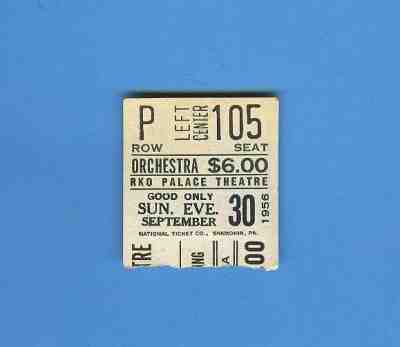
Sold on eBay Apr, 27th 2020
Rare Judy Garland TICKET STUB Palace Theatre NYC September 30, 1956
<br />A rare, original ticket stub to Judy Garland's concert at the Palace Theatre in New York City on September 30, 1956.<br /><br />Concert stubs to Judy's 1951 Palace Theatre engagement have survived and are fairly common - a ticket stub to her 1956 Palace engagement is very difficult to find.<br /><br />The front of the ticket stub is in very good condition. There is some residue on the back of the stub.<br />The stub was found inside a program and I have attached a picture of that area in my scans. This auction is for the ticket stub only (the program was damaged).<br /><br /><br />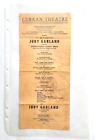
Sold on eBay May 22nd, 2024
1952 ORIGINAL PLAYBILL POSTER...JUDY GARLAND CURRAN THEATRE SAN FRANCISCO
This auction is for original vintage c.1952 playbill " Curran Theatre San Francisco Judy Garland and her International Variety Show...."Size: 12 3/8" x 5 3/8". Please note: colors can be slightly different in real life than shown at a scans. Enlarged at a scan for better viewing. As shown at a scans. Please see detailed scans for condition. Payments: Pay Pal. Please note: Pay Pal payment must be received within THREE days from the auction closed. Shipping: buyer pays for shipping. Items will be combine to save on shipping charges. Thank You and good luck. Please check my other auctions.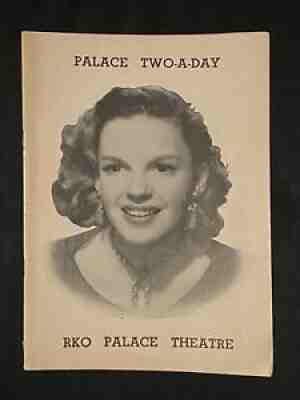
Sold on eBay Dec 13, 2021
JUDY GARLAND -Rare 1951 RKO Palace Theatre Playbill - Two-A-Day "Comeback" Shows
Playbill is in EXCELLENT condition would have been flawless aside from one small scuff near the bottom staple on the back page shown in two pictures.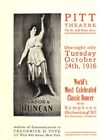
Sold on eBay May 5th, 2024
*LEGENDARY DANCER ISADORA DUNCAN RARE 1916 DANCE PROGRAM*
A rare large original 1916 dance program for the legendary Isadora Duncan. Four pages. Dimensions ten and three quarters by five and a half inches. Light wear otherwise good. See Isadora Duncan's extraordinary biography below. Shipping discounts for multiple purchases. Inquiries always welcome. Please visit my other eBay items for more early ballet and dance memorabilia, early theatre, opera, film, magic, and historical autographs, photographs, programs and broadsides, and great actor and actress cabinet photos and CDV's.From Isadora Duncan (May 26, 1877 or May 27, 1878[a] – September 14, 1927) was an American and French dancer who performed to acclaim throughout Europe. Born in California, she lived in Western Europe and the Soviet Union from the age of 22 until her death at age 50, when her scarf became entangled in the wheels and axle of the car in which she was riding.Isadora Duncan was born in San Francisco, the youngest of the four children of Joseph Charles Duncan (1819–1898), a banker, mining engineer and connoisseur of the arts, and Mary Isadora Gray (1849–1922). Her brothers were Augustin Duncan and Raymond Duncan;[2] her sister, Elizabeth Duncan, was also a dancer.[3][4] Soon after Isadora's birth, her father was exposed to illegal bank dealings, and the family became extremely poor.[2]Her parents divorced when she was an infant,[5] and her mother moved with her family to Oakland, California, where she worked as a seamstress and piano teacher. From ages six to ten, Isadora attended school, but she dropped out, finding it constricting. As her family was very poor, she and her three siblings earned money by teaching dance to local children.[2]In 1896, Duncan became part of Augustin Daly's theater company in New York, but she soon became disillusioned with the form and craved a different environment with less of a hierarchy.[6] Her father, along with his third wife and their daughter, died in 1898 when the British passenger steamer SS Mohegan ran aground off the coast of Cornwall [7]WorkPhoto by Arnold Genthe of Duncan performing barefoot during her 1915–1918 American tourAbraham Walkowitz's Isadora Duncan #29, one of many works of art she inspired.Duncan began her dancing career at a very early age by giving lessons in her home to neighbourhood children, and this continued through her teenage years.[8] Her novel approach to dance was evident in these early classes, in which she "followed [her] fantasy and improvised, teaching any pretty thing that came into [her] head".[9] A desire to travel brought her to Chicago, where she auditioned for many theater companies, finally finding a place in Augustin Daly's company. This took her to New York City where her unique vision of dance clashed with the popular pantomimes of theater companies.[10] In New York, Duncan took some classes with Marie Bonfanti but was quickly disappointed in ballet routine.Feeling unhappy and unappreciated in America, Duncan moved to London in 1898. She performed in the drawing rooms of the wealthy, taking inspiration from the Greek vases and bas-reliefs in the British Museum.[11][12] The earnings from these engagements enabled her to rent a studio, allowing her to develop her work and create larger performances for the stage.[13] From London, she traveled to Paris, where she was inspired by the Louvre and the Exposition Universelle of 1900.[14]In 1902, Loie Fuller invited Duncan to tour with her. This took Duncan all over Europe as she created new works using her innovative technique,[15] which emphasized natural movement in contrast to the rigidity of tradition ballet.[16] She spent most of the rest of her life touring Europe and the Americas in this fashion.[17] Despite mixed reaction from critics, Duncan became quite popular for her distinctive style and inspired many visual artists, such as Antoine Bourdelle, Auguste Rodin, Arnold Rönnebeck, and Abraham Walkowitz, to create works based on her.[18]Duncan disliked the commercial aspects of public performance, such as touring and contracts, because she felt they distracted her from her real mission, namely the creation of beauty and the education of the young.[citation needed] To achieve her mission, she opened schools to teach young women her philosophy of dance. The first was established in 1904 in Berlin Grunewald Germany. This institution was the birthplace of the "Isadorables" (Anna, Maria-Theresa, Irma, Liesel, Gretel, and Erika[19]), Duncan's protégées who would continue her legacy.[20] Duncan legally adopted all six girls in 1919, and they took her last name.[21] After about a decade in Berlin, Duncan established a school in Paris that was shortly closed because of the outbreak of World War I.[22]In 1910, Duncan met the occultist Aleister Crowley at a party, an episode recounted by Crowley in his Confessions [23] He refers to Duncan as "Lavinia King", and used the same invented name for her in his novel Moonchild. Crowley wrote of Duncan that she "has this gift of gesture in a very high degree. Let the reader study her dancing, if possible in private than in public, and learn the superb unconsciousness — which is magical consciousness — with which she suits the action to the melody."[24] Crowley was, in fact, more attracted to Duncan's bohemian companion Mary Dempsey (a.k.a. Mary D'Este or Desti), with whom he had an affair. Desti had come to Paris in 1901 where she soon met Duncan, and the two became inseparable. Desti, who also appeared in Moonchild (as "Lisa la Giuffria") and became a member of Crowley's occult order,[b] later wrote a memoir of her experiences with Duncan.[25]In 1911, the French fashion designer Paul Poiret rented a mansion — Pavillon du Butard in La Celle Saint Cloud — and threw lavish parties, including one of the more famous grandes fêtes, La fête de Bacchus on June 20, 1912, re-creating the Bacchanalia hosted by Louis XIV at Versailles. Isadora Duncan, wearing a Greek evening gown designed by Poiret,[26] danced on tables among 300 guests; 900 bottles of champagne were consumed until the first light of day.[26]Duncan c. 1916–1918Duncan said to have posed for the photographer Eadweard Muybridge,[27] placed an emphasis on "evolutionary" dance motion, insisting that each movement was born from the one that preceded it, that each movement gave rise to the next, and so on in organic succession. Her dancing defined the force of progress, change, abstraction and liberation. In France, as elsewhere, Duncan delighted her audience.[28]In 1914, Duncan moved to the United States and transferred her school there. A townhouse on Gramercy Park was provided for its use, and its studio was nearby, on the northeast corner of 23rd Street and Fourth Avenue (now Park Avenue South).[29] Otto Kahn, the head of Kuhn, Loeb & Co., gave Duncan use of the very modern Century Theatre at West 60th Street and Central Park West for her performances and productions, which included a staging of Oedipus Rex that involved almost all of Duncan's extended entourage and friends.[30] During her time in New York, Duncan posed for a number of studies by the photographer Arnold Genthe.Duncan had been due to leave the United States in 1915 aboard the RMS Lusitania on its ill-fated voyage, but historians believe her financial situation at the time drove her to choose a more modest crossing.[31] In 1921, Duncan's leftist sympathies took her to the Soviet Union, where she founded a school in Moscow. However, the Soviet government's failure to follow through on promises to support her work caused her to return to the West and leave the school to her protégée Irma.[32] In 1924, Duncan composed a dance routine called Varshavianka to the tune of the Polish revolutionary song known in English as Whirlwinds of Danger [33]Philosophy and techniqueDuncan in a Greek-inspired pose and wearing her signature Greek tunic. She took inspiration from the classical Greek arts and combined them with an American athleticism to form a new philosophy of dance, in opposition to the rigidity of traditional ballet.Breaking with convention, Duncan imagined she had traced dance to its roots as a sacred art.[34] She developed from this notion a style of free and natural movements inspired by the classical Greek arts, folk dances, social dances, nature and natural forces as well as an approach to the new American athleticism which included skipping, running, jumping, leaping and tossing [citation needed]Duncan's philosophy of dance moved away from rigid ballet technique and towards what she perceived as natural movement. To restore dance to a high art form instead of merely entertainment, she strove to connect emotions and movement: "I spent long days and nights in the studio seeking that dance which might be the divine expression of the human spirit through the medium of the body's movement."[35] She believed dance was meant to encircle all that life had to offer—joy and sadness. Duncan took inspiration from ancient Greece and combined it with an American love of freedom. Her movement was feminine and arose from the deepest feelings in her body. This is exemplified in her revolutionary costume of a white Greek tunic and bare feet. Inspired by Greek forms, her tunics also allowed a freedom of movement that corseted ballet costumes and pointe shoes did not.[36] Costumes were not the only inspiration Duncan took from Greece: she was also inspired by ancient Greek art, and utilized some of its forms in her movement (see image) [37]Duncan wrote of American dancing: "let them come forth with great strides, leaps and bounds, with lifted forehead and far-spread arms, to dance."[38] Her focus on natural movement emphasized steps, such as skipping, outside of codified ballet technique. Duncan also cited the sea as an early inspiration for her movement.[39] Also, she believed movement originated from the solar plexus, which she thought was the source of all movement.[35] It is this philosophy and new dance technique that garnered Duncan the title of the creator of modern dance.Photo studies of Isadora Duncan made in New York by Arnold Genthe during her visits to America in 1915–1918 Personal lifeDuncan with her children Deirdre and Patrick, in 1913In both professional and private life, Duncan flouted traditional mores and morality. She was bisexual[40] and an atheist,[41] and alluded to her communism during her last United States tour, in 1922–23: she waved a red scarf and bared her breast on stage in Boston, proclaiming, "This is red! So am I!"[42]Duncan bore two children, both out of wedlock. The first, Deirdre Beatrice (born September 24, 1906), by theatre designer Gordon Craig, and the second, Patrick Augustus (born May 1, 1910),[43] by Paris Singer, one of the many sons of sewing machine magnate Isaac Singer. Both children drowned in the care of their nanny in 1913 when their runaway car went into the Seine [43]Following the accident, Duncan spent several months recuperating in Corfu with her brother and sister. She then spent several weeks at the Viareggio seaside resort with the actress Eleonora Duse. The fact that Duse had just left a relationship with the rebellious and epicene young feminist Lina Poletti fueled speculation as to the nature of Duncan and Duse's relationship, but there has never been any indication that the two were involved romantically [44]Duncan and Sergei YeseninIn her autobiography, Duncan relates that she begged a young Italian stranger, the sculptor Romano Romanelli,[45] to sleep with her because she was desperate for another baby. She became pregnant by him, and gave birth to a son on August 13, 1914; the infant died shortly after birth [46][47]In 1921, after the end of the Russian Revolution, Duncan moved to Moscow where she met the acclaimed poet Sergei Yesenin, who was 18 years her junior. On May 2, 1922, they married, and Yesenin accompanied her on a tour of Europe and the United States. However, the marriage was brief, and in May 1923 he left Duncan and returned to Moscow. Two years later, on December 28, 1925, Yesenin was found dead in his room in the Hotel Angleterre in St Petersburg in an apparent suicide [48]Duncan had a relationship with the poet and playwright Mercedes de Acosta, as documented in numerous revealing letters they wrote to each other.[49] In one, Duncan wrote, "Mercedes, lead me with your little strong hands and I will follow you – to the top of a mountain. To the end of the world. Wherever you wish."[50]Later lifeBy the late 1920s, Duncan's performing career had dwindled, and she became as notorious for her financial woes, scandalous love life and all too frequent public drunkenness as for her contributions to the arts. She spent her final years moving between Paris and the Mediterranean, running up debts at hotels. She spent short periods in apartments rented on her behalf by a decreasing number of friends and supporters, many of whom attempted to assist her in writing an autobiography. They hoped it might be successful enough to support her.[citation needed] In a reminiscent sketch, Zelda Fitzgerald wrote how she and F. Scott Fitzgerald, her husband, sat in a Paris cafe watching a somewhat drunk Duncan. He would speak of how memorable it was, but what Zelda recalled was that while all eyes were watching Duncan, Zelda was able to steal the salt and pepper shakers from the table.[51]In his book Isadora, an Intimate Portrait, Sewell Stokes, who met Duncan in the last years of her life, describes her extravagant waywardness. Duncan's autobiography My Life was published in 1927. The Australian composer Percy Grainger called Isadora's autobiography a "life-enriching masterpiece [52]DeathDuncan s tomb at Père Lachaise CemeteryOn the night of September 14, 1927, in Nice, France, Duncan was a passenger in an Amilcar CGSS automobile owned by Benoît Falchetto, a French-Italian mechanic. She wore a long, flowing, hand-painted silk scarf, created by the Russian-born artist Roman Chatov, a gift from her friend Mary Desti, the mother of American film director Preston Sturges. Desti, who saw Duncan off, had asked her to wear a cape in the open-air vehicle because of the cold weather, but she would only agree to wear the scarf.[53] As they departed, she reportedly said to Desti and some companions, "Adieu, mes amis. Je vais à la gloire !" ("Farewell, my friends. I go to glory!"); but according to the American novelist Glenway Wescott, Desti later told him that Duncan's actual parting words were, "Je vais à l'amour" ("I am off to love"). Desti considered this embarrassing, as it suggested that she and Falchetto were going to her hotel for a tryst.Her silk scarf, draped around her neck, became entangled around the open-spoked wheels and rear axle, pulling her from the open car and breaking her neck.[1] Desti said she called out to warn Duncan about the scarf almost immediately after the car left. Desti brought Duncan to the hospital, where she was pronounced dead.[53]As The New York Times noted in its obituary, Duncan "met a tragic death at Nice on the Riviera." "According to dispatches from Nice, Duncan was hurled in an extraordinary manner from an open automobile in which she was riding and instantly killed by the force of her fall to the stone pavement."[57] Other sources noted that she was almost decapitated by the sudden tightening of the scarf around her neck.[58] The accident gave rise to Gertrude Stein's mordant remark that "affectations can be dangerous".[59] At the time of her death, Duncan was a Soviet citizen. Her will was the first of a Soviet citizen's to be probated in the U.S.[60]Duncan was cremated, and her ashes were placed next to those of her children[61] in the columbarium at Père Lachaise Cemetery in Paris.[62] On the headstone of her grave is inscribed École du Ballet de l'Opéra de Paris ("Ballet School of the Opera of Paris ) LegacyDuncan is known as "The Mother of Dance". While her schools in Europe did not last long, Duncan's work had impact in the art and her style is still danced based upon the instruction of Maria-Theresa Duncan,[63] Anna Duncan,[64] and Irma Duncan,[65] three of her six adopted daughters. The adoption process was never verified, but all six of Isadora's dancers did change their last name to Duncan. Through her sister, Elizabeth, Duncan's approach was adopted by Jarmila Je?ábková from Prague where her legacy persists.[66] By 1913 she was already being celebrated. When the Théâtre des Champs Élysées was built, Duncan's likeness was carved in its bas-relief over the entrance by sculptor Antoine Bourdelle and included in painted murals of the nine muses by Maurice Denis in the auditorium. In 1987, she was inducted into the National Museum of Dance and Hall of Fame.Anna, Lisa,[67] Theresa and Irma, pupils of Isadora Duncan's first school, carried on the aesthetic and pedagogical principles of Isadora's work in New York and Paris. Choreographer and dancer Julia Levien was also instrumental in furthering Duncan's work through the formation of the Duncan Dance Guild in the 1950s and the establishment of the Duncan Centenary Company in 1977 [68]Another means by which Duncan's dance techniques were carried forth was in the formation of the Isadora Duncan Heritage Society, by Mignon Garland, who had been taught dance by two of Duncan's key students. Garland was such a fan that she later lived in a building erected at the same site and address as Duncan, attached a commemorative plaque near the entrance, which is still there as of 2016. Garland also succeeded in having San Francisco rename an alley on the same block from Adelaide Place to Isadora Duncan Lane.[69][70]In medicine, the Isadora Duncan Syndrome refers to injury or death consequent to entanglement of neckwear with a wheel or other machinery [71]In popular cultureDuncan has attracted literary and artistic attention from the 1920s to the present, in novels, film, ballet, theatre, music, and poetry.Duncan has been portrayed in novels including Aleister Crowley's Moonchild (as 'Lavinia King'), published in 1923,[72] and Upton Sinclair's World's End (1940) and Between Two Worlds (1941), the first two novels in his Pulitzer Prize winning Lanny Budd series.[73] She is also the subject of Amelia Gray's novel Isadora (2017).[74] Two characters in the A Series of Unfortunate Events series of novels are named after her, Isadora Quagmire and Duncan Quagmire [75]Among the films featuring Duncan are:The 1966 BBC biopic by Kenneth Russell, Isadora Duncan, the Biggest Dancer in the World, which was introduced by Duncan's biographer, Sewell Stokes, Duncan was played by Vivian Pickles.[76]The 1968 film Isadora, nominated for the Palme d'Or at Cannes, stars Vanessa Redgrave as Duncan. The film was based in part of Duncan's autobiography. Redgrave was nominated for the Academy Award for Best Actress for her performance as Duncan [76][77]Archival footage of Duncan was used in the 1985 popular documentary That's Dancing [78][79]A 1989 documentary, Isadora Duncan: Movement from the Soul, was nominated for the Grand Jury Prize at the 1989 Sundance Film Festival [80]Ballets based on Duncan include:In 1976 Frederick Ashton created a short ballet entitled Five Brahms Waltzes in the Manner of Isadora Duncan for Lynn Seymour of the Royal Ballet, in which "Ashton fused Duncan's style with an imprint of his own"; Marie Rambert claimed after seeing it that it was exactly as she remembered Duncan dancing.[81]In 1981, she was the subject of a ballet, Isadora, written and choreographed by the Royal Ballet's Kenneth MacMillan, and performed at Covent Garden.[82]On the theatre stage, Duncan is portrayed in:A 1991 stage play When She Danced by Martin Sherman about Duncan's later years, won the Evening Standard Award for Vanessa Redgrave as Best Actress.[83]In 2016, Lily-Rose Depp portrayed Duncan in The Dancer, a French biographical musical drama of dancer Loie Fuller [84]Duncan is featured in music in:The popular 1970s TV sitcom Maude mentions her in its theme song: "Isadora was the first bra burner Ain t ya glad she showed up?"Celia Cruz recorded a track titled Isadora Duncan with the Fania All-Stars for the album Cross Over released in 1979.[85]Rock musician Vic Chesnutt included a song about Duncan on his debut album Little.[86]Rock band Burden of a day included a song about Duncan on their album the poem Fever 103 by Sylvia Plath, the speaker alludes to Isadora's scarves.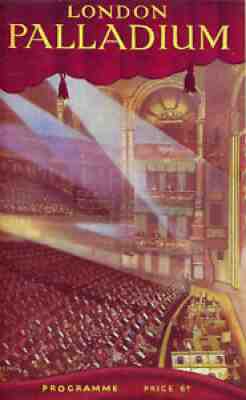
Sold on eBay Aug 14, 2021