

Playbill Collectibles : Playbill+maude Price List
average value
-
low
-high
-Found 20 out of 56,978 items matching 'maude'
Sold on eBay Oct, 7th 2020
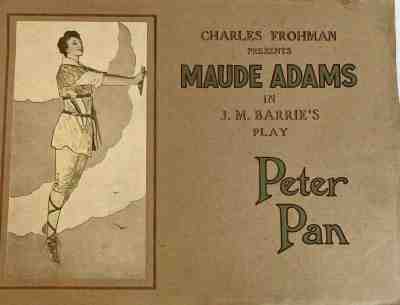
Rare 1907 PETER PAN" PROGRAM with ACTRESS MAUDE ADAMS
This is a program for "Charles Frohman Presents Maude Adams in J. M. Barrie's Play Peter Pan, or The Boy Who Wouldn't Grow Up". It has 16 (un-numbered) pages. The soft-cover program measures approximately nbsp;9 25 by 12.25 inches with tan paper covers stamped in green and brown. There's a color pictorial paper label on the front cover. The book is held togetherwith a green string binding. There are numeroussepia colored ;photographs nbsp;or illustrations throughout. They're scenes from the play "Peter Pan" taken especially for this book, which served as a souv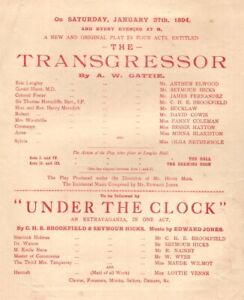
Sold on eBay September 22nd, 2023
1ST APPEARANCE SHERLOCK HOLMES ON STAGE: 1894 UNDER THE CLOCK PROGRAM*
A rare original January 1894 program for the first play to feature A. Conan Doyle's famed detective Sherlock Holmes, Under the Clock, with Charles Brookfield as Holmes and Seymour Hicks as Dr. Watson. Four pages. Dimensions ten by seven and a half inches. Light wear and partial separation at spine otherwise good. See the stories of Sherlock Holmes and Under the Clock below. Combined shipping discounts for multiple purchases. Inquiries always welcome. Please visit my other eBay items for more early theatre, opera, film and historical autographs, photographs and programs and great actor and actress cabinet photos and CDV's.From Wikipedia:From the Arthur Conan Doyle the Clock (An Extravaganza, in one act) is a British play written by Charles Brookfield and Seymour Hicks, performed on 25 november 1893 at 10pm as the third part of the evening triple bill (after plays Good-Bye at 8.15pm by Seymour Hicks, and Faithful James at 9pm by B. C. Stephenson) at Royal Court Theatre (London, UK), starring Charles Brookfield as Sherlock Holmes and Seymour Hicks as Dr. Watson.This is the first play with the character Sherlock Holmes CastSherlock Holmes : Charles BrookfieldDr. Watson : Seymour HicksEmile Nana : R. NainbyMaster of Ceremonies : W. WyesPlaque of Goethe : H. PauloFirst Forester : Hugh GwynneSecond Forester : Charles SimsonThe Third Mrs. Tanqueray : E. LyallStatue of Niobe : Maude WilmotHannah : Lottie : Charles Brookfield, Seymour HicksMusic : Edward JonesDances : Marriette D'AubanDresses supplied by : L. & H. and Furniture by : Marler & Bennett of Sloane StreetScenery painted by : T. W. HallPlot summaryHolmes and Watson are in their sanctum when the servant announces a visitor, who proves to be M. Emile Zola (here called M. Emile Nana). Sherlock Holmes, with his usual tendency to discover some deep plot, mystery or crime in the actions of every person with whom he comes in contact, refuses to believe in the amiable professions of M. Zola - or Nana - and arranges with the maidservant Hannah to adopt a series of disguises while he and his friend will follow closely in the wake of the Frenchman, and keep the strictest watch upon his movements. The Parisian visitor has received an invitation to meet the Lord Mayor, and at his Lordship's official residence the fun becomes most amusing, taking the form of parodies of all the principal stages successes of the season.Sherlock Holmes (/????rl?k ?ho?mz/) is a fictional detective created by British author Sir Arthur Conan Doyle. Referring to himself as a "consulting detective" in the stories, Holmes is known for his proficiency with observation, deduction, forensic science and logical reasoning that borders on the fantastic, which he employs when investigating cases for a wide variety of clients, including Scotland Yard.First appearing in print in 1887's A Study in Scarlet, the character's popularity became widespread with the first series of short stories in The Strand Magazine, beginning with "A Scandal in Bohemia" in 1891; additional tales appeared from then until 1927, eventually totalling four novels and 56 short stories. All but one[a] are set in the Victorian or Edwardian eras, between about 1880 and 1914. Most are narrated by the character of Holmes's friend and biographer Dr. John H. Watson, who usually accompanies Holmes during his investigations and often shares quarters with him at the address of 221B Baker Street, London, where many of the stories begin.Though not the first fictional detective, Sherlock Holmes is arguably the best known.[1] By the 1990s there were already over 25,000 stage adaptations, films, television productions and publications featuring the detective,[2] and Guinness World Records lists him as the most portrayed literary human character in film and television history.[3] Holmes's popularity and fame are such that many have believed him to be not a fictional character but a real numerous literary and fan societies have been founded on this pretence. Avid readers of the Holmes stories helped create the modern practice of fandom.[7] The character and stories have had a profound and lasting effect on mystery writing and popular culture as a whole, with the original tales as well as thousands written by authors other than Conan Doyle being adapted into stage and radio plays, television, films, video games, and other media for over one hundred years.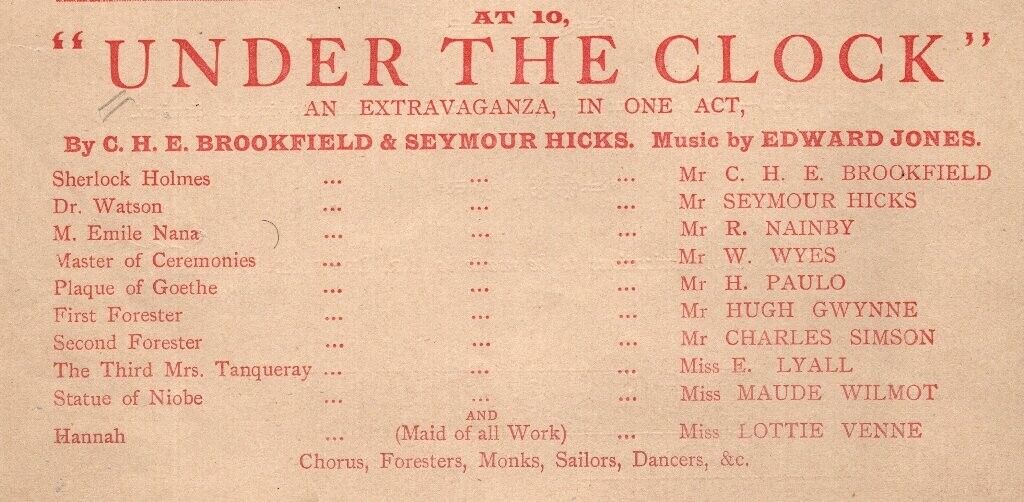
Sold on eBay January 26th, 2025
*FIRST SHERLOCK HOLMES PLAY 1893 RARE UNDER THE CLOCK PROGRAM*
It was the first play to feature Arthur Conan Doyle's famous detective Sherlock Holmes and opened at the Court Theatre on November 25, 1893 starring Charles Brookfield as Holmes and Seymour Hicks as Dr. Watson. A rare original 1893 playbill for Under the Clock. Light wear otherwise good. See the story of Under the Clock and Sherlock Holmes below. Shipping discounts for multiple purchases. Inquiries always welcome. Please visit my other eBay items for more early theatre, opera, film and historical autographs, photographs and programs and great actor and actress cabinet photos and CDV's. From the Arthur Conan Doyle the Clock (An Extravaganza, in one act) is a British play written by Charles Brookfield and Seymour Hicks, performed on 25 november 1893 at 10pm as the third part of the evening triple bill (after plays Good-Bye at 8.15pm by Seymour Hicks, and Faithful James at 9pm by B. C. Stephenson) at Royal Court Theatre (London, UK), starring Charles Brookfield as Sherlock Holmes and Seymour Hicks as Dr. Watson.This is the first play with the character Sherlock Holmes CastSherlock Holmes : Charles BrookfieldDr. Watson : Seymour HicksEmile Nana : R. NainbyMaster of Ceremonies : W. WyesPlaque of Goethe : H. PauloFirst Forester : Hugh GwynneSecond Forester : Charles SimsonThe Third Mrs. Tanqueray : E. LyallStatue of Niobe : Maude WilmotHannah : Lottie : Charles Brookfield, Seymour HicksMusic : Edward JonesDances : Marriette D'AubanDresses supplied by : L. & H. and Furniture by : Marler & Bennett of Sloane StreetScenery painted by : T. W. HallPlot summaryHolmes and Watson are in their sanctum when the servant announces a visitor, who proves to be M. Emile Zola (here called M. Emile Nana). Sherlock Holmes, with his usual tendency to discover some deep plot, mystery or crime in the actions of every person with whom he comes in contact, refuses to believe in the amiable professions of M. Zola - or Nana - and arranges with the maidservant Hannah to adopt a series of disguises while he and his friend will follow closely in the wake of the Frenchman, and keep the strictest watch upon his movements. The Parisian visitor has received an invitation to meet the Lord Mayor, and at his Lordship's official residence the fun becomes most amusing, taking the form of parodies of all the principal stages successes of the season.FROM Holmes (/????rl?k ?ho?mz/) is a fictional detective created by British author Sir Arthur Conan Doyle. Referring to himself as a "consulting detective" in the stories, Holmes is known for his proficiency with observation, deduction, forensic science and logical reasoning that borders on the fantastic, which he employs when investigating cases for a wide variety of clients, including Scotland Yard.First appearing in print in 1887's A Study in Scarlet, the character's popularity became widespread with the first series of short stories in The Strand Magazine, beginning with "A Scandal in Bohemia" in 1891; additional tales appeared from then until 1927, eventually totalling four novels and 56 short stories. All but one[a] are set in the Victorian or Edwardian eras, between about 1880 and 1914. Most are narrated by the character of Holmes's friend and biographer Dr. John H. Watson, who usually accompanies Holmes during his investigations and often shares quarters with him at the address of 221B Baker Street, London, where many of the stories begin.Though not the first fictional detective, Sherlock Holmes is arguably the best known.[1] By the 1990s there were already over 25,000 stage adaptations, films, television productions and publications featuring the detective,[2] and Guinness World Records lists him as the most portrayed literary human character in film and television history.[3] Holmes's popularity and fame are such that many have believed him to be not a fictional character but a real numerous literary and fan societies have been founded on this pretence. Avid readers of the Holmes stories helped create the modern practice of fandom.[7] The character and stories have had a profound and lasting effect on mystery writing and popular culture as a whole, with the original tales as well as thousands written by authors other than Conan Doyle being adapted into stage and radio plays, television, films, video games, and other media for over one hundred years.
Sold on eBay August 23rd, 2024
Danny Kaye (Debut) "STRAW HAT REVUE" Alfred Drake / Imogene Coca 1939 Flyer
This is a rare advertising handbill (flyer) promoting the Original Broadway production of the MAX LIEBMAN, SYLVIA FINE and JAMES SHELTON musical revue "THE STRAW HAT REVUE" at the Ambassador Theatre in New York City. (The production opened September 29th, 1939 and ran for only 75 performances.) ..... The talented young cast included DANNY KAYE (making his Broadway debut), ALFRED DRAKE, IMOGENE COCA, JEROME ROBBINS, META MATA and OTTO HARI, DOROTHY BIRD, JEROME ANDREWS, ALBIA KAVAN, ROBERT BURTON, JAMES SHELTON, WIERE BROTHERS, GERTRUDE GOLDSMITH, HERBERT SHEPARD, HARRIETTE HENNING, NANA MATISSE, VERA VOLKENAU, LILLI SANDAN, RUTHANNA BORIS, LEON BARTE, RICHARD REED, WILLIAM BALES, CULLY RICHARDS, BRONSON DUDLEY, PANCHO SCORDI, MARJORIE MOFFETT, NAN RAE, MAUDE DAVIS, DOLORES GRANAFEI and LEE BRODY. (Please Note: No cast members are mentioned by name in the text of the handbill.) ..... CREDITS: Music and Lyrics by SYLVIA FINE and JAMES SHELTON; Sketches mostly by MAX LIEBMAN; Sets designed by EDWARD GILBERT; Choreographed by JEROME ANDREWS; Conceived and Staged by MAX LIEBMAN; Produced by THE STRAW HAT COMPANY ..... DETAILS: Advertising handbills (heralds) were distributed or inserted into the playbills of other productions to help generate ticket sales for upcoming shows and events. This single page, one-sided handbill measures 6" X 9" inches and includes production credits, beautiful graphics and excerpts from several New York reviews on the front. The backside is blank ..... CONDITION: This rare flyer is in excellent condition and will make a wonderful addition to the collection of any musical theatre aficionado or historian. This item will be carefully packaged in a protective, carded sleeve and backed by stiff cardboard ..... SHIPPING DISCOUNTS: Check my "Other Items" for additional rare Broadway playbills and other theatre related memorabilia. Shipping discounts are available for multiple purchases when all items are combined into a single payment. Please wait for a revised invoice before sending payment ..... THANKS !!! Pay me securely with any major credit card through PayPal!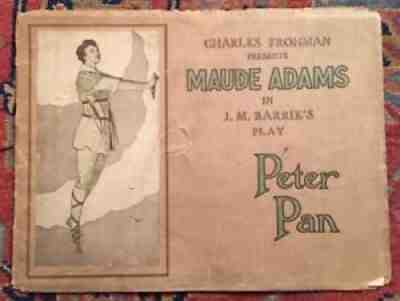
Sold on eBay Jan 31, 2021
*MAUDE ADAMS PETER PAN RARE ORIGINAL 1907 SOUVENIR PROGRAM 22 PHOTOS*
Beautifully illustrated with twenty two photos of Maude Adams and the play. Fragile with light wear and small tears and wear to cover otherwise good. See Maude Adams's extraordinary biography below.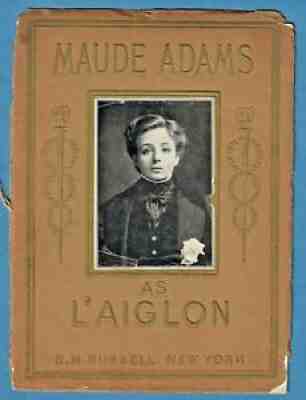
Sold on eBay Oct 05, 2021
1901 MAUDE ADAMS AS L'AIGLON ~ THEATER PICTORIAL SOUVENIR BOOK ~ RARE
Scarce "playbill" (Pictorial Souvenir) published in 1901: "Maude Adams In L'Aiglon.".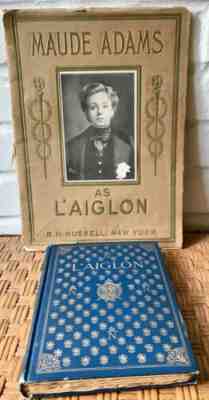
Sold on eBay Jan 16, 2023
1901 MAUDE ADAMS L AIGLON THEATER PICTORIAL SOUVENIR BOOK+BOOK W/ENTIRE PLAY
Full of wonderful photos of the iconic play. Slight wear on cover, mostly on top & bottom edges. Then, abeautiful copy of the whole play, presented in an elegant blue buckram binding with the Napolean Bee embossed over the cover.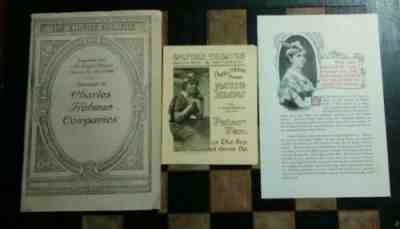
Sold on eBay Jun, 27th 2020
1906 Jan Playbill - Peter Pan @ Empire Theater, Maude Adams first US run ex cond
<br /> You are bidding on the item in the title. Please use the pictures to assess condition. Shipping and Handling will be as shown to the US in a rigid envelope. International shipping will be via USPS First Class International rates and will not be negotiated further. Please ask before bidding if you want a specific quote. I do combine shipping for multiple auctions but only if paid as one payment, please wait for or request a combined invoice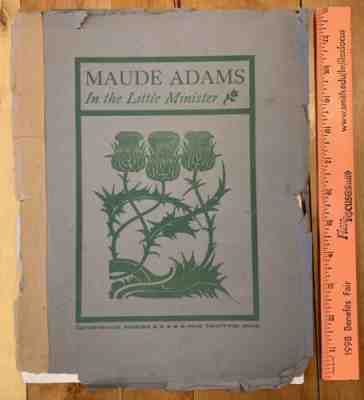
Sold on eBay Feb 05, 2023
1898 Maude Adams Souvenir Theater Folio Photos Illustrations â??Little Ministerâ??
Gorgeous photos/folio. The cover has come undone and there is some wear at binding but images are clean and in great condition. This folio is in two parts - while the frayed paper cover is titled â??Maude Adams in the Little Ministerâ?? and the first sewed binding section is filled with illustrations of that J. M. Barrie playing, the second section is comprised of photos from another Barrie play, â??Quality Streetâ??. First part with a publication date of 1899, second with date of 1901. Really beautiful photos. Any questions, please ask. Happy to combine shipping if you bid on anot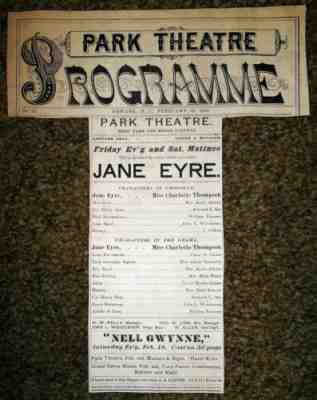
Sold on eBay Mar 14, 2023
Maude Adams 9 years old Jane Eyre 1882 Park Theatre mom Annie prog VERY RARE
Find many great new & used options and get the best deals for Maude Adams 9 years old Jane Eyre 1882 Park Theatre mom Annie prog VERY RARE at the best online prices at eBay! Free shipping for many products!
Sold on eBay May 5th, 2024
*LEGENDARY DANCER ISADORA DUNCAN RARE 1916 DANCE PROGRAM*
A rare large original 1916 dance program for the legendary Isadora Duncan. Four pages. Dimensions ten and three quarters by five and a half inches. Light wear otherwise good. See Isadora Duncan's extraordinary biography below. Shipping discounts for multiple purchases. Inquiries always welcome. Please visit my other eBay items for more early ballet and dance memorabilia, early theatre, opera, film, magic, and historical autographs, photographs, programs and broadsides, and great actor and actress cabinet photos and CDV's.From Isadora Duncan (May 26, 1877 or May 27, 1878[a] – September 14, 1927) was an American and French dancer who performed to acclaim throughout Europe. Born in California, she lived in Western Europe and the Soviet Union from the age of 22 until her death at age 50, when her scarf became entangled in the wheels and axle of the car in which she was riding.Isadora Duncan was born in San Francisco, the youngest of the four children of Joseph Charles Duncan (1819–1898), a banker, mining engineer and connoisseur of the arts, and Mary Isadora Gray (1849–1922). Her brothers were Augustin Duncan and Raymond Duncan;[2] her sister, Elizabeth Duncan, was also a dancer.[3][4] Soon after Isadora's birth, her father was exposed to illegal bank dealings, and the family became extremely poor.[2]Her parents divorced when she was an infant,[5] and her mother moved with her family to Oakland, California, where she worked as a seamstress and piano teacher. From ages six to ten, Isadora attended school, but she dropped out, finding it constricting. As her family was very poor, she and her three siblings earned money by teaching dance to local children.[2]In 1896, Duncan became part of Augustin Daly's theater company in New York, but she soon became disillusioned with the form and craved a different environment with less of a hierarchy.[6] Her father, along with his third wife and their daughter, died in 1898 when the British passenger steamer SS Mohegan ran aground off the coast of Cornwall [7]WorkPhoto by Arnold Genthe of Duncan performing barefoot during her 1915–1918 American tourAbraham Walkowitz's Isadora Duncan #29, one of many works of art she inspired.Duncan began her dancing career at a very early age by giving lessons in her home to neighbourhood children, and this continued through her teenage years.[8] Her novel approach to dance was evident in these early classes, in which she "followed [her] fantasy and improvised, teaching any pretty thing that came into [her] head".[9] A desire to travel brought her to Chicago, where she auditioned for many theater companies, finally finding a place in Augustin Daly's company. This took her to New York City where her unique vision of dance clashed with the popular pantomimes of theater companies.[10] In New York, Duncan took some classes with Marie Bonfanti but was quickly disappointed in ballet routine.Feeling unhappy and unappreciated in America, Duncan moved to London in 1898. She performed in the drawing rooms of the wealthy, taking inspiration from the Greek vases and bas-reliefs in the British Museum.[11][12] The earnings from these engagements enabled her to rent a studio, allowing her to develop her work and create larger performances for the stage.[13] From London, she traveled to Paris, where she was inspired by the Louvre and the Exposition Universelle of 1900.[14]In 1902, Loie Fuller invited Duncan to tour with her. This took Duncan all over Europe as she created new works using her innovative technique,[15] which emphasized natural movement in contrast to the rigidity of tradition ballet.[16] She spent most of the rest of her life touring Europe and the Americas in this fashion.[17] Despite mixed reaction from critics, Duncan became quite popular for her distinctive style and inspired many visual artists, such as Antoine Bourdelle, Auguste Rodin, Arnold Rönnebeck, and Abraham Walkowitz, to create works based on her.[18]Duncan disliked the commercial aspects of public performance, such as touring and contracts, because she felt they distracted her from her real mission, namely the creation of beauty and the education of the young.[citation needed] To achieve her mission, she opened schools to teach young women her philosophy of dance. The first was established in 1904 in Berlin Grunewald Germany. This institution was the birthplace of the "Isadorables" (Anna, Maria-Theresa, Irma, Liesel, Gretel, and Erika[19]), Duncan's protégées who would continue her legacy.[20] Duncan legally adopted all six girls in 1919, and they took her last name.[21] After about a decade in Berlin, Duncan established a school in Paris that was shortly closed because of the outbreak of World War I.[22]In 1910, Duncan met the occultist Aleister Crowley at a party, an episode recounted by Crowley in his Confessions [23] He refers to Duncan as "Lavinia King", and used the same invented name for her in his novel Moonchild. Crowley wrote of Duncan that she "has this gift of gesture in a very high degree. Let the reader study her dancing, if possible in private than in public, and learn the superb unconsciousness — which is magical consciousness — with which she suits the action to the melody."[24] Crowley was, in fact, more attracted to Duncan's bohemian companion Mary Dempsey (a.k.a. Mary D'Este or Desti), with whom he had an affair. Desti had come to Paris in 1901 where she soon met Duncan, and the two became inseparable. Desti, who also appeared in Moonchild (as "Lisa la Giuffria") and became a member of Crowley's occult order,[b] later wrote a memoir of her experiences with Duncan.[25]In 1911, the French fashion designer Paul Poiret rented a mansion — Pavillon du Butard in La Celle Saint Cloud — and threw lavish parties, including one of the more famous grandes fêtes, La fête de Bacchus on June 20, 1912, re-creating the Bacchanalia hosted by Louis XIV at Versailles. Isadora Duncan, wearing a Greek evening gown designed by Poiret,[26] danced on tables among 300 guests; 900 bottles of champagne were consumed until the first light of day.[26]Duncan c. 1916–1918Duncan said to have posed for the photographer Eadweard Muybridge,[27] placed an emphasis on "evolutionary" dance motion, insisting that each movement was born from the one that preceded it, that each movement gave rise to the next, and so on in organic succession. Her dancing defined the force of progress, change, abstraction and liberation. In France, as elsewhere, Duncan delighted her audience.[28]In 1914, Duncan moved to the United States and transferred her school there. A townhouse on Gramercy Park was provided for its use, and its studio was nearby, on the northeast corner of 23rd Street and Fourth Avenue (now Park Avenue South).[29] Otto Kahn, the head of Kuhn, Loeb & Co., gave Duncan use of the very modern Century Theatre at West 60th Street and Central Park West for her performances and productions, which included a staging of Oedipus Rex that involved almost all of Duncan's extended entourage and friends.[30] During her time in New York, Duncan posed for a number of studies by the photographer Arnold Genthe.Duncan had been due to leave the United States in 1915 aboard the RMS Lusitania on its ill-fated voyage, but historians believe her financial situation at the time drove her to choose a more modest crossing.[31] In 1921, Duncan's leftist sympathies took her to the Soviet Union, where she founded a school in Moscow. However, the Soviet government's failure to follow through on promises to support her work caused her to return to the West and leave the school to her protégée Irma.[32] In 1924, Duncan composed a dance routine called Varshavianka to the tune of the Polish revolutionary song known in English as Whirlwinds of Danger [33]Philosophy and techniqueDuncan in a Greek-inspired pose and wearing her signature Greek tunic. She took inspiration from the classical Greek arts and combined them with an American athleticism to form a new philosophy of dance, in opposition to the rigidity of traditional ballet.Breaking with convention, Duncan imagined she had traced dance to its roots as a sacred art.[34] She developed from this notion a style of free and natural movements inspired by the classical Greek arts, folk dances, social dances, nature and natural forces as well as an approach to the new American athleticism which included skipping, running, jumping, leaping and tossing [citation needed]Duncan's philosophy of dance moved away from rigid ballet technique and towards what she perceived as natural movement. To restore dance to a high art form instead of merely entertainment, she strove to connect emotions and movement: "I spent long days and nights in the studio seeking that dance which might be the divine expression of the human spirit through the medium of the body's movement."[35] She believed dance was meant to encircle all that life had to offer—joy and sadness. Duncan took inspiration from ancient Greece and combined it with an American love of freedom. Her movement was feminine and arose from the deepest feelings in her body. This is exemplified in her revolutionary costume of a white Greek tunic and bare feet. Inspired by Greek forms, her tunics also allowed a freedom of movement that corseted ballet costumes and pointe shoes did not.[36] Costumes were not the only inspiration Duncan took from Greece: she was also inspired by ancient Greek art, and utilized some of its forms in her movement (see image) [37]Duncan wrote of American dancing: "let them come forth with great strides, leaps and bounds, with lifted forehead and far-spread arms, to dance."[38] Her focus on natural movement emphasized steps, such as skipping, outside of codified ballet technique. Duncan also cited the sea as an early inspiration for her movement.[39] Also, she believed movement originated from the solar plexus, which she thought was the source of all movement.[35] It is this philosophy and new dance technique that garnered Duncan the title of the creator of modern dance.Photo studies of Isadora Duncan made in New York by Arnold Genthe during her visits to America in 1915–1918 Personal lifeDuncan with her children Deirdre and Patrick, in 1913In both professional and private life, Duncan flouted traditional mores and morality. She was bisexual[40] and an atheist,[41] and alluded to her communism during her last United States tour, in 1922–23: she waved a red scarf and bared her breast on stage in Boston, proclaiming, "This is red! So am I!"[42]Duncan bore two children, both out of wedlock. The first, Deirdre Beatrice (born September 24, 1906), by theatre designer Gordon Craig, and the second, Patrick Augustus (born May 1, 1910),[43] by Paris Singer, one of the many sons of sewing machine magnate Isaac Singer. Both children drowned in the care of their nanny in 1913 when their runaway car went into the Seine [43]Following the accident, Duncan spent several months recuperating in Corfu with her brother and sister. She then spent several weeks at the Viareggio seaside resort with the actress Eleonora Duse. The fact that Duse had just left a relationship with the rebellious and epicene young feminist Lina Poletti fueled speculation as to the nature of Duncan and Duse's relationship, but there has never been any indication that the two were involved romantically [44]Duncan and Sergei YeseninIn her autobiography, Duncan relates that she begged a young Italian stranger, the sculptor Romano Romanelli,[45] to sleep with her because she was desperate for another baby. She became pregnant by him, and gave birth to a son on August 13, 1914; the infant died shortly after birth [46][47]In 1921, after the end of the Russian Revolution, Duncan moved to Moscow where she met the acclaimed poet Sergei Yesenin, who was 18 years her junior. On May 2, 1922, they married, and Yesenin accompanied her on a tour of Europe and the United States. However, the marriage was brief, and in May 1923 he left Duncan and returned to Moscow. Two years later, on December 28, 1925, Yesenin was found dead in his room in the Hotel Angleterre in St Petersburg in an apparent suicide [48]Duncan had a relationship with the poet and playwright Mercedes de Acosta, as documented in numerous revealing letters they wrote to each other.[49] In one, Duncan wrote, "Mercedes, lead me with your little strong hands and I will follow you – to the top of a mountain. To the end of the world. Wherever you wish."[50]Later lifeBy the late 1920s, Duncan's performing career had dwindled, and she became as notorious for her financial woes, scandalous love life and all too frequent public drunkenness as for her contributions to the arts. She spent her final years moving between Paris and the Mediterranean, running up debts at hotels. She spent short periods in apartments rented on her behalf by a decreasing number of friends and supporters, many of whom attempted to assist her in writing an autobiography. They hoped it might be successful enough to support her.[citation needed] In a reminiscent sketch, Zelda Fitzgerald wrote how she and F. Scott Fitzgerald, her husband, sat in a Paris cafe watching a somewhat drunk Duncan. He would speak of how memorable it was, but what Zelda recalled was that while all eyes were watching Duncan, Zelda was able to steal the salt and pepper shakers from the table.[51]In his book Isadora, an Intimate Portrait, Sewell Stokes, who met Duncan in the last years of her life, describes her extravagant waywardness. Duncan's autobiography My Life was published in 1927. The Australian composer Percy Grainger called Isadora's autobiography a "life-enriching masterpiece [52]DeathDuncan s tomb at Père Lachaise CemeteryOn the night of September 14, 1927, in Nice, France, Duncan was a passenger in an Amilcar CGSS automobile owned by Benoît Falchetto, a French-Italian mechanic. She wore a long, flowing, hand-painted silk scarf, created by the Russian-born artist Roman Chatov, a gift from her friend Mary Desti, the mother of American film director Preston Sturges. Desti, who saw Duncan off, had asked her to wear a cape in the open-air vehicle because of the cold weather, but she would only agree to wear the scarf.[53] As they departed, she reportedly said to Desti and some companions, "Adieu, mes amis. Je vais à la gloire !" ("Farewell, my friends. I go to glory!"); but according to the American novelist Glenway Wescott, Desti later told him that Duncan's actual parting words were, "Je vais à l'amour" ("I am off to love"). Desti considered this embarrassing, as it suggested that she and Falchetto were going to her hotel for a tryst.Her silk scarf, draped around her neck, became entangled around the open-spoked wheels and rear axle, pulling her from the open car and breaking her neck.[1] Desti said she called out to warn Duncan about the scarf almost immediately after the car left. Desti brought Duncan to the hospital, where she was pronounced dead.[53]As The New York Times noted in its obituary, Duncan "met a tragic death at Nice on the Riviera." "According to dispatches from Nice, Duncan was hurled in an extraordinary manner from an open automobile in which she was riding and instantly killed by the force of her fall to the stone pavement."[57] Other sources noted that she was almost decapitated by the sudden tightening of the scarf around her neck.[58] The accident gave rise to Gertrude Stein's mordant remark that "affectations can be dangerous".[59] At the time of her death, Duncan was a Soviet citizen. Her will was the first of a Soviet citizen's to be probated in the U.S.[60]Duncan was cremated, and her ashes were placed next to those of her children[61] in the columbarium at Père Lachaise Cemetery in Paris.[62] On the headstone of her grave is inscribed École du Ballet de l'Opéra de Paris ("Ballet School of the Opera of Paris ) LegacyDuncan is known as "The Mother of Dance". While her schools in Europe did not last long, Duncan's work had impact in the art and her style is still danced based upon the instruction of Maria-Theresa Duncan,[63] Anna Duncan,[64] and Irma Duncan,[65] three of her six adopted daughters. The adoption process was never verified, but all six of Isadora's dancers did change their last name to Duncan. Through her sister, Elizabeth, Duncan's approach was adopted by Jarmila Je?ábková from Prague where her legacy persists.[66] By 1913 she was already being celebrated. When the Théâtre des Champs Élysées was built, Duncan's likeness was carved in its bas-relief over the entrance by sculptor Antoine Bourdelle and included in painted murals of the nine muses by Maurice Denis in the auditorium. In 1987, she was inducted into the National Museum of Dance and Hall of Fame.Anna, Lisa,[67] Theresa and Irma, pupils of Isadora Duncan's first school, carried on the aesthetic and pedagogical principles of Isadora's work in New York and Paris. Choreographer and dancer Julia Levien was also instrumental in furthering Duncan's work through the formation of the Duncan Dance Guild in the 1950s and the establishment of the Duncan Centenary Company in 1977 [68]Another means by which Duncan's dance techniques were carried forth was in the formation of the Isadora Duncan Heritage Society, by Mignon Garland, who had been taught dance by two of Duncan's key students. Garland was such a fan that she later lived in a building erected at the same site and address as Duncan, attached a commemorative plaque near the entrance, which is still there as of 2016. Garland also succeeded in having San Francisco rename an alley on the same block from Adelaide Place to Isadora Duncan Lane.[69][70]In medicine, the Isadora Duncan Syndrome refers to injury or death consequent to entanglement of neckwear with a wheel or other machinery [71]In popular cultureDuncan has attracted literary and artistic attention from the 1920s to the present, in novels, film, ballet, theatre, music, and poetry.Duncan has been portrayed in novels including Aleister Crowley's Moonchild (as 'Lavinia King'), published in 1923,[72] and Upton Sinclair's World's End (1940) and Between Two Worlds (1941), the first two novels in his Pulitzer Prize winning Lanny Budd series.[73] She is also the subject of Amelia Gray's novel Isadora (2017).[74] Two characters in the A Series of Unfortunate Events series of novels are named after her, Isadora Quagmire and Duncan Quagmire [75]Among the films featuring Duncan are:The 1966 BBC biopic by Kenneth Russell, Isadora Duncan, the Biggest Dancer in the World, which was introduced by Duncan's biographer, Sewell Stokes, Duncan was played by Vivian Pickles.[76]The 1968 film Isadora, nominated for the Palme d'Or at Cannes, stars Vanessa Redgrave as Duncan. The film was based in part of Duncan's autobiography. Redgrave was nominated for the Academy Award for Best Actress for her performance as Duncan [76][77]Archival footage of Duncan was used in the 1985 popular documentary That's Dancing [78][79]A 1989 documentary, Isadora Duncan: Movement from the Soul, was nominated for the Grand Jury Prize at the 1989 Sundance Film Festival [80]Ballets based on Duncan include:In 1976 Frederick Ashton created a short ballet entitled Five Brahms Waltzes in the Manner of Isadora Duncan for Lynn Seymour of the Royal Ballet, in which "Ashton fused Duncan's style with an imprint of his own"; Marie Rambert claimed after seeing it that it was exactly as she remembered Duncan dancing.[81]In 1981, she was the subject of a ballet, Isadora, written and choreographed by the Royal Ballet's Kenneth MacMillan, and performed at Covent Garden.[82]On the theatre stage, Duncan is portrayed in:A 1991 stage play When She Danced by Martin Sherman about Duncan's later years, won the Evening Standard Award for Vanessa Redgrave as Best Actress.[83]In 2016, Lily-Rose Depp portrayed Duncan in The Dancer, a French biographical musical drama of dancer Loie Fuller [84]Duncan is featured in music in:The popular 1970s TV sitcom Maude mentions her in its theme song: "Isadora was the first bra burner Ain t ya glad she showed up?"Celia Cruz recorded a track titled Isadora Duncan with the Fania All-Stars for the album Cross Over released in 1979.[85]Rock musician Vic Chesnutt included a song about Duncan on his debut album Little.[86]Rock band Burden of a day included a song about Duncan on their album the poem Fever 103 by Sylvia Plath, the speaker alludes to Isadora's scarves.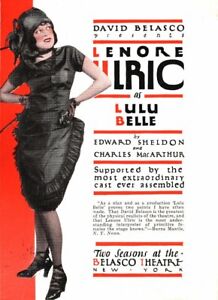
Sold on eBay April 22nd, 2024
*1926 RACE RELATIONS DAVID BELASCO COLOR LULU BELLE HERALD SHELDON & MACARTHUR*
A magnificent circa 1926 color herald for David Belasco's production of Edward Sheldon and Charles MacArthur's play or race relations Lulu Belle with the great Lenore Ulric. Excellent condition. This is one of the finest theatrical heralds I've ever seen. Dimensions seven by five inches. See David Belasco's extraordinary biography and thee story of the play. Shipping discounts for multiple purchases. Inquiries always welcome. Please visit my other eBay items for more early theatre, opera, film and historical autographs, photographs and programs and great actor and actress cabinet photos and CDV's. From Wikipedia:David Belasco (July 25, 1853 – May 14, 1931) was an American theatrical producer, impresario, director, and playwright.[1] He was the first writer to adapt the short story Madame Butterfly for the stage, and he launched the theatrical career of many actors, including James O'Neill, Mary Pickford, Lenore Ulric and Barbara Stanwyck. Belasco pioneered many innovative new forms of stage lighting and special effects in order to create realism and naturalism David Belasco was born in San Francisco, California, the son of Abraham H. Belasco (1830–1911) and Reyna Belasco (née Nunes, 1830–1899), Sephardic Jews who had moved from London’s Spanish and Portuguese Jewish community during the California Gold Rush.[3]:13 He began working in a San Francisco theater doing a variety of routine jobs, such as call boy, script copier or as an extra in small parts.[3]:14 He received his first experience as a stage manager while on the road. He said, "We used to play in any place we could hire or get into—a hall, a big dining room, an empty barn; any place that would take us."[3]:14From late 1873 to early 1874, he worked as an actor, director, and secretary at Piper's Opera House in Virginia City, Nevada, where he found "more reckless women and desperadoes to the square foot…than anywhere else in the world". His developmental years as a supporting player in Virginia City colored his thoughts eventually helping him to conceive realistic stage settings.[4] He said that while there, seeing "people die under such peculiar circumstances" made him "all the more particular in regard to the psychology of dying on the stage. I think I was one of the first to bring naturalness to bear in death scenes, and my varied Virginia City experiences did much to help me toward this. Later I was to go deeper into such studies." His recollections of that time were published in Hearst's Magazine in 1914.[5] By March 1874, he was back at work in San Francisco, eventually managing Thomas Maguire's Baldwin Theater. When Maguire lost the theater in 1882, Belasco relocated to the East Coast bringing his practical western experiences with him. The West allowed him to develop his talents as not only a performer, but in progressive production design and execution.[6]A gifted playwright, Belasco went to New York City in 1882 where he worked as stage manager for the Madison Square Theatre (starting with Young Mrs. Winthrop), and then the old Lyceum Theatre while writing plays. By 1895, he was so successful that he was considered America's most distinguished playwright and producer CareerBelasco in 1873During his long creative career, stretching between 1884 and 1930, Belasco either wrote, directed, or produced more than 100 Broadway plays, including Hearts of Oak, The Heart of Maryland, and Du Barry, making him the most powerful personality on the New York City theater scene. He also helped establish careers for dozens of notable stage performers, many of whom went on to work in films.Among them were Leslie Carter, dubbed "The American Sarah Bernhardt,"[7] whose association with Belasco skyrocketed her to theatrical fame after her roles in Zaza (1898) and Madame Du Barry (1901).[7] Ina Claire's lead in Polly with a Past (1917) and The Gold Diggers (1919) similarly propelled her career.[7] Belasco wrote a lead part for 18-year-old Maude Adams in his new play Men and Women (1890), which ran for 200 performances [7]Other stars whose careers he helped launch included Jeanne Eagels, who would later achieve immortality as Sadie Thompson in Rain (1923), which played for 340 performances [8] Belasco discovered and managed the careers of Lenore Ulric[9] and David Warfield, both of whom became major stars on Broadway. He launched the career of Barbara Stanwyck, and was responsible for changing her name.[7]Belasco is perhaps most famous for having adapted the short story Madame Butterfly into a play with the same name and for penning The Girl of the Golden West for the stage, both of which were adapted as operas by Giacomo Puccini (Madama Butterfly 1904—twice, after revision) and La fanciulla del West (1910). More than forty motion pictures have been made from the many plays he authored.To me, David Belasco was like the King of England, Julius Caesar and Napoleon rolled into one.Mary Pickford[7]Many prominent performers of the late 19th and early 20th centuries sought the opportunity to work with Belasco; among them were D. W. Griffith, Helen Hayes, Lillian Gish, Mary Pickford[7] and Cecil B. DeMille.[7] DeMille's father had been close friends with Belasco, and after DeMille graduated from the American Academy of Dramatic Arts, he began his stage career under Belasco's guidance.[10] DeMille's later methods of handling actors, using dramatic lighting and directing films, were modeled after Belasco's staging techniques [7]Pickford appeared in his plays The Warrens of Virginia at the first Belasco Theatre in 1907 and A Good Little Devil in 1913. The two remained in touch after Pickford began working in Hollywood; Belasco appeared with her in the 1914 film adaptation of A Good Little Devil. He is credited as giving Pickford her stage name as well. He also worked with Lionel Barrymore, who starred in his play Laugh, Clown, Laugh opposite Lucille Kahn, whose Broadway career Belasco launched. Belasco was a member of The Lambs from 1893 to 1931 MarriageDavid Belasco was married to Cecilia Loverich for over fifty years; they had two daughters, Reina (who was married to producer Morris Gest) and Augusta DeathBelasco died in 1931 at the age of 77 in Manhattan.[1] He was interred in the Linden Hill Jewish Cemetery on Metropolitan Avenue in Ridgewood, Queens [11][12]Influence on American theatrePoster for The Heart of Maryland with Maurice Barrymore and Mrs. Leslie CarterBelasco demanded a natural acting style, and to complement that, he developed stage settings with authentic lighting effects to enhance his plays. His productions inspired several generations of theatre lighting designers [13]:29Belasco s contributions to modern stage and lighting techniques were originally not appreciated as much as those of his European counterparts, such as André Antoine and Constantin Stanislavski, however today he is regarded as "one of the first significant directorial figures in the history of the American theatre," writes theatre historian Lise-Lone Marker [3]:xiBelasco s monogramHe brought a new standard of naturalism to the American stage as the first to develop modern stage lighting along with the use of colored lights, via motorized color changing wheels, to evoke mood and setting [3]:xi[13] America's earliest stage lighting manufacturer, Kliegl Brothers, began by serving the specialized needs of producers and directors such as Belasco and Florenz Ziegfeld [13]:157 With regard to these modern lighting effects, Belasco is best remembered for his production of Girl of the Golden West (1905), with the play opening to a spectacular sunset which lasted five minutes before any dialogue started [13]:29Belasco became one of the first directors to eschew the use of traditional footlights in favor of lights concealed below floor level, thereby hidden from the audience. His lighting assistant, Louis Hartmann, realised Belasco's design ideas.[13]:29 He also used follow spots to further create realism and often tailored his lighting configurations to complement the complexions and hair of the actors.[13]:135 He ordered a specially made 1000-watt lamp developed just for his own productions, and was the only director to have one for the first two years after its introduction (1914–1915) [13]:135In his own theatres, the dressing rooms were equipped with lamps of several colors, allowing the performers to see how their makeup looked under different lighting conditions Supposedly he put appropriate scents to set scenes in the ventilation of the theaters, while his sets paid great attention to detail, and sometimes spilled out into the audience area. In one play, for instance, an operational laundromat was built onstage. In The Governor's Lady, there was a reproduction of a Childs Restaurant kitchen where actors actually cooked and prepared food during the play.Childs Restaurant Scene in The Governor's LadyHe is even said to have purchased a room in a flophouse, cut it out of the building, brought it to his theater, cut out one wall and presented it as the set for a production. Belasco's original scripts were often filled with long, specific descriptions of props and set dressings. He has not been noted for producing unusually naturalistic scenarios Belasco also embraced existing theatre technology and sought to expand on it. Both of Belasco's New York theatres were built on the cutting edge of their era's technology. When Belasco took over the Republic Theatre he drilled a new basement level to accommodate his machinery; the Stuyvesant Theatre was specially constructed with enormous amounts of flyspace, hydraulics systems and lighting rigs. The basement of the Stuyvesant contained a working machine shop, where Belasco and his team experimented with lighting and other special effects. Many of the innovations developed in the Belasco shop were sold to other producers.F. Scott Fitzgerald references Belasco's reputation for realism in The Great Gatsby when he has a drunken visitor in the library of Gatsby's mansion exclaim in amazement that the books are genuine: "See!" he cried triumphantly. "It's a bona-fide piece of printed matter. It fooled me. This fella's a regular Belasco. It's a triumph. What thoroughness! What realism! Knew when to stop, too—didn't cut the pages [14]TheatresSee also: Belasco TheatreSee also: The BelascoThe first Belasco Theatre in New York was located at 229 West 42nd Street, between 7th and 8th Avenues, in the Times Square district of Manhattan. Belasco took over management of the theater and completely remodeled it in 1902, only two years after it was constructed as the Theatre Republic by Oscar Hammerstein (the grandfather of the famous lyricist). He gave up the theater in 1910 and it was renamed the Republic. Under various owners, it went through a tumultuous period as a burlesque venue, hosted second-run and, eventually, pornographic films and fell into a period of neglect before being rehabilitated and reopened as the New Victory Theater in 1995.The second Belasco Theatre is located at 111 West 44th Street, between 6th and 7th Avenues, only a few blocks away from the New Victory. It was constructed in 1907 as the Stuyvesant Theatre and renamed after Belasco in 1910. The theater was built to Belasco's wishes, with Tiffany lighting and ceiling panels, rich woodwork and murals. His business office and private apartment were also housed there. The Belasco is still in operation as a Broadway venue with much of the original decor intact. In 2010 it underwent a massive US $14.5 million restoration, which strove to renovate and restore the theater to the condition it was in when David Belasco was alive [15]Belasco Theatres also existed in several other cities. In Los Angeles, the first Belasco Theatre was located at 337 S. Main St. The theater, which hosted the Belasco Stock Company, opened in 1904 and was operated by David Belasco's brother, Frederick. This theater was renamed twice: as the Republic in about 1913 and as the Follies, circa 1919. The theater eventually became a burlesque venue in the 1940s, fell into sharp decline, and was demolished in May 1974 [16][17]The second, and perhaps more well known theatre in Los Angeles, The Belasco is located at 1050 S. Hill St in Downtown Los Angeles. The theatre, which was built by Morgan, Walls & Clements, opened in 1926, and was managed by Edward Belasco, another of David's brothers. Many Hollywood stars with theatrical roots, as well as Broadway stars who were visiting the West Coast, appeared at the theatre.[18] The theater declined after the death of Edward Belasco in 1937. After closing altogether in the early 1950s, the theater was used as a church for several decades.[19] In 2010 - 2011, the theater underwent an extensive restoration, and is currently in operation as a nightclub and convention venue.[20]The Shubert-Belasco Theatre, located in Washington, D.C., was purchased by Belasco in September 1905. Originally built in 1895 as the Lafayette Square Opera House, at 717 Madison Place, across from the White House, the theater was razed in 1962 and replaced by the U.S. Court of Claims building [21]Selected playsHearts of Oak (1879), by James A. Herne and David BelascoLa Belle Russe (1882), by David BelascoMay Blossom (1884), by David BelascoLord Chumley (1888), by Henry Churchill de Mille and David BelascoMen and Women (1890), by Henry Churchill de Mille and David BelascoThe Girl I Left Behind Me (1893), by Franklin Fyles and David BelascoPawn Ticket No. 210 (1894), by Clay M. Greene and David BelascoThe Heart of Maryland (1895), by David BelascoZaza (1898), by David Belasco (based on the play Zaza by Pierre Berton and Charles Simon [fr])Madame Butterfly (1900), by David Belasco (based on the short story Madame Butterfly by John Luther Long)Du Barry (1901), by David BelascoThe Auctioneer Kitty Bellairs (1903), by David Belasco (based on the novel The Bath Comedy by Agnes Castle and Egerton Castle)The Music Master (1904), by Charles KleinAdrea (1905), by David Belasco and John Luther LongThe Girl of the Golden West (1905), by David BelascoRose of the Rancho (1906), by Richard Walton Tully and David BelascoThe Warrens of Virginia (1907), by William C. deMilleThe Fighting Hope (1908), by William J. HurlbutThe Easiest Way (1909), by Eugene WalterThe Lily (1909), by David Belasco (based on the play Le Lys by Pierre Wolff and Gaston Leroux)Just a Wife (1910), by Eugene WalterThe Woman (1911), by William C. deMilleThe Return of Peter Grimm (1911), by David BelascoThe Governor's Lady (1912), by Alice BradleyThe Case of Becky (1912), by Edward LockeA Good Little Devil (1913), by Austin Strong (based on the play Un bon petit diable by Rosemonde Gérard and Maurice Rostand)Seven Chances (1916), by Roi Cooper MegrueTiger Rose (1917), by Willard MackThe Gold Diggers (1919), by Avery HopwoodThe Son-Daughter (1919), by George Scarborough and David BelascoKiki (1921), by David Belasco (based on the play Kiki by André Picard [fr])Shore Leave (1922), by Hubert OsborneLaugh, Clown, Laugh (1923), by Tom Cushing and David Belasco (based on the play Ridi, pagliaccio! by Fausto Maria Martini [it])Ladies of the Evening (1924), by Milton Herbert GropperThe Dove (1925), by Willard Mack (based on a story by Gerald Beaumont)Lulu Belle (1926), by Charles MacArthur and Edward SheldonTonight or Never (1930), by Fanny Hatton and Frederic Hatton (based on the play Ma este vagy soha by Lili Hatvany Chumley, directed by James Kirkwood (1914, based on the play Lord Chumley)La Belle Russe [it], directed by William J. Hanley (1914, based on the play La Belle Russe)Men and Women, directed by James Kirkwood (1914, based on the play Men and Women)Rose of the Rancho, directed by Cecil B. DeMille (1914, based on the play Rose of the Rancho)The Girl of the Golden West, directed by Cecil B. DeMille (1915, based on the play The Girl of the Golden West)The Girl I Left Behind Me [it], directed by Lloyd B. Carleton (1915, based on the play The Girl I Left Behind Me)DuBarry, directed by Edoardo Bencivenga (1915, based on the play Du Barry)The Heart of Maryland, directed by Herbert Brenon (1915, based on the play The Heart of Maryland)May Blossom, directed by Allan Dwan (1915, based on the play May Blossom)The Case of Becky, directed by Frank Reicher (1915, based on the play The Case of Becky)Madame Butterfly, directed by Sidney Olcott (1915, based on the play Madame Butterfly)Zaza, directed by Edwin S. Porter and Hugh Ford (1915, based on the play Zaza)Sweet Kitty Bellairs, directed by James Young (1916, based on the play Sweet Kitty Bellairs)La Belle Russe, directed by Charles Brabin (1919, based on the play La Belle Russe)Harakiri, directed by Fritz Lang (Germany, 1919, based on the play Madame Butterfly)The Heart of Maryland, directed by Tom Terriss (1921, based on the play The Heart of Maryland)The Case of Becky, directed by Chester M. Franklin (1921, based on the play The Case of Becky)Pawn Ticket 210, directed by Scott R. Dunlap (1922, based on the play Pawn Ticket No. 210)The Girl of the Golden West, directed by Edwin Carewe (1923, based on the play The Girl of the Golden West)Zaza, directed by Allan Dwan (1923, based on the play Zaza)Tiger Rose, directed by Sidney Franklin (1923, based on the play Tiger Rose)Forty Winks, directed by Paul Iribe and Frank Urson (1925, based on the play Lord Chumley)Seven Chances, directed by Buster Keaton (1925, based on the play Seven Chances)Men and Women, directed by William C. deMille (1925, based on the play Men and Women)Kiki, directed by Clarence Brown (1926, based on the play Kiki)The Lily, directed by Victor Schertzinger (1926, based on the play The Lily)The Return of Peter Grimm, directed by Victor Schertzinger (1926, based on the play The Return of Peter Grimm)The Music Master, directed by Allan Dwan (1927, based on the play The Music Master)The Heart of Maryland, directed by Lloyd Bacon (1927, based on the play The Heart of Maryland)Laugh, Clown, Laugh, directed by Herbert Brenon (1928, based on the play Laugh, Clown, Laugh)Ladies of Leisure, directed by Frank Capra (1930, based on the play Ladies of the Evening)Sweet Kitty Bellairs, directed by Alfred E. Green (1930, based on the play Sweet Kitty Bellairs)Du Barry, Woman of Passion, directed by Sam Taylor (1930, based on the play Du Barry)The Girl of the Golden West, directed by John Francis Dillon (1930, based on the play The Girl of the Golden West)Kiki, directed by Sam Taylor (1931, based on the play Kiki)Tonight or Never, directed by Mervyn LeRoy (1931, based on the play Tonight or Never)Girl of the Rio, directed by Herbert Brenon (1932, based on the play The Dove)The Hatchet Man, directed by William A. Wellman (1932, based on the play The Honorable Mr. Wong)The Son-Daughter, directed by Clarence Brown (1932, based on the play The Son Daughter)Madame Butterfly, directed by Marion Gering (1932, based on the play Madame Butterfly)The Return of Peter Grimm, directed by George Nicholls Jr. (1935, based on the play The Return of Peter Grimm)Rose of the Rancho, directed by Marion Gering (1936, based on the play Rose of the Rancho)Follow the Fleet, directed by Mark Sandrich (1936, based on the play Shore Leave)The Girl of the Golden West, directed by Robert Z. Leonard (1938, based on the play The Girl of the Golden West)Zaza, directed by George Cukor (1939, based on the play Zaza)Lulu Belle, directed by Leslie Fenton (1948, based on the play Lulu Belle)Madame Butterfly, directed by Carmine Gallone (Italy, 1954, based on the opera Madama Butterfly, directed by Frédéric Mitterrand (France, 1995, based on the opera Madama Good Little Devil, directed by Edwin S. Porter (1914, Famous Players Film Company)Rose of the Rancho, directed by Cecil B. DeMille (1914, Jesse L. Lasky Feature Play Co.)The Girl of the Golden West, directed by Cecil B. DeMille (1915, Jesse L. Lasky Feature Play Co.)The Warrens of Virginia, directed by Cecil B. DeMille (1915, Jesse L. Lasky Feature Play Co.)The Governor's Lady, directed by George Melford (1915, Jesse L. Lasky Feature Play Co.)The Woman, directed by George Melford (1915, Jesse L. Lasky Feature Play Co.)The Fighting Hope, directed by George Melford (1915, Jesse L. Lasky Feature Play Co.)The Case of Becky, directed by Frank Reicher (1915, Jesse L. Lasky Feature Play Co.)Her Accidental Husband, directed by Dallas M. Fitzgerald (1923, Belasco Productions, Inc.)The Gold Diggers, directed by Harry Beaumont (1923, Warner Bros.)Tiger Rose, directed by Sidney Franklin (1923, Warner Bros.)Welcome Stranger, directed by James Young (1924, Belasco Productions, Inc.)Friendly Enemies, directed by George Melford (1925, Belasco Productions, Inc.)Fifth Avenue, directed by Robert G. Vignola (1926, Belasco Productions, Inc.)The Prince of Pilsen, directed by Paul Powell (1926, Belasco Productions, Inc.)Lulu Belle is a 1948 American drama musical romance film directed by Leslie Fenton and starring Dorothy Lamour.[1] The film was an adaption of a sensational 1926 hit play by Charles MacArthur and Edward Sheldon,[2][3] about a mulatto songstress, a "man-trap" who bewitched powerful men in New Orleans. This convoluted but heavily Code-sanitized film version of the play was about a Caucasian songbird who could not be true to her boxer beau. Although the film offered a change of pace for its star, Dorothy Lamour, it was not a success at the box office PlotFamous Broadway singer Lulu Belle (Dorothy Lamour) and Harry Randolph (Otto Kruger), her rich suitor, are found shot and severely wounded in her dressing room one night after the show. They are discovered by Lulu's best friend, Molly Benson (Glenda Farrell), and taken unconscious to the hospital [4]Lulu s ex-husband, George Davis (George Montgomery), is accused of the shooting, since he has been previously convicted of attempted murder of another man who got too close to Lulu. During George's interrogation he tells the story of how he met Lulu for the first time. She was performing in a dodgy place called the Natchez Café, and he was so taken with her that he left his fiancée and law practice to elope with her to New Orleans. They lived a wild life of luxury for awhile until his money ran out. She left for another man, high-stakes gambler Mark Brady (Albert Dekker) to support her expensive lifestyle. George realizes that Lulu is bad news and leaves her. It doesn't take long before they get back together again. Lulu is offered a job by Mark, as a singer at a club he is starting, and George starts drinking heavily to drown his sorrows. He tries to get Molly to help stop Lulu's way of life. Lulu wants to divorce him to set him free. That night a wealthy man named Harry Randolph comes to visit the club with his wife (Charlotte Wynters). He is immediately smitten with Lulu, and decides to help her become a star on Broadway.George picks a fight with boxer Butch and is beaten black and blue. George manages to stick a fork in Butch's eye and put an end to his fighting career. For this he is convicted and sentenced to prison. Lulu goes with Randolph, her new benefactor, to New York and Broadway. Randolph puts a lot of money and effort into building Lulu's career and a theater. After five years of working close together, Randolph asks Lulu to marry him. Lulu finds out that George has been released from prison and asks him to come her apartment. Mark turns up later in the evening at the theater and tries to force Lulu to come back with him, but she refuses. George meets Lulu right after the show that night and is sucked into her beam of charm again, when she proclaims her love for him. They decide to start a new life together. Without hesitation, Lulu tells Randolph that she won't marry him and he is upset. Then comes the night of the shooting Returning to the present, police commissioner Dixon (Addison Richards) gathers all the persons involved in the story, including Mrs. Randolph, at the dying Randolph's bedside. He asks Randolph to tell them who the shooter was, and he reveals it was his wife. George is vindicated and freed of all charges. He stays by Lulu's side long enough to make sure she will recover, then returns to his hometown alone.Edward Brewster (Ned) Sheldon (Chicago, Illinois, February 4, 1886 – April 1, 1946, New York City) was an American dramatist. His plays include Salvation Nell (1908) and Romance (1913), which was made into a motion picture with Greta Garbo.After becoming ill at age 29 with crippling rheumatoid arthritis, which eventually claimed his sight (around 1930), Sheldon became a source of emotional and creative support for his many friends, notably Minnie Maddern Fiske (he wrote Salvation Nell for her), Julia Marlowe, John Barrymore (his closest friend and confidante), Thornton Wilder, Alexander Woollcott, Anne Morrow Lindbergh, Ruth Gordon, Helen Hayes. While in hospital his advice was received by those in the theatrical profession as gospel. Actress and librettist Dorothy Donnelly formed a close friendship with Sheldon, and after he became bedridden often assisted with transcribing, editing, and supporting his work.In May 1915 Sheldon narrowly missed sailing on the Lusitania's infamous last voyage. He had been asked by theater impresario Charles Frohman to accompany him to England. A Harvard classmate of Sheldon's was getting married on May 11 and asked Sheldon to be best man. Sheldon then declined Frohman's offer.A 1936 lawsuit against Metro Goldwyn Mayer for copyright infringement claimed that the script MGM used for the 1932 motion picture Letty Lynton plagiarized material from the play Dishonored Lady by Sheldon and Margaret Ayer Barnes. The film is still unavailable today because of this lawsuit.His life is detailed in The Man Who Lived Twice by Eric Wollencott Barnes. In this biography Barnes states that Sheldon was in love all his adult life with Doris Keane, the actress who starred in Romance in 1913.Minnie Maddern Fiske and Frederick Perry in The High Road (1912)Basil Sydney and Doris Keane in the film Romance Nell (1908), made into the 1915, 1921, and 1931 motion pictures of the same nameThe Nigger (1909), made into the 1915 motion picture of the same name (aka The New Governor or The Mystery of Morrow's Rest) produced by William FoxThe Boss (1911), made into the 1915 motion picture of the same nameThe High Road (1912), made into the 1915 motion picture of the same nameRomance (1913), notable for its London run of 1,049 performances. Made into a 1920 silent film by United Artists starring Doris Keane, the actress who appeared in the role on stage. Also made into a 1930 motion picture starring Greta Garbo. Produced in New York as a musical, My Romance, with music by Sigmund Romberg and book and lyrics by Rowland Leigh, in 1948.The Song of Songs (1914), dramatization of the novel by Hermann Sudermann, made into films in 1918 (The Song of Songs), 1924 (Lily of the Dust), and in 1933 (The Song of Songs, starring Marlene Dietrich, Brian Aherne, and Lionel Atwill)The Garden of Paradise (1914), from "The Little Mermaid" by Hans Christian AndersenThe Call of Her People (1916), a silent film for Ethel Barrymore, from Sheldon's own play Egypt.The Jest (1919), adaptation from the Italian of Sem BenelliThe Czarina (1922), adaptation of the Hungarian play by Melchior Lengyel and Lajos Bíró, made into the 1924 silent Forbidden Paradise with Pola Negri.Bewitched (1924), with Sidney HowardLulu Belle (1926), with Charles MacArthur, starring Lenore Ulric; made into the 1948 motion picture of the same name, starring Dorothy LamourJenny (1929), with Margaret Ayer Lady (1930), with Barnes, made into the 1947 motion picture of the same name, starring Hedy Lamarr and directed by Robert Stevenson (alternate title Sins Lenore Ulric (born Lenore Ulrich, July 21, 1892 – December 30, 1970) was a star of the Broadway stage and Hollywood films of the silent-film and early sound era.Discovered in 1913 by theater director David Belasco, who would go on to manage her stage career, she was noted for portraying fiery, hot-blooded women of the typical vamp of Ulrich was born on July 21, 1892 to Franz Xavier Ulrich, who was a United States Army hospital steward, and Ida Ulrich (née Engenhart) [1][2] Both of her parents were first generation German Americans [3] Franz reportedly named his daughter Lenore due to his fondness for the Edgar Allan Poe poem, "The Raven".[1] She later dropped the "h" from her surname.[1] She had four sisters, Isabel, Francis, Alma, and Florence, and a brother, Roy Richard [4][5][6] She left school after completing 3rd grade.[7]As a young girl, Lenore obtained a job with a stock company in Milwaukee, Wisconsin. She played with stock companies in Grand Rapids, Michigan and Chicago, Illinois. She worked briefly as a film actress for Essanay Studios and joined another stock company in Schenectady, New York. She found work in The First Man (1911), A Polished Burglar (1911), Kilmeny (1915), and The Better Woman (1915).She specialized in playing sultry, impassioned women.[8] In 1915, she went to work for Pallas Pictures starring in several silent pictures, such as Frozen Justice and The Intrigue, that survive today at the Library of Congress [9][10]BroadwayCaricature by Ralph Barton, 1925Ulric was discovered by theatrical producer David Belasco who first saw her in The Bird of Paradise in 1913, after Ulric wrote to him requesting that he see her on stage.[10] Belasco, who would go on "fishing trips" to find new stage talents, recalled that it was often a long time between "bites," but he enjoyed the sport as he sometimes would "hook a big one [11]:367After watching her on stage, he asked her to audition at his playhouse. He watched her perform while he sat incognito in one of the theater's seats. "After twenty minutes," he said, "I knew I was watching a very talented and unusual young woman."[11]:369 He then offered her the leading role in The Heart of Wetona [11]:369[8] He recalled: "Among the biggest I have ever landed is, I believe, little Miss Ulric: I think she will grow bigger every season she is before the public [11]:367Biographer William Winter called her a "born actress," someone who Belasco hoped would fulfill the theater's need for talent. Winter also notes that no one in her family had ever been involved in acting, adding: "She resorted to the dramatic calling not through mere vanity, the impulse of personal exhibition, or the acquisitive hope of profit, but because her natural vocation is acting [11]:367Ulric in The Son-Daughter (1919)Under Belasco's management during most of her stage career, Ulric played a variety of female roles. Among them was her portrayal of Rose, a French-Canadian orphan, in Tiger Rose (1917). Winter says that Ulric's personality traits allowed her to play the role realistically as written:Miss Lenore Ulric, who acts the part, is possessed of exceptional natural advantages —youth; a handsome face; abundant hair; expressive eyes, dark and beautiful; a slender, lithe figure; a sympathetic voice; strong, attractive personality, and an engaging manner. Her temperament is intense, her nature passionate, her style direct and simple. Her acting reveals force of character, experience, observation, thought, sensibility, ardor, definite purpose, and unusual command of the mechanics of art...She is an admirable listener, an excellent speaker...The disposition she exhibits in this performance seems altogether childlike and lovely. Under Belasco's sagacious direction, she should go far.[11]:469She acted in numerous plays at the Belasco Theater, all under the direction of Belasco. She played in The Son-Daughter (1919), a play about China by Belasco and George Scarborough, which ran for 223 performances. She played a Parisian street urchin in Kiki (1921), a seductress in The Harem (1924), and in one of Ulric's biggest hits for Belasco, the 1926 Lulu Belle, where she played a prostitute, a genre that spawned several Broadway hits in the 1920s.[1] In 1928 she starred in Mima. Other stars who played at the Belasco during that period included Lionel Barrymore and Katharine Cornell [12]:28Success goes to women who are interesting. Nothing else matters. I don't believe even beauty matters.Lenore Ulric[13]After seeing Ulric in some of her plays, British producer Charles Cochrane cabled David Belasco with an "urgent request" that he be granted the privilege of presenting Ulric at one of his London playhouses.[14] During that time, however, Belasco had been writing a new version of Camille for Ulric to star in. According to one critic, "Miss Ulric's youth fits her peculiarly for the part, while her undisputed genius as an emotional actress justifies the prediction that she would be the greatest Camille who has ever been seen upon the stage."[14]In 1947 she returned to the Belasco Theater after doing seven films in Hollywood, beginning with a leading role in a revival of Antony and Cleopatra, alongside Eli Wallach, Maureen Stapleton and Charlton Heston.[12]:173 She told a critic, "I certainly never really left the theater."[1] Belasco had managed her stage career until shortly before his death.[1] In a tribute to Belasco, she said:All of us who were with him depended upon him so much that we'd just flounder around and say, "What do I do now?" He was a good soldier, a hard worker, and a great director [1]During the height of her stage career, Ulric was considered one of the American theater's "great stars."[1] She was noted for portraying fiery, hot-blooded women of the typical "femme fatale."[1] According to the New York Times, theater-goers would go to her plays just to see her, while the play in which she appeared was secondary. Ulric's "name in white lights blazing on the playhouse marquee was always more compelling" than the play itself [1]Hollywood and return to theaterLenore came to Hollywood in 1929 and appeared in Frozen Justice and South Sea Rose. She signed with Fox Film Corporation to make several films with an approximate salary of $650,000. Frozen Justice was directed by Allan Dwan. Some of the scenes were filmed in Alaska. She was successful in a supporting role in Camille, starring Greta Garbo. Ulric returned to Broadway in 1940, acting in The Fifth Column by Ernest Hemingway and again in 1947, in a revival of Antony and Cleopatra Personal lifeUlric had been married only once, to actor Sidney Blackmer from 1929 to 1939. She accepted some of the blame for their divorce:I don't think I'm comfortable to live with. I have a temper. I'm difficult. I'm too quick and too impulsive. And men have a right to be comfortable [1]She died of heart failure in Rockland State Hospital, Orangeburg, New York on December 30, 1970, aged 78.Charles Gordon MacArthur (November 5, 1895 – April 21, 1956) was an American playwright, screenwriter and 1935 winner of the Academy Award for Best Story.MacArthur was born in Scranton, Pennsylvania, the sixth of seven children of stern evangelist William Telfer MacArthur and Georgiana Welsted MacArthur.[1] He early developed a passion for reading. Declining to follow his father into ministry, he moved to the Midwest and soon became a successful reporter in Chicago, working for the Chicago Tribune and Chicago Daily News. MacArthur joined the United States Army for World War I, and served in France as a private assigned to Battery F, 149th Field Artillery, a unit of the 42nd Division.[2] He recounted his wartime experience in 1919's A Bug's-Eye View of the War.[3] After the war, he wrote several short stories, two of which, "Hang It All" (1921) and "Rope" (1923), were published in H. L. Mencken's The Smart Set magazine.[1] Eventually he settled in New York City, where he turned to playwriting MacArthur is best known for his plays in collaboration with Ben Hecht, Ladies and Gentlemen (filmed as Perfect Strangers), Twentieth Century and the frequently filmed The Front Page, which was based in part on MacArthur's experiences at the City News Bureau of Chicago. MacArthur also co-wrote, with Edward Sheldon, the play Lulu Belle, which was staged in 1926 by David Belasco MacArthur was friends with members of the Algonquin Round Table. He shared an apartment with Robert Benchley and had an affair with Dorothy Parker.His second marriage was to the stage and screen actress Helen Hayes, from 1928 until his death. They lived in Nyack, New York. He was preceded in death by his daughter, Mary, who died of polio in 1949 at the age of 19. The shock of her death hastened MacArthur's own, according to those who knew him.Their adopted son, James MacArthur, was also an actor, best known for playing Danny Williams on the American television series Hawaii Five-O.His brother, John D. MacArthur, was an insurance company owner and executive, and founded the John D. and Catherine T. MacArthur Foundation, the benefactor of the MacArthur Fellowships Awards and Award for Best Writing, Original Story - The Scoundrel (shared with Ben Hecht) Writing, Screenplay - Wuthering Heights (shared with Ben Hecht) in 1940Best Writing, Original Story - Rasputin and the Empress in 1934In 1983, MacArthur was posthumously inducted into the American Theater Hall of Fame.[4]Film was portrayed by Matthew Broderick in the 1994 film Mrs. Parker and the Vicious Circle [5]Selected Song (1946), (with Ben Hecht)Ladies and Gentlemen (1939), (with Ben Hecht), made into the 1950 film Perfect StrangersSpring Tonic, made into the 1935 movie of the same nameJohnny on a SpotJumbo, (with Ben Hecht), made into the 1935 musical play Jumbo and the 1962 film musical Billy Rose's JumboTwentieth Century (with Ben Hecht), made into the 1934 film Twentieth CenturyThe Front Page (1928), with Ben Hecht, made into the 1931, 1945, and 1974 motion pictures of the same name, the 1940 film His Girl Friday, and the 1988 movie Switching ChannelsLulu Belle (1926), (with Edward Heights (1939)Gunga Din (1939)Angels with Dirty Faces (1938) of Gamblers (1937), aka Czar of the Slot Machines the Rich (1936)The Scoundrel (1935)Barbary Coast (1935)Once in a Blue Moon (1935)Crime Without Passion (1934) (also directed by him and Ben Hecht)Topaze (1933)Freaks (1932) and the Empress (1932)The Unholy Garden (1931)Quick Millions (1931) Divers (1931)New Adventures of Get Rich Quick Wallingford (1931)The Sin of Madelon Claudet (1931)Paid (1930)Way for a Sailor (1930)King of Jazz (1930) the Kid (1930)The Girl Said No (1930)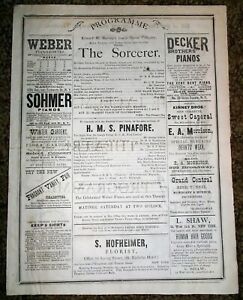
Sold on eBay August 30th, 2023
HMS Pinafore & Sorcerer Gilbert Sullivan Lyceum Theatre NYC 1879 Maria Harvey
You are bidding on:“H. M. S. Pinafore” & “The Sorcerer” partial program (first page); Lyceum Theatre, NYC week ending March 15 (on verso) 1879 (from research, “The Annals of the New York Stage); Edward H Harvey’s Comic Opera Company with Maria (or Marie) Harvey, J Graaf, C H Duncan, George Gaston, H R Humphries, Maude Branscombe (who was MUCH photographed in the era), etc; approx 10" x 13"; some wear, etc Good see photosPhotos are considered an essential part of the description, please examine carefully. Please ask any questions before the end of the auction. I am happy to answer any and all question. Please pay within 3 days of auction end. All items in as-is condition. No refunds unless it can be established that the item was not accurately described (photos are considered an essential part of the description). Thanks!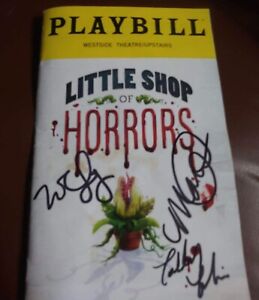
Sold on eBay December 5th, 2023
Little Shop Of Horror Signed Autographed Broadway Playbill Maude Apatow
eBay Hello and welcome to goforit signatures All items are obtained in person, and are guaranteed to pass any Third-party Authentication. I will be offering a wide variety of entertainment, sports, political and other various memorabilia. Please bid with confidence and ask any questions that you may have. Thank you for your time and consideration Signed by: Maude Apatow plus two othersProduct: PlaybillSigned in: Black Sharpie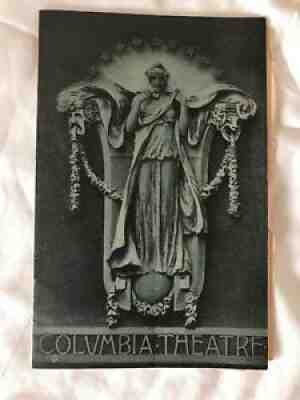
Sold on eBay Sep 18, 2020
Columbia Theater San Francisco Maude Adams What Every Woman Knows 1910 Program
Columbia Theater San Francisco Maude Adams in J.M. Barrieâ??s comedy â??What Every Woman Knowsâ? 1910 Program.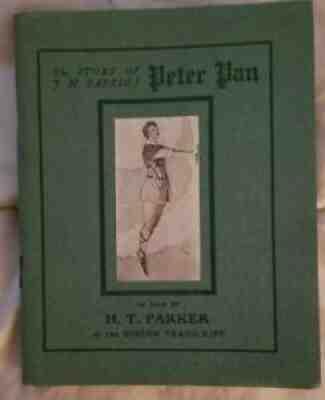
Sold on eBay Jun 10, 2021
Maude Adams PETER PAN 1916 Boston 3.5" x 4.5" illustrated 28 pages
Find many great new & used options and get the best deals for Maude Adams PETER PAN 1916 Boston 3.5" x 4.5" illustrated 28 pages at the best online prices at eBay! Free shipping for many products!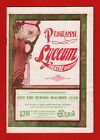
Sold on eBay May 8th, 2024
Joseph Hawthorn "LITTLE NEMO" Victor Herbert / Winsor McCay 1910 Memphis Program
This is a rare January 27th, 1910 program (playbill) from the three-night, Post-Broadway engagement of the VICTOR HERBERT and HARRY B. SMITH musical comedy "LITTLE NEMO" at the Lyceum Theatre in Memphis, Tennessee. (The Original Broadway production opened October 20th, 1908 at New York's New Amsterdam Theatre and ran for 111 performances before going on the road.) ..... Based on the famous cartoons of WINSOR McCAY, the musical starred MASTER GABRIEL in the title role and JOSEPH CAWTHORN as "Dr. Pill" and the cast included HARRY CLAY BLANEY, HARRY KELLY, W. W. BLACK, GEORGE A. NATANSON, DAVE ABRAHAMS, LOUIS HART, SIM COLLINS, EDWARD B. KRAMER, MAUDE CAMPBELL, AIMEE EHRLICH, NATALIE ALTE, QUEENIE VASSAR, MADELINE MARSHALL and MAY GUNDERMAN ..... CREDITS: Music by VICTOR HERBERT ("Cyrano de Bergerac", "Babes in Toyland", "Mlle. Modiste", "The Red Mill", "Naughty Marietta", "Sweethearts", "Ziegfeld Follies", "Sally", "Gypsy Lady"); Book and Lyrics by HARRY B. SMITH based on the famous cartoons of WINSOR McCAY; Orchestra conducted by MAX HIRSCHFELD; Sets designed by ERNEST ALBERT, JOHN YOUNG and the YOUNG BROTHERS; Costumes designed by F. RICHARD ANDERSON; Staged by HERBERT GRESHAM; Produced by KLAW and ERLANGER ..... DETAILS: The 24 page program measures 6" X 8 5/8" inches and includes beautiful cover graphics, production credits, cast list, synopsis of scenes and wonderful vintage advertising, but no cast photos or bios ..... CONDITION: (Please Note!) There is paper loss at the top of the back cover (last scanned image), small surface abrasions in the top right margin of the front cover, light creasing and moderate edge wear. Despite these flaws, this rare program will make a wonderful addition to the collection of any musical theatre aficionado or historian. This item will be carefully packaged in a protective, carded sleeve and backed by stiff cardboard.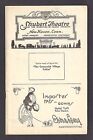
Sold on eBay August 5th, 2024
1st Annual "GREENWICH VILLAGE FOLLIES" A. Baldwin Sloane 1920 New Haven Program
This is a rare April 5th (1920) program (playbill) from the one-week, National Tour engagement of the First Annual New York Latin Quarter Revusical Comedy "THE GREENWICH VILLAGE FOLLIES" at the Shubert Theatre in New Haven, Connecticut. (The Original Broadway production opened July 15th, 1919 at the Greenwich Village Theatre, transferred to the Nora Bayes Theatre on September 9th, 1919 and ran for 232 performances before going on the road.) ..... The Greenwich Village Theatre was located between Christopher Street and West Fourth Street across from Sheridan Square. The theatre opened as a neighborhood playhouse in November of 1917 and was built by Maguerite Abbott Barker. The first shows were so good that they attracted uptown audiences downtown in droves. The one thing responsible for putting the theatre on the map was "THE GREENWICH VILLAGE FOLLIES", a "Revusical Comedy of New York's Latin Quarter", invented and produced for the stage by JOHN MURRAY ANDERSON. In these Pre and Post World War One days, the lavish Broadway playhouses competed with more and more money to stage the biggest and most dazzling shows. Murray had no money, but all the talent he needed to create the very concept of the intimate revue of New York City. The first "Follies" of Greenwich Village opened in July of 1919, and starred a popular Village artist, singer-musician Bobby Edwards whose hit "Why be an Industrial Slave When You Can be Crazy?" Tony Sarge, who gained a great deal of fame with his marionettes, choreographed a full puppet ballet. His real fame was earned as the person who designed the first giant balloons for the Macy's Thanksgiving Day Parade. Bessie McCoy Davis sang "I'm the Hostess of a Bum Cabaret!" It wasn't long before a "Sold Out" sign hung in the box office window. After a six week run the show moved uptown to Broadway, which no other Village production had ever managed to do before. A second Follies was spun by Anderson for the 1920 season, and like the first, it also moved to a Broadway theatre. From then on the Follies became a Broadway only production and renewed itself annually throughout the 1920's. (Reprinted in part from the Greenwich Village Gazette website) ..... The touring cast included SUZANNE MORGAN, WARNER GAULT, GORDON DREXEL, JOHN O'DARE, PAUL BURNS, JAMES WATTS, JANE CARROLL, HOMER ROSINE, BILLIE WESTON, ALICE HUMPHREYS, BEVERLY JUNEAV, BERNICE ELMORE, SALLY RUSSELL, LOUISE BLAKELY, LOUISE STRONG, BETTY JONES, GERTRUDE COATES, ELEANORE RYLEY, FRANCES WHITE, IRENE OLSEN, MIRIAM MEDIE, REX STORY, ADA FORMAN, EDMUND MAKALIF, BABETTE BUSEY, BELLE MAUDE, VIRGINIA CURTIS, DOROTHY LEE and MONTE WALSH ..... CREDITS: Music by A. BALDWIN SLOANE; Book by PHILIP BARTHOLOMAE and JOHN MURRAY ANDERSON; Scenery designed by CHARLES B. FALLS; Costumes designed by ANDRE SHERRI and SHIRLEY BARKER; Choreographed by JACK MANNING; Directed by JOHN MURRAY ANDERSON; Produced by THE BOHEMIANS, INCORPORATED ..... DETAILS: The sixteen page program measures 5 3/4" X 9" inches and includes full production credits, cast list, scenes, musical numbers and wonderful vintage advertising, but no cast photos or bios ..... CONDITION: With the exception of light creasing and minor edge wear, this rare program is in excellent condition and will make a wonderful addition to the collection of any musical theatre aficionado or historian. This item will be carefully packaged in a protective, carded sleeve and backed by stiff cardboard.
Sold on eBay May 9th, 2024
Lew Wallace's "BEN HUR" Richard Buhler / J. Arthur Young 1909 Pittsburgh Program
This is a rare December 27th, 1909 program (playbill) from the one-week, National Tour engagement of the General LEW WALLACE and WILLIAM YOUNG dramatic spectacle "BEN-HUR" at the Nixon Theatre in Pittsburgh, Pennsylvania. (The Original Broadway production opened November 29th, 1899 at New York's Broadway Theatre and ran for 194 performances. The play would be revived five times on Broadway in the next seventeen years, would tour the United States, England and Australia for the next 21 years and would be seen by more than twenty million people.) ..... Based on General Lew Wallace's 1880 novel, the key spectacle of the show recreated the novel's chariot race with live horses and real chariots running on treadmills against a rotating backdrop. The play starred RICHARD BUHLER in the title role and featured WALTER M. SHERWIN, CHARLES J. O'BRIEN, J. ARTHUR YOUNG, MITCHELL HARRIS, ANTHONY ANDRE, FRANK WESTON, CHARLES CANFIELD, BISSELL PUTNAM, GEORGE WILKES, CHARLES LAWRENCE, VAN DUSEN PHILLIPS, ROWDEN HALL, FREDERICK SCATES, A. J. GOLDING, ALICE HAYNES, ELEANOR MORETTI, LOYOLA O'CONNOR, ZAIDEE APPLETON and MAUDE REAM STOVER ..... CREDITS: Original Book by General LEW WALLACE; Arranged for the Stage by WILLIAM YOUNG; Vocal and Instrumental Music composed by EDGAR STILLMAN KELLEY; Scenery designed by ERNEST ALBERT and ERNEST GROS; Costumes designed by F. RICHARD ANDERSON; Directed by JOSEPH BROOKS; Produced by KLAW and ERLANGER ..... DETAILS: The 44 page program measures 6" X 8 3/4" inches and includes full production credits, cast list, synopsis of scenes, promotional text and wonderful vintage advertising, but no cast photos or bios ..... CONDITION: With the exception of a seam split below the bottom staple, slight edge discoloration to the back cover and moderate edge wear, this rare program is in excellent condition and will make a wonderful addition to the collection of any theatre aficionado or historian. This item will be carefully packaged in a protective, carded sleeve and backed by stiff cardboard.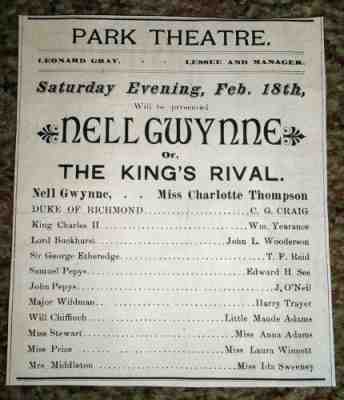
Sold on eBay May 1, 2023