

Playbill Collectibles : Playbill+sons Price List
average value
-
low
-high
-Found 20 out of 56,978 items matching 'sons'
Sold on eBay September 21st, 2024
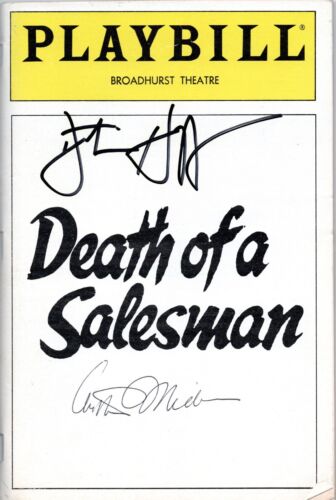
PLAYBILL for DEATH OF A SALESMAN Signed by Arthur Miller and Dustin Hoffman 1984
This copy of the Broadhurst Theatre PLAYBILL for DEATH OF A SALESMAN, Signed by Arthur Miller and Dustin Hoffman was published by Playbill Incorporated in 1984 to accompany that year’s production of the critically acclaimed play starring Dustin Hoffman as the salesman, Willie Loman. The signatures of both Arthur Miller, the play’s playwright, and Dustin Hoffman appear on the front cover of the Playbill. The Playbill magazine, which measures approximately 5 ½ inches wide by 8 ½ inches tall, contains 134 pages of text, illustrations and advertisements related to the play, the theater world, and the New York environment in which theaters are prominent. The magazine is staple bound in stiff paper covers. The two signatures, on the front cover, are clean and unblemished. The magazine is complete and in fine condition. The illustrations accompanying this description show the front cover of the Playbill, the “Title Page” for the play, a 2-page spread showing the cast and some of Arthur Miller’s “own words about life and art”, and a page of “Scenes from Death of a Salesman”. Arthur Asher Miller (October 17, 1915 – February 10, 2005) was an American playwright, essayist and screenwriter in the 20th-century American theater. Among his most popular plays are All My Sons (1947),Death of a Salesman (1949), The Crucible (1953), and A View from the Bridge (1955). He wrote several screenplays, including The Misfits (1961). The drama Death of a Salesman is considered one of the best American plays of the 20th century. [Wikipedia] Dustin Lee Hoffman (born August 8, 1937) is an American actor. As one of the key actors in the formation of New Hollywood, Hoffman is known for his versatile portrayals of antiheroes and emotionally vulnerable characters. He is the recipient of numerous accolades, including two Academy Awards, four BAFTA Awards, five Golden Globe Awards, and two Primetime Emmy Awards. Hoffman has received numerous honors, including the Cecil B. DeMille Award in 1997, the AFI Life Achievement Award in 1999, and the Kennedy Center Honors Award in 2012. Actor Robert De Niro has described him as "an actor with the everyman's face who embodied the heartbreakingly human". [Wikipedia]![[Dracula] Large Nottingham Theatre Royal Playbill Hamilton Deane June, 1931](https://collectionhero.s3.us-east-2.amazonaws.com/playbill/60e518bcc791e.jpg)
Sold on eBay Jul 06, 2021
[Dracula] Large Nottingham Theatre Royal Playbill Hamilton Deane June, 1931
Nottingham Theatre Royal Playbill. th, 1931. Nottingham: Derry & Sons, Ltd., Printers, 1931. Verso is blank. Light toning, creasing, and chipping, with occasional small punctures and edge tears.
Sold on eBay January 13th, 2024
Huge lot of 390 BROADWAY PLAYBILLS 1930's to 1950's only - ALL UNIQUE PLAYBILLS
eBay You're looking a HUGE lot of 390 of random BROADWAY PLAYBILLS from the1930's - 1950's only. All the playbills are unique for the theatre and years of issue. In other words, there are no exact duplicates, but plays from the same theater for a different date with different cover and contents. These programs are used, but in good vintage condition overall. Some of the programs are in better condition than others (none of them is complete beat up). The programs have imperfections such as: corner dings, creases, fold marks, writing (like a date on the show), sticker on cover page (with date), staple marks (from ticket stub), clear tape on corner of cover page, very small insignificant tears, minor cover page/spine wear, discoloration or staining due to age, and other similar imperfections. See pictures. Other minor flaws may be present. What you see is what you get. A few of these programs may come with original inserts. To be sold as a lot only. Great starter collection or opportunity to add to your playbill collection Please note: I threw in some extra free (unique) playbills with condition issues (like loose cover page, more staining, etc.) to bump the actual number of playbills to well over 400.Here's a link to my UPS, USPS or FedEx Ground shipping within Continental US. Priority Mail international shipping is $250.Please ask any questions before making a purchase. Thanks and good luck! Complete list of programs in alphabetical order:1.) A View From The Bridge (Coronet, 1955)2.) Accent On Youth (Plymouth, 1935)3.) Affairs Of State (Music Box, 1951)4.) All For Love (Mark Hellinger, 1949)5.) All My Songs (Coronet, 1947)6.) Allegro (Majestic, 1947)7.) Almanac (Imperial, 1953)8.) American Repertory Theatre (International, 1946)9.) American Way, The (Center, 1939)10.)An Evening With Beatrice Lillie (Booth, 1952)11.)An Inspector Calls (Booth, 1947)12 )Anastasia (Lyceum, 1955)13.)Angel In The Wings (Coronet, 1948)14.)Angel In The Wings (Coronet, 1947)15.)Anna Lucasta (Mansfield, 1945)16.)Anna Lucasta (Mansfield, 1945) different cover date17 )Anne Of The Thousand Days (Sam S. Shubert, 1949)18.)Angel Street (John Golden, 1942)19 )Another Part Of The Forest (Fulton, 1946)20 )Another Part Of The Forest (Fulton, 1947)21 )Another Love Story (Fulton, 1943)22 )Antigone (Cort, 1946)23 )Anything Goes (Alvin, 1935)24.)Apple Cart, The (Plymouth, 1956)25.)Around The World In 80 Days (Rivoli, 1956)26 )Arsenic And Old Lace (Fulton, 1943)27 )Arsenic And Old Lace (Fulton, 1941)28.)Arms And The Girl (Forth-Sixth Street, 1950)29.)Army Play By Play, The (Martin Beck, 1943)30.)Awake And Sing (Windsor, 1939)31 )Bachelor Born (Morosco, 1938)32.)Bad Seed, The (Forty-Sixth Street, 1955)33 )Ballett Russe (Majestic, 1935)34 )Barefoot Boy With Cheek (Martin Beck, 1947)35 )Barretts Of Winpole Street, The (Ethel Barrymore, 1945)36 )Beautiful People, The (Lyceum, 1941)37 )Beggar s Holiday (Broadway, 1947)38.)Bells Are Ringing (Sam S. Shubert, 1957)39.)Bell, Book And Candle (Ethel Barrymore, 1951)40.)Best Foot Forward (Ethel Barrymore, 1941)41 )Billion Dollar Baby (Alvin, 1946)42.)Bless You All (Mark Hellinger, 1951)43.)Blithe Spirit (Booth, 1943)44 )Bloomer Girl (Sam S. Shubert, 1945)45 )Blossom Time (Forty-Sixth Street, 1938)46.)Blow Ye Winds (Forty-Sixth Street, 1937)47.)Born Yesterday (Lyceum, 1946)48 )Borscht Capades (Royale, 1951)49.)Boy Meets Girl (Cort, 1936)50.)Boy Friend, The (Royale, 1955)51 )Burgess Meredith (Booth, 1946)52 )Burlesque (Belasco, 1947)53.)By Jupiter (Sam S. Shubert, 1943)54.)By The Beautiful Sea (Imperial, 1954)55.)Caesar And Cleopatra (National, 1950)56.)Caesar And Cleopatra (National, 1950) different cover date57 )Caine Mutiny Court Martial, The (Plymouth, 1954)58.)Call Me Madam (Imperial, 1951)59 )Can Can (Sam S. Shubert, 1955)60.)Carmen Jones (Broadway, 1944)61 )Carousel (Majestic, 1945)62.)Child Of Fortune (Royale, 1956)63 )Children s Hour, The (Coronet, 1953)64 )Children s Hour, The (Maxine Elliott's, 1936)65.)Clash By Night (Belasco, 1941)66 )Claudia (Booth, 1941)67 )Clutterbuck (Biltmore, 1950)68 )Cocktail Party, The (Henry Miller s 1950)69 )Come Back, Little Sheba (Booth, 1950)70.)Come In Music (John Golden, 1954)71 )Compulsion (Ambassador, 19 )72 )Compulsion (Ambassador, 19??) different cover date73 )Common Ground (Fulton, 1945)74 )Confidential Clerk, The (Morosco, 1954)75 )Constant Wife, The (National, 1952)76 )Consul The (Ethel Barrymore, 1950)77.)Cradle Will Rock, The (Mansfield, 1948)78 )Craig s Wife (Playhouse, 1947)79.)Cranks (Bijou, 1956)80.)Cream In The Well, The (Booth, 1941)81 )Crucible The (Martin Beck, 1953)82.)Cup Of Trembling, The (Music Box, 1948)83.)D'Oyly Carte Opera Company (Martin Beck, 1939)84.)Damn Yankees (Forty-Sixth Street, 1956)85.)Damn Yankees (Forth-Sixth Street, 1956) different cover date86 )Dance Me A Song (Royale, 1950)87.)Daphne Laureola (Music Box, 1950)88.)Dark Eyes (Belasco, 1943)89.)Dark Is Light Enough, The (Anta, 1955)90.)Dark Victory (Plymouth, 1934)91.)Dead End (Belasco, 1936)92.)Dear Charles (Morosco, 1954)93.)Dear Ruth (Henry Miller's, 1944)94.)Death Of A Salesman (Morosco, 1949)95.)Deep Are The Roots (Fulton, 1946)96.)The Deep Blue Sea (Morosco, 1952)97.)Desk Set, The (Broadhurst, 1955)98 )Desperate Hours, The (Ethel Barrymore, 1955)99 )Detective Story (Hudson, 1949)100 )Devil s Disciple, The (Royale, 1950)101.)Dial 'M' For Murder (Plymouth, 1953)102.)Diary Of Anne Frank, The (Cort, 1956)103.)Diary Of Anne Frank, The (Cort, 1955)104.)Diary Of Anne Frank, The (Ambassador, 1957)105 )Distaff Side, The (Booth, 1934)106 )Dodsworth (Sam S. Shubert, 1934)107 )Doll s House, A (Broadhurst, 1938)108 )Doughgirls The (Lyceum, 1943)109.)Dream Child (Vanderbilt, 1934)110.)Du Barry Was A Lady (Forty-Sixth Street, 1940)111.)Earl Carroll Vanities (St. James, 1940)112.)Earl Carroll Sketch Book (Winter Garden, 1935)113 )Edward My Son (Martin Beck, 1948)114.)End As A Man (Vanderbilt, 1953)115 )Ernest Pascal's Peepshow (Fulton, 1944) 116.)Ethel Barrymore In The Corn Is Green (Martin Beck, 1943)117 )Evening With Beatrice Lillie, An (Booth, 1952)118 )Fabulous Invalid, The (Broadhurst, 1938)119.)Fair Game (Longacre, 19 )120 )Fallen Angels (Playhouse, 1956)121.)Fanny (Majestic, 1955)122 )Father Malady's Miracle (St. James, 1938)123.)Farm Of Three Echoes (Cort, 1939)124.)Fifth Season, The (Cort, 1953)125 )Finian s Rainbow (Forty-Sixth Street, 1947)126.)First Lady (Music Box, 1936)127 )Flowering Peach, The (Belasco, 1955)128 )Foolish Notion (Martin Beck, 1945)129.)Four Winds (Cort)130 )Fourposters The (John Golden, 1953)131 )Fourposters The (Ethel Barrymore, 1951)132 )Gentle People, The (Belasco, 1939)133 )Gentlemen Prefer Blondes (Ziegfeld, 1951)134 )Gilbert And Sullivan Operas (New Century, 1948)135.)Girl In Pink Tights, The (Mark Hellinger, 1954)136.)Girl On The Via Flaminia, The (Forty-Sixth Street, 1954)137.)Girls Of Summer (Longacre 1956)138 )Gladys George (Henry Millers, 1935)139.)Glass Menagerie, The (Playhouse, 1945)140 )Golden Apple, The (Phoenix, 1954)141 )Golden Boy (Belasco, 1938)142.)Good Night Ladies (Royale, 1945)143 )Goodbye My Fancy (Morosco, 1948)144.)Green Pastures, The (Broadway, 1951)145.)Guys & Dolls A Musical Fable Of Broadway (Forty-Sixth Street, 1952)146 )Hallams The - Booth (Booth, 1948)147 )Happies Millionaire, The (Lyceum, 1957)148.)Happy Time, The (Plymouth, 1950)149 )Harriet (Henry Millers, 1944)150 )Harvey (Forty-Eigth Street, 1947)151 )Hatful Of Rain, A (Lyceum, 1956)152.)Helen Goes To Troy (Alvin, 1944)153.)Helen Hayes (Broadhurst, 1936)154.)Hellz Poppin (Winter Garden, 1939)155.)Henry IV (St. James, 1939)156 )Hidden River, The (Playhouse, 1957)157.)High Tor (Martin Beck, 1937)158.)Hold On To Your Hats (Sam S. Shubert, 1940)159 )Hooray For What (Winter Garden, 1938)160.)I Knock At The Door (Belasco, 19??)161.)I Know My Love (Sam S. Shubert, 1950)162.)I Remember Mama (Music Box, 1945)163.)I'd Rather Be Right (Alvin, 1938)164 )Idiot s Delight (Sam S. Shubert, 1936)165 )Inherit The Wind (National, 1957)166 )Importance Of Being Earnest, The (Royale, 1947)167 )Importance Of Being Earnest, The (Vanderbilt, 1939168 )Innocents The (Playhouse, 1950)169 )Jackpot (Alvin, 1944)170.)Janus (Plymouth, 1956)171.)Jason (Hudson, 1942)172.)Joan Of Lorraine (Alvin, 1947)173.)Joy To The World (Plymouth, 1948)174 )Jubilee (Imperial, 1935)175 )Junior Miss (Majestic, 1943)176 )Junior Miss (Lyceum, 1942)177.)Juno And The Paycock (Mansfield, 1935)178.)Kind Lady (Longacre, 1935)179.)King And I, The (St. James, 1952)180.)Kind Sir (Alvin, 1954)181.)King Of Hearts (Lyceum 1954)182 )King Richard III (St. James, 1937)183 )Kismet (Ziegfeld, 1954)184.)Kiss And Tell (Biltmore, 1944)185.)La Vida Es Sueno (Broadhurst, 1953)186.)Lady From The Sea, The (Fulton, 1950)187.)The Lady's Not For Burning (Royale, 1950)188.)Land Is Bright, The (Music Box 1941)189 )Lady In The Dark (Alvin, 1942)190.)Lark, The (Longacre, 1956)191.)Late George Apley, The (Lyceum, 1945)192.)Leave It To Me! (Mansfield, 1939)193.)Leave It To Me! (Imperial 1939)194 )Lend An Ear (National, 1948)195.)Let's Face It (Imperial, 1942)196.)Les Ballets De Paris (Winter Garden, 1949)197 )Liberty Jones (Sam S. Shubert, 1941)198.)Light Up The Sky (Royale, 1948)199 )Little Foxes, The (National, 1939)200.)Li'l Abner (St. James, 1956)201 )Little Blue Light, The (Anta Playhouse, 1951)202 )Living Room, The (Henry Miller's, 1954)203.)Look, Ma, I'm Dancin'! (Adelphi, 1948)204 )Louisiana Purchase (Imperial, 1941)205.)Love Of Four Colonels, The (Sam S. Shubert, 1953)206 )Lovers And Friends (Plymouth, 1944)207 )Lunatics And Lovers (Broadhurst, 1955)208.)Lute Song (Plymouth, 1945)209 )Madame Bovary (Broadhurst, 1937)210 )Mademoiselle Colombe (Longacre, 1954)211 )Madwoman Of Chaillot, The (Belasco, 1949)212.)Major Barbara (Morosco, 1957)213.)Make Mine Manhattan (Broadhurst, 1948)214.)Make Way For Lucia (Cort, 1949)215.)Male Animal, The (Cort, 1940)216.)Male Animal, The (Music Box, 1952)217.)Man And Superman (Alvin, 1948)218.)Man Who Came To Dinner, The (Music Box, 1940)219 )Marcel Marceau (Ethel Barrymore, 1955)220 )Margin For Error (Plymouth, 1948)221 )Marinka (Winter Garden, 1945)222.)Mary Rose (Anta Playhouse, 1951)223.)May Wine (St. James, 1936)224.)Me And Juliet (Majestic, 1953)225 )Member Of The Wedding, The (Empire, 1950)226 )Merrily We Roll Along (Music Box 1934)227 )Merry Widow, The (Majestic, 1944)228 )Mexican Hayride (Majestic, 1945)229 )Middle Of The Night (Anta, 1956)230 )Misalliance (Ethel Barrymore, 1953)231.)Miss Isabel (Royale, 19 )232 )Mister Roberts (Alvin, 1948)233.)Moon Is Blue. The (Henry Milller's, 1951)234 )Morning s At 7 (Longacre, 1939)235.)Most Happy Fella, The (Imperial, 1957)236.)Mr. And Mrs. North (Belasco, 1941)237.)Mr. Wonderful (Broadway, 1956)238.)Mr. Wonderful (Broadway. 1956) different cover date239 )My Fair Lady (Mark Hellinger, 1957)240.)My Name Is Aquilon (Lyceum, 1949(241.)My Sister Eileen (Biltmore, 1941)242.)My 3 Angels (Morosco, 1953)243 )Native Son (St. James, 1941)244.)New Faces Of 1952 (Royale, 1952)245.)New Girl In Town (Forty-Six Street, 1957)246.)New Pins And Needles (Windsor, 1940)247.)New York City Ballet, (New York City Ballet, 1958)248.)New York City Ballet Winter Season (New York City Ballet, 1958)249.)Night Of January 16 (Ambassador, 1935)250.)No Time For Comedy (Ethel Barrymore, 1939)251.)No Time For Sergeants (Alvin, 1956)252.)Now I Lady Me Down To Sleep (Broadhurst, 1950)253.)Nude With Violin (Belasco, 19??)254.)O Mistress Mine (Empire 1947)255 )Of Mice And Men (Music Box, 1937)256.)Oh, Men! Oh, Women! (Henry Miller's, 1954)257 )Oklahoma (St. James, 1947)258.)Old Acquaintance (Morosco, 1941)259.)On Borrowed Time (Longacre, 1938)260.)On The Town (Forty-Fourth Street, 1945) 261.)On Your Toes (Forth-Sixth Street, 1954)262.)On Whitman Avenue (Cort 1946)263 )Once Is Enough (Henry Miller's, 1938)264.)One Touch Of Venus (Forty-Sixth Street, 1944)265.)One Touch Of Venus (Forty-Sixth Street, 1944) different cover date266 )Our Town (Morosco, 1938)267.)Out Of This World (New Century, 1951)268 )Overtons The (Forrest, 1945)269.)Paint Your Wagon (Sam S. Shubert, 1952)270 )Pajama Game, The (St. James, 1955)271 )Parisienne (Fulton, 1950272 )Patriots The (National, 1943)273 )Personal Appearance (Henry Miller's, 1934)274 )Petrified Forest, The (Broadhurst, 1935)275 )Philadelphia Story, The (Sam S. Shubert, 1939)276 )Pirate The (Martin Beck, 1943)277 )Pirate The (Martin beck, 1942)278.)Plain And Fancy (Winter Garden, 1955)279.)Plain And Fancy (Winter Garden, 1955) different cover date280 )Play s The Thing, The (Booth, 1948)281 )Playboy Of The Western World, The (Booth, 1946)282 )Ponder Heart, The (Music Box, 1956)283.)Post Road (Masque, 1934)284 )Pre Honeyroom (Lyceum, 1936)285 )Present Laughter (Plymouth, 1946)286 )Pygmalion (Ethel Barrymore, 1946)287 )Ramshackle Inn (Royale, 1944)288.)Red Gloves (Mansfield, 1949)289.)Red Mill, The (Forth-Sixth Street, 1946)290 )Relapse The Or Virtue In Danger (Morosco, 1950)291 )Reluctant Debutante, The (Henry Miller s 1956)292 )Remarkable Mr. Pennypacker, The (Coronet, 1954)293 )Respectful Prostitute, The (Cort, 1948)294 )Righteous Are Bold, The (Holiday, 1956)295.)Ring Round The Moon (Martin Beck, 1950)296.)Romeo And Juliet (Fifty-First Street, 1940)297.)Romeo And Juliet (Martin Beck, 1935)298.)Room Service (Cort, 1937)299 )Roomful Of Roses, A (Playhouse, 1955)300 )Rosalinda (Forty-Fourth Street, 1943)301 )Rugged Path, The (Plymouth, 1945)302 )Rumple (Alvin, 19 )303 )Russet Mantle (Masque, 1936)304.)Ryan Girl, The (Plymouth, 1945)305 )Sabrina Fair (National, 1954)306 )Sabrina Fair (National, 1954) different cover date307 )School For Brides (Ambassador, 1945)308.)Say When (Imperial, 1934)309 )Seagull The (Phoenix, 1954)310 )Season In The Sun (Cort, 1950)311.)See My Lawyer (Adelphi 1940)312 )Separate Tables (Music Box, 1957)313 )Separate Tables (Music Box, 1957) different cover date314 )Set To Music (Music Box, 1939)315.)Seven Year Itch, The (Fulton, 1953)316.)Seven Year Itch, The (Fulton, 1954)317 )Seventeen (Broadhurst, 1951)318 )Shadow And Substance (John Golden, 1938)319.)Show Boat (Ziegfeld, 1946)320 )Shrike The (Cort, 1952)321.)Silk Stockings (Imperial, 1955)322.)Skin Of Our Teeth, The (Plymouth, 1942)323 )Skylark (Morosco, 1939)324 )Slavenska Franklin Ballet with Alexandra Danilova (New Century, 1952)325 )Sleeping Prince, The (Coronet, 1956)326.)Small Miracle (Golden, 1934)327.)Small Wonder (Coronet, 1948)328.)Solid Gold Cadillac, The (Music Box, 1954)329.)Solid Gold Cadillac, The (Belasco. 1954)330.)Sons O'Fun (Forty-Sixth Street, 1943)331.)Song Of Norway (Imperial, 1945)332.)South Pacific (Majestic, 1951)333.)South Pacific (Majestic, 1949)334.)South Pacific (Majestic, 1952)335.)South Pacific (Majestic, 1951) different cover date336 )South Pacific (Majestic, 1951) different cover date337 )Spring Thaw (Martin Beck. 1938)338.)Stars In Your Eyes (Majestic, 1939)339.)State Of The Union (Hudson, 1946)340.)Storm Operation (Belasco, 1944)341 )Street Scene (Adelphi. 1947)342 )Survivors The (Playhouse. 1948)343.)Swan Lake (Forty-Sixth Street, 1941)344 )Tallery Method, The (Henry Miller's, 1941)345 )Taming Of Shrew, The (Guild, 1935)346.)Tea And Symphony (Ethel Barrymore, 1954)347 )Teahouse Of The August Moon, The (Martin Beck 1954)348 )Tempest The (Broadway, 1945)349 )Tender Trap, The (Longacre, 1954)350.)Ten Little Indians (Plymouth, 1945)351.)That Lady (Martin Beck, 1950)352.)There Shall Be No Night (Alvin, 1940)353.)Three For Tonight (Plymouth, 1955)354.)Three Men On A Horse (Fulton, 1936)355.)Three To Make Ready (Broadhurst, 1946)356.)Three Waltzes (Majestic, 1938)357.)Tiger At The Gates (Plymouth, 1955)358.)Time Of The Cuckoo, The (Empire, 1952)359.)Time Of Your Life, The (Guild, 1940)360.)Time Out For Ginger (Lyceum, 1953)361 )Tobacco Road (Forrest, 1937)362 )Sweethearts (Sam S. Shubert, 1947)363 )Tomorrow The World (Ethel Barrymore, 1943)364 )Tonight At 8:30 (National, 1948)365 )Traitor The (Forty-Eigth Street, 1949)366.)Trial By Jury (Sam S. Shubert, 1955)367 )Tunnel of Love, The (Royale, 1957)368 )Twelfth Night (Empire 1949)369 )Uncle Harry (Hudson, 1943)370.)Uncle Willie (John Golden, 1956)371 )Victoria Regina (Martin Beck, 1938)372.)Visit To A Small Planet (Booth 1957)373 )Voice Of The Turtle, The (Morosco, 1947)374.)Voice Of The Turtle, The (Morosco, 1944)375.)Voice Of The Turtle, The (Morosco, 1945)376.)Walk With Music (Ethel Barrymore, 1940)377 )Wallflower (Cort, 1944)378.)Waltz Of The Toreadors (Coronet, 1957)379 )Washington Jitters (Guild, 1938)380.)What A Life (Biltmore, 1938)381.)When We Are Married (Lyceum, 1940)382 )Where s Charley? (St. James, 1950)383.)White Steed, The (Cort, 1939)384.)Will Success Spoil Rock Hunter? (Belasco, 1955)385 )Wisteria Trees, The (Martin Beck, 1950)386 )Women The (Ethel Barrymore, 1937)387.)You Can't Take It With You (Booth, 1937)388.)You Can't Take It With You (Imperial, 1938)389.)Yes, My Darling Daughter (Playhouse, 1937)390 )Ziegfeld Follies (Winter Garden, 1943)
Sold on eBay August 18th, 2024
*EDWIN BOOTH RARE LARGE 1891 DOUBLE MATTED FAREWELL TO THE STAGE BROADSIDE*
A rare large original March 21, 1891 broadside, handsomely double matted for display in black and red, for Edwin Booth's final stage engagement in Manhattan. Booth retired from the stage two weeks later at the Brooklyn Academy of Music. Lawrence Barrett is billed as sharing the stage with Booth, but alas, he didn't. He died the day before on March 20. This was probably the last bill to list Lawrence Barrett. Booth carried on without his partner for the next two weeks and then ended his illustrious stage career. Dimensions seventeen by eight inches, with broadside twelve and a half by four and a half inches. Light wear otherwise fine. An extraordinary display piece of the greatest actor America has ever known. See Edwin Booth and and the Booth family's extraordinary biographies below.Shipping discounts for multiple purchases. Credit cards accepted with Paypal. Inquiries always welcome. Please visit my other eBay items for more early theatre and historical autographs, photographs and programs and great singer, actor, and actress cabinet photos and CDV's.From Wikipedia:The Booth family was an English American theatrical family of the 19th century. Its most famous and well known members were Edwin Booth, one of the leading actors of his day, and John Wilkes Booth, who assassinated Abraham Lincoln.The patriarch was Junius Brutus Booth, a London-born lawyer's son who eventually became an actor after he attended a production of Othello at the Covent Garden theatre. The prospects of fame, fortune, and freedom were very appealing to young Booth, and he displayed remarkable talent from an early age, deciding on a career in the theatre by the age of 17. He performed roles in several small theaters throughout England, and joined a tour of the Low Countries in 1814, returning the following year to make his London debut.Booth abandoned his wife and their young son in 1821 and ran off to the United States with Mary Ann Holmes, a London flower girl. They settled on some 150 acres in Harford County near Baltimore and started a family; they had 10 children, six of whom survived to adulthood [1][2]Junius Sr. and Edwin toured in California during the Gold Rush.[citation needed] Edwin bought an interest in the Winter Garden Theatre at 667 Broadway in New York City together with his brother-in-law John Sleeper Clarke. The brothers John Wilkes, Edwin, and Junius Brutus, Jr. performed there in the play Julius Caesar at a benefit in 1864, the only time they were seen together on a stage, playing Mark Antony, Brutus, and Cassius, respectively Junius Brutus Booth (1796–1852) brought his mistress Mary Ann Holmes, who bore him 10 children, to the United States.He also wrote many letters in fits of drunken anger and madness to President Andrew Jackson threatening assassination. He requested that two prisoners who had been sentenced to death for piracy, named De Ruiz and De Soto, be pardoned, else: "I will cut your throat whilst you are sleeping." This letter would later be recanted by Junius, stating, "May god preserve General Jackson and this happy republic [4]Junius Brutus Booth Jr. (1821–1883) was married to Agnes Booth. Junius Jr. never achieved the same fame as his brothers, but his third wife Agnes was popular.Their son Sydney Barton Booth (1877–1937) was an actor well into the era of modern film [5]Edwin Thomas Booth (1833–1893) came to be the foremost American Shakespearean actor of his day. He founded The Players, a New York City actors' club which continues to the present day.Edwin's grandson Edwin Booth Grossman was a painter of some note.Asia Frigga Booth (1835–1888) married John Sleeper Clarke, an actor/comedian who was briefly imprisoned in the aftermath of the assassination. They then emigrated to Britain, where he became a successful theatre manager.Creston Clarke[6] and Wilfred Clarke,[7] sons of John and Asia, were noted actors in their day.John Wilkes Booth (1838–1865) was a popular young star in less serious fare than his brothers.A Confederate sympathizer during the American Civil War, during a play attended by Abraham Lincoln, Booth took advantage of his access to the theatre to invade the President's box and assassinate the President. He was killed 12 days later by Union soldier Boston CorbettEdwin Thomas Booth (November 13, 1833 – June 7, 1893) was an American actor who toured throughout the United States and the major capitals of Europe, performing Shakespearean plays. In 1869, he founded Booth's Theatre in New York.[2] Some theatrical historians consider him the greatest American actor, and the greatest Prince Hamlet, of the 19th century.[3] His achievements are often overshadowed by his relationship with his younger brother, actor John Wilkes Booth, who assassinated President Abraham Lincoln.Booth was born in Bel Air, Maryland, into the Anglo-American theatrical Booth family. He was the son of the famous actor, Junius Brutus Booth, an Englishman, who named Edwin after Edwin Forrest and Thomas Flynn, two of Junius' colleagues. He was the elder brother of John Wilkes Booth, himself a successful actor who gained notoriety as the assassin of President Lincoln.Nora Titone, in her book My Thoughts Be Bloody, recounts how the shame and ambition of Junius Brutus Booth's three actor sons, Junius Brutus Booth, Jr. (who never achieved the stage stardom of his two younger actor brothers), Edwin Booth, and John Wilkes Booth, spurred them to strive, as rivals, for achievement and acclaim—Edwin a Unionist, and John Wilkes, a Confederate and the assassin of Abraham Lincoln [4]CareerIn early appearances, Booth usually performed alongside his father, making his stage debut as Tressel or Tressil in Colley Cibber's version of Richard III in Boston on September 10, 1849. His first appearance in New York City was in the character of Wilford in The Iron Chest, which he played at the National Theatre in Chatham Street, on the 27th of September 1850. A year later, on the illness of the father, the son took his place in the character of Richard III.[5]After his father's death in 1852, Booth went on a worldwide tour, visiting Australia and Hawaii, and finally gaining acclaim of his own during an engagement in Sacramento, California, in 1856.[6]Before his brother assassinated Lincoln, Edwin had appeared with his two brothers, John Wilkes and Junius Brutus Booth Jr., in Julius Caesar in 1864.[7] John Wilkes played Marc Antony, Edwin played Brutus, and Junius played Cassius.[8] It was a benefit performance, and the only time that the three brothers appeared together on the same stage.[9] The funds were used to erect a statue of William Shakespeare that still stands in Central Park just south of the Promenade. Immediately afterwards, Edwin Booth began a production of Hamlet on the same stage, which came to be known as the "hundred nights Hamlet", setting a record that lasted until John Barrymore broke the record in 1922, playing the title character for 101 performances From 1863 to 1867, Booth managed the Winter Garden Theatre in New York City, mostly staging Shakespearean tragedies. In 1863, he bought the Walnut Street Theatre in Philadelphia [10]After John Wilkes Booth's assassination of President Lincoln in April 1865, the infamy associated with the Booth name forced Edwin Booth to abandon the stage for many months. Edwin, who had been feuding with John Wilkes before the assassination, disowned him afterward, refusing to have John's name spoken in his house.[11] He made his return to the stage at the Winter Garden Theatre in January 1866, playing the title role in Hamlet,[6] which would eventually become his signature role.Acting styleEdwin's acting style was distinctly different from that of his father. While the senior Booth was, like his contemporaries Edmund Kean and William Charles Macready, strong and bombastic, favoring characters such as Richard III, Edwin played more naturalistically with a quiet, more thoughtful delivery, tailored to roles like Hamlet.Later lifeBooth was married to Mary Devlin from 1860 to 1863, the year of her death. They had one daughter, Edwina, born on December 9, 1861, in London. He later remarried, wedding his acting partner Mary McVicker in 1869, and became a widower again in 1881.Edwin Booth with daughter Edwina, circa 1864Portrait of Edwin Booth by John Singer Sargent, 1890, which hung at The Players clubhouse. Now in the collection of the Amon Carter Museum of American Art.In 1869, Edwin acquired his brother John's body after repeatedly writing to President Andrew Johnson pleading for it. Johnson finally released the remains, and Edwin had them buried, unmarked, in the family plot at Green Mount Cemetery in Baltimore.In 1888, Booth founded The Players, a private club for performing, literary, and visual artists and their supporters, and dedicated his home on Gramercy Park to it.His final performance was, fittingly, in his signature role of Hamlet, in 1891 at the Brooklyn Academy of Music.Robert Lincoln rescueEdwin Booth saved Abraham Lincoln's son,[12] Robert, from serious injury or even death. The incident occurred on a train platform in Jersey City, New Jersey. The exact date of the incident is uncertain, but it is believed to have taken place in late 1864 or early 1865. Robert Lincoln recalled the incident in a 1909 letter to Richard Watson Gilder, editor of The Century Magazine.The incident occurred while a group of passengers were late at night purchasing their sleeping car places from the conductor who stood on the station platform at the entrance of the car. The platform was about the height of the car floor, and there was of course a narrow space between the platform and the car body. There was some crowding, and I happened to be pressed by it against the car body while waiting my turn. In this situation the train began to move, and by the motion I was twisted off my feet, and had dropped somewhat, with feet downward, into the open space, and was personally helpless, when my coat collar was vigorously seized and I was quickly pulled up and out to a secure footing on the platform. Upon turning to thank my rescuer I saw it was Edwin Booth, whose face was of course well known to me, and I expressed my gratitude to him, and in doing so, called him by name.Booth did not know the identity of the man whose life he had saved until some months later, when he received a letter from a friend, Colonel Adam Badeau, who was an officer on the staff of General Ulysses S. Grant. Badeau had heard the story from Robert Lincoln, who had since joined the Union Army and was also serving on Grant's staff. In the letter, Badeau gave his compliments to Booth for the heroic deed. The fact that he had saved the life of Abraham Lincoln's son was said to have been of some comfort to Edwin Booth following his brother's assassination of the president Statue of Booth as Hamlet, Gramercy Park by Edmond T. Quinn, circa 1916Booth's TheatreBooth's Theatre Playbill of his Richard III circa 1872In 1867, a fire damaged the Winter Garden Theatre, resulting in the building's subsequent demolition. Afterwards, Booth built his own theatre, an elaborate structure called Booth's Theatre in Manhattan, which opened on February 3, 1869, with a production of Romeo and Juliet starring Booth as Romeo, and Mary McVicker as Juliet. Elaborate productions followed, but the theatre never became a profitable or even stable financial venture. The panic of 1873 caused the final bankruptcy of Booth's Theatre in 1874. After the bankruptcy, Booth went on another worldwide tour, eventually regaining his fortune DeathEdwin Booth had a small stroke in 1891, which precipitated his decline. He suffered another stroke in April 1893 and died June 7, 1893, in his apartment in The Players clubhouse. He was buried next to his first wife at Mount Auburn Cemetery in Cambridge, Massachusetts. His bedroom in the club has been kept untouched since his death.[13] The New York Times reported his death [14]Exhumation requestIn December 2010, descendants of Edwin Booth reported that they obtained permission to exhume the Shakespearean actor's body to obtain DNA samples to compare with a sample of his brother John's DNA to refute the rumor he had escaped after the assassination. However, Bree Harvey, a spokesperson from the Mount Auburn Cemetery in Cambridge, Massachusetts, where Edwin Booth is buried, denied reports that the family had contacted them and requested to exhume Edwin's body.[15] The family hopes to obtain DNA samples from artifacts belonging to John Wilkes, or from remains such as vertebrae stored at the National Museum of Health and Medicine in Maryland [16][17] On March 30, 2013, museum spokesperson Carol Johnson announced that the family's request to extract DNA from the vertebrae had been rejected [18]DramatizationsA number of modern dramatizations have been made of Edwin Booth's life, on both stage and screen. One of the best known is the 1955 film Prince of Players written by Moss Hart, based loosely on the popular book of that name by Eleanor Ruggles. It was directed by Philip Dunne and stars Richard Burton and Raymond Massey as Edwin and Junius Brutus Booth, Sr., with Charles Bickford and Eva Le Gallienne, the latter of whom plays Gertrude to Burton's Hamlet. The film depicts events in Booth's life well before, and then surrounding, the assassination of Lincoln by Booth's younger brother.[19]The opening scenes of Prince of Players are very similar to scenes in the earlier 1946 John Ford western My Darling Clementine. In that movie, the character of Granville Thorndyke (as acted by Alan Mowbray) is an obvious nod to Booth's father Junius, and the scenes portray essentially the same sequence where the great actor has to be retrieved from a bar and dragged back to the theatre where he is overdue to give a performance in front of a restless audience [20][21]The Brothers BOOTH!, by W. Stuart McDowell, which focuses on the relationships of the three Booth brothers leading up to the assassination of Lincoln, was workshopped and given a series of staged readings featuring David Strathairn, David Dukes, Angela Goethals, Maryann Plunkett, and Stephen Lang at the New Harmony Project,[22] and at The Guthrie Theatre Lab in Minneapolis, and later presented in New York at the Players' Club, the Second Stage Theatre, and the Boston Athenaeum. It was given its first fully staged professional production at the Bristol Riverside Theatre outside Philadelphia in 1992 [23][24][25] A second play by the same name, The Brothers Booth, which focuses on "the world of the 1860s theatre and its leading family"[26] was written by Marshell Bradley and staged in New York at the Perry Street Theatre in 2004.Oliver Ingraham Lay: Edwin Booth as Hamlet, 1887Austin Pendleton's play, Booth, which depicts the early years of the brothers Edwin, Junius, and John Wilkes Booth and their father, was produced off Broadway at the York Theatre, starring Frank Langella as Junius Brutus Booth, Sr. In a review, the play was called "a psychodrama about the legendary theatrical family of the 19th century" by The New York Times.[27] Pendleton had adapted this version from his earlier work, Booth Is Back, produced at Long Wharf Theatre in New Haven, Connecticut, in the 1991-1992 season.The Tragedian, by playwright and actor Rodney Lee Rogers, is a one-man show about Booth that was produced by PURE Theatre of Charleston, South Carolina, in 2007. It was revived for inclusion in the Piccolo Spoleto Arts Festival in May and June 2008.[28]A play by Luigi Creatore called Error of the Moon played off-Broadway on Theatre Row in New York City from August 13 to October 10, 2010. The play is a fictionalized account of Booth's life, hinging on the personal, professional, and political tensions between brothers Edwin and John Wilkes, leading up to the assassination of Lincoln.[29]In 1959, the actor Robert McQueeney played Booth in the episode "The Man Who Loved Lincoln" on the ABC/Warner Brothers western television series, Colt .45, starring Wayde Preston as the fictitious undercover agent Christopher Colt, who in the story line is assigned to protect Booth from a death threat.[30]In 1960, the anthology series television series Death Valley Days broadcast "His Brother's Keeper", in which Booth visits a small town after the Lincoln assassination, with one of the town's influential citizens trying to have him run out of town.In 1966, Martin Landau played Edwin Booth in the episode "This Stage of Fools" of the NBC western television series, Branded, starring Chuck Connors as Jason McCord. In the story line, McCord takes a job as the bodyguard to the actor Edwin Booth, brother of the presidential assassin, John Wilkes Booth [31][32]In 2013, Will Forte played Edwin Booth in the "Washington, D.C." episode of the Comedy Central's series, Drunk History, created by Derek Waters.In 2014, Edwin Booth was played by Gordon Tanner in The Pinkertons episode, "The Play's the Thing" (S1:E3). In the episode, both the "Hundred nights Hamlet" and Edwin's rescue of Robert Lincoln are mentioned LegacyGrave of Edwin BoothBooth left a considerable estate upon his death. He left charitable bequests that furthered the development of the acting profession and the treatment of mental illness. He left bequests of $5,000 each (almost $150,000 in 2021 dollars) to the Actor's' Fund, the Actors' Association of Friendship of the City of New York (Edwin Forrest Lodge), The Actors' Association of Friendship of the City of Philadelphia (Shakespeare Lodge), the Asylum Fund of New York and the Home for Incurables (West Farms, New York).[33] Other examples of his legacy include:The Players still exists in its original clubhouse at 16 Gramercy Park South in Manhattan.[34] A statue of Booth as Hamlet, by Edmond T. Quinn, has been the centerpiece of the private Gramercy Park since 1916. It can be seen by the public through the south gate of the park.Booth left a few recordings of his voice preserved on wax cylinder. One of them can be heard on the Naxos Records set Great Historical Shakespeare Recordings and Other Miscellany.[35] Another place to hear his preserved voice is on the site shown here [3:34][36] Booth's voice is barely audible with all the surface noise, but what can be deciphered reveals it to have been rich and deep.Memorials of Booth can still be found around Bel Air, Maryland. In front of the courthouse is a fountain dedicated to his memory. Inside the post office is a portrait of him. Also, his family's home, Tudor Hall, still stands and was bought in 2006 by Harford County, Maryland, to become a museum.A chamber in Mammoth Cave in Kentucky is called "Booth's Amphitheatre" – so called because Booth entertained visitors there.The Springer Opera House in Columbus, Georgia, is said to be haunted by the ghost of Edwin Booth Broadway s Booth Theatre was the first, and remains the oldest, Broadway theatre to be named in honor of an actor.Stephen Sondheim's musical Assassins mentions Edwin in "The Ballad of Booth" with the lyrics: "Your brother made you jealous, John/You couldn't fill his shoes."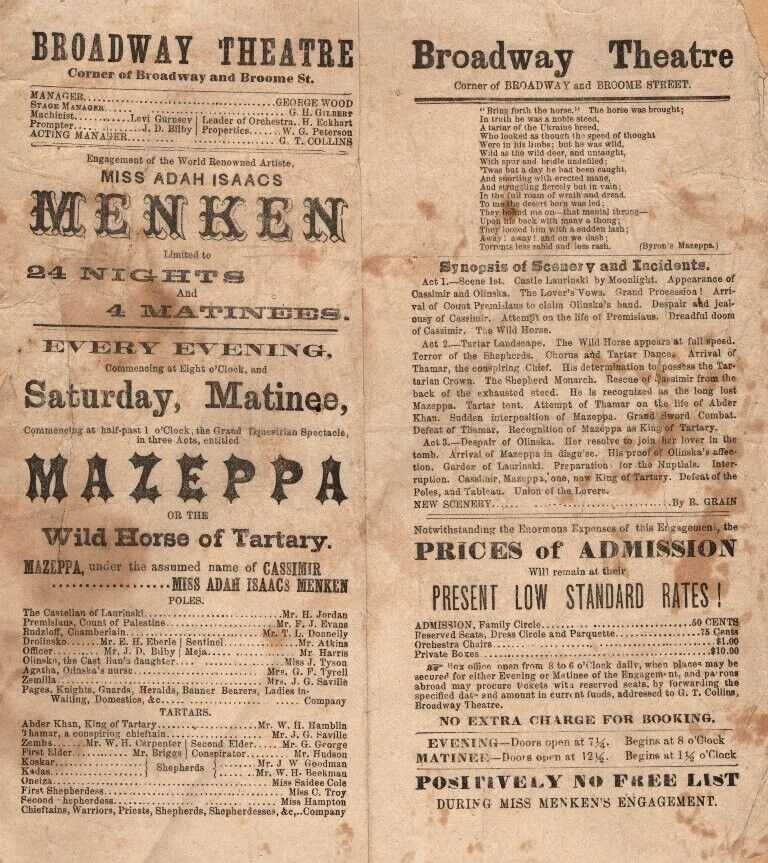
Sold on eBay November 17th, 2024
*ADAH ISSACS MENKEN IN LORD BYRON'S MAZEPPA RARE 1863 PLAY PROGRAM*
Audiences of the 1860s thought she was naked when she rode onstage on her horse wearing only flesh colored tights. She acted with the young Edwin Booth and befriended Walt Whitman. A rare original circa 1863 Broadway Theatre program for Adah Issacs Menken in her greatest and most sensational role in Lord Byron's Mazeppa. Dimensions nine by seven and a half inches lad down to a twelve by nine inch backing. Light wear otherwise good. See Adah Issacs Menken and Lord Byron's extraordinary biograpies below. Combined shipping discounts for multiple purchases. Credit cards accepted with Paypal. Inquiries always welcome. Please visit my other eBay items for more early theatre and historical autographs, photographs and programs and great singer, actor and actress cabinet photos and CDV's. From Wikipedia:Adah Isaacs Menken (June 15, 1835 – August 10, 1868) was an American actress, painter and poet, and was the highest earning actress of her time.[1] She was best known for her performance in the hippodrama Mazeppa, with a climax that featured her apparently nude and riding a horse on stage. After great success for a few years with the play in New York and San Francisco, she appeared in a production in London and Paris, from 1864 to 1866. After a brief trip back to the United States, she returned to Europe. She became ill within two years and died in Paris at the age of 33.[2]Menken told many versions of her origins, including her name, place of birth, ancestry, and religion, and historians have differed in their accounts. Most have said she was born a Louisiana Creole Catholic, with European and African ancestry. A celebrity who created sensational performances in the United States and Europe, she married several times and was also known for her affairs. She had two sons, both of whom died in infancy [3]Though she was better known as an actress, Menken sought to be known as a writer. She published about 20 essays, 100 poems, and a book of her collected poems, from 1855 to 1868 (the book was published posthumously). Early work was devoted to family and after her marriage, her poetry and essays featured Jewish themes. Beginning with work published after moving to New York, with which she changed her style, Menken expressed a wide range of emotions and ideas about women's place in the world. Her collection Infelicia went through several editions and was in print until 1902.Early life and of Menken's early life and origins vary considerably. In her "Some Notes of Her Life in Her Own Hand," published in The New York Times in 1868, Menken said she was born in Bordeaux, France, and lived in Cuba as a child before her family settled in New Orleans. There are many conflicting reports as to Menken's birth name, but she has been called Marie Rachel Adelaide de Vere Spenser and Adah Bertha Theodore, and Ed James, a journalist friend, wrote after her death: "Her real name was Adelaide McCord, and she was born at Milneburg, near New Orleans, on June 15, 1835."[4] Menken's birth year also varies, with some records stating 1835 and some stating 1832. [5] Elsewhere, in 1865, she wrote that her birth name was Dolores Adios Los Fiertes, and that she was the daughter of a French woman from New Orleans and a Spanish-Jewish man.[6] About 1940, the consensus of scholars was that her parents were Auguste Théodore, a free Black man, and Marie, a mixed-race Creole, and Adah was raised as a Catholic. She had a sister and a brother [6]Based on Menken's assertions of being a native of New Orleans, Wolf Mankowitz and others have studied Board of Health records for the city. They have concluded that Ada was born in the city as the legitimate daughter of Auguste Théodore, a free man of color (mixed race) and his wife Magdaleine Jean Louis Janneaux,[4][7] likely also a Louisiana Creole. Ada would have been raised as Catholic. However, in 1990, John Cofran, using census records, said that she was born as Ada C. McCord, in Memphis, Tennessee, in late 1830. He said she was the daughter of an Irish merchant, Richard McCord, and his wife Catherine [8][9] According to Cofran, her father died when she was young and her mother remarried. The family then moved from Memphis to New Orleans.Menken was said to have been a bright student; she became fluent in French and Spanish,[10] and was described as having a gift for languages.[6] As a child, Menken performed as a dancer in the ballet of the French Opera House in New Orleans. In her later childhood, she performed as a dancer in Havana, Cuba, where she was crowned "Queen of the Plaza [10]American as The French Spy, 1863After Cuba, Menken left dance for acting, and began working as an actress in Texas first. According to Gregory Eiselein, she gave Shakespeare readings, and wrote poems and sketches for The Liberty Gazette. She was married for the first time in Galveston County, in February 1855, to G. W. Kneass, a musician. The marriage had ended by sometime in 1856,[6] when she met and in 1856 married the man more generally considered her first husband, Alexander Isaac Menken, a musician who was from a prominent Reform Jewish family in Cincinnati, Ohio.[11]He began to act as her manager, and Ada Menken performed as an actress in the Midwest and Upper South, also giving literary readings. She received decent reviews, which noted her "reckless energy," and performed with men who became notable actors: Edwin Booth in Louisville, Kentucky, and James E. Murdoch in Nashville, Tennessee [12]In 1857, the couple moved to Cincinnati, where Menken created her Jewish roots, telling a reporter that she was born Jewish. She did study Judaism and stayed with the faith, although she never formally converted.[6] In this period, she published poetry and articles on Judaism in The Israelite in Cincinnati.[12] The newspaper was founded by Rabbi Isaac Mayer Wise, who was crucial to the Reform Judaism movement in the United States.[13] She also began to be published in the Jewish Messenger of New York.[6]Ada added an "h" to her first name and an "s" to Isaac, and by 1858 she billed herself as Adah Isaacs Menken. She eventually worked as an actress in New York and San Francisco, as well as in touring productions across the country.[14] She also became known for her poetry and painting. While none of her art was well received by major critics, she became a celebrity [11]At this time, Menken wore her wavy hair short, a highly unusual style for women of the time. She cultivated a bohemian and at times androgynous appearance. She deliberately created her image at a time when the growth of popular media helped to publicize it.[11]In 1859, Menken appeared on Broadway in New York City in the play The French Spy. Her work was not highly regarded by critics. The New York Times described her as "the worst actress on Broadway." The needed] said, "she is delightfully unhampered by the shackles of talent." Menken continued to perform small parts in New York, as well as reading Shakespeare in performance, and giving lectures.[4]Her third husband was John C. Heenan, a popular Irish-American prizefighter whom she married in 1859. Some time after their marriage, the press discovered she did not yet have a legal divorce from Menken and accused her of bigamy. She had expected Menken to handle the divorce, which he eventually did.As John Heenan was one of the most famous and popular figures in America, the press also accused Menken of marrying for his celebrity. She billed herself as Mrs. Heenan in Boston, Providence, Baltimore, and Philadelphia, using his name despite their divorce within a year of marriage.[11] They had a son, who died soon after birth.[10]While in New York, Menken met the poet Walt Whitman and some others of his bohemian circle. She was influenced by his work and began to write in a more confessional style while adhering to common sentimental conventions of the time. In 1860–61, she published 25 poems in the Sunday Mercury, an entertainment newspaper in New York. These were later collected with six more in her only book, Infelicia, published a few months after her death.[12] By publishing in a newspaper, she reached a larger audience than through women's magazines, including both men and women readers who might go to see her perform as an actress.[11]In 1860, Menken wrote a review titled "Swimming Against the Current," which praised Whitman's new edition of Leaves of Grass, saying he was "centuries ahead of his contemporaries [11][12][15] She identified with the controversial poet, and declared her bohemian identity through her support for him.[11] That year, Menken also wrote an article on the 1860 election, an unusual topic for a woman, which further added to her image.[11]When Menken met Charles Blondin, notable for crossing Niagara Falls on a tightrope, the two were quickly attracted to each other. She suggested she would marry him if they could perform a couple's act above the falls. Blondin refused, saying that he would be "distracted by her beauty."[10] The two had an affair, during which they conducted a vaudeville tour across the United States Mazeppa[edit]See also: Cultural legacy of MazeppaMenken in Mazeppa, 1866After it ended, she appealed to her business manager Jimmie Murdock to help her become recognized as a great actress. Murdock dissuaded Menken from that goal, as he knew she had little acting talent.[10] He offered her the "breeches role" (that of a man) of the noble Tartar in the hippodrama Mazeppa, based on the poem of that title by Lord Byron[1] (and ultimately on the life of Ivan Mazepa). At the climax of this hit, the Tartar was stripped of his clothing, tied to his horse, and sent off to his death.[16] The audiences were thrilled with the scene, although the production used a dummy strapped to a horse, which was led away by a handler giving sugar cubes. Menken wanted to perform the stunt herself.[9] Dressed in nude tights and riding a horse on stage, she appeared to be naked and caused a sensation.[9] New York audiences were shocked but still attended and made the play popular.Menken took the production of Mazeppa to San Francisco. Audiences again flocked to the show.[10][17] She became known across the country for this role, and San Francisco adopted her as its performer.In 1862, she married Robert Henry Newell, a humorist and editor of the Sunday Mercury in New York, who had recently published most of her poetry. They were together about three years. Next she wed James Paul Barkley, a gambler, in 1866, but soon returned without him to France, where she was performing. There she had their son, whom she named Louis Dudevant Victor Emanuel Barkley. The baby's godmother was the author George Sand (A. F. Lesser).[1] Louis died in infancy.[1]A previous version of Astley's Amphitheatre, showing the horse ringMenken arranged to play in a production of Mazeppa in London and France for much of 1864 to 1866. Controversy arose over her costume, and she responded to critics in the newspapers of London by saying that she was influenced by classical sculpture, and that her costume was more modest than those of ballet or burlesque. The show opened on October 3, 1864, at the Astley Theatre to "overflowing houses."[18] She was so well known that she was referred to as "the Menken," needing no other name.[11]Jokes and poems were printed about the controversy, and Punch wrote:[18]Here s half the town - if bills be true -To Astley's nightly thronging,To see the Menken throw asideAll to her sex belonging Stripping off woman's modesty,With woman's outward trappings -A barebacked jade on barebacked steed,In Cartlich's old strappings!(The last line refers to John Cartlich, equestrian performer [19])During this time of her greatest earning, she was generous to friends, theatre people in need, and charities.[1] While in Europe, the Menken continued to play to the American public as well, in terms of her image.[11] As usual, she attracted a crowd of male admirers, including such prominent figures as the writer Charles Dickens, the humorist Tom Hood, and the dramatist and novelist Charles Reade.[20]Later with Alexandre Dumas, 1866Playing in a sold-out run of Les pirates de la savane in Paris in 1866, Menken had an affair with the French novelist Alexandre Dumas, père, considered somewhat scandalous as he was more than twice her age. Returning to England in 1867, she struggled to attract audiences to Mazeppa and attendance fell off. During this time she had an affair with the English poet Algernon Charles Swinburne [1]She fell ill in London and was forced to stop performing, struggling with poverty as a result. Few realized that the glamorous star was ill until she collapsed during rehearsal and died a few weeks later.[4] She began preparing her poems for publication and moved back to Paris, where she died on August 10, 1868.[1] She had just written to a friend:I am lost to art and life. Yet, when all is said and done, have I not at my age tasted more of life than most women who live to be a hundred? It is fair, then, that I should go where old people go.[10]How long she had been a consumptive no one knew but, from what is known, she was dead at 33 – the flamelike quality that Dickens had called the “world’s delight” extinguished forever. They buried her in a corner of the little Jewish cemetery in Montparnasse, and on her grave stone are the words, “Thou Knowest,” an epitaph she had chosen from Swinburne, the poet who had said of her, “A woman who has such beautiful legs need not discuss poetry.”She was believed to have died of peritonitis and/or tuberculosis [10] Late twentieth century sources suggest she had cancer.[1] She was buried in Montparnasse Cemetery.[1] The inscription on her tomb reads "Thou knowest."[21]In 1862, Menken had written about her public and private personae:I have always believed myself to be possessed of two souls, one that lives on the surface of life, pleasing and pleased; the other as deep and as unfathomable as the ocean; a mystery to me and all who know me.[5]Her only book, Infelicia, a collection of 31 poems, was published several days after her death.Literary wanted to be known as a writer, but her work was overshadowed by her sensational stage career and private and public life. In total, she published about 20 essays, 100 poems and a book of her collected poems, from 1855 to 1868; the book was published posthumously. Her work was not received well by contemporary critics. George Merriam Hyde, one of the most respected critics of his day, refused to critique Menken's work, saying (privately) that "it would be an insult to himself and his profession".Van Wyck Brooks joked (in public) that "her work is the best example of unintentional wit and accidental humour".Her early work was devoted to family and romance. After her marriage to Menken and her study of Judaism, her poetry and essays for years into the 1860s featured Jewish themes. After her marriage and divorce from Heenan and meeting with writers in New York, she changed her style, adopting some influence from Walt Whitman. She was said to be the "first poet and the only woman poet before the twentieth century" to follow his lead in using free verse.[6] The New York Times reported that Walt Whitman had disassociated himself from Menken's work, implying he thought little of it.Beginning in New York, her poetry expressed a wider range of emotions related to relationships, sexuality, and also about women's struggle to find a place in the world. Her collection Infelicia went through several editions and was in print until 1902. In the late nineteenth century, critics were hard on women writers, and Menken's public notoriety caused even more critical scrutiny of her poems. Later critics (such as A. R. Lloyd in his book, The Great Prize Fight and Graham Gordon in his book Master of the Ring) generally dismiss her work as being devoid of talent. Admirers included Christina Rossetti and Joaquin Miller.George Gordon Byron (later Noel), 6th Baron Byron, FRS (22 January 1788 – 19 April 1824), commonly known simply as Lord Byron, was an English poet and a leading figure in the Romantic movement. Among his best-known works are the lengthy narrative poems Don Juan and Childe Harold's Pilgrimage, and the short lyric "She Walks in Beauty".Byron is regarded as one of the greatest British poets,[1] and remains widely read and influential. He travelled widely across Europe, especially in Italy where he lived for seven years. Later in life, Byron joined the Greek War of Independence fighting the Ottoman Empire, for which many Greeks revere him as a national hero.[2] He died in 1824 at the young age of 36 from a fever contracted while in Missolonghi. Often described as the most flamboyant and notorious of the major Romantics, Byron was both celebrated and castigated in life for his aristocratic excesses, including huge debts, numerous love affairs - with men as well as women, rumours of a scandalous liaison with his half-sister, and self-imposed exile [3]Manfred: A dramatic poem is a poem written in 1816–1817 by Lord Byron. It contains supernatural elements, in keeping with the popularity of the ghost story in England at the time. It is a typical example of a Romantic closet drama.Byron wrote this "metaphysical drama", as he called it, after his marriage failed in scandal amidst charges of sexual improprieties and an incestuous affair between Byron and his half-sister, Augusta Leigh. Attacked by the press and ostracised by London society, Byron fled England for Switzerland in 1816 and never returned. Because Manfred was written immediately after this, and because it regards a main character tortured by his own sense of guilt for an unmentionable offence, some critics consider it to be , or even confessional [1] The unnamed but forbidden nature of Manfred's relationship to Astarte is believed to represent Byron's relationship with his half-sister Augusta.Byron commenced this work in late 1816, only a few months after the famed ghost-story sessions which provided the initial impetus for Mary Shelley's Frankenstein. The supernatural references are made clear throughout the poem.Manfred was adapted musically by Robert Schumann in 1852, in a composition entitled Manfred: Dramatic Poem with music in Three Parts, and later by Pyotr Ilyich Tchaikovsky in his Manfred Symphony. Friedrich Nietzschewas impressed by the poem's depiction of a super-human being, and wrote some music for it.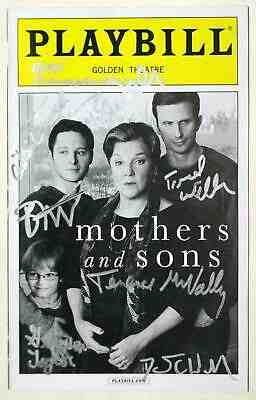
Sold on eBay Aug, 17th 2020
Full Cast Tyne Daly, Terrence McNally Signed MOTHERS & SONS Playbill
<br /><br /><br /><br /><br /><br /><br /><br /><br /><br /><br /><br /><br /><br /><br /><br /><br /><br /><br /><br /><br /><br /><br /><br /><br /><br /> Full Cast Tyne Daly, Terrence McNally Signed MOTHERS & SONS Playbill Click images to enlarge Description From the sadly now closed Tony Award nominated Mothers & Sons comes this special This Playbill has been autographed by the entire cast of Mothers & Sons including Tyne Daly, Bob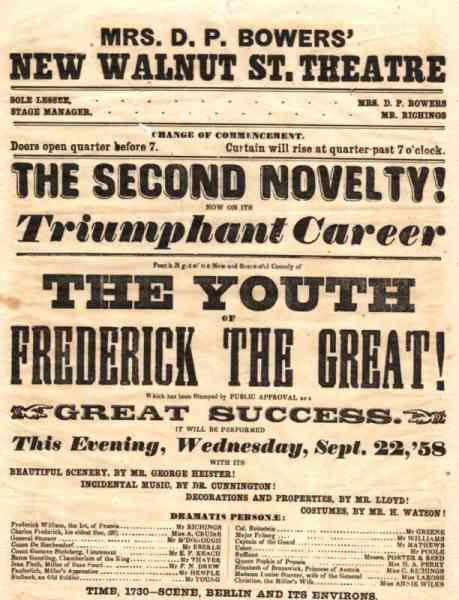
Sold on eBay November 4th, 2024
*WALNUT STREET THEATRE RARE 1858 BROADSIDE THE YOUTH OF FREDERICK THE GREAT*
A rare large original September 1858 broadside for Mrs. D. P. Bowers's New Walnut Street Theatre, Philadelphia featuring The Youth of Frederick the Great with All that Glitters Is Not Gold as afterpiece. Featured among both casts is Frank Drew, John Drew's brother and great uncle of Ethel, Lionel, and John Barrymore. Dimensions nineteen and a half by ten inches. Light creasing, small punctures and small mounting hole at top margin otherwise good. Mrs. D. P. Bowers was among the few female theatre managers of the era. See the story of the Walnut Street Theatre below. Shipping discounts for multiple purchases. Inquiries always welcome. Please visit my other eBay items for more early theatre, opera, film and historical autographs, photographs and programs and great actor and actress cabinet photos and CDV's. From Wikipedia: The Walnut Street Theatre at 825 Walnut Street on the corner of S. 9th Street in the Washington Square West neighborhood of Philadelphia, Pennsylvania, is the oldest continuously operating theatre in the English speaking world and the oldest in the United States.[3] The venue is operated by the Walnut Street Theatre Company, a non-profit organization, and has three stages: the Mainstage, for the company's primary and larger productions, the Independence Studio on 3, a studio located on the building's third floor for smaller productions, and the Studio 5 on the fifth floor, which is rented out for independent productions. The company wants to build a theatre in the round next door, where the parking lot currently is. The Walnut Street Theatre was built by the Circus of Pepin and Breschard, which toured the United States from 1807 until 1815. Pepin and Breschard constructed numerous venues in cities along the East Coast of the United States, which often featured, along with performances of their circus, classical plays as well as horse dramas.[5] The theatre was founded in 1809, going by the name of The New Circus. In 1811, the two partners commissioned architect William Strickland to design and construct a stage and orchestra pit for theatrical performances and the theatre's name was changed to The Olympic. The official website says that the name The Walnut Street Theatre was first used there in 1820, though the name was changed back to The Olympic in 1822 and to The Walnut again in 1828. A travel guidebook from 1849 indicates that in the mid 19th century, this building was called The American Theatre. The Walnut was the first theatre to install gas footlights in 1837. In 1855 it was also the first theatre to feature air conditioning. The theatre switched to electric chandeliers and footlights in 1892. The theatre has undergone many renovations since its opening. The first theatrical production at the theatre was The Rivals in 1812 (President Thomas Jefferson and the Marquis de Lafayette were in attendance). Edwin Booth and John Sleeper Clarke purchased the theatre in 1865, and then the theatre became part of The Shubert Organization in 1941. On October 15, 1966, The Walnut Street Theatre was designated a National Historic Landmark and in 1969, the theatre was purchased by a non-profit organization and turned over to the new Walnut Street Theatre Corporation. On September 23, 1976, it was the site of the debate between Gerald R. Ford and Jimmy Carter. The Walnut Street Theatre Company, a non-profit regional producing company, was formed in 1983. In 1984, the Walnut Street Theatre School was established and over 1,200 students enroll annually, and 1986 saw the introduction of the Independence Studio on 3 series. To this day, the company produces five productions a season on the theatre's main stage and is the most subscribed theatre company in the world. In Fall 2008, the theater celebrated its 200th season of live entertainment. Elizabeth Crocker Bowers (March 12, 1830 – November 6, 1895) [1] was an American stage actress and theatrical manager.[2][3] She was also known professionally as Mrs. D. P. Bowers. Early life Elizabeth Crocker Bowers was born March 12, 1830 in Stamford, Connecticut,[4] the daughter of an Episcopal clergyman[1] and sister of actress Sarah Crocker Conway (also known as Mrs. F. B. Conway).[4] Career and marriages[edit] In 1846, she appeared in the character of Amanthis [1] at the Park Theatre in New York City, New York. On March 4, 1847,[1][4] she married actor David P. Bowers,[3] and moved to Philadelphia. She appeared as Donna Victoria in A Bold Stroke for a Husband at the Walnut Street Theatre in Philadelphia. She became very popular at the Arch Street Theatre, and made Philadelphia her home until her husband's death in 1857. In December 1857, after a period of retirement from the stage, she leased the Walnut Street Theatre and retained its management until 1859. She then leased the Philadelphia Academy of Music for a short dramatic season. She married Dr. Brown of Baltimore in 1861.[3] and traveled to London. She made a great success as "Julia" in The Hunchback at the Sadler's Wells Theatre and "Geraldine D'Arcy" in Woman (play) at the Lyceum Theatre in London. Returning to New York City in 1863, she played for a time at the Winter Garden (now demolished). Among her favorite roles were Juliet, Lady Macbeth, Marie Antoinette, and Lady Audley. After the death of Dr. Brown in 1867, she married actor J. C. McCollom,[4] with whom she repeated many of her popular roles. Her subsequent retirement in Philadelphia was interrupted by a return to the stage in October 1886 for several years.[3] She organized a new dramatic company, and visited the principal cities of the U.S., playing many of her old and favorite characters. Under A. M. Palmer's management she appeared in Lady Windermere's Fan (1893), and later she was a supporting actress for Rose Coghlan and Olga Nethersole.[1] Bowers died of pneumonia and heart failure [4] on November 6, 1895[3] in at the home of her son-in-law, Frank Bennett, in Washington D.C. She was survived by a daughter, Mrs. F. V.(May) Bennett and two sons, Harry C. Bowers of Portland, OR and Walter Bowers of New York City.[5] She was buried at Rock Creek Cemetery in Washington, D.C.
Sold on eBay May, 3rd 2020
Big Lot of BROADWAY Playbills 2000s Musicals & Plays
Lot of 88 Playbills - plays/musicals - Broadway only, 2000-2020.<br />NO DUPES. All original casts unless otherwise noted.<br />Overall collection is in great condition - but a few do have mild handling wear/light creasing. Collection sold AS IS.<br />All My Sons 2019, Network, Oklahoma!, Diana, Girl From the North Country, West Side Story 2020, Outside Mullingar, Heartbreak House, The Norman Conquests, August: Osage County, The Lightning Thief: The Percy Jackson Musical, The Sound Inside, Linda Vista, The Inheritance, The Rose Tattoo, Six Degrees of Separation, The 25th Annual Putnam County S
Sold on eBay October 5th, 2023
*A CONAN DOYLE JAMES O'NEILL CRESTON CLARKE 1903 ADVENTURES OF GERARD PROGRAM*
A rare original program clip circa 1903 for James O'Neill--Eugene O'Neill's father--and Creston Clarke, nephew of Edwin and John Wilkes Booth, in Sherlock Holmes author A. Conan Doyle's The Adventures of Gerard. Laid down to an Edwardian album page. Dimensions seven by four inches. Light wear otherwise good. See the story of Brigadier Gerard and A. Conan Doyle's extraordinary biography below. Shipping discounts for multiple purchases. Inquiries always welcome. Please visit my other eBay items for more early Gilbert and Sullivan items, theatre, opera, film and historical autographs, photographs and programs, and great actor and actress cabinet photos and CDV's. Sir Arthur Ignatius Conan Doyle KStJ DL (22 May 1859 – 7 July 1930) was a British writer and physician. He created the character Sherlock Holmes in 1887 for A Study in Scarlet, the first of four novels and fifty-six short stories about Holmes and Dr. Watson. The Sherlock Holmes stories are milestones in the field of crime fiction.Doyle was a prolific writer; other than Holmes stories, his works include fantasy and science fiction stories about Professor Challenger and humorous stories about the Napoleonic soldier Brigadier Gerard, as well as plays, romances, poetry, non-fiction, and historical novels. One of Doyle's early short stories, "J. Habakuk Jephson's Statement" (1884), helped to popularise the mystery of the Mary Celeste.His first work featuring Sherlock Holmes and Dr. Watson, A Study in Scarlet, was written in three weeks when he was 27 and was accepted for publication by Ward Lock & Co on 20 November 1886, which gave Doyle £25 (equivalent to £2,900 in 2019) in exchange for all rights to the story. The piece appeared a year later in the Beeton's Christmas Annual and received good reviews in The Scotsman and the Glasgow Herald [9]Holmes was partially modelled on Doyle's former university teacher Joseph Bell. In 1892, in a letter to Bell, Doyle wrote, "It is most certainly to you that I owe Sherlock Holmes ... round the centre of deduction and inference and observation which I have heard you inculcate I have tried to build up a man",[35] and in his 1924 autobiography, he remarked, "It is no wonder that after the study of such a character [viz., Bell] I used and amplified his methods when in later life I tried to build up a scientific detective who solved cases on his own merits and not through the folly of the criminal."[36] Robert Louis Stevenson was able to recognise the strong similarity between Joseph Bell and Sherlock Holmes: "My compliments on your very ingenious and very interesting adventures of Sherlock Holmes. ... can this be my old friend Joe Bell?"[37] Other authors sometimes suggest additional instance, Edgar Allan Poe's character C. Auguste Dupin, who is mentioned, disparagingly, by Holmes in A Study in Scarlet.[38] Dr. (John) Watson owes his surname, but not any other obvious characteristic, to a Portsmouth medical colleague of Doyle's, Dr. James Watson [39]Sherlock Holmes statue in Edinburgh, erected opposite the birthplace of Doyle, which was demolished c. 1970A sequel to A Study in Scarlet was commissioned, and The Sign of the Four appeared in Lippincott's Magazine in February 1890, under agreement with the Ward Lock company. Doyle felt grievously exploited by Ward Lock as an author new to the publishing world, and so, after this, he left them.[9] Short stories featuring Sherlock Holmes were published in the Strand Magazine. Doyle wrote the first five Holmes short stories from his office at 2 Upper Wimpole Street (then known as Devonshire Place), which is now marked by a memorial plaque [40]Doyle s attitude towards his most famous creation was ambivalent.[39] In November 1891, he wrote to his mother: "I think of slaying Holmes, ... and winding him up for good and all. He takes my mind from better things." His mother responded, "You won't! You can't! You mustn't!"[41] In an attempt to deflect publishers' demands for more Holmes stories, he raised his price to a level intended to discourage them, but found they were willing to pay even the large sums he asked.[39] As a result, he became one of the best-paid authors of his time.Statue of Holmes and the English Church in MeiringenIn December 1893, to dedicate more of his time to his historical novels, Doyle had Holmes and Professor Moriarty plunge to their deaths together down the Reichenbach Falls in the story "The Final Problem". Public outcry, however, led him to feature Holmes in 1901 in the novel The Hound of the Baskervilles. Holmes's fictional connection with the Reichenbach Falls is celebrated in the nearby town of Meiringen.In 1903, Doyle published his first Holmes short story in ten years, "The Adventure of the Empty House", in which it was explained that only Moriarty had fallen, but since Holmes had other dangerous Colonel Sebastian Moran—he had arranged to make it look as if he too were dead. Holmes was ultimately featured in a total of 56 short stories—the last published in 1927—and four novels by Doyle, and has since appeared in many novels by other authors Brigadier Gerard is the comedic hero of a series of 17 historical short stories, a play, and a major character in a novel by the British writer Arthur Conan Doyle. Brigadier Etienne Gerard is a Hussar officer in the French Army during the Napoleonic Wars. Gerard's most notable attribute is his vanity – he is utterly convinced that he is the bravest soldier, greatest swordsman, most accomplished horseman and most gallant lover in all France. Gerard is not entirely wrong, since he displays notable bravery on many occasions, but his self satisfaction undercuts this quite often. Obsessed with honour and glory, he is always ready with a stirring speech or a gallant remark to a lady.Doyle, in making his hero a vain, and often rather uncomprehending Frenchman, was able to satirise both the stereotypical English view of the French and – by presenting them from Gerard's baffled point of view – English manners and attitudes.The Booth family was an English American theatrical family of the 19th century. Its most known members were Edwin Booth, one of the leading actors of his day, and John Wilkes Booth, who assassinated Abraham Lincoln.The patriarch was Junius Brutus Booth, a London-born lawyer's son who eventually became an actor after he attended a production of Othello at the Covent Garden theatre. The prospects of fame, fortune, and freedom were very appealing to young Booth, and he displayed remarkable talent from an early age, deciding on a career in the theatre by the age of 17. He performed roles in several small theaters throughout England, and joined a tour of the Low Countries in 1814, returning the following year to make his London debut.Booth abandoned his wife and their young son in 1821 and ran off to the United States with Mary Ann Holmes, a London flower girl. They settled on some 150 acres in Harford County near Baltimore and started a family; they had 10 children, six of whom survived to adulthood [1][2]Junius Sr. and Edwin toured in California during the Gold Rush.[citation needed] Edwin bought an interest in the Winter Garden Theatre at 667 Broadway in New York City with his brother-in-law John Sleeper Clarke. The brothers John Wilkes, Edwin, and Junius Brutus, Jr. performed there in the play Julius Caesar at a benefit in 1864, the only time they were seen together on a stage, playing Mark Antony, Brutus, and Cassius, respectively [3]MembersThe Booth Family gravesite, Green Mount CemeteryJunius Brutus Booth (1796–1852) brought his mistress Mary Ann Holmes, who bore him 10 children, to the United States.He also wrote many letters in fits of drunken anger and madness to President Andrew Jackson threatening assassination. He requested that two prisoners who had been sentenced to death for piracy, named De Ruiz and De Soto, be pardoned, or else: "I will cut your throat whilst you are sleeping." This letter would later be recanted by Junius, stating, "May god preserve General Jackson and this happy republic [4]Junius Brutus Booth Jr. (1821–1883) was married to Agnes Booth. Junius Jr. never achieved the same fame as his brothers, but his third wife Agnes was popular.Their son Sydney Barton Booth (1877–1937) was an actor well into the era of modern film [5]Edwin Thomas Booth (1833–1893) came to be the foremost American Shakespearean actor of his day. He founded The Players, a New York City actors' club which continues to the present day. His second wife, Mary McVicker, was an actress [6]Edwin s grandson Edwin Booth Grossman was a painter of some note.Asia Frigga Booth (1835–1888) married John Sleeper Clarke, an actor/comedian who was briefly imprisoned in the aftermath of the assassination. They then emigrated to Britain, where he became a successful theatre manager.Creston Clarke[7] and Wilfred Clarke,[8] sons of John and Asia, were noted actors in their day.John Wilkes Booth (1838–1865) was a popular young star in less serious fare than his brothers.A Confederate sympathizer during the American Civil War, during a play attended by Abraham Lincoln, Booth took advantage of his access to the theatre to invade the President's box and assassinate the President. He was killed 12 days later by Union soldier Boston Corbett.Edwina Booth Grossman (1861–1938) daughter of Edwin Booth,[9] and the author of Edwin Booth: Recollections by His Daughter, Edwina Booth Grossman, and Letters to Her and to His Friends (1894).James O'Neill (November 15, 1847 – August 10, 1920) was an Irish-American theatre actor and the father of the American playwright Eugene O'Neill.Early lifeJames O'Neill[1] was born on November 15, 1847, in County Kilkenny, Ireland. His parents were distant cousins, Edward[2] and Mary O'Neill. His father was a farmer. The family emigrated to America in 1851 and settled in Buffalo, New York. In 1857 they moved to Cincinnati, Ohio, where James was apprenticed to a machinist [3]CareerPlaque in New Ross, County Wexford recalling his emigration to America in 1851At the age of 21, he made his stage debut in a Cincinnati, Ohio, production of Boucicault's The Colleen Bawn (1867). Also in 1867, Edwin Forrest embarked on a "farewell tour". O'Neill had a minor part in Forrest's Cincinnati production of Virginius, and then joined a travelling repertory company. He played a young sailor in Joseph Jefferson's Rip Van Winkle and for the first time found his brogue a handicap.[3] He also played Macduff to Edwin Booth's Macbeth.The San Francisco Chronicle of August 3, 1879, described James O'Neill as "...a quiet gentleman of medium height, well proportioned figure, square shoulders and stands very erect. He has black hair, black eyes, rather dark complexion, a black mustache, and a fine set of teeth which he knows how to display to advantage."[3] "[4]While in San Francisco, O'Neill became friends with fellow actor, John Elitch. When Elitch opened the Elitch Zoological Gardens in Denver, Colorado, on May 1, 1890, O'Neill attended the opening and promised "I'll come back and play on that stage whenever you say." On May 30, 1897, O'Neill kept his promise and appeared in the opening play, Helene, by Martha Morton.[5]He was considered a promising actor, quickly working his way up the ranks to become a matinee idol. [6]ScandalIn 1874 O'Neill joined Richard M. Hooley's company, and the following year toured San Francisco, Virginia City and Sacramento. He then headed back east to join the Union Square Company.[3]On June 14, 1877, while in New York, James O'Neill married Mary Ellen Quinlan, daughter of Thomas and Bridget Quinlan, at St. Ann's Church on 12th Street. James and Ella had three sons: James (b. 1878), Edmund (b. 1883) and Eugene O'Neill (b. 1888). While James was on tour, Ella often accompanied him, and the boys were placed in boarding school. In the fall of 1877, three months after James' marriage, a woman by the name of Nettie Walsh sued O'Neill, claiming that O'Neill already married her, when she was 15, and he was the father of her three year old son. [4]The couple was in San Francisco on September 10, 1878, when their first son, James O'Neill, Jr. was born in the home of one of O'Neill's friends. While in San Francisco, O'Neill took on the role of Christ in David Belasco's production The Passion for which Belasco rounded up 100 nursing mothers to appear in the tableau "the Massacre of the Innocents". The Board of Supervisors passed a local ordinance prohibiting "profane" dramas, and O'Neill and the rest of the company were arrested. O'Neill pleaded guilty and paid a $50 fine for himself and $5 for each of his co-defendants. About October 30, 1880, O'Neill and his family took a train back to New York where he re-joined the Union Square Company.[3]The Count of Monte CristoPoster for a 1900 theatre production of Monte Cristo, adapted for the stage by Charles Fechter, starring James O'NeillEdmond Dantès (James O'Neill) loosens a stone before making his escape from the Château d'If in The Count of Monte Cristo (1913)As early as 1875, while a stock star at Hooley's Theatre in Chicago, O'Neill played the title role in a stage adaptation of Dumas' The Count of Monte Cristo. In early 1883 O'Neill took over the lead role in Monte Cristo at Booth's Theater in New York, after Charles R. Towne died suddenly in the wings after his first performance. O'Neill's interpretation of the part caused a sensation with the theater-going public. A company was immediately set up to take the play on tour. O'Neill bought the rights to the play. The San Francisco News Latter was less appreciative of O'Neill, saying on December 31, 1887 "In his hands the romantic story has degenerated into an extravagant melodrama. ...He is reaping the pecuniary profit of his business sagacity, but it is at the cost of art."[3]O'Neill soon had enough of the Count. His lines came out by rote and his performances became lackadaisical. He tried other plays but The Three Musketeers and Julius Caesar met with indifferent response, and O'Neill was forced to return to Monte Cristo in order to recoup the losses sustained in "artistic successes". Monte Cristo remained a popular favorite and would continue to make its appearance on tour as regular as clockwork. O'Neill could not afford to sacrifice wealth in the face of a growing family. His son Eugene was born in New York on October 16, 1888.[3]He went on to play this role over 6000 times. Some, including Eugene, saw O'Neill's willingness to play the role so many times as selling out; squandering the potential of his art in order to make money.[7] By 1887, The San Francisco Morning Call estimated O'Neill's fortune at a quarter of a million dollars. In March 1894, O'Neill took on the role of Shane O'Neill in the play The Prince of Ulster [3]According to his son, Eugene,My father was really a remarkable actor, but the enormous success of "Monte Cristo" kept him from doing other things. He could go out year after year and clear fifty thousand in a season. He thought that he simply couldn't afford to do anything else. But in his later years he was full of bitter regrets. He felt "Monte Cristo" had ruined his career as an artist.[3]The company toured as far west at St. Louis; Eugene O'Neill who had given up his studies at Princeton, was the assistant treasurer. He left the company to begin his wanderings at sea.[3] O'Neill converted "Monte Cristo" into tabloid form for the vaudeville circuit to accommodate changing taste in theater entertainment O Neill s celebrity and identification with Monte Cristo led Adolph Zukor to engage O'Neill in 1912 to appear in a feature film version of the play as the first production of his Famous Players Film Company. By that time O'Neill had been continuously playing the part for nearly 40 years and was 65 years old. Directed and photographed by Edwin S. Porter and co-starring Nance O'Neil as Mercedes, the film was initially held back in release but finally appeared in late 1913.DeathIn the middle of 1920 James was struck by an automobile in New York City and taken to Lawrence Memorial Hospital in New London, Connecticut. He died, aged 72, on August 11, 1920, from intestinal cancer,[4] at the family summer home, the Monte Cristo Cottage in Connecticut. His funeral at St. Joseph's Church was attended by, among others, O'Neill's sister, Mrs. M. Platt of St. Louis and Edward D. White, Chief Justice of the United States Supreme Court. O'Neill was buried in St. Mary's cemetery [3]LegacyJames O'Neill later became the model for James Tyrone, the frugal, mercurial, unseeing father character in Eugene O'Neill's posthumously published play Long Day's Journey into Night, which tells the story of the Tyrone family, which closely resembles the O'Neill family.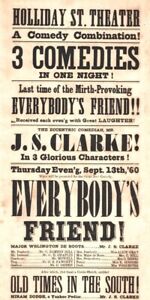
Sold on eBay July 28th, 2023
*EDWIN & JOHN WILKES BOOTH BROTHER IN LAW SLEEPER CLARKE RARE 1860 BROADSIDE*
He was the brother in law of Edwin and John Wilkes Booth and one of the finest comic actors of his generation. A rare original 1860 Holiday Street, Baltimore close to the Booth homes broadside for John Sleeper Clarke in three plays, Everybody's Friend, Old TImes in the South, and The Hypocrite. Dimensions sixteen by five and a half inches. Rare this early. Light wear otherwise good. See Sleeper Clarke and the Booth family's extraordinary biographies below.Shipping discounts for multiple purchases. Credit cards accepted with Paypal. Inquiries always welcome. Please visit my other eBay items for more early theatre and historical autographs, photographs and programs and great singer, actor and actress cabinet photos and CDV's.From Wikipedia:John Sleeper Clarke (September 3, 1833 – September 24, 1899) was a 19th-century American comedian and actor.He was born in Baltimore, Maryland to George W. Sleeper and Georgianna Sleeper (née Clarke), and was educated for the law. In his boyhood he was a schoolmate of Edwin Booth who was born in the same year as he, and with whom he engaged in amateur dramatic readings as members of the Baltimore Thespian Club.[1][2]He made his first appearance in Boston as Frank Hardy in Paul Pry in 1851, at the Howard Athenæum.[3] The next year he went to Philadelphia. Clarke's first appearance in New York City was made at the Metropolitan Theatre – afterward called the Winter Garden – on May 15, 1855, as Dickory in The Spectre Bridegroom,[4] but it was not until he returned in 1861–1862 to the same theatre that he made a conspicuous mark. In 1859 he became part of the Booth family when he married Asia Booth, daughter of Junius Brutus Booth, and sister of John Wilkes Booth. Clarke was associated with his brother-in-law Edwin Booth in the management of the Winter Garden Theatre in New York, the Walnut Street Theatre in Philadelphia and the Boston Theatre [3]Following the 1865 assassination of US president Abraham Lincoln by Clarke's brother-in-law, John Wilkes Booth, Clarke came into the possession of two letters, from his wife, written by the assassin. He turned them over to the Philadelphia Inquirer, which printed one of the two letters. His actions led to his arrest and imprisonment in the Capitol Prison in Washington D.C. for a month. Once released, he notified his pregnant wife that they must divorce. He wanted to distance himself professionally from the name of Booth.[5] She refused to divorce him, even as their relationship grew increasingly strained. However, they remained married in name only. "..He lives a free going bachelor life and does what he likes.." wrote Asia to her brother Edwin. She died May 16, 1888, at the age of 52.In August 1865, just months after the assassination, Asia gave birth to twins Creston and Lilian.[6]In 1867, Clarke moved his family to London, where Asia became a poet and a writer. Clarke made his first appearance at the St James's Theatre as Major Wellington de Boots in Stirling Coyne's Everybody's Friend, rewritten for him and called The Widow's Hunt. At the Princess's in February 1868, he was Salem Scudder in a revival of The Octoroon, and later, at the Strand, was the first Young Gosling in Fox versus Goose. On July 26, 1869, he was the first Babington Jones in John Brougham's Among the Breakers. At the same house he also played Toodles, Dr. Pangloss in The Heir at Law, and other parts.[3] His success was so great that he remained in England for the rest of his life, except for four visits to America [1]Among his favorite parts were Timothy Toodle in William E. Burton's The Toodles, which ran for 200 nights at the Strand Theatre, and two roles from plays by George Colman "the Younger": Dr. Pangloss in The Heir at Law, and Dr. Ollapod in The Poor Gentleman. At the beginning of his career Clarke wished to play tragedy, but he later turned to comic roles.[1] He managed several London theatres, including the Haymarket, where he preceded the Bancrofts. He retired in 1889.Death and legacyClarke died suddenly, in London, in his sixty-seventh year, on September 24, 1899.[1] Four days later, his remains were interred at Teddington Cemetery[7] in what is now the London Borough of Richmond upon Thames. Among the mourners were Mr. and Mrs. Clement Scott, Charles Hawtrey, the staff of the Strand Theatre, and Clarke's two sons, Creston and Wilfred. Many beautiful wreaths were placed upon the coffin.[8]He and his wife Asia had nine children. Their sons Creston and Wilfred went on to become actors.The Booth family was an English American theatrical family of the 19th century. Its most famous and well known members were Edwin Booth, one of the leading actors of his day, and John Wilkes Booth, who assassinated Abraham Lincoln.The patriarch was Junius Brutus Booth, a London-born lawyer's son who eventually became an actor after he attended a production of Othello at the Covent Garden theatre. The prospects of fame, fortune, and freedom were very appealing to young Booth, and he displayed remarkable talent from an early age, deciding on a career in the theatre by the age of 17. He performed roles in several small theaters throughout England, and joined a tour of the Low Countries in 1814, returning the following year to make his London debut.Booth abandoned his wife and their young son in 1821 and ran off to the United States with Mary Ann Holmes, a London flower girl. They settled on some 150 acres in Harford County near Baltimore and started a family; they had 10 children, six of whom survived to adulthood [1][2]Junius Sr. and Edwin toured in California during the Gold Rush.[citation needed] Edwin bought an interest in the Winter Garden Theatre at 667 Broadway in New York City together with his brother-in-law John Sleeper Clarke. The brothers John Wilkes, Edwin, and Junius Brutus, Jr. performed there in the play Julius Caesar at a benefit in 1864, the only time they were seen together on a stage, playing Mark Antony, Brutus, and Cassius, respectively Junius Brutus Booth (1796–1852) brought his mistress Mary Ann Holmes, who bore him 10 children, to the United States.He also wrote many letters in fits of drunken anger and madness to President Andrew Jackson threatening assassination. He requested that two prisoners who had been sentenced to death for piracy, named De Ruiz and De Soto, be pardoned, else: "I will cut your throat whilst you are sleeping." This letter would later be recanted by Junius, stating, "May god preserve General Jackson and this happy republic [4]Junius Brutus Booth Jr. (1821–1883) was married to Agnes Booth. Junius Jr. never achieved the same fame as his brothers, but his third wife Agnes was popular.Their son Sydney Barton Booth (1877–1937) was an actor well into the era of modern film [5]Edwin Thomas Booth (1833–1893) came to be the foremost American Shakespearean actor of his day. He founded The Players, a New York City actors' club which continues to the present day.Edwin's grandson Edwin Booth Grossman was a painter of some note.Asia Frigga Booth (1835–1888) married John Sleeper Clarke, an actor/comedian who was briefly imprisoned in the aftermath of the assassination. They then emigrated to Britain, where he became a successful theatre manager.Creston Clarke[6] and Wilfred Clarke,[7] sons of John and Asia, were noted actors in their day.John Wilkes Booth (1838–1865) was a popular young star in less serious fare than his brothers.A Confederate sympathizer during the American Civil War, during a play attended by Abraham Lincoln, Booth took advantage of his access to the theatre to invade the President's box and assassinate the President. He was killed 12 days later by Union soldier Boston Corbett.
Sold on eBay May 5th, 2024
*LEGENDARY DANCER ISADORA DUNCAN RARE 1916 DANCE PROGRAM*
A rare large original 1916 dance program for the legendary Isadora Duncan. Four pages. Dimensions ten and three quarters by five and a half inches. Light wear otherwise good. See Isadora Duncan's extraordinary biography below. Shipping discounts for multiple purchases. Inquiries always welcome. Please visit my other eBay items for more early ballet and dance memorabilia, early theatre, opera, film, magic, and historical autographs, photographs, programs and broadsides, and great actor and actress cabinet photos and CDV's.From Isadora Duncan (May 26, 1877 or May 27, 1878[a] – September 14, 1927) was an American and French dancer who performed to acclaim throughout Europe. Born in California, she lived in Western Europe and the Soviet Union from the age of 22 until her death at age 50, when her scarf became entangled in the wheels and axle of the car in which she was riding.Isadora Duncan was born in San Francisco, the youngest of the four children of Joseph Charles Duncan (1819–1898), a banker, mining engineer and connoisseur of the arts, and Mary Isadora Gray (1849–1922). Her brothers were Augustin Duncan and Raymond Duncan;[2] her sister, Elizabeth Duncan, was also a dancer.[3][4] Soon after Isadora's birth, her father was exposed to illegal bank dealings, and the family became extremely poor.[2]Her parents divorced when she was an infant,[5] and her mother moved with her family to Oakland, California, where she worked as a seamstress and piano teacher. From ages six to ten, Isadora attended school, but she dropped out, finding it constricting. As her family was very poor, she and her three siblings earned money by teaching dance to local children.[2]In 1896, Duncan became part of Augustin Daly's theater company in New York, but she soon became disillusioned with the form and craved a different environment with less of a hierarchy.[6] Her father, along with his third wife and their daughter, died in 1898 when the British passenger steamer SS Mohegan ran aground off the coast of Cornwall [7]WorkPhoto by Arnold Genthe of Duncan performing barefoot during her 1915–1918 American tourAbraham Walkowitz's Isadora Duncan #29, one of many works of art she inspired.Duncan began her dancing career at a very early age by giving lessons in her home to neighbourhood children, and this continued through her teenage years.[8] Her novel approach to dance was evident in these early classes, in which she "followed [her] fantasy and improvised, teaching any pretty thing that came into [her] head".[9] A desire to travel brought her to Chicago, where she auditioned for many theater companies, finally finding a place in Augustin Daly's company. This took her to New York City where her unique vision of dance clashed with the popular pantomimes of theater companies.[10] In New York, Duncan took some classes with Marie Bonfanti but was quickly disappointed in ballet routine.Feeling unhappy and unappreciated in America, Duncan moved to London in 1898. She performed in the drawing rooms of the wealthy, taking inspiration from the Greek vases and bas-reliefs in the British Museum.[11][12] The earnings from these engagements enabled her to rent a studio, allowing her to develop her work and create larger performances for the stage.[13] From London, she traveled to Paris, where she was inspired by the Louvre and the Exposition Universelle of 1900.[14]In 1902, Loie Fuller invited Duncan to tour with her. This took Duncan all over Europe as she created new works using her innovative technique,[15] which emphasized natural movement in contrast to the rigidity of tradition ballet.[16] She spent most of the rest of her life touring Europe and the Americas in this fashion.[17] Despite mixed reaction from critics, Duncan became quite popular for her distinctive style and inspired many visual artists, such as Antoine Bourdelle, Auguste Rodin, Arnold Rönnebeck, and Abraham Walkowitz, to create works based on her.[18]Duncan disliked the commercial aspects of public performance, such as touring and contracts, because she felt they distracted her from her real mission, namely the creation of beauty and the education of the young.[citation needed] To achieve her mission, she opened schools to teach young women her philosophy of dance. The first was established in 1904 in Berlin Grunewald Germany. This institution was the birthplace of the "Isadorables" (Anna, Maria-Theresa, Irma, Liesel, Gretel, and Erika[19]), Duncan's protégées who would continue her legacy.[20] Duncan legally adopted all six girls in 1919, and they took her last name.[21] After about a decade in Berlin, Duncan established a school in Paris that was shortly closed because of the outbreak of World War I.[22]In 1910, Duncan met the occultist Aleister Crowley at a party, an episode recounted by Crowley in his Confessions [23] He refers to Duncan as "Lavinia King", and used the same invented name for her in his novel Moonchild. Crowley wrote of Duncan that she "has this gift of gesture in a very high degree. Let the reader study her dancing, if possible in private than in public, and learn the superb unconsciousness — which is magical consciousness — with which she suits the action to the melody."[24] Crowley was, in fact, more attracted to Duncan's bohemian companion Mary Dempsey (a.k.a. Mary D'Este or Desti), with whom he had an affair. Desti had come to Paris in 1901 where she soon met Duncan, and the two became inseparable. Desti, who also appeared in Moonchild (as "Lisa la Giuffria") and became a member of Crowley's occult order,[b] later wrote a memoir of her experiences with Duncan.[25]In 1911, the French fashion designer Paul Poiret rented a mansion — Pavillon du Butard in La Celle Saint Cloud — and threw lavish parties, including one of the more famous grandes fêtes, La fête de Bacchus on June 20, 1912, re-creating the Bacchanalia hosted by Louis XIV at Versailles. Isadora Duncan, wearing a Greek evening gown designed by Poiret,[26] danced on tables among 300 guests; 900 bottles of champagne were consumed until the first light of day.[26]Duncan c. 1916–1918Duncan said to have posed for the photographer Eadweard Muybridge,[27] placed an emphasis on "evolutionary" dance motion, insisting that each movement was born from the one that preceded it, that each movement gave rise to the next, and so on in organic succession. Her dancing defined the force of progress, change, abstraction and liberation. In France, as elsewhere, Duncan delighted her audience.[28]In 1914, Duncan moved to the United States and transferred her school there. A townhouse on Gramercy Park was provided for its use, and its studio was nearby, on the northeast corner of 23rd Street and Fourth Avenue (now Park Avenue South).[29] Otto Kahn, the head of Kuhn, Loeb & Co., gave Duncan use of the very modern Century Theatre at West 60th Street and Central Park West for her performances and productions, which included a staging of Oedipus Rex that involved almost all of Duncan's extended entourage and friends.[30] During her time in New York, Duncan posed for a number of studies by the photographer Arnold Genthe.Duncan had been due to leave the United States in 1915 aboard the RMS Lusitania on its ill-fated voyage, but historians believe her financial situation at the time drove her to choose a more modest crossing.[31] In 1921, Duncan's leftist sympathies took her to the Soviet Union, where she founded a school in Moscow. However, the Soviet government's failure to follow through on promises to support her work caused her to return to the West and leave the school to her protégée Irma.[32] In 1924, Duncan composed a dance routine called Varshavianka to the tune of the Polish revolutionary song known in English as Whirlwinds of Danger [33]Philosophy and techniqueDuncan in a Greek-inspired pose and wearing her signature Greek tunic. She took inspiration from the classical Greek arts and combined them with an American athleticism to form a new philosophy of dance, in opposition to the rigidity of traditional ballet.Breaking with convention, Duncan imagined she had traced dance to its roots as a sacred art.[34] She developed from this notion a style of free and natural movements inspired by the classical Greek arts, folk dances, social dances, nature and natural forces as well as an approach to the new American athleticism which included skipping, running, jumping, leaping and tossing [citation needed]Duncan's philosophy of dance moved away from rigid ballet technique and towards what she perceived as natural movement. To restore dance to a high art form instead of merely entertainment, she strove to connect emotions and movement: "I spent long days and nights in the studio seeking that dance which might be the divine expression of the human spirit through the medium of the body's movement."[35] She believed dance was meant to encircle all that life had to offer—joy and sadness. Duncan took inspiration from ancient Greece and combined it with an American love of freedom. Her movement was feminine and arose from the deepest feelings in her body. This is exemplified in her revolutionary costume of a white Greek tunic and bare feet. Inspired by Greek forms, her tunics also allowed a freedom of movement that corseted ballet costumes and pointe shoes did not.[36] Costumes were not the only inspiration Duncan took from Greece: she was also inspired by ancient Greek art, and utilized some of its forms in her movement (see image) [37]Duncan wrote of American dancing: "let them come forth with great strides, leaps and bounds, with lifted forehead and far-spread arms, to dance."[38] Her focus on natural movement emphasized steps, such as skipping, outside of codified ballet technique. Duncan also cited the sea as an early inspiration for her movement.[39] Also, she believed movement originated from the solar plexus, which she thought was the source of all movement.[35] It is this philosophy and new dance technique that garnered Duncan the title of the creator of modern dance.Photo studies of Isadora Duncan made in New York by Arnold Genthe during her visits to America in 1915–1918 Personal lifeDuncan with her children Deirdre and Patrick, in 1913In both professional and private life, Duncan flouted traditional mores and morality. She was bisexual[40] and an atheist,[41] and alluded to her communism during her last United States tour, in 1922–23: she waved a red scarf and bared her breast on stage in Boston, proclaiming, "This is red! So am I!"[42]Duncan bore two children, both out of wedlock. The first, Deirdre Beatrice (born September 24, 1906), by theatre designer Gordon Craig, and the second, Patrick Augustus (born May 1, 1910),[43] by Paris Singer, one of the many sons of sewing machine magnate Isaac Singer. Both children drowned in the care of their nanny in 1913 when their runaway car went into the Seine [43]Following the accident, Duncan spent several months recuperating in Corfu with her brother and sister. She then spent several weeks at the Viareggio seaside resort with the actress Eleonora Duse. The fact that Duse had just left a relationship with the rebellious and epicene young feminist Lina Poletti fueled speculation as to the nature of Duncan and Duse's relationship, but there has never been any indication that the two were involved romantically [44]Duncan and Sergei YeseninIn her autobiography, Duncan relates that she begged a young Italian stranger, the sculptor Romano Romanelli,[45] to sleep with her because she was desperate for another baby. She became pregnant by him, and gave birth to a son on August 13, 1914; the infant died shortly after birth [46][47]In 1921, after the end of the Russian Revolution, Duncan moved to Moscow where she met the acclaimed poet Sergei Yesenin, who was 18 years her junior. On May 2, 1922, they married, and Yesenin accompanied her on a tour of Europe and the United States. However, the marriage was brief, and in May 1923 he left Duncan and returned to Moscow. Two years later, on December 28, 1925, Yesenin was found dead in his room in the Hotel Angleterre in St Petersburg in an apparent suicide [48]Duncan had a relationship with the poet and playwright Mercedes de Acosta, as documented in numerous revealing letters they wrote to each other.[49] In one, Duncan wrote, "Mercedes, lead me with your little strong hands and I will follow you – to the top of a mountain. To the end of the world. Wherever you wish."[50]Later lifeBy the late 1920s, Duncan's performing career had dwindled, and she became as notorious for her financial woes, scandalous love life and all too frequent public drunkenness as for her contributions to the arts. She spent her final years moving between Paris and the Mediterranean, running up debts at hotels. She spent short periods in apartments rented on her behalf by a decreasing number of friends and supporters, many of whom attempted to assist her in writing an autobiography. They hoped it might be successful enough to support her.[citation needed] In a reminiscent sketch, Zelda Fitzgerald wrote how she and F. Scott Fitzgerald, her husband, sat in a Paris cafe watching a somewhat drunk Duncan. He would speak of how memorable it was, but what Zelda recalled was that while all eyes were watching Duncan, Zelda was able to steal the salt and pepper shakers from the table.[51]In his book Isadora, an Intimate Portrait, Sewell Stokes, who met Duncan in the last years of her life, describes her extravagant waywardness. Duncan's autobiography My Life was published in 1927. The Australian composer Percy Grainger called Isadora's autobiography a "life-enriching masterpiece [52]DeathDuncan s tomb at Père Lachaise CemeteryOn the night of September 14, 1927, in Nice, France, Duncan was a passenger in an Amilcar CGSS automobile owned by Benoît Falchetto, a French-Italian mechanic. She wore a long, flowing, hand-painted silk scarf, created by the Russian-born artist Roman Chatov, a gift from her friend Mary Desti, the mother of American film director Preston Sturges. Desti, who saw Duncan off, had asked her to wear a cape in the open-air vehicle because of the cold weather, but she would only agree to wear the scarf.[53] As they departed, she reportedly said to Desti and some companions, "Adieu, mes amis. Je vais à la gloire !" ("Farewell, my friends. I go to glory!"); but according to the American novelist Glenway Wescott, Desti later told him that Duncan's actual parting words were, "Je vais à l'amour" ("I am off to love"). Desti considered this embarrassing, as it suggested that she and Falchetto were going to her hotel for a tryst.Her silk scarf, draped around her neck, became entangled around the open-spoked wheels and rear axle, pulling her from the open car and breaking her neck.[1] Desti said she called out to warn Duncan about the scarf almost immediately after the car left. Desti brought Duncan to the hospital, where she was pronounced dead.[53]As The New York Times noted in its obituary, Duncan "met a tragic death at Nice on the Riviera." "According to dispatches from Nice, Duncan was hurled in an extraordinary manner from an open automobile in which she was riding and instantly killed by the force of her fall to the stone pavement."[57] Other sources noted that she was almost decapitated by the sudden tightening of the scarf around her neck.[58] The accident gave rise to Gertrude Stein's mordant remark that "affectations can be dangerous".[59] At the time of her death, Duncan was a Soviet citizen. Her will was the first of a Soviet citizen's to be probated in the U.S.[60]Duncan was cremated, and her ashes were placed next to those of her children[61] in the columbarium at Père Lachaise Cemetery in Paris.[62] On the headstone of her grave is inscribed École du Ballet de l'Opéra de Paris ("Ballet School of the Opera of Paris ) LegacyDuncan is known as "The Mother of Dance". While her schools in Europe did not last long, Duncan's work had impact in the art and her style is still danced based upon the instruction of Maria-Theresa Duncan,[63] Anna Duncan,[64] and Irma Duncan,[65] three of her six adopted daughters. The adoption process was never verified, but all six of Isadora's dancers did change their last name to Duncan. Through her sister, Elizabeth, Duncan's approach was adopted by Jarmila Je?ábková from Prague where her legacy persists.[66] By 1913 she was already being celebrated. When the Théâtre des Champs Élysées was built, Duncan's likeness was carved in its bas-relief over the entrance by sculptor Antoine Bourdelle and included in painted murals of the nine muses by Maurice Denis in the auditorium. In 1987, she was inducted into the National Museum of Dance and Hall of Fame.Anna, Lisa,[67] Theresa and Irma, pupils of Isadora Duncan's first school, carried on the aesthetic and pedagogical principles of Isadora's work in New York and Paris. Choreographer and dancer Julia Levien was also instrumental in furthering Duncan's work through the formation of the Duncan Dance Guild in the 1950s and the establishment of the Duncan Centenary Company in 1977 [68]Another means by which Duncan's dance techniques were carried forth was in the formation of the Isadora Duncan Heritage Society, by Mignon Garland, who had been taught dance by two of Duncan's key students. Garland was such a fan that she later lived in a building erected at the same site and address as Duncan, attached a commemorative plaque near the entrance, which is still there as of 2016. Garland also succeeded in having San Francisco rename an alley on the same block from Adelaide Place to Isadora Duncan Lane.[69][70]In medicine, the Isadora Duncan Syndrome refers to injury or death consequent to entanglement of neckwear with a wheel or other machinery [71]In popular cultureDuncan has attracted literary and artistic attention from the 1920s to the present, in novels, film, ballet, theatre, music, and poetry.Duncan has been portrayed in novels including Aleister Crowley's Moonchild (as 'Lavinia King'), published in 1923,[72] and Upton Sinclair's World's End (1940) and Between Two Worlds (1941), the first two novels in his Pulitzer Prize winning Lanny Budd series.[73] She is also the subject of Amelia Gray's novel Isadora (2017).[74] Two characters in the A Series of Unfortunate Events series of novels are named after her, Isadora Quagmire and Duncan Quagmire [75]Among the films featuring Duncan are:The 1966 BBC biopic by Kenneth Russell, Isadora Duncan, the Biggest Dancer in the World, which was introduced by Duncan's biographer, Sewell Stokes, Duncan was played by Vivian Pickles.[76]The 1968 film Isadora, nominated for the Palme d'Or at Cannes, stars Vanessa Redgrave as Duncan. The film was based in part of Duncan's autobiography. Redgrave was nominated for the Academy Award for Best Actress for her performance as Duncan [76][77]Archival footage of Duncan was used in the 1985 popular documentary That's Dancing [78][79]A 1989 documentary, Isadora Duncan: Movement from the Soul, was nominated for the Grand Jury Prize at the 1989 Sundance Film Festival [80]Ballets based on Duncan include:In 1976 Frederick Ashton created a short ballet entitled Five Brahms Waltzes in the Manner of Isadora Duncan for Lynn Seymour of the Royal Ballet, in which "Ashton fused Duncan's style with an imprint of his own"; Marie Rambert claimed after seeing it that it was exactly as she remembered Duncan dancing.[81]In 1981, she was the subject of a ballet, Isadora, written and choreographed by the Royal Ballet's Kenneth MacMillan, and performed at Covent Garden.[82]On the theatre stage, Duncan is portrayed in:A 1991 stage play When She Danced by Martin Sherman about Duncan's later years, won the Evening Standard Award for Vanessa Redgrave as Best Actress.[83]In 2016, Lily-Rose Depp portrayed Duncan in The Dancer, a French biographical musical drama of dancer Loie Fuller [84]Duncan is featured in music in:The popular 1970s TV sitcom Maude mentions her in its theme song: "Isadora was the first bra burner Ain t ya glad she showed up?"Celia Cruz recorded a track titled Isadora Duncan with the Fania All-Stars for the album Cross Over released in 1979.[85]Rock musician Vic Chesnutt included a song about Duncan on his debut album Little.[86]Rock band Burden of a day included a song about Duncan on their album the poem Fever 103 by Sylvia Plath, the speaker alludes to Isadora's scarves.
Sold on eBay August 28th, 2023
*WORLD'S GREATEST ACTOR: THE AMAZING EDMUND KEAN (1787-1833) RARE 1817 PROGRAM*
He may have been the greatest actor that ever lived. To see Edmund Kean, wrote Samuel Taylor Coleridge, was like reading Shakespeare "by flashes of lightning." Lord Byron was among his greatest admirers. A rare February 1817 issue of the Drury Lane Theatrical Gazette with attractions at the leading London playhouses featuring the great Edmund Kean as Sir Giles Overreach in A New Way To Pay Old Debts, also a role played by Junius Brutus Booth and his son Edwin. Eight pages. Dimensions eight and a half by five and three quarters inches. Light wear otherwise good. See Edmund Kean's extraordinary biography below.Shipping discounts for buyers of multiple items. Credit cards accepted with Paypal. Inquiries always welcome. Please visit my other eBay items for more early theatre and historical autographs, broadsides, photographs and programs and great actor and actress cabinet photos and CDV's.From Kean (4 November 1787 – 15 May 1833) was celebrated Shakespearean stage actor born in England, who performed in London, Belfast, New York, Quebec, and Paris among other places. He was well known for his short stature, tumultuous personal life, and controversial divorce. He expired of dissipation at the age of 44.Kean was born in Westminster London. His father was probably Edmund Kean (see Ó Catháin), an architect’s clerk, and his mother was an actress, Anne Carey, daughter of the 18th-century composer and playwright Henry Carey.Kean made his first appearance on the stage, aged four, as Cupid in Jean-Georges Noverre’s ballet of Cymon. As a child his vivacity, cleverness and ready affection made him a universal favorite, but his harsh circumstances and lack of discipline, both helped develop self-reliance and fostered wayward tendencies. About 1794 a few benevolent persons paid for him to go to school, where he did well; but finding the restraint intolerable, he shipped as a cabin boy atPortsmouth. Finding life at sea even more restricting, he pretended to be both deaf and lame so skilfully that he deceived the doctors at Madeira.On his return to England, he sought the protection of his uncle, Moses Kean, a mimic, ventriloquist and general entertainer, who, besides continuing his pantomimic studies, introduced him to the study of Shakespeare. At the same time, Miss Charlotte Tidswell, an actress who had been especially kind to him from infancy, taught him the principles of acting.On the death of his uncle, she took charge of him, and he began the systematic study of the principal Shakespearean characters, displaying the peculiar originality of his genius by interpretations entirely different from those of John Philip Kemble, then considered the great exponent of these roles. Kean’s talents and interesting countenance caused a Mrs Clarke to adopt him, but he took offense at the comments of a visitor and suddenly left her house and went back to his old surroundings DiscoverAged fourteen, he obtained an engagement to play leading characters for twenty nights in the York Theatre, appearing as Hamlet, Hastings and Cato.Shortly afterwards, while he was in Richardson's Theatre, a travelling theatre company, the rumor of his abilities reached George III, who commanded him to appear at Windsor Castle. He subsequently joined Saunders’s circus, where in the performance of an equestrian feat he fell and broke both legs—the accident leaving traces of swelling in his insteps throughout his life.About this time, he picked up music from Charles Incledon, dancing from D’Egville, and fencing from Angelo. In 1807, he played leading parts in the Belfast theater with Sarah Siddons, who began by calling him "a horrid little man" and on further experience of his ability said that he "played very, very well," but that "there was too little of him to make a great actor." In 1808, he joined Samuel Butler’s provincial troupe and went on to marry Mary Chambers of Waterford, the leading actress, on 17 July. His wife bore him two sons, one of whom was actor Charles Kean.Drury Lane and New YorkFor several years, his prospects were very gloomy, but in 1814, the committee of Drury Lane Theatre, which was on the verge of bankruptcy, resolved to give him a chance among the "experiments" they were making to win a return of popularity. When the expectation of his first appearance in London was close upon him, he was so feverish that he exclaimed, "If I succeed I shall go mad." Unable to afford medical treatment for some time, his elder son died the day after he signed the three-year Drury Lane contract.His opening at Drury Lane on 26 January 1814 as Shylock roused the audience to almost uncontrollable enthusiasm.[1] Contemporaries recognized that Kean had brought dignity and humanity to his portrayal of the character [2]Successive appearances in Richard III, Hamlet, Othello, Macbeth and King Lear demonstrated his mastery of the range of tragic emotion. His triumph was so great that he himself said on one occasion, "I could not feel the stage under me."In 1817, a local playwright named Charles Bucke submitted his play The Italians, or; The Fatal Accusation to Drury Lane, for which Kean was to play the lead. The play was well received by both council and actors until Kean seemed to have a change of heart and began to make several offhand remarks that his part was not big enough for him. Then, after a performance where Kean went out of his way to botch the opening night of Switzerland by historical novelist Jane Porterin February 1819, for whom Kean had had a personal dislike, Bucke pulled the play out of contempt for Kean's conduct.[3] After much cajoling to still perform the play by the theater staff, Mr. Bucke then later had it republished with a preface concerning the incident, including excerpts from correspondences between the involved parties, which was later challenged in two books, The Assailant Assailed and A Defense of Edmund Kean, Esq. The result was loss of face on both sides and the play being performed anyway on 3 April 1819 to a disastrous reception thanks to the controversy already surrounding the play and Kean's previous conduct.[4]On 29 November 1820, Kean appeared for the first time in New York, as Richard III. The success of his visit to America was unequivocal, although he fell into a vexatious dispute with the press. In 1821, he appeared in Boston with Mary Ann Duff in The Distrest Mother, by Ambrose Philips, an adaptation of Racine's Andromaque. On 4 June 1821, he returned to England.Kean was the first to restore the tragic ending to Shakespeare's King Lear, which had been replaced on stage since 1681 by Nahum Tate's happy ending adaptation The History of King Lear. Kean had previously acted Tate's Lear, but told his wife that the London audience "have no notion of what I can do till they see me over the dead body of Cordelia."[5] Kean played the tragic Lear for a few performances. They were not well received, though one critic described his dying scene as "deeply affecting",[6] and with regret, he reverted to Tate [7]8]Private lifeKean's lifestyle became a hindrance to his career. As a result of his relationship with Charlotte Cox, the wife of a London city alderman, Kean was sued by Mr Cox for damages for criminal conversation (adultery). Damages of £800 were awarded against him by a jury that had deliberated for just 10 minutes. The Times launched a violent attack on him. The adverse decision in the criminal conversation case of Cox v. Kean on 17 January 1825 caused his wife to leave him, and aroused against him such bitter feeling that he was booed and pelted with fruit when he re-appeared at Drury Lane and nearly compelled to retire permanently into private life. For many years, he lived at Keydell House, Horndean.Second American visitA second visit to America in 1825 was largely a repetition of the persecution which he had suffered in England. Some cities showed him a spirit of charity; many audiences submitted him to insults and even violence. In Quebec City, he was much impressed with the kindness of some Huron Indians who attended his performances, and he was purportedly made an honorary chief of the tribe, receiving the name Alanienouidet [9] Kean’s last appearance in New York was on 5 December 1826 in Richard III, the role in which he was first seen in America.Decline and deathHe returned to England and was ultimately received with favour, but by now he was so dependent on the use of stimulants that the gradual deterioration of his gifts was inevitable. Still, his great powers triumphed during the moments of his inspiration over the absolute wreck of his physical faculties. His appearance in Paris was a failure owing to a fit of drunkenness.His last appearance on the stage was at Covent Garden on 25 March 1833, when he played Othello to the Iago of his son, Charles Kean, who was also an accomplished actor. At the words "Villain, be sure," in scene 3 of act iii, he suddenly broke down, and crying in a faltering voice "O God, I am dying. Speak to them, Charles," fell insensible into his son’s arms. He died at Richmond, Surrey where he had spent his last years as manager of the local theatre, and is commemorated in the Parish Church where there is a floor plaque marking his grave and a wall plaque originally on the outside but moved inside and heavily restored during restoration work in 1904. He is buried in the parish church of All Saints, in the village of Catherington, Hampshire. His last words were alleged to be "dying is easy; comedy is hard."[10] In Dublin, Gustavus Vaughan Brooke took up the part of William Tell vacated by Kean.Artistic legacyIt was in the impersonation of the great creations of Shakespeare’s genius that the varied beauty and grandeur of the acting of Kean were displayed in their highest form, although probably his most powerful character was Sir Giles Overreach in Philip Massinger’s A New Way to Pay Old Debts, the effect of his first performance of which was such that the pit rose en masse, and even the actors and actresses themselves were overcome by the terrific dramatic illusion. His main disadvantage as an actor was his small stature. Coleridge said, "Seeing him act was like reading Shakespeare by flashes of lightning [11]EccentricityHis eccentricities at the height of his fame were numerous. Sometimes he would ride recklessly on his horse, Shylock, throughout the night. He was presented with a tame lion with which he might be found playing in his drawing room The prize-fighters Mendoza and Richmond the Black were among his visitors. Grattan was his devoted friend.
Sold on eBay March 26th, 2024
Noel Coward "COCHRAN'S 1931 REVUE" Irving Berlin / Bobby Clark / London Program
This is a rare March 23rd, 1931 programme (playbill) from the Original West End production of the musical variety revue "CHARLES B. COCHRAN'S 1931 REVUE" at the London Pavilion. (The production opened March 19th, 1931 at the London Pavilion and closed April 11th, 1931 after only 27 performances.) ..... The ensemble cast included BOBBY CLARK and PAUL McCULLOUGH, MELVILLE COOPER, EDWARD COOPER, JOHN MILLS, EFFIE ATHERTON, QUEENIE LEONARD, MOLLY MOLLOY, JANE WELSH, KATHRYN HAMILL, ADA-MAY, BETTY SHALE, FRED LEROY, AL MARSHAL, FRED BEBBINGTON, DIGGER HEYWOOD, AL RIOUX, BERNARDI, HENRY MOLLISON, JACK ADNES, MILES ARLEN, BILLY CORAM, EDWARD COVENTRY, NORMAN GRAHAM, ANTHONY PELISSIER, WILLIAM TINKLER, CHARLES FAREY, EDDIE WILLIAMS, JOEY SHIELDS, SONIA WATSON, DAN INGMAN, BERT WILTON, LEN SHEVILL, COCHRAN'S YOUNG LADIES and the JOHN TILLER GIRLS ..... CREDITS: Music mostly by NOEL COWARD; Additional Songs and Sketches by DOUGLAS BYNG, IRVING BERLIN ("Music Box Revues", the Marx Brothers' "The Cocoanuts", "Louisiana Purchase", "This is the Army", "Miss Liberty", "Annie Get Your Gun", "Call Me Madam", "Mr. President"), PHIL BAXTER, RONALD JEANS, MELVILLE GIDEON, ELSIE APIL, ANDIE RAZAF, EUBIE BLAKE and MOISES SIMONS; Sets designed by ALICK JOHNSTONE, REX WHISTLER, G. E. CALTHROP, OLIVER MESSEL, NICOLAS DE MOLAS, EDWARD WOLFE, MICHAEL WEIGHT and DORIS ZINKEISEN; Costumes designed by DORIS ZINKEISEN, ADA PEACOCK, REVILLE, LTD., G. E. CALTHROP, OLIVER MESSEL, OLGA ASHFORD, NICOLAS DE MOLAS, MARY NEWBERRY, EDWARD WOLFE and MORRIS ANGEL and Sons; Ballets by GEORGES BALANCHIN; Choreographed by BILLY PIERCE and BUDDY BRADLEY; Staged by FRANK COLLINS; Produced by CHARLES B. COCHRAN ..... DETAILS: The 28 page program measures 5 1/2" X 8 1/2" inches and includes full production credits, cast list, scenes and musical numbers and wonderful vintage advertising, but no cast photos or bios ..... CONDITION: With the exception of a light vertical fold, minor rust marks at the staples, a small tear at the bottom seam and creasing to the seal on the cover, this rare program is in excellent condition and will make a wonderful addition to the collection of any musical theatre aficionado or historian. This item will be carefully packaged in a protective, carded sleeve and backed by stiff cardboard.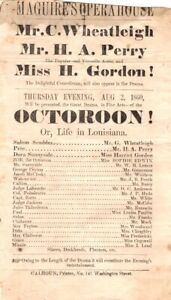
Sold on eBay February 25th, 2024
*JUNIUS BRUTUS BOOTH JR RARE 1860 SAN FRANCISCO OCTOROON HANDBILL BOUCICAULT*
A rare original August 1860 Maguire's Opera House, San Francisco handbill for Junius Brutus Booth Jr., brother of Edwin and John Wilkes Booth, in Dion Boucicault's famous play of race The Octoroon. Also in the cast are H. A. Perry--Booth's future wife Agnes's first husband; Agnes Booth's sister Isabelle; and Dave Anderson, who was a close friend and mentor to Edwin Booth when he acted in California. Dimensions seven and a half by four and a quarter inches. Light wear and small loss at top otherwise fine. See the Booth family's extraordinary biographies below. Shipping discounts for multiple purchases. Inquiries always welcome. Please visit my other eBay items for more early theatre, opera, film and historical autographs, photographs and programs and great actor and actress cabinet photos and CDV's. From Wikipedia: The Booth family was an American theatrical family of the 19th century. Its most famous and well known members were Edwin Booth, one of the leading actors of his day, and John Wilkes Booth, who assassinated Abraham Lincoln.The patriarch was Junius Brutus Booth, a London-born lawyer's son who eventually became an actor after he attended a production of Othello at the Covent Garden theatre. The prospects of fame, fortune, and freedom were very appealing to young Booth, and he displayed remarkable talent from an early age, deciding on a career in the theatre by the age of 17. He performed roles in several small theaters throughout England, and joined a tour of the Low Countries in 1814, returning the following year to make his London debut.Booth abandoned his wife and their young son in 1821 and ran off to the United States with Mary Ann Holmes, a London flower girl. They settled on some 150 acres in Harford County near Baltimore and started a family; they had 10 children, six of whom survived to adulthood [1][2]Junius Sr. and Edwin toured in California during the Gold Rush.[citation needed] Edwin bought an interest in the Winter Garden Theatre at 667 Broadway in New York Citytogether with his brother-in-law John Sleeper Clarke. The brothers John Wilkes, Edwin, and Junius Brutus, Jr. performed there in the play Julius Caesar at a benefit in 1864, the only time they were seen together on a stage, playing Mark Antony, Brutus, and Cassius, respectively MembersThe Booth Family gravesite, Green Mount CemeteryJunius Brutus Booth (1796–1852) brought his mistress Mary Ann Holmes, who bore him 10 children, to the United States.He also wrote many letters in fits of drunken anger and madness to President Andrew Jackson threatening assassination. He requested that two prisoners who had been sentenced to death for piracy, named De Ruiz and De Soto, be pardoned, else: "I will cut your throat whilst you are sleeping." This letter would later be recanted by Junius, stating, "May god preserve General Jackson and this happy republic." [4]Junius Brutus Booth Jr. (1821–1883) was married to Agnes Booth. Junius Jr. never achieved the same fame as his brothers, but his third wife Agnes was popular.Their son Sydney Barton Booth (1877–1937) was an actor well into the era of modern film [5]Edwin Thomas Booth (1833–1893) came to be the foremost American Shakespearean actor of his day. He founded The Players, a New York City actors' club which continues to the present day.Edwin's grandson Edwin Booth Grossman was a painter of some note.Asia Frigga Booth (1835–1888) married John Sleeper Clarke, an actor/comedian who was briefly imprisoned in the aftermath of the assassination. They then emigrated to Britain, where he became a successful theatre manager.Creston Clarke[6] and Wilfred Clarke,[7] sons of John and Asia, were noted actors in their day.John Wilkes Booth (1838–1865) was a popular young star in less serious fare than his brothers.A Confederate sympathizer during the American Civil War, during a play attended by Abraham Lincoln, Booth took advantage of his access to the theatre to invade the President's box and assassinate the President. He was killed 12 days later by Union soldier Boston Corbett.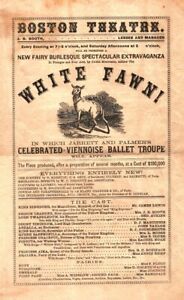
Sold on eBay September 30th, 2023
*WHITE FAWN 1868 BALLET SPECTACULAR PROGRAM MR & MRS JUNIUS BRUTUS BOOTH*
A rare original March 1868 Boston Theatre program for the legendary ballet spectacular White Fawn, "The Piece produced, after a preparation of several months, at a Cost of $100,000"--the equivalent of millions of dollars today. The play was produced by Junius Brutus Booth Jr., brother of Edwin and John Wilkes Booth, and starred Agnes Booth, Junius Brutus Booth Jr.'s wife. Also featured were Jarrett and Palmer's Celebrated Viennoise [sic] Ballet Troupe. Four pages. Dimensions ten and a quarter by six and three quarters inches. Light wear and light fold otherwise good. See the Booth family's extraordinary biography below. Shipping discounts for multiple purchases. Inquiries always welcome. Please visit my other eBay items for more early theatre, opera, film and historical autographs, photographs and programs and great actor and actress cabinet photos and CDV's. From Wikipedia: Agnes Booth (October 4, 1843 – January 2, 1910), born Marian Agnes Land Rookes, was an Australian-born American actress and in-law of Junius Brutus Booth, John Wilkes Booth, and Edwin BoothAlthough there are no records of Agnes Booth's birth or her family's residence in Australia,[2] by her own account she was born in Sydney, New South Wales. She migrated to California with her family in 1858, at the age of about 14.She made her US debut in early 1858 as Agnes Land, performing with her sister Belle at Maguire's Opera House, San Francisco, attracting attention and gaining recognition and managing a season of the Metropolitan theatre in Detroit. In 1861 she married actor Harry A. Perry in San Francisco, but was widowed in 1862 [2][3][4][5]In 1865 she moved to New York where she appeared at the Winter Garden Theatre.[6] As Agnes Perry, in 1866 she joined the Boston Theatre Company, of which she was a member for several years. In 1867, she was married to Junius Brutus Booth, Jr. and she performed as Agnes Booth thereafter.At the height of her popularity reviews of her performances were effusive. In 1874, the News described her as "the most finished and effective emotional actress at present on the metropolitan stage."[1] In 1889, Belford's Magazine wrote of another "great triumph" by Agnes Booth in Captain Swift. "For painstaking attention to detail, nicety of intonation, and powerful expression, Agnes Booth is in the front rank of leading ladies. We have seen her in many society dramas, and in each she has shown a charming appreciation of all the requirements... The mingled expression of shame, suffering and maternal love in Agnes Booth's face during [one] scene is one not soon to be forgotten.[7]In 1878 she played Madeleine Renaud in the Union Square Theatre's production of "A Celebrated Case," the program noting that she had "kindly undertaken this part in order to strengthen the cast." From 1881 to 1891, she was with the Madison Square Company. After 1891, she went to Europe, then returned to the United States where she resided in the artist community of New Rochelle, New York and resumed her work on Broadway in nearby New York City. Booth gained fame for her role in the melodrama The Sporting Duchess (The Derby Winner by Cecil Raleigh) along with fellow actress and New Rochelle neighbor Cora Tanner [8]Junius Booth died in 1883, and in 1885 she married John B. Schoeffel, manager of Boston's Tremont theatre. Her last major performance was in L'Arlesienne in 1897.[The Booth family was an American theatrical family of the 19th century. Its most famous and well known members were Edwin Booth, one of the leading actors of his day, and John Wilkes Booth, who assassinated Abraham Lincoln.The patriarch was Junius Brutus Booth, a London-born lawyer's son who eventually became an actor after he attended a production of Othello at the Covent Garden theatre. The prospects of fame, fortune, and freedom were very appealing to young Booth, and he displayed remarkable talent from an early age, deciding on a career in the theatre by the age of 17. He performed roles in several small theaters throughout England, and joined a tour of the Low Countries in 1814, returning the following year to make his London debut.Booth abandoned his wife and their young son in 1821 and ran off to the United States with Mary Ann Holmes, a London flower girl. They settled on some 150 acres in Harford County near Baltimore and started a family; they had 10 children, six of whom survived to adulthood [1][2]Junius Sr. and Edwin toured in California during the Gold Rush.[citation needed] Edwin bought an interest in the Winter Garden Theatre at 667 Broadway in New York Citytogether with his brother-in-law John Sleeper Clarke. The brothers John Wilkes, Edwin, and Junius Brutus, Jr. performed there in the play Julius Caesar at a benefit in 1864, the only time they were seen together on a stage, playing Mark Antony, Brutus, and Cassius, respectively MembersThe Booth Family gravesite, Green Mount CemeteryJunius Brutus Booth (1796–1852) brought his mistress Mary Ann Holmes, who bore him 10 children, to the United States.He also wrote many letters in fits of drunken anger and madness to President Andrew Jackson threatening assassination. He requested that two prisoners who had been sentenced to death for piracy, named De Ruiz and De Soto, be pardoned, else: "I will cut your throat whilst you are sleeping." This letter would later be recanted by Junius, stating, "May god preserve General Jackson and this happy republic." [4]Junius Brutus Booth Jr. (1821–1883) was married to Agnes Booth. Junius Jr. never achieved the same fame as his brothers, but his third wife Agnes was popular.Their son Sydney Barton Booth (1877–1937) was an actor well into the era of modern film [5]Edwin Thomas Booth (1833–1893) came to be the foremost American Shakespearean actor of his day. He founded The Players, a New York City actors' club which continues to the present day.Edwin's grandson Edwin Booth Grossman was a painter of some note.Asia Frigga Booth (1835–1888) married John Sleeper Clarke, an actor/comedian who was briefly imprisoned in the aftermath of the assassination. They then emigrated to Britain, where he became a successful theatre manager.Creston Clarke[6] and Wilfred Clarke,[7] sons of John and Asia, were noted actors in their day.John Wilkes Booth (1838–1865) was a popular young star in less serious fare than his brothers.A Confederate sympathizer during the American Civil War, during a play attended by Abraham Lincoln, Booth took advantage of his access to the theatre to invade the President's box and assassinate the President. He was killed 12 days later by Union soldier Boston Corbett.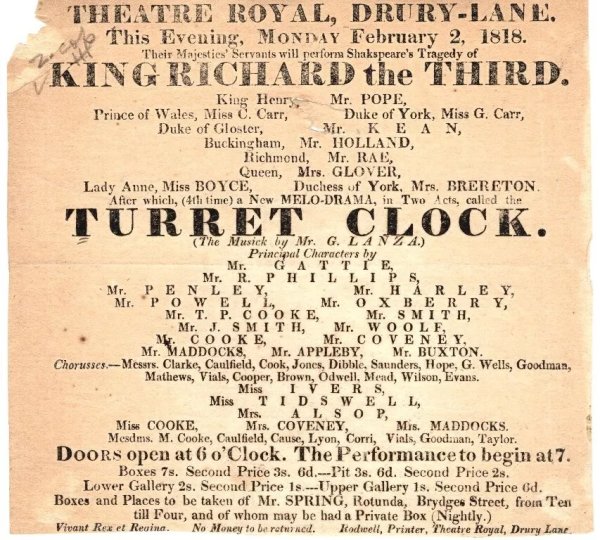
Sold on eBay May 5th, 2025
*EDMUND KEAN WORLD'S GREATEST ACTOR (1787-1833) RARE 1818 RICHARD III BROADSIDE*
He may have been the greatest actor that ever lived. To see Edmund Kean, wrote Samuel Taylor Coleridge, was like reading Shakespeare "by flashes of lightning." Lord Byron was among his greatest admirers. A rare February 1818 trimmed broadside featuring the great Edmund Kean in Richard III, also a role played by Junius Brutus Booth and his son Edwin. Eight pages. Dimensions six and a half by six inches. Light wear otherwise good. See Edmund Kean's extraordinary biography below.Shipping discounts for buyers of multiple items. Credit cards accepted with Paypal. Inquiries always welcome. Please visit my other eBay items for more early theatre and historical autographs, broadsides, photographs and programs and great actor and actress cabinet photos and CDV's.From Wikipedia:Edmund Kean (4 November 1787 - 15 May 1833) was celebrated Shakespearean stage actor born in England, who performed in London, Belfast, New York, Quebec, and Paris among other places. He was well known for his short stature, tumultuous personal life, and controversial divorce. He expired of dissipation at the age of 44.Kean was born in Westminster London. His father was probably Edmund Kean (see O Cathain), an architect's clerk, and his mother was an actress, Anne Carey, daughter of the 18th-century composer and playwright Henry Carey.Kean made his first appearance on the stage, aged four, as Cupid in Jean-Georges Noverre's ballet of Cymon. As a child his vivacity, cleverness and ready affection made him a universal favorite, but his harsh circumstances and lack of discipline, both helped develop self-reliance and fostered wayward tendencies. About 1794 a few benevolent persons paid for him to go to school, where he did well; but finding the restraint intolerable, he shipped as a cabin boy atPortsmouth. Finding life at sea even more restricting, he pretended to be both deaf and lame so skilfully that he deceived the doctors at Madeira.On his return to England, he sought the protection of his uncle, Moses Kean, a mimic, ventriloquist and general entertainer, who, besides continuing his pantomimic studies, introduced him to the study of Shakespeare. At the same time, Miss Charlotte Tidswell, an actress who had been especially kind to him from infancy, taught him the principles of acting.On the death of his uncle, she took charge of him, and he began the systematic study of the principal Shakespearean characters, displaying the peculiar originality of his genius by interpretations entirely different from those of John Philip Kemble, then considered the great exponent of these roles. Kean's talents and interesting countenance caused a Mrs Clarke to adopt him, but he took offense at the comments of a visitor and suddenly left her house and went back to his old surroundings.DiscoverAged fourteen, he obtained an engagement to play leading characters for twenty nights in the York Theatre, appearing as Hamlet, Hastings and Cato.Shortly afterwards, while he was in Richardson's Theatre, a travelling theatre company, the rumor of his abilities reached George III, who commanded him to appear at Windsor Castle. He subsequently joined Saunders's circus, where in the performance of an equestrian feat he fell and broke both legs--the accident leaving traces of swelling in his insteps throughout his life.About this time, he picked up music from Charles Incledon, dancing from D'Egville, and fencing from Angelo. In 1807, he played leading parts in the Belfast theater with Sarah Siddons, who began by calling him "a horrid little man" and on further experience of his ability said that he "played very, very well," but that "there was too little of him to make a great actor." In 1808, he joined Samuel Butler's provincial troupe and went on to marry Mary Chambers of Waterford, the leading actress, on 17 July. His wife bore him two sons, one of whom was actor Charles Kean.Drury Lane and New YorkFor several years, his prospects were very gloomy, but in 1814, the committee of Drury Lane Theatre, which was on the verge of bankruptcy, resolved to give him a chance among the "experiments" they were making to win a return of popularity. When the expectation of his first appearance in London was close upon him, he was so feverish that he exclaimed, "If I succeed I shall go mad." Unable to afford medical treatment for some time, his elder son died the day after he signed the three-year Drury Lane contract.His opening at Drury Lane on 26 January 1814 as Shylock roused the audience to almost uncontrollable enthusiasm.[1] Contemporaries recognized that Kean had brought dignity and humanity to his portrayal of the character.[2]Successive appearances in Richard III, Hamlet, Othello, Macbeth and King Lear demonstrated his mastery of the range of tragic emotion. His triumph was so great that he himself said on one occasion, "I could not feel the stage under me."In 1817, a local playwright named Charles Bucke submitted his play The Italians, or; The Fatal Accusation to Drury Lane, for which Kean was to play the lead. The play was well received by both council and actors until Kean seemed to have a change of heart and began to make several offhand remarks that his part was not big enough for him. Then, after a performance where Kean went out of his way to botch the opening night of Switzerland by historical novelist Jane Porterin February 1819, for whom Kean had had a personal dislike, Bucke pulled the play out of contempt for Kean's conduct.[3] After much cajoling to still perform the play by the theater staff, Mr. Bucke then later had it republished with a preface concerning the incident, including excerpts from correspondences between the involved parties, which was later challenged in two books, The Assailant Assailed and A Defense of Edmund Kean, Esq. The result was loss of face on both sides and the play being performed anyway on 3 April 1819 to a disastrous reception thanks to the controversy already surrounding the play and Kean's previous conduct.[4]On 29 November 1820, Kean appeared for the first time in New York, as Richard III. The success of his visit to America was unequivocal, although he fell into a vexatious dispute with the press. In 1821, he appeared in Boston with Mary Ann Duff in The Distrest Mother, by Ambrose Philips, an adaptation of Racine's Andromaque. On 4 June 1821, he returned to England.Kean was the first to restore the tragic ending to Shakespeare's King Lear, which had been replaced on stage since 1681 by Nahum Tate's happy ending adaptation The History of King Lear. Kean had previously acted Tate's Lear, but told his wife that the London audience "have no notion of what I can do till they see me over the dead body of Cordelia."[5] Kean played the tragic Lear for a few performances. They were not well received, though one critic described his dying scene as "deeply affecting",[6] and with regret, he reverted to Tate.[7]8]Private lifeKean's lifestyle became a hindrance to his career. As a result of his relationship with Charlotte Cox, the wife of a London city alderman, Kean was sued by Mr Cox for damages for criminal conversation (adultery). Damages of GBP800 were awarded against him by a jury that had deliberated for just 10 minutes. The Times launched a violent attack on him. The adverse decision in the criminal conversation case of Cox v. Kean on 17 January 1825 caused his wife to leave him, and aroused against him such bitter feeling that he was booed and pelted with fruit when he re-appeared at Drury Lane and nearly compelled to retire permanently into private life. For many years, he lived at Keydell House, Horndean.Second American visitA second visit to America in 1825 was largely a repetition of the persecution which he had suffered in England. Some cities showed him a spirit of charity; many audiences submitted him to insults and even violence. In Quebec City, he was much impressed with the kindness of some Huron Indians who attended his performances, and he was purportedly made an honorary chief of the tribe, receiving the name Alanienouidet.[9] Kean's last appearance in New York was on 5 December 1826 in Richard III, the role in which he was first seen in America.Decline and deathHe returned to England and was ultimately received with favour, but by now he was so dependent on the use of stimulants that the gradual deterioration of his gifts was inevitable. Still, his great powers triumphed during the moments of his inspiration over the absolute wreck of his physical faculties. His appearance in Paris was a failure owing to a fit of drunkenness.His last appearance on the stage was at Covent Garden on 25 March 1833, when he played Othello to the Iago of his son, Charles Kean, who was also an accomplished actor. At the words "Villain, be sure," in scene 3 of act iii, he suddenly broke down, and crying in a faltering voice "O God, I am dying. Speak to them, Charles," fell insensible into his son's arms. He died at Richmond, Surrey where he had spent his last years as manager of the local theatre, and is commemorated in the Parish Church where there is a floor plaque marking his grave and a wall plaque originally on the outside but moved inside and heavily restored during restoration work in 1904. He is buried in the parish church of All Saints, in the village of Catherington, Hampshire. His last words were alleged to be "dying is easy; comedy is hard."[10] In Dublin, Gustavus Vaughan Brooke took up the part of William Tell vacated by Kean.Artistic legacyIt was in the impersonation of the great creations of Shakespeare's genius that the varied beauty and grandeur of the acting of Kean were displayed in their highest form, although probably his most powerful character was Sir Giles Overreach in Philip Massinger's A New Way to Pay Old Debts, the effect of his first performance of which was such that the pit rose en masse, and even the actors and actresses themselves were overcome by the terrific dramatic illusion. His main disadvantage as an actor was his small stature. Coleridge said, "Seeing him act was like reading Shakespeare by flashes of lightning."[11]EccentricityHis eccentricities at the height of his fame were numerous. Sometimes he would ride recklessly on his horse, Shylock, throughout the night. He was presented with a tame lion with which he might be found playing in his drawing-room.The prize-fighters Mendoza and Richmond the Black were among his visitors. Grattan was his devoted friend.
Sold on eBay May 12th, 2024
Ann Miller "GEORGE WHITE'S SCANDALS" Ella Logan / Sammy Fain 1939 Program
This is a rare souvenir program from the Original Broadway production of the Thirteenth (and final) Edition of the musical revue "GEORGE WHITE'S SCANDALS" at the Alvin Theatre in New York City. (The 13th edition of the "Scandals" opened August 28th, 1939 and ran for 120 performances.) ..... This series of revues, produced by White from 1919 through 1939, were given to elaborate show numbers much like the "Ziegfeld Follies", but were less ornate and cumbersome. Their comedy tended to be far more topical and, because White had been a dancer, the productions were fast paced and featured better choreography and music than similar revues ..... The production starred WILLIE & EUGENE HOWARD, BEN BLUE, ELLA LOGAN and ANN MILLER and included COLLETTE LYONS, BILLY RAYES, CRAIG MATHUES, CHRISTINE FORSYTH, SHIRLEY KILDUFF, OLGA GOREY, PRUDENCE HAYES, JUNE CURTIS, KAY BUCKLEY, VICTOR ARDEN and His Orchestra and THE GEORGE WHITE GIRLS ..... CREDITS: Music by SAMMY FAIN ( Hellzapoppin "Sons o' Fun", "Alive and Kicking", "Flahooley", "Ankles Aweigh", "Christine", "Something More!"); Lyrics by JACK YELLEN; Additional Lyrics by HERB MAGIDSON; Sketches by MATT BROOKS, EDDIE DAVIS and GEORGE WHITE; Sets designed by ALBERT JOHNSON; Costumes designed by CHARLES LeMAIRE; Choreographed by GEORGE WHITE; Dialogue Directed by WILLIAM K. WELLS; Conceived, Produced and Staged by GEORGE WHITE ..... DETAILS: The oversized 16 page program measures 9" X 12" inches and includes extensive text on the twenty year history of "The Scandals", photos and bios of each of the leading actors, individual photos of many of the chorus girls and several pages of production photos ..... PLEASE NOTE: The scanned pages have been cropped due to the limitations of my scanner. The margins are slightly wider than shown ..... CONDITION: With the exception of light edge wear, this program is in excellent condition and will make a wonderful addition to the collection of any musical theatre aficionado or historian ..... Check my "Other Auctions" for additional rare souvenir programs and playbills, Original Cast CD's and other theatre related memorabilia. Multiple purchases are always combined to save on shipping costs ..... NO RESERVE! ..... This item will be carefully packaged in a protective sleeve and backed by stiff cardboard ..... U.S. SHIPPING: Buyer pays choice of $3.75 USPS first class/ media rate shipping with delivery confirmation (50 cents for each additional program or playbill purchased when combined into a single payment - U.S. addresses only) or $5.95 USPS Priority with delivery confirmation. PayPal preferred ..... INTERNATIONAL CUSTOMERS: (Please Note!) I can now ship by USPS International First Class Airmail ($7.50 to Canada / $11.50 to all other international destinations) or by USPS Priority International recorded delivery ($16.00 to Canada / $20.00 to all other international destinations). Please email me with any other inquiries ..... THANKS !!! Pay me securely with any major credit card through PayPal!
Sold on eBay Feb, 23rd 2020
LOT Of 85 Playbills & Stagebills Broadway / Off Broadway Jeffrey,Les Mis, Wicked
LOT Of 85 Playbills & Stagebills Broadway / Off Broadway Jeffrey, Les Mis, Wicked. Shipped with USPS Media Mail.<br />**NO RESERVE**<br />*None are signed*<br /><br />They are mostly in alphabetical order in the pictures. There may be a couple that were missed in the order but they would be available either on the next picture or the very last picture.<br /><br />List:<br />33 Variations (last picture)All My Sons (Gerald Schoenfeld)All My Sons (American Airlines)A Little Night MusicA Raisin in the Sun (search for ‘R’ in pics not ‘A’)A Streetcar Named DesireAfter Miss JulieAngels in Ame
Sold on eBay July 31st, 2024
Junius B Booth Holly Tree Inn Dombey Sons Boston 1892 Dickens Edwin John RARE
You are bidding on:“Holly Tree Inn” & “Dombey & Son”; partial program; Boston Museum (Mr R M Field, Manager); Feb 29, 1892; Hours with Dickens, Dickens Sketch and Dickens Comedy; including “A Dramatic Sketch from Charles Dickens” by Mrs Oscar Beringer of London (first performance in this country); cast of the plays includes: Junius B Booth (grandson of J B Booth; son of J B Booth, Jr and Agnes Booth; nephew of Edwin and John Wilkes Booth), Geo C Boniface, Fanny Addison, Geo W Wilson, Charles Barron, E (Edgar) L Davenport; approx 7" x 17 ½" (two pieces glued together); some wear, old folds (as expected); Good Condition; see Buyers should know that I use the Ebay International Shipping Program.Photos are considered an essential part of the description, please examine carefully. Please ask any questions before the end of the auction. I am happy to answer any and all question. Please pay within 3 days of auction end. All items in as-is condition. No refunds unless it can be established that the item was not accurately described (photos are considered an essential part of the description). Thanks!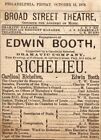
Sold on eBay September 15th, 2024