

Playbill Collectibles : Playbill+saint Price List
average value
-
low
-high
-Found 20 out of 56,978 items matching 'saint'
Sold on eBay June 16th, 2024
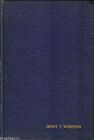
Stephen Sondheim (Composer) "A MIGHTY MAN IS HE" Bound 1955 Playbill Volume
This is a very rare hardcover volume of theatre programs (playbills) from the 1955 season of the FALMOUTH PLAYHOUSE in Falmouth (on Cape Cod), Massachusetts. The popular Summer Stock playhouse which opened in 1949 (and was destroyed by fire in 1994) presented nine different weekly productions beginning on July 2nd, 1955 and closing September 4th, 1955 ..... Of specific importance is the World Premiere engagement of the ARTHUR KOBER and GEORGE OPPENHEIMER play "A MIGHTY MAN IS HE" which starred CLAUDETTE COLBERT, who for the first time in her career sang onstage. The song, written by a young STEPHEN SONDHEIM, is among his earliest credits. In an article in the previous week's program (third scanned image), the song, "Rag Me That Mendelssohn March" is mentioned by name. The actual program credit (shown in the fourth scanned image) does not include the song title. The play would eventually open January 6th, 1960 at New York's Cort Theatre (without Claudette Colbert or Sondheim's song) and would survive for only five performances ..... The nine programs in the bound volume are (1) FRANCHOT TONE in Edward Chodorov's "OH, MEN! OH, WOMEN!" (July 2nd, 1955) featuring Betsy Von Furstenberg; (2) EVA MARIE SAINT in N. Richard Nash's "THE RAINMAKER" (July 11th, 1955) featuring Will Geer and Arthur Storch; (3) CATHY O'DONNELL and ESTELLE WINWOOD in Anita Loos' "GIGI" (July 18th, 1955) featuring Josephine Brown; (4) DONALD COOK and JOHN DALL in Leslie Stevens' "CHAMPAGNE COMPLEX" (July 25th, 1955) featuring Monica Lovett; (5) SARAH CHURCHILL in S. N. Behrman's "NO TIME FOR COMEDY" (August 1st, 1955) featuring Butterfly McQueen and Frances Tannehill; (6) JEFFREY LYNN in Herman Wouk's "THE CAINE MUTINY COURT-MARTIAL" (August 8th, 1955) featuring Stephen Elliott; (7) CLAUDETTE COLBERT in Arthur Kober and George Oppenheimer's "A MIGHTY MAN IS HE" (August 15th, 1955) featuring Joan Wetmore; (8) DOROTHY STICKNEY in Meade Roberts' "A PALM TREE IN A ROSE GARDEN" (August 22nd, 1955) featuring Alice Ghostley and Barbara Baxley; (9) VAN HEFLIN in Arthur Miller's "A VIEW FROM THE BRIDGE" (August 29th, 1955) featuring Carrol Naish, Eileen Heckart and Jack Warden ..... DETAILS: The 188 page book measures 6 1/4" X 9 1/4" inches and includes the complete season of programs with full production credits, synopsis of scenes, photos and bios of the leading actors, promotional text and vintage advertising. The bound volume belonged to a Henry T. Weinstein, whose name is engraved in gold on the front cover. "Falmouth Playhouse - 1955" is printed in gold on the binding ..... CONDITION: With the exception of light edge wear to the cover, this rare volume is in excellent condition and will make a wonderful addition to the collection of any theatre aficionado or historian. This item will be carefully packaged in a protective, carded sleeve, backed by stiff cardboard and bubble wrapped.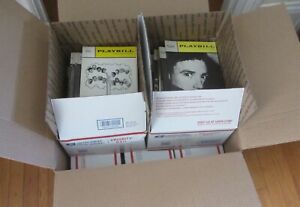
Sold on eBay February 17th, 2024
Huge lot of 337 BROADWAY PLAYBILLS late 1950's to 1970's only - UNIQUE PLAYBILLS
*** HUGE PRICE REDUCTION ***You're looking a HUGE lot of 337 of random BROADWAY PLAYBILLS from the late 1950's to the early 1970's only. All the playbills are unique for the theatre and years of issue. In other words, there are no exact duplicates, but plays from the same theater for a different date with different cover and contents. These programs are used, but in good vintage condition overall. Some of the programs are in better condition than others (none of them is complete beat up). The programs have imperfections such as: corner dings, creases, fold marks, writing (like a date on the show), sticker on cover page (with date), staple marks (from ticket stub), clear tape on corner of cover page, very small insignificant tears, minor cover page/spine wear, discoloration or staining due to age, and other similar imperfections. See pictures. Other minor flaws may be present. What you see is what you get. A few of these programs may come with original inserts. To be sold as a lot only. Great starter collection or opportunity to add to your playbill collection Please note: I threw in some extra free (unique) playbills with condition issues (like loose cover page, more staining, etc.) to bump the actual number of playbills to 348.Here's a link to my UPS, USPS or FedEx Ground shipping within Continental US. Priority Mail international shipping is $250.Please ask any questions before making a purchase. Thanks and good luck! Complete list of programs in alphabetical order:1.) Actors Studio Theater, The Productions 193-1964 (Morosco 1964)2 ) Affair, The (Henry Miller's, 1962)3.) All The Way Home (Belasco, 1960)4.) American Ballet Theatre (Metropolitan Opera House, 19??)5.) An Evening With Yves Montand (Henry Miller's, 19??)6.) Andersonville Trial, The (Henry Miller's, 19??)7.) Annie Get Your Gun (Forrest, 1966)8.) Any Wednesday (Music Box, 1964)9.) Applause (Palace, 1970)10.)Apple Tree, The (Shubert, 1966)11.)Aspern Papers, The (Playhouse, 1962)12.)At The Drop Of Another Hat (Booth, 1966)13.)Auntie Mame (Broadhurst, 19??)14.)Back To Methuselah (Ambassador, 1958)15.)Bajour (Sam S. Shubert, 1965)16.)Baker Street (Broadway, 1965)17.)Ballad Of The Sad Cafe, The (Martin Beck, 1963)18 )Barefoot In The Park (Biltmore, 1964)19 )Barefoot In The Park (Blackstone, 1965)20 )Barefoot In The Park (Biltmore, 1965)21.)Becket (Royale, 1961)22.)Bells Are Ringing (Sam S. Shubert, 1958)23.)Bells Are Ringing (Sam S. Shubert, 1958) different cover issue24 )Ben Franklin In Paris (Lunt-Fontanne, 1964)25.)Best Man, The (Morosco, 1961)26.)Beyond The Fringe (John Golden, 1962)27.)Big Fish, Little Fish (Anta, 1961)28.)Black Comedy (Wilbur, 1967)29.)Black Comedy (Ethel Barrymore, 1967)30.)Bob And Ray The Two And Only (John Golden, 1971)31 )Boeing Boeing (Cort, 1965)32.)Bravo Giovanni (Broadhurst, 1962)33 )Brigadoon (City Center Of Music And Darma, 1963)34 )Butterflies Are Free (Booth, 1970)35.)Bye Bye Birdie (54th Street, 1960)36 )Cabaret (Imperial, 1967)37.)Cactus Flower (Royale, 1966)38 )Calculated Risk (Ambassador, 1963)39 )Caligula (54th Street, 19 )40 )Carnival (Imperial, 1961)41 )Carnival (Imperial, 1962)42 )Cocktail Party, The (Lyceum, 1968)43.)Chips With Everything (Plymouth, 1963)44 )Chinese Prime Minister, The (Royale, 1964)45.)Case Of Libel, A (Longacre, 1964)46.)Coco (Mark Hellinger, 1970)47.)Coco (Mark Hellinger, 1969)48.)Come Blow Your Horn (Brooks Atkinson, 1961)49.)Come Blow Your Horn (Shubert, 1969)50.)Comedy Francaise, The (City Center Of Music and Drama, 1961)51.)Comes A Day (Ambassador, 19 )52 )Conduct Unbecoming (Ethel Barrymore, 1970)53 )Country Wife, The (Henry Miller's, 1957)54 )Country Wife, The (Henry Miller's, 1957) different cover issue55 )Critic s Choice (Ethel Barrymore, 1961)56.)Cry For Us All (Broadhurst, 1970)57.)Cue For Passion (Henry Miller's, 19??)58.)D'Oyly Carte Opera Company, The (New York City Center, 1964)59.)Danny Kaye (Ziegfeld, 1963)60.)Dark At The Top Of The Stairs, The (Music Box, 19 )61 )Delicate Balance, A (Martin Beck, 1966)62.)Destry Rides Again (Imperial, 19 )63 )Devil s Advocate, The (Billy Rose, 1961)64 )Devils The (Broadway, 1963)65.)Dinner At Eight (Alvin, 1967)66 )Disenchanted The (Coronet, 1959)67 )Donnybrook (46th St., 1961)68.)Do Re Mi (St. James, 1961)69 )Elizabeth The Queen (City Center Of Music And Drama, 1966)70 )Entertainer The (Royale, 1958)71 )Entertainer The (Royale, 1958) different cover issue72 )Epitaph For George Dillon (John Golden, 1958)73 )Epitaph For George Dillon (Henry Miller's, 1959)74.)Family Affair, A (Billy Rose 1962)75 )Family Reunion, The (Phoenix, 1958)76 )Fantasticks The (Circle In The Square, 1970)77.)Far Country, A (Music Box, 1961)78 )Fightinh Cock, The (Anta, 1960)79 )Fiddler On The Roof (Broadway, 1971)80 )Fiddler On The Roof (Majestic, 1967)81 )Fiddler On The Roof (Majestic, 1968)82 )Fiddler On The Roof (Majestic, 19 )83 )Fiddler On The Roof (Imperial, 1964)84 )Fiddler On The Roof (Imperial, 1965)85 )Fiddler On The Roof (Imperial, 1967)86 )Finian s Rainbow (46th Street, 1960)87 )Finian s Rainbow (City Center Of Music And Drama, 1967)88 )Finian s Rainbow (City Center Of Music And Drama, 19 )89 )Fiorello (Broadhurst, 1960)90 )Fiorello (Broadway, 1961)91.)Five Finger Exercise (Music Box, 1960)92.)Folies Bergere (Broadway, 1964)93 )Follies (Winter Garden, 1972)94.)Forty Carats (Blackstone, 19??)95.)Forty Carats (Morosco, 1970)96.)49th Cousin, The (Ambassador, 1960)97.)Four On A Garden (National, 1970)98.)Four On A Garden (Colonial, 1970)99.)Funny Girl (Broadway, 1967)100.)Funny Girl (Majestic, 1966)101.)Funny Thing Happened On The Way To The Forum, A (Alvin, 1962)102.)Funny Thing Happened On The Way To The Forum, A (Lunt-Fontanne, 1972)103 )Gang s All Here, The (Ambassador, 1959)104.)Gay Life, The (Sam S. Shubert, 1961)105 )Generation (Morosco, 1966)106 )George M! (Palace, 1968)107.)Girls Against The Boys, The (Alvin, 1959)108 )Gilbert & Sullivan Company (City Center, 1968)109 )Gingerbread Lady, The (Plymouth, 1971)110.)Girl Who Came To Supper, The (Broadway, 1963)111.)Glass Menagerie, The (Brooks Atkinson, 1965)112 )Golden Boy (Majestic, 1965)113 )Golden Fleecing (Henry Miller's, 1959)114 )Golden Rainbow (Shubert, 1968)115 )Goldilocks (Lunt-Fontanne, 1958)116 )Goldilocks (Lunt-Fontanne, 1958) different cover issue117 )Golden Soldier Schweik, The (New York City Center, 1958)118.)Good Soup, The (Plymouth, 1960)119.)Grand Kabuki (City Center Of Music And Drama, 1960)120.)Great White Hope, The (Alvin, 1969)121 )Greenwillow (Alvin, 1960)122.)Guys And Dolls (City Center Of Music And Drama, 1963)123.)Gypsy (Imperial, 1960)124 )H M S Pinafore (Phoenix, 1960)125 )Hadrian VII (Helen Hayes, 1969)126.)Hair (Biltmore, 19??)127.)Half A Sixpence (Broadhurst, 1965)128 )Hamlet (Lunt-Fontanne, 1964)129 )Hamlet (Lunt-Fontanne, 1969)130 )Hamlet (Colonial, 1969)131 )Heartbreak House (Billy Rose, 1959)132 )Hello Dolly! (St. James, 1970)133 )Hello Dolly! (St. James, 1966)134 )Hello Dolly! (St. James, 1967)135 )Hello Dolly! (St. James, 1964)136.)Henry IV, Part 2 (Phoenix, 19 )137 )Here s Love (Sam S. Shubert, 1964)138 )Here s Love (Sam S. Shubert, 1964) different cover issue139 )High Spirits (Alvin, 1964)140.)Hit The Deck The Nautical Musical Comedy Hit! (Jones Beach Marine, 19??)141.)Home (Morosco, 1970)142.)How Now, Dow Jones (Lunt-Fontanne, 1968)143.)How The Other Half Loves (Wilbur, 19??)144.)How To Succeed In Business Without Really Trying (46th St., 1962)145 )Hostage The (Cort, 1960)146 )Hostage The (Eugene O'Neill, 1960)147.)I Do! I Do! (46th St., 1967)148.)I Never Sang For My Father (Longacre, 1968)149.)Illya Darling (Mark Hellinger, 1967)150 )Impossible Years, The (Playhouse, 1966)151 )Indians (Brooks Atkinson, 1969)152.)Irma La Douce (Plymouth, 1960)153 )Irregular Verb To Love, The (Ethel Barrymore, 1963)154 )Ivanov (Shubert, 1966)155 )Jamaica (Imperial, 1958)156.)JB (Anta, 1959)157 )Jennie (Majestic, 1963)158.)Joe Egg (Brooks Atkinson, 1968)159.)Kean (Broadway, 1961)160 )Killing Of Sister George, The (Belasco, 1966)161.)King And I, The (City Center Of Music And Drama, 1968)162.)Kiss Me Kate (CIty Center Of Music And Drama, 1963)163.)La Grosse Valise (Shubert, 1965)164.)La Plume De Ma Tante (Royale, 1959)165.)La Plume De Ma Tante (Royale, 1960)166.)Late Christopher Bean, The (Westport County Playhouse, 19 )167 )Laughs And Other Events (Ethel Barrymore, 1960)168.)Lion In Winter, The (Ambassador, 1966)169 )Little Me (Lunt-Fontanne, 1962)170.)Look Back In Anger (John Golden, 1958)171.)Lost In The Stars (Imperial, 1972)172.)Lute Song (City Center Of Music And Drama, 1959)173 )Luther (St. James, 1963)174.)Luv (Booth, 1965)175 )Majority Of One, A (Sam S. Shubert, 1959)176.)Make A Million (Morosco, 1959)177 )Malcolm (Shubert, 1966)178.)Mame (Winter Garden, 1965)179.)Man For All Seasons, A (Anta, 1962)180.)Man Of La Mancha (Anta Washington Square, 1967)181.)Man Of La Mancha (Valley Forge Music Fair, 1970)182.)Man Of La Mancha (Anta Washington Square, 1965)183.)Man Of La Mancha (National, 1969)184 )Marcel Marceau (City Center Of Music And Drama, 1960)185 )Martha Graham And Dance Company (54th Street, 1965)186 )Martha Graham And Her Dance Company (Adelphi, 1958)187.)Mary, Mary (Helen Hayes, 1961)188.)Me Nobody Knows, The (Helen Hayes, 1971)189 )Midsummer Night's Dream, A (City Center Of Music And Drama, 19??)190.)Milk & Honey (Martin Beck, 1962)191.)Minor Miracle (Henry Miller's, 1965)192 )Miracle Worker, The (Playhouse, 1960)193.)More Stately Mansions (Broadhurst, 1967)194 )Moscow Art Theatre (New York City Center, 195.)Most Happy Fella, The (?, 1957)196.)Most Happy Fella, The (City Center Of Music And Drama, 1966)197.)Mr. President (St. James, 1963)198.)Music Man, The (Majestic, 1959)199.)Music Man, The (Broadway, 1961)200.)Music Man, The (City Center Of Music And Drama, 1965)201.)My Daughter, Your Son (Booth, 1969)202.)My Fair Lady (City Center Of Music And Drama, 1968)203.)My Fair Lady (Broadway, 1962)204.)My Fair Lady (Mark Hellinger, 1959)205.)My Fair Lady (Mark Hellinger, 1961)206.)My Fair Lady (Mark Hellinger, 1958)207.)My Fair Lady (Mark Hellinger, 1959) different cover issue208 )National Repertory Theatre (National, 1967)209 )National Repertory Theatre (Colonial, 1965)210.)Never Too Late (Playhouse, 1963)211.)New Girl In Town (46th Street, 1958)212.)New Girl In Town (46th Street, 1958) different cover issue213 )New York City Opera 38th New York Season Spring 1963 (City Center Of Music And Drama, 1963)214.)New York City Opera 40th New York Season Fall 1964 (City Center Of Music And Drama, 1964)215.)NY City Ballet (City Center Of Music And Drama, 1960)216.)NY City Ballet (City Center Of Music And Drama, 1960) different cover/issue 217.)NY City Ballet (City Center Of Music And Drama, 1961)218.)No Place To Be Somebody (Anta, 1970)219.)No Strings (Broadhurst, 1963)220.)No Strings (54th Street, 1962)221 )Nobody Loves An Albatross (Lyceum, 1964)222.)No, No, Nanette (46th Street, 1971)223.)Odd Couple, The (Plymouth, 1966)224.)Odd Couple, The (Plymouth, 1965)225.)Odd Couple, The (Colonial, 1965) different cover issue226 )Octoroon The (Phoenix, 1961)227.)Oh What A Lovely War (Broadhurst, 1964)228.)Oh! Calcutta! (Belasco, 1972)229 )Oklahoma (City Center Of Music And Drama, 1963)230 )Oliver (Sam S. Shubert, 1964)231 )Oliver (Imperial, 1963)232.)On The Town (Imperial, 1971)233.)110 In The Shade (Broadhurst, 1964)234.)110 In The Shade (Broadhurst, 1963)235.)Our Town (Anta, 1969)236.)Pal Joey (City Center Of Music And Drama, 1961)237 )Passage To India, A (Ambassador, 1962)238.)Paul Taylor Dance Company, The (City Center O Music And Drama, 1969)239.)Penny Wars, The (National, 1969)240 )Period Of Adjustment (Helen Hayes, 1960)241 )Persecution And Assassination Of Marat (Martin Beck, 1966)242 )Philadelphia Here I Come (Helen Hayes, 1966)243 )Physicists The (Martin Beck, 1964)244.)Plays Of Shakespeare, The (Broadway, 1958)245.)Plaza Suite (Plymouth, 1969)246 )Pleasure Of His Company, The (Longacre, 1959)247 )Pleasure And His Company, The (Longacre, 1958)248 )Polish Mime Theatre (New York City Center, 1965)249 )Price The (Morosco, 1968)250 )Price The (46th Street, 1968)251 )Prisoner Of Second Avenue, The (Eugene O'Neill, 1972)252 )Prisoner Of Second Avenue, The (National, 1971)253 )Promenade All! (Alvin, 1972)254 )Promises Promises (Shubert, 1971)255 )Purlie (Broadway, 19 )256 )Purlie (National, 1972)257 )Purlie (Winter Garden, 1971)258.)Rape Of The Belt, The (Martin Beck, 1960)259 )Rehearsal The (Royale, 1963)260 )Repertory Theater Of Lincoln Center For The Performing Arts (Lincoln Center, 1965)261 )Rhinoceros (Longacre, 1961)262.)Roar Of The Greasepaint - The Smell Of The Crowd (American Theatre Saint Louis, 1967)263.)Roar Of The Greasepaint - The Smell Of The Crowd (Sam S. Shubert, 1965)264.)Roar Of The Greasepaint - The Smell Of The Crowd (Shubert, 1965)265.)Rose Tattoo, The (City Center Of Music And Drama, 1966)266 )Rosencrantz And Guldenstern Are Dead (Eugene O'Neill, 1965)267 )Rosencrantz And Guldenstern Are Dead (Shubert, 1969)268 )Rosencrantz And Guldenstern Are Dead (Alvin, 1967)269.)Ross (Eugene O'Neill, 1962)270 )Rothschilds The (Lunt-Fontanne, 1970)271.)Say, Darling (Anta, 1958)272.)Say, Darling (Anta, 1958) different cover issue273 )Say Darling (Anta, 19??)274.)1776 (46th Street, 1970)275.)1776 (Majestic. 1971)276 )Sherry (Alvin, 1967)277.)Sign In Sidney Brustein's Window (Henry Miller's, 1965)278 )Skyscraper (Lunt-Fontanne, 1965)279 )Sleuth (National, 1970)280 )Sleuth (Music Box, 1971)281.)South Pacific (City Center Of Music And Drama, 1965)282 )Spofford (Anta, 1968)283.)Sound Of Music, The (Lunt-Fontanne, 1960)284.)Sound Of Music, The (Mark Hellinger, 1963)285.)Sound Of Music, The (National (1963)286.)Star Spangled Girl, The (Plymouth, 1966)287.)Story Theatre (Ambassador, 1970)288 )Strange Interlude (Hudson, 1963)289 )Subject Was Roses, The (Helen Hayes, 1965)290 )Subways Are For Sleeping (St. James, 1962)291.)Sugar (Majestic, 1972)292 )Sunday In New York (John Golden, 1962)293 )Sunrise At Campobello (Cort, 1958)294.)Sweet Bird Of Youth (Martin Beck, 1959)295.)Take Her, She's Mine (Biltmore, 1962)296.)Take Her, She's Mine (Biltmore, 1961)297.)Take Me Along (Sam S. Shubert, 19??)298.)Taste Of Honey, A (Lyceum, 1960)299 )Tchin Tchin (Plymouth. 1962)300 )Tenderloin (46th Street, 1960)301 )Tenderloin (46th Street, 1960)302.)Tenth Man, The (Booth, 1959)303 )Theatre De France (New York City Center, 1964)304 )There s A Girl In My Soup (Music Box, 1968)305 )There s A Girl In My Soup (Music Box, 1967)306.)Third Best Sport (Ambassador, 1959)307.)Time Remembered (Morosco, 1958)308.)Touch Of The Poet, A (Helen Hayes, 1959)309.)Touch Of The Poet, A (Helen Hayes, 19 )310 )Tovarich (Broadway, 1963)311.)Toys In The Attic (Hudson, 1960)312.)Toys In The Attic (Hudson, 1960) different cover issue313 )Travita La (City Center Of Music And Drama, 1960)314.)12th Night, The (Broadway, 1958)315.)Twigs (Plymouth 1972)316 )Twigs (Broadhurst, 1971)317.)Two By Two (Imperial, 1970)318.)Two For The Seesaw (Booth, 1958)319.)Two For The Seesaw (Booth, 1958) different cover issue320 )Two Gentlemen Of Verona (St. James, 1972)321 )Unsinkable Molly Brown, The (Winter Garden, 1961)322 )Visit The (New York City Center, 1960)323 )Visit The (Morosco, 1958)324 )Visit The (Lunt-Fontanne, 1958)325.)Wait A Minim! (John Golden, 1966)326 )Walking Happy (Lunt-Fontanne, 1966)327.)West Side Story (City Center Of Music And Drama, 1964)328.)What Makes Sammy Run? (54th Street, 1964)329 )Where s Daddy? (Billy Rose, 1966)330.)Who Was That Lady I Saw You With? (Martin Beck, 1958)331.)Who's Afraid Of Virginia Woolf? (Billy Rose, 1962)332 )Wonderful Town (City Center Of Music And Drama, 1967)333.)You Know I Can't Hear You When The Water's Running (Ambassador, 1968)334.)You Know I Can't Hear You When The Water's Running (Ambassador, 1967)335 )You re A Good Man Charlie Brown (Ciricle In The Square at Ford's Theatre, 1971)336.)Zizi Jeanmaire (Broadway, 1964)337.)Zorba (Imperial, 1969)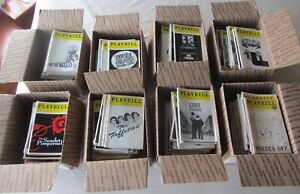
Sold on eBay February 17th, 2024
Huge lot of 317 BROADWAY PLAYBILLS from the 1990's to early 2000's
*** HUGE PRICE REDUCTION ***You're looking a HUGE lot of 317 of random official BROADWAY PLAYBILLS from the 1980's to early 2000's only. Dimension are roughly 8.5" x 5.5" in size. They cover theaters all over America, but mostly from the NYC area. These playbills are unique for the theatre and years of issue. In other words, there are no exact duplicates, but plays from the same theater for a different date with different cover and contents. Some have black & white cover pages while other have colorized cover pages. These programs are used, but in good vintage condition overall. Some of the programs are in better condition than others (none of them is complete beat up). The programs have imperfections such as: corner dings, creases, fold marks, writing (like a date on the show), sticker on cover page (with date), staple marks (from ticket stub), clear tape on corner of cover page, very small insignificant tears, minor cover page/spine wear, discoloration or staining due to age, and other similar imperfections. See pictures. Other minor flaws may be present. What you see is what you get. A few of these programs may come with original inserts. To be sold as a lot only. Great starter collection or opportunity to add to your playbill collection Here s a link to my UPS, USPS or FedEx Ground shipping within Continental US. Priority Mail international shipping is $300..Please ask any questions before making a purchase. Thanks and good luck! Complete list of programs in mostly alphabetical order:1.) After-Play (Theatre Four, March 1996)2.) Agnes Of God (Music Box, April 1982)3.) Ain't Misbehavin' (Ambassador, November 1988)4.) Alvin Ailey American Dance Theater (City Center, December 1998)5.) Amadeus (Broadhurst, June 1983)6.) Amy's View (Ethel Barrymore, May 1999)7.) And The World Goes 'Round (Westside, November 1991)8.) Annie (Uris, August 1982)9.) Annie Get Your Gun (Marquis, February 2000)10.)Annie Get Your Gun (Marquis, January 2000)11 )Anything Goes (Lincoln Center At The Vivian Beaumont, June 1988)12 )Anything Goes (Lincoln Center At The Vivian Beaumont, July 1989)13.)Arms And The Man (Roundabout, May 1989)14.)Arms And The Man (Circle In The Square, 19 )15 )Aspects Of Love (Broadhurst, May 1990)16.)Baby (Ethel Barrymore, May 1984) Centennial Edition17.)Baby (Ethel Barrymore, March 1984)18.)Beauty Queen Of Leenane (Walter Kerr, November 1998)19.)Beauty Queen Of Leenane (Atlantic, April 1998)20.)Beauty And The Beast (Palace, January 1997)21.)Beauty And The Beast (Wang, July 1998)22 )Benefactors (Brooks Atkinson, January 1986)23.)Best Little Whorehouse In Texas, The (Eugene O'Neill, May 1982)24.)Biloxi Blues (Neil Simon, November 1985)25.)Biloxi Blues (Neil Simon, 19??)26.)Black And Blue (Minkoff, December 1989)27.)Blood Brothers (Music Box, July 1993)28.)Blue Window (Manhattan Club, February 1996)29 )Breaking Legs (Promenade, February 1992)30 )Brighton Beach Memoirs (Neil Simon, 19 )31 )Brighton Beach Memoirs (46th Street, 19 )32 )Broadway Jukebox (John Houseman, August 1990)33 )Broadway (Imperial, February 1990)34 )Broadway (John Houseman, July 1992)35 )Broadway Sound (Broadhurst, December 1986)36 )Cabaret (Roundabout At Studio 54, 19??)37.)Caine Munity Court-Martial, The (Circle In The Square, June 1983)38 )Caretaker The (Circle In The Square, February 1986)39 )Carousel (Lincoln Center At The Vivian Beaumont, May 1994) 40.)Catskills On Broadway (Lunt-Fontanne, January 1992)41 )Catskills On Broadway (Lyric Opera House, 19??)42.)Cats (Winter Garden, January 2000)43 )Chairs The (John Golden, May 1998)44 )Chicago (Colonial, December 1997)45 )Chicago (Richard Rodgers, November 1996)46 )Checkmates (46th Street, November 1998)47.)Chorus Line, A (Shubert, December 1995)48.)City Of Angels (Virginia, April 1990)49.)Come Back To The 5 & Dime Jimmy Dean, Jimmy Dean (Martin Beck, March 1982)50.)Comedy Tonight (Lunt-Fontanne, December 1994)51 )Conversations With My Father (Royale, January 1993)52.)Corn Is Green, The (Lunt-Fontanne, September 1993)53.)Crazy For You (Shubert, October 1994)54.)Crazy For You (Shubert, July 1992) colorized55 )Crucible The (Belasco, 1992)56 )Current Events (Manhattan Theatre Club, May 2000)57.)Dance Theatre Of Harlem (City Center, January 1982)58 )Dancing At Lughnasa (Plymouth, April 1992)59.)Death Of A Salesman (Broadhurst, April 1994)60.)Death Of A Salesman (Eugene O'Neill. June 1999 61 )Devil s Disciple, The (Circle In The Square, January 1989)62.)Dinah Was (Gramercy, August 1998)63.)Dirty Rotten Scoundrels (Opera House, March 2000)64.)Do Black Patent Leather Shoes Really Reflect Up? (Wilbur, April 1985)65 )Doctor s Dilemma (Roundabout, January 1990)66.)Doll's House, A (Belasco, May 1997)67 )Doubles (Ritz, 1985)68 )Dreamgirls (Merriam, )69 )Dreamgirls (Imperial, March 1982)70 )Dresser The (Brooks Atkinson, March 1982)71 )Driving Miss Daisy (John Houseman, December 1989)72 )Exactly Like You (York, April 1999)73.)Evita (Shubert, November 1982)74.)Evita (Colonial, May 1994)75.)Evita (Broadway, October 1982)76 )Father The (Roundabout Criterion Center Stage Right, January 1996)77.)Fences (46th Street, December 1987)78.)Few Good Men, A (Music Box, November 1989)79 )Fiddler On The Roof (Gershwin, March 1991)80.)Five Guys Named Moe (Eugene O'Neill, March 1992)81 )Flowering Peach. The (Lyceum, March 1994)82.)Food Chain, The (Westside August 1995)83 )Forbidden Broadway Cleans Up Its Act! (Stardust, December 1998)84 )Forever Tango (Marquis, June 1998)85 )Forever Tango (Walter Kerr, January 1998)86.)84 Charis Cross Road (Nederlander, January 1983)87.)42nd Street (St. James, June 1988)88.)42nd Street (Shubert, June 1984)89.)42nd Street (Majestic, January 1982)90 )Footloose (Richard Rodgers, February 1999)91.)Fosse (Broadhurst, August 1999)92.)Four Dogs And A Bone (Lucille Lortel, June 1994)93 )Foxfire (Ethel Barrymore, November 1982)94 )Foxfire (Colonial, October 1982)95 )Frankie And Johnny In The Clair De Lune (Westside Arts, September 1988)96.)Fuddy Meers (Minetta Lane, February 2000)97 )Grandma Sylvia's Funeral (Soho Playhouse, January 1996)98.)G.B. Shaw's Getting Married (Circle In The Square, July 1991)99.)Ghosts (Brooks Atkinson, September 1982)100 )George M. Cohan's Give Me Regards To Broadway (Playhouse 91, July 1989)101.)Glass Menagerie, The (Roundabout Criterion Center Stage Right, November 1994)102.)Grand Hotel The Musical (Martin Beck, May 1991)103.)Gross Indecency The Three Trials Of Oscar Wilde (Minetta Lane (July 1998)104.)Guys And Dolls (Martin Beck, April 1993)105.)Guys In The Truck, The (New Apollo, June 1983)106.)H2$ (Richard Rodgers, December 1995)107.)Hay Fever (Music Box, March 1986)108.)Heidi Chronicles, The (Plymouth, April 1990)109.)Heidi Chronicles, The (Plymouth, May 1989)110 )Hello Dolly (Lunt-Fontanne, January 1996)111 )Hello Dolly (Lunt-Fontanne, October 1995)112 )Holiday Heart (Manhattan Club At City Center, April 1995)113 )Homecoming The (Roundabout Criterion Center Stage Right, October 1991)114 )Hurrah At Last (Gramercy, June 1999)115 )Harrigan 'N Hart (Longacre, 1994)116.)Ian McKellen Acting Shakespeare (Ritz, January 1984)117.)Ice Cream With Hot Fudge (New York Shakespeare Festival, April 1990)118.)Ideal Husband, An (Ethel Barrymore, December 1996)119 )Impossible Marriage (Roundabout Criterion Center Laura Pels, October 1998)120 )Inside Out (Cherry Lane, November 1994)121.)Into The Woods (Martin Beck, July 1988)122 )Irish And How They Got That Way (Wilbur, March 1998)123.)Is There Life After High School? (Ethel Barrymore, April 1982)124.)Isn't It Romance (Walnut Street, November 1985)125 )Jackie (Belasco, February 1998)126 )Jackie Mason (Neil Simon, January 1991)127 )Jackie Mason's The World According To Me! (Brooks Atkinson, January 1987)128 )Jake s Women (Neil Simon, August 1992)129 )Jacques Brel Is Alive & Well & Living Paris (Arden, ?)130.)Jeffrey (Minetta Lane, May 1993)131 )Jekyll & Hude (Plymouth, July 1997)132 )Jekyll & Hyde (Plymouth, May 1998)133 )Jerry s Girls (St. James, February 1986)134.)Joe Turner's Come And Gone (Ethel Barrymore. April 1988)135 )Joseph And The Amazing Technicolor Dreamcoat Royale, Januar 1982)136 ) Joseph And The Amazing Technicolor Dreamcoat (Minskoff, December 1993)137 )Joyicity (Actors' Playhouse, September 1982)138.)Judas Kiss, The (Broadhurst, June 1998)139.)June Moon (Variety Arts, February 1998)140.)Kat And The Kings (Cort, August 1999)141 )Kentucky Cycle, The (Royale, November 1993)142.)King And I, The (Neil Simon, May 1997)143.)King And I, The (Neil Simon, April 1996) colorized144 )Knife The (New York Shakespeare Festival Public Theater, March 1987)145.)King Lear by William Shakespeare (Roundabout, October 1990)146.)Kiss Me Kate (Martin Beck, January 2000)147.)Kiss Of The Spider Woman (Broadhurst, June 1994)148.)Labor Day (Manhattan Theatre Club, June 1998)149.)La Cage Aux Folles (Palace, 1985)150 )Legends (Shubert, August 1986)151.)Les Miserables (Broadway, February 1988)152.)Les Miserables (Imperial, January 1996)153.)Les Miserables (Colonial, ?)154.)Lettice & Lovage (Ethel Barrymore, September 1990)155 )Lieutenant Of Inishmore (Atlantic Theater Company, March 2006)156.)Life On The Third Rail (Theatre At Saint Peter's Church, October 1990)157 )Lighthouse The (Boston Shakespeare, November 1983)158 )Lillian (Ethel Barrymore, February 1986)159.)Lips Together Teeth Apart (Manhattan Theatre Club At City Center (December 1991)160 )Little Family Business, A (Martin Beck, November 1982)161 )Little Hotel On The Side, A (Belasco, February 1992)162 )Little Like Magic, A (Lyceum, October 1986)163 )Little Me (Roundabout Theatre Company Criterion Center Stage Right, December 1998)164.)Long Day's Journey Into Night (Broadhurst, May 1986)165.)Lost In Yonkers (Richard Rodgers, March 1992)166.)Love Letters (Promenade, September 1989)167.)Love Thy Neighbor (Booth, December 1996)168.)M. (Eugene O'Neill, December 1988)169.)Ma Rainey's Black Bottom (Cort, October 1984)170 )Machinal (New York Shakespear Festival Public Theater, October 1990)171.)Magic On Broadway (Lamb's, April 1997)172.)Mamma Mia! (Colonial, April 2003)173.)Man And Superman (Arden, October 1993)164.)Marie Christine (Lincoln Center At The Vivian Beaumont, December 1999)165 )Master Class (John Golden, October 1996)166 )Master Harold...And The Boys (Lyceum, August 1982)167 )Matchmaker The (Roundabout At The Haft Theater, July 1991)168.)Me And My Girl (Marquis, July 1987)169.)Medea (Longacre, June 1994)170 )Merchant Of Venice, The (46th Street, February 1990)171 )Merlin (Mark Hellinger, March 1983)172 )Misalliance (Roundabout Criterion Center Laura Pels, September 1997)173 )Misanthrope The (Circle In The Square, February 1983)174 )Miser The (Circle In The Square, December 1990)175.)Miss Saigon (Broadway, January 1998)176 )Mizlansky Zilansky Ar Schmucks (Manhattan Theatre Club, March 1998)177 )Moliere Comedies The School For Husbands The Imaginary Cuckold (Roundabout Criterion Center Stage Right, February 1995)178.)Molly Sweeney (Roundabout Criterion Center Laura Pels, May 1996)179.)Month In The Country, A (Roundabout Criterion Center Stage Right, May 1995)180.)Moon For The Misbegotten (Walter Kerr, May 2000)181 )Moonlight (Roundabout Criterion Center Laura Pels, December 1995)182.)Music Man, The (Neil Simon, June 2000)183.)Music Of The Night (Colonial, November 1996)184.)My One And Only (St. James, August 1983)185 )Mystery Of Edwin Drood, The (Imperial, January 1986)186 )National Theatre Magazine, The (NTM, December 1983)187 )National Theatre Magazine, The (NTM, January 1984)188 )National Theatre Magazine, The (NTM, November 1983)189 )National Theatre Magazine, The (NTM, March 1984)190 )National Theatre Magazine, The (NTM, September 1984)191 ) Night Mother (John Golden, July 1983)192.)Night And Her Stars (Manhattan Club At The American Place Theatre, April 1995)193.)Nine (46th Street, May 1983)194.)New England (Manhattan Theatre Club At City Center, December 1995)195.)No Man's Land (Roundabout Theatre Company Criterion Center Stage Right, March 1994)196.)Not About Nightingales (Circle In The Square, May 1999)197 )Noises Off (Brooks Atkinson, 1984)198 )Noises Off (Brooks Atkinson, May 1984) Centennial Edition199 )Nunsense (Charles Playhouse, ?)200.)Nunsense (Boston Shakespeare, November 1986)201 )Nunsense (Douglas Fairbanks, November 1991)202.)Only Thing Worse You Could Have Told Me..., The (Actor's Playhouse, June 1995)203.)Open Admissions (Music Box, February 1984)204 )Orpheus Descending (Neil Simon, December 1989)205 )Oedipus (Blue Light At CSC Theater, October 1998)206 )Othello (Winter Garden, January 1982)207.)Over The River And Through The Woods (John Houseman, July 1999)208.)Mo Show: Parallel Lives (Westside Arts, July 1989)209.)Park Your Car In Harvard Yard (Music Box, ?)210.)Passion (Plymouth, October 1994)211.)Penn & Teller Rot In Hell (John Houseman, August 1991)212.)Peter Nero And The Philly Pops (Academy Of Music, 1991)213 )Phantom Of The Opera (Majestic, September 1991)214 )Phantom Of The Opera (Wang, February 2001)215 )Phantom Of The Opera (Majestic, March 1997)216 )Philadelphia Here I Come (Roundabout Criterion Center Stage Right, October 1994)217.)Piano Lesson, The (Walter Kerr, May 1990)218 )Picnic (Roundabout Criterion Center Stage Right, April 1994)219.)Play Me A Country Song, A (Virginia, June 1982)220 )Plenty (Plymouth, February 1983)221 )Politically Correct (John Golden, July 1994)222.)Porgy And Bess (Radio City Music Hall, April 1983)223 )Pounding Nails (Minetta Lane, March 1994)224.)Power Plays (Promenade, October 1998)225 )Prelude To A Kiss (Helen Hayes, October 1990)226 )Present Laughter (Circle In The Square, July 1982)227 )Present Laughter (Walter Kerr, January 1997)228 )Present Laughter (Walter Kerr, February 1997)229 )Private Lives (Lunt-Fontanne, May 1983)230 )Privates On Parade (Roundabout, October 1989)231 )Producers The (Colonial, July 2003)232 )Price The (Roundabout Criterion Center Stage Right. July 1992)233.)Price Of Fame (Roundabout, June 1990)234.)Queen And The Rebels, The (Plymouth, October 1982)235 )Ragtime The Musical (Ford Center For The Performing Arts, January 2000)236 )Ragtime The Musical (Ford Center For The Performing Arts, November 1998)237.)Real Thing, The (Plymouth, 1984)238.)Red Diaper Baby (Actor's Playhouse, July 1992)239.)Rise Of David Levinsky, The (John Houseman, February 1987)240.)Road Show (Circle Repertory Company, June 1987)241.)Rose Tattoo, The (Circle In The Square, June 1995)242 )Salome (Circle In The Square, June 1992)243 )Scapin (Roundabout Criterion Center Laura Pels, December 1996) 244.)Scarlet Pimpernel, The (Minksoff, November 1998)245 )Scarlet Pimpernel, The (Minksoff, January 1998)246 )Search And Destroy (Circle In The Square, February 1992)247 )Search For intelligent Signs In The Universe, The (Plymouth, June 1986)248 )Secret Garden, The (St. James, February 1992)249 )Secret Rapture, The (New York Shakespeare Festival Public Theater, September 1989)250 )Shadowlands (Brooks Atkinson, January 1991)251 )Shakespeare For My Father (Helen Hayes, April 1993)252 )Shirley Valentine (Booth, November 1989)253.)Show Boat (Lyric Opera House, 1982)254.)Show Boat (Gershwin, September 1996)255.)Side Show (Richard Rodgers, January 1998)256 )Singin In The Rain (Gershwin, 1985)257 )Sisters Rosensweig, The (Ethel Barrymore. July 1993)258.)Six Degrees Of Separation (Lincoln Center At The Mitzi E. Newhouse (September 1990)259.)Six Degrees Of Separation (Lincoln Center At The Vivian Beaumont, January 1991)260 )Smokey Joe's Cafe The Songs Of Leiber And Stoller (Virginia, December 1998)261 )Smokey Joe's Cafe The Songs Of Leiber And Stoller (Virginia, August 1995)262 )Social Security (Ethel Barrymore, September 1986)263 )Someone Who'll Watch Over Me (Booth, February 1993)264 )Sophisticated Ladies (Lunt-Fontanne, June 1982)265.)Speed The Plow (Royale, August 1988)266.)Speed The Plow (Royale, November 1988)267.)Spunk (New York Shakespeare Festival Public Theater, April 1990)268 )Starlight Express (Gershwin, August 1987) colorized269 )Starlight Express (Gershwin, October 1987)270 )Street Corner Symphony (Brooks Atkinson, November 1987)271 )Strike Up The Band (City Center, February 1998)272 )Steaming (Brooks Atkinson, January 1993)273.)Stomp (Wilbur, November 1997)274.)Stomp (Orpheum, May 1994)275 )Student s Prince, The (Playhouse 91, February 1989)276 )Streetcar Named Desire, A (Ethel Barrymore, May 1992)277.)Suds The Rocking 60's Musical Soap Opera (Criterion, November 1988)278 )Summer And Smoke (Roundabout Criterion Center Stage Company, September 1996)279 )Taffetas (Village Gate Upstairs, February 1989)280.)Talk Radio (New York Shakespeare Festival Public Theater, May 1987)281.)Tap Dance Kid, The (Minskoff, 1985)282.)Tap Dance Kid, The (Broadhurst, February 1984)283 )Tempest The (Roundabout, October 1989)284 )Tenderloin (City Center, March 2000)285.)Texts For Nothing (Joseph Papp, ?)286.)Three Birds Alighting On A Field (Manhattan Theatre Club At City Center, February 1994) 287.)Three Days Of Rain (Manhattan Theatre Club, December 1997)288.)Three Tall Women (Promenade, April 1994)289.)Tis Pity She's A Whore (New York Shakespeare Festival Public Theater, April 1992)290 )Titanic (Lunt-Fontanne, May 1998)291.)Torch Song Trilogy (Little Theatre, July 1982)292.)Torch Song Trilogy (Helen Hayes, 1985)293 )Treatment The (Joseph Rapp, November 1993)294.)Tru (Booth, March 1990)295.)Twice Around The Park (Cort, November 1982)296.)Two Trains Running (Walter Kerr, June 1992)297.)Wake Of Jamey Foster, The (Eugene O'Neill, October 1982)298.)Water Engine, The (Atlantic, October 1999)299 )What s Wrong With This Picture? (Brooks Atkinson, December 1994)300 )Welcome To The Club (Music Box, April 1989)301 )Whoop Dee Doo (Actors' Playhouse, September 1993)302 )Whoopi Goldberg (Lyceum, 1984)303.)Who's Tommy (St. James, September 1993)304.)Woman Of The Year (Palace, August 1982)305.)Woman Of The Year (Palace, February 1982)306 )Wonderful Town (Al Hirschfeld, January 2004)307.)World According To Me, The (Brooks Atkinson, April 1987)308 )Unidentified Himan Remains And The True Nature Of Love (Orpheum, October 1991)309 )Vampire Lesbians Of Sodom And Sleeping Beauty Or Coma (Provincetown Playhouse, January 1989)310 )Victor Victoria (Marquis, January 1996)311.)View From The Bridge, A (Ambassador, April 1983)312 )Visit The (Roundabout Criterion Center Stage Right, January 1992)313.)Vita & Virginia (Union Square, January 1995)314.)Will Rogers Follies A Life In The Revue (Palace, June 1991)315 )Years The (Manhattan Theatre Club At City Center, January 1993)316.)You Can't Take It With You (Plymouth, April 1983)317.)You Never Can Tell (Circle In The Square, November 1986)318.)Your Arms Too Short To Box With God (Alvin, October 1982)319.)Zorba (Broadway, December 1983)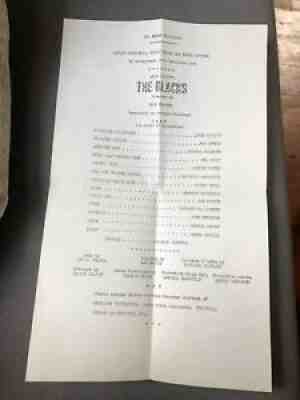
Sold on eBay Sep 07, 2021
THE BLACKS Playbill 1961 St Marks ORIGINAL PROGRAM Cicely Tyson & Original Cast
Cicely Tyson. "THE BLACKS " Playbill, by Jean Genet - Saint Mark's Playhouse, NYC, 1961. ORIGINAL CAST I'm sure we can. Minnie Gentry. Duke Williams. Lex Monson .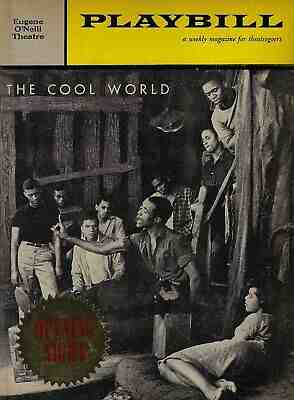
Sold on eBay Apr, 14th 2020
Billy Dee Williams "COOL WORLD" Cicely Tyson 1960 FLOP Opening Night Playbill
This nbsp;is nbsp;a nbsp;rare February 22nd, 1960 PREMIERE PERFORMANCE playbill from the Original Broadway nbsp;production of the WARREN MILLER and ROBERT ROSSEN play "THE COOL WORLD" at the Eugene O'Neill Theatre in New York City. (The production openedFebruary 22nd, 1960 nbsp;and nbsp;closed nbsp;February 23rd, 1960 after only nbsp;two ) ..... The play starredBILLY DEE WILLIAMS, ALEASE WHITTINGTON, HILDA SIMMS, P. JAY SIDNEY, ALICE CHILDRESS, ROSCOE LEE BROWNE, LYNN HAMILTON, CALVIN LOCKHART, HAROLD SCOTT, RAYMOND SAINT-JACQUES, EULABELLE MOO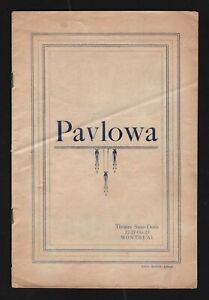
Sold on eBay February 5th, 2024
Ballet Legend ANNA PAVLOVA (Pavlowa) Laurent Novikoff 1923 Montreal Program
eBay This is a rare October 25th, 1923 program (playbill) from the one-week engagement of the Incomparable ANNA PAVLOVA and her Corps de Ballet at the Theatre Saint-Denis in Montreal, Quebec, Canada ..... The engagement included the Ballets "A POLISH WEDDING", "CHOPINIANA", "MAGIC FLUTE", "AUTUMN LEAVES", "AMARILLA", "ORIENTAL IMPRESSIONS" and several Divertissements and included performances by ANNA PAVLOWA, LAURENT NOVIKOFF, HILDA BUTSOVA, M. PIANOWSKI, J. ZALEWSKI, ANDRE OLIVEROFF, FR. VAGINSKI and the Corps de Ballet, with IVAN CLUSTINE, the eminent Ballet Director and THEODORE STIER conducting the Symphony Orchestra ..... Biographical Note: Mlle. ANNA PAVLOVA (1881-1931) is widely regarded as one of the finest classical ballet dancers in history and was most noted as a Principal artist of the Imperial Russian Ballet and the Ballets Russes of Serge Diaghilev. Pavlova is most recognized for the creation of the rôle "The Dying Swan" and with her own company, would become the first ballerina to tour ballet around the world. Pavlova's passion for the art of ballet was realized when her mother took her to a performance of Marius Petipa's original production of The Sleeping Beauty at the Imperial Mariinsky Theatre. The lavish spectacle made an impression on the young Pavlova, and at the age of eight her mother took her to audition for the renowned Imperial Ballet School where she was finally accepted at age ten. Upon graduating, she began to perform at the Mariinsky Theatre, debuting on September 19th, 1899. In 1907, Anna Pavlova began her first tour, to Moscow, and by 1910 was appearing at the Metropolitan Opera House in America. In 1914, she was traveling through Germany on her way to England when Germany declared war on Russia. At that time, her connection to Russia was for all intents broken. For the rest of her life, Anna Pavlova toured the world with her own company and kept a home in London, where her exotic pets were constant company when she was there. While her contemporary, Isadora Duncan, introduced revolutionary innovations to dance, Anna Pavlova remained largely committed to the classic style. She was known for her daintiness, frailness, lightness and both wittiness and pathos. Her last world tour was in 1928-29 and her last performance in England in 1930. Anna Pavlova appeared in a few silent films: one, The Immortal Swan, she shot in 1924 but it was not shown until after her death. Anna Pavlova died of pleurisy in the Netherlands in 1931. (Reprinted in part from the website About.com.) ..... PROGRAM DETAILS: The sixteen page program measures 6 7/8" X 10 1/4" inches and includes production credits, names of the dancers, a list of the ballets and divertissements in the repertoire and wonderful vintage advertising, but no photos or bios ..... CONDITION: (Please Note!) There is a heavy diagonal fold, a clipped corner to the back cover, the start of splits at both the top and bottom seam, creasing at the corners and moderate edge wear. Despite these flaws, this rare program will make a wonderful addition to the collection of any classical music aficionado or dance historian. This item will be carefully packaged in a protective, carded sleeve and backed by stiff cardboard.
Sold on eBay May 5th, 2024
*LEGENDARY DANCER ISADORA DUNCAN RARE 1916 DANCE PROGRAM*
A rare large original 1916 dance program for the legendary Isadora Duncan. Four pages. Dimensions ten and three quarters by five and a half inches. Light wear otherwise good. See Isadora Duncan's extraordinary biography below. Shipping discounts for multiple purchases. Inquiries always welcome. Please visit my other eBay items for more early ballet and dance memorabilia, early theatre, opera, film, magic, and historical autographs, photographs, programs and broadsides, and great actor and actress cabinet photos and CDV's.From Isadora Duncan (May 26, 1877 or May 27, 1878[a] – September 14, 1927) was an American and French dancer who performed to acclaim throughout Europe. Born in California, she lived in Western Europe and the Soviet Union from the age of 22 until her death at age 50, when her scarf became entangled in the wheels and axle of the car in which she was riding.Isadora Duncan was born in San Francisco, the youngest of the four children of Joseph Charles Duncan (1819–1898), a banker, mining engineer and connoisseur of the arts, and Mary Isadora Gray (1849–1922). Her brothers were Augustin Duncan and Raymond Duncan;[2] her sister, Elizabeth Duncan, was also a dancer.[3][4] Soon after Isadora's birth, her father was exposed to illegal bank dealings, and the family became extremely poor.[2]Her parents divorced when she was an infant,[5] and her mother moved with her family to Oakland, California, where she worked as a seamstress and piano teacher. From ages six to ten, Isadora attended school, but she dropped out, finding it constricting. As her family was very poor, she and her three siblings earned money by teaching dance to local children.[2]In 1896, Duncan became part of Augustin Daly's theater company in New York, but she soon became disillusioned with the form and craved a different environment with less of a hierarchy.[6] Her father, along with his third wife and their daughter, died in 1898 when the British passenger steamer SS Mohegan ran aground off the coast of Cornwall [7]WorkPhoto by Arnold Genthe of Duncan performing barefoot during her 1915–1918 American tourAbraham Walkowitz's Isadora Duncan #29, one of many works of art she inspired.Duncan began her dancing career at a very early age by giving lessons in her home to neighbourhood children, and this continued through her teenage years.[8] Her novel approach to dance was evident in these early classes, in which she "followed [her] fantasy and improvised, teaching any pretty thing that came into [her] head".[9] A desire to travel brought her to Chicago, where she auditioned for many theater companies, finally finding a place in Augustin Daly's company. This took her to New York City where her unique vision of dance clashed with the popular pantomimes of theater companies.[10] In New York, Duncan took some classes with Marie Bonfanti but was quickly disappointed in ballet routine.Feeling unhappy and unappreciated in America, Duncan moved to London in 1898. She performed in the drawing rooms of the wealthy, taking inspiration from the Greek vases and bas-reliefs in the British Museum.[11][12] The earnings from these engagements enabled her to rent a studio, allowing her to develop her work and create larger performances for the stage.[13] From London, she traveled to Paris, where she was inspired by the Louvre and the Exposition Universelle of 1900.[14]In 1902, Loie Fuller invited Duncan to tour with her. This took Duncan all over Europe as she created new works using her innovative technique,[15] which emphasized natural movement in contrast to the rigidity of tradition ballet.[16] She spent most of the rest of her life touring Europe and the Americas in this fashion.[17] Despite mixed reaction from critics, Duncan became quite popular for her distinctive style and inspired many visual artists, such as Antoine Bourdelle, Auguste Rodin, Arnold Rönnebeck, and Abraham Walkowitz, to create works based on her.[18]Duncan disliked the commercial aspects of public performance, such as touring and contracts, because she felt they distracted her from her real mission, namely the creation of beauty and the education of the young.[citation needed] To achieve her mission, she opened schools to teach young women her philosophy of dance. The first was established in 1904 in Berlin Grunewald Germany. This institution was the birthplace of the "Isadorables" (Anna, Maria-Theresa, Irma, Liesel, Gretel, and Erika[19]), Duncan's protégées who would continue her legacy.[20] Duncan legally adopted all six girls in 1919, and they took her last name.[21] After about a decade in Berlin, Duncan established a school in Paris that was shortly closed because of the outbreak of World War I.[22]In 1910, Duncan met the occultist Aleister Crowley at a party, an episode recounted by Crowley in his Confessions [23] He refers to Duncan as "Lavinia King", and used the same invented name for her in his novel Moonchild. Crowley wrote of Duncan that she "has this gift of gesture in a very high degree. Let the reader study her dancing, if possible in private than in public, and learn the superb unconsciousness — which is magical consciousness — with which she suits the action to the melody."[24] Crowley was, in fact, more attracted to Duncan's bohemian companion Mary Dempsey (a.k.a. Mary D'Este or Desti), with whom he had an affair. Desti had come to Paris in 1901 where she soon met Duncan, and the two became inseparable. Desti, who also appeared in Moonchild (as "Lisa la Giuffria") and became a member of Crowley's occult order,[b] later wrote a memoir of her experiences with Duncan.[25]In 1911, the French fashion designer Paul Poiret rented a mansion — Pavillon du Butard in La Celle Saint Cloud — and threw lavish parties, including one of the more famous grandes fêtes, La fête de Bacchus on June 20, 1912, re-creating the Bacchanalia hosted by Louis XIV at Versailles. Isadora Duncan, wearing a Greek evening gown designed by Poiret,[26] danced on tables among 300 guests; 900 bottles of champagne were consumed until the first light of day.[26]Duncan c. 1916–1918Duncan said to have posed for the photographer Eadweard Muybridge,[27] placed an emphasis on "evolutionary" dance motion, insisting that each movement was born from the one that preceded it, that each movement gave rise to the next, and so on in organic succession. Her dancing defined the force of progress, change, abstraction and liberation. In France, as elsewhere, Duncan delighted her audience.[28]In 1914, Duncan moved to the United States and transferred her school there. A townhouse on Gramercy Park was provided for its use, and its studio was nearby, on the northeast corner of 23rd Street and Fourth Avenue (now Park Avenue South).[29] Otto Kahn, the head of Kuhn, Loeb & Co., gave Duncan use of the very modern Century Theatre at West 60th Street and Central Park West for her performances and productions, which included a staging of Oedipus Rex that involved almost all of Duncan's extended entourage and friends.[30] During her time in New York, Duncan posed for a number of studies by the photographer Arnold Genthe.Duncan had been due to leave the United States in 1915 aboard the RMS Lusitania on its ill-fated voyage, but historians believe her financial situation at the time drove her to choose a more modest crossing.[31] In 1921, Duncan's leftist sympathies took her to the Soviet Union, where she founded a school in Moscow. However, the Soviet government's failure to follow through on promises to support her work caused her to return to the West and leave the school to her protégée Irma.[32] In 1924, Duncan composed a dance routine called Varshavianka to the tune of the Polish revolutionary song known in English as Whirlwinds of Danger [33]Philosophy and techniqueDuncan in a Greek-inspired pose and wearing her signature Greek tunic. She took inspiration from the classical Greek arts and combined them with an American athleticism to form a new philosophy of dance, in opposition to the rigidity of traditional ballet.Breaking with convention, Duncan imagined she had traced dance to its roots as a sacred art.[34] She developed from this notion a style of free and natural movements inspired by the classical Greek arts, folk dances, social dances, nature and natural forces as well as an approach to the new American athleticism which included skipping, running, jumping, leaping and tossing [citation needed]Duncan's philosophy of dance moved away from rigid ballet technique and towards what she perceived as natural movement. To restore dance to a high art form instead of merely entertainment, she strove to connect emotions and movement: "I spent long days and nights in the studio seeking that dance which might be the divine expression of the human spirit through the medium of the body's movement."[35] She believed dance was meant to encircle all that life had to offer—joy and sadness. Duncan took inspiration from ancient Greece and combined it with an American love of freedom. Her movement was feminine and arose from the deepest feelings in her body. This is exemplified in her revolutionary costume of a white Greek tunic and bare feet. Inspired by Greek forms, her tunics also allowed a freedom of movement that corseted ballet costumes and pointe shoes did not.[36] Costumes were not the only inspiration Duncan took from Greece: she was also inspired by ancient Greek art, and utilized some of its forms in her movement (see image) [37]Duncan wrote of American dancing: "let them come forth with great strides, leaps and bounds, with lifted forehead and far-spread arms, to dance."[38] Her focus on natural movement emphasized steps, such as skipping, outside of codified ballet technique. Duncan also cited the sea as an early inspiration for her movement.[39] Also, she believed movement originated from the solar plexus, which she thought was the source of all movement.[35] It is this philosophy and new dance technique that garnered Duncan the title of the creator of modern dance.Photo studies of Isadora Duncan made in New York by Arnold Genthe during her visits to America in 1915–1918 Personal lifeDuncan with her children Deirdre and Patrick, in 1913In both professional and private life, Duncan flouted traditional mores and morality. She was bisexual[40] and an atheist,[41] and alluded to her communism during her last United States tour, in 1922–23: she waved a red scarf and bared her breast on stage in Boston, proclaiming, "This is red! So am I!"[42]Duncan bore two children, both out of wedlock. The first, Deirdre Beatrice (born September 24, 1906), by theatre designer Gordon Craig, and the second, Patrick Augustus (born May 1, 1910),[43] by Paris Singer, one of the many sons of sewing machine magnate Isaac Singer. Both children drowned in the care of their nanny in 1913 when their runaway car went into the Seine [43]Following the accident, Duncan spent several months recuperating in Corfu with her brother and sister. She then spent several weeks at the Viareggio seaside resort with the actress Eleonora Duse. The fact that Duse had just left a relationship with the rebellious and epicene young feminist Lina Poletti fueled speculation as to the nature of Duncan and Duse's relationship, but there has never been any indication that the two were involved romantically [44]Duncan and Sergei YeseninIn her autobiography, Duncan relates that she begged a young Italian stranger, the sculptor Romano Romanelli,[45] to sleep with her because she was desperate for another baby. She became pregnant by him, and gave birth to a son on August 13, 1914; the infant died shortly after birth [46][47]In 1921, after the end of the Russian Revolution, Duncan moved to Moscow where she met the acclaimed poet Sergei Yesenin, who was 18 years her junior. On May 2, 1922, they married, and Yesenin accompanied her on a tour of Europe and the United States. However, the marriage was brief, and in May 1923 he left Duncan and returned to Moscow. Two years later, on December 28, 1925, Yesenin was found dead in his room in the Hotel Angleterre in St Petersburg in an apparent suicide [48]Duncan had a relationship with the poet and playwright Mercedes de Acosta, as documented in numerous revealing letters they wrote to each other.[49] In one, Duncan wrote, "Mercedes, lead me with your little strong hands and I will follow you – to the top of a mountain. To the end of the world. Wherever you wish."[50]Later lifeBy the late 1920s, Duncan's performing career had dwindled, and she became as notorious for her financial woes, scandalous love life and all too frequent public drunkenness as for her contributions to the arts. She spent her final years moving between Paris and the Mediterranean, running up debts at hotels. She spent short periods in apartments rented on her behalf by a decreasing number of friends and supporters, many of whom attempted to assist her in writing an autobiography. They hoped it might be successful enough to support her.[citation needed] In a reminiscent sketch, Zelda Fitzgerald wrote how she and F. Scott Fitzgerald, her husband, sat in a Paris cafe watching a somewhat drunk Duncan. He would speak of how memorable it was, but what Zelda recalled was that while all eyes were watching Duncan, Zelda was able to steal the salt and pepper shakers from the table.[51]In his book Isadora, an Intimate Portrait, Sewell Stokes, who met Duncan in the last years of her life, describes her extravagant waywardness. Duncan's autobiography My Life was published in 1927. The Australian composer Percy Grainger called Isadora's autobiography a "life-enriching masterpiece [52]DeathDuncan s tomb at Père Lachaise CemeteryOn the night of September 14, 1927, in Nice, France, Duncan was a passenger in an Amilcar CGSS automobile owned by Benoît Falchetto, a French-Italian mechanic. She wore a long, flowing, hand-painted silk scarf, created by the Russian-born artist Roman Chatov, a gift from her friend Mary Desti, the mother of American film director Preston Sturges. Desti, who saw Duncan off, had asked her to wear a cape in the open-air vehicle because of the cold weather, but she would only agree to wear the scarf.[53] As they departed, she reportedly said to Desti and some companions, "Adieu, mes amis. Je vais à la gloire !" ("Farewell, my friends. I go to glory!"); but according to the American novelist Glenway Wescott, Desti later told him that Duncan's actual parting words were, "Je vais à l'amour" ("I am off to love"). Desti considered this embarrassing, as it suggested that she and Falchetto were going to her hotel for a tryst.Her silk scarf, draped around her neck, became entangled around the open-spoked wheels and rear axle, pulling her from the open car and breaking her neck.[1] Desti said she called out to warn Duncan about the scarf almost immediately after the car left. Desti brought Duncan to the hospital, where she was pronounced dead.[53]As The New York Times noted in its obituary, Duncan "met a tragic death at Nice on the Riviera." "According to dispatches from Nice, Duncan was hurled in an extraordinary manner from an open automobile in which she was riding and instantly killed by the force of her fall to the stone pavement."[57] Other sources noted that she was almost decapitated by the sudden tightening of the scarf around her neck.[58] The accident gave rise to Gertrude Stein's mordant remark that "affectations can be dangerous".[59] At the time of her death, Duncan was a Soviet citizen. Her will was the first of a Soviet citizen's to be probated in the U.S.[60]Duncan was cremated, and her ashes were placed next to those of her children[61] in the columbarium at Père Lachaise Cemetery in Paris.[62] On the headstone of her grave is inscribed École du Ballet de l'Opéra de Paris ("Ballet School of the Opera of Paris ) LegacyDuncan is known as "The Mother of Dance". While her schools in Europe did not last long, Duncan's work had impact in the art and her style is still danced based upon the instruction of Maria-Theresa Duncan,[63] Anna Duncan,[64] and Irma Duncan,[65] three of her six adopted daughters. The adoption process was never verified, but all six of Isadora's dancers did change their last name to Duncan. Through her sister, Elizabeth, Duncan's approach was adopted by Jarmila Je?ábková from Prague where her legacy persists.[66] By 1913 she was already being celebrated. When the Théâtre des Champs Élysées was built, Duncan's likeness was carved in its bas-relief over the entrance by sculptor Antoine Bourdelle and included in painted murals of the nine muses by Maurice Denis in the auditorium. In 1987, she was inducted into the National Museum of Dance and Hall of Fame.Anna, Lisa,[67] Theresa and Irma, pupils of Isadora Duncan's first school, carried on the aesthetic and pedagogical principles of Isadora's work in New York and Paris. Choreographer and dancer Julia Levien was also instrumental in furthering Duncan's work through the formation of the Duncan Dance Guild in the 1950s and the establishment of the Duncan Centenary Company in 1977 [68]Another means by which Duncan's dance techniques were carried forth was in the formation of the Isadora Duncan Heritage Society, by Mignon Garland, who had been taught dance by two of Duncan's key students. Garland was such a fan that she later lived in a building erected at the same site and address as Duncan, attached a commemorative plaque near the entrance, which is still there as of 2016. Garland also succeeded in having San Francisco rename an alley on the same block from Adelaide Place to Isadora Duncan Lane.[69][70]In medicine, the Isadora Duncan Syndrome refers to injury or death consequent to entanglement of neckwear with a wheel or other machinery [71]In popular cultureDuncan has attracted literary and artistic attention from the 1920s to the present, in novels, film, ballet, theatre, music, and poetry.Duncan has been portrayed in novels including Aleister Crowley's Moonchild (as 'Lavinia King'), published in 1923,[72] and Upton Sinclair's World's End (1940) and Between Two Worlds (1941), the first two novels in his Pulitzer Prize winning Lanny Budd series.[73] She is also the subject of Amelia Gray's novel Isadora (2017).[74] Two characters in the A Series of Unfortunate Events series of novels are named after her, Isadora Quagmire and Duncan Quagmire [75]Among the films featuring Duncan are:The 1966 BBC biopic by Kenneth Russell, Isadora Duncan, the Biggest Dancer in the World, which was introduced by Duncan's biographer, Sewell Stokes, Duncan was played by Vivian Pickles.[76]The 1968 film Isadora, nominated for the Palme d'Or at Cannes, stars Vanessa Redgrave as Duncan. The film was based in part of Duncan's autobiography. Redgrave was nominated for the Academy Award for Best Actress for her performance as Duncan [76][77]Archival footage of Duncan was used in the 1985 popular documentary That's Dancing [78][79]A 1989 documentary, Isadora Duncan: Movement from the Soul, was nominated for the Grand Jury Prize at the 1989 Sundance Film Festival [80]Ballets based on Duncan include:In 1976 Frederick Ashton created a short ballet entitled Five Brahms Waltzes in the Manner of Isadora Duncan for Lynn Seymour of the Royal Ballet, in which "Ashton fused Duncan's style with an imprint of his own"; Marie Rambert claimed after seeing it that it was exactly as she remembered Duncan dancing.[81]In 1981, she was the subject of a ballet, Isadora, written and choreographed by the Royal Ballet's Kenneth MacMillan, and performed at Covent Garden.[82]On the theatre stage, Duncan is portrayed in:A 1991 stage play When She Danced by Martin Sherman about Duncan's later years, won the Evening Standard Award for Vanessa Redgrave as Best Actress.[83]In 2016, Lily-Rose Depp portrayed Duncan in The Dancer, a French biographical musical drama of dancer Loie Fuller [84]Duncan is featured in music in:The popular 1970s TV sitcom Maude mentions her in its theme song: "Isadora was the first bra burner Ain t ya glad she showed up?"Celia Cruz recorded a track titled Isadora Duncan with the Fania All-Stars for the album Cross Over released in 1979.[85]Rock musician Vic Chesnutt included a song about Duncan on his debut album Little.[86]Rock band Burden of a day included a song about Duncan on their album the poem Fever 103 by Sylvia Plath, the speaker alludes to Isadora's scarves.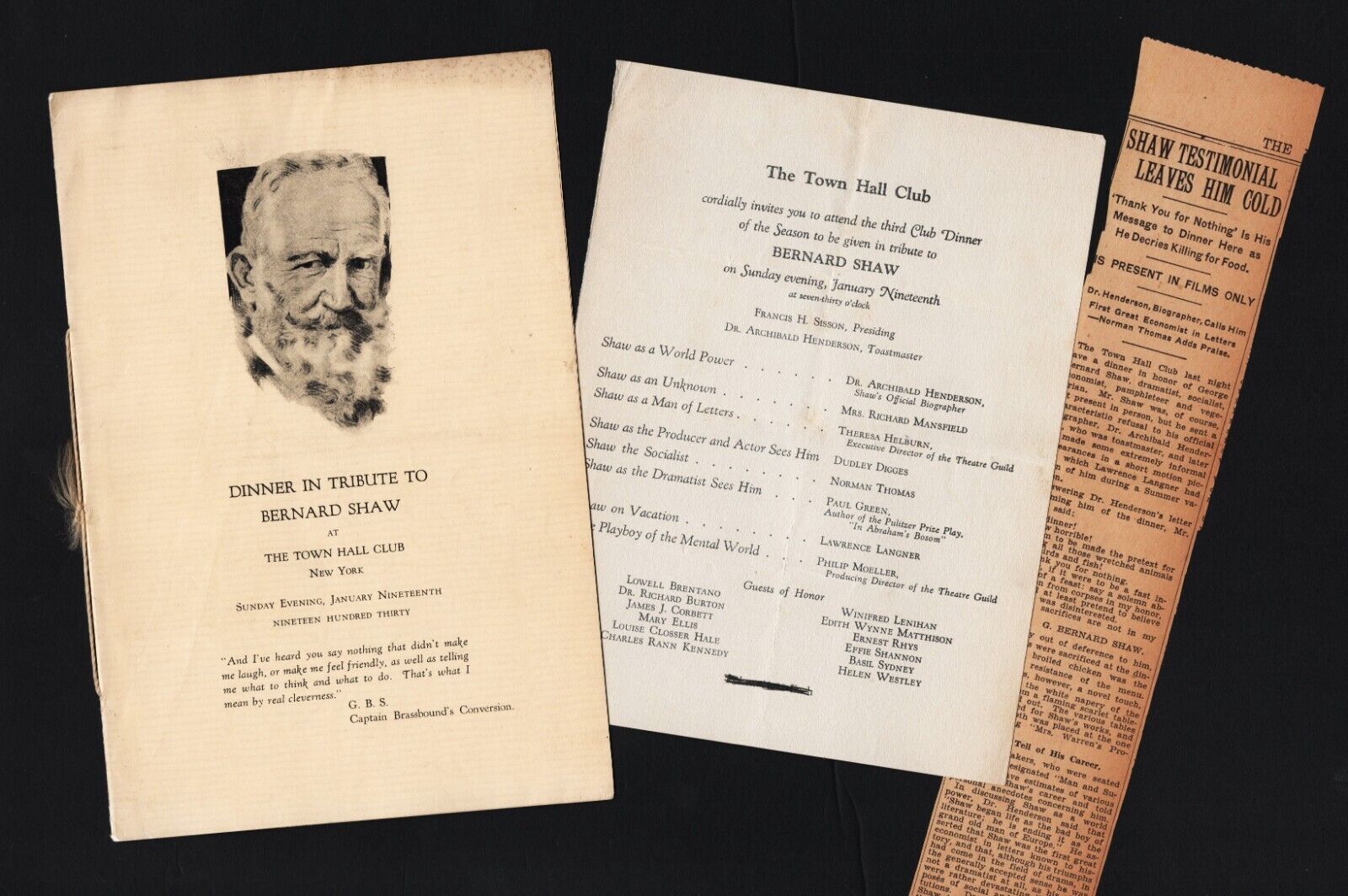
Sold on eBay February 16th, 2025
Tribute Dinner / GEORGE BERNARD SHAW / Town Hall Club 1930 New York City Program
This is a rare program from the Dinner In Tribute to BERNARD SHAW at the Town Hall in New York City on Sunday evening, January 19th, 1930. Among the evening's speakers were Dr. Archibald Henderson, Mrs. Richard Mansfield, Theresa Helburn, Norman Thomas, Paul Green, Philip Moeller and Lawrence Langner ..... Biographical note: GEORGE BERNARD SHAW (July 26, 1856 – November 2nd, 1950) was born in Dublin, Ireland, the son of a civil servant. Although he was best known for drama, he was also proficient in the areas journalism, music literary criticism. He began his literary career as a novelist. Shaw’s works concerned themselves mostly with prevailing social problems, specifically with what he saw as the exploitation of the working middle class. Shaw attended various schools throughout his youth but always harbored an animosity towards schools and teachers. He is quoted as saying that “Schools and schoolmasters, as we have them today, are not popular as places of education and teachers, but rather prisons and turnkeys in which children are kept to prevent them disturbing and chaperoning their parents”. In his personal life, Shaw was an avid Socialist and a member of the Fabian society. In 1898 he married fellow Fabian member and Irish heiress Charlotte Payne-Townsend. He was the first person to be awarded the Nobel prize for Literature as well as an Oscar (for his work on "Pygmalion", which was an adaptation of his play of the same name). He wrote 60 plays, most of which deal with social themes such as marriage, religion, class government and health care. Among his more prominent works were "Arms and the Man", "Mrs. Warren’s Profession", "Candida", "You Can Never Tell", "The Devil’s Disciple", "Caesar and Cleopatra", "Captain Brassbound’s Conversion", "Man and Superman", "Major Barbara", "The Doctor’s Dilemma", "Misalliance", "Androcles and the Lion", "Pygmalion", "Heartbreak House", "Back to Methuselah", "Saint Joan", "The Apple Cart" and "Too True to be Good". Two of his greatest influences were Henrik Ibsen and Henry Fielding. Ibsen’s plays and Fielding’s expulsion from playwriting inspired him to write his own plays on the social injustices of the world around him, including the late nineteenth century censorship of plays, continued from Prime Minister Walpole’s rein in the mid 1740's. The Lord Chamberlain’s Examiner of Plays especially irked him: “A gentleman who robs, insults, and suppresses me as irresistibly as if he were the Tsar of Russia and I the meanest of his subjects… But I must submit [my play] in order to obtain from him an insolent and insufferable document, which I cannot read without boiling of the blood, certifying that in his opinion — his opinion!– my play ‘does not in its general tendency contain anything immoral or otherwise improper for the stage,’ and that the Lord Chamberlain therefore ‘allows’ its performance (confound his impudence!).” George Bernard Shaw died at the age of 94 due to injuries incurred from falling while pruning a tree. (Reprinted in part from the British Literature Wiki site) ..... The production opened September 14th, 1925 at the Guild Theatre, transferred on October 19th, 1925 to the 49th Street Theatre and settled into the Garrick Theatre on December 2nd, 1925, running for a combined 180 performances.) ..... DETAILS: The eight page program measures 6 1/8" X 9 1/8" inches and includes the evening's program details and list of attendees with table assignments. The single page program lists the speakers, their topics and the list of Guests of Honor ..... BONUS: Includes a newspaper clipping with a recap of the evening, noting that Bernard Shaw was not in attendance ..... CONDITION: With the exception of minor creasing to both programs, soiling to the covers and moderate edge wear, this rare set is in excellent condition and will make a wonderful addition to the collection of any theatre aficionado or historian. These items will be carefully packaged in a protective, carded sleeve and backed by stiff cardboard.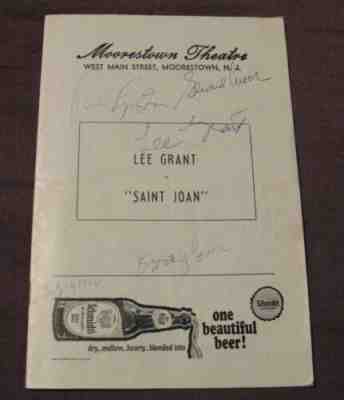
Sold on eBay Dec 04, 2022
Rare 1966 Signed Roy Scheider, Lee Grant, and others "Saint Joan" Playbill
Roy Scheider signature is on separate piece of paper. "Saint Joan" Playbill. July 10, 1966. Missing one staple so inner sections at top are a little 'loose'.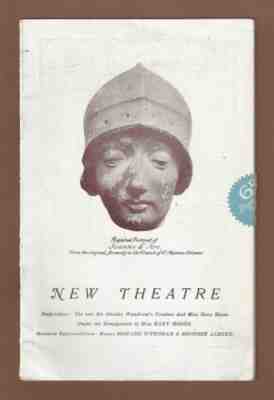
Sold on eBay Jan 28, 2023
Sybil Thorndike "SAINT JOAN" Bernard Shaw / Raymond Massey 1924 London Playbill
(This is a rare program (playbill) from the Original West End production of the GEORGE BERNARD SHAW classic "SAINT JOAN" at the New Theatre in London. The London production opened March 26th, 1924 and ran for 244 performances.).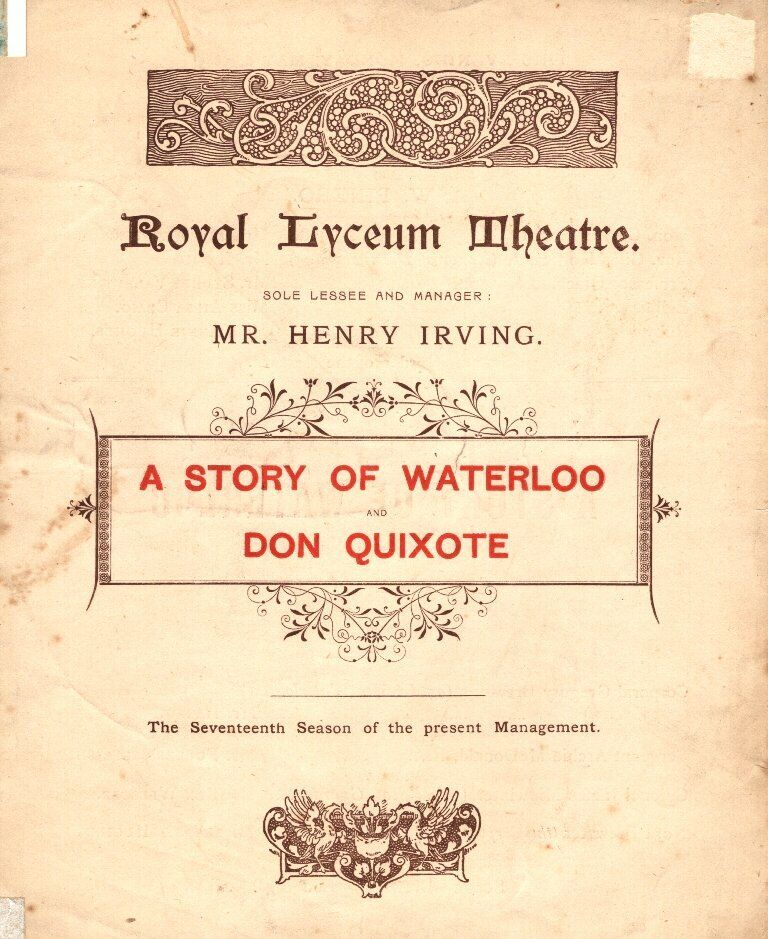
Sold on eBay January 18th, 2025
*SHERLOCK HOLMES: ARTHUR CONAN DOYLE RARE 1895 WATERLOO SECOND NIGHT PROGRAM*
A rare original Lyceum Theatre second night program for Sherlock Holmes author A. Conan Doyle's A Story of Waterloo starring Sir Henry Irving. Also featured on the bill are Arthur Wing Pinero's Bygones and Don Quixote, with Irving in the title role and Ellen Terry's daughter Ailsa Craig. Future Dracula author Bram Stoker is listed as Acting Manager. Four pages. Dimensions eight and a quarter by six and three quarters inches. Light wear, archival reinforcement at corners and general dusting and staining else good. See A. Conan Doyle and Henry Irving's extraordinary biographies below. Shipping discounts for multiple purchases. Inquiries always welcome. Please visit my other eBay items for more early theatre, opera, film and historical autographs, photographs and programs and great actor and actress cabinet photos and CDV's. From Wikipedia: Sir Arthur Ignatius Conan Doyle KStJ DL (22 May 1859 – 7 July 1930) was a British writer and medical doctor. He created the character Sherlock Holmes in 1887 when he published A Study in Scarlet, the first of four novels and more than fifty short stories about Holmes and Dr. Watson. The Sherlock Holmes stories are generally considered milestones in the field of crime fiction.Doyle was a prolific writer; other than Holmes stories, his works include fantasy and science fiction stories about Professor Challenger and humorous stories about the Napoleonic soldier Brigadier Gerard, as well as plays, romances, poetry, non-fiction and historical novels. One of Doyle's early short stories, "J. Habakuk Jephson's Statement" (1884), helped to popularise the mystery of the Mary Celeste.Doyle was born on 22 May 1859 at 11 Picardy Place, Edinburgh, Scotland.[5][6] His father, Charles Altamont Doyle, was English, of Irish Catholic descent, and his mother, Mary (née Foley), was Irish Catholic. His parents married in 1855.[7] In 1864 the family scattered because of Charles's growing alcoholism, and the children were temporarily housed across Edinburgh. Arthur lodged with Mary Burton, the aunt of a friend, at Liberton Bank House on Gilmerton Road, while studying at Newington Academy.[8]In 1867, the family came together again and lived in squalid tenement flats at 3 Sciennes Place.[9] Doyle's father died in 1893, in the Crichton Royal, Dumfries, after many years of psychiatric illness [10][11] Beginning at an early age, throughout his life, Doyle wrote letters to his mother, and many of them were preserved [12]Supported by wealthy uncles, Doyle was sent to England, at the Jesuit preparatory school Hodder Place, Stonyhurst in Lancashire at the age of nine (1868–70). He then went on to Stonyhurst College, which he attended until 1875. While Doyle was not unhappy at Stonyhurst, he said he did not have any fond memories of it because the school was run on medieval principles: the only subjects covered were rudiments, rhetoric, Euclidean geometry, algebra and the classics.[13] Doyle commented later in his life that this academic system could only be excused "on the plea that any exercise, however stupid in itself, forms a sort of mental dumbbell by which one can improve one's mind."[13] He also found the school harsh, noting that, instead of compassion and warmth, it favoured the threat of corporal punishment and ritual humiliation [14]From 1875 to 1876, he was educated at the Jesuit school Stella Matutina in Feldkirch, Austria.[9] His family decided that he would spend a year there in order to perfect his German and broaden his academic horizons.[15] He later rejected the Catholic faith and became an agnostic.[16] One source attributed his drift away from religion to the time he spent in the less strict Austrian school.[14] He also later became a spiritualist mystic [17]Medical careerFrom 1876 to 1881, Doyle studied medicine at the University of Edinburgh Medical School; during this period he spent time working in Aston (then a town in Warwickshire, now part of Birmingham), Sheffield and Ruyton XI Towns Shropshire.[18] Also during this period, he studied practical botany at the Royal Botanic Garden in Edinburgh.[19] While studying, Doyle began writing short stories. His earliest extant fiction, "The Haunted Grange of Goresthorpe", was unsuccessfully submitted to Blackwood's Magazine.[9] His first published piece, "The Mystery of Sasassa Valley", a story set in South Africa, was printed in Chambers's Edinburgh Journal on 6 September 1879.[9][20] On 20 September 1879, he published his first academic article, "Gelsemium as a Poison" in the British Medical Journal [9][21][22] a study which The Daily Telegraph regarded as potentially useful in a 21st-century murder investigation [23]Professor Challenger by Harry Rountree in the novella The Poison Belt published in The Strand MagazineDoyle was the doctor on the Greenland whaler Hope of Peterhead in 1880.[24] On 11 July 1880 John Gray's Hope and David Gray's Eclipse met up with the Eira and Leigh Smith. The photographer W.J.A. Grant took a photograph aboard the Eira of Doyle along with Smith, the Gray brothers, and ship's surgeon William Neale, who were members of the Smith expedition. That expedition explored Franz Josef Land, and led to the naming, on 18 August, of Cape Flora, Bell Island, Nightingale Sound, Gratton ("Uncle Joe") Island, and Mabel Island [25]After graduating with Bachelor of Medicine and Master of Surgery (M.B. C.M.) degrees from the University of Edinburgh in 1881, he was ship's surgeon on the SS Mayumba during a voyage to the West African coast.[9] He completed his Doctor of Medicine (M.D.) degree (an advanced degree beyond the basic medical qualification in the UK) with a dissertation on tabes dorsalis in 1885.[26]In 1882, Doyle partnered with his former classmate George Turnavine Budd in a medical practice in Plymouth, but their relationship proved difficult, and Doyle soon left to set up an independent practice [9][27] Arriving in Portsmouth in June 1882, with less than £10 (£1000 today[28]) to his name, he set up a medical practice at 1 Bush Villas in Elm Grove, Southsea.[29] The practice was not successful. While waiting for patients, Doyle returned to writing fiction.Doyle was a staunch supporter of compulsory vaccination and wrote several articles advocating the practice and denouncing the views of anti vaccinators [30][31]In early 1891, Doyle embarked on the study of ophthalmology in Vienna. He had previously studied at the Portsmouth Eye Hospital in order to qualify to perform eye tests and prescribe glasses. Vienna has been suggested by his friend Vernon Morris as a place to spend six months and train to be an eye surgeon. But Doyle found it too difficult to understand the German medical terms being used in his classes in Vienna, and soon quit his studies there. For the rest of his two-month stay in Vienna, he pursued other activities, such as ice skating with his wife Louisa and drinking with Brinsley Richards of the London Times. He also wrote The Doings of Raffles Haw.After visiting Venice and Milan, he spent a few days in Paris observing Edmund Landolt, an expert on diseases of the eye. Within three months of his departure for Vienna, Doyle returned to London. He opened a small office and consulting room at 2 Upper Wimpole Street, or 2 Devonshire Place as it was then. (There is today a Westminster City Council commemorative plaque over the front door.) He had no patients, according to his autobiography, and his efforts as an ophthalmologist were a failure [32][33][34]Sherlock HolmesPortrait of Sherlock Holmes by Sidney Paget, 1904Doyle struggled to find a publisher for his work. His first work featuring Sherlock Holmes and Dr. Watson, A Study in Scarlet, was written in 3 weeks when he was 27 and was accepted for publication by Ward Lock & Co on 20 November 1886, which gave Doyle £25 (equivalent to £2,700 in 2019) in exchange for all rights to the story. The piece appeared a year later in the Beeton's Christmas Annual and received good reviews in The Scotsman and the Glasgow Herald [9]Holmes was partially modelled on his former university teacher Joseph Bell. In 1892, in a letter to Bell, Doyle wrote, "It is most certainly to you that I owe Sherlock Holmes ... round the centre of deduction and inference and observation which I have heard you inculcate I have tried to build up a man",[35] and in his 1924 autobiography he remarked, "It is no wonder that after the study of such a character [viz., Bell] I used and amplified his methods when in later life I tried to build up a scientific detective who solved cases on his own merits and not through the folly of the criminal."[36] Robert Louis Stevenson was able, even in faraway Samoa, to recognise the strong similarity between Joseph Bell and Sherlock Holmes: "My compliments on your very ingenious and very interesting adventures of Sherlock Holmes. ... can this be my old friend Joe Bell?"[37] Other authors sometimes suggest additional instance, the famous Edgar Allan Poe character C. Auguste Dupin.[38] Dr. (John) Watson owes his surname, but not any other obvious characteristic, to a Portsmouth medical colleague of Doyle's, Dr. James Watson [39]Sherlock Holmes statue in Edinburgh, erected opposite the birthplace of Doyle, which was demolished c. 1970A sequel to A Study in Scarlet was commissioned, and The Sign of the Four appeared in Lippincott's Magazine in February 1890, under agreement with the Ward Lock company. Doyle felt grievously exploited by Ward Lock as an author new to the publishing world, and so, after this, he left them.[9] Short stories featuring Sherlock Holmes were published in the Strand Magazine. Doyle wrote the first five Holmes short stories from his office at 2 Upper Wimpole Street (then known as Devonshire Place), which is now marked by a memorial plaque [40]Doyle s attitude towards his most famous creation was ambivalent.[39] In November 1891 he wrote to his mother: "I think of slaying Holmes, ... and winding him up for good and all. He takes my mind from better things." His mother responded, "You won't! You can't! You mustn't!"[41] In an attempt to deflect publishers' demands for more Holmes stories, he raised his price to a level intended to discourage them, but found they were willing to pay even the large sums he asked.[39] As a result, he became one of the best-paid authors of his time.Statue of Holmes and the English Church in MeiringenIn December 1893, to dedicate more of his time to his historical novels, Doyle had Holmes and Professor Moriarty plunge to their deaths together down the Reichenbach Falls in the story "The Final Problem". Public outcry, however, led him to feature Holmes in 1901 in the novel The Hound of the Baskervilles. Holmes' fictional connection with the Reichenbach Falls is celebrated in the nearby town of Meiringen.In 1903, Doyle published his first Holmes short story in ten years, "The Adventure of the Empty House", in which it was explained that only Moriarty had fallen, but since Holmes had other dangerous Colonel Sebastian Moran—he had arranged to make it look like he too was dead. Holmes was ultimately featured in a total of 56 short stories—the last published in 1927—and four novels by Doyle, and has since appeared in many novels and stories by other authors.Jane Stanford compares some of Moriarty's characteristics to those of the Fenian John O'Connor Power. "The Final Problem" was published the year the Second Home Rule Bill passed through the House of Commons. "The Valley of Fear" was serialised in 1914, the year Home Rule, the Government of Ireland Act (18 September) was placed on the Statute Book.[42]Other worksDoyle's house in South NorwoodDoyle's first novels were The Mystery of Cloomber, not published until 1888, and the unfinished Narrative of John Smith, published only posthumously, in 2011.[43] He amassed a portfolio of short stories, including "The Captain of the Pole-Star" and "J. Habakuk Jephson's Statement", both inspired by Doyle's time at sea. The latter popularised the mystery of the Mary Celeste[44] and added fictional details such as that the ship was found in perfect condition (it had actually taken on water by the time it was discovered), and that its boats remained on board (the single boat was in fact missing). These fictional details have come to dominate popular accounts of the incident, [9][44] and Doyle's alternate spelling of the ship's name as the Marie Celeste has become more commonly used than the original spelling [45]Between 1888 and 1906, Doyle wrote seven historical novels, which he and many critics regarded as his best work.[39] He also authored nine other novels, and—later in his career (1912–29)— five narratives (two of novel length) featuring the irascible scientist Professor Challenger. The Challenger stories include what is probably his best-known work after the Holmes oeuvre, The Lost World. His historical novels include The White Company and its prequel Sir Nigel, set in the Middle Ages. He was a prolific author of short stories, including two collections set in Napoleonic times and featuring the French character Brigadier Gerard.Doyle's works for the stage include: Waterloo, which centres on the reminiscences of an English veteran of the Napoleonic Wars, and features a character, Gregory Brewster, that was written for Henry Irving; The House of Temperley, the plot of which reflects his abiding interest in boxing; The Speckled Band, adapted from his earlier short story "The Adventure of the Speckled Band"; and an 1893 collaboration with J.M. Barrie on the libretto of Jane Annie [46]Sporting careerWhile living in Southsea, the seaside resort of Portsmouth, Doyle played football as a goalkeeper for Portsmouth Association Football Club, an amateur side, under the pseudonym A. C. Smith.[47]Doyle was a keen cricketer, and between 1899 and 1907 he played 10 first-class matches for the Marylebone Cricket Club (MCC).[48] He also played for the amateur cricket teams the Allahakbarries and the Authors XI alongside fellow writers J. M. Barrie, P. G. Wodehouse and A. A. Milne.[49][50] His highest score, in 1902 against London County, was 43. He was an occasional bowler who took just one first-class wicket, although one of the highest pedigree as it was W. G. Grace.[51]Doyle was an amateur boxer.[52] In 1909, he was invited to referee the James Jeffries–Jack Johnson heavyweight championship fight in Reno, Nevada. Doyle wrote, "I was much inclined to accept...though my friends pictured me as winding up with a revolver at one ear and a razor at the other. However, the distance and my engagements presented a final bar."[52]Also a keen golfer, Doyle was elected captain of the Crowborough Beacon Golf Club in Sussex for 1910. He had moved to Little Windlesham house in Crowborough with Jean Leckie, his second wife, and resided there with his family from 1907 until his death in July 1930.[53]He entered the English Amateur billiards championship in 1913.[54]Family lifeArthur Conan Doyle by George Wylie Hutchinson, 1894In 1885 Doyle married Louisa (sometimes called "Touie") Hawkins (1857–1906). She was the youngest daughter of J. Hawkins, of Minsterworth, Gloucestershire and the sister of one of Doyle's patients. Louisa suffered from tuberculosis [55] In 1907, the year after Louisa's death, he married Jean Elizabeth Leckie (1874–1940). He had met and fallen in love with Jean in 1897, but had maintained a platonic relationship with her while his first wife was still alive, out of loyalty to her.[56] Jean survived him by ten years, and died in London [57]Doyle fathered five children. He had two with his first wife: Mary Louise (1889–1976) and Arthur Alleyne Kingsley, known as Kingsley (1892–1918). He had an additional three with his second wife: Denis Percy Stewart (1909–1955), who became the second husband of Georgian Princess Nina Mdivani; Adrian Malcolm (1910–1970); and Jean Lena Annette (1912–1997) [58] All of Doyle's five children died without issue, so he has no direct descendants [59][60]Political served as a volunteer doctor in the Langman Field Hospital at Bloemfontein between March and June 1900,[61] during the Second Boer War in South Africa (1899–1902). Later that same year, he wrote a book on the war, The Great Boer War, as well as a short work titled The War in South Africa: Its Cause and Conduct, in which he responded to critics of the United Kingdom's role in that war, and argued that its role was justified. The latter work was widely translated, and Doyle believed it was the reason he was knighted (given the rank of Knight Bachelor) by King Edward VII in the 1902 Coronation Honours.[62] (He received the accolade from the King in person at Buckingham Palace on 24 October of that year.)[63]He stood for Parliament twice as a Liberal Unionist: in 1900 in Edinburgh Central; and in 1906 in the Hawick Burghs. He received a respectable share of the vote, but was not elected.[64] He served as a Deputy Lieutenant of Surrey beginning in 1902,[65] and was appointed a Knight of Grace of the Order of the Hospital of Saint John of Jerusalem in 1903.[66]Doyle was a supporter of the campaign for the reform of the Congo Free State that was led by the journalist E. D. Morel and diplomat Roger Casement. In 1909 he wrote The Crime of the Congo, a long pamphlet in which he denounced the horrors of that colony. He became acquainted with Morel and Casement, and it is possible that, together with Bertram Fletcher Robinson, they inspired several characters that appear in his 1912 novel The Lost World.[67] Later, after the Easter Rising, Casement was found guilty of treason against the Crown, and was sentenced to death. Doyle tried, unsuccessfully, to save him, arguing that Casement had been driven mad, and therefore should not be held responsible for his actions [68]Justice advocateDoyle statue in Crowborough, East SussexDoyle was also a fervent advocate of justice and personally investigated two closed cases, which led to two men being exonerated of the crimes of which they were accused. The first case, in 1906, involved a shy half-British, half-Indian lawyer named George Edalji who had allegedly penned threatening letters and mutilated animals in Great Wyrley. Police were set on Edalji's conviction, even though the mutilations continued after their suspect was jailed.[69] Apart from helping George Edalji, Doyle's work helped establish a way to correct other miscarriages of justice, as it was partially as a result of this case that the Court of Criminal Appeal was established in 1907.[70]The story of Doyle and Edalji was dramatised in an episode of the 1972 BBC television series, The Edwardians. In Nicholas Meyer's pastiche The West End Horror (1976), Holmes manages to help clear the name of a shy Parsi Indian character wronged by the English justice system. Edalji was of Parsi heritage on his father's side. The story was fictionalised in Julian Barnes's 2005 novel Arthur and George, which was adapted into a three-part drama by ITV in 2015.The second case, that of Oscar Slater—a Jew of German origin who operated a gambling den and was convicted of bludgeoning an 82-year-old woman in Glasgow in 1908–excited Doyle's curiosity because of inconsistencies in the prosecution's case and a general sense that Slater was not guilty. He ended up paying most of the costs for Slater's successful 1928 appeal [71]Spiritualism had a longstanding interest in mystical subjects, and remained fascinated by the idea of paranormal phenomena, even though the strength of his belief in their reality waxed and waned periodically over the years.In 1887, in Southsea, influenced by Major-General Alfred Wilks Drayson, a member of the Portsmouth Literary and Philosophical Society, Doyle began a series of investigations into the possibility of psychic phenomena, and attended about 20 seances, experiments in telepathy, and sittings with mediums. Writing to Spiritualist journal Light that year, he declared himself to be a Spiritualist, describing one particular event that had convinced him psychic phenomena were real.[72] Also in 1887 (on 26 January), he was initiated as a Freemason at the Phoenix Lodge No. 257 in Southsea. (He resigned from the Lodge in 1889, returned to it in 1902, and resigned again in 1911.)[73]In 1889, he became a founding member of the Hampshire Society for Psychical Research; in 1893, he joined the London-based Society for Psychical Research; and in 1894, he collaborated with Sir Sidney Scott and Frank Podmore in a search for poltergeists in Devon.[74]In 1916, during the height of World War I, Doyle's belief in psychic phenomena was strengthened by what he took to be the psychic abilities of his children's nanny, Lily Loder Symonds.[75] This and the constant drumbeat of wartime deaths inspired him with the idea that Spiritualism was what he called a "New Revelation"[76] sent by God to bring solace to the bereaved. He wrote a piece in Light magazine about his faith and began lecturing frequently on Spiritualism. In 1918, he published his first Spiritualist work, The New Revelation.Some have mistakenly assumed that Doyle's turn to Spiritualism was prompted by the death of his son Kingsley, but Doyle began presenting himself publicly as a Spiritualist in 1916, and Kingsley died on 28 October 1918 (of pneumonia contracted during his convalescence after being seriously wounded in the 1916 Battle of the Somme) [76]Nevertheless the war-related deaths of many people who were close to him appears to have even further strengthened his long-held belief in life after death and spirit communication. Doyle's brother Brigadier general Innes Doyle died, also from pneumonia, in February 1919. His two brothers-in-law (one of whom was E. W. Hornung, creator of the literary character Raffles), as well as his two nephews, also died shortly after the war. His second book on Spiritualism, The Vital Message, appeared in 1919.Doyle found solace in supporting Spiritualism's ideas and the attempts of Spiritualists to find proof of an existence beyond the grave. In particular, according to some,[77] he favoured Christian Spiritualism and encouraged the Spiritualists' National Union to accept an eighth precept – that of following the teachings and example of Jesus of Nazareth. He was a member of the renowned supernaturalist organisation The Ghost Club.[78]Doyle with his family in New York City, 1922In 1919, the magician P. T. Selbit staged a séance at his flat in Bloomsbury, which Doyle attended. Although some later claimed that Doyle had endorsed the apparent instances of clairvoyance at that séance as genuine [79][80] a contemporaneous report by the Sunday Express quoted Doyle as saying, "I should have to see it again before passing a definite opinion on it," and, "I have my doubts about the whole thing".[81] In 1920, Doyle and the noted sceptic Joseph McCabe held a public debate at Queen's Hall in London, with Doyle taking the position that the claims of Spiritualism were true. After the debate, McCabe published a booklet, entitled Is Spiritualism Based on Fraud?, in which he laid out evidence refuting Doyle's arguments and claimed that Doyle had been duped into believing in Spiritualism through deliberate mediumship trickery [82]Doyle also debated the psychiatrist Harold Dearden, who vehemently disagreed with Doyle's belief that many cases of diagnosed mental illness were the result of spirit possession [83]In 1920, Doyle travelled to Australia and New Zealand on Spiritualist missionary work, and over the next several years, until his death, he continued his mission, giving talks about his Spiritualist conviction in Britain, Europe, and the United States.[74]One of the five photographs of Frances Griffiths with the alleged fairies, taken by Elsie Wright in July 1917Doyle wrote a novel centered on Spiritualist themes, The Land of Mist, featuring the character Professor Challenger. He also wrote many non-fiction Spiritualist works. Perhaps his most famous of these was The Coming of the Fairies (1922),[84] in which Doyle described his beliefs about the nature and existence of fairies and spirits, reproduced the five Cottingley Fairies photographs, asserted that those who suspected they were faked were wrong, and expressed his conviction that they were authentic. Decades later, the photos were definitively shown to have been faked, and their creators admitted to the fakery.Doyle was friends for a time with the American magician Harry Houdini. Even though Houdini explained that his feats were based on illusion and trickery, Doyle was convinced that Houdini had supernatural powers, and said as much in his work, The Edge of the Unknown. Houdini's friend Bernard M. L. Ernst, recounted a time when Houdini had performed an impressive trick at his home in Doyle's presence. Houdini had assured Doyle that the trick was pure illusion, and had expressed the hope that this demonstration would persuade Doyle not to go around "endorsing phenomena" simply because he could think of no explanation for what he had seen other than supernatural power. But, according to Ernst, Doyle simply refused to believe it had been a trick [85]Houdini became a prominent opponent of the Spiritualist movement in the 1920s, after the death of his beloved mother. He insisted that Spiritualist mediums employed trickery, and consistently exposed them as frauds. These differences between Houdini and Doyle eventually led to a bitter, public falling-out between them.[86]In 1922, the psychical researcher Harry Price accused the "spirit photographer" William Hope of fraud. Doyle defended Hope, but further evidence of trickery was obtained from other researchers [87] Doyle threatened to have Price evicted from the National Laboratory of Psychical Research and predicted that, if he persisted in writing what he called "sewage" about Spiritualists, he would meet the same fate as Harry Houdini.[88] Price wrote "Arthur Conan Doyle and his friends abused me for years for exposing Hope."[89] In response to the exposure of frauds that had been perpetrated by Hope and other Spiritualists, Doyle led eighty-four members of the Society for Psychical Research to resign in protest from the society on the ground that they believed it was opposed to Spiritualism [90]In another instance, Doyle and the Spiritualist William Thomas Stead were led to believe that Julius and Agnes Zancig had genuine psychic powers, and they claimed publicly that the Zancigs used telepathy. However, in 1924, the Zancigs confessed that their mind reading act had been a trick; they published the secret code and all other details of the trick method they had used under the title "Our Secrets!!" in a London newspaper.[91] Doyle also praised the psychic phenomena and spirit that he believed had been produced by Eusapia Palladino and Mina Crandon, both of whom were also later exposed as frauds [92]Doyle s two-volume book, The History of Spiritualism was published in 1926. W. Leslie Curnow, a Spiritualist, contributed much research to the book.[93][94] Later that year, Robert John Tillyard wrote a predominantly supportive review of it in the journal Nature.[95] This review provoked controversy: Several other critics, notably A. A. Campbell Swinton, pointed out the evidence of fraud in mediumship as well as Doyle's non-scientific approach to the subject [96][97][98] In 1927, Doyle gave a filmed interview, in which he spoke about Sherlock Holmes and Spiritualism [99]Richard Milner, an American historian of science, has presented a case that Doyle may have been the perpetrator of the Piltdown Man hoax of 1912, creating the counterfeit hominid fossil that fooled the scientific world for over 40 years. Milner noted that Doyle had a plausible motive—namely revenge on the scientific establishment for debunking one of his favourite psychics—and said that The Lost World appeared to contain several clues referring cryptically to his having been involved in the hoax.[100][101] Samuel Rosenberg's 1974 book Naked is the Best Disguise purports to explain how, throughout his writings, Doyle had provided overt clues to otherwise hidden or suppressed aspects of his way of thinking that seemed to support the idea Doyle would be involved in such a hoax [102]However more recent research suggests that Doyle was not involved. In 2016, researchers at the Natural History Museum and Liverpool John Moores University analyzed DNA evidence showing that responsibility for the hoax lay with the amateur archaeologist Charles Dawson, who had originally "found" the remains. He had initially not been considered the likely perpetrator, because the hoax was seen as being too elaborate for him to have devised. However, the DNA evidence showed that a supposedly ancient tooth he had "discovered" in 1915 (at a different site) came from the same jaw as that of the Piltdown Man, suggesting he had planted them both. That tooth, too, was later proven to have been planted as part of a hoax.[103]Dr Chris Stringer, an anthropologist from the Natural History Museum, was quoted as saying: “Conan Doyle was known to play golf at the Piltdown site and had even given Dawson a lift in his car to the area, but he was a public man and very busy and it is very unlikely that he would have had the time [to create the hoax]. So there are some coincidences, but I think they are just coincidences. When you look at the fossil evidence you can only associate Dawson with all the finds, and Dawson was known to be personally ambitious. He wanted professional recognition. He wanted to be a member of the Royal Society and he was after an MBE. He wanted people to stop seeing him as an amateur ”[104]ArchitectureFaçade of Undershaw with Doyle's children, Mary and Kingsley, on the driveAnother of Doyle's longstanding interests was architectural design. In 1895, when he commissioned an architect friend of his, Joseph Henry Ball, to build him a home, he played an active part in the design process [105][106] The home in which he lived from October 1897 to September 1907, known as Undershaw (near Hindhead, in Surrey),[107] was used as a hotel and restaurant from 1924 until 2004, when it was bought by a developer and then stood empty while and Doyle fans fought to preserve it.[55] In 2012, the High Court in London ruled in favor of those seeking to preserve the historic building, ordering that the redevelopment permission be quashed on the ground that it had not been obtained through proper procedures [108] The building was later approved to become part of Stepping Stones, a school for children with disabilities and special needs.Doyle made his most ambitious foray into architecture in March 1912, while he was staying at the Lyndhurst Grand Hotel: He sketched the original designs for a third storey extension and for an alteration of the front facade of the building.[109] Work began later that year, and when it was finished, the building was a nearly exact manifestation of the plans Doyle had sketched. Superficial alterations have been subsequently made, but the essential structure is still clearly Doyle's.[110]In 1914, on a family trip to the Jasper National Park in Canada, he designed a golf course and ancillary buildings for a hotel. The plans were realised in full, but neither the golf course nor the buildings have survived [111]In 1926, Doyle laid the foundation stone for a Spiritualist temple in Camden, London. Of the building's total £600 construction costs, he provided £500.Sir Henry Irving (6 February 1838 – 13 October 1905), born John Henry Brodribb, sometimes known as J. H. Irving, was an English stage actor in the Victorian era, known as an actor-manager because he took complete responsibility (supervision of sets, lighting, direction, casting, as well as playing the leading roles) for season after season at the West End’s Lyceum Theatre, establishing himself and his company as representative of English classical theatre. In 1895 he became the first actor to be awarded a knighthood, indicating full acceptance into the higher circles of British society.Irving is widely acknowledged to be one of the inspirations for Count Dracula, the title character of the 1897 novel Dracula whose author, Bram Stoker, was business manager of the theatre.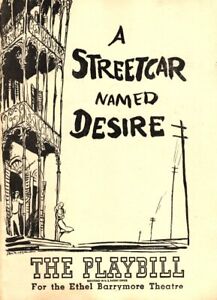
Sold on eBay November 14th, 2023
*GREAT AMERICAN PLAYWRIGHT TENNESSEE WILLIAMS 1949 STREETCAR PROGRAM BRANDO*
eBay A rare original March 1949 program for Tennessee Williams's brilliant play A Streetcar Named Desire with Marlon Brando, Jessica Tandy, Karl Malden, and Kim Hunter. Thirty two pages. Dimensions nine by six and a half inches. Light wear otherwise good. See Tennessee Williams's extraordinary biography and the story of the play below. Buyer pays first class insured shipping. Overseas shipping by Reistered Airmail. Shipping discounts for multiple purchases. Inquiries always welcome. Please visit my other eBay items for more early theatre, opera, film and historical autographs, photographs and programs and great actor and actress cabinet photos and CDV's. From Wikipedia: Thomas Lanier "Tennessee" Williams III (March 26, 1911– February 25, 1983) was an American playwright. Along with Eugene O'Neill and Arthur Miller, he is considered among the three foremost playwrights of 20th-century American drama.[1]After years of obscurity, at age 33 he became suddenly famous with the success of The Glass Menagerie (1944) in New York City.This play closely reflected his own unhappy family background. It was the first of a string of successes, including A Streetcar Named Desire (1947), Cat on a Hot Tin Roof (1955), and Sweet Bird of Youth(1959). With his later work, he attempted a new style that did not appeal to audiences. Increasing alcohol and drug dependence inhibited his creative expression. His drama A Streetcar Named Desire is often numbered on short lists of the finest American plays of the 20th century alongside Eugene O'Neill's Long Day's Journey into Night and Arthur Miller's Death of a Salesman [1]Much of Williams' most acclaimed work has been adapted for the cinema. He also wrote short stories, poetry, essays and a volume of memoirs. In 1979, four years before his death, Williams was inducted into the American Theater Hall of Fame.Thomas Lanier Williams III was born in Columbus, Mississippi, of English, Welsh, and Huguenot ancestry, the second child of Edwina Dakin (August 9, 1884 – June 1, 1980) and Cornelius Coffin "C. C." Williams (August 21, 1879 – March 27, 1957).[2] His father was a traveling shoe salesman who became alcoholic and was frequently away from home. His mother, Edwina, was the daughter of Rose O. Dakin, a music teacher, and the Reverend Walter Dakin, an Episcopal priest from Illinois who was assigned to a parish in Clarksdale, Mississippi, shortly after Williams' birth. Williams lived in his parsonage with his family for much of his early childhood and was close to his grandparents.He had two siblings, older sister Rose Isabel Williams and younger brother Walter Dakin Williams [4](1919[5]–2008) [6]As a young child Williams nearly died from a case of diphtheria that left him weak and virtually confined to his house during a period of recuperation that lasted a year. At least in part as a result of his illness, he was less robust as a child than his father wished. Cornelius Williams, a descendant of hearty East Tennessee pioneer stock, had a violent temper and was a man prone to use his fists. He regarded what he thought was his son's effeminacy with disdain. Edwina, locked in an unhappy marriage, focused her overbearing attention almost entirely on her frail young son.[7] Many critics and historians note that Williams drew from his own dysfunctional family in much of his writing.[1]When Williams was eight years old, his father was promoted to a job at the home office of the International Shoe Company in St. Louis, Missouri. His mother's continual search for what she considered to be an appropriate address, as well as his father's heavy drinking and loudly turbulent behavior, caused them to move numerous times around St. Louis. Williams attended Soldan High School, a setting he referred to in his play The Glass Menagerie.[8] Later he studied at University City High School.[9][10] At age 16, Williams won third prize (five dollars, = $70± in 2017) for an essay published in Smart Set, titled "Can a Good Wife Be a Good Sport?" A year later, his short story "The Vengeance of Nitocris" was published in the August 1928 issue of the magazine Weird Tales.[11]That same year he first visited Europe with his maternal grandfather Dakin EducationFrom 1929 to 1931, Williams attended the University of Missouri, in Columbia, where he enrolled in journalism classes.[12] He was bored by his classes and distracted by unrequited love for a girl. Soon he began entering his poetry, essays, stories, and plays in writing contests, hoping to earn extra income. His first submitted play was Beauty Is the Word (1930), followed by Hot Milk at Three in the Morning (1932).[13] As recognition for Beauty, a play about rebellion against religious upbringing, he became the first freshman to receive honorable mention in a writing competition [14]At University of Missouri, Williams joined the Alpha Tau Omega fraternity, but he did not fit in well with his fraternity brothers. According to Hale, the "brothers found him shy and socially backward, a loner who spent most of his time at the typewriter." After he failed a military training course in his junior year, his father pulled him out of school and put him to work at the International Shoe Company factory. Although Williams, then 21, hated the monotony, the job "forced him out of the pretentious gentility" of his upbringing, which had, according to Hale, "tinged him with [his mother's] snobbery and detachment from reality."[14] His dislike of his new nine-to-five routine drove him to write even more than before. He set himself a goal of writing one story a week, working on Saturday and Sunday, often late into the night. His mother recalled his intensity:Tom would go to his room with black coffee and cigarettes and I would hear the typewriter clicking away at night in the silent house. Some mornings when I walked in to wake him for work, I would find him sprawled fully dressed across the bed, too tired to remove his clothes [15]Overworked unhappy, and lacking any further success with his writing, by his twenty-fourth birthday Williams had suffered a nervous breakdown and left his job. He drew from memories of this period, and a particular factory co-worker, to create the character Stanley Kowalski in A Streetcar Named Desire.[14] By the mid-1930s his mother separated from his father, due to C.C.'s worsening alcoholism and abusive temper (part of his ear was bitten off in a poker game fight). They never divorced.In 1936, Williams enrolled at Washington University in St. Louis; while there, he wrote the play Me, Vashya (1937). In the autumn of 1937, he transferred to the University of Iowa, where he graduated with a B.A. in English in August 1938.[16] He later studied at the Dramatic Workshop of The New School in New York City. Speaking of his early days as a playwright and referring to an early collaborative play called Cairo, Shanghai, Bombay!, produced while he was a part of an amateur summer theater group in Memphis, Tennessee, Williams wrote, "The laughter ... enchanted me. Then and there the theatre and I found each other for better and for worse. I know it's the only thing that saved my life."[17] Around 1939, he adopted "Tennessee Williams" as his professional name.Literary influencesWilliams writings include mention of some of the poets and writers he most admired in his early years: Hart Crane, Arthur Rimbaud, Anton Chekhov (from the age of ten), William Shakespeare, Clarence Darrow, D. H. Lawrence, Katherine Mansfield, August Strindberg, William Faulkner, Thomas Wolfe, and Emily Dickinson. In later years he also referred to William Inge, James Joyce, and Ernest Hemingway; of Hemingway, he said "[his] great quality, aside from his prose style, is this fearless expression of brute nature [15]:xiCareerIn the late 1930s, as Williams struggled to gain production and an audience for his work, he worked at a string of menial jobs that included a notably disastrous stint as caretaker on a chicken ranch in Laguna Beach, California. In 1939, with the help of his agent Audrey Wood, he was awarded a $1,000 grant [2017 equivalent $17,000+] from the Rockefeller Foundation in recognition of his play Battle of Angels; it was produced in Boston in 1940, but poorly received.Using some of the Rockefeller funds, Williams moved to New Orleans in 1939 to write for the Works Progress Administration (WPA), a federally funded program begun by President Franklin D. Roosevelt created to put people to work. In addition to sponsoring construction and infrastructure projects, it hired many artists, musicians and writers, to create local cultural programs, to write state histories, and to create art for public buildings. It was critical to the survival of many such artists during the Great Depression. Williams lived for a time in New Orleans' French Quarter; first at 722 Toulouse Street, the setting of his 1977 play Vieux Carré. (The building is now part of The Historic New Orleans Collection )[18] The Rockefeller grant brought him to the attention of the Hollywood film industry and Williams received a six-month contract as a writer from the Metro Goldwyn Mayer film studio, earning $250 weekly.During the winter of 1944–45, his "memory play" The Glass Menagerie, developed from his 1943 short story "Portrait of a Girl in Glass", was successfully produced in Chicago and garnered good reviews. It moved to New York where it became an instant and enormous hit, and had a long Broadway run. It explores the lives of a young man named Tom, his disabled sister, Laura, and their controlling mother Amanda, who tries to make a match between Laura and a gentleman caller. Williams' use of his own familial relationships as inspiration for the play is clear. Elia Kazan (who directed many of Williams' greatest successes) said of Williams: "Everything in his life is in his plays, and everything in his plays is in his life."[19] The Glass Menagerie won the award for the best play of the season, the New York Drama Critics' Circle Award.The huge success of his next play, A Streetcar Named Desire in 1947 secured his reputation as a great playwright. Although widely celebrated and increasingly wealthy, Williams was still restless and insecure, always gripped by fear that he would not be able to replicate his success. During the late 1940s and 1950s, Williams began to travel widely with his partner Frank Merlo (1922 – September 21, 1963), often spending summers in Europe. To stimulate his writing he moved often, living in cities including New York, New Orleans, Key West, Rome, Barcelona, and London. Williams wrote, "Only some radical change can divert the downward course of my spirit, some startling new place or people to arrest the drift, the drag [20]Williams arriving at funeral services for Dylan Thomas, 1953Between 1948 and 1959 Williams had seven of his plays produced on Broadway: Summer and Smoke (1948), The Rose Tattoo (1951), Camino Real (1953), Cat on a Hot Tin Roof (1955), Orpheus Descending (1957), Garden District(1958), and Sweet Bird of Youth (1959). By 1959 he had earned two Pulitzer Prizes, three New York Drama Critics' Circle Awards, three Donaldson Awards, and a Tony Award.Williams' work reached wide audiences in the early 1950s when The Glass Menagerie and A Streetcar Named Desirewere adapted as motion pictures. Later plays also adapted for the screen included Cat on a Hot Tin Roof, The Rose Tattoo, Orpheus Descending, The Night of the Iguana, Sweet Bird of Youth, and Summer and Smoke.After the extraordinary successes of the 1940s and 1950s, he had more personal turmoil and theatrical failures in the 1960s and 1970s. Although he continued to write every day, the quality of his work suffered from his increasing alcohol and drug consumption, as well as occasional poor choices of collaborators [21] In 1963, his partner Frank Merlo died.Consumed by depression over the loss, and in and out of treatment facilities while under the control of his mother and younger brother Dakin, Williams spiraled downward. His plays Kingdom of Earth (1967), In the Bar of a Tokyo Hotel(1969), Small Craft Warnings (1973), The Two Character Play (also called Out Cry, 1973), The Red Devil Battery Sign(1976), Vieux Carré (1978), Clothes for a Summer Hotel (1980), and others were all box office failures. Relentlessly negative press notices wore down his spirit. His last play, A House Not Meant To Stand, was produced in Chicago in 1982. Despite largely positive reviews, it ran for only 40 performances Critics and audiences alike failed to appreciate Williams' new style and the approach to theater he developed during the 1970s. Williams said, "I've been working very hard since 1969 to make an artistic comeback there is no release short of death" (Spoto 335), and "I want to warn you, Elliot, the critics are out to get me. You'll see how vicious they are. They make comparisons with my earlier work, but I'm writing differently now" (Spoto 331). Leverich explains that Williams to the end was concerned with "the depths and origin of human feelings and motivations, the difference being that he had gone into a deeper, more obscure realm, which, of course, put the poet in him to the fore, and not the playwright who would bring much concern for audience and critical reaction" (xxiii).In addition to struggling with changing audience tastes, Williams had to deal with changes in the business model of the theatrical world. In the 1970s, free performances for charitable causes were becoming increasingly popular. The aging playwright found it a challenge to adapt to the times, although many of the changes in theater were due to his own legacy [citation needed] Despite the inferior quality of Williams's work compared to his creative peak 30 years earlier, he continued writing almost without a break.In 1974, Williams received the St. Louis Literary Award from the Saint Louis University Library Associates [22][23] In 1979, four years before his death, he was inducted into the American Theater Hall of Fame [24]Personal lifeThroughout his life Williams remained close to his sister Rose, who was diagnosed with schizophrenia as a young woman. In 1943, as her behavior became increasingly disturbing, she was subjected to a lobotomy. It required her to be for the rest of her life. As soon as he was financially able, Williams had her moved to a private institution just north of New York City, where he often visited her. He gave her a percentage interest in several of his most successful plays, the royalties from which were applied toward her care.[25][26] The devastating effects of Rose's illness may have contributed to Williams' alcoholism and his dependence on various combinations of amphetamines and barbiturates [27]After some early attempts at relationships with women, by the late 1930s Williams had finally accepted his homosexuality. In New York City he joined a gay social circle that included fellow writer and close friend Donald Windham (1920–2010) and his then partner Fred Melton. In the summer of 1940, Williams initiated an affair with Kip Kiernan (1918–1944), a young Canadian dancer he met in Provincetown, Massachusetts. When Kiernan left him to marry a woman, he was distraught. Kiernan's death four years later at age 26 was another heavy blow.On a 1945 visit to Taos, New Mexico, Williams met Pancho Rodríguez y González, a hotel clerk of Mexican heritage. Rodríguez was, by all accounts, a loving and loyal companion. But he was also prone to jealous rages and excessive drinking, and their relationship was tempestuous. In February I946 Rodríguez left New Mexico to join Williams in his New Orleans apartment. They lived and traveled together until late 1947, when Williams ended the affair. Rodríguez and Williams remained friends, however, and were in contact as late as the 1970s.Frank Merlo in Key West, 1950Williams spent the spring and summer of 1948 in Rome in the company of an Italian teenager, called "Rafaello" in Williams' Memoirs. He provided financial assistance to the younger man for several years afterward. Williams drew from this for his first novel, The Roman Spring of Mrs. Stone.235 E 58th Street, New York, New YorkTennessee Williams House, Key West, FloridaWhen he returned to New York that spring, Williams met and fell in love with Frank Merlo (1922–1963). An occasional actor of Sicilian heritage, he had served in the U.S. Navy in World War II. This was the enduring romantic relationship of Williams' life, and it lasted 14 years until infidelities and drug abuse on both sides ended it. Merlo, who had become Williams' personal secretary, took on most of the details of their domestic life. He provided a period of happiness and stability, acting as a balance to the playwright's frequent bouts with depression [28]Williams feared that, like his sister Rose, he would fall into insanity. His years with Merlo, in an apartment in Manhattan and a modest house in Key West, Florida, were Williams' happiest and most productive. Shortly after their breakup, Merlo was diagnosed with inoperable lung cancer. Williams returned to him and cared for him until his death on September 20, 1963.In the years following Merlo's death, Williams descended into a period of nearly catatonic depression and increasing drug use; this resulted in several and commitments to mental health facilities. He submitted to injections by Dr. Max Jacobson – known popularly as Dr. Feelgood – who used increasing amounts of amphetamines to overcome his depression. Jacobson combined these with prescriptions for the sedative Seconal to relieve his insomnia. During this time, influenced by his mother, a Roman Catholic convert, Williams joined the Catholic Church (though he later claimed that he never took his conversion seriously).[29] He was never truly able to recoup his earlier success, or to entirely overcome his dependence on prescription drugs.Edwina Dakin died in 1980 at the age of 95. Her health had begun failing during the early 1970s and she lived in a care facility from 1975 onward. Williams rarely saw his mother in her later years and retained a strong animosity toward her; friends described his reaction to her death as mixed [citation needed]As Williams grew older, he felt increasingly alone; he feared old age and losing his sexual appeal to younger gay men. In the 1970s, when he was in his 60s, Williams had a lengthy relationship with Robert Carroll, a Vietnam veteran and aspiring writer in his 20s. Williams had deep affection for Carroll and respect for what he saw as the younger man's talents. Along with Williams' sister Rose, Carroll was one of the two people who received a bequest in Williams' will [30]Williams described Carroll's behavior as a combination of "sweetness" and "beastliness". Because Carroll had a drug problem (as did Williams), friends such as Maria St. Just saw the relationship as "destructive". Williams wrote that Carroll played on his "acute loneliness" as an aging gay man. When the two men broke up in 1979, Williams called Carroll a "twerp", but they remained friends until Williams died four years later [31]DeathFirst page of the last will and testament of Tennessee WilliamsOn February 25, 1983, Williams was found dead at age 71 in his suite at the Hotel Elysée in New York. The Chief Medical Examiner of New York City, Elliot M. Gross, reported that Williams had choked to death from inhaling the plastic cap of a bottle of the type that might contain a nasal spray or eye solution.[32]He wrote in his will in 1972: "I, Thomas Lanier (Tennessee) Williams, being in sound mind upon this subject, and having declared this wish repeatedly to my close friends-do hereby state my desire to be buried at sea. More specifically, I wish to be buried at sea at as close a possible point as the American poet Hart Crane died by choice in the sea; this would be ascrnatible [sic], this geographic point, by the various books (biographical) upon his life and death. I wish to be sewn up in a canvas sack and dropped overboard, as stated above, as close as possible to where Hart Crane was given by himself to the great mother of life which is the sea: the Caribbean, specifically, if that fits the geography of his death. fits it [sic].".[33] But his brother Dakin Williams arranged for him to be buried at Calvary Cemetery, in St. Louis, Missouri, where his mother is buried [34]Williams left his literary rights to The University of the South in Sewanee, Tennessee, an Episcopal school, in honor of his maternal grandfather, Walter Dakin, an alumnus of the university. The funds support a creative writing program. When his sister Rose died in 1996 after many years in a mental institution, she bequeathed $7 million from her part of the Williams estate to The University of the South as well [35]Posthumous recognitionWilliams grave, Calvary Cemetery, St. Louis, MissouriFrom February 1 to July 21, 2011, to commemorate the 100th anniversary of his birth, the Harry Ransom Center at the University of Texas at Austin, the home of Williams' archive, exhibited 250 of his personal items. The exhibit, titled "Becoming Tennessee Williams," included a collection of Williams manuscripts, correspondence, photographs and artwork.[36] The Ransom Center holds the earliest and largest collections of Williams' papers, including all of his earliest manuscripts, the papers of his mother Edwina Williams, and those of his long-time agent Audrey Wood.[37]In late 2009, Williams was inducted into the Poets' Corner at the Cathedral of Saint John the Divine in New York. Performers and artists who took part in his induction included Vanessa Redgrave, playwright John Guare, Eli Wallach, Sylvia Miles, Gregory Mosher, and Ben Griessmeyer [38]The Tennessee Williams Theatre in Key West, Florida, is named for him. The Tennessee Williams Key West Exhibit on Truman Avenue houses rare Williams memorabilia, photographs, and pictures including his famous typewriter.At the time of his death, Williams had been working on a final play, In Masks Outrageous and Austere,[39] which attempted to reconcile certain forces and facts of his own life. This was a continuing theme in his work. As of September 2007, author Gore Vidal was completing the play, and Peter Bogdanovich was slated to direct its Broadway debut.[40] The play received its world premiere in New York City in April 2012, directed by David Schweizer and starring Shirley Knight as Babe.[41]The rectory of St. Paul's Episcopal Church in Columbus, Mississippi, where Williams's grandfather Dakin was rector at the time of Williams's birth, was moved to another location in 1993 for preservation. It was newly renovated in 2010 for use by the City of Columbus as the Tennessee Williams Welcome Center [42][43]Williams s literary legacy is represented by the literary agency headed by Georges Borchardt.In 1985, French author-composer Michel Berger wrote a song dedicated to Tennessee Williams, "Quelque chose de Tennessee" (Something of Tennessee), for Johnny Hallyday. It became one of the singer's most famous songs.Since 1986, the Tennessee Williams New Orleans Literary Festival has been held annually in New Orleans, Louisiana, in commemoration of the playwright. The festival takes place at the end of March to coincide with Williams's birthday [44]Since 2016, St. Louis, Missouri has held an annual Tennessee Williams' Festival, featuring a main production and related events such as literary discussions and new plays inspired by his work. In 2018 the festival produced A Streetcar Named Desire.The U.S. Postal Service honored Williams on a stamp in 1994 as part of its literary arts series.Williams is honored with a star on the St. Louis Walk of Fame [45]WorksCharacters in his plays are often seen as representations of his family members. Laura Wingfield in The Glass Menagerie was understood to be modeled on his sister Rose. Some biographers believed that the character of Blanche DuBois in A Streetcar Named Desire is also based on her.Amanda Wingfield in The Glass Menagerie was generally taken to represent Williams' mother, Edwina. Characters such as Tom Wingfield in The Glass Menagerie and Sebastian in Suddenly, Last Summer were understood to represent Williams himself. In addition, he used a lobotomy as a motif in Suddenly, Last Summer.The Pulitzer Prize for Drama was awarded to A Streetcar Named Desire in 1948 and to Cat on a Hot Tin Roof in 1955. These two plays were later adapted as highly successful films, by noted directors Elia Kazan (Streetcar), with whom Williams developed a very close artistic relationship, and Richard Brooks (Cat). Both plays included references to elements of Williams's life such as homosexuality, mental instability, and alcoholism Although The Flowering Peach by Clifford Odets was the preferred choice of the Pulitzer Prize jury in 1955, and Cat on a Hot Tin Roof was at first considered the weakest of the five shortlisted nominees, Joseph Pulitzer Jr., chairman of the Board, had seen Cat on a Hot Tin Roof and thought it worthy of the drama prize. The Board went along with him after considerable discussion [46]Williams wrote The Parade, or Approaching the End of a Summer when he was 29, and worked on it sporadically throughout his life. A semi autobiographical depiction of his 1940 romance with Kip Kiernan in Provincetown, Massachusetts, it was produced for the first time on October 1, 2006, in Provincetown by the Shakespeare on the Cape production company. This was part of the First Annual Provincetown Tennessee Williams Festival.His last play went through many drafts as he was trying to reconcile what would be the end of his life.[38] There are many versions of it, but it is referred to as In Masks Outrageous and Austere PlaysApprentice playsCandles to the Sun (1936)Fugitive Kind (1937)Spring Storm (1937)Me Vaysha (1937)Not About Nightingales (1938)Battle of Angels (1940)I Rise in Flame, Cried the Phoenix (1941)You Touched Me (1945)Stairs to the Roof (1947)Major playsVivien Leigh as Blanche DuBois in the film version of A Streetcar Named Desire(1951)The Glass Menagerie (1944)A Streetcar Named Desire (1947)Summer and Smoke (1948)The Rose Tattoo (1951)Camino Real (1953)Cat on a Hot Tin Roof (1955)Orpheus Descending (1957)Suddenly Last Summer (1958)Sweet Bird of Youth (1959)Period of Adjustment (1960)The Night of the Iguana (1961)The Eccentricities of a Nightingale (1962, rewriting of Summer and Smoke)The Milk Train Doesn't Stop Here Anymore (1963)The Mutilated (1965)The Seven Descents of Myrtle (1968, aka Kingdom of Earth)In the Bar of a Tokyo Hotel (1969)Will Mr. Merriweather Return from Memphis? (1969)Small Craft Warnings (1972)The Two-Character Play (1973)Out Cry (1973, rewriting of The Two-Character Play)The Red Devil Battery Sign (1975)This Is (An Entertainment) (1976)Vieux Carré (1977)A Lovely Sunday for Creve Coeur (1979)Clothes for a Summer Hotel (1980)The Notebook of Trigorin (1980)Something Cloudy, Something Clear (1981)A House Not Meant to Stand (1982)In Masks Outrageous and Austere (1983)NovelsThe Roman Spring of Mrs. Stone (1950, adapted into a film in 1961, and again in 2003)Moise and the World of Reason and teleplaysThe Glass Menagerie (1950)A Streetcar Named Desire (1951)The Rose Tattoo (1955)Baby Doll (1956)Suddenly, Last Summer (1959)The Fugitive Kind (1959)Ten Blocks on the Camino Real (1966)Boom! (1968)The Loss of a Teardrop Diamond (2009; screenplay from 1957)Short storiesThe Vengeance of Nitocris (1928)The Field of Blue Children (1939)Oriflamme (1944)The Resemblance Between a Violin Case and a Coffin (1951)Hard Candy: A Book of Stories (1954)Three Players of a Summer Game and Other Stories (1960)The Knightly Quest: a Novella and Four Short Stories (1966)One Arm and Other Stories (1967)"One Arm""The Malediction The Poet""Chronicle of a Demise""Desire and the Black Masseur Portrait of a Girl in Glass""The Important Thing""The Angel in the Alcove""The Field of Blue Children""The Night of the Iguana""The Yellow Bird"Eight Mortal Ladies Possessed: a Book of Stories (1974)Tent Worms (1980)It Happened the day the Sun Rose, and Other Stories (1981), published by Sylvester & OrphanosOne-act playsMain article: List of one-act plays by Tennessee wrote over 70 one-act plays during his lifetime. The one-acts explored many of the same themes that dominated his longer works. Williams' major collections are published by New Directions in New York City.American Blues (1948)Mister Paradise and Other One-Act Plays (2005)Dragon Country: a book of one-act plays (1970)The Traveling Companion and Other Plays (2008)The Magic Tower and Other One-Act Plays (2011)At Liberty (1939)The Magic Tower (1936)Me, Vashya (1937)Curtains for the Gentleman (1936)In Our Profession (1938)Every Twenty Minutes (1938)Honor the Living (1937)The Case of the Crushed Petunias (1941)Moony's Kid Don't Cry (1936)The Dark Room (1939)The Pretty Trap (1944)Interior: Panic (1946)Kingdom of Earth (1967)I Never Get Dressed Till After Dark on Sundays (1973)Some Problems for the Moose Lodge (1980)27 Wagons Full of Cotton and Other Plays (1946 and wild...» (introduction) (1953)27 Wagons Full of Cotton (1946 and 1953)The Purification (1946 and 1953)The Lady of Larkspur Lotion (1946 and 1953)The Last of My Solid Gold Watches (1946 and 1953)Portrait of a Madonna (1946 and 1953)Auto da Fé (1946 and 1953)Lord Byron's Love Letter (1946 and 1953)The Strangest Kind of Romance (1946 and 1953)The Long Goodbye (1946 and 1953)At Liberty (1946)Moony's Kid Don't Cry (1946)Hello from Bertha (1946 and 1953)This Property Is Condemned (1946 and 1953)Talk to Me Like the Rain and Let Me Listen... (1953)Something Unspoken (1953)Now the Cats with Jeweled Claws and Other One-Act Plays (2016)A Recluse and His Guest (1982)Now the Cats with Jeweled Claws (1981)Steps Must Be Gentle (1980)Ivan's Widow (1982)This Is the Peaceable Kingdom (1981)Aimez vous Ionesco? (c.1975)The Demolition Downtown (1971)Lifeboat Drill (1979)Once in a Lifetime (1939)The Strange Play (1939)The Theatre of Tennessee Williams, Volume VIThe Theatre of Tennessee Williams, Volume VIIPoetryIn the Winter of Cities (1956)Androgyne Mon Amour (1977)Selected worksGussow, Mel and Holditch, Kenneth, eds. Tennessee Williams, Plays 1937–1955 (Library of America, 2000) ISBN 978 1 883011 86 4 Spring StormNot About of AngelsI Rise in Flame, Cried the PhoenixFrom 27 Wagons Full of Cotton (1946)27 Wagons Full of CottonThe Lady of Larkspur LotionThe Last of My Solid Gold WatchesPortrait of a MadonnaAuto da FéLord Byron's Love LetterThis Property Is CondemnedThe Glass MenagerieA Streetcar Named DesireSummer and SmokeThe Rose TattooCamino RealFrom 27 Wagons Full of Cotton (1953) Something Wild"Talk to Me Like the Rain and Let Me ListenSomething UnspokenCat on a Hot Tin RoofGussow, Mel and Holditch, Kenneth, eds. Tennessee Williams, Plays 1957–1980 (Library of America, 2000) ISBN 978 1 883011 87 1 Orpheus DescendingSuddenly Last SummerSweet Bird of YouthPeriod of AdjustmentThe Night of the IguanaThe Eccentricities of a NightingaleThe Milk Train Doesn't Stop Here AnymoreThe of Earth (The Seven Descents of Myrtle)Small Craft WarningsOut CryVieux CarréA Lovely Sunday for Creve Coeur"Crazy Night [47]Tennessee Williams: Memoirs (New Directions Publishing Corporation, 2006) ISBN 978 0 811216 69 2A Streetcar Named Desire is a play written by Tennessee Williams and first performed on Broadway on December 3, 1947.[1] The play dramatizes the experiences of Blanche DuBois, a former Southern belle who, after encountering a series of personal losses, leaves her privileged background to move into a shabby apartment in New Orleans rented by her younger sister and brother in law Williams most popular work, A Streetcar Named Desire is one of the most critically acclaimed plays of the twentieth century.[1] It still ranks among his most performed plays, and has inspired many adaptations in other forms, notably a critically acclaimed film that was released in 1951.[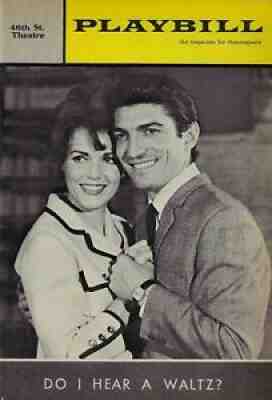
Sold on eBay Nov 28, 2021
Stephen Sondheim "DO I HEAR A WALTZ?" Sergio Franchi 1965 Opening Night Playbill
(The production opened March 18th, 1965 and ran for 220 performances.). and SERGIO FRANCHI's "Live" album, both on RCA Victor Records. Also includes the illustration of BARBRA STREISAND as "Saint Joan" and STEVE LAWRENCE as "The Dauphin", number 13 in the AL HIRSCHFELD series "Unlikely Casting". CONDITION: With the exception of slight discoloration to most of the inside pages and minor edge wear, this playbill is in excellent condition and will make a wonderful addition to the collection of any musical theatre aficionado or historian.
Sold on eBay Feb 21, 2022
Playbill LOT Vintage 10X NYC Broadway Musical Theatre 1920's Movie Program Color
Playbill Collection. 1929- Burlesque - Werba's Brooklyn Theatre. 1929 - Sweethearts - Jolsons Theatre. 1924 - Saint Joan - Empire Theatre an extra special one! cover is beautiful. Movie Program 1928 - Tommy Atkins - Little Carnegie Playhouse.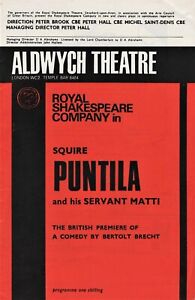
Sold on eBay March 17th, 2024
Bertolt Brecht "PUNTILA" Roy Dotrice / Patrick Magee '65 London Premiere Program
This is a rare programme (playbill) from the Royal Shakespeare Company production and BRITISH PREMIERE engagement of the BERTOLT BRECHT comedy "SQUIRE PUNTILA AND HIS SERVANT MATTI" at the Aldwych Theatre in London. (Written in 1940, the play premiered at the Schauspielhaus in Zurich, Switzerland on June 5th, 1948. The London production opened July 15th, 1965.) ..... The play starred ROY DOTRICE as "Jan Puntila" and PATRICK MAGEE as "Matti Altonen" and the cast included CLIFFORD ROSE, DAVYD HARRIES, GLENDA JACKSON, IAN RICHARDSON, PATIENCE COLLIER, JOHN MALCOLM, SUSAN ENGEL, JEANETTE LANDIS, CAROL RAYMONT, TERENCE RIGBY, MICHAEL JAYSTON, KEN WYNNE, GABRIELLE HAMILTON, MORGAN SHEPPARD, JUNE BAKER, WALTER BATALIA, JOHN SALMON, MICHELE DOTRICE, JOHN STEINER, JOHN NORMINGTON, PENELOPE KEITH, MICHAEL FARNSWORTH, IAIN BLAIR, RICHARD MOORE, IAN HOGG, LEON LISSEK, PETER HARRISON, COLIN BELL, MALCOLM McDOWELL, EDWARD CLAYTON, RICHARD MORTON and NICHOLAS MOES ..... CREDITS: Book by BERTOLT BRECHT; Original Music composed by GUY WOOLFENDEN; Adaptation and Lyrics by JEREMY BROOKS from a translation by PAUL KRIWACZEK and PAUL LEWIS; Sets and Costumes designed by ABD 'ELKADER FARRAH; Directed by MICHEL SAINT-DENIS; Produced by the ROYAL SHAKESPEARE COMPANY ..... DETAILS: The sixteen page program measures 5 1/2" X 8 1/2" inches and includes full production credits, cast list, synopsis of scenes, program notes, a photo and bio of the playwright, brief bios of the leading actors and one rehearsal photo ..... CONDITION: With the exception of a heavy corner crease at the top right, a lighter corner crease at the bottom right and minor soiling to the back cover, this rare program is in excellent condition and will make a wonderful addition to the collection of any theatre aficionado or historian. This item will be carefully packaged in a protective, carded sleeve and backed by stiff cardboard.
Sold on eBay July 7th, 2024
*FRANKENSTEIN: RARE 1929 COLIN CLIVE JAMES WHALE JOURNEY'S END THEATRE PROGRAM*
A rare original 1929 illustrated program for future Frankenstein and Bride of Frankenstein film star Colin Clive in Journey's End at the Savoy Theatre London. The play was directed by James Whale and also featured future horror film star George Zucco. Twenty eight pages, with photos of Clive and Zucco. Dimensions eight and a half by five and a half inches. Light wear otherwise good. Shipping discounts for multiple purchases. Inquiries always welcome. Please visit my other eBay items for more early theatre, classical music, film and historical autographs, photographs and programs and great actor and actress cabinet photos and CDV's. From Wikipedia:Colin Glenn Clive (born Clive-Greig; 20 January 1900 – 25 June 1937) was a British stage and screen actor. His most memorable role was Henry Frankenstein, the creator of the monster, in the 1931 film Frankenstein and its 1935 sequel, Bride of Frankenstein Early lifeClive was born in Saint-Malo, France, to an English colonel, Colin Philip Greig, and his wife, Caroline Margaret Lugard Clive. He attended Stonyhurst College and subsequently Royal Military Academy Sandhurst, where an injured knee disqualified him from military service and contributed to his becoming a stage actor.[1] He was a member of the Hull Repertory Theatre Company for three years.[1]Clive created the role of Steve Baker, the white husband of racially mixed Julie LaVerne, in the first London production of Show Boat; the production featured Cedric Hardwicke and Paul Robeson. Clive first worked with James Whale in the Savoy Theatre production of Journey's End and subsequently joined the British community in Hollywood, repeating his stage role in the film version [2][3]HollywoodClive s first screen role, in Journey's End (1930), was also directed by James Whale. Clive played the tormented alcoholic Captain Stanhope, a character that (much like Clive's other roles) mirrored his personal life. He was an in-demand leading man for several major film actresses of the era, including Katharine Hepburn, Bette Davis, Corinne Griffith, and Jean Arthur. He starred as Edward Rochester in the 1934 adaptation of Jane Eyre opposite Virginia Bruce. He was a descendant of Robert Clive and appeared in a featured role in Clive of India (1935), a biopic of his ancestor [4][2]Colin Clive, together with Leo G. Carroll, starred in a radio play titled The Other Place. It was written by John L. Balderston for the radio program The Fleischmann's Yeast Hour hosted by Rudy Vallee. It was aired on 14 November 1935 [5]Personal lifeClive was married to Jeanne de Casalis[6] in June 1929, though they were estranged for several years before his death DeathColin Clive suffered from severe chronic alcoholism and died from complications of tuberculosis in 1937 at age 37.[4]Clive's alcoholism was apparent to his co-stars, as he was often seen napping on set and sometimes was so intoxicated that he had to be held upright for over the shoulder shots. Clive was tormented by the medical threat of amputation of his long-damaged leg.[7]Forrest J Ackerman recalled visiting Clive's body: "I actually saw him in death, lying in a bed at a mortuary where it was possible for the public to view his body. He looked remarkably as he had when lying in bed in The Bride of Frankenstein [8] Over 300 mourners turned out. One of the pallbearers was Peter Lorre Frankenstein is a 1931 American pre-Code science fiction horror film directed by James Whale, produced by Carl Laemmle Jr., and adapted from a 1927 play by Peggy Webling, which in turn was based on Mary Shelley's 1818 novel Frankenstein; or, The Modern Prometheus. The Webling play was adapted by John L. Balderston and the screenplay written by Francis Edward Faragoh and Garrett Fort, with uncredited contributions from Robert Florey and John Russell Frankenstein stars Colin Clive as Henry Frankenstein (Victor Frankenstein in the novel), an obsessed scientist who digs up corpses with his assistant in order to assemble a living being from body parts. The resulting creature, often known as Frankenstein's monster, is portrayed by Boris Karloff. The makeup for the monster was provided by Jack Pierce. Alongside Clive and Karloff, the film's cast also includes Mae Clarke, John Boles, Dwight Frye, and Edward Van Sloan.Produced and distributed by Universal Pictures, the film was a commercial success upon release, and was generally well received by both critics and audiences. It spawned a number of sequels and spin-offs, and has had a significant impact on popular culture: the imagery of a maniacal "mad" scientist with a subservient hunchbacked assistant and the film's depiction of Frankenstein's monster have since become iconic. In 1991, the United States Library of Congress selected Frankenstein for preservation in the National Film Registry as being "culturally, historically, or aesthetically significant".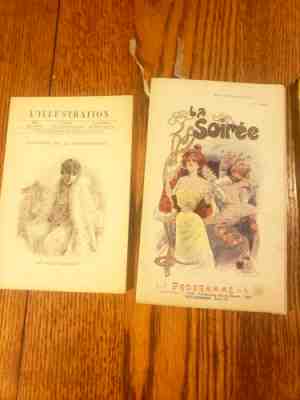
Sold on eBay Oct 12, 2022
2 Paris programs " Camelias" Sarah Bernhardt 1896 & Premier "Phryne" Opera 1893
. and an 1893 premier production of "PHRYNE" music by Saint-Saens with the Theatre De L OPERA COMIQUE Nice pieces of theatre history. Worth the research. A theatre lover who saved his programs.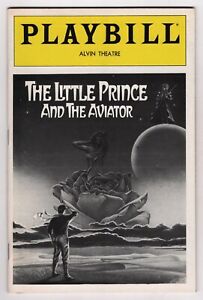
Sold on eBay February 7th, 2024
Michael York "THE LITTLE PRINCE AND THE AVIATOR" Anthony Rapp 1982 FLOP Playbill
eBay This is a rare January 11th, 1982 preview playbill from the HUGH WHEELER, JOHN BARRY and DON BLACK musical "THE LITTLE PRINCE AND THE AVIATOR" at the Alvin Theatre in New York City. (The production played twenty previews beginning on January 1st, 1982 and closed January 17th, 1982, cancelling the scheduled January 20th, 1982 Broadway opening.) ..... The musical starred MICHAEL YORK and featured ten year-old ANTHONY RAPP (who would have been making his Broadway debut had the musical actually opened) as the "Little Prince". Others in the cast included ELLEN GREENE, JANET EILBER, DAVID PURDHAM, CHIP GARNETT, JOE DEGUNTHER, MARK DOVEY, ALAN GILBERT, ROBERT HOSHOUR, LARRY G. BAILEY, KENNETH D. ARD, FRED C. MANN III, BROOKS ALMY, LYNN GENDRON, ROBIN KENSEY, DIANA LAURENSON, LEE GORDON, JENNIFER FETTEN and EDWARD CONERY ..... CREDITS: Book by HUGH WHEELER ("Big Fish, Little Fish", "A Little Night Music", "Sweeney Todd", "Truckload", "Pacific Overtures") based on "The Little Prince" by ANTOINE DE SAINT-EXUPERY; Music by JOHN BARRY; Lyrics by DON BLACK ("Merlin", "Song and Dance", "Aspects of Love", "Sunset Boulevard", "Dance of the Vampires", "Bombay Dreams", "Bonnie and Clyde"); Sets designed by EUGENE LEE; Costumes designed by CHRISTA SCHOLTZ; Choreographed by BILLY WILSON; Directed by JERRY ADLER; Produced by A. JOSEPH TANDET ..... DETAILS: The 76 page playbill measures 5 5/8" X 8 1/2" inches and includes full production credits, cast list, musical numbers and bios of each of the actors and members of the creative team, but no cast photos ..... CONDITION: With the exception of light edge wear, this rare playbill is in excellent condition and will make a wonderful addition to the collection of any musical theatre aficionado or historian. This item will be carefully packaged in a protective, carded sleeve and backed by stiff cardboard.
Sold on eBay May 27th, 2024
Playbill program ticket stub LOT Ordway Saint Paul MN 2012 - 2019
2012 - 2019Playbill program and ticket/stub LOT.Ordway, Saint Paul, MN.
Sold on eBay May 1st, 2024