

Playbill Collectibles : Playbill+sister Price List
average value
-
low
-high
-Found 20 out of 56,978 items matching 'sister'
Sold on eBay January 13th, 2024
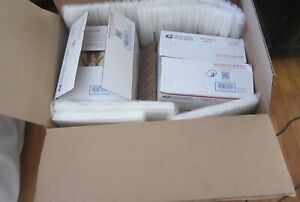
Huge lot of 390 BROADWAY PLAYBILLS 1930's to 1950's only - ALL UNIQUE PLAYBILLS
eBay You're looking a HUGE lot of 390 of random BROADWAY PLAYBILLS from the1930's - 1950's only. All the playbills are unique for the theatre and years of issue. In other words, there are no exact duplicates, but plays from the same theater for a different date with different cover and contents. These programs are used, but in good vintage condition overall. Some of the programs are in better condition than others (none of them is complete beat up). The programs have imperfections such as: corner dings, creases, fold marks, writing (like a date on the show), sticker on cover page (with date), staple marks (from ticket stub), clear tape on corner of cover page, very small insignificant tears, minor cover page/spine wear, discoloration or staining due to age, and other similar imperfections. See pictures. Other minor flaws may be present. What you see is what you get. A few of these programs may come with original inserts. To be sold as a lot only. Great starter collection or opportunity to add to your playbill collection Please note: I threw in some extra free (unique) playbills with condition issues (like loose cover page, more staining, etc.) to bump the actual number of playbills to well over 400.Here's a link to my UPS, USPS or FedEx Ground shipping within Continental US. Priority Mail international shipping is $250.Please ask any questions before making a purchase. Thanks and good luck! Complete list of programs in alphabetical order:1.) A View From The Bridge (Coronet, 1955)2.) Accent On Youth (Plymouth, 1935)3.) Affairs Of State (Music Box, 1951)4.) All For Love (Mark Hellinger, 1949)5.) All My Songs (Coronet, 1947)6.) Allegro (Majestic, 1947)7.) Almanac (Imperial, 1953)8.) American Repertory Theatre (International, 1946)9.) American Way, The (Center, 1939)10.)An Evening With Beatrice Lillie (Booth, 1952)11.)An Inspector Calls (Booth, 1947)12 )Anastasia (Lyceum, 1955)13.)Angel In The Wings (Coronet, 1948)14.)Angel In The Wings (Coronet, 1947)15.)Anna Lucasta (Mansfield, 1945)16.)Anna Lucasta (Mansfield, 1945) different cover date17 )Anne Of The Thousand Days (Sam S. Shubert, 1949)18.)Angel Street (John Golden, 1942)19 )Another Part Of The Forest (Fulton, 1946)20 )Another Part Of The Forest (Fulton, 1947)21 )Another Love Story (Fulton, 1943)22 )Antigone (Cort, 1946)23 )Anything Goes (Alvin, 1935)24.)Apple Cart, The (Plymouth, 1956)25.)Around The World In 80 Days (Rivoli, 1956)26 )Arsenic And Old Lace (Fulton, 1943)27 )Arsenic And Old Lace (Fulton, 1941)28.)Arms And The Girl (Forth-Sixth Street, 1950)29.)Army Play By Play, The (Martin Beck, 1943)30.)Awake And Sing (Windsor, 1939)31 )Bachelor Born (Morosco, 1938)32.)Bad Seed, The (Forty-Sixth Street, 1955)33 )Ballett Russe (Majestic, 1935)34 )Barefoot Boy With Cheek (Martin Beck, 1947)35 )Barretts Of Winpole Street, The (Ethel Barrymore, 1945)36 )Beautiful People, The (Lyceum, 1941)37 )Beggar s Holiday (Broadway, 1947)38.)Bells Are Ringing (Sam S. Shubert, 1957)39.)Bell, Book And Candle (Ethel Barrymore, 1951)40.)Best Foot Forward (Ethel Barrymore, 1941)41 )Billion Dollar Baby (Alvin, 1946)42.)Bless You All (Mark Hellinger, 1951)43.)Blithe Spirit (Booth, 1943)44 )Bloomer Girl (Sam S. Shubert, 1945)45 )Blossom Time (Forty-Sixth Street, 1938)46.)Blow Ye Winds (Forty-Sixth Street, 1937)47.)Born Yesterday (Lyceum, 1946)48 )Borscht Capades (Royale, 1951)49.)Boy Meets Girl (Cort, 1936)50.)Boy Friend, The (Royale, 1955)51 )Burgess Meredith (Booth, 1946)52 )Burlesque (Belasco, 1947)53.)By Jupiter (Sam S. Shubert, 1943)54.)By The Beautiful Sea (Imperial, 1954)55.)Caesar And Cleopatra (National, 1950)56.)Caesar And Cleopatra (National, 1950) different cover date57 )Caine Mutiny Court Martial, The (Plymouth, 1954)58.)Call Me Madam (Imperial, 1951)59 )Can Can (Sam S. Shubert, 1955)60.)Carmen Jones (Broadway, 1944)61 )Carousel (Majestic, 1945)62.)Child Of Fortune (Royale, 1956)63 )Children s Hour, The (Coronet, 1953)64 )Children s Hour, The (Maxine Elliott's, 1936)65.)Clash By Night (Belasco, 1941)66 )Claudia (Booth, 1941)67 )Clutterbuck (Biltmore, 1950)68 )Cocktail Party, The (Henry Miller s 1950)69 )Come Back, Little Sheba (Booth, 1950)70.)Come In Music (John Golden, 1954)71 )Compulsion (Ambassador, 19 )72 )Compulsion (Ambassador, 19??) different cover date73 )Common Ground (Fulton, 1945)74 )Confidential Clerk, The (Morosco, 1954)75 )Constant Wife, The (National, 1952)76 )Consul The (Ethel Barrymore, 1950)77.)Cradle Will Rock, The (Mansfield, 1948)78 )Craig s Wife (Playhouse, 1947)79.)Cranks (Bijou, 1956)80.)Cream In The Well, The (Booth, 1941)81 )Crucible The (Martin Beck, 1953)82.)Cup Of Trembling, The (Music Box, 1948)83.)D'Oyly Carte Opera Company (Martin Beck, 1939)84.)Damn Yankees (Forty-Sixth Street, 1956)85.)Damn Yankees (Forth-Sixth Street, 1956) different cover date86 )Dance Me A Song (Royale, 1950)87.)Daphne Laureola (Music Box, 1950)88.)Dark Eyes (Belasco, 1943)89.)Dark Is Light Enough, The (Anta, 1955)90.)Dark Victory (Plymouth, 1934)91.)Dead End (Belasco, 1936)92.)Dear Charles (Morosco, 1954)93.)Dear Ruth (Henry Miller's, 1944)94.)Death Of A Salesman (Morosco, 1949)95.)Deep Are The Roots (Fulton, 1946)96.)The Deep Blue Sea (Morosco, 1952)97.)Desk Set, The (Broadhurst, 1955)98 )Desperate Hours, The (Ethel Barrymore, 1955)99 )Detective Story (Hudson, 1949)100 )Devil s Disciple, The (Royale, 1950)101.)Dial 'M' For Murder (Plymouth, 1953)102.)Diary Of Anne Frank, The (Cort, 1956)103.)Diary Of Anne Frank, The (Cort, 1955)104.)Diary Of Anne Frank, The (Ambassador, 1957)105 )Distaff Side, The (Booth, 1934)106 )Dodsworth (Sam S. Shubert, 1934)107 )Doll s House, A (Broadhurst, 1938)108 )Doughgirls The (Lyceum, 1943)109.)Dream Child (Vanderbilt, 1934)110.)Du Barry Was A Lady (Forty-Sixth Street, 1940)111.)Earl Carroll Vanities (St. James, 1940)112.)Earl Carroll Sketch Book (Winter Garden, 1935)113 )Edward My Son (Martin Beck, 1948)114.)End As A Man (Vanderbilt, 1953)115 )Ernest Pascal's Peepshow (Fulton, 1944) 116.)Ethel Barrymore In The Corn Is Green (Martin Beck, 1943)117 )Evening With Beatrice Lillie, An (Booth, 1952)118 )Fabulous Invalid, The (Broadhurst, 1938)119.)Fair Game (Longacre, 19 )120 )Fallen Angels (Playhouse, 1956)121.)Fanny (Majestic, 1955)122 )Father Malady's Miracle (St. James, 1938)123.)Farm Of Three Echoes (Cort, 1939)124.)Fifth Season, The (Cort, 1953)125 )Finian s Rainbow (Forty-Sixth Street, 1947)126.)First Lady (Music Box, 1936)127 )Flowering Peach, The (Belasco, 1955)128 )Foolish Notion (Martin Beck, 1945)129.)Four Winds (Cort)130 )Fourposters The (John Golden, 1953)131 )Fourposters The (Ethel Barrymore, 1951)132 )Gentle People, The (Belasco, 1939)133 )Gentlemen Prefer Blondes (Ziegfeld, 1951)134 )Gilbert And Sullivan Operas (New Century, 1948)135.)Girl In Pink Tights, The (Mark Hellinger, 1954)136.)Girl On The Via Flaminia, The (Forty-Sixth Street, 1954)137.)Girls Of Summer (Longacre 1956)138 )Gladys George (Henry Millers, 1935)139.)Glass Menagerie, The (Playhouse, 1945)140 )Golden Apple, The (Phoenix, 1954)141 )Golden Boy (Belasco, 1938)142.)Good Night Ladies (Royale, 1945)143 )Goodbye My Fancy (Morosco, 1948)144.)Green Pastures, The (Broadway, 1951)145.)Guys & Dolls A Musical Fable Of Broadway (Forty-Sixth Street, 1952)146 )Hallams The - Booth (Booth, 1948)147 )Happies Millionaire, The (Lyceum, 1957)148.)Happy Time, The (Plymouth, 1950)149 )Harriet (Henry Millers, 1944)150 )Harvey (Forty-Eigth Street, 1947)151 )Hatful Of Rain, A (Lyceum, 1956)152.)Helen Goes To Troy (Alvin, 1944)153.)Helen Hayes (Broadhurst, 1936)154.)Hellz Poppin (Winter Garden, 1939)155.)Henry IV (St. James, 1939)156 )Hidden River, The (Playhouse, 1957)157.)High Tor (Martin Beck, 1937)158.)Hold On To Your Hats (Sam S. Shubert, 1940)159 )Hooray For What (Winter Garden, 1938)160.)I Knock At The Door (Belasco, 19??)161.)I Know My Love (Sam S. Shubert, 1950)162.)I Remember Mama (Music Box, 1945)163.)I'd Rather Be Right (Alvin, 1938)164 )Idiot s Delight (Sam S. Shubert, 1936)165 )Inherit The Wind (National, 1957)166 )Importance Of Being Earnest, The (Royale, 1947)167 )Importance Of Being Earnest, The (Vanderbilt, 1939168 )Innocents The (Playhouse, 1950)169 )Jackpot (Alvin, 1944)170.)Janus (Plymouth, 1956)171.)Jason (Hudson, 1942)172.)Joan Of Lorraine (Alvin, 1947)173.)Joy To The World (Plymouth, 1948)174 )Jubilee (Imperial, 1935)175 )Junior Miss (Majestic, 1943)176 )Junior Miss (Lyceum, 1942)177.)Juno And The Paycock (Mansfield, 1935)178.)Kind Lady (Longacre, 1935)179.)King And I, The (St. James, 1952)180.)Kind Sir (Alvin, 1954)181.)King Of Hearts (Lyceum 1954)182 )King Richard III (St. James, 1937)183 )Kismet (Ziegfeld, 1954)184.)Kiss And Tell (Biltmore, 1944)185.)La Vida Es Sueno (Broadhurst, 1953)186.)Lady From The Sea, The (Fulton, 1950)187.)The Lady's Not For Burning (Royale, 1950)188.)Land Is Bright, The (Music Box 1941)189 )Lady In The Dark (Alvin, 1942)190.)Lark, The (Longacre, 1956)191.)Late George Apley, The (Lyceum, 1945)192.)Leave It To Me! (Mansfield, 1939)193.)Leave It To Me! (Imperial 1939)194 )Lend An Ear (National, 1948)195.)Let's Face It (Imperial, 1942)196.)Les Ballets De Paris (Winter Garden, 1949)197 )Liberty Jones (Sam S. Shubert, 1941)198.)Light Up The Sky (Royale, 1948)199 )Little Foxes, The (National, 1939)200.)Li'l Abner (St. James, 1956)201 )Little Blue Light, The (Anta Playhouse, 1951)202 )Living Room, The (Henry Miller's, 1954)203.)Look, Ma, I'm Dancin'! (Adelphi, 1948)204 )Louisiana Purchase (Imperial, 1941)205.)Love Of Four Colonels, The (Sam S. Shubert, 1953)206 )Lovers And Friends (Plymouth, 1944)207 )Lunatics And Lovers (Broadhurst, 1955)208.)Lute Song (Plymouth, 1945)209 )Madame Bovary (Broadhurst, 1937)210 )Mademoiselle Colombe (Longacre, 1954)211 )Madwoman Of Chaillot, The (Belasco, 1949)212.)Major Barbara (Morosco, 1957)213.)Make Mine Manhattan (Broadhurst, 1948)214.)Make Way For Lucia (Cort, 1949)215.)Male Animal, The (Cort, 1940)216.)Male Animal, The (Music Box, 1952)217.)Man And Superman (Alvin, 1948)218.)Man Who Came To Dinner, The (Music Box, 1940)219 )Marcel Marceau (Ethel Barrymore, 1955)220 )Margin For Error (Plymouth, 1948)221 )Marinka (Winter Garden, 1945)222.)Mary Rose (Anta Playhouse, 1951)223.)May Wine (St. James, 1936)224.)Me And Juliet (Majestic, 1953)225 )Member Of The Wedding, The (Empire, 1950)226 )Merrily We Roll Along (Music Box 1934)227 )Merry Widow, The (Majestic, 1944)228 )Mexican Hayride (Majestic, 1945)229 )Middle Of The Night (Anta, 1956)230 )Misalliance (Ethel Barrymore, 1953)231.)Miss Isabel (Royale, 19 )232 )Mister Roberts (Alvin, 1948)233.)Moon Is Blue. The (Henry Milller's, 1951)234 )Morning s At 7 (Longacre, 1939)235.)Most Happy Fella, The (Imperial, 1957)236.)Mr. And Mrs. North (Belasco, 1941)237.)Mr. Wonderful (Broadway, 1956)238.)Mr. Wonderful (Broadway. 1956) different cover date239 )My Fair Lady (Mark Hellinger, 1957)240.)My Name Is Aquilon (Lyceum, 1949(241.)My Sister Eileen (Biltmore, 1941)242.)My 3 Angels (Morosco, 1953)243 )Native Son (St. James, 1941)244.)New Faces Of 1952 (Royale, 1952)245.)New Girl In Town (Forty-Six Street, 1957)246.)New Pins And Needles (Windsor, 1940)247.)New York City Ballet, (New York City Ballet, 1958)248.)New York City Ballet Winter Season (New York City Ballet, 1958)249.)Night Of January 16 (Ambassador, 1935)250.)No Time For Comedy (Ethel Barrymore, 1939)251.)No Time For Sergeants (Alvin, 1956)252.)Now I Lady Me Down To Sleep (Broadhurst, 1950)253.)Nude With Violin (Belasco, 19??)254.)O Mistress Mine (Empire 1947)255 )Of Mice And Men (Music Box, 1937)256.)Oh, Men! Oh, Women! (Henry Miller's, 1954)257 )Oklahoma (St. James, 1947)258.)Old Acquaintance (Morosco, 1941)259.)On Borrowed Time (Longacre, 1938)260.)On The Town (Forty-Fourth Street, 1945) 261.)On Your Toes (Forth-Sixth Street, 1954)262.)On Whitman Avenue (Cort 1946)263 )Once Is Enough (Henry Miller's, 1938)264.)One Touch Of Venus (Forty-Sixth Street, 1944)265.)One Touch Of Venus (Forty-Sixth Street, 1944) different cover date266 )Our Town (Morosco, 1938)267.)Out Of This World (New Century, 1951)268 )Overtons The (Forrest, 1945)269.)Paint Your Wagon (Sam S. Shubert, 1952)270 )Pajama Game, The (St. James, 1955)271 )Parisienne (Fulton, 1950272 )Patriots The (National, 1943)273 )Personal Appearance (Henry Miller's, 1934)274 )Petrified Forest, The (Broadhurst, 1935)275 )Philadelphia Story, The (Sam S. Shubert, 1939)276 )Pirate The (Martin Beck, 1943)277 )Pirate The (Martin beck, 1942)278.)Plain And Fancy (Winter Garden, 1955)279.)Plain And Fancy (Winter Garden, 1955) different cover date280 )Play s The Thing, The (Booth, 1948)281 )Playboy Of The Western World, The (Booth, 1946)282 )Ponder Heart, The (Music Box, 1956)283.)Post Road (Masque, 1934)284 )Pre Honeyroom (Lyceum, 1936)285 )Present Laughter (Plymouth, 1946)286 )Pygmalion (Ethel Barrymore, 1946)287 )Ramshackle Inn (Royale, 1944)288.)Red Gloves (Mansfield, 1949)289.)Red Mill, The (Forth-Sixth Street, 1946)290 )Relapse The Or Virtue In Danger (Morosco, 1950)291 )Reluctant Debutante, The (Henry Miller s 1956)292 )Remarkable Mr. Pennypacker, The (Coronet, 1954)293 )Respectful Prostitute, The (Cort, 1948)294 )Righteous Are Bold, The (Holiday, 1956)295.)Ring Round The Moon (Martin Beck, 1950)296.)Romeo And Juliet (Fifty-First Street, 1940)297.)Romeo And Juliet (Martin Beck, 1935)298.)Room Service (Cort, 1937)299 )Roomful Of Roses, A (Playhouse, 1955)300 )Rosalinda (Forty-Fourth Street, 1943)301 )Rugged Path, The (Plymouth, 1945)302 )Rumple (Alvin, 19 )303 )Russet Mantle (Masque, 1936)304.)Ryan Girl, The (Plymouth, 1945)305 )Sabrina Fair (National, 1954)306 )Sabrina Fair (National, 1954) different cover date307 )School For Brides (Ambassador, 1945)308.)Say When (Imperial, 1934)309 )Seagull The (Phoenix, 1954)310 )Season In The Sun (Cort, 1950)311.)See My Lawyer (Adelphi 1940)312 )Separate Tables (Music Box, 1957)313 )Separate Tables (Music Box, 1957) different cover date314 )Set To Music (Music Box, 1939)315.)Seven Year Itch, The (Fulton, 1953)316.)Seven Year Itch, The (Fulton, 1954)317 )Seventeen (Broadhurst, 1951)318 )Shadow And Substance (John Golden, 1938)319.)Show Boat (Ziegfeld, 1946)320 )Shrike The (Cort, 1952)321.)Silk Stockings (Imperial, 1955)322.)Skin Of Our Teeth, The (Plymouth, 1942)323 )Skylark (Morosco, 1939)324 )Slavenska Franklin Ballet with Alexandra Danilova (New Century, 1952)325 )Sleeping Prince, The (Coronet, 1956)326.)Small Miracle (Golden, 1934)327.)Small Wonder (Coronet, 1948)328.)Solid Gold Cadillac, The (Music Box, 1954)329.)Solid Gold Cadillac, The (Belasco. 1954)330.)Sons O'Fun (Forty-Sixth Street, 1943)331.)Song Of Norway (Imperial, 1945)332.)South Pacific (Majestic, 1951)333.)South Pacific (Majestic, 1949)334.)South Pacific (Majestic, 1952)335.)South Pacific (Majestic, 1951) different cover date336 )South Pacific (Majestic, 1951) different cover date337 )Spring Thaw (Martin Beck. 1938)338.)Stars In Your Eyes (Majestic, 1939)339.)State Of The Union (Hudson, 1946)340.)Storm Operation (Belasco, 1944)341 )Street Scene (Adelphi. 1947)342 )Survivors The (Playhouse. 1948)343.)Swan Lake (Forty-Sixth Street, 1941)344 )Tallery Method, The (Henry Miller's, 1941)345 )Taming Of Shrew, The (Guild, 1935)346.)Tea And Symphony (Ethel Barrymore, 1954)347 )Teahouse Of The August Moon, The (Martin Beck 1954)348 )Tempest The (Broadway, 1945)349 )Tender Trap, The (Longacre, 1954)350.)Ten Little Indians (Plymouth, 1945)351.)That Lady (Martin Beck, 1950)352.)There Shall Be No Night (Alvin, 1940)353.)Three For Tonight (Plymouth, 1955)354.)Three Men On A Horse (Fulton, 1936)355.)Three To Make Ready (Broadhurst, 1946)356.)Three Waltzes (Majestic, 1938)357.)Tiger At The Gates (Plymouth, 1955)358.)Time Of The Cuckoo, The (Empire, 1952)359.)Time Of Your Life, The (Guild, 1940)360.)Time Out For Ginger (Lyceum, 1953)361 )Tobacco Road (Forrest, 1937)362 )Sweethearts (Sam S. Shubert, 1947)363 )Tomorrow The World (Ethel Barrymore, 1943)364 )Tonight At 8:30 (National, 1948)365 )Traitor The (Forty-Eigth Street, 1949)366.)Trial By Jury (Sam S. Shubert, 1955)367 )Tunnel of Love, The (Royale, 1957)368 )Twelfth Night (Empire 1949)369 )Uncle Harry (Hudson, 1943)370.)Uncle Willie (John Golden, 1956)371 )Victoria Regina (Martin Beck, 1938)372.)Visit To A Small Planet (Booth 1957)373 )Voice Of The Turtle, The (Morosco, 1947)374.)Voice Of The Turtle, The (Morosco, 1944)375.)Voice Of The Turtle, The (Morosco, 1945)376.)Walk With Music (Ethel Barrymore, 1940)377 )Wallflower (Cort, 1944)378.)Waltz Of The Toreadors (Coronet, 1957)379 )Washington Jitters (Guild, 1938)380.)What A Life (Biltmore, 1938)381.)When We Are Married (Lyceum, 1940)382 )Where s Charley? (St. James, 1950)383.)White Steed, The (Cort, 1939)384.)Will Success Spoil Rock Hunter? (Belasco, 1955)385 )Wisteria Trees, The (Martin Beck, 1950)386 )Women The (Ethel Barrymore, 1937)387.)You Can't Take It With You (Booth, 1937)388.)You Can't Take It With You (Imperial, 1938)389.)Yes, My Darling Daughter (Playhouse, 1937)390 )Ziegfeld Follies (Winter Garden, 1943)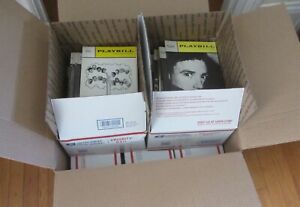
Sold on eBay February 17th, 2024
Huge lot of 337 BROADWAY PLAYBILLS late 1950's to 1970's only - UNIQUE PLAYBILLS
*** HUGE PRICE REDUCTION ***You're looking a HUGE lot of 337 of random BROADWAY PLAYBILLS from the late 1950's to the early 1970's only. All the playbills are unique for the theatre and years of issue. In other words, there are no exact duplicates, but plays from the same theater for a different date with different cover and contents. These programs are used, but in good vintage condition overall. Some of the programs are in better condition than others (none of them is complete beat up). The programs have imperfections such as: corner dings, creases, fold marks, writing (like a date on the show), sticker on cover page (with date), staple marks (from ticket stub), clear tape on corner of cover page, very small insignificant tears, minor cover page/spine wear, discoloration or staining due to age, and other similar imperfections. See pictures. Other minor flaws may be present. What you see is what you get. A few of these programs may come with original inserts. To be sold as a lot only. Great starter collection or opportunity to add to your playbill collection Please note: I threw in some extra free (unique) playbills with condition issues (like loose cover page, more staining, etc.) to bump the actual number of playbills to 348.Here's a link to my UPS, USPS or FedEx Ground shipping within Continental US. Priority Mail international shipping is $250.Please ask any questions before making a purchase. Thanks and good luck! Complete list of programs in alphabetical order:1.) Actors Studio Theater, The Productions 193-1964 (Morosco 1964)2 ) Affair, The (Henry Miller's, 1962)3.) All The Way Home (Belasco, 1960)4.) American Ballet Theatre (Metropolitan Opera House, 19??)5.) An Evening With Yves Montand (Henry Miller's, 19??)6.) Andersonville Trial, The (Henry Miller's, 19??)7.) Annie Get Your Gun (Forrest, 1966)8.) Any Wednesday (Music Box, 1964)9.) Applause (Palace, 1970)10.)Apple Tree, The (Shubert, 1966)11.)Aspern Papers, The (Playhouse, 1962)12.)At The Drop Of Another Hat (Booth, 1966)13.)Auntie Mame (Broadhurst, 19??)14.)Back To Methuselah (Ambassador, 1958)15.)Bajour (Sam S. Shubert, 1965)16.)Baker Street (Broadway, 1965)17.)Ballad Of The Sad Cafe, The (Martin Beck, 1963)18 )Barefoot In The Park (Biltmore, 1964)19 )Barefoot In The Park (Blackstone, 1965)20 )Barefoot In The Park (Biltmore, 1965)21.)Becket (Royale, 1961)22.)Bells Are Ringing (Sam S. Shubert, 1958)23.)Bells Are Ringing (Sam S. Shubert, 1958) different cover issue24 )Ben Franklin In Paris (Lunt-Fontanne, 1964)25.)Best Man, The (Morosco, 1961)26.)Beyond The Fringe (John Golden, 1962)27.)Big Fish, Little Fish (Anta, 1961)28.)Black Comedy (Wilbur, 1967)29.)Black Comedy (Ethel Barrymore, 1967)30.)Bob And Ray The Two And Only (John Golden, 1971)31 )Boeing Boeing (Cort, 1965)32.)Bravo Giovanni (Broadhurst, 1962)33 )Brigadoon (City Center Of Music And Darma, 1963)34 )Butterflies Are Free (Booth, 1970)35.)Bye Bye Birdie (54th Street, 1960)36 )Cabaret (Imperial, 1967)37.)Cactus Flower (Royale, 1966)38 )Calculated Risk (Ambassador, 1963)39 )Caligula (54th Street, 19 )40 )Carnival (Imperial, 1961)41 )Carnival (Imperial, 1962)42 )Cocktail Party, The (Lyceum, 1968)43.)Chips With Everything (Plymouth, 1963)44 )Chinese Prime Minister, The (Royale, 1964)45.)Case Of Libel, A (Longacre, 1964)46.)Coco (Mark Hellinger, 1970)47.)Coco (Mark Hellinger, 1969)48.)Come Blow Your Horn (Brooks Atkinson, 1961)49.)Come Blow Your Horn (Shubert, 1969)50.)Comedy Francaise, The (City Center Of Music and Drama, 1961)51.)Comes A Day (Ambassador, 19 )52 )Conduct Unbecoming (Ethel Barrymore, 1970)53 )Country Wife, The (Henry Miller's, 1957)54 )Country Wife, The (Henry Miller's, 1957) different cover issue55 )Critic s Choice (Ethel Barrymore, 1961)56.)Cry For Us All (Broadhurst, 1970)57.)Cue For Passion (Henry Miller's, 19??)58.)D'Oyly Carte Opera Company, The (New York City Center, 1964)59.)Danny Kaye (Ziegfeld, 1963)60.)Dark At The Top Of The Stairs, The (Music Box, 19 )61 )Delicate Balance, A (Martin Beck, 1966)62.)Destry Rides Again (Imperial, 19 )63 )Devil s Advocate, The (Billy Rose, 1961)64 )Devils The (Broadway, 1963)65.)Dinner At Eight (Alvin, 1967)66 )Disenchanted The (Coronet, 1959)67 )Donnybrook (46th St., 1961)68.)Do Re Mi (St. James, 1961)69 )Elizabeth The Queen (City Center Of Music And Drama, 1966)70 )Entertainer The (Royale, 1958)71 )Entertainer The (Royale, 1958) different cover issue72 )Epitaph For George Dillon (John Golden, 1958)73 )Epitaph For George Dillon (Henry Miller's, 1959)74.)Family Affair, A (Billy Rose 1962)75 )Family Reunion, The (Phoenix, 1958)76 )Fantasticks The (Circle In The Square, 1970)77.)Far Country, A (Music Box, 1961)78 )Fightinh Cock, The (Anta, 1960)79 )Fiddler On The Roof (Broadway, 1971)80 )Fiddler On The Roof (Majestic, 1967)81 )Fiddler On The Roof (Majestic, 1968)82 )Fiddler On The Roof (Majestic, 19 )83 )Fiddler On The Roof (Imperial, 1964)84 )Fiddler On The Roof (Imperial, 1965)85 )Fiddler On The Roof (Imperial, 1967)86 )Finian s Rainbow (46th Street, 1960)87 )Finian s Rainbow (City Center Of Music And Drama, 1967)88 )Finian s Rainbow (City Center Of Music And Drama, 19 )89 )Fiorello (Broadhurst, 1960)90 )Fiorello (Broadway, 1961)91.)Five Finger Exercise (Music Box, 1960)92.)Folies Bergere (Broadway, 1964)93 )Follies (Winter Garden, 1972)94.)Forty Carats (Blackstone, 19??)95.)Forty Carats (Morosco, 1970)96.)49th Cousin, The (Ambassador, 1960)97.)Four On A Garden (National, 1970)98.)Four On A Garden (Colonial, 1970)99.)Funny Girl (Broadway, 1967)100.)Funny Girl (Majestic, 1966)101.)Funny Thing Happened On The Way To The Forum, A (Alvin, 1962)102.)Funny Thing Happened On The Way To The Forum, A (Lunt-Fontanne, 1972)103 )Gang s All Here, The (Ambassador, 1959)104.)Gay Life, The (Sam S. Shubert, 1961)105 )Generation (Morosco, 1966)106 )George M! (Palace, 1968)107.)Girls Against The Boys, The (Alvin, 1959)108 )Gilbert & Sullivan Company (City Center, 1968)109 )Gingerbread Lady, The (Plymouth, 1971)110.)Girl Who Came To Supper, The (Broadway, 1963)111.)Glass Menagerie, The (Brooks Atkinson, 1965)112 )Golden Boy (Majestic, 1965)113 )Golden Fleecing (Henry Miller's, 1959)114 )Golden Rainbow (Shubert, 1968)115 )Goldilocks (Lunt-Fontanne, 1958)116 )Goldilocks (Lunt-Fontanne, 1958) different cover issue117 )Golden Soldier Schweik, The (New York City Center, 1958)118.)Good Soup, The (Plymouth, 1960)119.)Grand Kabuki (City Center Of Music And Drama, 1960)120.)Great White Hope, The (Alvin, 1969)121 )Greenwillow (Alvin, 1960)122.)Guys And Dolls (City Center Of Music And Drama, 1963)123.)Gypsy (Imperial, 1960)124 )H M S Pinafore (Phoenix, 1960)125 )Hadrian VII (Helen Hayes, 1969)126.)Hair (Biltmore, 19??)127.)Half A Sixpence (Broadhurst, 1965)128 )Hamlet (Lunt-Fontanne, 1964)129 )Hamlet (Lunt-Fontanne, 1969)130 )Hamlet (Colonial, 1969)131 )Heartbreak House (Billy Rose, 1959)132 )Hello Dolly! (St. James, 1970)133 )Hello Dolly! (St. James, 1966)134 )Hello Dolly! (St. James, 1967)135 )Hello Dolly! (St. James, 1964)136.)Henry IV, Part 2 (Phoenix, 19 )137 )Here s Love (Sam S. Shubert, 1964)138 )Here s Love (Sam S. Shubert, 1964) different cover issue139 )High Spirits (Alvin, 1964)140.)Hit The Deck The Nautical Musical Comedy Hit! (Jones Beach Marine, 19??)141.)Home (Morosco, 1970)142.)How Now, Dow Jones (Lunt-Fontanne, 1968)143.)How The Other Half Loves (Wilbur, 19??)144.)How To Succeed In Business Without Really Trying (46th St., 1962)145 )Hostage The (Cort, 1960)146 )Hostage The (Eugene O'Neill, 1960)147.)I Do! I Do! (46th St., 1967)148.)I Never Sang For My Father (Longacre, 1968)149.)Illya Darling (Mark Hellinger, 1967)150 )Impossible Years, The (Playhouse, 1966)151 )Indians (Brooks Atkinson, 1969)152.)Irma La Douce (Plymouth, 1960)153 )Irregular Verb To Love, The (Ethel Barrymore, 1963)154 )Ivanov (Shubert, 1966)155 )Jamaica (Imperial, 1958)156.)JB (Anta, 1959)157 )Jennie (Majestic, 1963)158.)Joe Egg (Brooks Atkinson, 1968)159.)Kean (Broadway, 1961)160 )Killing Of Sister George, The (Belasco, 1966)161.)King And I, The (City Center Of Music And Drama, 1968)162.)Kiss Me Kate (CIty Center Of Music And Drama, 1963)163.)La Grosse Valise (Shubert, 1965)164.)La Plume De Ma Tante (Royale, 1959)165.)La Plume De Ma Tante (Royale, 1960)166.)Late Christopher Bean, The (Westport County Playhouse, 19 )167 )Laughs And Other Events (Ethel Barrymore, 1960)168.)Lion In Winter, The (Ambassador, 1966)169 )Little Me (Lunt-Fontanne, 1962)170.)Look Back In Anger (John Golden, 1958)171.)Lost In The Stars (Imperial, 1972)172.)Lute Song (City Center Of Music And Drama, 1959)173 )Luther (St. James, 1963)174.)Luv (Booth, 1965)175 )Majority Of One, A (Sam S. Shubert, 1959)176.)Make A Million (Morosco, 1959)177 )Malcolm (Shubert, 1966)178.)Mame (Winter Garden, 1965)179.)Man For All Seasons, A (Anta, 1962)180.)Man Of La Mancha (Anta Washington Square, 1967)181.)Man Of La Mancha (Valley Forge Music Fair, 1970)182.)Man Of La Mancha (Anta Washington Square, 1965)183.)Man Of La Mancha (National, 1969)184 )Marcel Marceau (City Center Of Music And Drama, 1960)185 )Martha Graham And Dance Company (54th Street, 1965)186 )Martha Graham And Her Dance Company (Adelphi, 1958)187.)Mary, Mary (Helen Hayes, 1961)188.)Me Nobody Knows, The (Helen Hayes, 1971)189 )Midsummer Night's Dream, A (City Center Of Music And Drama, 19??)190.)Milk & Honey (Martin Beck, 1962)191.)Minor Miracle (Henry Miller's, 1965)192 )Miracle Worker, The (Playhouse, 1960)193.)More Stately Mansions (Broadhurst, 1967)194 )Moscow Art Theatre (New York City Center, 195.)Most Happy Fella, The (?, 1957)196.)Most Happy Fella, The (City Center Of Music And Drama, 1966)197.)Mr. President (St. James, 1963)198.)Music Man, The (Majestic, 1959)199.)Music Man, The (Broadway, 1961)200.)Music Man, The (City Center Of Music And Drama, 1965)201.)My Daughter, Your Son (Booth, 1969)202.)My Fair Lady (City Center Of Music And Drama, 1968)203.)My Fair Lady (Broadway, 1962)204.)My Fair Lady (Mark Hellinger, 1959)205.)My Fair Lady (Mark Hellinger, 1961)206.)My Fair Lady (Mark Hellinger, 1958)207.)My Fair Lady (Mark Hellinger, 1959) different cover issue208 )National Repertory Theatre (National, 1967)209 )National Repertory Theatre (Colonial, 1965)210.)Never Too Late (Playhouse, 1963)211.)New Girl In Town (46th Street, 1958)212.)New Girl In Town (46th Street, 1958) different cover issue213 )New York City Opera 38th New York Season Spring 1963 (City Center Of Music And Drama, 1963)214.)New York City Opera 40th New York Season Fall 1964 (City Center Of Music And Drama, 1964)215.)NY City Ballet (City Center Of Music And Drama, 1960)216.)NY City Ballet (City Center Of Music And Drama, 1960) different cover/issue 217.)NY City Ballet (City Center Of Music And Drama, 1961)218.)No Place To Be Somebody (Anta, 1970)219.)No Strings (Broadhurst, 1963)220.)No Strings (54th Street, 1962)221 )Nobody Loves An Albatross (Lyceum, 1964)222.)No, No, Nanette (46th Street, 1971)223.)Odd Couple, The (Plymouth, 1966)224.)Odd Couple, The (Plymouth, 1965)225.)Odd Couple, The (Colonial, 1965) different cover issue226 )Octoroon The (Phoenix, 1961)227.)Oh What A Lovely War (Broadhurst, 1964)228.)Oh! Calcutta! (Belasco, 1972)229 )Oklahoma (City Center Of Music And Drama, 1963)230 )Oliver (Sam S. Shubert, 1964)231 )Oliver (Imperial, 1963)232.)On The Town (Imperial, 1971)233.)110 In The Shade (Broadhurst, 1964)234.)110 In The Shade (Broadhurst, 1963)235.)Our Town (Anta, 1969)236.)Pal Joey (City Center Of Music And Drama, 1961)237 )Passage To India, A (Ambassador, 1962)238.)Paul Taylor Dance Company, The (City Center O Music And Drama, 1969)239.)Penny Wars, The (National, 1969)240 )Period Of Adjustment (Helen Hayes, 1960)241 )Persecution And Assassination Of Marat (Martin Beck, 1966)242 )Philadelphia Here I Come (Helen Hayes, 1966)243 )Physicists The (Martin Beck, 1964)244.)Plays Of Shakespeare, The (Broadway, 1958)245.)Plaza Suite (Plymouth, 1969)246 )Pleasure Of His Company, The (Longacre, 1959)247 )Pleasure And His Company, The (Longacre, 1958)248 )Polish Mime Theatre (New York City Center, 1965)249 )Price The (Morosco, 1968)250 )Price The (46th Street, 1968)251 )Prisoner Of Second Avenue, The (Eugene O'Neill, 1972)252 )Prisoner Of Second Avenue, The (National, 1971)253 )Promenade All! (Alvin, 1972)254 )Promises Promises (Shubert, 1971)255 )Purlie (Broadway, 19 )256 )Purlie (National, 1972)257 )Purlie (Winter Garden, 1971)258.)Rape Of The Belt, The (Martin Beck, 1960)259 )Rehearsal The (Royale, 1963)260 )Repertory Theater Of Lincoln Center For The Performing Arts (Lincoln Center, 1965)261 )Rhinoceros (Longacre, 1961)262.)Roar Of The Greasepaint - The Smell Of The Crowd (American Theatre Saint Louis, 1967)263.)Roar Of The Greasepaint - The Smell Of The Crowd (Sam S. Shubert, 1965)264.)Roar Of The Greasepaint - The Smell Of The Crowd (Shubert, 1965)265.)Rose Tattoo, The (City Center Of Music And Drama, 1966)266 )Rosencrantz And Guldenstern Are Dead (Eugene O'Neill, 1965)267 )Rosencrantz And Guldenstern Are Dead (Shubert, 1969)268 )Rosencrantz And Guldenstern Are Dead (Alvin, 1967)269.)Ross (Eugene O'Neill, 1962)270 )Rothschilds The (Lunt-Fontanne, 1970)271.)Say, Darling (Anta, 1958)272.)Say, Darling (Anta, 1958) different cover issue273 )Say Darling (Anta, 19??)274.)1776 (46th Street, 1970)275.)1776 (Majestic. 1971)276 )Sherry (Alvin, 1967)277.)Sign In Sidney Brustein's Window (Henry Miller's, 1965)278 )Skyscraper (Lunt-Fontanne, 1965)279 )Sleuth (National, 1970)280 )Sleuth (Music Box, 1971)281.)South Pacific (City Center Of Music And Drama, 1965)282 )Spofford (Anta, 1968)283.)Sound Of Music, The (Lunt-Fontanne, 1960)284.)Sound Of Music, The (Mark Hellinger, 1963)285.)Sound Of Music, The (National (1963)286.)Star Spangled Girl, The (Plymouth, 1966)287.)Story Theatre (Ambassador, 1970)288 )Strange Interlude (Hudson, 1963)289 )Subject Was Roses, The (Helen Hayes, 1965)290 )Subways Are For Sleeping (St. James, 1962)291.)Sugar (Majestic, 1972)292 )Sunday In New York (John Golden, 1962)293 )Sunrise At Campobello (Cort, 1958)294.)Sweet Bird Of Youth (Martin Beck, 1959)295.)Take Her, She's Mine (Biltmore, 1962)296.)Take Her, She's Mine (Biltmore, 1961)297.)Take Me Along (Sam S. Shubert, 19??)298.)Taste Of Honey, A (Lyceum, 1960)299 )Tchin Tchin (Plymouth. 1962)300 )Tenderloin (46th Street, 1960)301 )Tenderloin (46th Street, 1960)302.)Tenth Man, The (Booth, 1959)303 )Theatre De France (New York City Center, 1964)304 )There s A Girl In My Soup (Music Box, 1968)305 )There s A Girl In My Soup (Music Box, 1967)306.)Third Best Sport (Ambassador, 1959)307.)Time Remembered (Morosco, 1958)308.)Touch Of The Poet, A (Helen Hayes, 1959)309.)Touch Of The Poet, A (Helen Hayes, 19 )310 )Tovarich (Broadway, 1963)311.)Toys In The Attic (Hudson, 1960)312.)Toys In The Attic (Hudson, 1960) different cover issue313 )Travita La (City Center Of Music And Drama, 1960)314.)12th Night, The (Broadway, 1958)315.)Twigs (Plymouth 1972)316 )Twigs (Broadhurst, 1971)317.)Two By Two (Imperial, 1970)318.)Two For The Seesaw (Booth, 1958)319.)Two For The Seesaw (Booth, 1958) different cover issue320 )Two Gentlemen Of Verona (St. James, 1972)321 )Unsinkable Molly Brown, The (Winter Garden, 1961)322 )Visit The (New York City Center, 1960)323 )Visit The (Morosco, 1958)324 )Visit The (Lunt-Fontanne, 1958)325.)Wait A Minim! (John Golden, 1966)326 )Walking Happy (Lunt-Fontanne, 1966)327.)West Side Story (City Center Of Music And Drama, 1964)328.)What Makes Sammy Run? (54th Street, 1964)329 )Where s Daddy? (Billy Rose, 1966)330.)Who Was That Lady I Saw You With? (Martin Beck, 1958)331.)Who's Afraid Of Virginia Woolf? (Billy Rose, 1962)332 )Wonderful Town (City Center Of Music And Drama, 1967)333.)You Know I Can't Hear You When The Water's Running (Ambassador, 1968)334.)You Know I Can't Hear You When The Water's Running (Ambassador, 1967)335 )You re A Good Man Charlie Brown (Ciricle In The Square at Ford's Theatre, 1971)336.)Zizi Jeanmaire (Broadway, 1964)337.)Zorba (Imperial, 1969)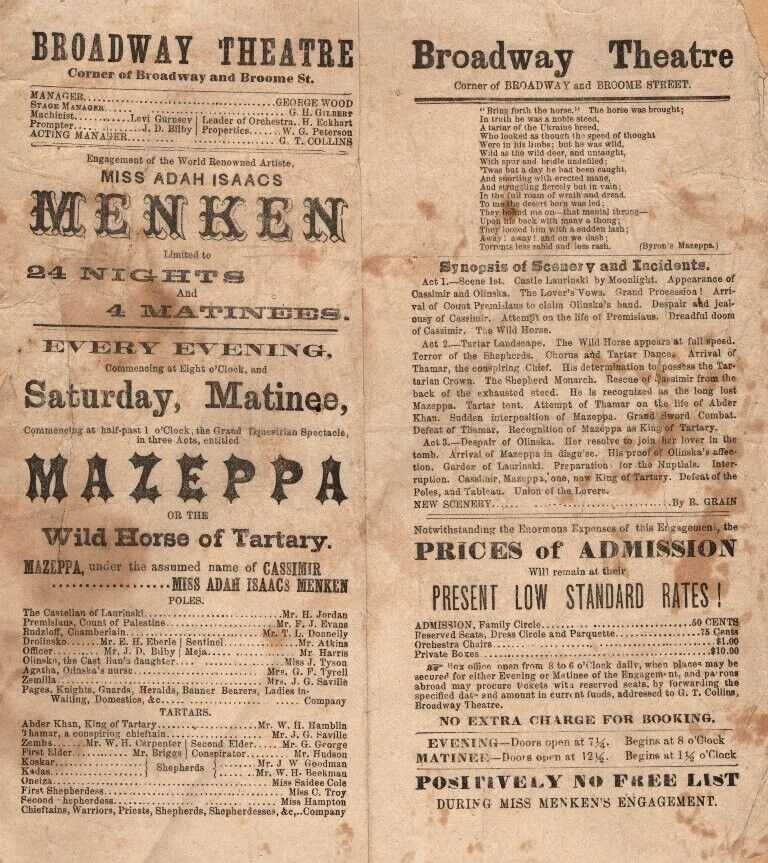
Sold on eBay November 17th, 2024
*ADAH ISSACS MENKEN IN LORD BYRON'S MAZEPPA RARE 1863 PLAY PROGRAM*
Audiences of the 1860s thought she was naked when she rode onstage on her horse wearing only flesh colored tights. She acted with the young Edwin Booth and befriended Walt Whitman. A rare original circa 1863 Broadway Theatre program for Adah Issacs Menken in her greatest and most sensational role in Lord Byron's Mazeppa. Dimensions nine by seven and a half inches lad down to a twelve by nine inch backing. Light wear otherwise good. See Adah Issacs Menken and Lord Byron's extraordinary biograpies below. Combined shipping discounts for multiple purchases. Credit cards accepted with Paypal. Inquiries always welcome. Please visit my other eBay items for more early theatre and historical autographs, photographs and programs and great singer, actor and actress cabinet photos and CDV's. From Wikipedia:Adah Isaacs Menken (June 15, 1835 – August 10, 1868) was an American actress, painter and poet, and was the highest earning actress of her time.[1] She was best known for her performance in the hippodrama Mazeppa, with a climax that featured her apparently nude and riding a horse on stage. After great success for a few years with the play in New York and San Francisco, she appeared in a production in London and Paris, from 1864 to 1866. After a brief trip back to the United States, she returned to Europe. She became ill within two years and died in Paris at the age of 33.[2]Menken told many versions of her origins, including her name, place of birth, ancestry, and religion, and historians have differed in their accounts. Most have said she was born a Louisiana Creole Catholic, with European and African ancestry. A celebrity who created sensational performances in the United States and Europe, she married several times and was also known for her affairs. She had two sons, both of whom died in infancy [3]Though she was better known as an actress, Menken sought to be known as a writer. She published about 20 essays, 100 poems, and a book of her collected poems, from 1855 to 1868 (the book was published posthumously). Early work was devoted to family and after her marriage, her poetry and essays featured Jewish themes. Beginning with work published after moving to New York, with which she changed her style, Menken expressed a wide range of emotions and ideas about women's place in the world. Her collection Infelicia went through several editions and was in print until 1902.Early life and of Menken's early life and origins vary considerably. In her "Some Notes of Her Life in Her Own Hand," published in The New York Times in 1868, Menken said she was born in Bordeaux, France, and lived in Cuba as a child before her family settled in New Orleans. There are many conflicting reports as to Menken's birth name, but she has been called Marie Rachel Adelaide de Vere Spenser and Adah Bertha Theodore, and Ed James, a journalist friend, wrote after her death: "Her real name was Adelaide McCord, and she was born at Milneburg, near New Orleans, on June 15, 1835."[4] Menken's birth year also varies, with some records stating 1835 and some stating 1832. [5] Elsewhere, in 1865, she wrote that her birth name was Dolores Adios Los Fiertes, and that she was the daughter of a French woman from New Orleans and a Spanish-Jewish man.[6] About 1940, the consensus of scholars was that her parents were Auguste Théodore, a free Black man, and Marie, a mixed-race Creole, and Adah was raised as a Catholic. She had a sister and a brother [6]Based on Menken's assertions of being a native of New Orleans, Wolf Mankowitz and others have studied Board of Health records for the city. They have concluded that Ada was born in the city as the legitimate daughter of Auguste Théodore, a free man of color (mixed race) and his wife Magdaleine Jean Louis Janneaux,[4][7] likely also a Louisiana Creole. Ada would have been raised as Catholic. However, in 1990, John Cofran, using census records, said that she was born as Ada C. McCord, in Memphis, Tennessee, in late 1830. He said she was the daughter of an Irish merchant, Richard McCord, and his wife Catherine [8][9] According to Cofran, her father died when she was young and her mother remarried. The family then moved from Memphis to New Orleans.Menken was said to have been a bright student; she became fluent in French and Spanish,[10] and was described as having a gift for languages.[6] As a child, Menken performed as a dancer in the ballet of the French Opera House in New Orleans. In her later childhood, she performed as a dancer in Havana, Cuba, where she was crowned "Queen of the Plaza [10]American as The French Spy, 1863After Cuba, Menken left dance for acting, and began working as an actress in Texas first. According to Gregory Eiselein, she gave Shakespeare readings, and wrote poems and sketches for The Liberty Gazette. She was married for the first time in Galveston County, in February 1855, to G. W. Kneass, a musician. The marriage had ended by sometime in 1856,[6] when she met and in 1856 married the man more generally considered her first husband, Alexander Isaac Menken, a musician who was from a prominent Reform Jewish family in Cincinnati, Ohio.[11]He began to act as her manager, and Ada Menken performed as an actress in the Midwest and Upper South, also giving literary readings. She received decent reviews, which noted her "reckless energy," and performed with men who became notable actors: Edwin Booth in Louisville, Kentucky, and James E. Murdoch in Nashville, Tennessee [12]In 1857, the couple moved to Cincinnati, where Menken created her Jewish roots, telling a reporter that she was born Jewish. She did study Judaism and stayed with the faith, although she never formally converted.[6] In this period, she published poetry and articles on Judaism in The Israelite in Cincinnati.[12] The newspaper was founded by Rabbi Isaac Mayer Wise, who was crucial to the Reform Judaism movement in the United States.[13] She also began to be published in the Jewish Messenger of New York.[6]Ada added an "h" to her first name and an "s" to Isaac, and by 1858 she billed herself as Adah Isaacs Menken. She eventually worked as an actress in New York and San Francisco, as well as in touring productions across the country.[14] She also became known for her poetry and painting. While none of her art was well received by major critics, she became a celebrity [11]At this time, Menken wore her wavy hair short, a highly unusual style for women of the time. She cultivated a bohemian and at times androgynous appearance. She deliberately created her image at a time when the growth of popular media helped to publicize it.[11]In 1859, Menken appeared on Broadway in New York City in the play The French Spy. Her work was not highly regarded by critics. The New York Times described her as "the worst actress on Broadway." The needed] said, "she is delightfully unhampered by the shackles of talent." Menken continued to perform small parts in New York, as well as reading Shakespeare in performance, and giving lectures.[4]Her third husband was John C. Heenan, a popular Irish-American prizefighter whom she married in 1859. Some time after their marriage, the press discovered she did not yet have a legal divorce from Menken and accused her of bigamy. She had expected Menken to handle the divorce, which he eventually did.As John Heenan was one of the most famous and popular figures in America, the press also accused Menken of marrying for his celebrity. She billed herself as Mrs. Heenan in Boston, Providence, Baltimore, and Philadelphia, using his name despite their divorce within a year of marriage.[11] They had a son, who died soon after birth.[10]While in New York, Menken met the poet Walt Whitman and some others of his bohemian circle. She was influenced by his work and began to write in a more confessional style while adhering to common sentimental conventions of the time. In 1860–61, she published 25 poems in the Sunday Mercury, an entertainment newspaper in New York. These were later collected with six more in her only book, Infelicia, published a few months after her death.[12] By publishing in a newspaper, she reached a larger audience than through women's magazines, including both men and women readers who might go to see her perform as an actress.[11]In 1860, Menken wrote a review titled "Swimming Against the Current," which praised Whitman's new edition of Leaves of Grass, saying he was "centuries ahead of his contemporaries [11][12][15] She identified with the controversial poet, and declared her bohemian identity through her support for him.[11] That year, Menken also wrote an article on the 1860 election, an unusual topic for a woman, which further added to her image.[11]When Menken met Charles Blondin, notable for crossing Niagara Falls on a tightrope, the two were quickly attracted to each other. She suggested she would marry him if they could perform a couple's act above the falls. Blondin refused, saying that he would be "distracted by her beauty."[10] The two had an affair, during which they conducted a vaudeville tour across the United States Mazeppa[edit]See also: Cultural legacy of MazeppaMenken in Mazeppa, 1866After it ended, she appealed to her business manager Jimmie Murdock to help her become recognized as a great actress. Murdock dissuaded Menken from that goal, as he knew she had little acting talent.[10] He offered her the "breeches role" (that of a man) of the noble Tartar in the hippodrama Mazeppa, based on the poem of that title by Lord Byron[1] (and ultimately on the life of Ivan Mazepa). At the climax of this hit, the Tartar was stripped of his clothing, tied to his horse, and sent off to his death.[16] The audiences were thrilled with the scene, although the production used a dummy strapped to a horse, which was led away by a handler giving sugar cubes. Menken wanted to perform the stunt herself.[9] Dressed in nude tights and riding a horse on stage, she appeared to be naked and caused a sensation.[9] New York audiences were shocked but still attended and made the play popular.Menken took the production of Mazeppa to San Francisco. Audiences again flocked to the show.[10][17] She became known across the country for this role, and San Francisco adopted her as its performer.In 1862, she married Robert Henry Newell, a humorist and editor of the Sunday Mercury in New York, who had recently published most of her poetry. They were together about three years. Next she wed James Paul Barkley, a gambler, in 1866, but soon returned without him to France, where she was performing. There she had their son, whom she named Louis Dudevant Victor Emanuel Barkley. The baby's godmother was the author George Sand (A. F. Lesser).[1] Louis died in infancy.[1]A previous version of Astley's Amphitheatre, showing the horse ringMenken arranged to play in a production of Mazeppa in London and France for much of 1864 to 1866. Controversy arose over her costume, and she responded to critics in the newspapers of London by saying that she was influenced by classical sculpture, and that her costume was more modest than those of ballet or burlesque. The show opened on October 3, 1864, at the Astley Theatre to "overflowing houses."[18] She was so well known that she was referred to as "the Menken," needing no other name.[11]Jokes and poems were printed about the controversy, and Punch wrote:[18]Here s half the town - if bills be true -To Astley's nightly thronging,To see the Menken throw asideAll to her sex belonging Stripping off woman's modesty,With woman's outward trappings -A barebacked jade on barebacked steed,In Cartlich's old strappings!(The last line refers to John Cartlich, equestrian performer [19])During this time of her greatest earning, she was generous to friends, theatre people in need, and charities.[1] While in Europe, the Menken continued to play to the American public as well, in terms of her image.[11] As usual, she attracted a crowd of male admirers, including such prominent figures as the writer Charles Dickens, the humorist Tom Hood, and the dramatist and novelist Charles Reade.[20]Later with Alexandre Dumas, 1866Playing in a sold-out run of Les pirates de la savane in Paris in 1866, Menken had an affair with the French novelist Alexandre Dumas, père, considered somewhat scandalous as he was more than twice her age. Returning to England in 1867, she struggled to attract audiences to Mazeppa and attendance fell off. During this time she had an affair with the English poet Algernon Charles Swinburne [1]She fell ill in London and was forced to stop performing, struggling with poverty as a result. Few realized that the glamorous star was ill until she collapsed during rehearsal and died a few weeks later.[4] She began preparing her poems for publication and moved back to Paris, where she died on August 10, 1868.[1] She had just written to a friend:I am lost to art and life. Yet, when all is said and done, have I not at my age tasted more of life than most women who live to be a hundred? It is fair, then, that I should go where old people go.[10]How long she had been a consumptive no one knew but, from what is known, she was dead at 33 – the flamelike quality that Dickens had called the “world’s delight” extinguished forever. They buried her in a corner of the little Jewish cemetery in Montparnasse, and on her grave stone are the words, “Thou Knowest,” an epitaph she had chosen from Swinburne, the poet who had said of her, “A woman who has such beautiful legs need not discuss poetry.”She was believed to have died of peritonitis and/or tuberculosis [10] Late twentieth century sources suggest she had cancer.[1] She was buried in Montparnasse Cemetery.[1] The inscription on her tomb reads "Thou knowest."[21]In 1862, Menken had written about her public and private personae:I have always believed myself to be possessed of two souls, one that lives on the surface of life, pleasing and pleased; the other as deep and as unfathomable as the ocean; a mystery to me and all who know me.[5]Her only book, Infelicia, a collection of 31 poems, was published several days after her death.Literary wanted to be known as a writer, but her work was overshadowed by her sensational stage career and private and public life. In total, she published about 20 essays, 100 poems and a book of her collected poems, from 1855 to 1868; the book was published posthumously. Her work was not received well by contemporary critics. George Merriam Hyde, one of the most respected critics of his day, refused to critique Menken's work, saying (privately) that "it would be an insult to himself and his profession".Van Wyck Brooks joked (in public) that "her work is the best example of unintentional wit and accidental humour".Her early work was devoted to family and romance. After her marriage to Menken and her study of Judaism, her poetry and essays for years into the 1860s featured Jewish themes. After her marriage and divorce from Heenan and meeting with writers in New York, she changed her style, adopting some influence from Walt Whitman. She was said to be the "first poet and the only woman poet before the twentieth century" to follow his lead in using free verse.[6] The New York Times reported that Walt Whitman had disassociated himself from Menken's work, implying he thought little of it.Beginning in New York, her poetry expressed a wider range of emotions related to relationships, sexuality, and also about women's struggle to find a place in the world. Her collection Infelicia went through several editions and was in print until 1902. In the late nineteenth century, critics were hard on women writers, and Menken's public notoriety caused even more critical scrutiny of her poems. Later critics (such as A. R. Lloyd in his book, The Great Prize Fight and Graham Gordon in his book Master of the Ring) generally dismiss her work as being devoid of talent. Admirers included Christina Rossetti and Joaquin Miller.George Gordon Byron (later Noel), 6th Baron Byron, FRS (22 January 1788 – 19 April 1824), commonly known simply as Lord Byron, was an English poet and a leading figure in the Romantic movement. Among his best-known works are the lengthy narrative poems Don Juan and Childe Harold's Pilgrimage, and the short lyric "She Walks in Beauty".Byron is regarded as one of the greatest British poets,[1] and remains widely read and influential. He travelled widely across Europe, especially in Italy where he lived for seven years. Later in life, Byron joined the Greek War of Independence fighting the Ottoman Empire, for which many Greeks revere him as a national hero.[2] He died in 1824 at the young age of 36 from a fever contracted while in Missolonghi. Often described as the most flamboyant and notorious of the major Romantics, Byron was both celebrated and castigated in life for his aristocratic excesses, including huge debts, numerous love affairs - with men as well as women, rumours of a scandalous liaison with his half-sister, and self-imposed exile [3]Manfred: A dramatic poem is a poem written in 1816–1817 by Lord Byron. It contains supernatural elements, in keeping with the popularity of the ghost story in England at the time. It is a typical example of a Romantic closet drama.Byron wrote this "metaphysical drama", as he called it, after his marriage failed in scandal amidst charges of sexual improprieties and an incestuous affair between Byron and his half-sister, Augusta Leigh. Attacked by the press and ostracised by London society, Byron fled England for Switzerland in 1816 and never returned. Because Manfred was written immediately after this, and because it regards a main character tortured by his own sense of guilt for an unmentionable offence, some critics consider it to be , or even confessional [1] The unnamed but forbidden nature of Manfred's relationship to Astarte is believed to represent Byron's relationship with his half-sister Augusta.Byron commenced this work in late 1816, only a few months after the famed ghost-story sessions which provided the initial impetus for Mary Shelley's Frankenstein. The supernatural references are made clear throughout the poem.Manfred was adapted musically by Robert Schumann in 1852, in a composition entitled Manfred: Dramatic Poem with music in Three Parts, and later by Pyotr Ilyich Tchaikovsky in his Manfred Symphony. Friedrich Nietzschewas impressed by the poem's depiction of a super-human being, and wrote some music for it.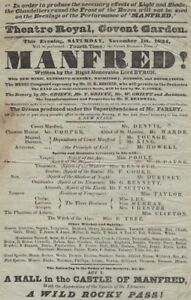
Sold on eBay February 16th, 2024
*LORD BYRON RARE MAGNIFICENT 1834 COVENT GARDEN DOUBLE PLAY BROADSIDE MANFRED*
A rare original November 1834 Theatre Royal Covent Garden double broadside for Lord Byron's Manfred. Boldly printed in black and orange. Dimensions thirteen and a quarter by sixteen inches. Edgewear, light fold with reinforced spine and small tears otherwise good. See Lord Byron's extraordinary biography below. Shipping discounts for multiple purchases. Credit cards accepted with Paypal. Inquiries always welcome. Please visit my other eBay items for more early theatre and historical autographs, photographs and programs and great singer, actor and actress cabinet photos and CDV's. From Gordon Byron (later Noel), 6th Baron Byron, FRS (22 January 1788 – 19 April 1824), commonly known simply as Lord Byron, was an English poet and a leading figure in the Romantic movement. Among his best-known works are the lengthy narrative poems Don Juan and Childe Harold's Pilgrimage, and the short lyric "She Walks in Beauty".Byron is regarded as one of the greatest British poets,[1] and remains widely read and influential. He travelled widely across Europe, especially in Italy where he lived for seven years. Later in life, Byron joined the Greek War of Independence fighting the Ottoman Empire, for which many Greeks revere him as a national hero.[2] He died in 1824 at the young age of 36 from a fever contracted while in Missolonghi. Often described as the most flamboyant and notorious of the major Romantics, Byron was both celebrated and castigated in life for his aristocratic excesses, including huge debts, numerous love affairs - with men as well as women, rumours of a scandalous liaison with his half-sister, and self-imposed exile [3]Manfred: A dramatic poem is a poem written in 1816–1817 by Lord Byron. It contains supernatural elements, in keeping with the popularity of the ghost story in England at the time. It is a typical example of a Romantic closet drama.Byron wrote this "metaphysical drama", as he called it, after his marriage failed in scandal amidst charges of sexual improprieties and an incestuous affair between Byron and his half-sister, Augusta Leigh. Attacked by the press and ostracised by London society, Byron fled England for Switzerland in 1816 and never returned. Because Manfred was written immediately after this, and because it regards a main character tortured by his own sense of guilt for an unmentionable offence, some critics consider it to be autobiographical or even confessional [1] The unnamed but forbidden nature of Manfred's relationship to Astarte is believed to represent Byron's relationship with his half-sister Augusta.Byron commenced this work in late 1816, only a few months after the famed ghost-story sessions which provided the initial impetus for Mary Shelley's Frankenstein. The supernatural references are made clear throughout the poem.Manfred was adapted musically by Robert Schumann in 1852, in a composition entitled Manfred: Dramatic Poem with music in Three Parts, and later by Pyotr Ilyich Tchaikovsky in his Manfred Symphony. Friedrich Nietzschewas impressed by the poem's depiction of a super-human being, and wrote some music for it.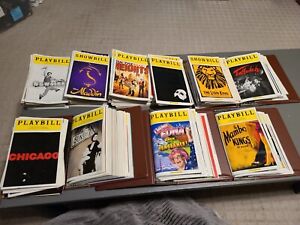
Sold on eBay November 2nd, 2023
Lot of 150 Vintage Playbill Theatre Programs 1996 - 2015, Includes Four Binders
eBay There is approximately 150 play bill theater program booklets in this lot. Including for binders that hold some of the magazines. Most of them have the tickets taped into the inside front cover, and some of them have to additional program paper tape to it also. There is some light wear and a light folds there might be an occasional tear. Please see photos. Included are Sunset Boulevard, art, cabaret, Peter pan, the wild party, aida, the music man, wit, fosse, Beauty and the beast, Les miserables, titanic, ragtime, mamma mia, Dame Edna, White christmas, little shop of horrors, Carolina chance, evita, as you like it, lennon, Monty Python spam lot, La Cage aux Folles, Carnegie Hall, Chitty Chitty Bang Bang, the Mambo kings, Goldas balcony, annie, rain, 700 sundays, Lestat, spelling bee, swan lake, slava's snow show, Martin Short, A Chorus line, tallulah, Fiddler on the roof, Saturday night fever, contact, ada, proof, copenhagen, kiss me Kate, Jitney, stones in his pockets, the producers, Les miserellis, oklahoma, Thoroughly Modern millie, the lion king, South pacific, 9:00, say goodnight gracie, the producers, La Boheme, some like it hot, the fully monty, the allergist wife, tf5, wicked, chicago, riverdance, Miss saigon, La Cage Aux Folles, phantom, evita, rent, Mandy Patinkin, showboat, barrymore, Jekyll and hyde, top dog, cats, the exonerated, 42nd street, Jesus Christ superstar,Aida, phantom, the graduate, Starlight express, the lion king, millie, hairspray, big river, the producers, moving out, hair, sister act, anything goes, million dollar quartet, follies, newsies, phantom, 39 steps, Fiddler on the roof, in the heights, Young frankenstein, dreamgirls, West Side story, Track the musical, Blue Man group, Billy elliot, next to normal, Rock of ages, spider-man, and American in paris, amazing grace, finding neverland, irina's val, South pacific, August, Edward scissors hands, doubt, 39 steps, in the heights, 9 to 5, Monty Python spam lot, who's Afraid of Virginia woolf, the light in the piazza, fila, bring it on, the caretaker, American idiot, Les miserelli's, War horse, the lion king, the king and i, anything goes, wicked, Jersey boys, cinderella, the trip bountiful, aladdin, Mary poppins, curtains, stars and treasures, the pirate queen, deuce, drowsy chaperone, gray gardens, Avenue q, the color purple, jersey boys, a midnight summer's dream, The Drowsy chaperone, spring awakening, Bronx tale, phantom, wicked, Grease, something rotten There are a few duplicates, see photos,
Sold on eBay October 28th, 2024
*FANNY KEMBLE RARE LARGE 1829 ROMEO & JULIET BROADSIDE*
A magnificent original October 16, 1829 Theatre Royal, Covent Garden broadside for the great Fanny Kemble and her father Charles Kemble in Romeo and Juliet. Dimensions thirteen and a half by eight inches. Light wear otherwise good. See Fannny and Charles Kemble's extraordinary biographies below.Ships USPS insured. Shipping discounts for buyers of multiple items. Credit cards accepted with Paypal. Inquiries always welcome. Please visit my other eBay items for more early dance, theatre music and historical autographs, broadsides, photographs and programs and great actor and actress cabinet photos and CDV's. From Anne "Fanny" Kemble (27 November 1809 – 15 January 1893) was a British actress from a theatre family in the early and mid-19th century. She was a well-known and popular writer and abolitionist, whose published works included plays, poetry, eleven volumes of memoirs, travel writing and works about the theatre.In 1834, Kemble married a French man, Pierce Mease Butler, grandson of U.S. Senator Pierce Butler, whom she had met on an American acting tour with her father in 1832. After living in Philadelphia for a time, Butler became heir to the cotton, tobacco and rice plantations of his grandfather on Butler Island, just south of Darien, Georgia, and to the hundreds of slaves who worked them. He made trips to the plantations during the early years of their marriage, but never took Kemble or their children with him. At Kemble's insistence, they finally spent the winter of 1838–1839 there and Kemble kept a diary of her observations, flavored strongly by abolitionist sentiment Butler disapproved of Kemble's outspokenness, forbidding her to publish. The relationship grew abusive, and Kemble eventually returned to England with her two daughters. Butler filed for a divorce in 1847, after they had been separated for some time, citing abandonment and misdeed by Kemble.[1] She returned to the theatre and toured major US cities, giving successful readings of Shakespeare plays. Her memoir circulated in American abolitionist circles, but she waited until 1863, during the American Civil War, to publish her anti-slavery Journal of a Residence on a Georgian Plantation in 1838–1839.[2] It has become her best-known work in the United States: she published several other volumes of journals. In 1877, she returned to England with her second daughter and son-in-law. She lived in London and was active in society, befriending the writer Henry James. In 2000, Harvard University Press published an edited compilation from her journals. These included Record of a Girlhood (1878) and Records of Later Life (1882).[3]Youth and acting careerFanny Kemble as a young girlA member of the famous Kemble theatrical family, Fanny was the eldest daughter of the actor Charles Kemble and his Viennese-born wife, the former Marie Therese De Camp. She was a niece of the noted tragedienne Sarah Siddons and of the famous actor John Philip Kemble. Her younger sister was the opera singer Adelaide Kemble.[2] Fanny was born in London and educated chiefly in France [citation needed] In 1821, Fanny Kemble departed to boarding school in Paris to study art and music as befitted the child of the most celebrated artistic family in England at that time. In addition to literature and society, it was at Mrs Lamb's Academy in the Rue d'Angoulême, Champs Elysées, that Fanny received her first real personal exposure to the stage performing staged readings for students' parents during her time at school. As an adolescent, Kemble spent time studying literature and poetry, in particular the work of Lord Byron.[4]One of her teachers was Frances Arabella Rowden (1774 – c. 1840),[5] who had been associated with the Reading Abbey Girls' School since she was 16. Rowden was an engaging teacher, with a particular enthusiasm for the theatre. She was not only a poet, but according to Mary Russell Mitford, "she had a knack of making poetesses of her pupils"[6]In 1827, Kemble wrote her first five-act play, Francis the First. It was met with critical acclaim from multiple quarters. Nineteenth century critics wrote that the script "displays so much spirit and originality, so much of the true qualities which are required in dramatic composition, that it may fairly stand upon its own intrinsic worth, and that the author may fearlessly challenge a comparison with any other modern dramatist [7]On 26 October 1829, at the age of 20, Kemble first appeared on the stage as Juliet in Romeo and Juliet at Covent Garden Theatre, after only three weeks of rehearsals. Her attractive personality at once made her a great favourite, and her popularity enabled her father to recoup his losses as a manager. She played all the principal women's roles of the time, notably Shakespeare's Portia and Beatrice (Much Ado about Nothing), and Lady Teazle in Richard Brinsley Sheridan's The School for Scandal.[8][9] Kemble disliked the artificiality of stardom in general, but appreciated the salary which she accepted to help her family in their frequent financial troubles.In 1832, Kemble accompanied her father on a theatrical tour of the United States. While in Boston in 1833, she journeyed to Quincy to witness the revolutionary technology of the first commercial railroad in the United States. She had previously accompanied George Stephenson on a test of the Liverpool and Manchester, prior to its opening in England, and described this in a letter written in early 1830. The Granite Railway was among many sights which she recorded in her journal.Kemble returned to acting as a solo platform performer, beginning her first American tour in 1849. During her readings she rose to focus on presenting edited works of Shakespeare, though unlike others she insisted on representing his entire canon, ultimately building her repertoire to 25 of his plays. She performed in Britain and in the United States, concluding her career as a platform performer in 1868 [10]Marriage and daughtersIn 1834, Kemble retired from the stage to marry on 7 June an American, Pierce Mease Butler.[2] Although they met and lived in Philadelphia, Butler was the grandson of Pierce Butler, a Founding Father and heir to a large fortune in cotton, tobacco, and rice plantations. By the time the couple's daughters, Sarah and Frances, were born, Butler had inherited three of his grandfather's plantations on Butler Island, just south of Darien, Georgia, and the hundreds of people who were enslaved on them.[11]The family visited Georgia during the winter of 1838–1839, where they lived at the plantations at Butler and St. Simons islands, in conditions primitive compared to their house in Philadelphia. Kemble was shocked by the living and working conditions of the slaves and their treatment by the overseers and managers. She tried to improve matters, complaining to her husband about slavery and about the mixed-race slave children attributed to the overseer, Roswell King, Jr.[citation needed]Marital tensions had emerged when the family returned to Philadelphia in the spring of 1839. Apart from their disagreements over slave treatment on Butler's plantations, Kemble was "embittered and embarrassed" by Butler's marital infidelities [12] Butler threatened to deny Kemble access to their daughters if she published any of her observations about the plantations [13] By 1845–1847, the marriage had failed irretrievably and Kemble returned to Europe [2]Separation and divorceIn 1847, Kemble returned to the stage in the United States, as she needed to make a living. Following her father's example, she appeared with success as a Shakespearean reader, rather than acting in plays. She toured the United States. The couple endured a bitter and protracted divorce in 1849, with Butler retaining custody of their two daughters. At that time, with divorce rare, the father was customarily awarded custody in the patriarchal society. Other than brief visits, Kemble was not reunited with her daughters until each came of age at 21.[14]Her ex-husband squandered a fortune estimated at $700,000, but was saved from bankruptcy by a sale on 2–3 March 1859 of 436 people he held in slavery. The Great Slave Auction, at Ten Broeck racetrack outside Savannah, Georgia, was the largest single slave auction in United States history. As such, it was covered by national reporters [15]After the American Civil War, Butler tried to run his plantations with free labour, but failed to make a profit. He died of malaria in Georgia in 1867. Neither Butler nor Kemble remarried [16]Later lifeKemble's success as a Shakespearean reader enabled her to buy a home in Lenox, Massachusetts [17] In 1877, she returned to London to join her younger daughter Frances, who had moved there with her British husband and child. Using her maiden name, Kemble lived there until her death. During this period she was a prominent and popular figure in London society, and became a great friend of the American writer Henry James during her later years. His novel, Washington Square (1880), was based on a story Kemble told him about one of her relatives [18]Literary careerKemble wrote two plays, Francis the First (1832) and The Star of Seville (1837). She also published a volume of poems (1844). She published the first volume of her memoirs, Journal, in 1835, shortly after her marriage. In 1863, she published another volume in both the United States and Great Britain. Entitled Journal of a Residence on a Georgian Plantation in 1838-1839, it included her observations of slavery and life on her husband's Southern plantation in the winter of 1838–1839. It contains the earliest-known written use of the word "vegetarian": "The sight and smell of raw meat are especially odious to me, and I have often thought that if I had had to be my own cook, I should inevitably become a vegetarian, probably, indeed, return entirely to my green and salad days."[19]After separating from Butler in the 1840s, Kemble travelled in Italy and wrote a two-volume book on this time, A Year of Consolation (1847).[20]In 1863 Kemble also published a volume of plays, including translations from Alexandre Dumas, père and Friedrich Schiller. These were followed by additional memoirs: Records of a Girlhood (1878); Records of Later Life (1882); Far Away and Long Ago (1889); and Further Records (1891). Her various reminiscences contain much valuable material about the social and theatrical history of the period. She also published Notes on Some of Shakespeare's Plays (1882), based on long experience in acting and reading his works DescendantsKemble s older daughter, Sarah Butler, married Owen Jones Wister, an American doctor. Their one child, Owen Wister, grew up to become a popular American novelist, writing in 1902 a popular 1902 western, The Virginian Fanny s other daughter Frances met James Leigh in Georgia. He was a minister born in England. The couple married in 1871, and their one child, Alice Leigh, was born in 1874. An attempt was made to run Frances's father's plantations there with free labour, but no profit could be made. Leaving Georgia in 1877, they moved permanently to England. Frances Butler Leigh defended her father in the continuing post-war dispute over slavery as an institution. Based on her experience, Leigh published Ten Years on a Georgian Plantation since the War (1883), a rebuttal to her mother's account [14]DeathHer granddaughter Alice Leigh was present when Fanny Kemble died in London in 1893 Controversy[edit]While Kemble's account of the plantations has been criticised, it is seen as notable for voicing the enslaved black people, especially enslaved black women, and has been drawn on by many historians.[21] As noted earlier, her daughter published a rebuttal account. Margaret Davis Cate published a strong critique in the Georgia Historical Quarterly in 1960. In the early 21st century, historians Catherine Clinton[ and Deirdre David studied Kemble's Journal and raised questions[ about her portrayal of Roswell King, father and son, who successively managed Pierce Butler's plantations, and about Kemble's own racial sentiments.On Kemble's racial views, David notes how she would call black slaves stupid, lazy, filthy and ugly, but such views were then common and compatible with opposing slavery and outrage at its cruelties [22]Clinton noted that in 1930, Julia King, granddaughter of Roswell King, Jr., stated that Kemble had falsified her account of him after he spurned her affections.[23] There is little evidence in Kemble's Journal that she encountered Roswell King, Jr., on more than a few occasions, and none that she knew his wife, the former Julia Rebecca Maxwell. But she criticized Maxwell as "a female fiend" because a slave named Sophy told her that Mrs. King had ordered the flogging of Judy and Scylla, "of whose children Mr. K[ing] was the father."[24] Roswell King, Jr., was no longer in the employ of her husband when Pierce Butler and Kemble began their short residency in Georgia. King had resigned due to "growing uneasiness... born of a dispute between the Kings and the Butlers over fees the elder King thought were owed him as co administrator of Major Butler's estate [25]Before arriving in Georgia, Kemble had written, "It is notorious that almost every Southern planter has a family more or less numerous of illegitimate coloured children."[26] Her statements about Roswell King, Sr., and Roswell King, Jr., and their alleged status as white fathers of enslaved mulatto children, are based on what she was told by other slaves. In some cases, individuals relied on hearsay accounts of their paternity, although European ancestry was visible. The mulatto Renty, for example, was "ashamed" to ask his mother about the identity of his father. He believed he was the son of Roswell King, Jr. because "Mr. C[ouper]'s children told me so, and I 'spect they know it."[27] John Couper, the Scottish-born owner of a rival plantation adjacent to Pierce Butler's Hampton Point on St. Simon's Island, had had marked disagreements with the Roswell Kings in the past. Clinton suggests that Kemble favored Couper's accounts [28][BiographiesNumerous books have appeared on Fanny Kemble and her family, including Deirdre David's A Performed Life[9] (2007) and Vanessa Dickerson's passage on Kemble in Dark Victorians (2008). Earlier works were Fanny Kemble (1933) by Leota Stultz Driver, Fanny Kemble: A Passionate Victorian (1939) by Margaret Armstrong,[29] Fanny Kemble: Actress, Author, Abolitionist (1967) by Winifred Wise,[30] and Fanny Kemble: Leading Lady of the Nineteenth century Stage : A Biography (1982) by J.C. Furnas.[31]Some recent biographies that focus on Kemble's role as an abolitionist include Catherine Clinton's Fanny Kemble's Civil Wars: The Story of America's Most Unlikely Abolitionist (2000). Others have studied the theatrical careers of Kemble and her family. One of these, Henry Gibbs' Affectionately Yours, Fanny: Fanny Kemble and the Theatre, appeared in eight editions between 1945 and 1947.Charles Kemble (25 November 1775 – 12 November 1854) was a Welsh-born English actor of a prominent theatre family.[Charles Kemble was one of 13 siblings and the youngest son of English Roman Catholic theatre manager/actor Roger Kemble, and Irish-born actress Sarah Ward. He was the younger brother of, among others, John Philip Kemble, Stephen Kemble and Sarah Siddons. He was born at Brecon in South Wales. Like his brothers he was raised in his father's Catholic faith, while his sisters were raised in their mother's Protestant faith. He and John Philip were educated at Douai School.After returning to England in 1792, he obtained a job in the post office, but soon resigned to go on the stage, making his first recorded appearance at Sheffield as Orlando in As You Like It in that year. During the early part of his career as an actor he slowly gained popularity. For a considerable time he played with his brother and sister, chiefly in secondary parts, and received little attention Charles Kemble, by Henry Perronet Briggs. Oil on canvas, before 1832His first London appearance was on 21 April 1794, as Malcolm to his brother's Macbeth. Ultimately he won independent fame, especially in such characters as Archer in George Farquhar's Beaux' Stratagem, Dorincourt in Hannah Cowley's Belle's Stratagem, Charles Surface and Ranger in Benjamin Hoadley's Suspicious Husband. His Laërtes and Macduff were as accomplished as his brother's Hamlet and Macbeth. His production of Cymbeline in 1827 inaugurated the trend to historical accuracy in stagings of that play that reached a peak with Henry Irving at the turn of the century.In comedy he was ably supported by his wife, Marie Therese De Camp, whom he married on 2 July 1806. His visit, with his daughter Fanny, to America during 1832 and 1834, aroused much enthusiasm. The later part of his career was beset by money troubles in connection with his joint proprietorship of Covent Garden theatre.He formally retired from the stage in December 1836, but his final appearance was on 10 April 1840. From 1836-1840 he held the office of Examiner of Plays.[2] In 1844-45 he gave readings from Shakespeare at Willis's Rooms. Macready regarded his Cassio as incomparable, and summed him up as "a first-rate actor of second-rate parts."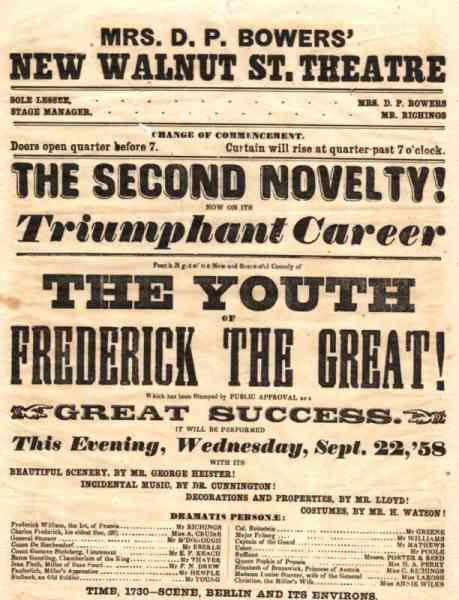
Sold on eBay November 4th, 2024
*WALNUT STREET THEATRE RARE 1858 BROADSIDE THE YOUTH OF FREDERICK THE GREAT*
A rare large original September 1858 broadside for Mrs. D. P. Bowers's New Walnut Street Theatre, Philadelphia featuring The Youth of Frederick the Great with All that Glitters Is Not Gold as afterpiece. Featured among both casts is Frank Drew, John Drew's brother and great uncle of Ethel, Lionel, and John Barrymore. Dimensions nineteen and a half by ten inches. Light creasing, small punctures and small mounting hole at top margin otherwise good. Mrs. D. P. Bowers was among the few female theatre managers of the era. See the story of the Walnut Street Theatre below. Shipping discounts for multiple purchases. Inquiries always welcome. Please visit my other eBay items for more early theatre, opera, film and historical autographs, photographs and programs and great actor and actress cabinet photos and CDV's. From Wikipedia: The Walnut Street Theatre at 825 Walnut Street on the corner of S. 9th Street in the Washington Square West neighborhood of Philadelphia, Pennsylvania, is the oldest continuously operating theatre in the English speaking world and the oldest in the United States.[3] The venue is operated by the Walnut Street Theatre Company, a non-profit organization, and has three stages: the Mainstage, for the company's primary and larger productions, the Independence Studio on 3, a studio located on the building's third floor for smaller productions, and the Studio 5 on the fifth floor, which is rented out for independent productions. The company wants to build a theatre in the round next door, where the parking lot currently is. The Walnut Street Theatre was built by the Circus of Pepin and Breschard, which toured the United States from 1807 until 1815. Pepin and Breschard constructed numerous venues in cities along the East Coast of the United States, which often featured, along with performances of their circus, classical plays as well as horse dramas.[5] The theatre was founded in 1809, going by the name of The New Circus. In 1811, the two partners commissioned architect William Strickland to design and construct a stage and orchestra pit for theatrical performances and the theatre's name was changed to The Olympic. The official website says that the name The Walnut Street Theatre was first used there in 1820, though the name was changed back to The Olympic in 1822 and to The Walnut again in 1828. A travel guidebook from 1849 indicates that in the mid 19th century, this building was called The American Theatre. The Walnut was the first theatre to install gas footlights in 1837. In 1855 it was also the first theatre to feature air conditioning. The theatre switched to electric chandeliers and footlights in 1892. The theatre has undergone many renovations since its opening. The first theatrical production at the theatre was The Rivals in 1812 (President Thomas Jefferson and the Marquis de Lafayette were in attendance). Edwin Booth and John Sleeper Clarke purchased the theatre in 1865, and then the theatre became part of The Shubert Organization in 1941. On October 15, 1966, The Walnut Street Theatre was designated a National Historic Landmark and in 1969, the theatre was purchased by a non-profit organization and turned over to the new Walnut Street Theatre Corporation. On September 23, 1976, it was the site of the debate between Gerald R. Ford and Jimmy Carter. The Walnut Street Theatre Company, a non-profit regional producing company, was formed in 1983. In 1984, the Walnut Street Theatre School was established and over 1,200 students enroll annually, and 1986 saw the introduction of the Independence Studio on 3 series. To this day, the company produces five productions a season on the theatre's main stage and is the most subscribed theatre company in the world. In Fall 2008, the theater celebrated its 200th season of live entertainment. Elizabeth Crocker Bowers (March 12, 1830 – November 6, 1895) [1] was an American stage actress and theatrical manager.[2][3] She was also known professionally as Mrs. D. P. Bowers. Early life Elizabeth Crocker Bowers was born March 12, 1830 in Stamford, Connecticut,[4] the daughter of an Episcopal clergyman[1] and sister of actress Sarah Crocker Conway (also known as Mrs. F. B. Conway).[4] Career and marriages[edit] In 1846, she appeared in the character of Amanthis [1] at the Park Theatre in New York City, New York. On March 4, 1847,[1][4] she married actor David P. Bowers,[3] and moved to Philadelphia. She appeared as Donna Victoria in A Bold Stroke for a Husband at the Walnut Street Theatre in Philadelphia. She became very popular at the Arch Street Theatre, and made Philadelphia her home until her husband's death in 1857. In December 1857, after a period of retirement from the stage, she leased the Walnut Street Theatre and retained its management until 1859. She then leased the Philadelphia Academy of Music for a short dramatic season. She married Dr. Brown of Baltimore in 1861.[3] and traveled to London. She made a great success as "Julia" in The Hunchback at the Sadler's Wells Theatre and "Geraldine D'Arcy" in Woman (play) at the Lyceum Theatre in London. Returning to New York City in 1863, she played for a time at the Winter Garden (now demolished). Among her favorite roles were Juliet, Lady Macbeth, Marie Antoinette, and Lady Audley. After the death of Dr. Brown in 1867, she married actor J. C. McCollom,[4] with whom she repeated many of her popular roles. Her subsequent retirement in Philadelphia was interrupted by a return to the stage in October 1886 for several years.[3] She organized a new dramatic company, and visited the principal cities of the U.S., playing many of her old and favorite characters. Under A. M. Palmer's management she appeared in Lady Windermere's Fan (1893), and later she was a supporting actress for Rose Coghlan and Olga Nethersole.[1] Bowers died of pneumonia and heart failure [4] on November 6, 1895[3] in at the home of her son-in-law, Frank Bennett, in Washington D.C. She was survived by a daughter, Mrs. F. V.(May) Bennett and two sons, Harry C. Bowers of Portland, OR and Walter Bowers of New York City.[5] She was buried at Rock Creek Cemetery in Washington, D.C.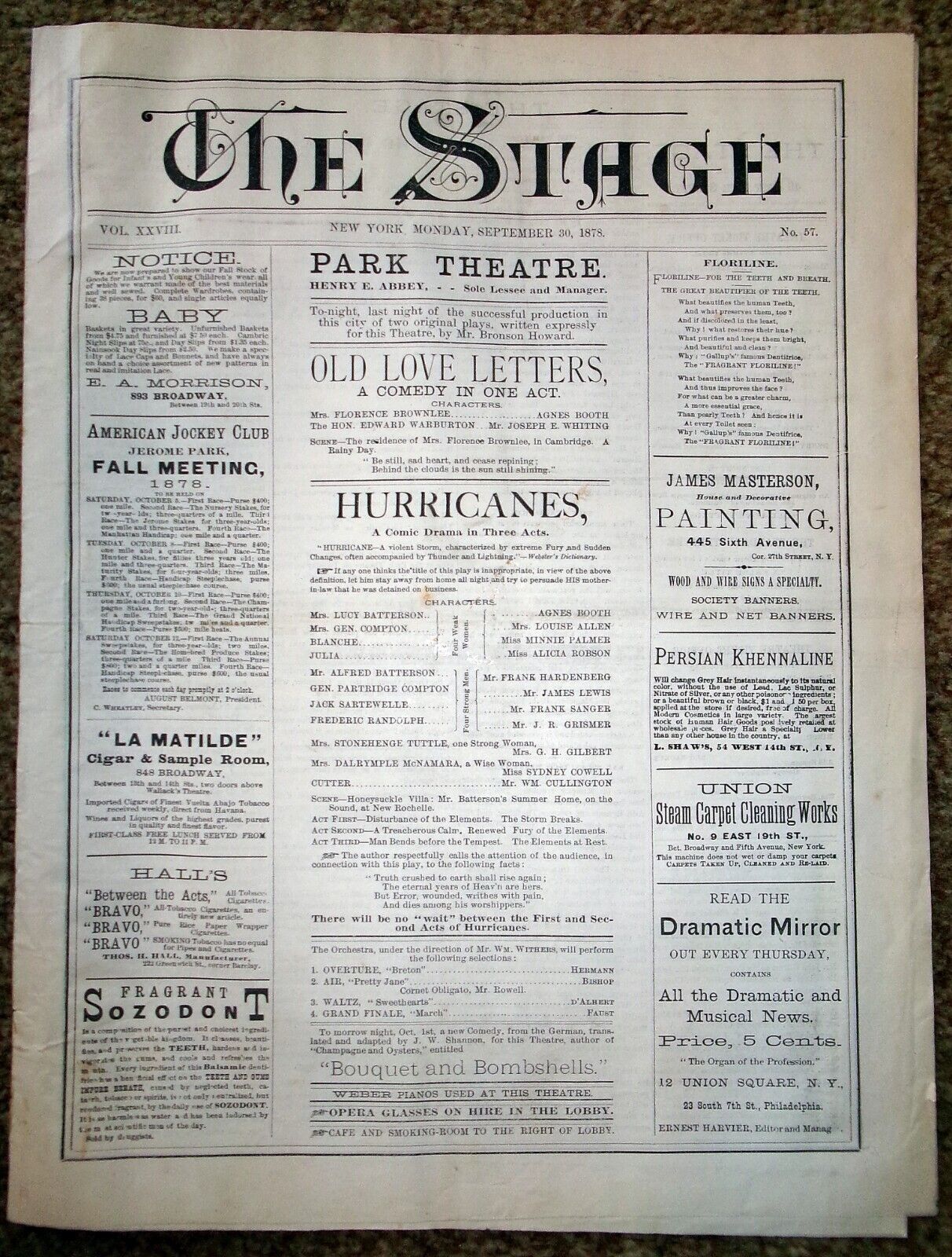
Sold on eBay January 28th, 2025
Agnes Booth Hurricanes Old Love Letters Full Program 1878 Park Theatre Edwin
You are bidding & “Old Love Letters” full program; Park Theatre, NYC; Sept 30, 1878; with Agnes Booth (wife of JB Booth Jr, sister-in-law of John Wilkes Booth and Edwin Booth), Minnie Palmer, Frank Hardenberg, James Lewis, Mrs G H Gilbert, Miss Sydney Cowell;Che 4 pp (one sheet folded); approx 11 x 14 ½"; some wear, minor paper loss p3/4 (reinforced with archival tape), mounting paper last page; still Good see photos Buyers should know that I use the Ebay International Shipping Program.Photos are considered an essential part of the description, please examine carefully. Please ask any questions before the end of the auction. I am happy to answer any and all question. Please pay within 3 days of auction end. All items in as-is condition. No refunds unless it can be established that the item was not accurately described (photos are considered an essential part of the description). Thanks!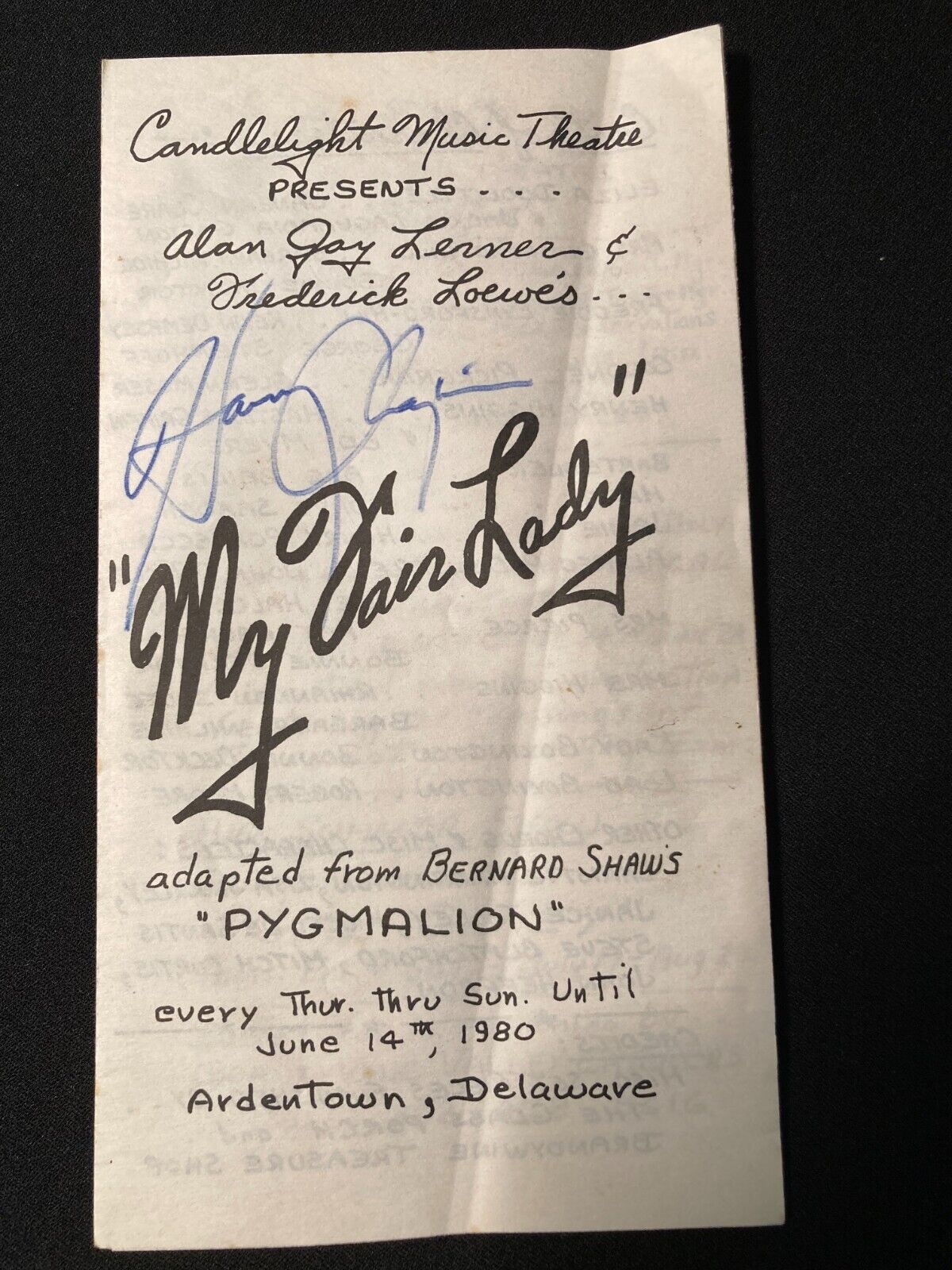
Sold on eBay February 21st, 2025
Harry Chapin Autographed Playbill Ardentown Delaware 1980 Autograph
This is an autographed pamphlet signed by Harry Chapin from 1980 at the Candlelight Music Theater in Ardentown, Delaware. Arden is a quaint little town in Northern Delaware.This belonged to my sister-in-law, who sadly passed away many years ago. She met Harry and got him to sign her pamphlet. Harry visited Delaware on numerous occasions, at the Grand Opera House and University of Delaware, to name a few venues. The pamphlet has some stains and creases, but they do not affect his signature whatsoever Please look at all photos as they are part of my description and show the exact condition.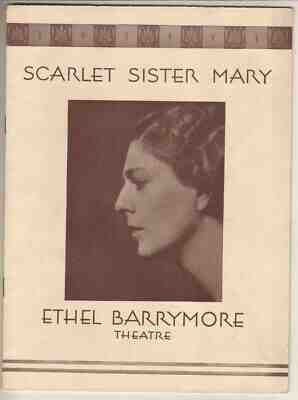
Sold on eBay Sep, 16th 2020
Tony Sarg Marionettes AD "Scarlet Sister Mary" 1930 Playbill Ethel Barrymore
Tony Sarg Marionettes AD "Scarlet Sister Mary" 1930 Playbill Ethel Barrymore<br /> DESCRIPTION: Tony Sarg Marionettes featured in ad for Camel Cigarettes on pages 22 & 23. See scans above. Characters rendered by Sarg are from Shakespeare's Macbeth; headline says: Lay off, Macduff- and have a Camel nbsp; nbsp;Please write with any questions.<br /><br />This Broadway Playbill is from the week of November 25, 1930, at the Ethel Barrymore Theatre, forScarlet Sister Mary, a play by Daniel Reed, from the novel by Julia Peterkin. The company appeared in black
Sold on eBay Aug 14, 2022
Clevelan Theatre PLAYBILL 1930 Scarlet Sister Mary ETHEL BARRYMORE Tony Sarg ad
See photos for details. solid binding.
Sold on eBay February 1st, 2025
Alex Brightman Signed School Of Rock October 2016 Playbill & Stickers Of Cast
Thanks for looking :-)This Broadway playbill is signed by Alex from when my sister and I saw the musical in the Fall of 2016. Including sticker sheet if the OG cast and promo brochure too :-) If I can find the other stickers & cup from the theatre I’ll include that too!I hope you love your purchase! Should you have any issues, please contact us rather than leaving negative feedback - i care about your happiness :-)
Sold on eBay October 5th, 2023
*A CONAN DOYLE JAMES O'NEILL CRESTON CLARKE 1903 ADVENTURES OF GERARD PROGRAM*
A rare original program clip circa 1903 for James O'Neill--Eugene O'Neill's father--and Creston Clarke, nephew of Edwin and John Wilkes Booth, in Sherlock Holmes author A. Conan Doyle's The Adventures of Gerard. Laid down to an Edwardian album page. Dimensions seven by four inches. Light wear otherwise good. See the story of Brigadier Gerard and A. Conan Doyle's extraordinary biography below. Shipping discounts for multiple purchases. Inquiries always welcome. Please visit my other eBay items for more early Gilbert and Sullivan items, theatre, opera, film and historical autographs, photographs and programs, and great actor and actress cabinet photos and CDV's. Sir Arthur Ignatius Conan Doyle KStJ DL (22 May 1859 – 7 July 1930) was a British writer and physician. He created the character Sherlock Holmes in 1887 for A Study in Scarlet, the first of four novels and fifty-six short stories about Holmes and Dr. Watson. The Sherlock Holmes stories are milestones in the field of crime fiction.Doyle was a prolific writer; other than Holmes stories, his works include fantasy and science fiction stories about Professor Challenger and humorous stories about the Napoleonic soldier Brigadier Gerard, as well as plays, romances, poetry, non-fiction, and historical novels. One of Doyle's early short stories, "J. Habakuk Jephson's Statement" (1884), helped to popularise the mystery of the Mary Celeste.His first work featuring Sherlock Holmes and Dr. Watson, A Study in Scarlet, was written in three weeks when he was 27 and was accepted for publication by Ward Lock & Co on 20 November 1886, which gave Doyle £25 (equivalent to £2,900 in 2019) in exchange for all rights to the story. The piece appeared a year later in the Beeton's Christmas Annual and received good reviews in The Scotsman and the Glasgow Herald [9]Holmes was partially modelled on Doyle's former university teacher Joseph Bell. In 1892, in a letter to Bell, Doyle wrote, "It is most certainly to you that I owe Sherlock Holmes ... round the centre of deduction and inference and observation which I have heard you inculcate I have tried to build up a man",[35] and in his 1924 autobiography, he remarked, "It is no wonder that after the study of such a character [viz., Bell] I used and amplified his methods when in later life I tried to build up a scientific detective who solved cases on his own merits and not through the folly of the criminal."[36] Robert Louis Stevenson was able to recognise the strong similarity between Joseph Bell and Sherlock Holmes: "My compliments on your very ingenious and very interesting adventures of Sherlock Holmes. ... can this be my old friend Joe Bell?"[37] Other authors sometimes suggest additional instance, Edgar Allan Poe's character C. Auguste Dupin, who is mentioned, disparagingly, by Holmes in A Study in Scarlet.[38] Dr. (John) Watson owes his surname, but not any other obvious characteristic, to a Portsmouth medical colleague of Doyle's, Dr. James Watson [39]Sherlock Holmes statue in Edinburgh, erected opposite the birthplace of Doyle, which was demolished c. 1970A sequel to A Study in Scarlet was commissioned, and The Sign of the Four appeared in Lippincott's Magazine in February 1890, under agreement with the Ward Lock company. Doyle felt grievously exploited by Ward Lock as an author new to the publishing world, and so, after this, he left them.[9] Short stories featuring Sherlock Holmes were published in the Strand Magazine. Doyle wrote the first five Holmes short stories from his office at 2 Upper Wimpole Street (then known as Devonshire Place), which is now marked by a memorial plaque [40]Doyle s attitude towards his most famous creation was ambivalent.[39] In November 1891, he wrote to his mother: "I think of slaying Holmes, ... and winding him up for good and all. He takes my mind from better things." His mother responded, "You won't! You can't! You mustn't!"[41] In an attempt to deflect publishers' demands for more Holmes stories, he raised his price to a level intended to discourage them, but found they were willing to pay even the large sums he asked.[39] As a result, he became one of the best-paid authors of his time.Statue of Holmes and the English Church in MeiringenIn December 1893, to dedicate more of his time to his historical novels, Doyle had Holmes and Professor Moriarty plunge to their deaths together down the Reichenbach Falls in the story "The Final Problem". Public outcry, however, led him to feature Holmes in 1901 in the novel The Hound of the Baskervilles. Holmes's fictional connection with the Reichenbach Falls is celebrated in the nearby town of Meiringen.In 1903, Doyle published his first Holmes short story in ten years, "The Adventure of the Empty House", in which it was explained that only Moriarty had fallen, but since Holmes had other dangerous Colonel Sebastian Moran—he had arranged to make it look as if he too were dead. Holmes was ultimately featured in a total of 56 short stories—the last published in 1927—and four novels by Doyle, and has since appeared in many novels by other authors Brigadier Gerard is the comedic hero of a series of 17 historical short stories, a play, and a major character in a novel by the British writer Arthur Conan Doyle. Brigadier Etienne Gerard is a Hussar officer in the French Army during the Napoleonic Wars. Gerard's most notable attribute is his vanity – he is utterly convinced that he is the bravest soldier, greatest swordsman, most accomplished horseman and most gallant lover in all France. Gerard is not entirely wrong, since he displays notable bravery on many occasions, but his self satisfaction undercuts this quite often. Obsessed with honour and glory, he is always ready with a stirring speech or a gallant remark to a lady.Doyle, in making his hero a vain, and often rather uncomprehending Frenchman, was able to satirise both the stereotypical English view of the French and – by presenting them from Gerard's baffled point of view – English manners and attitudes.The Booth family was an English American theatrical family of the 19th century. Its most known members were Edwin Booth, one of the leading actors of his day, and John Wilkes Booth, who assassinated Abraham Lincoln.The patriarch was Junius Brutus Booth, a London-born lawyer's son who eventually became an actor after he attended a production of Othello at the Covent Garden theatre. The prospects of fame, fortune, and freedom were very appealing to young Booth, and he displayed remarkable talent from an early age, deciding on a career in the theatre by the age of 17. He performed roles in several small theaters throughout England, and joined a tour of the Low Countries in 1814, returning the following year to make his London debut.Booth abandoned his wife and their young son in 1821 and ran off to the United States with Mary Ann Holmes, a London flower girl. They settled on some 150 acres in Harford County near Baltimore and started a family; they had 10 children, six of whom survived to adulthood [1][2]Junius Sr. and Edwin toured in California during the Gold Rush.[citation needed] Edwin bought an interest in the Winter Garden Theatre at 667 Broadway in New York City with his brother-in-law John Sleeper Clarke. The brothers John Wilkes, Edwin, and Junius Brutus, Jr. performed there in the play Julius Caesar at a benefit in 1864, the only time they were seen together on a stage, playing Mark Antony, Brutus, and Cassius, respectively [3]MembersThe Booth Family gravesite, Green Mount CemeteryJunius Brutus Booth (1796–1852) brought his mistress Mary Ann Holmes, who bore him 10 children, to the United States.He also wrote many letters in fits of drunken anger and madness to President Andrew Jackson threatening assassination. He requested that two prisoners who had been sentenced to death for piracy, named De Ruiz and De Soto, be pardoned, or else: "I will cut your throat whilst you are sleeping." This letter would later be recanted by Junius, stating, "May god preserve General Jackson and this happy republic [4]Junius Brutus Booth Jr. (1821–1883) was married to Agnes Booth. Junius Jr. never achieved the same fame as his brothers, but his third wife Agnes was popular.Their son Sydney Barton Booth (1877–1937) was an actor well into the era of modern film [5]Edwin Thomas Booth (1833–1893) came to be the foremost American Shakespearean actor of his day. He founded The Players, a New York City actors' club which continues to the present day. His second wife, Mary McVicker, was an actress [6]Edwin s grandson Edwin Booth Grossman was a painter of some note.Asia Frigga Booth (1835–1888) married John Sleeper Clarke, an actor/comedian who was briefly imprisoned in the aftermath of the assassination. They then emigrated to Britain, where he became a successful theatre manager.Creston Clarke[7] and Wilfred Clarke,[8] sons of John and Asia, were noted actors in their day.John Wilkes Booth (1838–1865) was a popular young star in less serious fare than his brothers.A Confederate sympathizer during the American Civil War, during a play attended by Abraham Lincoln, Booth took advantage of his access to the theatre to invade the President's box and assassinate the President. He was killed 12 days later by Union soldier Boston Corbett.Edwina Booth Grossman (1861–1938) daughter of Edwin Booth,[9] and the author of Edwin Booth: Recollections by His Daughter, Edwina Booth Grossman, and Letters to Her and to His Friends (1894).James O'Neill (November 15, 1847 – August 10, 1920) was an Irish-American theatre actor and the father of the American playwright Eugene O'Neill.Early lifeJames O'Neill[1] was born on November 15, 1847, in County Kilkenny, Ireland. His parents were distant cousins, Edward[2] and Mary O'Neill. His father was a farmer. The family emigrated to America in 1851 and settled in Buffalo, New York. In 1857 they moved to Cincinnati, Ohio, where James was apprenticed to a machinist [3]CareerPlaque in New Ross, County Wexford recalling his emigration to America in 1851At the age of 21, he made his stage debut in a Cincinnati, Ohio, production of Boucicault's The Colleen Bawn (1867). Also in 1867, Edwin Forrest embarked on a "farewell tour". O'Neill had a minor part in Forrest's Cincinnati production of Virginius, and then joined a travelling repertory company. He played a young sailor in Joseph Jefferson's Rip Van Winkle and for the first time found his brogue a handicap.[3] He also played Macduff to Edwin Booth's Macbeth.The San Francisco Chronicle of August 3, 1879, described James O'Neill as "...a quiet gentleman of medium height, well proportioned figure, square shoulders and stands very erect. He has black hair, black eyes, rather dark complexion, a black mustache, and a fine set of teeth which he knows how to display to advantage."[3] "[4]While in San Francisco, O'Neill became friends with fellow actor, John Elitch. When Elitch opened the Elitch Zoological Gardens in Denver, Colorado, on May 1, 1890, O'Neill attended the opening and promised "I'll come back and play on that stage whenever you say." On May 30, 1897, O'Neill kept his promise and appeared in the opening play, Helene, by Martha Morton.[5]He was considered a promising actor, quickly working his way up the ranks to become a matinee idol. [6]ScandalIn 1874 O'Neill joined Richard M. Hooley's company, and the following year toured San Francisco, Virginia City and Sacramento. He then headed back east to join the Union Square Company.[3]On June 14, 1877, while in New York, James O'Neill married Mary Ellen Quinlan, daughter of Thomas and Bridget Quinlan, at St. Ann's Church on 12th Street. James and Ella had three sons: James (b. 1878), Edmund (b. 1883) and Eugene O'Neill (b. 1888). While James was on tour, Ella often accompanied him, and the boys were placed in boarding school. In the fall of 1877, three months after James' marriage, a woman by the name of Nettie Walsh sued O'Neill, claiming that O'Neill already married her, when she was 15, and he was the father of her three year old son. [4]The couple was in San Francisco on September 10, 1878, when their first son, James O'Neill, Jr. was born in the home of one of O'Neill's friends. While in San Francisco, O'Neill took on the role of Christ in David Belasco's production The Passion for which Belasco rounded up 100 nursing mothers to appear in the tableau "the Massacre of the Innocents". The Board of Supervisors passed a local ordinance prohibiting "profane" dramas, and O'Neill and the rest of the company were arrested. O'Neill pleaded guilty and paid a $50 fine for himself and $5 for each of his co-defendants. About October 30, 1880, O'Neill and his family took a train back to New York where he re-joined the Union Square Company.[3]The Count of Monte CristoPoster for a 1900 theatre production of Monte Cristo, adapted for the stage by Charles Fechter, starring James O'NeillEdmond Dantès (James O'Neill) loosens a stone before making his escape from the Château d'If in The Count of Monte Cristo (1913)As early as 1875, while a stock star at Hooley's Theatre in Chicago, O'Neill played the title role in a stage adaptation of Dumas' The Count of Monte Cristo. In early 1883 O'Neill took over the lead role in Monte Cristo at Booth's Theater in New York, after Charles R. Towne died suddenly in the wings after his first performance. O'Neill's interpretation of the part caused a sensation with the theater-going public. A company was immediately set up to take the play on tour. O'Neill bought the rights to the play. The San Francisco News Latter was less appreciative of O'Neill, saying on December 31, 1887 "In his hands the romantic story has degenerated into an extravagant melodrama. ...He is reaping the pecuniary profit of his business sagacity, but it is at the cost of art."[3]O'Neill soon had enough of the Count. His lines came out by rote and his performances became lackadaisical. He tried other plays but The Three Musketeers and Julius Caesar met with indifferent response, and O'Neill was forced to return to Monte Cristo in order to recoup the losses sustained in "artistic successes". Monte Cristo remained a popular favorite and would continue to make its appearance on tour as regular as clockwork. O'Neill could not afford to sacrifice wealth in the face of a growing family. His son Eugene was born in New York on October 16, 1888.[3]He went on to play this role over 6000 times. Some, including Eugene, saw O'Neill's willingness to play the role so many times as selling out; squandering the potential of his art in order to make money.[7] By 1887, The San Francisco Morning Call estimated O'Neill's fortune at a quarter of a million dollars. In March 1894, O'Neill took on the role of Shane O'Neill in the play The Prince of Ulster [3]According to his son, Eugene,My father was really a remarkable actor, but the enormous success of "Monte Cristo" kept him from doing other things. He could go out year after year and clear fifty thousand in a season. He thought that he simply couldn't afford to do anything else. But in his later years he was full of bitter regrets. He felt "Monte Cristo" had ruined his career as an artist.[3]The company toured as far west at St. Louis; Eugene O'Neill who had given up his studies at Princeton, was the assistant treasurer. He left the company to begin his wanderings at sea.[3] O'Neill converted "Monte Cristo" into tabloid form for the vaudeville circuit to accommodate changing taste in theater entertainment O Neill s celebrity and identification with Monte Cristo led Adolph Zukor to engage O'Neill in 1912 to appear in a feature film version of the play as the first production of his Famous Players Film Company. By that time O'Neill had been continuously playing the part for nearly 40 years and was 65 years old. Directed and photographed by Edwin S. Porter and co-starring Nance O'Neil as Mercedes, the film was initially held back in release but finally appeared in late 1913.DeathIn the middle of 1920 James was struck by an automobile in New York City and taken to Lawrence Memorial Hospital in New London, Connecticut. He died, aged 72, on August 11, 1920, from intestinal cancer,[4] at the family summer home, the Monte Cristo Cottage in Connecticut. His funeral at St. Joseph's Church was attended by, among others, O'Neill's sister, Mrs. M. Platt of St. Louis and Edward D. White, Chief Justice of the United States Supreme Court. O'Neill was buried in St. Mary's cemetery [3]LegacyJames O'Neill later became the model for James Tyrone, the frugal, mercurial, unseeing father character in Eugene O'Neill's posthumously published play Long Day's Journey into Night, which tells the story of the Tyrone family, which closely resembles the O'Neill family.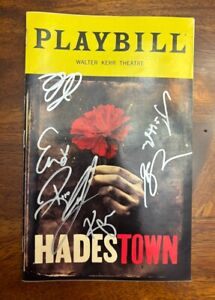
Sold on eBay January 9th, 2024
HADESTOWN Broadway playbill SIGNED ORIGINAL CAST 9/18/2019 (Eva and Revee)
eBay This signed original cast playbill from the Broadway production of HADESTOWN is a must-have for any theater memorabilia collector. Featuring the iconic music and lyrics by Anaïs Mitchell, this playbill is a rare find for fans of the show. The signature of both Eva Noblezada and Reeve Carney make this item even more special for those who saw the production during its original run. This piece is perfect for any fan of theater and entertainment memorabilia, particularly those who collect playbills or items from specific productions. Don't miss out on the opportunity to own a piece of Broadway history Hadestown Playbill from September 18th, 2019. Full original pre-pandemic cast, original playbill design. Signed by Eva Noblezada (Eurydice) , Revee Carney(Orpheus) , Jewelle Blackman (Fate), Kimberly Marable (Worker), Timothy Hughes (Worker), John Krause (Worker). Playbill is in mint condition and well preserved! The full original cast performed that day. I have an extra signed one that I kept so the one in the other pictures is not the same one from the main photo. The main photo one is the one you would receive. It is signed by all the people pictured (shoutout to my big sister!!) The girl in the pictures is senior year of high school me after crying at the end of the show btw. Want one but can't get the signed one? Check my page for some unsigned ones from the same day! (Also Revee's Eva bracelet in the third photo, just peep it.)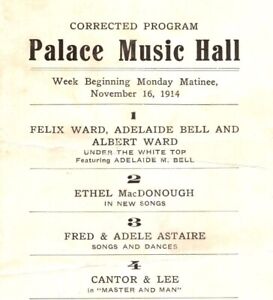
Sold on eBay March 10th, 2024
*EDDIE CANTOR FRED & ADEL6E ASTAIRE RARE LARGE 1914 VAUDEVILLE BROADSIDE *
A rare large original 1914 broadside type program for Eddie Cantor with Cantor and Lee and the amazing brother and sister team of Fred and Adele Astaire at the Palace Music Hall. Dimensions fifteen by four inches. Light wear and light folds otherwise good. See Eddie Cantor and Fred Astaire's extraordinary biographies below.Shipping discounts for buyers of multiple items. Credit cards accepted with Paypal. Inquiries always welcome. Please visit my other eBay items for more early theatre and historical autographs, broadsides, photographs and programs and great actor and actress cabinet photos and CDV's. From Wikipedia:Eddie Cantor (born Isidore January 31, 1892 – October 10, 1964) was an American comedian, actor, dancer, singer, songwriter, film producer, screenwriter and author.[3] Familiar to Broadway, radio, movie, and early television audiences, this "Apostle of Pep" was regarded almost as a family member by millions because his top-rated radio shows revealed intimate stories and amusing anecdotes about his wife, Ida, and five daughters. Some of his hits include "Makin' Whoopee", "Ida (Sweet as Apple Cider)", "If You Knew Susie", "Ma! He's Making Eyes at Me", “Mandy”, "My Baby Just Cares for Me”, "Margie", and "How Ya Gonna Keep 'em Down on the Farm (After They've Seen Paree)?" He also wrote a few songs, including "Merrily We Roll Along", the Merrie Melodies Warner Bros. cartoon theme.His eye-rolling song-and-dance routines eventually led to his nickname "Banjo Eyes". In 1933, artist Frederick J. Garner caricatured Cantor with large round eyes resembling the drum-like pot of a banjo. Cantor's eyes became his trademark, often exaggerated in illustrations, and leading to his appearance on Broadway in the musical Banjo Eyes (1941).His charity and humanitarian work was extensive. He helped to develop the March of Dimes and is credited with coining its name. Cantor was awarded an honorary Oscar in 1956 for distinguished service to the film industry.Early lifeReports and accounts of Cantor's early life often conflict with one another. What is known is that he was born in New York City, the son of Mechel Iskowitz (also Michael), an amateur violinist, and his wife Meta Kantrowitz Iskowitz (also Maite), a young Jewish couple from Russia.[4] It is generally accepted that he was born in 1892, though the day is subject to debate, with either January 31 or Rosh Hashanah, which was on September 10 or September 11, being reported [5][6][7] Although it was reported Cantor was an orphan, his mother dying in childbirth and his father of pneumonia, official records say otherwise; Meta died from complications of tuberculosis in July 1894 and the fate of Mechel is unclear, as no death certificate exists for him. There is also discrepancy as to his name; both his 1957 autobiography and The New York Times obituary for Cantor report his birth name as Isidore Iskowitch, although some articles published after the 20th century give his birth name as Edward (a nickname given him by his future wife, Ida, in 1913) or Israel Itzkowitz [8][5] His grandmother, Esther Kantrowitz (died January 29, 1917), took custody of him, and referred to him as Izzy and Itchik, both diminutives for Isidor, and his last name, due to a clerical error, was thought to be Kantrowitz and shortened to Kanter.[5] No birth certificate existed for him, though this is not unusual for someone born in New York in the 19th century StageSaloon songs to vaudevilleBy his early teens, Cantor began winning talent contests at local theaters and started appearing on stage. One of his earliest paying jobs was doubling as a waiter and performer, singing for tips at Carey Walsh's Coney Island saloon, where a young Jimmy Durante accompanied him on piano. He made his first public appearance in Vaudeville in 1907 at New York's Clinton Music Hall. In 1912, he was the only performer over the age of 20 to appear in Gus Edwards's Kid Kabaret, where he created his first blackface character "Jefferson". He later toured with Al Lee as the team Cantor and Lee. Critical praise from that show got the attention of Broadway's top producer Florenz Ziegfeld, who gave Cantor a spot in the Ziegfeld rooftop post-show, Midnight Frolic (1917) [5]BroadwayA year later, Cantor made his Broadway debut in the Ziegfeld Follies of 1917. He continued in the Follies until 1927,[9] a period considered the best years of the long-running revue. For several years, Cantor co-starred in an act with pioneer comedian Bert Williams, both appearing in blackface; Cantor played Williams's fresh-talking son. Other co-stars with Cantor during his time in the Follies included Will Rogers, Marilyn Miller, Fanny Brice, and W.C. Fields.[10] He moved on to stardom in book musicals, starting with Kid Boots (1923) and Whoopee! (1928).[9] On tour with Banjo Eyes, he romanced the unknown Jacqueline Susann, who had a small part in the show and who became the best-selling author of Valley of the Dolls. Banjo Eyes successful Broadway run was cut short when Cantor suffered a major heart attack, the first of several that would plague his later years.Fred Astaire (born Frederick Austerlitz;[1] May 10, 1899 – June 22, 1987) was an American actor, dancer, singer, choreographer, and television presenter. He is widely considered the most influential dancer in the history of film.[2]His stage and subsequent film and television careers spanned a total of 76 years. He starred in more than 10 Broadway and West End musicals, made 31 musical films, four television specials, and issued numerous recordings. As a dancer, his most outstanding traits were his uncanny sense of rhythm, perfectionism, and innovation. His most memorable dancing partnership was with Ginger Rogers, with whom he co-starred in a series of ten Hollywood musicals, including Top Hat (1935), Swing Time (1936), and Shall We Dance (1937).[3] Among his other most notable films where Astaire gained popularity and took the genre of tap dancing to a new level include Holiday Inn (1944), Easter Parade (1948), The Band Wagon (1953), Funny Face (1957), and Silk Stockings (1957). The American Film Institute named Astaire the fifth-greatest male star of Classic Hollywood cinema.Fred Astaire was born Frederick Austerlitz on May 10, 1899, in Omaha, Nebraska, the son of Johanna "Ann" (née Geilus; 1878–1975) and Friedrich "Fritz" Emanuel Austerlitz, in the US: Frederic Austerlitz (1868–1923) [1][6][7][8] Astaire's mother was born in the US to Lutheran German immigrants from East Prussia and Alsace. Astaire's father was born in Linz, Austria to Roman Catholic parents who had converted from Judaism [1][9][10][11]Astaire s father, Fritz Austerlitz, arrived in New York City at the age of 25 on October 26, 1893, at Ellis Island.[12] Fritz was seeking work in the brewing trade and moved to Omaha, Nebraska, where he was employed by the Storz Brewing Company. Astaire's mother dreamed of escaping Omaha by her children's talents. Astaire's older sister, Adele, was an instinctive dancer and singer early in her childhood. Johanna planned a "brother and sister act", common in vaudeville at the time, for her two children. Although Fred refused dance lessons at first, he easily mimicked his older sister's steps and took up piano, accordion, and clarinet.When their father lost his job, the family moved to New York City in January 1905 to launch the show business careers of the children. They began training at the Alviene Master School of the Theatre and Academy of Cultural Arts.[13] Fred and Adele's mother suggested they change their name to "Astaire", as she felt "Austerlitz" was reminiscent of the Battle of Austerlitz. Family legend attributes the name to an uncle surnamed L Astaire [14]They were taught dance, speaking, and singing in preparation for developing an act. Their first act was called Juvenile Artists Presenting an Electric Musical Toe-Dancing Novelty. Fred wore a top hat and tails in the first half and a lobster outfit in the second. In an interview, Astaire's daughter, Ava Astaire McKenzie, observed that they often put Fred in a top hat to make him look taller.[15] In November 1905, the goofy act debuted in Keyport, New Jersey at a "tryout theater". The local paper wrote, "the Astaires are the greatest child act in vaudeville [16]As a result of their father's salesmanship, Fred and Adele landed a major contract and played the Orpheum Circuit in the Midwest, Western and some Southern cities in the US. Soon Adele grew to at least three inches taller than Fred, and the pair began to look incongruous. The family decided to take a two-year break from show business to let time take its course and to avoid trouble from the Gerry Society and the child labor laws of the time. In 1912, Fred became an Episcopalian [17] The career of the Astaire siblings resumed with mixed fortunes, though with increasing skill and polish, as they began to incorporate tap dancing into their routines. Astaire's dancing was inspired by Bill "Bojangles" Robinson and John "Bubbles" Sublett.[18] From vaudeville dancer Aurelio Coccia, they learned the tango, waltz, and other ballroom dances popularized by Vernon and Irene Castle. Some sources[19] state that the Astaire siblings appeared in a 1915 film titled Fanchon, the Cricket, starring Mary Pickford, but the Astaires have consistently denied this [20][21][22]By age 14, Fred had taken on the musical for their act.[13] He first met George Gershwin, who was working as a song plugger for Jerome H. Remick's music publishing company, in 1916.[23] Fred had already been hunting for new music and dance ideas. Their chance meeting was to affect the careers of both artists profoundly. Astaire was always on the lookout for new steps on the circuit and was starting to demonstrate his ceaseless quest for novelty and perfection 1917–1933: Stage career on Broadway and in LondonFred and Adele Astaire in 1921The Astaires broke into Broadway in 1917 with Over the Top, a patriotic revue, and performed for U.S. and Allied troops at this time as well. They followed up with several more shows. Of their work in The Passing Show of 1918, Heywood Broun wrote: "In an evening in which there was an abundance of good dancing, Fred Astaire stood out ... He and his partner, Adele Astaire, made the show pause early in the evening with a beautiful loose-limbed dance [24]Adele s sparkle and humor drew much of the attention, owing in part to Fred's careful preparation and sharp supporting choreography. She still set the tone of their act. But by this time, Astaire's dancing skill was beginning to outshine his sister's.During the 1920s, Fred and Adele appeared on Broadway and the London stage. They won popular acclaim with the theater crowd on both sides of the Atlantic in shows such as Jerome Kern's The Bunch and Judy (1922), George and Ira Gershwin's Lady, Be Good (1924), and Funny Face (1927) and later in The Band Wagon (1931). Astaire's tap dancing was recognized by then as among the best. For example, Robert Benchley wrote in 1930, "I don't think that I will plunge the nation into war by stating that Fred is the greatest tap-dancer in the world."[25] Whilst in London, Fred studied piano at the Guildhall School of Music alongside his friend and colleague Noël Coward;[26], and in 1926, was one of the judges at the 'Charleston (dance) Championship of the World ' competition at the Royal Albert Hall, where Lew Grade was declared the winner.fter the close of Funny Face, the Astaires went to Hollywood for a screen test (now lost) at Paramount Pictures, but Paramount deemed them unsuitable for films.They split in 1932 when Adele married her first husband, Lord Charles Cavendish, the second son of the 9th Duke of Devonshire. Fred went on to achieve success on his own on Broadway and in London with Gay Divorce (later made into the film The Gay Divorcee) while considering offers from Hollywood. The end of the partnership was traumatic for Astaire but stimulated him to expand his range.Free of the brother-sister constraints of the former pairing and working with new partner Claire Luce, Fred created a romantic partnered dance to Cole Porter's "Night and Day", which had been written for Gay Divorce. Luce stated that she had to encourage him to take a more romantic approach: "Come on, Fred, I'm not your sister, you know."[25]: 6 The success of the stage play was credited to this number, and when recreated in The Gay Divorcee (1934), the film version of the play, it ushered in a new era in filmed dance.[25]: 23, 26, 61 Recently, film footage taken by Fred Stone of Astaire performing in Gay Divorce with Luce's successor, Dorothy Stone, in New York in 1933 was uncovered by dancer and historian Betsy Baytos and now represents the earliest known performance footage of Astaire [27]1933–1939: Astaire and Ginger Rogers at RKOGinger Rogers and Fred Astaire in Top Hat (1935)According to Hollywood folklore, a screen test report on Astaire for RKO Radio Pictures, now lost along with the test, is reported to have read: "Can't sing. Can't act. Balding. Can dance a little." The producer of the pictures, Pandro S. Berman, claimed he had never heard the story in the 1930s and that it only emerged years afterward.[25]: 7 Astaire later clarified, insisting that the report had read: "Can't act. Slightly bald. Also dances."[28] In any case, the test was clearly disappointing, and David O. Selznick, who had signed Astaire to RKO and commissioned the test, stated in a memo, "I am uncertain about the man, but I feel, in spite of his enormous ears and bad chin line, that his charm is so tremendous that it comes through even on this wretched test."[25]: 7 However, this did not affect RKO's plans for Astaire. They lent him for a few days to MGM in 1933 for his significant Hollywood debut in the successful musical film Dancing Lady. In the movie, he appeared as himself dancing with Joan Crawford. On his return to RKO, he got fifth billing after fourth billed Ginger Rogers in the 1933 Dolores del Río vehicle Flying Down to Rio. In a review, Variety magazine attributed its massive success to Astaire's presence:The main point of Flying Down to Rio is the screen promise of Fred Astaire ... He's assuredly a bet after this one, for he's distinctly likable on the screen, the mike is kind to his voice and as a dancer, he remains in a class by himself. The latter observation will be no news to the profession, which has long admitted that Astaire starts dancing where the others stop hoofing [29][25]: 7 Having already been linked to his sister Adele on stage, Astaire was initially very reluctant to become part of another dance team. He wrote his agent, "I don't mind making another picture with her, but as for this 'team' idea, it's 'out!' I've just managed to live down one partnership and I don't want to be bothered with anymore."[25]: 8 However, he was persuaded by the apparent public appeal of the pairing. The partnership, and the choreography of Astaire and Hermes Pan, helped make dancing an important element of the Hollywood film musical.Astaire and Rogers made nine films together at RKO. These included Flying Down to Rio (1933), The Gay Divorcee (1934), Roberta (1935, in which Astaire also demonstrates his oft-overlooked piano skills with a spirited solo on "I Won't Dance"), Top Hat (1935), Follow the Fleet (1936), Swing Time (1936), Shall We Dance (1937), Carefree (1938), and The Story of Vernon and Irene Castle (1939). Six out of the nine musicals became the biggest moneymakers for RKO; all of the films brought a certain prestige and artistry that all studios coveted at the time. Their partnership elevated them both to stardom; as Katharine Hepburn reportedly said, "He gives her class and she gives him sex appeal."[30]: 134 Astaire received a percentage of the films' profits, something scarce in actors' contracts at that time InnovationsAstaire revolutionized dance on film by having complete autonomy over its presentation [31] He is credited with two important innovations in early film musicals.[25]: 23, 26 First, he insisted that a closely tracking dolly camera film a dance routine in as few shots as possible, typically with just four to eight cuts, while holding the dancers in full view at all times. This gave the illusion of an almost stationary camera filming an entire dance in a single shot. Astaire famously quipped: "Either the camera will dance, or I will."[25]: 420 Astaire maintained this policy from The Gay Divorcee in 1934 until his last film musical Finian's Rainbow in 1968, when director Francis Ford Coppola overruled him [32]Astaire s style of dance sequences allowed the viewer to follow the dancers and choreography in their entirety. This style differed strikingly from those in the Busby Berkeley musicals. Those musicals' sequences were filled with extravagant aerial shots, dozens of cuts for quick takes, and zooms on areas of the body such as a chorus row of arms or legs [33]Astaire s second innovation involved the context of the dance; he was adamant that all song and dance routines be integral to the plotlines of the film. Instead of using dance as a spectacle as Busby Berkeley did, Astaire used it to move the plot along. Typically, an Astaire picture would include at least three standard dances. One would be a solo performance by Astaire, which he termed his "sock solo". Another would be a partnered comedy dance routine. Finally, he would include a partnered romantic dance routine [34]Assessment of the Rogers partnershipAn RKO publicity still of Astaire and Rogers dancing to "Smoke Gets in Your Eyes" in Roberta (1935)Dance commentators Arlene Croce,[30]: 6 Hannah Hyam[35]: 146–147 and John Mueller[25]: 8, 9 consider Rogers to have been Astaire's greatest dance partner, a view shared[36] by Hermes Pan and Stanley Donen.[36] Film critic Pauline Kael adopts a more neutral stance,[37] while Time magazine film critic Richard Schickel writes "The nostalgia surrounding tends to bleach out other partners [38]Mueller sums up Rogers's abilities as follows:Rogers was outstanding among Astaire's partners not because she was superior to others as a dancer, but because, as a skilled, intuitive actress, she was cagey enough to realize that acting did not stop when dancing began ... the reason so many women have fantasized about dancing with Fred Astaire is that Ginger Rogers conveyed the impression that dancing with him is the most thrilling experience imaginable [25]According to Astaire, "Ginger had never danced with a partner before Flying Down to Rio. She faked it an awful lot. She couldn't tap and she couldn't do this and that ... but Ginger had style and talent and improved as she went along. She got so that after a while everyone else who danced with me looked wrong."[39] On p. 162 of his book Ginger: Salute to a Star, author Dick Richards quotes Astaire saying to Raymond Rohauer, curator of the New York Gallery of Modern Art, "Ginger was brilliantly effective. She made everything work for her. Actually, she made things very fine for both of us and she deserves most of the credit for our success."In 1976, British talk-show host Sir Michael Parkinson asked Astaire who his favorite dancing partner was on Parkinson. At first, Astaire refused to answer. But, ultimately, he said "Excuse me, I must say Ginger was certainly, uh, uh, the one. You know, the most effective partner I had. Everyone knows [40]Rogers described Astaire's uncompromising standards extending to the whole production: "Sometimes he'll think of a new line of dialogue or a new angle for the story ... they never know what time of night he'll call up and start ranting about a fresh idea ... No loafing on the job on an Astaire picture, and no cutting corners."[25]: 16 Despite their success, Astaire was unwilling to have his career tied exclusively to any partnership. He negotiated with RKO to strike out on his own with A Damsel in Distress in 1937 with an inexperienced, non-dancing Joan Fontaine, unsuccessfully as it turned out. He returned to make two more films with Rogers, Carefree (1938) and The Story of Vernon and Irene Castle (1939). While both films earned respectable gross incomes, they both lost money because of increased production costs,[25]: 410 and Astaire left RKO, after being labeled "box office poison" by the Independent Theatre Owners of America. Astaire was reunited with Rogers in 1949 at MGM for their final outing, The Barkleys of Broadway, the only one of their films together to be shot in Technicolor 1940–1947: Holiday Inn, early left RKO in 1939 to freelance and pursue new film opportunities, with mixed though generally successful outcomes. Throughout this period, Astaire continued to value the input of choreographic collaborators. Unlike the 1930s when he worked almost exclusively with Hermes Pan, he tapped the talents of other choreographers to innovate continually. His first post-Ginger dance partner was the redoubtable Eleanor Powell, considered the most exceptional female tap-dancer of her generation. They starred in Broadway Melody of 1940, in which they performed a celebrated extended dance routine to Cole Porter's "Begin the Beguine". In his autobiography Steps in Time, Astaire remarked, "She 'put 'em down' like a man, no ricky ticky sissy stuff with Ellie. She really knocked out a tap dance in a class by herself."[41]He played alongside Bing Crosby in Holiday Inn (1942) and later Blue Skies (1946). But, in spite of the enormous financial success of both, he was reportedly dissatisfied with roles where he lost the girl to Crosby. The former film is memorable for his virtuoso solo dance to "Let's Say it with Firecrackers". The latter film featured "Puttin' On the Ritz", an innovative song-and-dance routine indelibly associated with him. Other partners during this period included Paulette Goddard in Second Chorus (1940), in which he dance-conducted the Artie Shaw orchestra.With Rita Hayworth in You Were Never Lovelier (1942)He made two pictures with Rita Hayworth. The first film, You'll Never Get Rich (1941), catapulted Hayworth to stardom. In the movie, Astaire integrated for the third time Latin American dance idioms into his style (the first being with Ginger Rogers in "The Carioca" number from Flying Down to Rio (1933) and the second, again with Rogers, was the "Dengozo" dance from The Story of Vernon and Irene Castle (1939)). His second film with Hayworth, You Were Never Lovelier (1942), was equally successful. It featured a duet to Kern's "I'm Old Fashioned", which became the centerpiece of Jerome Robbins's 1983 New York City Ballet tribute to Astaire. He next appeared opposite the seventeen year old Joan Leslie in the wartime drama The Sky's the Limit (1943). In it, he introduced Arlen and Mercer's "One for My Baby" while dancing on a bar counter in a dark and troubled routine. Astaire choreographed this film alone and achieved modest box office success. It represented a notable departure for Astaire from his usual charming, happy-go-lucky screen persona, and confused contemporary critics.His next partner, Lucille Bremer, was featured in two lavish vehicles, both directed by Vincente Minnelli. The fantasy Yolanda and the Thief (1945) featured an avant-garde surrealistic ballet. In the musical revue Ziegfeld Follies (1945), Astaire danced with Gene Kelly to the Gershwin song "The Babbit and the Bromide", a song Astaire had introduced with his sister Adele back in 1927. While Follies was a hit, Yolanda bombed at the box office.Always insecure and believing his career was beginning to falter, Astaire surprised his audiences by announcing his retirement during the production of his next film Blue Skies (1946). He nominated "Puttin' on the Ritz" as his farewell dance. After announcing his retirement in 1946, Astaire concentrated on his horse-racing interests and in 1947 founded the Fred Astaire Dance Studios, which he subsequently sold in 1966 1948–1957: MGM films and second retirementIn Daddy Long Legs (1955)Astaire's retirement did not last long. Astaire returned to the big screen to replace an injured Gene Kelly in Easter Parade (1948) opposite Judy Garland, Ann Miller, and Peter Lawford. He followed up with a final reunion with Rogers (replacing Judy Garland) in The Barkleys of Broadway (1949). Both of these films revived Astaire's popularity and in 1950 he starred in two musicals. Three Little Words with Vera-Ellen and Red Skelton was for MGM. Let's Dance with Betty Hutton was on loan-out to Paramount. While Three Little Words did quite well at the box office, Let's Dance was a financial disappointment. Royal Wedding (1951) with Jane Powell and Peter Lawford proved to be very successful, but The Belle of New York (1952) with Vera-Ellen was a critical and box-office disaster. The Band Wagon (1953) received rave reviews from critics and drew huge crowds. But because of its high cost, it failed to make a profit on its first release.Soon after, Astaire, like the other remaining stars at MGM, was let go from his contract because of the advent of television and the downsizing of film production. In 1954, Astaire was about to start work on a new musical, Daddy Long Legs (1955) with Leslie Caron at 20th Century Fox. Then, his wife Phyllis became ill and suddenly died of lung cancer. Astaire was so bereaved that he wanted to shut down the picture and offered to pay the production costs out of his pocket. However, Johnny Mercer, the film's composer, and Fox studio executives convinced him that work would be the best thing for him. Daddy Long Legs only did moderately well at the box office. His next film for Paramount, Funny Face (1957), teamed him with Audrey Hepburn and Kay Thompson. Despite the sumptuousness of the production and the good reviews from critics, it failed to make back its cost. Similarly, Astaire's next project – his final musical at MGM, Silk Stockings (1957), in which he co-starred with Cyd Charisse – also lost money at the box office Afterward Astaire announced that he was retiring from dancing in the film. His legacy at this point was 30 musical films in 25 years.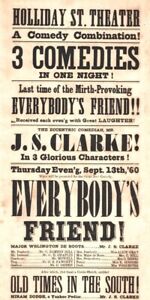
Sold on eBay July 28th, 2023
*EDWIN & JOHN WILKES BOOTH BROTHER IN LAW SLEEPER CLARKE RARE 1860 BROADSIDE*
He was the brother in law of Edwin and John Wilkes Booth and one of the finest comic actors of his generation. A rare original 1860 Holiday Street, Baltimore close to the Booth homes broadside for John Sleeper Clarke in three plays, Everybody's Friend, Old TImes in the South, and The Hypocrite. Dimensions sixteen by five and a half inches. Rare this early. Light wear otherwise good. See Sleeper Clarke and the Booth family's extraordinary biographies below.Shipping discounts for multiple purchases. Credit cards accepted with Paypal. Inquiries always welcome. Please visit my other eBay items for more early theatre and historical autographs, photographs and programs and great singer, actor and actress cabinet photos and CDV's.From Wikipedia:John Sleeper Clarke (September 3, 1833 – September 24, 1899) was a 19th-century American comedian and actor.He was born in Baltimore, Maryland to George W. Sleeper and Georgianna Sleeper (née Clarke), and was educated for the law. In his boyhood he was a schoolmate of Edwin Booth who was born in the same year as he, and with whom he engaged in amateur dramatic readings as members of the Baltimore Thespian Club.[1][2]He made his first appearance in Boston as Frank Hardy in Paul Pry in 1851, at the Howard Athenæum.[3] The next year he went to Philadelphia. Clarke's first appearance in New York City was made at the Metropolitan Theatre – afterward called the Winter Garden – on May 15, 1855, as Dickory in The Spectre Bridegroom,[4] but it was not until he returned in 1861–1862 to the same theatre that he made a conspicuous mark. In 1859 he became part of the Booth family when he married Asia Booth, daughter of Junius Brutus Booth, and sister of John Wilkes Booth. Clarke was associated with his brother-in-law Edwin Booth in the management of the Winter Garden Theatre in New York, the Walnut Street Theatre in Philadelphia and the Boston Theatre [3]Following the 1865 assassination of US president Abraham Lincoln by Clarke's brother-in-law, John Wilkes Booth, Clarke came into the possession of two letters, from his wife, written by the assassin. He turned them over to the Philadelphia Inquirer, which printed one of the two letters. His actions led to his arrest and imprisonment in the Capitol Prison in Washington D.C. for a month. Once released, he notified his pregnant wife that they must divorce. He wanted to distance himself professionally from the name of Booth.[5] She refused to divorce him, even as their relationship grew increasingly strained. However, they remained married in name only. "..He lives a free going bachelor life and does what he likes.." wrote Asia to her brother Edwin. She died May 16, 1888, at the age of 52.In August 1865, just months after the assassination, Asia gave birth to twins Creston and Lilian.[6]In 1867, Clarke moved his family to London, where Asia became a poet and a writer. Clarke made his first appearance at the St James's Theatre as Major Wellington de Boots in Stirling Coyne's Everybody's Friend, rewritten for him and called The Widow's Hunt. At the Princess's in February 1868, he was Salem Scudder in a revival of The Octoroon, and later, at the Strand, was the first Young Gosling in Fox versus Goose. On July 26, 1869, he was the first Babington Jones in John Brougham's Among the Breakers. At the same house he also played Toodles, Dr. Pangloss in The Heir at Law, and other parts.[3] His success was so great that he remained in England for the rest of his life, except for four visits to America [1]Among his favorite parts were Timothy Toodle in William E. Burton's The Toodles, which ran for 200 nights at the Strand Theatre, and two roles from plays by George Colman "the Younger": Dr. Pangloss in The Heir at Law, and Dr. Ollapod in The Poor Gentleman. At the beginning of his career Clarke wished to play tragedy, but he later turned to comic roles.[1] He managed several London theatres, including the Haymarket, where he preceded the Bancrofts. He retired in 1889.Death and legacyClarke died suddenly, in London, in his sixty-seventh year, on September 24, 1899.[1] Four days later, his remains were interred at Teddington Cemetery[7] in what is now the London Borough of Richmond upon Thames. Among the mourners were Mr. and Mrs. Clement Scott, Charles Hawtrey, the staff of the Strand Theatre, and Clarke's two sons, Creston and Wilfred. Many beautiful wreaths were placed upon the coffin.[8]He and his wife Asia had nine children. Their sons Creston and Wilfred went on to become actors.The Booth family was an English American theatrical family of the 19th century. Its most famous and well known members were Edwin Booth, one of the leading actors of his day, and John Wilkes Booth, who assassinated Abraham Lincoln.The patriarch was Junius Brutus Booth, a London-born lawyer's son who eventually became an actor after he attended a production of Othello at the Covent Garden theatre. The prospects of fame, fortune, and freedom were very appealing to young Booth, and he displayed remarkable talent from an early age, deciding on a career in the theatre by the age of 17. He performed roles in several small theaters throughout England, and joined a tour of the Low Countries in 1814, returning the following year to make his London debut.Booth abandoned his wife and their young son in 1821 and ran off to the United States with Mary Ann Holmes, a London flower girl. They settled on some 150 acres in Harford County near Baltimore and started a family; they had 10 children, six of whom survived to adulthood [1][2]Junius Sr. and Edwin toured in California during the Gold Rush.[citation needed] Edwin bought an interest in the Winter Garden Theatre at 667 Broadway in New York City together with his brother-in-law John Sleeper Clarke. The brothers John Wilkes, Edwin, and Junius Brutus, Jr. performed there in the play Julius Caesar at a benefit in 1864, the only time they were seen together on a stage, playing Mark Antony, Brutus, and Cassius, respectively Junius Brutus Booth (1796–1852) brought his mistress Mary Ann Holmes, who bore him 10 children, to the United States.He also wrote many letters in fits of drunken anger and madness to President Andrew Jackson threatening assassination. He requested that two prisoners who had been sentenced to death for piracy, named De Ruiz and De Soto, be pardoned, else: "I will cut your throat whilst you are sleeping." This letter would later be recanted by Junius, stating, "May god preserve General Jackson and this happy republic [4]Junius Brutus Booth Jr. (1821–1883) was married to Agnes Booth. Junius Jr. never achieved the same fame as his brothers, but his third wife Agnes was popular.Their son Sydney Barton Booth (1877–1937) was an actor well into the era of modern film [5]Edwin Thomas Booth (1833–1893) came to be the foremost American Shakespearean actor of his day. He founded The Players, a New York City actors' club which continues to the present day.Edwin's grandson Edwin Booth Grossman was a painter of some note.Asia Frigga Booth (1835–1888) married John Sleeper Clarke, an actor/comedian who was briefly imprisoned in the aftermath of the assassination. They then emigrated to Britain, where he became a successful theatre manager.Creston Clarke[6] and Wilfred Clarke,[7] sons of John and Asia, were noted actors in their day.John Wilkes Booth (1838–1865) was a popular young star in less serious fare than his brothers.A Confederate sympathizer during the American Civil War, during a play attended by Abraham Lincoln, Booth took advantage of his access to the theatre to invade the President's box and assassinate the President. He was killed 12 days later by Union soldier Boston Corbett.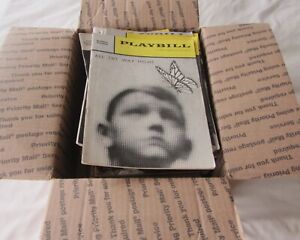
Sold on eBay December 12th, 2023
Huge lot of 78 BROADWAY PLAYBILLS 1950's - 1970's RARE musicals vintage RARE
eBay You're looking a huge lot of 78 random and rare BROADWAY PLAYBILLS. It's a grouping of older playbills from the late 1950's through early 1970's. They are from different Broadway theatres, which are indicated below. No duplicates are included in this lot as far as I can tell. These programs are used, but in good vintage condition overall. Some of the programs are in slightly better condition than others (none of them is complete beat up). The programs have some rather minor imperfections such as corner dings or creases, minor vertical fold/crease marks from being stored in a Playbill pleather binder, writing (like the date of the show), visible but rather insignificant tears (cover page/loser cover page), minor cover page wear, loose staples, visible discoloration and staining due to age or minor water exposure, and other similar imperfections. See pictures. Other minor flaws may be present as these are very old (some over 70 years). What you see is what you get.Here's a link to my priority mail shipping within Continental US. Priority mail international shipping is $70Please ask any questions before making a purchase. Thanks and good luck!Here is a list of all the playbills that you will get (in mostly alphabetical order):1.) All The Way Home (Belasco) 19612.) Apple Tree, The (Shubert) 19673.) Baker Street (Broadway) 19654.) Bells Are Ringing (Sam S. Shubert) 19585.) Ben Franklin In Paris (Lunt-Fontanne) 19656.) Best Man, The (Morosco) 19617.) Big Fish, Little Fish (Anta) 19618.) Butterflies Are Free (Booth) 19699.) Bye Bye Birdie (Martin Beck) 196010.)Cabaret (Imperial) 196611 )Delicate Balance, A (Martin Beck) 196612.)Destry Rides Again (Imperial) 195913.)Devil's Advocate, A (Billy Rose) 196114.)Do Re Mi (St. James) 196115 )Entertaining Mr. Sloane (Lyceum) 196516.)Fade Out-Fade In (Mark Hellinger) 196417.)Fiddler On The Roof (Imperial) 196618 )Fiorello (Broadhurst) 196119.)Follies (Winter Garden) 197220.)Funny Girl (Majestic) 196621.)Funny Thing Happened On The Way To The Forum, A (Alvin) 196222.)Golden Boy (Majestic)196523 )Grease (Broadhurst) 197224.)Great White Hope, The (Alvin) 196925.)Hair (Biltmore) 196926.)Half A Sixpence (Broadhurst) 196627.)Hello, Dolly! (St. James) 196628.)How To Succeed In Business Without Really Trying (46th Street) 1962 *** staples came off, pages are loose)29.)I Do! I Do! (46th Street) 196730.)Illya Darling (Mark Hellinger) 196731.)Jesus Christ Superstar (Mark Hellinger) 197232.)Killing Of Sister George, The (Belasco) 196633.)La Plume De La Tante (Royale) 196034.)Les Ballets De Paris (Broadway) 195835.)Luv (Booth) 196536 )Majority Of One, A (Sam S. Shubert) 195937.)Mame (Winter Garden) 196938.)Man And Boy (Brooks Atkinson) 196339.)Man Of La Mancha (Anta Washington) 196640.)Mary, Mary (Helen Hayes) 196141.)Me Nobody Knows, The (Helen Hayes) 42.)Milk & Honey (Martin Beck) 196243.)More Stanley Mansions (Broadhurst) 196744.)Most Happy Fella, The (City Center Of Music And Drama) 196645.)Mr. President (St. James) 196346.)Music Man, The (Majestic) 195847.)My Fair Lady (Mark Hellinger) 196148.)No, No, Nanette (46th Street) 197249.)Never Too Late (Playhouse) 196350.)Odd Couple, The (Eugene O'Neill) 196651.)Oh What A Lovely War (Broadhurst) 196452 )Oklahoma (City Center Of Music And Drama) 196353.)Oliver! (Sam S. Shubert) 196454.)110 In The Shade (Broadhurst) 196455.)Passage To India, A (Ambassador) 196256 )Philadelphia Here I Come! (Helen Hayes) 196657.)Plaza Suite (Plymouth) 196858 )Pleasure Of His Company, The (Longacre) 195959 )Promises Promises (Shubert) 197060.)Purlie (Broadway) 197061 )Rhinoceros (Longacre) 196162.)Roar Of The Greasepaint - The Smell Of The Crowd, The (Sam S. Shubert) 196563 )Rosencrantz And Guildenstern Are Dead (Eugene O'Neill) 196864.)1776 (Majestic) 65.)Skyscraper (Lint-Fontanne) 196666.)Sound Of Music, The (Lunt-Fontanne) 196167.)Star Spangled Girl (Plymouth) 196768.)Subways Are For Sleeping (St. James) 196269.)Sweet Bird Of Youth (Martin Beck) 195970.)Taste Of Honey, A (Lyceum) 196071.)Two Gentlemen Of Verona (St. James) 197172 )Unsinkable Molly Brown, The (Winter Garden) 196173.)Wait A Minim! (John Golden) 196674.)Walking Happy (Lunt-Fontanne) 196675.)What Makes Sammy Run? (54th Street) 196476.)Who's Afraid Of Virginia Woolf? (Billy Rose) 196477 )Wonderful Town (City Center Of Music And Drama) 196778.)You Know I Can't Hear You When The Water's Running (Ambassador) 1967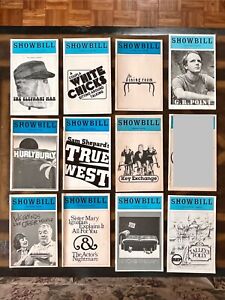
Sold on eBay April 21st, 2024
Lot of 30 Vintage Off Broadway Showbills
Selling these 30 Vintage Off Broadway Showbills from the 1970s-1980s. $90 or best offer. Playbills include:1 The Elephant Man2 A Coupla White Chicks Sitting Around Talking3 The Dining Room4 G.R. Point5 HurlyBurly6 Sam Shepard’s True West7 Key Exchange8 SOLD9 Weekends Like Other People10 Sister Mary Ignatus & The Actor’s Nightmare 11 Beyond Therapy12 Talley’s Folly13 SOLD14 Kaufman at Large15 Modigliani 16 Two Fish in the Sky17 The Beach House18 After the Prize19 Geniuses20 Ira Levin’s Veronica’s Room21 Full Hookup 22 Meetings23 Tintypes24 Maggie & Pierre25 Black Angel26 What I Did Last Summer27 The Sea Gull28 Levitation 29 How I Got That Story30 Cloud 931 SOLD32 Ladyhouse Blues33 Bonjour La Bonjour 34 SOLD35 SOLD 36 SOLD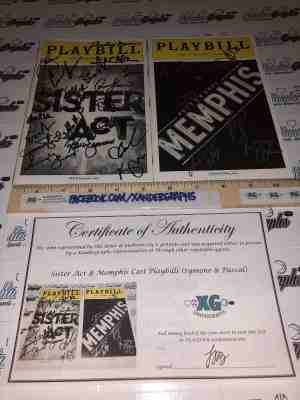
Sold on eBay Feb, 10th 2020
SISTER ACT & MEMPHIS CAST SIGNED THEATRE PLAYBILLS-COA ADAM PASCAL RAVEN SYMONE
BEAUTIFULLY SIGNED THEATRE PLAYBILLS BY:<br />CAST OF SISTER ACT (RAVEN SYMONE)CAST OF MEMPHIS (ADAM PASCAL)<br />YOU WILL RECEIVE EXACTLY WHAT IS PICTURED.<br />SIGNED IN-PERSON IN NEW YORK CITY OVER THE YEARS<br />COMES WITH PHOTO EMBOSSED CERTIFICATE SHOWN.<br />Condition of item: 10/10Quality of autograph: 10/10 <br />IF THESE ITEMS WERE TO EVER FAIL THIRD PARTY DNA JSA BECKETT ETC WE WILL REFUND YOUR PURCHASE PRICEAND RETURN SHIPPING!<br />$3.99 FIRST CLASS Shipping with delivery confirmation br /><br /><br /><br /><br /> <br />Posted with eBay Mob
Sold on eBay May 5th, 2024