

Playbill Collectibles : Playbill+nell Price List
average value
-
low
-high
-Found 20 out of 56,978 items matching 'nell'
Sold on eBay November 27th, 2023
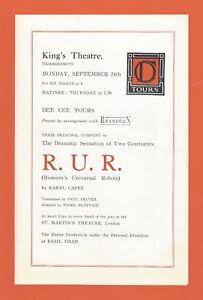
Karel Capek's "R.U.R." Rossum's Universal Robots 1923 Hammersmith, England Flyer
eBay This is a rare advertising herald (flyer) promoting the six-night, Provincial Tour engagement of the KAREL CAPEK Fantastic Melodrama "R.U.R." ("Rossum's Universal Robots") at the King's Theatre in Hammersmith, England beginning September 24th, 1923. (The Original West End production opened April 24th, 1923 at St. Martin's Theatre in London and ran for 126 performances before going on the road.) ..... The cast included CYRIL HARDINGHAM, DOROTHY HOPE, CECIL TOWNSEND, NELL CARTER, FRANK ADAIR, FREDERICK ANNERLEY, EVE McCARTHY, GEORGE COWLEY, MAY WARD and ALAN COTTER ..... Historical note: "R.U.R" is a science fiction play originally performed in the Czech language. "R.U.R." stands for Rossum's Universal Robots, an English phrase used as the subtitle in the Czech original. The play introduced the word "robot" to the English language and to science fiction as a whole. The play premiered in Prague in 1921 and was translated from Czech into English by Paul Selver in 1922. The American première was at the Garrick Theatre in New York City on October 9th, 1922, where it ran for 184 performances, a production in which Spencer Tracy and Pat O'Brien played robots in their Broadway debuts. London first saw the play at St. Martin's Theatre on April 24th, 1923, a production that ran for 126 performances and included Basil Rathbone as "Harry Domain". The play introduced the word Robot which displaced older words such as "automaton" or "android" in languages around the world. Karel ?apek named his brother Josef as the true inventor of the word. Isaac Asimov, author of the Robot Series of books and creator of the Three Laws of Robotics, stated: "Capek's play is, in my own opinion, a terribly bad one, but it is immortal for that one word. It contributed the word 'robot' not only to English but, through English, to all the languages in which science fiction is now written." (Wikipedia) ..... CREDITS: Book by KAREL CAPEK; English Version by PAUL SELVER; Adapted by NIGEL PLAYFAIR; Sets and Costumes designed by GEORGE W. HARRIS; Directed by BASIL DEAN; Produced by DEE CEE TOURS by arrangement with the REANDEAN COMPANY ..... DETAILS: Advertising handbills (heralds) were distributed or inserted into the playbills of other productions to help generate ticket sales for upcoming shows and events. This four page flyer measures 5 5/8" X 8 3/4" inches and includes production credits and performance dates on the front, excerpts from a number of reviews and a production photo on the inside pages and an announcement of upcoming engagements on the backside ..... CONDITION: With the exception of a light crease across the middle and minor edge wear, this rare advertising herald is in excellent condition and will make a wonderful addition to the collection of any theatre aficionado or historian. This item will be carefully packaged in a protective, carded sleeve and backed by stiff cardboard.
Sold on eBay June 11th, 2024
Ethel Merman (Debut) "GIRL CRAZY" George Gershwin / Ginger Rogers 1931 Playbill
This is a beautiful April 20th, 1931 playbill from the Original Broadway production of the GEORGE and IRA GERSHWIN, GUY BOLTON and JOHN McGOWAN musical comedy "GIRL CRAZY" which played the Alvin Theatre in New York City. (The production opened October 14th, 1930 and ran for 272 performances.) ..... The musical marked the Broadway debut of the legendary ETHEL MERMAN who brought down the house nightly, closing the first act with "I Got Rhythm". Others in the cast included GINGER ROGERS, ALLEN KEARNS, CLYDE VEAUX, CARLTON MACY, WILLIE HOWARD, EUNICE HEALY, NELL ROY, WILLIAM KENT, DONALD FOSTER, OLIVE BRADY, LEW PARKER, CHIEF RIVERS, JACK CLASSON, STARR JONES, NORMAN CURTIS, MARSHALL SMITH, RAY JOHNSON, DEL PORTER, DWIGHT SNYDER and RUTH GORDON (ensemble) with RED NICHOLS and his Orchestra and ROGER EDENS at the Piano ..... CREDITS: Book by GUY BOLTON and JOHN McGOWAN; Music by GEORGE GERSHWIN ("Girl Crazy", "Lady, Be Good!", "Of Thee I Sing", "Oh, Kay!", "Rosalie", "Funny Face", "Porgy and Bess", "George White's Scandals"); Lyrics by IRA GERSHWIN; Choreographed by GEORGE HALE; Sets designed by DONALD OENSLAGER; Costumes designed by KIVIETTE; Directed by ALEXANDER LEFTWICH; Produced by ALEX A. AARONS and VINTON FREEDLEY ..... DETAILS: This 36 page playbill measures 7" X 9 1/2" inches and includes full production credits, cast list, synopsis of scenes, list of musical numbers, bios of each of the leading actors and wonderful vintage advertising, but no cast photos ..... CONDITION: With the exception of minor edge wear, this rare playbill is in excellent condition and will make a wonderful addition to the collection of any musical theatre aficionado or historian. This item will be carefully packaged in a protective, carded sleeve and backed by stiff cardboard.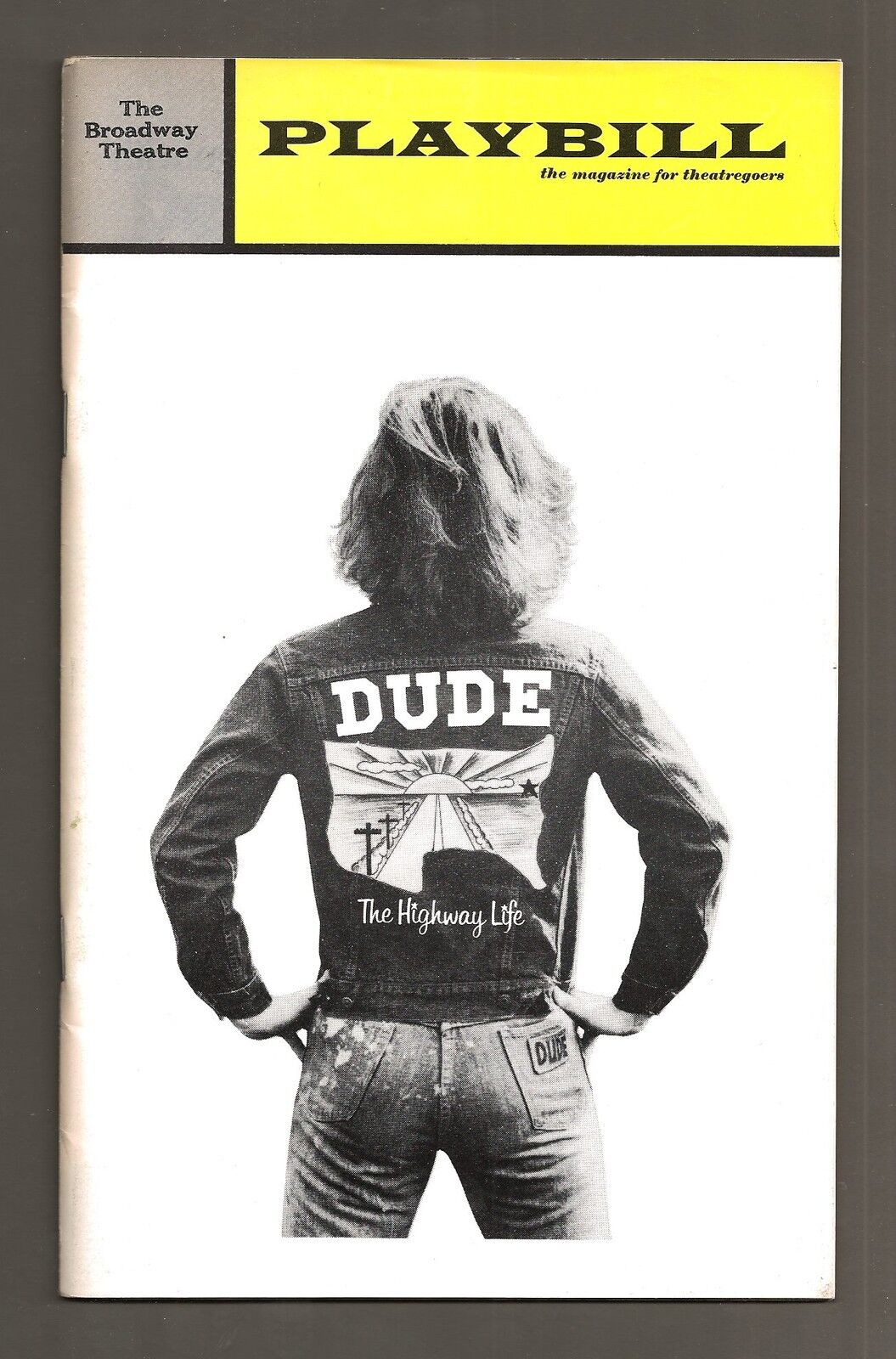
Sold on eBay February 12th, 2025
Tom O'Horgan (Signed) "DUDE" Gerome Ragni / Galt MacDermot 1972 FLOP Playbill
This is a rare autographed October 9th, 1972 PREMIERE PERFORMANCE playbill from the Original Broadway production of the GALT MacDERMOT and GEROME RAGNI musical "DUDE" ("The Highway Life") at the Broadway Theatre in New York City. (The production opened October 9th, 1972 and closed after only 16 performances.) ..... The musical starred WILLIAM REDFIELD and RAE ALLEN and the cast included SALOME BEY, ALLAN NICHOLLS, DELORES HALL, RALPH CARTER, NAT MORRIS and NELL CARTER ..... Note: The title page was signed by director TOM O'HORGAN who came on board to help his "Hair" collaborators during previews ..... CREDITS: Book and Lyrics by GEROME RAGNI ("Hair"); Music by GALT MacDERMOT ("Hair", "Two Gentlemen of Verona", "Dude", "Via Galactica", "The Human Comedy"); Sets designed by EUGENE LEE, ROGER MORGAN and FRANNE LEE; Costumes designed by RANDY BARCELO; Choreographed by LOUIS FALCO (Credit removed during previews); Directed and Staged by TOM O'HORGAN (who replaced ROCCO BUFANO during previews); Produced by ADELA and PETER HOLZER ..... DETAILS: The 54 page playbill measures 5 5/8" X 9" inches and includes full production credits, cast list, scenes, list of musical numbers and bios of each of the leading actors and members of the creative team, but no cast photos ..... CONDITION: With the exception of slight discoloration to some inside pages, this rare playbill is in excellent condition and will make a wonderful addition to the collection of any musical theatre aficionado or historian. This item will be carefully packaged in a protective, carded sleeve and backed by stiff cardboard.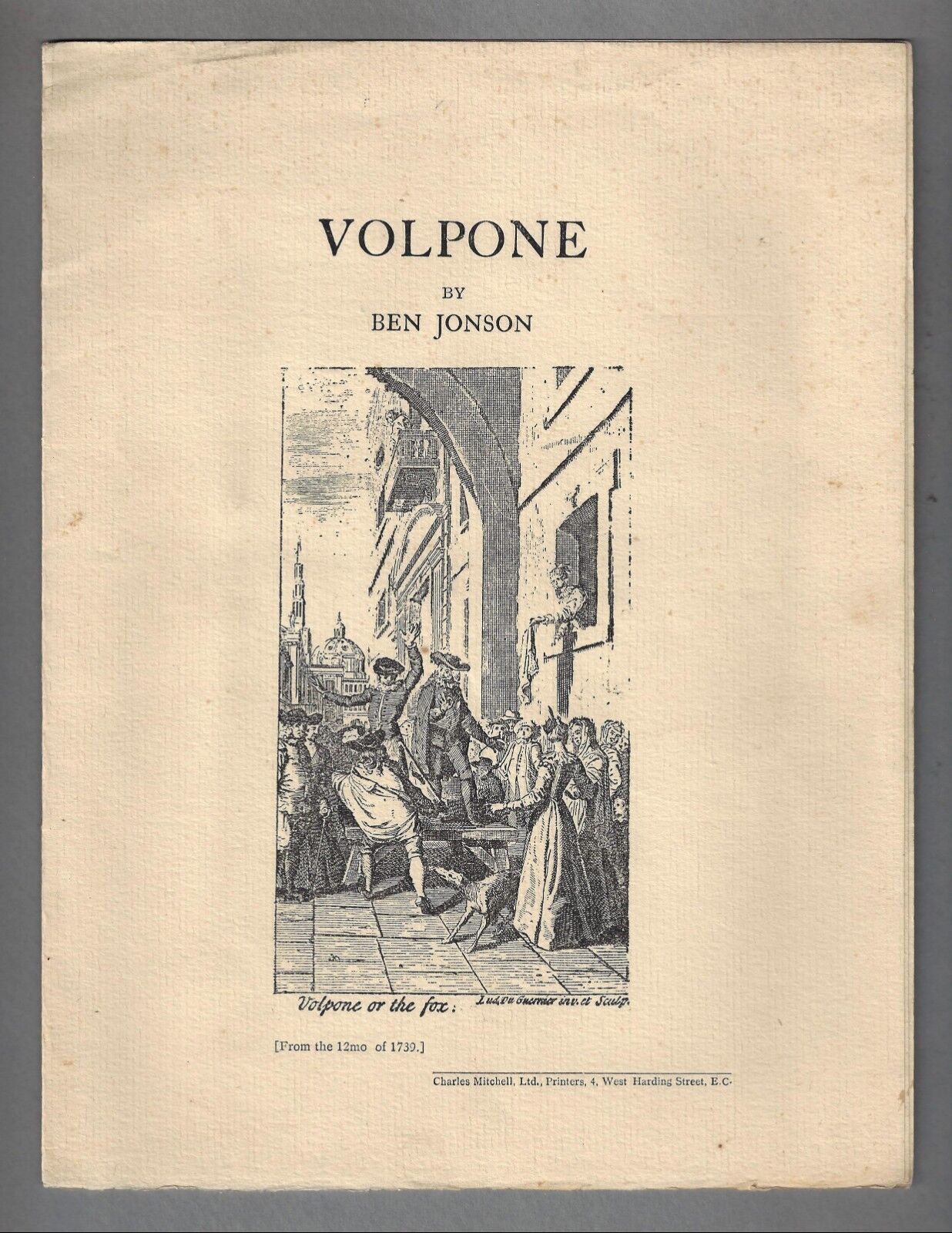
Sold on eBay December 19th, 2024
Baliol Holloway "VOLPONE" Isabel Jeans 1923 London Benefit Performance Program
This is a rare June 29th, 1923 programme (playbill) from a Special Matinee Benefit Performance of the BEN JONSON comedy "VOLPONE" at the Regent Theatre, King's Cross in London. (The production opened April 9th, 1928 and ran for 46 performances.) ..... Presented by the Phoenix Society, the performance was given in aid of the Funds of the Incorporated Stage Society. The play starred BALIOL HOLLOWAY in the title role and featured RUPERT HARVEY, D. LEWIN MANNERING, STANLEY LATHBURY, GEORGE ZUCCO, ROY BYFORD, JOHN H. MOORE, TRISTAN RAWSON, HOWARD ROSE, MATTHEW FORSYTH, EDWARD GARRETT, BRUCE WINSTON, EUGENE LEAHY, CHARLES MAUNSELL, MURRAY KINNELL, MARGARET YARDE, ISABEL JEANS, HENRY WINTER, ALAN EDMISTON, NELL CARTER and CLARE HARRIS ..... CREDITS: Book by BEN JONSON; Sets designed by NORMAN WILKINSON; Costumes arranged by TOM HESLEWOOD; Directed by ALLAN WADE; Produced by THE STAGE SOCIETY by the courtesy of the Directors of the Lyric Theatre, Hammersmith ..... DETAILS: The eight page program measures 7 1/2" X 10" inches, is printed on a textured stock and includes full production credits, cast list, synopsis of scenes, promotional and historical text and program notes, but no cast photos or bios ..... CONDITION: With the exception of light creasing, this program is in excellent condition and will make a wonderful addition to the collection of any theatre aficionado or historian. This item will be carefully packaged in a protective, carded sleeve and backed by stiff cardboard.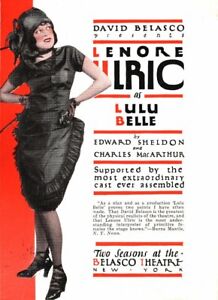
Sold on eBay April 22nd, 2024
*1926 RACE RELATIONS DAVID BELASCO COLOR LULU BELLE HERALD SHELDON & MACARTHUR*
A magnificent circa 1926 color herald for David Belasco's production of Edward Sheldon and Charles MacArthur's play or race relations Lulu Belle with the great Lenore Ulric. Excellent condition. This is one of the finest theatrical heralds I've ever seen. Dimensions seven by five inches. See David Belasco's extraordinary biography and thee story of the play. Shipping discounts for multiple purchases. Inquiries always welcome. Please visit my other eBay items for more early theatre, opera, film and historical autographs, photographs and programs and great actor and actress cabinet photos and CDV's. From Wikipedia:David Belasco (July 25, 1853 – May 14, 1931) was an American theatrical producer, impresario, director, and playwright.[1] He was the first writer to adapt the short story Madame Butterfly for the stage, and he launched the theatrical career of many actors, including James O'Neill, Mary Pickford, Lenore Ulric and Barbara Stanwyck. Belasco pioneered many innovative new forms of stage lighting and special effects in order to create realism and naturalism David Belasco was born in San Francisco, California, the son of Abraham H. Belasco (1830–1911) and Reyna Belasco (née Nunes, 1830–1899), Sephardic Jews who had moved from London’s Spanish and Portuguese Jewish community during the California Gold Rush.[3]:13 He began working in a San Francisco theater doing a variety of routine jobs, such as call boy, script copier or as an extra in small parts.[3]:14 He received his first experience as a stage manager while on the road. He said, "We used to play in any place we could hire or get into—a hall, a big dining room, an empty barn; any place that would take us."[3]:14From late 1873 to early 1874, he worked as an actor, director, and secretary at Piper's Opera House in Virginia City, Nevada, where he found "more reckless women and desperadoes to the square foot…than anywhere else in the world". His developmental years as a supporting player in Virginia City colored his thoughts eventually helping him to conceive realistic stage settings.[4] He said that while there, seeing "people die under such peculiar circumstances" made him "all the more particular in regard to the psychology of dying on the stage. I think I was one of the first to bring naturalness to bear in death scenes, and my varied Virginia City experiences did much to help me toward this. Later I was to go deeper into such studies." His recollections of that time were published in Hearst's Magazine in 1914.[5] By March 1874, he was back at work in San Francisco, eventually managing Thomas Maguire's Baldwin Theater. When Maguire lost the theater in 1882, Belasco relocated to the East Coast bringing his practical western experiences with him. The West allowed him to develop his talents as not only a performer, but in progressive production design and execution.[6]A gifted playwright, Belasco went to New York City in 1882 where he worked as stage manager for the Madison Square Theatre (starting with Young Mrs. Winthrop), and then the old Lyceum Theatre while writing plays. By 1895, he was so successful that he was considered America's most distinguished playwright and producer CareerBelasco in 1873During his long creative career, stretching between 1884 and 1930, Belasco either wrote, directed, or produced more than 100 Broadway plays, including Hearts of Oak, The Heart of Maryland, and Du Barry, making him the most powerful personality on the New York City theater scene. He also helped establish careers for dozens of notable stage performers, many of whom went on to work in films.Among them were Leslie Carter, dubbed "The American Sarah Bernhardt,"[7] whose association with Belasco skyrocketed her to theatrical fame after her roles in Zaza (1898) and Madame Du Barry (1901).[7] Ina Claire's lead in Polly with a Past (1917) and The Gold Diggers (1919) similarly propelled her career.[7] Belasco wrote a lead part for 18-year-old Maude Adams in his new play Men and Women (1890), which ran for 200 performances [7]Other stars whose careers he helped launch included Jeanne Eagels, who would later achieve immortality as Sadie Thompson in Rain (1923), which played for 340 performances [8] Belasco discovered and managed the careers of Lenore Ulric[9] and David Warfield, both of whom became major stars on Broadway. He launched the career of Barbara Stanwyck, and was responsible for changing her name.[7]Belasco is perhaps most famous for having adapted the short story Madame Butterfly into a play with the same name and for penning The Girl of the Golden West for the stage, both of which were adapted as operas by Giacomo Puccini (Madama Butterfly 1904—twice, after revision) and La fanciulla del West (1910). More than forty motion pictures have been made from the many plays he authored.To me, David Belasco was like the King of England, Julius Caesar and Napoleon rolled into one.Mary Pickford[7]Many prominent performers of the late 19th and early 20th centuries sought the opportunity to work with Belasco; among them were D. W. Griffith, Helen Hayes, Lillian Gish, Mary Pickford[7] and Cecil B. DeMille.[7] DeMille's father had been close friends with Belasco, and after DeMille graduated from the American Academy of Dramatic Arts, he began his stage career under Belasco's guidance.[10] DeMille's later methods of handling actors, using dramatic lighting and directing films, were modeled after Belasco's staging techniques [7]Pickford appeared in his plays The Warrens of Virginia at the first Belasco Theatre in 1907 and A Good Little Devil in 1913. The two remained in touch after Pickford began working in Hollywood; Belasco appeared with her in the 1914 film adaptation of A Good Little Devil. He is credited as giving Pickford her stage name as well. He also worked with Lionel Barrymore, who starred in his play Laugh, Clown, Laugh opposite Lucille Kahn, whose Broadway career Belasco launched. Belasco was a member of The Lambs from 1893 to 1931 MarriageDavid Belasco was married to Cecilia Loverich for over fifty years; they had two daughters, Reina (who was married to producer Morris Gest) and Augusta DeathBelasco died in 1931 at the age of 77 in Manhattan.[1] He was interred in the Linden Hill Jewish Cemetery on Metropolitan Avenue in Ridgewood, Queens [11][12]Influence on American theatrePoster for The Heart of Maryland with Maurice Barrymore and Mrs. Leslie CarterBelasco demanded a natural acting style, and to complement that, he developed stage settings with authentic lighting effects to enhance his plays. His productions inspired several generations of theatre lighting designers [13]:29Belasco s contributions to modern stage and lighting techniques were originally not appreciated as much as those of his European counterparts, such as André Antoine and Constantin Stanislavski, however today he is regarded as "one of the first significant directorial figures in the history of the American theatre," writes theatre historian Lise-Lone Marker [3]:xiBelasco s monogramHe brought a new standard of naturalism to the American stage as the first to develop modern stage lighting along with the use of colored lights, via motorized color changing wheels, to evoke mood and setting [3]:xi[13] America's earliest stage lighting manufacturer, Kliegl Brothers, began by serving the specialized needs of producers and directors such as Belasco and Florenz Ziegfeld [13]:157 With regard to these modern lighting effects, Belasco is best remembered for his production of Girl of the Golden West (1905), with the play opening to a spectacular sunset which lasted five minutes before any dialogue started [13]:29Belasco became one of the first directors to eschew the use of traditional footlights in favor of lights concealed below floor level, thereby hidden from the audience. His lighting assistant, Louis Hartmann, realised Belasco's design ideas.[13]:29 He also used follow spots to further create realism and often tailored his lighting configurations to complement the complexions and hair of the actors.[13]:135 He ordered a specially made 1000-watt lamp developed just for his own productions, and was the only director to have one for the first two years after its introduction (1914–1915) [13]:135In his own theatres, the dressing rooms were equipped with lamps of several colors, allowing the performers to see how their makeup looked under different lighting conditions Supposedly he put appropriate scents to set scenes in the ventilation of the theaters, while his sets paid great attention to detail, and sometimes spilled out into the audience area. In one play, for instance, an operational laundromat was built onstage. In The Governor's Lady, there was a reproduction of a Childs Restaurant kitchen where actors actually cooked and prepared food during the play.Childs Restaurant Scene in The Governor's LadyHe is even said to have purchased a room in a flophouse, cut it out of the building, brought it to his theater, cut out one wall and presented it as the set for a production. Belasco's original scripts were often filled with long, specific descriptions of props and set dressings. He has not been noted for producing unusually naturalistic scenarios Belasco also embraced existing theatre technology and sought to expand on it. Both of Belasco's New York theatres were built on the cutting edge of their era's technology. When Belasco took over the Republic Theatre he drilled a new basement level to accommodate his machinery; the Stuyvesant Theatre was specially constructed with enormous amounts of flyspace, hydraulics systems and lighting rigs. The basement of the Stuyvesant contained a working machine shop, where Belasco and his team experimented with lighting and other special effects. Many of the innovations developed in the Belasco shop were sold to other producers.F. Scott Fitzgerald references Belasco's reputation for realism in The Great Gatsby when he has a drunken visitor in the library of Gatsby's mansion exclaim in amazement that the books are genuine: "See!" he cried triumphantly. "It's a bona-fide piece of printed matter. It fooled me. This fella's a regular Belasco. It's a triumph. What thoroughness! What realism! Knew when to stop, too—didn't cut the pages [14]TheatresSee also: Belasco TheatreSee also: The BelascoThe first Belasco Theatre in New York was located at 229 West 42nd Street, between 7th and 8th Avenues, in the Times Square district of Manhattan. Belasco took over management of the theater and completely remodeled it in 1902, only two years after it was constructed as the Theatre Republic by Oscar Hammerstein (the grandfather of the famous lyricist). He gave up the theater in 1910 and it was renamed the Republic. Under various owners, it went through a tumultuous period as a burlesque venue, hosted second-run and, eventually, pornographic films and fell into a period of neglect before being rehabilitated and reopened as the New Victory Theater in 1995.The second Belasco Theatre is located at 111 West 44th Street, between 6th and 7th Avenues, only a few blocks away from the New Victory. It was constructed in 1907 as the Stuyvesant Theatre and renamed after Belasco in 1910. The theater was built to Belasco's wishes, with Tiffany lighting and ceiling panels, rich woodwork and murals. His business office and private apartment were also housed there. The Belasco is still in operation as a Broadway venue with much of the original decor intact. In 2010 it underwent a massive US $14.5 million restoration, which strove to renovate and restore the theater to the condition it was in when David Belasco was alive [15]Belasco Theatres also existed in several other cities. In Los Angeles, the first Belasco Theatre was located at 337 S. Main St. The theater, which hosted the Belasco Stock Company, opened in 1904 and was operated by David Belasco's brother, Frederick. This theater was renamed twice: as the Republic in about 1913 and as the Follies, circa 1919. The theater eventually became a burlesque venue in the 1940s, fell into sharp decline, and was demolished in May 1974 [16][17]The second, and perhaps more well known theatre in Los Angeles, The Belasco is located at 1050 S. Hill St in Downtown Los Angeles. The theatre, which was built by Morgan, Walls & Clements, opened in 1926, and was managed by Edward Belasco, another of David's brothers. Many Hollywood stars with theatrical roots, as well as Broadway stars who were visiting the West Coast, appeared at the theatre.[18] The theater declined after the death of Edward Belasco in 1937. After closing altogether in the early 1950s, the theater was used as a church for several decades.[19] In 2010 - 2011, the theater underwent an extensive restoration, and is currently in operation as a nightclub and convention venue.[20]The Shubert-Belasco Theatre, located in Washington, D.C., was purchased by Belasco in September 1905. Originally built in 1895 as the Lafayette Square Opera House, at 717 Madison Place, across from the White House, the theater was razed in 1962 and replaced by the U.S. Court of Claims building [21]Selected playsHearts of Oak (1879), by James A. Herne and David BelascoLa Belle Russe (1882), by David BelascoMay Blossom (1884), by David BelascoLord Chumley (1888), by Henry Churchill de Mille and David BelascoMen and Women (1890), by Henry Churchill de Mille and David BelascoThe Girl I Left Behind Me (1893), by Franklin Fyles and David BelascoPawn Ticket No. 210 (1894), by Clay M. Greene and David BelascoThe Heart of Maryland (1895), by David BelascoZaza (1898), by David Belasco (based on the play Zaza by Pierre Berton and Charles Simon [fr])Madame Butterfly (1900), by David Belasco (based on the short story Madame Butterfly by John Luther Long)Du Barry (1901), by David BelascoThe Auctioneer Kitty Bellairs (1903), by David Belasco (based on the novel The Bath Comedy by Agnes Castle and Egerton Castle)The Music Master (1904), by Charles KleinAdrea (1905), by David Belasco and John Luther LongThe Girl of the Golden West (1905), by David BelascoRose of the Rancho (1906), by Richard Walton Tully and David BelascoThe Warrens of Virginia (1907), by William C. deMilleThe Fighting Hope (1908), by William J. HurlbutThe Easiest Way (1909), by Eugene WalterThe Lily (1909), by David Belasco (based on the play Le Lys by Pierre Wolff and Gaston Leroux)Just a Wife (1910), by Eugene WalterThe Woman (1911), by William C. deMilleThe Return of Peter Grimm (1911), by David BelascoThe Governor's Lady (1912), by Alice BradleyThe Case of Becky (1912), by Edward LockeA Good Little Devil (1913), by Austin Strong (based on the play Un bon petit diable by Rosemonde Gérard and Maurice Rostand)Seven Chances (1916), by Roi Cooper MegrueTiger Rose (1917), by Willard MackThe Gold Diggers (1919), by Avery HopwoodThe Son-Daughter (1919), by George Scarborough and David BelascoKiki (1921), by David Belasco (based on the play Kiki by André Picard [fr])Shore Leave (1922), by Hubert OsborneLaugh, Clown, Laugh (1923), by Tom Cushing and David Belasco (based on the play Ridi, pagliaccio! by Fausto Maria Martini [it])Ladies of the Evening (1924), by Milton Herbert GropperThe Dove (1925), by Willard Mack (based on a story by Gerald Beaumont)Lulu Belle (1926), by Charles MacArthur and Edward SheldonTonight or Never (1930), by Fanny Hatton and Frederic Hatton (based on the play Ma este vagy soha by Lili Hatvany Chumley, directed by James Kirkwood (1914, based on the play Lord Chumley)La Belle Russe [it], directed by William J. Hanley (1914, based on the play La Belle Russe)Men and Women, directed by James Kirkwood (1914, based on the play Men and Women)Rose of the Rancho, directed by Cecil B. DeMille (1914, based on the play Rose of the Rancho)The Girl of the Golden West, directed by Cecil B. DeMille (1915, based on the play The Girl of the Golden West)The Girl I Left Behind Me [it], directed by Lloyd B. Carleton (1915, based on the play The Girl I Left Behind Me)DuBarry, directed by Edoardo Bencivenga (1915, based on the play Du Barry)The Heart of Maryland, directed by Herbert Brenon (1915, based on the play The Heart of Maryland)May Blossom, directed by Allan Dwan (1915, based on the play May Blossom)The Case of Becky, directed by Frank Reicher (1915, based on the play The Case of Becky)Madame Butterfly, directed by Sidney Olcott (1915, based on the play Madame Butterfly)Zaza, directed by Edwin S. Porter and Hugh Ford (1915, based on the play Zaza)Sweet Kitty Bellairs, directed by James Young (1916, based on the play Sweet Kitty Bellairs)La Belle Russe, directed by Charles Brabin (1919, based on the play La Belle Russe)Harakiri, directed by Fritz Lang (Germany, 1919, based on the play Madame Butterfly)The Heart of Maryland, directed by Tom Terriss (1921, based on the play The Heart of Maryland)The Case of Becky, directed by Chester M. Franklin (1921, based on the play The Case of Becky)Pawn Ticket 210, directed by Scott R. Dunlap (1922, based on the play Pawn Ticket No. 210)The Girl of the Golden West, directed by Edwin Carewe (1923, based on the play The Girl of the Golden West)Zaza, directed by Allan Dwan (1923, based on the play Zaza)Tiger Rose, directed by Sidney Franklin (1923, based on the play Tiger Rose)Forty Winks, directed by Paul Iribe and Frank Urson (1925, based on the play Lord Chumley)Seven Chances, directed by Buster Keaton (1925, based on the play Seven Chances)Men and Women, directed by William C. deMille (1925, based on the play Men and Women)Kiki, directed by Clarence Brown (1926, based on the play Kiki)The Lily, directed by Victor Schertzinger (1926, based on the play The Lily)The Return of Peter Grimm, directed by Victor Schertzinger (1926, based on the play The Return of Peter Grimm)The Music Master, directed by Allan Dwan (1927, based on the play The Music Master)The Heart of Maryland, directed by Lloyd Bacon (1927, based on the play The Heart of Maryland)Laugh, Clown, Laugh, directed by Herbert Brenon (1928, based on the play Laugh, Clown, Laugh)Ladies of Leisure, directed by Frank Capra (1930, based on the play Ladies of the Evening)Sweet Kitty Bellairs, directed by Alfred E. Green (1930, based on the play Sweet Kitty Bellairs)Du Barry, Woman of Passion, directed by Sam Taylor (1930, based on the play Du Barry)The Girl of the Golden West, directed by John Francis Dillon (1930, based on the play The Girl of the Golden West)Kiki, directed by Sam Taylor (1931, based on the play Kiki)Tonight or Never, directed by Mervyn LeRoy (1931, based on the play Tonight or Never)Girl of the Rio, directed by Herbert Brenon (1932, based on the play The Dove)The Hatchet Man, directed by William A. Wellman (1932, based on the play The Honorable Mr. Wong)The Son-Daughter, directed by Clarence Brown (1932, based on the play The Son Daughter)Madame Butterfly, directed by Marion Gering (1932, based on the play Madame Butterfly)The Return of Peter Grimm, directed by George Nicholls Jr. (1935, based on the play The Return of Peter Grimm)Rose of the Rancho, directed by Marion Gering (1936, based on the play Rose of the Rancho)Follow the Fleet, directed by Mark Sandrich (1936, based on the play Shore Leave)The Girl of the Golden West, directed by Robert Z. Leonard (1938, based on the play The Girl of the Golden West)Zaza, directed by George Cukor (1939, based on the play Zaza)Lulu Belle, directed by Leslie Fenton (1948, based on the play Lulu Belle)Madame Butterfly, directed by Carmine Gallone (Italy, 1954, based on the opera Madama Butterfly, directed by Frédéric Mitterrand (France, 1995, based on the opera Madama Good Little Devil, directed by Edwin S. Porter (1914, Famous Players Film Company)Rose of the Rancho, directed by Cecil B. DeMille (1914, Jesse L. Lasky Feature Play Co.)The Girl of the Golden West, directed by Cecil B. DeMille (1915, Jesse L. Lasky Feature Play Co.)The Warrens of Virginia, directed by Cecil B. DeMille (1915, Jesse L. Lasky Feature Play Co.)The Governor's Lady, directed by George Melford (1915, Jesse L. Lasky Feature Play Co.)The Woman, directed by George Melford (1915, Jesse L. Lasky Feature Play Co.)The Fighting Hope, directed by George Melford (1915, Jesse L. Lasky Feature Play Co.)The Case of Becky, directed by Frank Reicher (1915, Jesse L. Lasky Feature Play Co.)Her Accidental Husband, directed by Dallas M. Fitzgerald (1923, Belasco Productions, Inc.)The Gold Diggers, directed by Harry Beaumont (1923, Warner Bros.)Tiger Rose, directed by Sidney Franklin (1923, Warner Bros.)Welcome Stranger, directed by James Young (1924, Belasco Productions, Inc.)Friendly Enemies, directed by George Melford (1925, Belasco Productions, Inc.)Fifth Avenue, directed by Robert G. Vignola (1926, Belasco Productions, Inc.)The Prince of Pilsen, directed by Paul Powell (1926, Belasco Productions, Inc.)Lulu Belle is a 1948 American drama musical romance film directed by Leslie Fenton and starring Dorothy Lamour.[1] The film was an adaption of a sensational 1926 hit play by Charles MacArthur and Edward Sheldon,[2][3] about a mulatto songstress, a "man-trap" who bewitched powerful men in New Orleans. This convoluted but heavily Code-sanitized film version of the play was about a Caucasian songbird who could not be true to her boxer beau. Although the film offered a change of pace for its star, Dorothy Lamour, it was not a success at the box office PlotFamous Broadway singer Lulu Belle (Dorothy Lamour) and Harry Randolph (Otto Kruger), her rich suitor, are found shot and severely wounded in her dressing room one night after the show. They are discovered by Lulu's best friend, Molly Benson (Glenda Farrell), and taken unconscious to the hospital [4]Lulu s ex-husband, George Davis (George Montgomery), is accused of the shooting, since he has been previously convicted of attempted murder of another man who got too close to Lulu. During George's interrogation he tells the story of how he met Lulu for the first time. She was performing in a dodgy place called the Natchez Café, and he was so taken with her that he left his fiancée and law practice to elope with her to New Orleans. They lived a wild life of luxury for awhile until his money ran out. She left for another man, high-stakes gambler Mark Brady (Albert Dekker) to support her expensive lifestyle. George realizes that Lulu is bad news and leaves her. It doesn't take long before they get back together again. Lulu is offered a job by Mark, as a singer at a club he is starting, and George starts drinking heavily to drown his sorrows. He tries to get Molly to help stop Lulu's way of life. Lulu wants to divorce him to set him free. That night a wealthy man named Harry Randolph comes to visit the club with his wife (Charlotte Wynters). He is immediately smitten with Lulu, and decides to help her become a star on Broadway.George picks a fight with boxer Butch and is beaten black and blue. George manages to stick a fork in Butch's eye and put an end to his fighting career. For this he is convicted and sentenced to prison. Lulu goes with Randolph, her new benefactor, to New York and Broadway. Randolph puts a lot of money and effort into building Lulu's career and a theater. After five years of working close together, Randolph asks Lulu to marry him. Lulu finds out that George has been released from prison and asks him to come her apartment. Mark turns up later in the evening at the theater and tries to force Lulu to come back with him, but she refuses. George meets Lulu right after the show that night and is sucked into her beam of charm again, when she proclaims her love for him. They decide to start a new life together. Without hesitation, Lulu tells Randolph that she won't marry him and he is upset. Then comes the night of the shooting Returning to the present, police commissioner Dixon (Addison Richards) gathers all the persons involved in the story, including Mrs. Randolph, at the dying Randolph's bedside. He asks Randolph to tell them who the shooter was, and he reveals it was his wife. George is vindicated and freed of all charges. He stays by Lulu's side long enough to make sure she will recover, then returns to his hometown alone.Edward Brewster (Ned) Sheldon (Chicago, Illinois, February 4, 1886 – April 1, 1946, New York City) was an American dramatist. His plays include Salvation Nell (1908) and Romance (1913), which was made into a motion picture with Greta Garbo.After becoming ill at age 29 with crippling rheumatoid arthritis, which eventually claimed his sight (around 1930), Sheldon became a source of emotional and creative support for his many friends, notably Minnie Maddern Fiske (he wrote Salvation Nell for her), Julia Marlowe, John Barrymore (his closest friend and confidante), Thornton Wilder, Alexander Woollcott, Anne Morrow Lindbergh, Ruth Gordon, Helen Hayes. While in hospital his advice was received by those in the theatrical profession as gospel. Actress and librettist Dorothy Donnelly formed a close friendship with Sheldon, and after he became bedridden often assisted with transcribing, editing, and supporting his work.In May 1915 Sheldon narrowly missed sailing on the Lusitania's infamous last voyage. He had been asked by theater impresario Charles Frohman to accompany him to England. A Harvard classmate of Sheldon's was getting married on May 11 and asked Sheldon to be best man. Sheldon then declined Frohman's offer.A 1936 lawsuit against Metro Goldwyn Mayer for copyright infringement claimed that the script MGM used for the 1932 motion picture Letty Lynton plagiarized material from the play Dishonored Lady by Sheldon and Margaret Ayer Barnes. The film is still unavailable today because of this lawsuit.His life is detailed in The Man Who Lived Twice by Eric Wollencott Barnes. In this biography Barnes states that Sheldon was in love all his adult life with Doris Keane, the actress who starred in Romance in 1913.Minnie Maddern Fiske and Frederick Perry in The High Road (1912)Basil Sydney and Doris Keane in the film Romance Nell (1908), made into the 1915, 1921, and 1931 motion pictures of the same nameThe Nigger (1909), made into the 1915 motion picture of the same name (aka The New Governor or The Mystery of Morrow's Rest) produced by William FoxThe Boss (1911), made into the 1915 motion picture of the same nameThe High Road (1912), made into the 1915 motion picture of the same nameRomance (1913), notable for its London run of 1,049 performances. Made into a 1920 silent film by United Artists starring Doris Keane, the actress who appeared in the role on stage. Also made into a 1930 motion picture starring Greta Garbo. Produced in New York as a musical, My Romance, with music by Sigmund Romberg and book and lyrics by Rowland Leigh, in 1948.The Song of Songs (1914), dramatization of the novel by Hermann Sudermann, made into films in 1918 (The Song of Songs), 1924 (Lily of the Dust), and in 1933 (The Song of Songs, starring Marlene Dietrich, Brian Aherne, and Lionel Atwill)The Garden of Paradise (1914), from "The Little Mermaid" by Hans Christian AndersenThe Call of Her People (1916), a silent film for Ethel Barrymore, from Sheldon's own play Egypt.The Jest (1919), adaptation from the Italian of Sem BenelliThe Czarina (1922), adaptation of the Hungarian play by Melchior Lengyel and Lajos Bíró, made into the 1924 silent Forbidden Paradise with Pola Negri.Bewitched (1924), with Sidney HowardLulu Belle (1926), with Charles MacArthur, starring Lenore Ulric; made into the 1948 motion picture of the same name, starring Dorothy LamourJenny (1929), with Margaret Ayer Lady (1930), with Barnes, made into the 1947 motion picture of the same name, starring Hedy Lamarr and directed by Robert Stevenson (alternate title Sins Lenore Ulric (born Lenore Ulrich, July 21, 1892 – December 30, 1970) was a star of the Broadway stage and Hollywood films of the silent-film and early sound era.Discovered in 1913 by theater director David Belasco, who would go on to manage her stage career, she was noted for portraying fiery, hot-blooded women of the typical vamp of Ulrich was born on July 21, 1892 to Franz Xavier Ulrich, who was a United States Army hospital steward, and Ida Ulrich (née Engenhart) [1][2] Both of her parents were first generation German Americans [3] Franz reportedly named his daughter Lenore due to his fondness for the Edgar Allan Poe poem, "The Raven".[1] She later dropped the "h" from her surname.[1] She had four sisters, Isabel, Francis, Alma, and Florence, and a brother, Roy Richard [4][5][6] She left school after completing 3rd grade.[7]As a young girl, Lenore obtained a job with a stock company in Milwaukee, Wisconsin. She played with stock companies in Grand Rapids, Michigan and Chicago, Illinois. She worked briefly as a film actress for Essanay Studios and joined another stock company in Schenectady, New York. She found work in The First Man (1911), A Polished Burglar (1911), Kilmeny (1915), and The Better Woman (1915).She specialized in playing sultry, impassioned women.[8] In 1915, she went to work for Pallas Pictures starring in several silent pictures, such as Frozen Justice and The Intrigue, that survive today at the Library of Congress [9][10]BroadwayCaricature by Ralph Barton, 1925Ulric was discovered by theatrical producer David Belasco who first saw her in The Bird of Paradise in 1913, after Ulric wrote to him requesting that he see her on stage.[10] Belasco, who would go on "fishing trips" to find new stage talents, recalled that it was often a long time between "bites," but he enjoyed the sport as he sometimes would "hook a big one [11]:367After watching her on stage, he asked her to audition at his playhouse. He watched her perform while he sat incognito in one of the theater's seats. "After twenty minutes," he said, "I knew I was watching a very talented and unusual young woman."[11]:369 He then offered her the leading role in The Heart of Wetona [11]:369[8] He recalled: "Among the biggest I have ever landed is, I believe, little Miss Ulric: I think she will grow bigger every season she is before the public [11]:367Biographer William Winter called her a "born actress," someone who Belasco hoped would fulfill the theater's need for talent. Winter also notes that no one in her family had ever been involved in acting, adding: "She resorted to the dramatic calling not through mere vanity, the impulse of personal exhibition, or the acquisitive hope of profit, but because her natural vocation is acting [11]:367Ulric in The Son-Daughter (1919)Under Belasco's management during most of her stage career, Ulric played a variety of female roles. Among them was her portrayal of Rose, a French-Canadian orphan, in Tiger Rose (1917). Winter says that Ulric's personality traits allowed her to play the role realistically as written:Miss Lenore Ulric, who acts the part, is possessed of exceptional natural advantages —youth; a handsome face; abundant hair; expressive eyes, dark and beautiful; a slender, lithe figure; a sympathetic voice; strong, attractive personality, and an engaging manner. Her temperament is intense, her nature passionate, her style direct and simple. Her acting reveals force of character, experience, observation, thought, sensibility, ardor, definite purpose, and unusual command of the mechanics of art...She is an admirable listener, an excellent speaker...The disposition she exhibits in this performance seems altogether childlike and lovely. Under Belasco's sagacious direction, she should go far.[11]:469She acted in numerous plays at the Belasco Theater, all under the direction of Belasco. She played in The Son-Daughter (1919), a play about China by Belasco and George Scarborough, which ran for 223 performances. She played a Parisian street urchin in Kiki (1921), a seductress in The Harem (1924), and in one of Ulric's biggest hits for Belasco, the 1926 Lulu Belle, where she played a prostitute, a genre that spawned several Broadway hits in the 1920s.[1] In 1928 she starred in Mima. Other stars who played at the Belasco during that period included Lionel Barrymore and Katharine Cornell [12]:28Success goes to women who are interesting. Nothing else matters. I don't believe even beauty matters.Lenore Ulric[13]After seeing Ulric in some of her plays, British producer Charles Cochrane cabled David Belasco with an "urgent request" that he be granted the privilege of presenting Ulric at one of his London playhouses.[14] During that time, however, Belasco had been writing a new version of Camille for Ulric to star in. According to one critic, "Miss Ulric's youth fits her peculiarly for the part, while her undisputed genius as an emotional actress justifies the prediction that she would be the greatest Camille who has ever been seen upon the stage."[14]In 1947 she returned to the Belasco Theater after doing seven films in Hollywood, beginning with a leading role in a revival of Antony and Cleopatra, alongside Eli Wallach, Maureen Stapleton and Charlton Heston.[12]:173 She told a critic, "I certainly never really left the theater."[1] Belasco had managed her stage career until shortly before his death.[1] In a tribute to Belasco, she said:All of us who were with him depended upon him so much that we'd just flounder around and say, "What do I do now?" He was a good soldier, a hard worker, and a great director [1]During the height of her stage career, Ulric was considered one of the American theater's "great stars."[1] She was noted for portraying fiery, hot-blooded women of the typical "femme fatale."[1] According to the New York Times, theater-goers would go to her plays just to see her, while the play in which she appeared was secondary. Ulric's "name in white lights blazing on the playhouse marquee was always more compelling" than the play itself [1]Hollywood and return to theaterLenore came to Hollywood in 1929 and appeared in Frozen Justice and South Sea Rose. She signed with Fox Film Corporation to make several films with an approximate salary of $650,000. Frozen Justice was directed by Allan Dwan. Some of the scenes were filmed in Alaska. She was successful in a supporting role in Camille, starring Greta Garbo. Ulric returned to Broadway in 1940, acting in The Fifth Column by Ernest Hemingway and again in 1947, in a revival of Antony and Cleopatra Personal lifeUlric had been married only once, to actor Sidney Blackmer from 1929 to 1939. She accepted some of the blame for their divorce:I don't think I'm comfortable to live with. I have a temper. I'm difficult. I'm too quick and too impulsive. And men have a right to be comfortable [1]She died of heart failure in Rockland State Hospital, Orangeburg, New York on December 30, 1970, aged 78.Charles Gordon MacArthur (November 5, 1895 – April 21, 1956) was an American playwright, screenwriter and 1935 winner of the Academy Award for Best Story.MacArthur was born in Scranton, Pennsylvania, the sixth of seven children of stern evangelist William Telfer MacArthur and Georgiana Welsted MacArthur.[1] He early developed a passion for reading. Declining to follow his father into ministry, he moved to the Midwest and soon became a successful reporter in Chicago, working for the Chicago Tribune and Chicago Daily News. MacArthur joined the United States Army for World War I, and served in France as a private assigned to Battery F, 149th Field Artillery, a unit of the 42nd Division.[2] He recounted his wartime experience in 1919's A Bug's-Eye View of the War.[3] After the war, he wrote several short stories, two of which, "Hang It All" (1921) and "Rope" (1923), were published in H. L. Mencken's The Smart Set magazine.[1] Eventually he settled in New York City, where he turned to playwriting MacArthur is best known for his plays in collaboration with Ben Hecht, Ladies and Gentlemen (filmed as Perfect Strangers), Twentieth Century and the frequently filmed The Front Page, which was based in part on MacArthur's experiences at the City News Bureau of Chicago. MacArthur also co-wrote, with Edward Sheldon, the play Lulu Belle, which was staged in 1926 by David Belasco MacArthur was friends with members of the Algonquin Round Table. He shared an apartment with Robert Benchley and had an affair with Dorothy Parker.His second marriage was to the stage and screen actress Helen Hayes, from 1928 until his death. They lived in Nyack, New York. He was preceded in death by his daughter, Mary, who died of polio in 1949 at the age of 19. The shock of her death hastened MacArthur's own, according to those who knew him.Their adopted son, James MacArthur, was also an actor, best known for playing Danny Williams on the American television series Hawaii Five-O.His brother, John D. MacArthur, was an insurance company owner and executive, and founded the John D. and Catherine T. MacArthur Foundation, the benefactor of the MacArthur Fellowships Awards and Award for Best Writing, Original Story - The Scoundrel (shared with Ben Hecht) Writing, Screenplay - Wuthering Heights (shared with Ben Hecht) in 1940Best Writing, Original Story - Rasputin and the Empress in 1934In 1983, MacArthur was posthumously inducted into the American Theater Hall of Fame.[4]Film was portrayed by Matthew Broderick in the 1994 film Mrs. Parker and the Vicious Circle [5]Selected Song (1946), (with Ben Hecht)Ladies and Gentlemen (1939), (with Ben Hecht), made into the 1950 film Perfect StrangersSpring Tonic, made into the 1935 movie of the same nameJohnny on a SpotJumbo, (with Ben Hecht), made into the 1935 musical play Jumbo and the 1962 film musical Billy Rose's JumboTwentieth Century (with Ben Hecht), made into the 1934 film Twentieth CenturyThe Front Page (1928), with Ben Hecht, made into the 1931, 1945, and 1974 motion pictures of the same name, the 1940 film His Girl Friday, and the 1988 movie Switching ChannelsLulu Belle (1926), (with Edward Heights (1939)Gunga Din (1939)Angels with Dirty Faces (1938) of Gamblers (1937), aka Czar of the Slot Machines the Rich (1936)The Scoundrel (1935)Barbary Coast (1935)Once in a Blue Moon (1935)Crime Without Passion (1934) (also directed by him and Ben Hecht)Topaze (1933)Freaks (1932) and the Empress (1932)The Unholy Garden (1931)Quick Millions (1931) Divers (1931)New Adventures of Get Rich Quick Wallingford (1931)The Sin of Madelon Claudet (1931)Paid (1930)Way for a Sailor (1930)King of Jazz (1930) the Kid (1930)The Girl Said No (1930)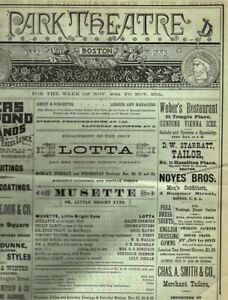
Sold on eBay February 14th, 2024
*LEGENDARY GOLD RUSH ACTRESS LOTTA CRABTREE LARGE 1882 MUSETTE PROGRAM*
She was the darling of Gold Rush California, a protege of Lola Montez, and as an adult became America's finest 19th century comedienne, famed for her charismatic vivaciousness and her risque for the time double entendres. A rare large original November 1882 program for the amazing Lotta Crabtree in Musette at the Park Theatre, Boston. With an articles about Lotta to inside page. Four pages. Dimensions thirteen by ten inches. Edgewear with small loss, small tears and light fold otherwise good. See Lotta Crabtree's extraordinary biography below.Shipping discounts for multiple purchases. Credit cards accepted with Paypal. Inquiries always welcome. Please visit my other eBay items for more early theatre and historical autographs, photographs and programs and great singer, actor and actress cabinet photos and CDV's. From Wikipedia:Lotta Mignon Crabtree (November 7, 1847 - September 25, 1924) was an Americanactress entertainer and comedian. She was also a significant philanthropist Born Charlotte Mignon Crabtree in New York City to British immigrants, Lotta Crabtree would go on to become one of the wealthiest and most beloved American entertainers of the late 19th century. From her beginnings as a 6-year-old until her retirement at the age of 45, she entertained and was named "The Nation's Darling".Her father, John Ashworth Crabtree, a book seller, left for San Francisco in 1851 to join those seeking fortune in the California Gold Rush. Lotta and her mother followed two years later, joining John in the boomtown of Grass Valley. While in Grass Valley, the Crabtrees ran a boarding house. Lotta soon attracted the attention of a neighbor, the dancer and actress Lola Montez, who encouraged Lotta's enthusiasm for the performance Early lifeThe Crabtrees moved again and set up another boarding house, this time in Rabbit Creek, forty miles north of Grass Valley. Soon after, Lotta made her first professional appearance at a tavern owned by Matt Taylor. She began touring throughout California, and Nevada, making a name for herself as a dancer, singer, and banjo player in the mining camps. In 1856, the family moved back to San Francisco. By 1859, she had become "Miss Lotta, the San Francisco Favorite Lotta s mother served as her manager and collected all of Lotta's earnings in gold, carrying it in a large leather bag. When this became too heavy, it was transferred to a steamer trunk.Later careerHaving made a name in California, in 1863 Lotta left to tour the east coast where she began acting inplays such as The Old Curiosity Shop, Uncle Tom's Cabin and Little Nell and the Marchioness. With her petite size, she became a favorite for her portrayals of children. The late 1860s would see the "Lotta Polka" and "Lotta Gallup" as quite the rage in America. At age 20 she was a national star. By 1875, Lotta was touring the nation with her own theatrical company. Lotta achieved the height of her success in the 1870s and 1880s.The 1880s saw her perennially as the highest paid actress in America, earning sums of up to $5,000 per week. Mary Ann was still managing Lotta's affairs: booking plays, finding locations, and organizing troupes of actors. When the steamer trunk became too heavy, she invested Lotta's earnings in local real estate, race horses and bonds. As well as investing, some of the money was used to support local charities and build fountains Lotta's Fountain, the most famous of these fountains, still stands at the intersection of Market and Kearny Streets in San Francisco, and is the site of meetings every April 18 marking the anniversary of the 1906 San Francisco earthquake Lotta traveled abroad with Mary Ann and her brothers, where she learned French, visited museums and began painting. After her tour abroad, Lotta returned to San Francisco where she played at the California Theatre, reprising her role in Little Nell and the Marchioness by John Bowen. Having missed her while she was away, the city responded warmly to her return and treated her like their very own star.[1]In 1885, Lotta's mother had an 18 room summer cottage built in the Breslin Park section of Mount Arlington on the shores of Lake Hopatcong, New Jersey, which was called Attol Tryst. The house, designed by noted architect Frank Furness, stands today and in recent years has been beautifully restored. Lotta gave parties, drove horses, and pursued her painting [edit]RetirementShe was forced to retire as a result of a fall in Wilmington, Delaware in May 1889. After recovering in Lake Hopatcong, she attempted a comeback in 1891 and decided to retire permanently from the stage. She later resisted calls for a farewell tour. At age 45, it was the perfect time to retire - she was the richest actress in America, the theatre was changing and she got out at the top. She made one final appearance in 1915 for "Lotta Crabtree Day" in San Francisco at the Panama-Pacific Exposition While Lotta apparently had her share of romance, her travel, lifestyle and mother made a long-term relationship difficult and Lotta never married Following retirement, Lotta traveled, painted (including studying at Paris in 1912) and was active in charitable work.Late in her life, Lotta moved to Massachusetts and was owner of acreage in the southern part of the Squantum section of Quincy, immediately south of Boston, Massachusetts. It is said to have been purchased for the benefit and health of her brother (Ashworth) and for their horses. Most of the land was sold as house lots in the 1930s and '40s. Children who walked to school through Lotta's land in those days often passed by two small markers of local granite set into the ground, engraved "Ruby Royal" and "Sonoma Girl" - two of the Crabtrees' horses. Local street names include Ashworth Road, Livesey Road, Sonoma Road, and the shoreline Crabtree Road. Ashworth was a family surname, as was Livesey. A large cylindrical stone tower constructed nearby likely had a farm-related storage purpose. Further information may be available through the Quincy (Massachusetts) Historical Society.Lotta spent the last 15 years of her life at the Brewster Hotel which she had purchased in Boston. She died September 25, 1924 at age 76. In her obituary, The New York Times called her the "eternal child". She was described by critics as mischievous, unpredictable, impulsive, rattlebrained, teasing, piquant, rollicking, cheerful and devilish. Lotta Crabtree was interred at the Woodlawn Cemetery in Bronx, NY.Lotta left an estate of some $4 million in a charitable trust for such causes as veterans, aging actors and animals. The estate ran into complications when a number of people unsuccessfully contested the will. The trust still exists today.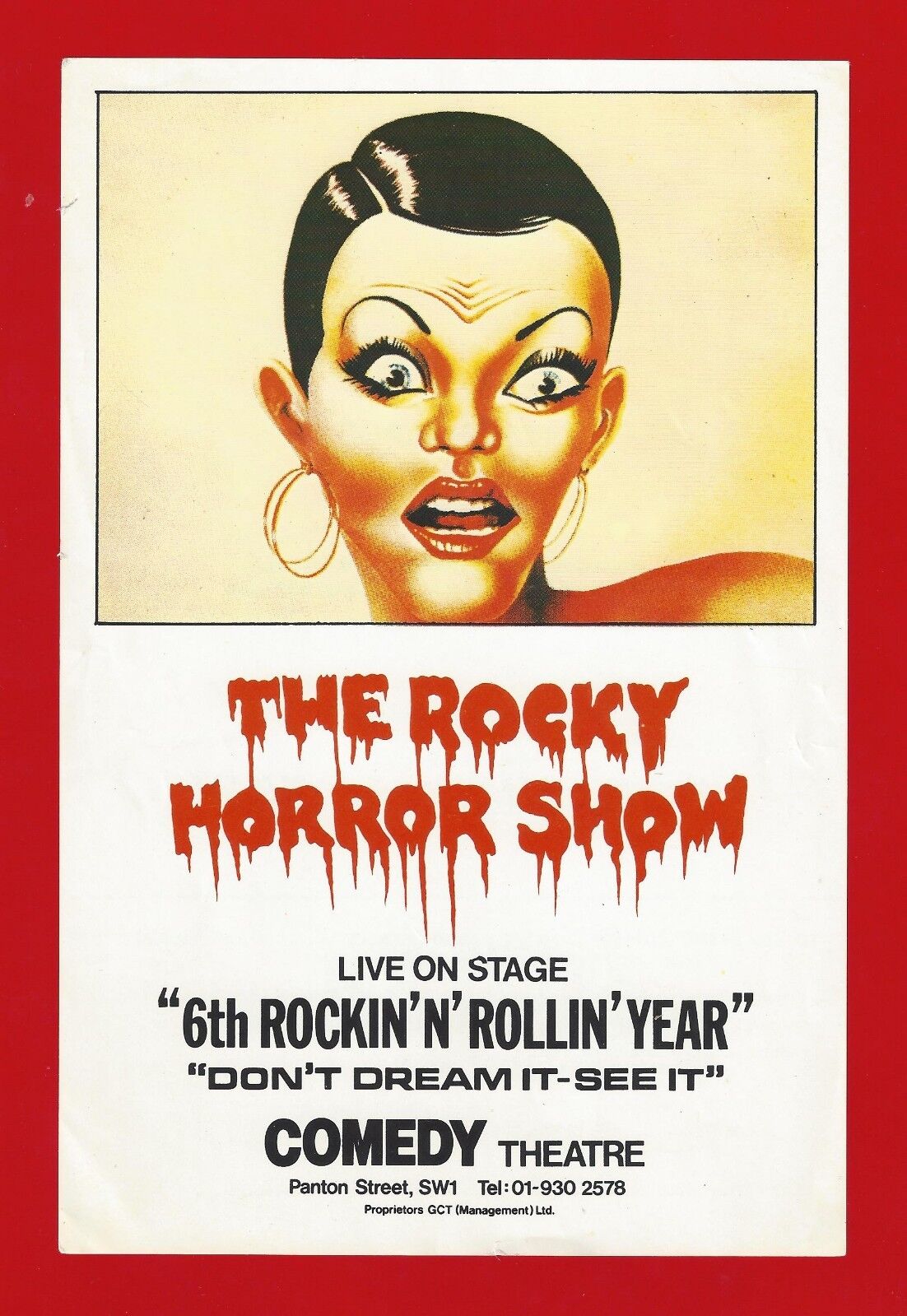
Sold on eBay December 24th, 2024
Richard O'Brien "ROCKY HORROR SHOW" Comedy Theatre / Tim Curry 1978 London Flyer
This is a rare single page advertising handbill (flyer) promoting ticket sales for the Original London production of the cult favorite RICHARD O'BRIEN musical "THE ROCKY HORROR SHOW" at the Comedy Theatre in London. (The Original London production premiered at the sixty-three seat Royal Court Theatre (Upstairs) on June 19th, 1973 and after four weeks transferred to the Classic Cinema Chelsea where the show played for the next three months. When the Classic Cinema was demolished in October 1973, the production moved to the King's Road Theatre and settled in for the next six years. The musical phenomenon would spend its final two seasons at London's Comedy Theatre, closing September 13th, 1980 after 2960 performances. The American Premiere took place at the Roxy Theatre in Los Angeles on March 24th, 1974, where it played for nine months. Most of the Los Angeles cast would make their Broadway debuts at New York's Belasco Theatre on March 10th, 1975, but the show would close after only 45 performances.) ..... What started as the creation of an out-of-work actor, "THE ROCKY HORROR SHOW" has become an international phenomenon, translated into more than twenty languages and performed on every continent. With music, lyrics and book all written by RICHARD O'BRIEN, the show is a humorous tribute to the science fiction and horror movies of the 1940's through the early 1970's. The Original 1973 London cast included its creator RICHARD O'BRIEN as "Riff Raff", TIM CURRY as Frank N Furter BELINDA SINCLAIR as "Janet Weiss", JAMES WARWICK as "Brad Majors", ANGELA BRUCE as "Usherette", LITTLE NELL CAMPBELL as "Columbia", BEN BAZELL as "Rocky Horror", ZIGGY BYFIELD as "Eddie" and "Dr. Everett Scott" and JONATHAN ADAMS as the Narrator ..... CREDITS: Book, Music and Lyrics by RICHARD O'BRIEN; Sets designed by BRIAN THOMSON; Costumes designed by SUE BLANE; Directed by JIM SHARMAN; Produced by MICHAEL WHITE ..... DETAILS: Advertising handbills (heralds) were distributed or inserted into the playbills of other productions to help generate ticket sales for upcoming shows. This single page, two-sided handbill measures 5 1/4" X 8" inches and includes wonderful graphics and promotional text on the front and ticket prices, performance times and a ticket order form on the backside ..... CONDITION: With the exception of two tiny edge tears and light creasing, this rare handbill is in excellent condition and will make a wonderful addition to the collection of any musical theatre aficionado or historian. This item will be carefully packaged in a protective, carded sleeve and backed by stiff cardboard.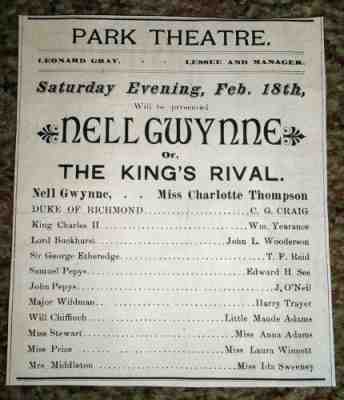
Sold on eBay May 1, 2023
Little Maude Adams Age 9 1882 Nell Gwynne Park Theatre Newark NJ VERY RARE
Find many great new & used options and get the best deals for Little Maude Adams Age 9 1882 Nell Gwynne Park Theatre Newark NJ VERY RARE at the best online prices at eBay! Free shipping for many products!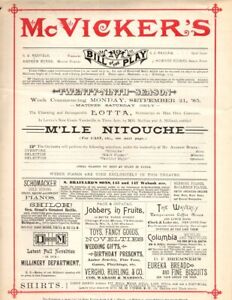
Sold on eBay February 25th, 2024
*LEGENDARY GOLD RUSH ACTRESS LOTTA CRABTREE 1884 MLLE NITOUCHE PROGRAM*
She was the darling of Gold Rush California, a protege of Lola Montez, and as an adult became America's finest 19th century comedienne, famed for her charismatic vivaciousness and her risque for the time double entendres. A rare large original September 1885 program for the amazing Lotta Crabtree in Mlle Nitouche at McVicker's Theatre, Chicago, in which she appeared in Japanese costume. Four pages front and back. Dimensions twelve by nine inches. Light edgewear otherwise good. See Lotta Crabtree's extraordinary biography below.Shipping discounts for multiple purchases. Credit cards accepted with Paypal. Inquiries always welcome. Please visit my other eBay items for more early theatre and historical autographs, photographs and programs and great singer, actor and actress cabinet photos and CDV's.From Wikipedia:Lotta Mignon Crabtree (November 7, 1847 - September 25, 1924) was an Americanactress entertainer and comedian. She was also a significant philanthropist Born Charlotte Mignon Crabtree in New York City to British immigrants, Lotta Crabtree would go on to become one of the wealthiest and most beloved American entertainers of the late 19th century. From her beginnings as a 6-year-old until her retirement at the age of 45, she entertained and was named "The Nation's Darling".Her father, John Ashworth Crabtree, a book seller, left for San Francisco in 1851 to join those seeking fortune in the California Gold Rush. Lotta and her mother followed two years later, joining John in the boomtown of Grass Valley. While in Grass Valley, the Crabtrees ran a boarding house. Lotta soon attracted the attention of a neighbor, the dancer and actress Lola Montez, who encouraged Lotta's enthusiasm for the performance Early lifeThe Crabtrees moved again and set up another boarding house, this time in Rabbit Creek, forty miles north of Grass Valley. Soon after, Lotta made her first professional appearance at a tavern owned by Matt Taylor. She began touring throughout California, and Nevada, making a name for herself as a dancer, singer, and banjo player in the mining camps. In 1856, the family moved back to San Francisco. By 1859, she had become "Miss Lotta, the San Francisco Favorite Lotta s mother served as her manager and collected all of Lotta's earnings in gold, carrying it in a large leather bag. When this became too heavy, it was transferred to a steamer trunk.Later careerHaving made a name in California, in 1863 Lotta left to tour the east coast where she began acting inplays such as The Old Curiosity Shop, Uncle Tom's Cabin and Little Nell and the Marchioness. With her petite size, she became a favorite for her portrayals of children. The late 1860s would see the "Lotta Polka" and "Lotta Gallup" as quite the rage in America. At age 20 she was a national star. By 1875, Lotta was touring the nation with her own theatrical company. Lotta achieved the height of her success in the 1870s and 1880s.The 1880s saw her perennially as the highest paid actress in America, earning sums of up to $5,000 per week. Mary Ann was still managing Lotta's affairs: booking plays, finding locations, and organizing troupes of actors. When the steamer trunk became too heavy, she invested Lotta's earnings in local real estate, race horses and bonds. As well as investing, some of the money was used to support local charities and build fountains Lotta's Fountain, the most famous of these fountains, still stands at the intersection of Market and Kearny Streets in San Francisco, and is the site of meetings every April 18 marking the anniversary of the 1906 San Francisco earthquake Lotta traveled abroad with Mary Ann and her brothers, where she learned French, visited museums and began painting. After her tour abroad, Lotta returned to San Francisco where she played at the California Theatre, reprising her role in Little Nell and the Marchioness by John Bowen. Having missed her while she was away, the city responded warmly to her return and treated her like their very own star.[1]In 1885, Lotta's mother had an 18 room summer cottage built in the Breslin Park section of Mount Arlington on the shores of Lake Hopatcong, New Jersey, which was called Attol Tryst. The house, designed by noted architect Frank Furness, stands today and in recent years has been beautifully restored. Lotta gave parties, drove horses, and pursued her painting [edit]RetirementShe was forced to retire as a result of a fall in Wilmington, Delaware in May 1889. After recovering in Lake Hopatcong, she attempted a comeback in 1891 and decided to retire permanently from the stage. She later resisted calls for a farewell tour. At age 45, it was the perfect time to retire - she was the richest actress in America, the theatre was changing and she got out at the top. She made one final appearance in 1915 for "Lotta Crabtree Day" in San Francisco at the Panama-Pacific Exposition While Lotta apparently had her share of romance, her travel, lifestyle and mother made a long-term relationship difficult and Lotta never married Following retirement, Lotta traveled, painted (including studying at Paris in 1912) and was active in charitable work.Late in her life, Lotta moved to Massachusetts and was owner of acreage in the southern part of the Squantum section of Quincy, immediately south of Boston, Massachusetts. It is said to have been purchased for the benefit and health of her brother (Ashworth) and for their horses. Most of the land was sold as house lots in the 1930s and '40s. Children who walked to school through Lotta's land in those days often passed by two small markers of local granite set into the ground, engraved "Ruby Royal" and "Sonoma Girl" - two of the Crabtrees' horses. Local street names include Ashworth Road, Livesey Road, Sonoma Road, and the shoreline Crabtree Road. Ashworth was a family surname, as was Livesey. A large cylindrical stone tower constructed nearby likely had a farm-related storage purpose. Further information may be available through the Quincy (Massachusetts) Historical Society.Lotta spent the last 15 years of her life at the Brewster Hotel which she had purchased in Boston. She died September 25, 1924 at age 76. In her obituary, The New York Times called her the "eternal child". She was described by critics as mischievous, unpredictable, impulsive, rattlebrained, teasing, piquant, rollicking, cheerful and devilish. Lotta Crabtree was interred at the Woodlawn Cemetery in Bronx, NY.Lotta left an estate of some $4 million in a charitable trust for such causes as veterans, aging actors and animals. The estate ran into complications when a number of people unsuccessfully contested the will. The trust still exists today.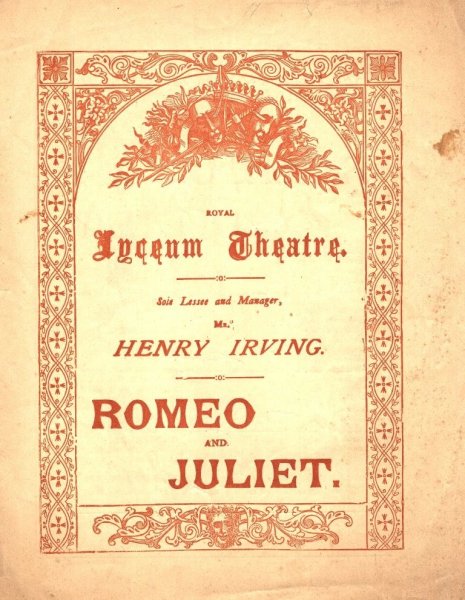
Sold on eBay May 9th, 2025
*HENRY IRVING ELLEN TERRY RARE ORIGINAL 1882 ROMEO AND JULIET PROGRAM*
A rare original 1882 program for Henry Irving and Ellen Terry in Romeo and Juliet at the Royal Lyceum Theatre, London, with future stars William Terrisss and George Alexander among the cast. Future Dracula author Bram Stoker is prominently listed as Acting Manager. Four pages. Dimensions eight and a quarter by six and a half inches. Light wear and small repaired tears otherwise good. See Henry Irving and Ellen Terry's extraordinary biographies below. Shipping discounts for multiple purchases. Inquiries always welcome. Please visit my other eBay items for more early theatre, opera, film and historical autographs, photographs and programs and great actor and actress cabinet photos and CDV's. From Wikipedia:Sir Henry Irving (6 February 1838 - 13 October 1905), born John Henry Brodribb, sometimes known as J. H. Irving, was an English stage actor in the Victorian era, known as an actor-manager because he took complete responsibility (supervision of sets, lighting, direction, casting, as well as playing the leading roles) for season after season at the Lyceum Theatre, establishing himself and his company as representative of English classical theatre. In 1895 he became the first actor to be awarded a knighthood, indicating full acceptance into the higher circles of British society.Irving is widely acknowledged to be one of the inspirations for Count Dracula, the title character of the 1897 novel Dracula whose author, Bram Stoker, was business manager of the theatre.Irving was born to a working-class family in Keinton Mandeville in the county of Somerset.[1] W.H. Davies, the celebrated poet, was a cousin. Irving spent his childhood living with his aunt, Mrs Penberthy, at Halsetown in Cornwall. He competed in a recitation contest at a local Methodist chapel where he was bested by William Curnow, later the editor of The Sydney Morning Herald.[2] He attended City Commercial School for two years before going to work in the office of a law firm at age 13. When he saw Samuel Phelps play Hamlet soon after this, he sought lessons, letters of introduction, and work in a theatre in Sunderland in 1856, labouring against great odds until his 1871 success in The Bells in London set him apart from all the rest.He married Florence O'Callaghan on 15 July 1869 at St. Marylebone, London, but his personal life took second place to his professional life. On opening night of The Bells, 25 November 1871, Florence, who was pregnant with their second child, criticised his profession: "Are you going on making a fool of yourself like this all your life?" Irving exited their carriage at Hyde Park Corner, walked off into the night, and chose never to see her again. He maintained a discreet distance from his children as well, but became closer to them as they grew older. Florence Irving never divorced Irving, and once he had been knighted she styled herself "Lady Irving"; Irving never remarried.[3]Sir Henry Irving, as Hamlet, in an 1893 illustration from The Idler magazineHis elder son, Harry Brodribb Irving (1870-1919), usually known as "H B Irving", became a famous actor and later a theatre manager. His younger son, Laurence Irving (1871-1914), became a dramatist and later drowned, with his wife, in the sinking of the Empress of Ireland. H B married Dorothea Baird and they had a son, Laurence Irving (1897-1988), who became a well-known Hollywood art director and his grandfather's biographer.In November 1882 Irving became a Freemason, being initiated into the prestigious Jerusalem Lodge No 197 in London.[4] In 1887 he became a founder member and first Treasurer of the Savage Club Lodge No 2190,[5] a Lodge associated with London's Savage Club.He eventually took over the management of the Lyceum Theatre and brought actress Ellen Terry into partnership with him as Ophelia to his Hamlet, Lady Macbeth to his Macbeth, Portia to his Shylock, Beatrice to his Benedick, etc. Before joining the Lyceum, Terry had fled her first marriage and conceived two out-of-wedlock children with architect-designer Edward William Godwin, but regardless of how much and how often her behavior defied the strict morality expected by her Victorian audiences, she somehow remained popular. It could be said that Irving found his family in his professional company, which included his ardent supporter and manager Bram Stoker and Terry's two illegitimate children, Teddy and Edy.Whether Irving's long, spectacularly successful relationship with leading lady Ellen Terry was romantic as well as professional has been the subject of much historical speculation. Most of their correspondence was lost or burned by her descendants.[6] According to Michael Holroyd's book about Irving and Terry, A Strange Eventful History:Years later, when Irving was dead, Marguerite Steen asked Ellen whether she really had been Irving's lover, and she promptly answered: 'Of course I was. We were terribly in love for a while.' But at earlier periods in her life, when there were more people around to be offended, she said contradictory things.Terry's son Teddy, later known as Edward Gordon Craig, spent much of his childhood (from 1879, when he was 8, until 1897) indulged by Irving backstage at the Lyceum. Craig, who came to be regarded as something of a visionary for the theatre of the future, wrote an especially vivid, book-length tribute to Irving. ("Let me state at once, in clearest unmistakable terms, that I have never known of, or seen, or heard, a greater actor than was Irving.") George Bernard Shaw, at the time a theatre critic who was jealous of Irving's connection to Ellen Terry (whom Shaw himself wanted in his own plays), conceded Irving's genius after Irving died.Dame Alice Ellen Terry, GBE (27 February 1847[1] - 21 July 1928), known professionally as Ellen Terry,[2] was a renowned English actress of the late 19th and early 20th centuries.Born into a family of actors, Terry began performing as a child, acting in Shakespeare plays in London, and toured throughout the British provinces in her teens. At 16, she married the 46-year-old artist George Frederic Watts, but they separated within a year. She soon returned to the stage but began a relationship with the architect Edward William Godwin and retired from the stage for six years. She resumed acting in 1874 and was immediately acclaimed for her portrayal of roles in Shakespeare and other classics.In 1878 she joined Henry Irving's company as his leading lady, and for more than the next two decades she was considered the leading Shakespearean and comic actress in Britain. Two of her most famous roles were Portia in The Merchant of Venice and Beatrice in Much Ado About Nothing. She and Irving also toured with great success in America and Britain.In 1903 Terry took over management of London's Imperial Theatre, focusing on the plays of George Bernard Shaw and Henrik Ibsen. The venture was a financial failure, and Terry turned to touring and lecturing. She continued to find success on stage until 1920, while also appearing in films from 1916 to 1922. Her career lasted nearly seven decades.In 1875, Terry gave an acclaimed performance as Portia in The Merchant of Venice at the Prince of Wales's Theatre, produced by the Bancrofts. Oscar Wilde wrote a sonnet, upon seeing her in this role: "No woman Veronese looked upon/Was half so fair as thou whom I behold."[11] She recreated this role many times in her career until her last appearance as Portia at London's Old Vic Theatre in 1917.In 1876 she appeared as Lady Teazle in The School for Scandal, Blanche Haye in a revival of T. W. Robertson's Ours, and the title role in Olivia by William Gorman Wills at the Court Theatre (an adaptation of The Vicar of Wakefield), where she joined the company of John Hare. In November 1877 she married Charles Clavering Wardell Kelly (1839-1885), an actor/journalist she had met while appearing in Reade's plays, but they separated in 1881. After this, she finally reconciled with her parents, whom she had not seen since she began to live out-of-wedlock with Godwin.[5]In 1878 the 30-year-old Terry joined Henry Irving's company at the Lyceum Theatre as its leading lady at a generous salary, beginning with Ophelia opposite Irving's Hamlet. Soon she was regarded as the leading Shakespearean actress in Britain, and in partnership with Irving,[12] she reigned as such for over 20 years until they left the Lyceum in 1902.[3][13] Their 1879 production of The Merchant of Venice ran for an unusual 250 nights, and success followed success in the Shakespeare canon as well as in Tennyson, Bulwer-Lytton, Reade, Sardou, and plays by other contemporary playwrights, such as W. G. Wills, and other major plays.[4]In 1879 The Times said of Terry's acting in Paul Terrier's All is Vanity, or the Cynic's Defeat, "Miss Terry's Iris was a performance of inimitable charm, full of movement, ease, and laughter... the most exquisite harmony and natural grace... such an Iris might well have turned the head of Diogenes himself."[14] In 1880, at the Lyceum, she played the title role in an adaptation of King Rene's Daughter called Iolanthe. The Era wrote: "Nothing more winning and enchanting than the grace, and simplicity, and girlish sweetness of the blind Iolanthe as shown by Miss Ellen Terry has within our memory been seen upon the stage. The assumption was delightfully perfect. ... Exquisite ... exercise of the peculiarly fascinating powers of Miss Ellen Terry, who achieved an undoubted triumph ... and was cheered again and again".[15]As Katherine in Henry VIIIAmong her most celebrated roles with Irving were Ophelia, Pauline in The Lady of Lyons by Edward Bulwer-Lytton (1878), Portia (1879), Queen Henrietta Maria in William Gorman Wills's drama Charles I (1879), Desdemona in Othello (1881), Camma in Tennyson's short tragedy The Cup (1881), Beatrice in Much Ado About Nothing, another of her signature roles (1882 and often thereafter), Juliet in Romeo and Juliet (1882), Jeanette in The Lyons Mail by Charles Reade (1883), the title part in Reade's romantic comedy Nance Oldfield (1883), Viola in Twelfth Night (1884), Margaret in the long-running adaptation of Faust by Wills (1885), the title role in Olivia (1885, which she had played earlier at the Court Theatre), Lady Macbeth in Macbeth (1888, with incidental music by Arthur Sullivan[16]), Queen Katherine in Henry VIII (1892),[17] Cordelia in King Lear (1892), Rosamund de Clifford in Becket by Alfred Tennyson (1893), Guinevere in King Arthur by J. Comyns Carr, with incidental music by Sullivan (1895),[18] Imogen in Cymbeline (1896), the title character in Victorien Sardou and Emile Moreau's play Madame Sans-Gene (1897)[10] and Volumnia in Coriolanus (1901).Terry made her American debut in 1883, playing Queen Henrietta opposite Irving in Charles I. Among the other roles she portrayed on this and six subsequent North American tours with Irving were Jeanette, Ophelia, Beatrice, Viola, and her most famous role, Portia.[19][20] Her last role at the Lyceum was Portia in 1902, after which she toured in the British provinces with Irving and his company that autumn. Whether Irving's relationship with Terry was romantic as well as professional has been the subject of much speculation. According to Sir Michael Holroyd's book about Irving and Terry, A Strange Eventful History, after Irving's death, Terry stated that she and Irving had been lovers and that: "We were terribly in love for a while".[21] Irving was separated, but not divorced from his wife. Terry was separated from Wardell in 1881, and Irving was godfather to both her children. They travelled on holiday together, and Irving wrote tender letters to Terry.[5][22]In London, Terry lived in Earls Court with her children and pets during the 1880s, first in Longridge Road, then Barkston Gardens in 1889, but she kept country homes. In 1900, she bought her farmhouse in Small Hythe, Kent, where she lived for the rest of her life.[23] In 1889, her son joined the Lyceum company as an actor, appearing with the company until 1897, when he retired from the stage to study drawing and produce woodblock engravings. Her daughter Edith also played at the Lyceum for several years from 1887, but she eventually turned to stage direction and costume design, creating costumes for Terry, Lillie Langtry, and others early in the 20th century.Edward Henry Gordon Craig CH OBE (born Edward Godwin; 16 January 1872 - 29 July 1966), sometimes known as Gordon Craig, was an English modernist theatre practitioner; he worked as an actor, director and scenic designer, as well as developing an influential body of theoretical writings. Craig was the son of actress Dame Ellen Terry.The Gordon Craig Theatre, built in Stevenage (the town of his birth), was named in his honour in 1975.The illegitimate son of the architect Edward Godwin and the actress Ellen Terry,[1] Craig was born Edward Godwin on 16 January 1872 in Railway Street, Stevenage, in Hertfordshire, England, and baptised at age 16 as Edward Henry Gordon. He took the surname Craig by deed poll at age 21.[2]Craig spent much of his childhood backstage at the Lyceum Theatre, where his mother was the leading lady to actor Sir Henry Irving. Craig later wrote a vivid, book-length tribute to Irving. Craig's sister was Edith Craig.In 1893 Craig married Helen Mary (May) Gibson, with whom he had five children: Philip Carlisle (born 1894), Rosemary Nell (born 1894), Henry Edward Robin (born 1895), John (born 1896) and Peter (born 1897).[3]With his lover, the violinist Elena Fortuna Meo (1879-1957) he had three children: Ellen Gordon (1903-1904), Ellen Gordon ("Nelly"; 1904-1975) and Edward Anthony Carrick (1905-1998; an art director of British films).[3] With his lover, the dancer Isadora Duncan, he had a daughter, Deirdre Beatrice (1906-1913), who drowned at the age of seven with another of Duncan's children, Patrick Augustus, and their nanny.[3] With his lover, the poet Dorothy Nevile Lees, he had a son, Davidino Lees (1916-2004), a noted Italian photojournalist.[3] His granddaughter is the illustrator and author Helen Craig.[2]Craig lived in straitened circumstances in France for much of his life and was interned by German Occupation forces in 1942. He died at Vence, France, in 1966, aged 94.[2]Career[edit]Further information: Moscow Art Theatre production of HamletCraig as Hamlet, Olympic Theatre, 1897Craig asserted that the director was "the true artist of the theatre" and, controversially, suggested viewing actors as no more important than marionettes. He designed and built elaborately symbolic sets; for instance, a set composed of his patented movable screens for the Moscow Art Theatre production of Hamlet. He was also the editor and chief writer for the first international theatre magazine, The Mask.[4]He worked as an actor in the company of Sir Henry Irving, but became more interested in art, learning to carve wood under the tutelage of James Pryde and William Nicholson. His acting career ended in 1897, when he went into theatrical design.Craig's first productions, Purcell's Dido and Aeneas, Handel's Acis and Galatea (both inspired and conducted by his lifelong friend Martin Shaw, who founded the Purcell Operatic Society with him to produce them), and Ibsen's The Vikings at Helgeland, were produced in London. The production of Dido and Aeneas was a considerable success and highly influential in reviving interest in the music of Purcell, then so little known that three copies of The Times review were delivered to the theatre: one addressed to Mr Shaw, one to Mr Craig, and one to Mr Purcell. Craig concentrated on keeping his designs simple, so as to set-off the movements of the actors and of light, and introduced the idea of a "unified stage picture" that covered all the elements of design.After finding little financial success in Britain, Craig set out for Germany in 1904. While there, he wrote one of his most famous works, the essay The Art of the Theatre (later reprinted with the title On the Art of the Theatre). In 1908, Isadora Duncan introduced Craig to Konstantin Stanislavski, the founder of the Moscow Art Theatre, who invited him to direct their famous production of Hamlet with the company, which opened in December 1911. After settling in Italy, Craig created a school of theatrical design with support from Lord Howard de Walden, the Arena Goldoni in Florence. During World War I, he wrote a cycle of puppet plays, the Drama for Fools[5] and published a little theatre magazine, The Marionnette (1918).Craig was considered extremely difficult to work with and ultimately refused to direct or design any project over which he did not have complete artistic control. This led to his withdrawal from practical theatre production.[6] His later career is remarkable for how little he achieved after the age of forty, during a long period of over fifty years.He received an OBE and in 1958 was made a Companion of Honour.Ideas[edit]Caricature of Craig by Max Beerbohm from A Survey, published in 1921.Craig's idea of using neutral, mobile, non-representational screens as a staging device is probably his most famous scenographic concept. In 1910 Craig filed a patent which described in considerable technical detail a system of hinged and fixed flats that could be quickly arranged to cater for both internal and external scenes. He presented a set to William Butler Yeats for use at the Abbey Theatre in Ireland, who shared his symbolist aesthetic.[citation needed]Craig's second innovation was in stage lighting. Doing away with traditional footlights, Craig lit the stage from above, placing lights in the ceiling of the theatre. Colour and light also became central to Craig's stage conceptualizations.Under the play of this light, the background becomes a deep shimmering blue, apparently almost translucent, upon which the green and purple make a harmony of great richness.[7]The third remarkable aspect of Craig's experiments in theatrical form were his attempts to integrate design elements with his work with actors. His mise en scene sought to articulate the relationships in space between movement, sound, line, and colour. Craig promoted a theatre focused on the craft of the director - a theatre where action, words, colour and rhythm combine in dynamic dramatic form.[8]Ellen Terry by Craig, from The Dome"Dumas Papa" by Craig, 1899All of his life, Craig sought to capture "pure emotion" or "arrested development" in the plays on which he worked. Even during the years when he was not producing plays, Craig continued to make models, to conceive stage designs and to work on directorial plans that were never to reach performance. He believed that a director should approach a play with no preconceptions and he embraced this in his fading up from the minimum or blank canvas approach.[9]As an engraver and a classical artist, Craig found inspiration in puppets and masks. In his 1910 article "A Note on Masks," Craig expounds the virtue of using masks as a mechanism for capturing the audience's attention, imagination and soul. "There is only one actor - nay one man who has the soul of the dramatic poet, and who has ever served as the true and loyal interpreter of the poet," he proclaimed, and "this is the marionette."[10]On the Art of the Theatre (1911) is written as a dialogue between a Playgoer and a Stage Director, who examine the problems of the nature of stage directing. Craig argues that it was not dramatists, but rather performers who made the first works of drama, using action, words, line, colour and rhythm. Craig goes on to contend that only the director who seeks to interpret drama truly, and commits to training in all aspects of dramatic art, can restore the "Art of the Theatre."[11] Maintaining that the director should seek a faithful interpretation of the text, Craig argues that audiences go to the theatre to see, rather than to hear, plays. The design elements may transcend reality and function as symbols, he thought, thereby communicating a deeper meaning, rather than simply reflecting the real world.On 29 June 1908 the Polish theater director, playwright, and theoretician of drama Leon Schiller initiated a correspondence with Craig. Together with his letter Schiller sent Craig, in Florence, his essay, "Dwa teatry" ("Two Theaters"), translated into English by Madeline Meager. Craig responded immediately, accepting the essay for his magazine, The Mask.[12] This was the beginning of a productive collaboration between the two prominent theater directors, who introduced each other's theoretical writings to foreign readers.[13]Archive[edit]One of the largest collections of Edward Gordon Craig's papers is held at the Harry Ransom Center at the University of Texas at Austin. The 32-box collection includes Craig's diaries, essays, reviews, notes, manuscripts, financial records, and correspondence.[14] Over 130 personal photographs are present in the archive.[15] The Ransom Center's art holdings including some of Craig's woodblocks from the Cranach Press Hamlet as well as proof prints made during production of the book. The center's library holds over 300 books from Craig's personal collection.[16] In addition to the archive of Edward Gordon Craig, the Ransom Center holds important holdings relating to Craig's mother Ellen Terry, as well as the archive of his son Edward Carrick.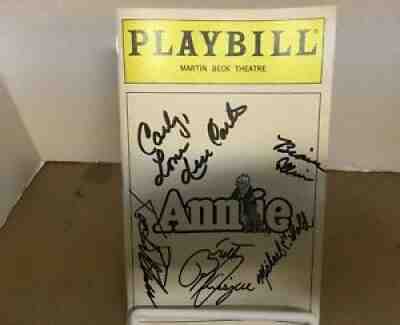
Sold on eBay Nov 01, 2021
Vintage Signed 1979 ANNIE Martin Beck Theatre Playbill Signed by Nell Carter
Find many great new & used options and get the best deals for Vintage Signed 1979 ANNIE Martin Beck Theatre Playbill Signed by Nell Carter at the best online prices at eBay! Free shipping for many products!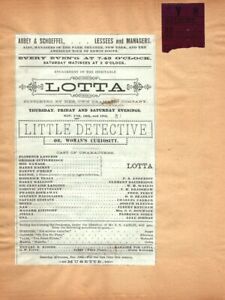
Sold on eBay February 25th, 2024
*LEGENDARY GOLD RUSH ACTRESS LOTTA CRABTREE LARGE 1884 PROGRAM & TICKET*
She was the darling of Gold Rush California, a protege of Lola Montez, and as an adult became America's finest 19th century comedienne, famed for her charismatic vivaciousness and her risque for the time double entendres. A rare large original circa 1884 program for the amazing Lotta Crabtree in The Little Detective, with an original ticket stub for Lotta's performance. To a Victorian album page with program and ticket stub for Joseph Jefferson in Rip Van Winkle to the reverse. Overall dimensions nine and a half by seven and a half inches. Light wear otherwise good. See Lotta Crabtree's extraordinary biography below.Shipping discounts for multiple purchases. Credit cards accepted with Paypal. Inquiries always welcome. Please visit my other eBay items for more early theatre and historical autographs, photographs and programs and great singer, actor and actress cabinet photos and CDV's. From Wikipedia:Lotta Mignon Crabtree (November 7, 1847 - September 25, 1924) was an Americanactress entertainer and comedian. She was also a significant philanthropist Born Charlotte Mignon Crabtree in New York City to British immigrants, Lotta Crabtree would go on to become one of the wealthiest and most beloved American entertainers of the late 19th century. From her beginnings as a 6-year-old until her retirement at the age of 45, she entertained and was named "The Nation's Darling".Her father, John Ashworth Crabtree, a book seller, left for San Francisco in 1851 to join those seeking fortune in the California Gold Rush. Lotta and her mother followed two years later, joining John in the boomtown of Grass Valley. While in Grass Valley, the Crabtrees ran a boarding house. Lotta soon attracted the attention of a neighbor, the dancer and actress Lola Montez, who encouraged Lotta's enthusiasm for the performance Early lifeThe Crabtrees moved again and set up another boarding house, this time in Rabbit Creek, forty miles north of Grass Valley. Soon after, Lotta made her first professional appearance at a tavern owned by Matt Taylor. She began touring throughout California, and Nevada, making a name for herself as a dancer, singer, and banjo player in the mining camps. In 1856, the family moved back to San Francisco. By 1859, she had become "Miss Lotta, the San Francisco Favorite Lotta s mother served as her manager and collected all of Lotta's earnings in gold, carrying it in a large leather bag. When this became too heavy, it was transferred to a steamer trunk.Later careerHaving made a name in California, in 1863 Lotta left to tour the east coast where she began acting inplays such as The Old Curiosity Shop, Uncle Tom's Cabin and Little Nell and the Marchioness. With her petite size, she became a favorite for her portrayals of children. The late 1860s would see the "Lotta Polka" and "Lotta Gallup" as quite the rage in America. At age 20 she was a national star. By 1875, Lotta was touring the nation with her own theatrical company. Lotta achieved the height of her success in the 1870s and 1880s.The 1880s saw her perennially as the highest paid actress in America, earning sums of up to $5,000 per week. Mary Ann was still managing Lotta's affairs: booking plays, finding locations, and organizing troupes of actors. When the steamer trunk became too heavy, she invested Lotta's earnings in local real estate, race horses and bonds. As well as investing, some of the money was used to support local charities and build fountains Lotta's Fountain, the most famous of these fountains, still stands at the intersection of Market and Kearny Streets in San Francisco, and is the site of meetings every April 18 marking the anniversary of the 1906 San Francisco earthquake Lotta traveled abroad with Mary Ann and her brothers, where she learned French, visited museums and began painting. After her tour abroad, Lotta returned to San Francisco where she played at the California Theatre, reprising her role in Little Nell and the Marchioness by John Bowen. Having missed her while she was away, the city responded warmly to her return and treated her like their very own star.[1]In 1885, Lotta's mother had an 18 room summer cottage built in the Breslin Park section of Mount Arlington on the shores of Lake Hopatcong, New Jersey, which was called Attol Tryst. The house, designed by noted architect Frank Furness, stands today and in recent years has been beautifully restored. Lotta gave parties, drove horses, and pursued her painting [edit]RetirementShe was forced to retire as a result of a fall in Wilmington, Delaware in May 1889. After recovering in Lake Hopatcong, she attempted a comeback in 1891 and decided to retire permanently from the stage. She later resisted calls for a farewell tour. At age 45, it was the perfect time to retire - she was the richest actress in America, the theatre was changing and she got out at the top. She made one final appearance in 1915 for "Lotta Crabtree Day" in San Francisco at the Panama-Pacific Exposition While Lotta apparently had her share of romance, her travel, lifestyle and mother made a long-term relationship difficult and Lotta never married Following retirement, Lotta traveled, painted (including studying at Paris in 1912) and was active in charitable work.Late in her life, Lotta moved to Massachusetts and was owner of acreage in the southern part of the Squantum section of Quincy, immediately south of Boston, Massachusetts. It is said to have been purchased for the benefit and health of her brother (Ashworth) and for their horses. Most of the land was sold as house lots in the 1930s and '40s. Children who walked to school through Lotta's land in those days often passed by two small markers of local granite set into the ground, engraved "Ruby Royal" and "Sonoma Girl" - two of the Crabtrees' horses. Local street names include Ashworth Road, Livesey Road, Sonoma Road, and the shoreline Crabtree Road. Ashworth was a family surname, as was Livesey. A large cylindrical stone tower constructed nearby likely had a farm-related storage purpose. Further information may be available through the Quincy (Massachusetts) Historical Society.Lotta spent the last 15 years of her life at the Brewster Hotel which she had purchased in Boston. She died September 25, 1924 at age 76. In her obituary, The New York Times called her the "eternal child". She was described by critics as mischievous, unpredictable, impulsive, rattlebrained, teasing, piquant, rollicking, cheerful and devilish. Lotta Crabtree was interred at the Woodlawn Cemetery in Bronx, NY.Lotta left an estate of some $4 million in a charitable trust for such causes as veterans, aging actors and animals. The estate ran into complications when a number of people unsuccessfully contested the will. The trust still exists today.
Sold on eBay April 8th, 2024
*EDWIN BOOTH'S THEATRE 1876 JULIUS CAESAR BROADSIDE L. BARRETT E. L. DAVENPORT*
A rare original February 1876 Booth's Theatre broadside for Julius Caesar, featuring Lawrence Barrett and E. L. Davenport. Barrett was among 19th century America's greatest actors, famed for his Shakespearean roles, for his partnership with Edwin Booth in the late 1880s and early 1890s, and for his close friendship and correspondence with George Armstrong Custer. Dimensions eleven and a half by four and a half inches. Laid down to backing with small tear otherwise good. Shipping discounts for buyers of multiple items. Credit cards accepted with Paypal. Inquiries always welcome. Please visit my other eBay items for more early theatre and historical autographs, broadsides, photographs and programs and great actor and actress cabinet photos and CDV's. From Wikipedia:Booth s Theatre was a theatre in New York built by actor Edwin Booth. Located on the southeast corner of 23rd Street and Sixth Avenue, Booth's Theatre opened on February 3, 1869.The theatre featured a grand vestibule with Italian marble floors and a large statue of Edwin Booth's father, the Shakespearean actor Junius Brutus Booth, by the sculptor Thomas Ridgeway Gould. The auditorium was similarly elaborate in its decor, and featured a large chandelier, as well as a stage that incorporated the most modern machinery in use at the time, such as hydraulic rams to raise and lower scenery, and stage lights that could be completely extinguished during the performance, a first in the United States.Despite the appearances by important talent of the times, Booth could not make the theatre a financially viable enterprise. It was sold in December 1881, and was converted into McCreery & Co. department store until 1965, when it was demolished to make room for a parking lot.HistoryIn 1869, Edwin Booth, then one of the world's most distinguished stage tragedians and arguably America's greatest Prince Hamlet, opened his theatre, Booth's Theatre, in Manhattan on the southeast corner of 23rd Street and Sixth Avenue.Central to the identity of Booth's theatre was the stage background of Edwin Booth, who belonged to the Booth family dynasty, which ruled the American stage in the 19th century. It was actually touring with his father, Junius Brutus Booth, that gave Edwin his first break, first appearing as Tressel in Richard II in Boston in 1849.[1] After his father's death in 1852 Booth toured internationally visiting Australia and Hawaii and briefly settling in California before returning to the east coast. Edwin is perhaps best known for his "hundred nights of Hamlet" in which he played Hamlet for 101 consecutive performances, a record held until 1922.[2] Booth is also known for his relationship with his infamous brother, John Wilkes, who assassinated President Abraham Lincoln. After the tragedy, Edwin publicly disowned his brother [3]Booth had been drawn to the idea of erecting his own theatre, particularly after he purchased the Walnut Street Theatre in Philadelphia. Plans overtook Booth when a tragic fire of 1867 consumed The Winter Garden Theatre—Booth s usual performing home in New York—-and with it much of Booth's personal wardrobe. The new theatre was to be one of the finest of its time, called in the press "A fitting temple for the presentation of Shakespearean drama [4]Booth s Theatre remained Booth's new performing home for several years, during which time Booth and his elder brother Junius Brutus Booth Jr., presented productions of the classics and hosted guest artists, such as Joseph Jefferson in his popular Rip Van Winkle. Finally, due in part to bad management, Booth lost the theatre to bankruptcy in 1874, and "never again participated in theatrical management."[5] In 1883 the theatre was converted into a department store, which was demolished in 1965. Presently [when ] the land is occupied by a Best Buy electronics store ConstructionOn April 8, 1868, after the removal of several old structures and blasting out an unexpected "stone ledge" at the corner of Twenty Third and Sixth Avenue, Edwin Booth, after "Masonic observances", laid the cornerstone for his new theatre.[6] Designed by the architectural firm of Renwick and Sands[7] the theatre was made of granite in the Second Empire style, with an impressive front, iron-trimmed facing north on Twenty Third Street of one hundred and fifty feet in length.[8] An additional wing extending to Sixth Avenue to the west, housed construction shops, studios and additional rooms—one of which was reserved for Edwin Booth. North to south, the theatre was one hundred feet, and stood at a height of one hundred and twenty feet, topped with a mansard roof, including three towers. Under the side walk along Twenty Third Street was the carpenter's shop, as well as a boiler-room with a steam engine used to heat the theatre through extensive hot-air pipes. The entire theatre was heated and cooled with forced air.Several arched doors led to a grand vestibule, where a large statue of Edwin Booth's father, the great Shakespearean actor, Junius Brutus Booth, by the sculptor Thomas Ridgeway Gould, greeted the audience. The floor was Italian marble, the ceiling was covered with frescoes.[9] In the theatre, a large chandelier, lit by gas-jets and ignited by electricity, hung above the auditorium. Marble pillars, adorned with statues, surrounded the box seats. In the center, above the proscenium arch stood a statue of Shakespeare by the Italian sculptor Signor G. Turini. Portrait busts of David Garrick, Edmund Kean and other great actors adorned the proscenium arch.[10]The stage itself was equipped with the most modern stage machinery then in use. The deck of the stage had double-floors. Two spiral staircases at the rear corners of the stage led to four fly galleries. Scenery was raised and lowered by hydraulic rams under the stage.[11]These were but some of the innovations in the theatre that made the theatre an architectural marvel in New York. Others included one of New York's first sprinkler systems for fire prevention, and, backstage, sets of hydraulic rams were used to raise moving bridges and platforms to change scenery.In addition, stage lights—for the first time in America—could be completely extinguished both in the auditorium and on the stage during the performance through the use of an electric spark ignition system. This allowed crews to plunge the entire theatre—both stage and complete darkness during a performance of Booth's Hamlet [12]Booth s Theatre, modeled after the finest theatres of Europe, and using American inventiveness, was a marvel of technology and a palace of theatrical pleasure Opening nightBooth chose to open his new theatre with a sumptuous production of William Shakespeare's Romeo and Juliet, starring leading actress Mary F. McVicker as Juliet and Booth as Romeo, supported by a "full and efficient company" of actors. The program also noted that "The tragedy will be produced in strict accordance with historical propriety, in every respect, following closely the text of Shakespeare [13]Opening night was called "a great event in theatrical circles" by the New York Times.[4] Seats for the opening performance were sold at public auction for a total of $10,000.The popular run of Romeo and Juliet lasted ten weeks, earning nearly sixty thousand dollars, then considered an exceptional triumph. Two years before Booth had played Hamlet to McVicker's Ophelia at the famous McVicker's Theatre in Chicago, leading to his invitation for her to play opposite Booth in New York. McVicker's performance at Booth's Theatre marked her New York stage debut. That same season she played Desdemona to Booth's Othello at Booth's Theatre, and, on May 29, 1869, made her farewell performance in that role. A little over a week later, Booth married McVicker, and then returned to acting at his theatre.[14]For five years—called "five brilliant but disastrous seasons" in the New York Booth struggled to make his theatre a profitable enterprise, but it was not to be. Despite his performing on the stage, and booking some of the leading talent at Booth's Theatre, such as his friend Joseph Jefferson, it was not possible to pay the bills. As William Winter, Booth's friend and eventual biographer wrote:"Booth was a dreamer; and in every part of his life as it was known to me during an intimacy extending over a period of about thirty years, I saw the operation of Hamlet's propensity to view all things as transitory and immaterial, and to let everything drift. He was happier as an actor than as a manager [15]Try as he might, Booth could not make his theatre into a viable business enterprise. Once again he turned to touring with his successful productions of Hamlet, Othello, and Richelieu, to raise funds he sent back to New York, but nothing could produce enough money to keep the doors of Booth's Theatre open.[16] He relied on the advice and "experience of others" to run the theatre, but it was not in his nature. The press, in writing of Booth's departure from managing his own theatre, suggested that "it is true that the frames have sometimes outshone the pictures," meaning that the spectacle of lavish sets and costumes at times upstaged the performances of the actors in Booth's productions, especially, apparently, the performances of the women.[17] Even when shows were financial successes, such as the revival of the popular The Little Detective and the hit drama Little Nell and the Marchioness both starring the renowned Charlotte Crabtree in 1871, the theatre was still in debt. Finally, in 1874, only five years after the triumphant opening Romeo and Juliet, Booth lost the theatre to bankruptcy, and "never again participated in theatrical management [18]ClosingAfter being sold by Booth, the theatre was owned by several different managers, including the theatrical impresarios Augustin Daly and Dion Boucicault Despite the appearances by important talent of the times, such as Dion Boucicault Jr., who made his stage début in his father's play, Louis XI, Joseph Jefferson as Rip Van Winkle, Polish born actress Helena Modjeska as Juliet, and the French-born "devine Sarah" – Sarah Bernhardt – who appeared in her acclaimed production of Adrienne Lecouveur in 1881, and despite successful runs of comedies, such as Bronson Howard's smash hit Love in the Green Room, and spectacular productions featuring lavish historical recreations such as Shakespeare's Henry V (see photo, left), the theatre could not sustain itself.[19] In 1882 Oedipus Rex was performed there to a sold-out audience which included Oscar Wilde, Robert Barnwell Roosevelt, his mistress Marion O'Shea Fortescue, the mother of Granville Roland Fortescue, and composer Joaquin Miller, but even such well regarded operas and elegant audiences couldn't revive the theater.Booth's Theatre ended as it began, with Shakespeare's Romeo and Juliet. The last performance at Booth's Theatre was played by the famed actress Helena Modjeska, portraying the role of Juliet in Romeo and Juliet in 1883. The production was given as a benefit performance (as was common in the era), for Andrew Boyd, beloved janitor of the building – a fitting farewell, perhaps, to one of New York's great theatres. After the production closed, the building was turned into a large department store.[20]On December 31, 1881, a headline in the New York Times read:BOOTH'S THEATRE SOLDTHE PLAY HOUSE TO BE MADE A DRY GOODS STOREBooth's Theatre was sold yesterday for $550,000, less than half its original cost. The building will be devoted by its new owners to business purposes, and it is probable that as early as next May the work of altering it will be begun, although it may be continued as a theatre for another year. It is rather a singular coincidence that one of the gentlemen interested in the present purchase of the property should be a gentlemen who sold the original site to Mr. Booth when he conceived of the idea of erecting a theatre that should be a fitting temple for the presentation of Shakespearean drama.[4]The building lived on as the McCreery & Co. department store, and was finally demolished in 1965 to make room for a parking lot.In December 1878, Booth wrote an open letter in The Christian Union, in which he observed:If the management of theatres could be denied to speculators, and placed in the hands of actors who value their reputation and respect their calling, the stage would at least afford healthy recreation, if not, indeed, a wholesome stimulus to the exercise of noble sentiments. But while the theatre is permitted to be a mere shop for gain,—pen to every huckster of immoral gim cracks —there is no other way to discriminate between the pure and base than through the experience of others.Yours truly,Edwin Booth,December, 1878.Lawrence Barrett (April 4, 1838 - March 20, 1891) was an American stage actor. He was born Lawrence Brannigan to Irish emigrant parents in Paterson, New Jersey. He made his first stage appearance at Detroit as Murad in The French Spy in 1853. In December 1856 he made his first New York appearance at the Chambers Street theatre as "Sir Thomas Clifford" in The Hunchback. Biography In 1858 he was in the repertory company at the Boston Museum. He served in the American Civil War as captain in Company B of the 28th Massachusetts Infantry regiment. However, he did not see action in any major battles. From 1867 to 1870, with John McCullough, he managed the California theatre, San Francisco. Among his many and varied parts may be mentioned Hamlet, King Lear, Macbeth, Shylock, Richard III, Wolsey, Benedick in Much Ado About Nothing, Richelieu, David Garrick, Hernani, Alfred Evelyn, Lanciotto in George Henry Bokers (1823 -1890) Francesca da Rimini, and Janies Harebell in The Man o' Airlie. He playedÃÆ €™Ãƒ à €š ¬Ã… ¡ÃƒÆ’à ‚¬Å¡Ãƒ €šÃ‚ Othello to Edwin Booth's Iago and Cassius to his Brutus. He acted in London in 1867, 1882, 1883 and 1884, his "Cardinal Richelieu" portrayal in Edward Bulwer-Lytton's drama being considered his best part. In 1889, he produced the first performance of The Duchess of Padua, retitling it Guido Ferranti and taking on the title role.
Sold on eBay February 18th, 2025
Dennis King "VAGABOND KING" Rudolf Friml / Arthur Deagon 1926 Chicago Playbill
This is a rare September 13th, 1926 program from the Post-Broadway engagement of the RUDOLF FRIML, WILLIAM H. POST and BRIAN HOOKER musical play "THE VAGABOND KING" at the Great Northern Theatre in Chicago, Illinois. (The production opened September 21st, 1925 at the Casino Theatre in New York City and ran for 511 performances before going on the road.) ..... The musical starred DENNIS KING as "Francois Villon", ARTHUR DEAGON, BERNA DEANE, GEORGE PROBERT and FRANCES HALLIDAY and featured EDWARD NELL, RAYMOND O'BRIEN, BELLE SYLVIA, HAZEL DRURY, MILDRED GORDON, DAVID BOGART, MARTIN SHEPPARD, JOAN MARREN, ANDREW GEORGE, BYRON RUSSELL, BEN ROBERTS, IVAN ARBUCKLE, ALETA EDWARDS, JOSEPH LATHAM, ALEXANDER F. FRANK, VIDA HANNA, OLGA LEIGH, WILLIAM SUNDERMAN, EILEEN BOWERS, COLLETTE and DAN McCARTHY, ALBERT SHRUBB, RICHARD TROTT, VALDEMIR DORMAN, GEORGE LEACH, WILLIAM HAGEN and HENRIETTA ABRAMS ..... CREDITS: Music by RUDOLF FRIML ("Rose-Marie", "The Vagabond King", "The Firefly", "High Jinks", "The Three Musketeers", "Ziegfeld Follies of 1921"); Book and Lyrics by WILLIAM H. POST and BRIAN HOOKER based on the JUSTIN HUNTLEY McCARTHY romantic drama "If I Were King"; Sets and Costumes designed by JAMES REYNOLDS; Choreographed by ROYAL CUTTER and HELEN GRENELLIE; Orchestra conducted by FRED WALZ; Directed by RICHARD BOLESLAWSKY; Produced by RUSSELL JANNEY ..... DETAILS: The twelve page program measures 5 1/4" X 7 3/4" inches and includes beautiful cover graphics, full production credits, cast list, synopsis of scenes, list of musical numbers and wonderful vintage advertising, but no cast photos or bios ..... CONDITION: This rare program is in excellent condition and will make a wonderful addition to the collection of any musical theatre aficionado or historian. This item will be carefully packaged in a protective, carded sleeve and backed by stiff cardboard.
Sold on eBay March 22nd, 2025
Nell Carter in Ain't Misbehavin', Musical Play Book Manhattan Theatre
Order multiple items at once for combined shipping. Shipping overages will be refunded once your order is packaged up. :) Nell Carter in Ain't Misbehavin', Musical Play Book Manhattan Theatre . Shipped with USPS Media Mail.
Sold on eBay September 28th, 2023
Broadway "Annie" OPENING NIGHT Playbill! RARE ORIGINAL BROADWAY CAST, 1997++
eBay This is an opening night playbill for "Annie". It is a rare original Broadway cast playbill, featuring Nell Carter, Brittny Kissinger, Conrad John Schuck, etc.This is extremely rare!Dated March 26th, 1997.Mint condition, please look at photos.Please feel free to ask me any questions, God bless!
Sold on eBay May 22, 2022
Sutton Foster "ANNIE" Nell Carter / Charles Strouse 1997 Broadway Playbill
(The 20th Anniversary revival opened March 26th, 1997 and ran for 239 performances.).
Sold on eBay Aug, 10th 2020
JONICA Playbill NELL ROY / JERRY NORRIS / BERT MATTHEWS / JUNE O'DEA NYC 1930
JONICA, Playbill type program, 04/07/30, Opening Night, Craig Theatre, NYC. The musical opened in NYC on 04/07/30 and ran for for only 40 performances The cast includes Nell Roy, Jerry Norris, Bert Matthews, June O'Dea, Joyce Barbour, Earle S. Dewey, The Wallace Sisters (Wilma and Earlyne), Priscilla Gurney, Ruth Goodwin, Jack Stillman, Julia Baron, Mabel Gore, Clara Thropp, Dorothy Murray, Charles Doyle, George S. Shiller, Harry T. Shannon, Madeline Gray, Larry Beck, Irene Swor and Walace Hertz. Music by Joseph Meyer, lyrics by William Moll and book by Dorothy Heyward
Sold on eBay January 2nd, 2025
April 1979 - Plymouth Theatre Playbill - Ain't Misbehavin - Debbie Allen
April 1979 - The Plymouth Theatre Playbill Ain't Misbehavin featuring Debbie Allen - Nell Carter - Ken Page - Alan Weeks - and More ! Playbill is in Great Condition (note cover shows light signs of wear from use and age - cast page has a light crease). It also has great ads of other featured items! Please note that playbill picture was taken by a camera with a flash for crisper quality and may appear hazy, brighter or have reflection due to protective plastic sleeve. Please see our other auctions for other great Playbill Programs and More!!!!! Shipping and Handling is $5.95 up to 5 playbills or 3.95 First Class per single playbill if requested. Shipping and Handling is $12.95 for 6-25 playbills. Buyer pays shipping. Paypal, Visa MasterCard American Express and Discover (through PayPal) accepted. I will ship USPS mail with Delivery Confirmation. I also ship internationally (International winners please contact me for shipping prices and options). We will package your item securely. Thank you for bidding!!! I will leave positive feedback upon receiving payment. This also lets you know I received your payment. When you leave me feedback, I know you received the item and that you are satisfied with it. Thanks. Those who do not send payment within a timely manner after the auction has ended will force me to leave them unfavorable feedback. See all of my other auctions since I am constantly adding new items. Good luck on your bidding!
Sold on eBay Sep, 24th 2020