

Playbill Collectibles : Playbill+society Price List
average value
-
low
-high
-Found 20 out of 56,978 items matching 'society'
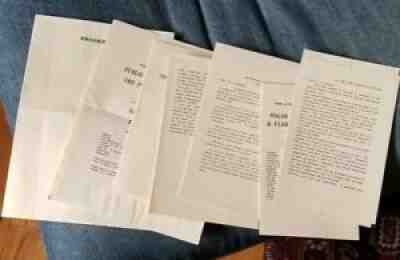
Sold on eBay Aug 27, 2021
Literary Theatre Club 7 items
Literary Theatre Society Program for public Matinee of The Persians by Aeshylus with A Miracle by Granville Barker 1907.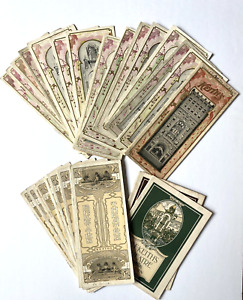
Sold on eBay April 6th, 2024
1900 Keith's Theater Program Lot Boston Houdini WC Fields Buster Keaton
Lot of 70 total antique playbills programs ranging from roughly 1900-1920, 25 programs for Keith's (B.F. Keith's) Theater in Boston MA. Incredible listings of productions, performers and advertising. Majority in excellent condition with staples secured, a few have some stains or a few loose pages. You can find Houdini, W.C. Fields and Buster Keaton amongst the lists plus so many others, for you to discover! Plus 45 programs from Worcester MA theaters early 1900s/turn of the century. Total 70 programs. Keith's Theatre (1894–1928) in Boston, Massachusetts, was a vaudeville playhouse run by B.F. Keith. It sat across from Boston Common in the city's theatre district on Tremont and Washington streets.Photos are of the actual item being sold and they are to be considered part of the description. We consider all offers in relation to current market values and we try to respond almost immediately. Your purchase will be packed carefully and shipped quickly. We are available 7 days a week. Please see other listings for books and collectibles that might be of interest to you and follow North Star Collectibles as we post new items every week.Thank you for looking and come again soon,North Star CollectiblesMember of the Ephemera Society of America and SNEAB Southern New England Antiquarian Booksellers
Sold on eBay June 29th, 2024
Ephemera Late 1800's Victorian Playbills Theater Programs Large Lot
Large lot of 70+ of turn of the century theater programs, playbills, announcements. Majority, if not all, from the Boston and Massachusetts area. Various degrees of condition though overall most are in very good condition and have been stored carefully by previously collector in individual archival plastic sheets. Many different theaters representing such as the Boston Theatre, Hippodrome, Columbia Theater, Shubert, Tremont and so on.Photos are of the actual item being sold and they are to be considered part of the description. We consider all offers in relation to current market values and we try to respond almost immediately. Your purchase will be packed carefully and shipped quickly. We are available 7 days a week. Please see other listings for books and collectibles that might be of interest to you and follow North Star Collectibles as we post new items every week.Thank you for looking and come again soon,North Star CollectiblesMember of the Ephemera Society of America and SNEAB Southern New England Antiquarian Booksellers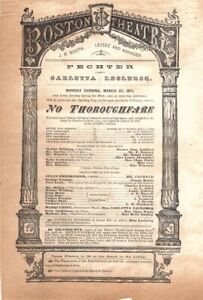
Sold on eBay February 25th, 2024
*CHARLES DICKENS & WILKIE COLLINS RARE ORIGINAL 1871 NO THOROUGHFARE PROGRAM*
An rare and extraordinary original museum quality MArch 1871 program for Charles Dickens and Wilkie Collins's play No Thoroughfaare at the Boston Theatre, managed by Junius Brutus Booth Jr. Dimensions ten nine a half by six and a half inches. Light wear otherwise good. See Charles Dickens and Wilkie Collins's extraordinary biographies below. Ships USPS insured in USA and Global Priority overseas. Shipping discounts for multiple purchases. Inquiries always welcome. Please visit my other eBay items for more early theatre, opera, film, and historical autographs, photographs, programs and broadsides and great actor and actress cabinet photos and CDV's. From Wikipedia: Charles John Huffam Dickens (/7 February 1812 – 9 June 1870) was an English writer and social critic. He created some of the world's best-known fictional characters and is regarded by many as the greatest novelist of the Victorian era.[1] His works enjoyed unprecedented popularity during his lifetime, and by the 20th century critics and scholars had recognised him as a literary genius. His novels and short stories enjoy lasting popularity [2][3]Born in Portsmouth, Dickens left school to work in a factory when his father was incarcerated in a debtors' prison. Despite his lack of formal education, he edited a weekly journal for 20 years, wrote 15 novels, five novellas, hundreds of short stories and non-fiction articles, lectured and performed readings extensively, was an indefatigable letter writer, and campaigned vigorously for children's rights, education, and other social reforms Dickens s literary success began with the 1836 serial publication of The Pickwick Papers. Within a few years he had become an international literary celebrity, famous for his humour, satire, and keen observation of character and society. His novels, most published in monthly or weekly instalments, pioneered the serial publication of narrative fiction, which became the dominant Victorian mode for novel publication [4][5] Cliffhanger endings in his serial publications kept readers in suspense.[6] The installment format allowed Dickens to evaluate his audience's reaction, and he often modified his plot and character development based on such feedback.[5] For example, when his wife's chiropodist expressed distress at the way Miss Mowcher in David Copperfield seemed to reflect her disabilities, Dickens improved the character with positive features.[7] His plots were carefully constructed, and he often wove elements from topical events into his narratives.[8] Masses of the illiterate poor chipped in ha'pennies to have each new monthly episode read to them, opening up and inspiring a new class of readers [9]Dickens was regarded as the literary colossus of his age.[10] His 1843 novella, A Christmas Carol, remains popular and continues to inspire adaptations in every artistic genre. Oliver Twist and Great Expectations are also frequently adapted, and, like many of his novels, evoke images of early Victorian London. His 1859 novel, A Tale of Two Cities, set in London and Paris, is his best-known work of historical fiction. Dickens has been praised by fellow writers—from Leo Tolstoy to George Orwell and G. K. his realism, comedy, prose style, unique characterisations and social criticism. On the other hand, Oscar Wilde, Henry James, and Virginia Woolfcomplained of a lack of psychological depth, loose writing, and a vein of saccharine sentimentalism. The term Dickensian is used to describe something that is reminiscent of Dickens and his writings, such as poor social conditions or comically repulsive characters William Wilkie Collins (8 January 1824 – 23 September 1889) was an English novelist and playwright known especially for The Woman in White (1859), a mystery novel and early sensation novel, and for The Moonstone (1868), which established many of the ground rules of the modern detective novel and is also perhaps the earliest clear example of the police procedural genre [1][2]Born to the London painter William Collins and his wife, Harriet Geddes, he moved with them to Italy when he was twelve, living there and in France for two years, learning both Italian and French. He worked initially as a tea merchant. After Antonina, his first novel, was published in 1850, Collins met Charles Dickens, who became his friend and mentor. Some of Collins' work appeared in Dickens' journals Household Words and All the Year Round. They also collaborated on drama and fiction. Collins gained financial stability and an international following by the 1860s, but in the 1870s and 1880s, after becoming addicted to the opium he took for his gout, the quality of both his health and his writing declined Collins criticised the institution of marriage. He had relationships with two women: widow Caroline Graves – living with her for most of his life, treating her daughter as his – and the younger Martha Rudd, with whom he had three children.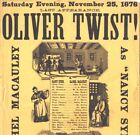
Sold on eBay June 2nd, 2024
*CHARLES DICKENS: RARE ORIGINAL 1876 OLIVER TWIST ILLUSTRATED BROADSIDE*
An rare and extraordinary original museum quality November 1876 illustrated broadside for Charles Dickens's Oliver Twist. Dimensions ten and a half by eight and a half inches. Edgewear and small tears otherwise good. An amazing historic example of Dickens and theatre history. See Charles Dickens's extraordinary biography and the story of Oliver Twist below. Ships USPS insured in USA and Global Priority overseas. Shipping discounts for multiple purchases. Inquiries always welcome. Please visit my other eBay items for more early theatre, opera, film, and historical autographs, photographs, programs and broadsides and great actor and actress cabinet photos and CDV's. From Wikipedia: Charles John Huffam Dickens (/7 February 1812 – 9 June 1870) was an English writer and social critic. He created some of the world's best-known fictional characters and is regarded by many as the greatest novelist of the Victorian era.[1] His works enjoyed unprecedented popularity during his lifetime, and by the 20th century critics and scholars had recognised him as a literary genius. His novels and short stories enjoy lasting popularity [2][3]Born in Portsmouth, Dickens left school to work in a factory when his father was incarcerated in a debtors' prison. Despite his lack of formal education, he edited a weekly journal for 20 years, wrote 15 novels, five novellas, hundreds of short stories and non-fiction articles, lectured and performed readings extensively, was an indefatigable letter writer, and campaigned vigorously for children's rights, education, and other social reforms Dickens s literary success began with the 1836 serial publication of The Pickwick Papers. Within a few years he had become an international literary celebrity, famous for his humour, satire, and keen observation of character and society. His novels, most published in monthly or weekly instalments, pioneered the serial publication of narrative fiction, which became the dominant Victorian mode for novel publication [4][5] Cliffhanger endings in his serial publications kept readers in suspense.[6] The installment format allowed Dickens to evaluate his audience's reaction, and he often modified his plot and character development based on such feedback.[5] For example, when his wife's chiropodist expressed distress at the way Miss Mowcher in David Copperfield seemed to reflect her disabilities, Dickens improved the character with positive features.[7] His plots were carefully constructed, and he often wove elements from topical events into his narratives.[8] Masses of the illiterate poor chipped in ha'pennies to have each new monthly episode read to them, opening up and inspiring a new class of readers [9]Dickens was regarded as the literary colossus of his age.[10] His 1843 novella, A Christmas Carol, remains popular and continues to inspire adaptations in every artistic genre. Oliver Twist and Great Expectations are also frequently adapted, and, like many of his novels, evoke images of early Victorian London. His 1859 novel, A Tale of Two Cities, set in London and Paris, is his best-known work of historical fiction. Dickens has been praised by fellow writers—from Leo Tolstoy to George Orwell and G. K. his realism, comedy, prose style, unique characterisations and social criticism. On the other hand, Oscar Wilde, Henry James, and Virginia Woolfcomplained of a lack of psychological depth, loose writing, and a vein of saccharine sentimentalism. The term Dickensian is used to describe something that is reminiscent of Dickens and his writings, such as poor social conditions or comically repulsive characters Oliver Twist; or, The Parish Boy's Progress, is the second novel by English author Charles Dickens. It was originally published as a serial from 1837 to 1839, and as a three-volume book in 1838.[1] The story follows the titular orphan, who, after being raised in a workhouse, escapes to London, where he meets a gang of juvenile pickpockets led by the elderly criminal Fagin, discovers the secrets of his parentage, and reconnects with his remaining family.Oliver Twist unromantically portrays the sordid lives of criminals, and exposes the cruel treatment of the many orphans in London in the mid-19th century.[2] The alternative title, The Parish Boy's Progress, alludes to Bunyan's The Pilgrim's Progress, as well as the 18th-century caricature series by painter William Hogarth, A Rake's Progress and A Harlot's Progress.[3]In an early example of the social novel, Dickens satirises child labour, domestic violence, the recruitment of children as criminals, and the presence of street children. The novel may have been inspired by the story of Robert Blincoe, an orphan whose account of working as a child labourer in a cotton mill was widely read in the 1830s. It is likely that Dickens's own experiences as a youth contributed as well, considering he spent two years of his life in the workhouse at the age of 12 and subsequently, missed out on some of his education [4]Oliver Twist has been the subject of numerous adaptations, including a 1948 film of the same title, starring Alec Guinness as Fagin; a highly successful musical, Oliver! (itself adapted into a multiple Academy Award-winning 1968 motion picture), and Disney's animated film Oliver & Company in 1988.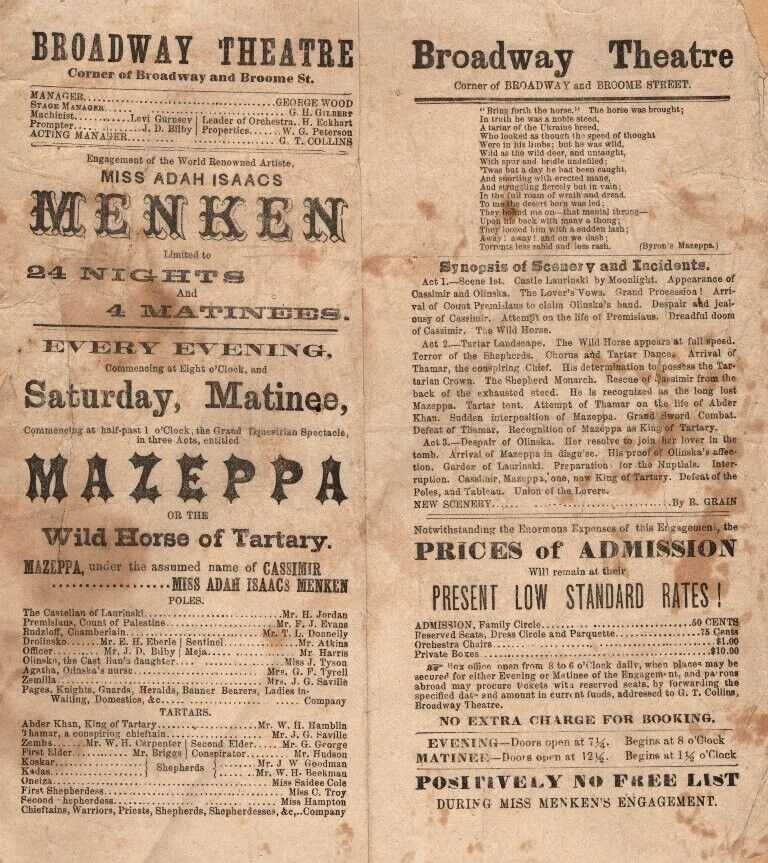
Sold on eBay November 17th, 2024
*ADAH ISSACS MENKEN IN LORD BYRON'S MAZEPPA RARE 1863 PLAY PROGRAM*
Audiences of the 1860s thought she was naked when she rode onstage on her horse wearing only flesh colored tights. She acted with the young Edwin Booth and befriended Walt Whitman. A rare original circa 1863 Broadway Theatre program for Adah Issacs Menken in her greatest and most sensational role in Lord Byron's Mazeppa. Dimensions nine by seven and a half inches lad down to a twelve by nine inch backing. Light wear otherwise good. See Adah Issacs Menken and Lord Byron's extraordinary biograpies below. Combined shipping discounts for multiple purchases. Credit cards accepted with Paypal. Inquiries always welcome. Please visit my other eBay items for more early theatre and historical autographs, photographs and programs and great singer, actor and actress cabinet photos and CDV's. From Wikipedia:Adah Isaacs Menken (June 15, 1835 – August 10, 1868) was an American actress, painter and poet, and was the highest earning actress of her time.[1] She was best known for her performance in the hippodrama Mazeppa, with a climax that featured her apparently nude and riding a horse on stage. After great success for a few years with the play in New York and San Francisco, she appeared in a production in London and Paris, from 1864 to 1866. After a brief trip back to the United States, she returned to Europe. She became ill within two years and died in Paris at the age of 33.[2]Menken told many versions of her origins, including her name, place of birth, ancestry, and religion, and historians have differed in their accounts. Most have said she was born a Louisiana Creole Catholic, with European and African ancestry. A celebrity who created sensational performances in the United States and Europe, she married several times and was also known for her affairs. She had two sons, both of whom died in infancy [3]Though she was better known as an actress, Menken sought to be known as a writer. She published about 20 essays, 100 poems, and a book of her collected poems, from 1855 to 1868 (the book was published posthumously). Early work was devoted to family and after her marriage, her poetry and essays featured Jewish themes. Beginning with work published after moving to New York, with which she changed her style, Menken expressed a wide range of emotions and ideas about women's place in the world. Her collection Infelicia went through several editions and was in print until 1902.Early life and of Menken's early life and origins vary considerably. In her "Some Notes of Her Life in Her Own Hand," published in The New York Times in 1868, Menken said she was born in Bordeaux, France, and lived in Cuba as a child before her family settled in New Orleans. There are many conflicting reports as to Menken's birth name, but she has been called Marie Rachel Adelaide de Vere Spenser and Adah Bertha Theodore, and Ed James, a journalist friend, wrote after her death: "Her real name was Adelaide McCord, and she was born at Milneburg, near New Orleans, on June 15, 1835."[4] Menken's birth year also varies, with some records stating 1835 and some stating 1832. [5] Elsewhere, in 1865, she wrote that her birth name was Dolores Adios Los Fiertes, and that she was the daughter of a French woman from New Orleans and a Spanish-Jewish man.[6] About 1940, the consensus of scholars was that her parents were Auguste Théodore, a free Black man, and Marie, a mixed-race Creole, and Adah was raised as a Catholic. She had a sister and a brother [6]Based on Menken's assertions of being a native of New Orleans, Wolf Mankowitz and others have studied Board of Health records for the city. They have concluded that Ada was born in the city as the legitimate daughter of Auguste Théodore, a free man of color (mixed race) and his wife Magdaleine Jean Louis Janneaux,[4][7] likely also a Louisiana Creole. Ada would have been raised as Catholic. However, in 1990, John Cofran, using census records, said that she was born as Ada C. McCord, in Memphis, Tennessee, in late 1830. He said she was the daughter of an Irish merchant, Richard McCord, and his wife Catherine [8][9] According to Cofran, her father died when she was young and her mother remarried. The family then moved from Memphis to New Orleans.Menken was said to have been a bright student; she became fluent in French and Spanish,[10] and was described as having a gift for languages.[6] As a child, Menken performed as a dancer in the ballet of the French Opera House in New Orleans. In her later childhood, she performed as a dancer in Havana, Cuba, where she was crowned "Queen of the Plaza [10]American as The French Spy, 1863After Cuba, Menken left dance for acting, and began working as an actress in Texas first. According to Gregory Eiselein, she gave Shakespeare readings, and wrote poems and sketches for The Liberty Gazette. She was married for the first time in Galveston County, in February 1855, to G. W. Kneass, a musician. The marriage had ended by sometime in 1856,[6] when she met and in 1856 married the man more generally considered her first husband, Alexander Isaac Menken, a musician who was from a prominent Reform Jewish family in Cincinnati, Ohio.[11]He began to act as her manager, and Ada Menken performed as an actress in the Midwest and Upper South, also giving literary readings. She received decent reviews, which noted her "reckless energy," and performed with men who became notable actors: Edwin Booth in Louisville, Kentucky, and James E. Murdoch in Nashville, Tennessee [12]In 1857, the couple moved to Cincinnati, where Menken created her Jewish roots, telling a reporter that she was born Jewish. She did study Judaism and stayed with the faith, although she never formally converted.[6] In this period, she published poetry and articles on Judaism in The Israelite in Cincinnati.[12] The newspaper was founded by Rabbi Isaac Mayer Wise, who was crucial to the Reform Judaism movement in the United States.[13] She also began to be published in the Jewish Messenger of New York.[6]Ada added an "h" to her first name and an "s" to Isaac, and by 1858 she billed herself as Adah Isaacs Menken. She eventually worked as an actress in New York and San Francisco, as well as in touring productions across the country.[14] She also became known for her poetry and painting. While none of her art was well received by major critics, she became a celebrity [11]At this time, Menken wore her wavy hair short, a highly unusual style for women of the time. She cultivated a bohemian and at times androgynous appearance. She deliberately created her image at a time when the growth of popular media helped to publicize it.[11]In 1859, Menken appeared on Broadway in New York City in the play The French Spy. Her work was not highly regarded by critics. The New York Times described her as "the worst actress on Broadway." The needed] said, "she is delightfully unhampered by the shackles of talent." Menken continued to perform small parts in New York, as well as reading Shakespeare in performance, and giving lectures.[4]Her third husband was John C. Heenan, a popular Irish-American prizefighter whom she married in 1859. Some time after their marriage, the press discovered she did not yet have a legal divorce from Menken and accused her of bigamy. She had expected Menken to handle the divorce, which he eventually did.As John Heenan was one of the most famous and popular figures in America, the press also accused Menken of marrying for his celebrity. She billed herself as Mrs. Heenan in Boston, Providence, Baltimore, and Philadelphia, using his name despite their divorce within a year of marriage.[11] They had a son, who died soon after birth.[10]While in New York, Menken met the poet Walt Whitman and some others of his bohemian circle. She was influenced by his work and began to write in a more confessional style while adhering to common sentimental conventions of the time. In 1860–61, she published 25 poems in the Sunday Mercury, an entertainment newspaper in New York. These were later collected with six more in her only book, Infelicia, published a few months after her death.[12] By publishing in a newspaper, she reached a larger audience than through women's magazines, including both men and women readers who might go to see her perform as an actress.[11]In 1860, Menken wrote a review titled "Swimming Against the Current," which praised Whitman's new edition of Leaves of Grass, saying he was "centuries ahead of his contemporaries [11][12][15] She identified with the controversial poet, and declared her bohemian identity through her support for him.[11] That year, Menken also wrote an article on the 1860 election, an unusual topic for a woman, which further added to her image.[11]When Menken met Charles Blondin, notable for crossing Niagara Falls on a tightrope, the two were quickly attracted to each other. She suggested she would marry him if they could perform a couple's act above the falls. Blondin refused, saying that he would be "distracted by her beauty."[10] The two had an affair, during which they conducted a vaudeville tour across the United States Mazeppa[edit]See also: Cultural legacy of MazeppaMenken in Mazeppa, 1866After it ended, she appealed to her business manager Jimmie Murdock to help her become recognized as a great actress. Murdock dissuaded Menken from that goal, as he knew she had little acting talent.[10] He offered her the "breeches role" (that of a man) of the noble Tartar in the hippodrama Mazeppa, based on the poem of that title by Lord Byron[1] (and ultimately on the life of Ivan Mazepa). At the climax of this hit, the Tartar was stripped of his clothing, tied to his horse, and sent off to his death.[16] The audiences were thrilled with the scene, although the production used a dummy strapped to a horse, which was led away by a handler giving sugar cubes. Menken wanted to perform the stunt herself.[9] Dressed in nude tights and riding a horse on stage, she appeared to be naked and caused a sensation.[9] New York audiences were shocked but still attended and made the play popular.Menken took the production of Mazeppa to San Francisco. Audiences again flocked to the show.[10][17] She became known across the country for this role, and San Francisco adopted her as its performer.In 1862, she married Robert Henry Newell, a humorist and editor of the Sunday Mercury in New York, who had recently published most of her poetry. They were together about three years. Next she wed James Paul Barkley, a gambler, in 1866, but soon returned without him to France, where she was performing. There she had their son, whom she named Louis Dudevant Victor Emanuel Barkley. The baby's godmother was the author George Sand (A. F. Lesser).[1] Louis died in infancy.[1]A previous version of Astley's Amphitheatre, showing the horse ringMenken arranged to play in a production of Mazeppa in London and France for much of 1864 to 1866. Controversy arose over her costume, and she responded to critics in the newspapers of London by saying that she was influenced by classical sculpture, and that her costume was more modest than those of ballet or burlesque. The show opened on October 3, 1864, at the Astley Theatre to "overflowing houses."[18] She was so well known that she was referred to as "the Menken," needing no other name.[11]Jokes and poems were printed about the controversy, and Punch wrote:[18]Here s half the town - if bills be true -To Astley's nightly thronging,To see the Menken throw asideAll to her sex belonging Stripping off woman's modesty,With woman's outward trappings -A barebacked jade on barebacked steed,In Cartlich's old strappings!(The last line refers to John Cartlich, equestrian performer [19])During this time of her greatest earning, she was generous to friends, theatre people in need, and charities.[1] While in Europe, the Menken continued to play to the American public as well, in terms of her image.[11] As usual, she attracted a crowd of male admirers, including such prominent figures as the writer Charles Dickens, the humorist Tom Hood, and the dramatist and novelist Charles Reade.[20]Later with Alexandre Dumas, 1866Playing in a sold-out run of Les pirates de la savane in Paris in 1866, Menken had an affair with the French novelist Alexandre Dumas, père, considered somewhat scandalous as he was more than twice her age. Returning to England in 1867, she struggled to attract audiences to Mazeppa and attendance fell off. During this time she had an affair with the English poet Algernon Charles Swinburne [1]She fell ill in London and was forced to stop performing, struggling with poverty as a result. Few realized that the glamorous star was ill until she collapsed during rehearsal and died a few weeks later.[4] She began preparing her poems for publication and moved back to Paris, where she died on August 10, 1868.[1] She had just written to a friend:I am lost to art and life. Yet, when all is said and done, have I not at my age tasted more of life than most women who live to be a hundred? It is fair, then, that I should go where old people go.[10]How long she had been a consumptive no one knew but, from what is known, she was dead at 33 – the flamelike quality that Dickens had called the “world’s delight” extinguished forever. They buried her in a corner of the little Jewish cemetery in Montparnasse, and on her grave stone are the words, “Thou Knowest,” an epitaph she had chosen from Swinburne, the poet who had said of her, “A woman who has such beautiful legs need not discuss poetry.”She was believed to have died of peritonitis and/or tuberculosis [10] Late twentieth century sources suggest she had cancer.[1] She was buried in Montparnasse Cemetery.[1] The inscription on her tomb reads "Thou knowest."[21]In 1862, Menken had written about her public and private personae:I have always believed myself to be possessed of two souls, one that lives on the surface of life, pleasing and pleased; the other as deep and as unfathomable as the ocean; a mystery to me and all who know me.[5]Her only book, Infelicia, a collection of 31 poems, was published several days after her death.Literary wanted to be known as a writer, but her work was overshadowed by her sensational stage career and private and public life. In total, she published about 20 essays, 100 poems and a book of her collected poems, from 1855 to 1868; the book was published posthumously. Her work was not received well by contemporary critics. George Merriam Hyde, one of the most respected critics of his day, refused to critique Menken's work, saying (privately) that "it would be an insult to himself and his profession".Van Wyck Brooks joked (in public) that "her work is the best example of unintentional wit and accidental humour".Her early work was devoted to family and romance. After her marriage to Menken and her study of Judaism, her poetry and essays for years into the 1860s featured Jewish themes. After her marriage and divorce from Heenan and meeting with writers in New York, she changed her style, adopting some influence from Walt Whitman. She was said to be the "first poet and the only woman poet before the twentieth century" to follow his lead in using free verse.[6] The New York Times reported that Walt Whitman had disassociated himself from Menken's work, implying he thought little of it.Beginning in New York, her poetry expressed a wider range of emotions related to relationships, sexuality, and also about women's struggle to find a place in the world. Her collection Infelicia went through several editions and was in print until 1902. In the late nineteenth century, critics were hard on women writers, and Menken's public notoriety caused even more critical scrutiny of her poems. Later critics (such as A. R. Lloyd in his book, The Great Prize Fight and Graham Gordon in his book Master of the Ring) generally dismiss her work as being devoid of talent. Admirers included Christina Rossetti and Joaquin Miller.George Gordon Byron (later Noel), 6th Baron Byron, FRS (22 January 1788 – 19 April 1824), commonly known simply as Lord Byron, was an English poet and a leading figure in the Romantic movement. Among his best-known works are the lengthy narrative poems Don Juan and Childe Harold's Pilgrimage, and the short lyric "She Walks in Beauty".Byron is regarded as one of the greatest British poets,[1] and remains widely read and influential. He travelled widely across Europe, especially in Italy where he lived for seven years. Later in life, Byron joined the Greek War of Independence fighting the Ottoman Empire, for which many Greeks revere him as a national hero.[2] He died in 1824 at the young age of 36 from a fever contracted while in Missolonghi. Often described as the most flamboyant and notorious of the major Romantics, Byron was both celebrated and castigated in life for his aristocratic excesses, including huge debts, numerous love affairs - with men as well as women, rumours of a scandalous liaison with his half-sister, and self-imposed exile [3]Manfred: A dramatic poem is a poem written in 1816–1817 by Lord Byron. It contains supernatural elements, in keeping with the popularity of the ghost story in England at the time. It is a typical example of a Romantic closet drama.Byron wrote this "metaphysical drama", as he called it, after his marriage failed in scandal amidst charges of sexual improprieties and an incestuous affair between Byron and his half-sister, Augusta Leigh. Attacked by the press and ostracised by London society, Byron fled England for Switzerland in 1816 and never returned. Because Manfred was written immediately after this, and because it regards a main character tortured by his own sense of guilt for an unmentionable offence, some critics consider it to be , or even confessional [1] The unnamed but forbidden nature of Manfred's relationship to Astarte is believed to represent Byron's relationship with his half-sister Augusta.Byron commenced this work in late 1816, only a few months after the famed ghost-story sessions which provided the initial impetus for Mary Shelley's Frankenstein. The supernatural references are made clear throughout the poem.Manfred was adapted musically by Robert Schumann in 1852, in a composition entitled Manfred: Dramatic Poem with music in Three Parts, and later by Pyotr Ilyich Tchaikovsky in his Manfred Symphony. Friedrich Nietzschewas impressed by the poem's depiction of a super-human being, and wrote some music for it.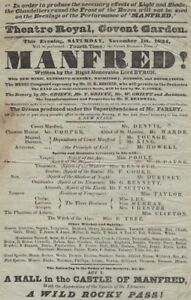
Sold on eBay February 16th, 2024
*LORD BYRON RARE MAGNIFICENT 1834 COVENT GARDEN DOUBLE PLAY BROADSIDE MANFRED*
A rare original November 1834 Theatre Royal Covent Garden double broadside for Lord Byron's Manfred. Boldly printed in black and orange. Dimensions thirteen and a quarter by sixteen inches. Edgewear, light fold with reinforced spine and small tears otherwise good. See Lord Byron's extraordinary biography below. Shipping discounts for multiple purchases. Credit cards accepted with Paypal. Inquiries always welcome. Please visit my other eBay items for more early theatre and historical autographs, photographs and programs and great singer, actor and actress cabinet photos and CDV's. From Gordon Byron (later Noel), 6th Baron Byron, FRS (22 January 1788 – 19 April 1824), commonly known simply as Lord Byron, was an English poet and a leading figure in the Romantic movement. Among his best-known works are the lengthy narrative poems Don Juan and Childe Harold's Pilgrimage, and the short lyric "She Walks in Beauty".Byron is regarded as one of the greatest British poets,[1] and remains widely read and influential. He travelled widely across Europe, especially in Italy where he lived for seven years. Later in life, Byron joined the Greek War of Independence fighting the Ottoman Empire, for which many Greeks revere him as a national hero.[2] He died in 1824 at the young age of 36 from a fever contracted while in Missolonghi. Often described as the most flamboyant and notorious of the major Romantics, Byron was both celebrated and castigated in life for his aristocratic excesses, including huge debts, numerous love affairs - with men as well as women, rumours of a scandalous liaison with his half-sister, and self-imposed exile [3]Manfred: A dramatic poem is a poem written in 1816–1817 by Lord Byron. It contains supernatural elements, in keeping with the popularity of the ghost story in England at the time. It is a typical example of a Romantic closet drama.Byron wrote this "metaphysical drama", as he called it, after his marriage failed in scandal amidst charges of sexual improprieties and an incestuous affair between Byron and his half-sister, Augusta Leigh. Attacked by the press and ostracised by London society, Byron fled England for Switzerland in 1816 and never returned. Because Manfred was written immediately after this, and because it regards a main character tortured by his own sense of guilt for an unmentionable offence, some critics consider it to be autobiographical or even confessional [1] The unnamed but forbidden nature of Manfred's relationship to Astarte is believed to represent Byron's relationship with his half-sister Augusta.Byron commenced this work in late 1816, only a few months after the famed ghost-story sessions which provided the initial impetus for Mary Shelley's Frankenstein. The supernatural references are made clear throughout the poem.Manfred was adapted musically by Robert Schumann in 1852, in a composition entitled Manfred: Dramatic Poem with music in Three Parts, and later by Pyotr Ilyich Tchaikovsky in his Manfred Symphony. Friedrich Nietzschewas impressed by the poem's depiction of a super-human being, and wrote some music for it.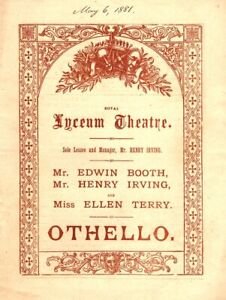
Sold on eBay August 22nd, 2023
*STAGE LEGENDS EDWIN BOOTH HENRY IRVING ELLEN TERRY RARE 1881 OTHELLO PROGRAM*
It's one of the most historic productions in the history of the stage. A rare original May 6, 1881 second night program for Edwin Booth, Henry Irving, and Ellen Terry in Othello at the Lyceum Theatre. Booth and Irving alternated Othello and Iago, with Booth here playing Othello in the first week of the run. Future playwright Arthur Wing Pinero plays Roderigo. Future Dracula author Bram Stoker is listed as acting manager. Four pages. Dimensions eight and a quarter by six and a quarter inches. Light wear, light fold, and soiling otherwise good. See the Edwin Booth, Henry Irving, and Ellen Terry's extraordinary biographies below. Ships first class insured in US and airmail overseas. Shipping discounts for multiple purchases. Inquiries always welcome. Please visit my other eBay items for more early theatre, opera, film, magic, and historical autographs, photographs, programs and broadsides and great actor and actress cabinet photos and CDV's. From Wikipedia: The Booth family was an English American theatrical family of the 19th century. Its most famous and well known members were Edwin Booth, one of the leading actors of his day, and John Wilkes Booth, who assassinated Abraham Lincoln. The patriarch was Junius Brutus Booth, a London-born lawyer's son who eventually became an actor after he attended a production of Othello at the Covent Garden theatre. The prospects of fame, fortune and freedom were very appealing to young Booth, and he displayed remarkable talent from an early age, deciding on a career in the theatre by the age of seventeen. He performed roles in several small theaters throughout England, and joined a tour of the Low Countries in 1814, returning the following year to make his London debut. Booth abandoned his wife and their young son in 1821 and ran off to the United States with Mary Ann Holmes, a London flower girl. They settled in Harford County near Baltimore, and built a house named "Tudor Hall" in 1847, which still survives. There they started a family; they had ten children, six of whom survived to adulthood [1][2] Junius Sr. and Edwin toured the Western United States during the Gold Rush, performing plays by Shakespeare for illiterate miners, who nevertheless had no tolerance for bad acting. Edwin Booth bought an interest in the Winter Garden Theatre at 667 Broadway in New York City together with his brother-in-law John Sleeper Clarke. The brothers John Wilkes, Edwin, and Junius Brutus, Jr. performed there in the play Julius Caesar at a benefit in 1864, the only time they were seen together on a stage, playing Mark Antony, Brutus and Cassius, respectively. Edwin Thomas Booth (November 13, 1833 – June 7, 1893) was a famous 19th-century American actor who toured throughout America and the major capitals of Europe, performing Shakespearean plays. In 1869 he founded Booth's Theatre in New York, a spectacular theatre that was quite modern for its time.[2] Some theatrical historians consider him the greatest American actor, and the greatest Hamlet, of the 19th century.[3] However, his achievements are often overshadowed by his relationship with his brother, John Wilkes Booth, the man who assassinated President Abraham Lincoln.Sir Henry Irving (6 February 1838 – 13 October 1905), born John Henry Brodribb, sometimes known as J. H. Irving, was an English stage actor in the Victorian era, known as an actor-manager because he took complete responsibility (supervision of sets, lighting, direction, casting, as well as playing the leading roles) for season after season at the Lyceum Theatre, establishing himself and his company as representative of English classical theatre. In 1895 he became the first actor to be awarded a knighthood, indicating full acceptance into the higher circles of British society.Irving is widely acknowledged to be one of the inspirations for Count Dracula, the title character of the 1897 novel Dracula whose author, Bram Stoker, was business manager of the theatre.Dame Alice Ellen Terry, GBE (27 February 1847[1] – 21 July 1928), known professionally as Ellen Terry,[2] was a renowned English actress of the late 19th and early 20th centuries.Born into a family of actors, Terry began performing as a child, acting in Shakespeare plays in London, and toured throughout the British provinces in her teens. At 16, she married the 46-year-old artist George Frederic Watts, but they separated within a year. She soon returned to the stage but began a relationship with the architect Edward William Godwin and retired from the stage for six years. She resumed acting in 1874 and was immediately acclaimed for her portrayal of roles in Shakespeare and other classics.In 1878 she joined Henry Irving's company as his leading lady, and for more than the next two decades she was considered the leading Shakespearean and comic actress in Britain. Two of her most famous roles were Portia in The Merchant of Venice and Beatrice in Much Ado About Nothing. She and Irving also toured with great success in America and Britain.In 1903 Terry took over management of London's Imperial Theatre, focusing on the plays of George Bernard Shaw and Henrik Ibsen. The venture was a financial failure, and Terry turned to touring and lecturing. She continued to find success on stage until 1920, while also appearing in films from 1916 to 1922. Her career lasted nearly seven decades.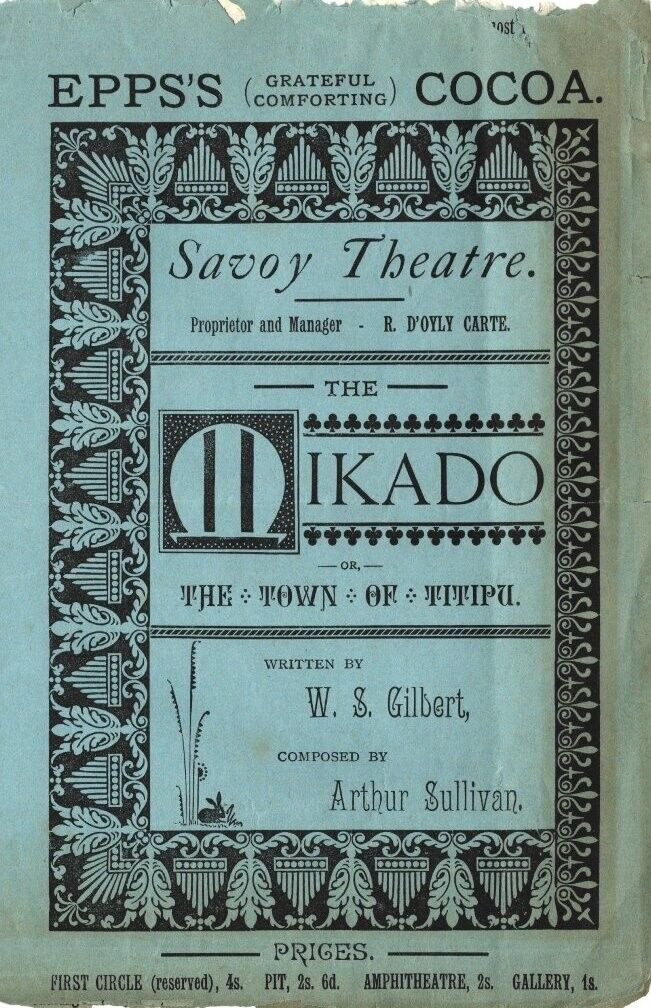
Sold on eBay December 29th, 2024
*GILBERT & SULLIVAN 1885 SAVOY THEATRE D'OYLY CARTE MIKADO PROGRAM*
A rare original 1885 Savoy Theatre program for the D'Oyly Carte London first production of the brilliant Gilbert and Sullivan comic light opera The Mikado. Four pages. Dimensions eight and a quarter by five and three quarters inches. Edgewear at margins; a good reading copy. See the story of Gilbert and Sullivan and The Mikado below. Shipping discounts for multiple purchases. Inquiries always welcome. Please visit my other eBay items for more early Gilbert and Sullivan items, theatre, opera, film and historical autographs, photographs and programs, and great actor and actress cabinet photos and CDV's. Gilbert and Sullivan refers to the Victorian-era theatrical partnership of the dramatist W. S. Gilbert (1836–1911) and the composer Arthur Sullivan (1842–1900) and to the works they jointly created. The two men collaborated on fourteen comic operas between 1871 and 1896, of which H.M.S. Pinafore, The Pirates of Penzance and The Mikado are among the best known [1]Gilbert who wrote the libretti for these operas, created fanciful "topsy-turvy" worlds where each absurdity is taken to its logical rub elbows with British lords, flirting is a capital offence, gondoliers ascend to the monarchy, and pirates emerge as noblemen who have gone astray.[2] Sullivan, six years Gilbert's junior, composed the music, contributing memorable melodies[n 1] that could convey both humour and pathos.[n 2]Their operas have enjoyed broad and enduring international success and are still performed frequently throughout the English speaking world.[5][6] Gilbert and Sullivan introduced innovations in content and form that directly influenced the development of musical theatre through the 20th century.[7] The operas have also influenced political discourse, literature, film and television and have been widely parodied and pastiched by humorists. The producer Richard D'Oyly Carte brought Gilbert and Sullivan together and nurtured their collaboration. He built the Savoy Theatre in 1881 to present their joint works (which came to be known as the Savoy Operas) and founded the D'Oyly Carte Opera Company, which performed and promoted Gilbert and Sullivan's works for over a century.The Mikado; or, The Town of Titipu is a comic opera in two acts, with music by Arthur Sullivan and libretto by W. S. Gilbert, their ninth of fourteen operatic collaborations. It opened on 14 March 1885, in London, where it ran at the Savoy Theatre for 672 performances, the second-longest run for any work of musical theatre and one of the longest runs of any theatre piece up to that time.[1][n 1] By the end of 1885, it was estimated that, in Europe and America, at least 150 companies were producing the opera.[2]The Mikado is the most internationally successful Savoy opera[3] and has been especially popular with amateur and school productions. The work has been translated into numerous languages and is one of the most frequently played musical theatre pieces in history. The Mikado is a satire of late 19th century British institutions, society and politics. By setting the opera in a fantasy Japan, an exotic locale far away from contemporary Britain, Gilbert was able to satirise British politics more freely and soften the impact of his criticisms of British social institutions, in a similar way that he used other "foreign" settings in Princess Ida, The Gondoliers, Utopia, Limited and The Grand Duke. Nevertheless, some 21st-century productions of the opera in the United States have drawn criticism for promoting stereotypes of East Asians.
Sold on eBay July 1st, 2024
HASTY PUDDING THEATRICALS, “Budda Knows Best” Harvard Souvenir Theatre prog.1951
HASTY PUDDING THEATRICALS, “Budda Knows Best” Harvard Souvenir Theatre program 1951. 1st edition with ( Woman of the year, Gertrude Lawrence), Rare!The Hasty Pudding Theatricals, known informally simply as The Pudding, is a theatrical student society at Harvard University, known for its burlesque crossdressing musicals. The Hasty Pudding is the oldest theatrical organization in the United States and the third oldest in the world, behind only the Comédie Française and the Oberammergau Passion Play.[1] The Hasty Pudding Theatricals was described by John Wheelwright in 1897 as a "kindly association of men of all ages in a gay evening of simple enjoyment."[2] It is a comedy show.The Hasty Pudding Woman of the Year award is bestowed annually by the Hasty Pudding Theatricals society at Harvard University. The award was created in 1951, and its first recipient was Gertrude Lawrence, an English actress, singer, and dancer. It has since been awarded annually by the society members of the Hasty Pudding to performers deemed to have made a "lasting and impressive contribution to the world of entertainment Very fine copy / example, please see the photos!Please also visit my store for more Vintage items and Souvenir Theatre Programs. I can combine shipping on multiple items, Thank you!
Sold on eBay October 28th, 2024
*FANNY KEMBLE RARE LARGE 1829 ROMEO & JULIET BROADSIDE*
A magnificent original October 16, 1829 Theatre Royal, Covent Garden broadside for the great Fanny Kemble and her father Charles Kemble in Romeo and Juliet. Dimensions thirteen and a half by eight inches. Light wear otherwise good. See Fannny and Charles Kemble's extraordinary biographies below.Ships USPS insured. Shipping discounts for buyers of multiple items. Credit cards accepted with Paypal. Inquiries always welcome. Please visit my other eBay items for more early dance, theatre music and historical autographs, broadsides, photographs and programs and great actor and actress cabinet photos and CDV's. From Anne "Fanny" Kemble (27 November 1809 – 15 January 1893) was a British actress from a theatre family in the early and mid-19th century. She was a well-known and popular writer and abolitionist, whose published works included plays, poetry, eleven volumes of memoirs, travel writing and works about the theatre.In 1834, Kemble married a French man, Pierce Mease Butler, grandson of U.S. Senator Pierce Butler, whom she had met on an American acting tour with her father in 1832. After living in Philadelphia for a time, Butler became heir to the cotton, tobacco and rice plantations of his grandfather on Butler Island, just south of Darien, Georgia, and to the hundreds of slaves who worked them. He made trips to the plantations during the early years of their marriage, but never took Kemble or their children with him. At Kemble's insistence, they finally spent the winter of 1838–1839 there and Kemble kept a diary of her observations, flavored strongly by abolitionist sentiment Butler disapproved of Kemble's outspokenness, forbidding her to publish. The relationship grew abusive, and Kemble eventually returned to England with her two daughters. Butler filed for a divorce in 1847, after they had been separated for some time, citing abandonment and misdeed by Kemble.[1] She returned to the theatre and toured major US cities, giving successful readings of Shakespeare plays. Her memoir circulated in American abolitionist circles, but she waited until 1863, during the American Civil War, to publish her anti-slavery Journal of a Residence on a Georgian Plantation in 1838–1839.[2] It has become her best-known work in the United States: she published several other volumes of journals. In 1877, she returned to England with her second daughter and son-in-law. She lived in London and was active in society, befriending the writer Henry James. In 2000, Harvard University Press published an edited compilation from her journals. These included Record of a Girlhood (1878) and Records of Later Life (1882).[3]Youth and acting careerFanny Kemble as a young girlA member of the famous Kemble theatrical family, Fanny was the eldest daughter of the actor Charles Kemble and his Viennese-born wife, the former Marie Therese De Camp. She was a niece of the noted tragedienne Sarah Siddons and of the famous actor John Philip Kemble. Her younger sister was the opera singer Adelaide Kemble.[2] Fanny was born in London and educated chiefly in France [citation needed] In 1821, Fanny Kemble departed to boarding school in Paris to study art and music as befitted the child of the most celebrated artistic family in England at that time. In addition to literature and society, it was at Mrs Lamb's Academy in the Rue d'Angoulême, Champs Elysées, that Fanny received her first real personal exposure to the stage performing staged readings for students' parents during her time at school. As an adolescent, Kemble spent time studying literature and poetry, in particular the work of Lord Byron.[4]One of her teachers was Frances Arabella Rowden (1774 – c. 1840),[5] who had been associated with the Reading Abbey Girls' School since she was 16. Rowden was an engaging teacher, with a particular enthusiasm for the theatre. She was not only a poet, but according to Mary Russell Mitford, "she had a knack of making poetesses of her pupils"[6]In 1827, Kemble wrote her first five-act play, Francis the First. It was met with critical acclaim from multiple quarters. Nineteenth century critics wrote that the script "displays so much spirit and originality, so much of the true qualities which are required in dramatic composition, that it may fairly stand upon its own intrinsic worth, and that the author may fearlessly challenge a comparison with any other modern dramatist [7]On 26 October 1829, at the age of 20, Kemble first appeared on the stage as Juliet in Romeo and Juliet at Covent Garden Theatre, after only three weeks of rehearsals. Her attractive personality at once made her a great favourite, and her popularity enabled her father to recoup his losses as a manager. She played all the principal women's roles of the time, notably Shakespeare's Portia and Beatrice (Much Ado about Nothing), and Lady Teazle in Richard Brinsley Sheridan's The School for Scandal.[8][9] Kemble disliked the artificiality of stardom in general, but appreciated the salary which she accepted to help her family in their frequent financial troubles.In 1832, Kemble accompanied her father on a theatrical tour of the United States. While in Boston in 1833, she journeyed to Quincy to witness the revolutionary technology of the first commercial railroad in the United States. She had previously accompanied George Stephenson on a test of the Liverpool and Manchester, prior to its opening in England, and described this in a letter written in early 1830. The Granite Railway was among many sights which she recorded in her journal.Kemble returned to acting as a solo platform performer, beginning her first American tour in 1849. During her readings she rose to focus on presenting edited works of Shakespeare, though unlike others she insisted on representing his entire canon, ultimately building her repertoire to 25 of his plays. She performed in Britain and in the United States, concluding her career as a platform performer in 1868 [10]Marriage and daughtersIn 1834, Kemble retired from the stage to marry on 7 June an American, Pierce Mease Butler.[2] Although they met and lived in Philadelphia, Butler was the grandson of Pierce Butler, a Founding Father and heir to a large fortune in cotton, tobacco, and rice plantations. By the time the couple's daughters, Sarah and Frances, were born, Butler had inherited three of his grandfather's plantations on Butler Island, just south of Darien, Georgia, and the hundreds of people who were enslaved on them.[11]The family visited Georgia during the winter of 1838–1839, where they lived at the plantations at Butler and St. Simons islands, in conditions primitive compared to their house in Philadelphia. Kemble was shocked by the living and working conditions of the slaves and their treatment by the overseers and managers. She tried to improve matters, complaining to her husband about slavery and about the mixed-race slave children attributed to the overseer, Roswell King, Jr.[citation needed]Marital tensions had emerged when the family returned to Philadelphia in the spring of 1839. Apart from their disagreements over slave treatment on Butler's plantations, Kemble was "embittered and embarrassed" by Butler's marital infidelities [12] Butler threatened to deny Kemble access to their daughters if she published any of her observations about the plantations [13] By 1845–1847, the marriage had failed irretrievably and Kemble returned to Europe [2]Separation and divorceIn 1847, Kemble returned to the stage in the United States, as she needed to make a living. Following her father's example, she appeared with success as a Shakespearean reader, rather than acting in plays. She toured the United States. The couple endured a bitter and protracted divorce in 1849, with Butler retaining custody of their two daughters. At that time, with divorce rare, the father was customarily awarded custody in the patriarchal society. Other than brief visits, Kemble was not reunited with her daughters until each came of age at 21.[14]Her ex-husband squandered a fortune estimated at $700,000, but was saved from bankruptcy by a sale on 2–3 March 1859 of 436 people he held in slavery. The Great Slave Auction, at Ten Broeck racetrack outside Savannah, Georgia, was the largest single slave auction in United States history. As such, it was covered by national reporters [15]After the American Civil War, Butler tried to run his plantations with free labour, but failed to make a profit. He died of malaria in Georgia in 1867. Neither Butler nor Kemble remarried [16]Later lifeKemble's success as a Shakespearean reader enabled her to buy a home in Lenox, Massachusetts [17] In 1877, she returned to London to join her younger daughter Frances, who had moved there with her British husband and child. Using her maiden name, Kemble lived there until her death. During this period she was a prominent and popular figure in London society, and became a great friend of the American writer Henry James during her later years. His novel, Washington Square (1880), was based on a story Kemble told him about one of her relatives [18]Literary careerKemble wrote two plays, Francis the First (1832) and The Star of Seville (1837). She also published a volume of poems (1844). She published the first volume of her memoirs, Journal, in 1835, shortly after her marriage. In 1863, she published another volume in both the United States and Great Britain. Entitled Journal of a Residence on a Georgian Plantation in 1838-1839, it included her observations of slavery and life on her husband's Southern plantation in the winter of 1838–1839. It contains the earliest-known written use of the word "vegetarian": "The sight and smell of raw meat are especially odious to me, and I have often thought that if I had had to be my own cook, I should inevitably become a vegetarian, probably, indeed, return entirely to my green and salad days."[19]After separating from Butler in the 1840s, Kemble travelled in Italy and wrote a two-volume book on this time, A Year of Consolation (1847).[20]In 1863 Kemble also published a volume of plays, including translations from Alexandre Dumas, père and Friedrich Schiller. These were followed by additional memoirs: Records of a Girlhood (1878); Records of Later Life (1882); Far Away and Long Ago (1889); and Further Records (1891). Her various reminiscences contain much valuable material about the social and theatrical history of the period. She also published Notes on Some of Shakespeare's Plays (1882), based on long experience in acting and reading his works DescendantsKemble s older daughter, Sarah Butler, married Owen Jones Wister, an American doctor. Their one child, Owen Wister, grew up to become a popular American novelist, writing in 1902 a popular 1902 western, The Virginian Fanny s other daughter Frances met James Leigh in Georgia. He was a minister born in England. The couple married in 1871, and their one child, Alice Leigh, was born in 1874. An attempt was made to run Frances's father's plantations there with free labour, but no profit could be made. Leaving Georgia in 1877, they moved permanently to England. Frances Butler Leigh defended her father in the continuing post-war dispute over slavery as an institution. Based on her experience, Leigh published Ten Years on a Georgian Plantation since the War (1883), a rebuttal to her mother's account [14]DeathHer granddaughter Alice Leigh was present when Fanny Kemble died in London in 1893 Controversy[edit]While Kemble's account of the plantations has been criticised, it is seen as notable for voicing the enslaved black people, especially enslaved black women, and has been drawn on by many historians.[21] As noted earlier, her daughter published a rebuttal account. Margaret Davis Cate published a strong critique in the Georgia Historical Quarterly in 1960. In the early 21st century, historians Catherine Clinton[ and Deirdre David studied Kemble's Journal and raised questions[ about her portrayal of Roswell King, father and son, who successively managed Pierce Butler's plantations, and about Kemble's own racial sentiments.On Kemble's racial views, David notes how she would call black slaves stupid, lazy, filthy and ugly, but such views were then common and compatible with opposing slavery and outrage at its cruelties [22]Clinton noted that in 1930, Julia King, granddaughter of Roswell King, Jr., stated that Kemble had falsified her account of him after he spurned her affections.[23] There is little evidence in Kemble's Journal that she encountered Roswell King, Jr., on more than a few occasions, and none that she knew his wife, the former Julia Rebecca Maxwell. But she criticized Maxwell as "a female fiend" because a slave named Sophy told her that Mrs. King had ordered the flogging of Judy and Scylla, "of whose children Mr. K[ing] was the father."[24] Roswell King, Jr., was no longer in the employ of her husband when Pierce Butler and Kemble began their short residency in Georgia. King had resigned due to "growing uneasiness... born of a dispute between the Kings and the Butlers over fees the elder King thought were owed him as co administrator of Major Butler's estate [25]Before arriving in Georgia, Kemble had written, "It is notorious that almost every Southern planter has a family more or less numerous of illegitimate coloured children."[26] Her statements about Roswell King, Sr., and Roswell King, Jr., and their alleged status as white fathers of enslaved mulatto children, are based on what she was told by other slaves. In some cases, individuals relied on hearsay accounts of their paternity, although European ancestry was visible. The mulatto Renty, for example, was "ashamed" to ask his mother about the identity of his father. He believed he was the son of Roswell King, Jr. because "Mr. C[ouper]'s children told me so, and I 'spect they know it."[27] John Couper, the Scottish-born owner of a rival plantation adjacent to Pierce Butler's Hampton Point on St. Simon's Island, had had marked disagreements with the Roswell Kings in the past. Clinton suggests that Kemble favored Couper's accounts [28][BiographiesNumerous books have appeared on Fanny Kemble and her family, including Deirdre David's A Performed Life[9] (2007) and Vanessa Dickerson's passage on Kemble in Dark Victorians (2008). Earlier works were Fanny Kemble (1933) by Leota Stultz Driver, Fanny Kemble: A Passionate Victorian (1939) by Margaret Armstrong,[29] Fanny Kemble: Actress, Author, Abolitionist (1967) by Winifred Wise,[30] and Fanny Kemble: Leading Lady of the Nineteenth century Stage : A Biography (1982) by J.C. Furnas.[31]Some recent biographies that focus on Kemble's role as an abolitionist include Catherine Clinton's Fanny Kemble's Civil Wars: The Story of America's Most Unlikely Abolitionist (2000). Others have studied the theatrical careers of Kemble and her family. One of these, Henry Gibbs' Affectionately Yours, Fanny: Fanny Kemble and the Theatre, appeared in eight editions between 1945 and 1947.Charles Kemble (25 November 1775 – 12 November 1854) was a Welsh-born English actor of a prominent theatre family.[Charles Kemble was one of 13 siblings and the youngest son of English Roman Catholic theatre manager/actor Roger Kemble, and Irish-born actress Sarah Ward. He was the younger brother of, among others, John Philip Kemble, Stephen Kemble and Sarah Siddons. He was born at Brecon in South Wales. Like his brothers he was raised in his father's Catholic faith, while his sisters were raised in their mother's Protestant faith. He and John Philip were educated at Douai School.After returning to England in 1792, he obtained a job in the post office, but soon resigned to go on the stage, making his first recorded appearance at Sheffield as Orlando in As You Like It in that year. During the early part of his career as an actor he slowly gained popularity. For a considerable time he played with his brother and sister, chiefly in secondary parts, and received little attention Charles Kemble, by Henry Perronet Briggs. Oil on canvas, before 1832His first London appearance was on 21 April 1794, as Malcolm to his brother's Macbeth. Ultimately he won independent fame, especially in such characters as Archer in George Farquhar's Beaux' Stratagem, Dorincourt in Hannah Cowley's Belle's Stratagem, Charles Surface and Ranger in Benjamin Hoadley's Suspicious Husband. His Laërtes and Macduff were as accomplished as his brother's Hamlet and Macbeth. His production of Cymbeline in 1827 inaugurated the trend to historical accuracy in stagings of that play that reached a peak with Henry Irving at the turn of the century.In comedy he was ably supported by his wife, Marie Therese De Camp, whom he married on 2 July 1806. His visit, with his daughter Fanny, to America during 1832 and 1834, aroused much enthusiasm. The later part of his career was beset by money troubles in connection with his joint proprietorship of Covent Garden theatre.He formally retired from the stage in December 1836, but his final appearance was on 10 April 1840. From 1836-1840 he held the office of Examiner of Plays.[2] In 1844-45 he gave readings from Shakespeare at Willis's Rooms. Macready regarded his Cassio as incomparable, and summed him up as "a first-rate actor of second-rate parts."
Sold on eBay January 15th, 2025
*BOWERY THEATRE EARLY AMERICAN THEATRE RARE LARGE 1874 STAGE BROADSIDE*
A rare original large 1874 Bowery Theatre, New York broadside for Macbeth, Metamora, Richard II, and other plays. Dimensions twenty two by eight and a quarter eighths inches. Edgewear, small tears, and archival repairs otherwise good. Shipping discounts for multiple purchases. Inquiries always welcome. Please visit my other eBay items for more early theatre, opera, film and historical autographs, photographs and programs and great actor and actress cabinet photos and CDV's. From Wikipedia: The Bowery Theatre was a playhouse on the Bowery in the Lower East Side of Manhattan, New York City. Although it was founded by rich families to compete with the upscale Park Theatre, the Bowery saw its most successful period under the populist, pro-American management of Thomas Hamblin in the 1830s and 1840s. By the 1850s, the theatre came to cater to immigrant groups such as the Irish, Germans, and Chinese. It burned down four times in 17 years, a fire in 1929 destroying it for good. Although the theatre's name changed several times (Thalia Theatre, Fay's Bowery Theatre, etc.), it was generally referred to as the "Bowery Theatre".By the mid-1820s, wealthy settler families in the new ward that was made fashionable by the opening of Lafayette Street, parallel to the Bowery, wanted easy access to fashionable high-class European drama, then only available at thePark Theatre. Under the leadership of Henry Astor, they formed the New York Association and bought the land where Astor's Bull's Head Tavern stood,[1] facing the neighborhood and occupying the area between Elizabeth, Canal (then called Walker), and Bayard streets.[2] They hired architect Ithiel Town to design the new venue.Some notable investors included Samuel Laurence Gouverneur, son-in-law to President James Monroe, and James Alexander Hamilton, son of Alexander Hamilton.[3]The new playhouse, with its Neoclassical design,[4] was more opulent than the Park, and it seated 3,500 people, making it the biggest theatre in the United States at the time.[5] Frances Trollope compared it to the Park Theatre as "superior in beauty; it is indeed as pretty a theatre as I ever entered, perfect as to size and proportion, elegantly decorated, and the scenery and machinery equal to any in London [6]The Bowery Theatre opened on 22 October 1826 under the name New York Theatre, with the comedy The Road to Ruin, by Thomas Holcroft, under the management of Charles A. Gilfert. New York Mayor Philip Hone spoke at the opening ceremony, imploring the theatre's intended upper-class audience: "It is therefore incumbent upon those whose standing in society enables them to control the opinions and direct the judgment of others, to encourage, by their countenance and support, a well-regulated theatre."[7] Its first few seasons were devoted to ballet, opera, and high drama. The theatre was by this time quite fashionable, and the northward expansion of Manhattan gave the theatre access to a large patronage. The theatre burnt out in 1828, but was rebuilt behind the same facade and reopened under the name Bowery Theatre.[8] Gilfert's understanding of advertising was keen, but in 1829 the owners fired him.Hamblin's tenureThe owners hired Thomas Hamblin and James H. Hackett in August 1830 to manage the theatre. A month later, Hackett left Hamblin in complete control. After the Bowery burned down later that year, Hamblin rebuilt. He then took the theatre in a decidedly different direction for what would be its most innovative and successful period.American theatres stratified in the Jacksonian Era, and the Bowery emerged as the home of American nativists and populist causes, placing it in direct contrast to the Park Theatre's cultivated image of traditional European high culture. This was partially the result of an anti-British theatre riot at the Park; Hamblin renamed the playhouse "theAmerican Theatre, Bowery" in reaction. Hamblin hired unknown American actors and playwrights and allowed them to play for long runs of up to a month. Before 1843, earlyblackface performers such as George Washington Dixon and Thomas D. Rice played there frequently, and acts such as J. B. Booth, Edwin Forrest, Louisa Lane Drew, andFrank Chanfrau also gained renown on the Bowery's stage. George L. Fox and hispantomime became the most popular act at the Bowery until after the Civil War. Bowery productions also debuted or popularized a number of new character types, including the Bowery B'hoy, the Yankee, the Frontiersman, and the blackface Negro.The pro-Americanism of the Bowery's audience came to a head during the Farren Riots of 1834. Farren,[9] the Bowery's British-born stage manager, had reportedly made anti-American comments and fired an American actor. Protesters reacted by attacking the homes, businesses, and churches of abolitionists and blacks in New York City and then storming the theatre on 9 July. Farren apologized for his comments, and George Washington Dixon sang popular songs to quell the rioters.Hamblin defied conventions of theatre as high culture by booking productions that appealed to working-class patrons and by advertising them extensively according to Gilfert's model. Animal acts, blackface minstrel shows, and melodrama enjoyed the most frequent billings, and hybrid forms, such as melodramas about dogs saving their human masters, became unprecedented successes. Spectacular productions with advanced visual effects, including water and fire, featured prominently. Hamblin also innovated by using gas lighting in lieu of candles and kerosene lamps. The Bowery Theatre earned the nickname "The Slaughterhouse" for its low-class offerings, and terms like "Bowery melodrama" and "Bowery actors" were coined to characterize the new type of theatre.[10]In the spring of 1834, Hamblin began buying shares in the theatre from the New York Association; he had enough to control the enterprise completely within 18 months. By the time the Bowery burned again in September 1836, it was the most popular playhouse in New York City,[11] despite steep increases in competition (the Bowery Amphitheatre was right across the street). Visual spectacle had become such an integral part of its appeal that Hamblin claimed $5,000 in wardrobe losses from the fire.[12] Hamblin bought out the remaining shares in the theatre and rented the site to W. E. Dinneford and Thomas Flynn, who rebuilt. When this interim Bowery burned down in February 1838, Hamblin replaced it with a bigger and more opulent structure, which opened in May 1839.Through Hamblin's actions, working-class theatre emerged as a form in its own right, and melodrama became the most popular form of American theatre. Low-class patrons such as Bowery b'hoys and g'hals predominated in the audience. The Spirit of the Times described the Bowery's patrons:“By reasonable computation there were about 300 persons on the stage and wings in fatigue with side arms—a few jolly tars, and a number of 'apple-munching urchins.' The scene was indescribably ludicrous. Booth played [Richard III] in his best style, and was really anxious to make a hit, but the confusion incidental to such a crowd on the stage, occasioned constant and most humorous interruptions. It was every thing or any thing, but a tragedy. In the scene with Lady Anne, a scene so much admired for its address, the gallery spectators amused themselves by throwing pennies and silver pieces on the stage, which occasioned an immense scramble among the boys, and they frequently ran between King Richard and Lady Anne, to snatch a stray copper. In the tent scene, so solemn and so impressive, several curious amateurs went up to the table, took up the crown, poised the heavy sword, and examined all the regalia with great care, while Richard was in agony from the terrible dream; and when the scene changed, discovering the ghosts of King Henry, Lady Anne and children, it was difficult to select them from the crowd who thrust their faces and persons among the Royal shadows.The Battle of Bosworth Field capped the climax—the audience mingled with the soldiers and raced across the stage, to the shouts of the people, the roll of the drums and the bellowing of the trumpets; and when the fight between Richard and Richmond came on, they made a ring round the combattants to see fair play, and kept them at if for nearly a quarter of an hour by "Shrewsberry clock [13]”Some sources even suggest that patrons engaged in sexual behavior in the lobbies and boxes.[14] Understandably, Hamblin was careful to remain in this crowd's good graces. For example, he regularly offered use of the Bowery Theatre for the annual firemen's ball. Only the Chatham Garden Theatre boasted a rowdier audience [15]Profits were harder to come by in the 1840s, as more playhouses sprung up in New York. Hamblin staged more effects-driven melodrama and later increased bookings of circus acts, minstrel shows, and other variety entertainments. The Bowery burned down once more in April 1845.[16] This time, Hamblin had fire insurance, and he rebuilt with an eye toward appealing to a more upscale patronage and to staging more spectacular melodrama. The theatre now seated 4,000 and with a stage 126 feet (38 m) square, secured its place as one of the largest playhouses in the world.[5] The architect and builder of the new theatre was J. M. Trimble.[17] Hamblin left the management to A. W. Jackson, though Jackson and later managers largely upheld Hamblin's emphasis on melodrama and visual splendor. Hamblin died in January 1853, and the theatre remained in his family until 1867.Successful plays of Hamblin's tenure included:The Elephant of Siam and the Fire Fiend by Samuel Beazley, which featured the elephant Mademoiselle D'Jeck and ran for 18 consecutive performances in early 1831 [18]Mazeppa Or, The Wild Horse of Ukraine, which debuted on July 22, 1833 and had 43 consecutive performances, an astounding feat for its time.[18]Nick of the Woods, adapted by Louisa Honor de Medina from the popular novel, debuted in February 1838, and reappeared after a theatre fire in May 1839 starringJoseph Proctor.Putnam, the Iron Son of '76 by Nathaniel Bannister. This play debuted on August 5, 1844 and ran for 78 consecutive performances [19][20]Later managementBy the middle of the 19th century, immigrant groups, notably the Irish, began populating the Bowery neighborhood. They came to form a significant portion of the Bowery's audience, mostly in the low-price gallery section. In order to cater to them, the theatre offered plays by James Pilgrim and other Irish playwrights. Meanwhile, the Bowery emerged as the theatrical center for New York's Lower East Side.Germans Gustav Amberg, Heinrich Conried, and Mathilde Cottrelly converted the Bowery into the Thalia Theatre in 1879, offering primarily German theatre during their ownership. In 1891, Yiddish theatre became the predominant attraction. Italian vaudeville succeeded this, followed by Chinese vaudeville.In 1894, Maria Roda addressed a large rally at the Thalia Theater celebrating Emma Goldman's release from prison. Although Roda spoke in Italian and Goldman understood none of it, she was moved by Roda's charismatic presence. She wrote, "Maria's strange beauty and the music of her speech roused the whole assembly to tensest enthusiasm. Maria proved a veritable ray of sunlight to me." She then pledged to become Maria Roda's "teacher, friend, comrade [21] Fay s Bowery Theatre" burned down on 5 June 1929 under Chinese management and was never rebuilt.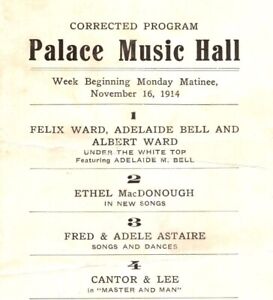
Sold on eBay March 10th, 2024
*EDDIE CANTOR FRED & ADEL6E ASTAIRE RARE LARGE 1914 VAUDEVILLE BROADSIDE *
A rare large original 1914 broadside type program for Eddie Cantor with Cantor and Lee and the amazing brother and sister team of Fred and Adele Astaire at the Palace Music Hall. Dimensions fifteen by four inches. Light wear and light folds otherwise good. See Eddie Cantor and Fred Astaire's extraordinary biographies below.Shipping discounts for buyers of multiple items. Credit cards accepted with Paypal. Inquiries always welcome. Please visit my other eBay items for more early theatre and historical autographs, broadsides, photographs and programs and great actor and actress cabinet photos and CDV's. From Wikipedia:Eddie Cantor (born Isidore January 31, 1892 – October 10, 1964) was an American comedian, actor, dancer, singer, songwriter, film producer, screenwriter and author.[3] Familiar to Broadway, radio, movie, and early television audiences, this "Apostle of Pep" was regarded almost as a family member by millions because his top-rated radio shows revealed intimate stories and amusing anecdotes about his wife, Ida, and five daughters. Some of his hits include "Makin' Whoopee", "Ida (Sweet as Apple Cider)", "If You Knew Susie", "Ma! He's Making Eyes at Me", “Mandy”, "My Baby Just Cares for Me”, "Margie", and "How Ya Gonna Keep 'em Down on the Farm (After They've Seen Paree)?" He also wrote a few songs, including "Merrily We Roll Along", the Merrie Melodies Warner Bros. cartoon theme.His eye-rolling song-and-dance routines eventually led to his nickname "Banjo Eyes". In 1933, artist Frederick J. Garner caricatured Cantor with large round eyes resembling the drum-like pot of a banjo. Cantor's eyes became his trademark, often exaggerated in illustrations, and leading to his appearance on Broadway in the musical Banjo Eyes (1941).His charity and humanitarian work was extensive. He helped to develop the March of Dimes and is credited with coining its name. Cantor was awarded an honorary Oscar in 1956 for distinguished service to the film industry.Early lifeReports and accounts of Cantor's early life often conflict with one another. What is known is that he was born in New York City, the son of Mechel Iskowitz (also Michael), an amateur violinist, and his wife Meta Kantrowitz Iskowitz (also Maite), a young Jewish couple from Russia.[4] It is generally accepted that he was born in 1892, though the day is subject to debate, with either January 31 or Rosh Hashanah, which was on September 10 or September 11, being reported [5][6][7] Although it was reported Cantor was an orphan, his mother dying in childbirth and his father of pneumonia, official records say otherwise; Meta died from complications of tuberculosis in July 1894 and the fate of Mechel is unclear, as no death certificate exists for him. There is also discrepancy as to his name; both his 1957 autobiography and The New York Times obituary for Cantor report his birth name as Isidore Iskowitch, although some articles published after the 20th century give his birth name as Edward (a nickname given him by his future wife, Ida, in 1913) or Israel Itzkowitz [8][5] His grandmother, Esther Kantrowitz (died January 29, 1917), took custody of him, and referred to him as Izzy and Itchik, both diminutives for Isidor, and his last name, due to a clerical error, was thought to be Kantrowitz and shortened to Kanter.[5] No birth certificate existed for him, though this is not unusual for someone born in New York in the 19th century StageSaloon songs to vaudevilleBy his early teens, Cantor began winning talent contests at local theaters and started appearing on stage. One of his earliest paying jobs was doubling as a waiter and performer, singing for tips at Carey Walsh's Coney Island saloon, where a young Jimmy Durante accompanied him on piano. He made his first public appearance in Vaudeville in 1907 at New York's Clinton Music Hall. In 1912, he was the only performer over the age of 20 to appear in Gus Edwards's Kid Kabaret, where he created his first blackface character "Jefferson". He later toured with Al Lee as the team Cantor and Lee. Critical praise from that show got the attention of Broadway's top producer Florenz Ziegfeld, who gave Cantor a spot in the Ziegfeld rooftop post-show, Midnight Frolic (1917) [5]BroadwayA year later, Cantor made his Broadway debut in the Ziegfeld Follies of 1917. He continued in the Follies until 1927,[9] a period considered the best years of the long-running revue. For several years, Cantor co-starred in an act with pioneer comedian Bert Williams, both appearing in blackface; Cantor played Williams's fresh-talking son. Other co-stars with Cantor during his time in the Follies included Will Rogers, Marilyn Miller, Fanny Brice, and W.C. Fields.[10] He moved on to stardom in book musicals, starting with Kid Boots (1923) and Whoopee! (1928).[9] On tour with Banjo Eyes, he romanced the unknown Jacqueline Susann, who had a small part in the show and who became the best-selling author of Valley of the Dolls. Banjo Eyes successful Broadway run was cut short when Cantor suffered a major heart attack, the first of several that would plague his later years.Fred Astaire (born Frederick Austerlitz;[1] May 10, 1899 – June 22, 1987) was an American actor, dancer, singer, choreographer, and television presenter. He is widely considered the most influential dancer in the history of film.[2]His stage and subsequent film and television careers spanned a total of 76 years. He starred in more than 10 Broadway and West End musicals, made 31 musical films, four television specials, and issued numerous recordings. As a dancer, his most outstanding traits were his uncanny sense of rhythm, perfectionism, and innovation. His most memorable dancing partnership was with Ginger Rogers, with whom he co-starred in a series of ten Hollywood musicals, including Top Hat (1935), Swing Time (1936), and Shall We Dance (1937).[3] Among his other most notable films where Astaire gained popularity and took the genre of tap dancing to a new level include Holiday Inn (1944), Easter Parade (1948), The Band Wagon (1953), Funny Face (1957), and Silk Stockings (1957). The American Film Institute named Astaire the fifth-greatest male star of Classic Hollywood cinema.Fred Astaire was born Frederick Austerlitz on May 10, 1899, in Omaha, Nebraska, the son of Johanna "Ann" (née Geilus; 1878–1975) and Friedrich "Fritz" Emanuel Austerlitz, in the US: Frederic Austerlitz (1868–1923) [1][6][7][8] Astaire's mother was born in the US to Lutheran German immigrants from East Prussia and Alsace. Astaire's father was born in Linz, Austria to Roman Catholic parents who had converted from Judaism [1][9][10][11]Astaire s father, Fritz Austerlitz, arrived in New York City at the age of 25 on October 26, 1893, at Ellis Island.[12] Fritz was seeking work in the brewing trade and moved to Omaha, Nebraska, where he was employed by the Storz Brewing Company. Astaire's mother dreamed of escaping Omaha by her children's talents. Astaire's older sister, Adele, was an instinctive dancer and singer early in her childhood. Johanna planned a "brother and sister act", common in vaudeville at the time, for her two children. Although Fred refused dance lessons at first, he easily mimicked his older sister's steps and took up piano, accordion, and clarinet.When their father lost his job, the family moved to New York City in January 1905 to launch the show business careers of the children. They began training at the Alviene Master School of the Theatre and Academy of Cultural Arts.[13] Fred and Adele's mother suggested they change their name to "Astaire", as she felt "Austerlitz" was reminiscent of the Battle of Austerlitz. Family legend attributes the name to an uncle surnamed L Astaire [14]They were taught dance, speaking, and singing in preparation for developing an act. Their first act was called Juvenile Artists Presenting an Electric Musical Toe-Dancing Novelty. Fred wore a top hat and tails in the first half and a lobster outfit in the second. In an interview, Astaire's daughter, Ava Astaire McKenzie, observed that they often put Fred in a top hat to make him look taller.[15] In November 1905, the goofy act debuted in Keyport, New Jersey at a "tryout theater". The local paper wrote, "the Astaires are the greatest child act in vaudeville [16]As a result of their father's salesmanship, Fred and Adele landed a major contract and played the Orpheum Circuit in the Midwest, Western and some Southern cities in the US. Soon Adele grew to at least three inches taller than Fred, and the pair began to look incongruous. The family decided to take a two-year break from show business to let time take its course and to avoid trouble from the Gerry Society and the child labor laws of the time. In 1912, Fred became an Episcopalian [17] The career of the Astaire siblings resumed with mixed fortunes, though with increasing skill and polish, as they began to incorporate tap dancing into their routines. Astaire's dancing was inspired by Bill "Bojangles" Robinson and John "Bubbles" Sublett.[18] From vaudeville dancer Aurelio Coccia, they learned the tango, waltz, and other ballroom dances popularized by Vernon and Irene Castle. Some sources[19] state that the Astaire siblings appeared in a 1915 film titled Fanchon, the Cricket, starring Mary Pickford, but the Astaires have consistently denied this [20][21][22]By age 14, Fred had taken on the musical for their act.[13] He first met George Gershwin, who was working as a song plugger for Jerome H. Remick's music publishing company, in 1916.[23] Fred had already been hunting for new music and dance ideas. Their chance meeting was to affect the careers of both artists profoundly. Astaire was always on the lookout for new steps on the circuit and was starting to demonstrate his ceaseless quest for novelty and perfection 1917–1933: Stage career on Broadway and in LondonFred and Adele Astaire in 1921The Astaires broke into Broadway in 1917 with Over the Top, a patriotic revue, and performed for U.S. and Allied troops at this time as well. They followed up with several more shows. Of their work in The Passing Show of 1918, Heywood Broun wrote: "In an evening in which there was an abundance of good dancing, Fred Astaire stood out ... He and his partner, Adele Astaire, made the show pause early in the evening with a beautiful loose-limbed dance [24]Adele s sparkle and humor drew much of the attention, owing in part to Fred's careful preparation and sharp supporting choreography. She still set the tone of their act. But by this time, Astaire's dancing skill was beginning to outshine his sister's.During the 1920s, Fred and Adele appeared on Broadway and the London stage. They won popular acclaim with the theater crowd on both sides of the Atlantic in shows such as Jerome Kern's The Bunch and Judy (1922), George and Ira Gershwin's Lady, Be Good (1924), and Funny Face (1927) and later in The Band Wagon (1931). Astaire's tap dancing was recognized by then as among the best. For example, Robert Benchley wrote in 1930, "I don't think that I will plunge the nation into war by stating that Fred is the greatest tap-dancer in the world."[25] Whilst in London, Fred studied piano at the Guildhall School of Music alongside his friend and colleague Noël Coward;[26], and in 1926, was one of the judges at the 'Charleston (dance) Championship of the World ' competition at the Royal Albert Hall, where Lew Grade was declared the winner.fter the close of Funny Face, the Astaires went to Hollywood for a screen test (now lost) at Paramount Pictures, but Paramount deemed them unsuitable for films.They split in 1932 when Adele married her first husband, Lord Charles Cavendish, the second son of the 9th Duke of Devonshire. Fred went on to achieve success on his own on Broadway and in London with Gay Divorce (later made into the film The Gay Divorcee) while considering offers from Hollywood. The end of the partnership was traumatic for Astaire but stimulated him to expand his range.Free of the brother-sister constraints of the former pairing and working with new partner Claire Luce, Fred created a romantic partnered dance to Cole Porter's "Night and Day", which had been written for Gay Divorce. Luce stated that she had to encourage him to take a more romantic approach: "Come on, Fred, I'm not your sister, you know."[25]: 6 The success of the stage play was credited to this number, and when recreated in The Gay Divorcee (1934), the film version of the play, it ushered in a new era in filmed dance.[25]: 23, 26, 61 Recently, film footage taken by Fred Stone of Astaire performing in Gay Divorce with Luce's successor, Dorothy Stone, in New York in 1933 was uncovered by dancer and historian Betsy Baytos and now represents the earliest known performance footage of Astaire [27]1933–1939: Astaire and Ginger Rogers at RKOGinger Rogers and Fred Astaire in Top Hat (1935)According to Hollywood folklore, a screen test report on Astaire for RKO Radio Pictures, now lost along with the test, is reported to have read: "Can't sing. Can't act. Balding. Can dance a little." The producer of the pictures, Pandro S. Berman, claimed he had never heard the story in the 1930s and that it only emerged years afterward.[25]: 7 Astaire later clarified, insisting that the report had read: "Can't act. Slightly bald. Also dances."[28] In any case, the test was clearly disappointing, and David O. Selznick, who had signed Astaire to RKO and commissioned the test, stated in a memo, "I am uncertain about the man, but I feel, in spite of his enormous ears and bad chin line, that his charm is so tremendous that it comes through even on this wretched test."[25]: 7 However, this did not affect RKO's plans for Astaire. They lent him for a few days to MGM in 1933 for his significant Hollywood debut in the successful musical film Dancing Lady. In the movie, he appeared as himself dancing with Joan Crawford. On his return to RKO, he got fifth billing after fourth billed Ginger Rogers in the 1933 Dolores del Río vehicle Flying Down to Rio. In a review, Variety magazine attributed its massive success to Astaire's presence:The main point of Flying Down to Rio is the screen promise of Fred Astaire ... He's assuredly a bet after this one, for he's distinctly likable on the screen, the mike is kind to his voice and as a dancer, he remains in a class by himself. The latter observation will be no news to the profession, which has long admitted that Astaire starts dancing where the others stop hoofing [29][25]: 7 Having already been linked to his sister Adele on stage, Astaire was initially very reluctant to become part of another dance team. He wrote his agent, "I don't mind making another picture with her, but as for this 'team' idea, it's 'out!' I've just managed to live down one partnership and I don't want to be bothered with anymore."[25]: 8 However, he was persuaded by the apparent public appeal of the pairing. The partnership, and the choreography of Astaire and Hermes Pan, helped make dancing an important element of the Hollywood film musical.Astaire and Rogers made nine films together at RKO. These included Flying Down to Rio (1933), The Gay Divorcee (1934), Roberta (1935, in which Astaire also demonstrates his oft-overlooked piano skills with a spirited solo on "I Won't Dance"), Top Hat (1935), Follow the Fleet (1936), Swing Time (1936), Shall We Dance (1937), Carefree (1938), and The Story of Vernon and Irene Castle (1939). Six out of the nine musicals became the biggest moneymakers for RKO; all of the films brought a certain prestige and artistry that all studios coveted at the time. Their partnership elevated them both to stardom; as Katharine Hepburn reportedly said, "He gives her class and she gives him sex appeal."[30]: 134 Astaire received a percentage of the films' profits, something scarce in actors' contracts at that time InnovationsAstaire revolutionized dance on film by having complete autonomy over its presentation [31] He is credited with two important innovations in early film musicals.[25]: 23, 26 First, he insisted that a closely tracking dolly camera film a dance routine in as few shots as possible, typically with just four to eight cuts, while holding the dancers in full view at all times. This gave the illusion of an almost stationary camera filming an entire dance in a single shot. Astaire famously quipped: "Either the camera will dance, or I will."[25]: 420 Astaire maintained this policy from The Gay Divorcee in 1934 until his last film musical Finian's Rainbow in 1968, when director Francis Ford Coppola overruled him [32]Astaire s style of dance sequences allowed the viewer to follow the dancers and choreography in their entirety. This style differed strikingly from those in the Busby Berkeley musicals. Those musicals' sequences were filled with extravagant aerial shots, dozens of cuts for quick takes, and zooms on areas of the body such as a chorus row of arms or legs [33]Astaire s second innovation involved the context of the dance; he was adamant that all song and dance routines be integral to the plotlines of the film. Instead of using dance as a spectacle as Busby Berkeley did, Astaire used it to move the plot along. Typically, an Astaire picture would include at least three standard dances. One would be a solo performance by Astaire, which he termed his "sock solo". Another would be a partnered comedy dance routine. Finally, he would include a partnered romantic dance routine [34]Assessment of the Rogers partnershipAn RKO publicity still of Astaire and Rogers dancing to "Smoke Gets in Your Eyes" in Roberta (1935)Dance commentators Arlene Croce,[30]: 6 Hannah Hyam[35]: 146–147 and John Mueller[25]: 8, 9 consider Rogers to have been Astaire's greatest dance partner, a view shared[36] by Hermes Pan and Stanley Donen.[36] Film critic Pauline Kael adopts a more neutral stance,[37] while Time magazine film critic Richard Schickel writes "The nostalgia surrounding tends to bleach out other partners [38]Mueller sums up Rogers's abilities as follows:Rogers was outstanding among Astaire's partners not because she was superior to others as a dancer, but because, as a skilled, intuitive actress, she was cagey enough to realize that acting did not stop when dancing began ... the reason so many women have fantasized about dancing with Fred Astaire is that Ginger Rogers conveyed the impression that dancing with him is the most thrilling experience imaginable [25]According to Astaire, "Ginger had never danced with a partner before Flying Down to Rio. She faked it an awful lot. She couldn't tap and she couldn't do this and that ... but Ginger had style and talent and improved as she went along. She got so that after a while everyone else who danced with me looked wrong."[39] On p. 162 of his book Ginger: Salute to a Star, author Dick Richards quotes Astaire saying to Raymond Rohauer, curator of the New York Gallery of Modern Art, "Ginger was brilliantly effective. She made everything work for her. Actually, she made things very fine for both of us and she deserves most of the credit for our success."In 1976, British talk-show host Sir Michael Parkinson asked Astaire who his favorite dancing partner was on Parkinson. At first, Astaire refused to answer. But, ultimately, he said "Excuse me, I must say Ginger was certainly, uh, uh, the one. You know, the most effective partner I had. Everyone knows [40]Rogers described Astaire's uncompromising standards extending to the whole production: "Sometimes he'll think of a new line of dialogue or a new angle for the story ... they never know what time of night he'll call up and start ranting about a fresh idea ... No loafing on the job on an Astaire picture, and no cutting corners."[25]: 16 Despite their success, Astaire was unwilling to have his career tied exclusively to any partnership. He negotiated with RKO to strike out on his own with A Damsel in Distress in 1937 with an inexperienced, non-dancing Joan Fontaine, unsuccessfully as it turned out. He returned to make two more films with Rogers, Carefree (1938) and The Story of Vernon and Irene Castle (1939). While both films earned respectable gross incomes, they both lost money because of increased production costs,[25]: 410 and Astaire left RKO, after being labeled "box office poison" by the Independent Theatre Owners of America. Astaire was reunited with Rogers in 1949 at MGM for their final outing, The Barkleys of Broadway, the only one of their films together to be shot in Technicolor 1940–1947: Holiday Inn, early left RKO in 1939 to freelance and pursue new film opportunities, with mixed though generally successful outcomes. Throughout this period, Astaire continued to value the input of choreographic collaborators. Unlike the 1930s when he worked almost exclusively with Hermes Pan, he tapped the talents of other choreographers to innovate continually. His first post-Ginger dance partner was the redoubtable Eleanor Powell, considered the most exceptional female tap-dancer of her generation. They starred in Broadway Melody of 1940, in which they performed a celebrated extended dance routine to Cole Porter's "Begin the Beguine". In his autobiography Steps in Time, Astaire remarked, "She 'put 'em down' like a man, no ricky ticky sissy stuff with Ellie. She really knocked out a tap dance in a class by herself."[41]He played alongside Bing Crosby in Holiday Inn (1942) and later Blue Skies (1946). But, in spite of the enormous financial success of both, he was reportedly dissatisfied with roles where he lost the girl to Crosby. The former film is memorable for his virtuoso solo dance to "Let's Say it with Firecrackers". The latter film featured "Puttin' On the Ritz", an innovative song-and-dance routine indelibly associated with him. Other partners during this period included Paulette Goddard in Second Chorus (1940), in which he dance-conducted the Artie Shaw orchestra.With Rita Hayworth in You Were Never Lovelier (1942)He made two pictures with Rita Hayworth. The first film, You'll Never Get Rich (1941), catapulted Hayworth to stardom. In the movie, Astaire integrated for the third time Latin American dance idioms into his style (the first being with Ginger Rogers in "The Carioca" number from Flying Down to Rio (1933) and the second, again with Rogers, was the "Dengozo" dance from The Story of Vernon and Irene Castle (1939)). His second film with Hayworth, You Were Never Lovelier (1942), was equally successful. It featured a duet to Kern's "I'm Old Fashioned", which became the centerpiece of Jerome Robbins's 1983 New York City Ballet tribute to Astaire. He next appeared opposite the seventeen year old Joan Leslie in the wartime drama The Sky's the Limit (1943). In it, he introduced Arlen and Mercer's "One for My Baby" while dancing on a bar counter in a dark and troubled routine. Astaire choreographed this film alone and achieved modest box office success. It represented a notable departure for Astaire from his usual charming, happy-go-lucky screen persona, and confused contemporary critics.His next partner, Lucille Bremer, was featured in two lavish vehicles, both directed by Vincente Minnelli. The fantasy Yolanda and the Thief (1945) featured an avant-garde surrealistic ballet. In the musical revue Ziegfeld Follies (1945), Astaire danced with Gene Kelly to the Gershwin song "The Babbit and the Bromide", a song Astaire had introduced with his sister Adele back in 1927. While Follies was a hit, Yolanda bombed at the box office.Always insecure and believing his career was beginning to falter, Astaire surprised his audiences by announcing his retirement during the production of his next film Blue Skies (1946). He nominated "Puttin' on the Ritz" as his farewell dance. After announcing his retirement in 1946, Astaire concentrated on his horse-racing interests and in 1947 founded the Fred Astaire Dance Studios, which he subsequently sold in 1966 1948–1957: MGM films and second retirementIn Daddy Long Legs (1955)Astaire's retirement did not last long. Astaire returned to the big screen to replace an injured Gene Kelly in Easter Parade (1948) opposite Judy Garland, Ann Miller, and Peter Lawford. He followed up with a final reunion with Rogers (replacing Judy Garland) in The Barkleys of Broadway (1949). Both of these films revived Astaire's popularity and in 1950 he starred in two musicals. Three Little Words with Vera-Ellen and Red Skelton was for MGM. Let's Dance with Betty Hutton was on loan-out to Paramount. While Three Little Words did quite well at the box office, Let's Dance was a financial disappointment. Royal Wedding (1951) with Jane Powell and Peter Lawford proved to be very successful, but The Belle of New York (1952) with Vera-Ellen was a critical and box-office disaster. The Band Wagon (1953) received rave reviews from critics and drew huge crowds. But because of its high cost, it failed to make a profit on its first release.Soon after, Astaire, like the other remaining stars at MGM, was let go from his contract because of the advent of television and the downsizing of film production. In 1954, Astaire was about to start work on a new musical, Daddy Long Legs (1955) with Leslie Caron at 20th Century Fox. Then, his wife Phyllis became ill and suddenly died of lung cancer. Astaire was so bereaved that he wanted to shut down the picture and offered to pay the production costs out of his pocket. However, Johnny Mercer, the film's composer, and Fox studio executives convinced him that work would be the best thing for him. Daddy Long Legs only did moderately well at the box office. His next film for Paramount, Funny Face (1957), teamed him with Audrey Hepburn and Kay Thompson. Despite the sumptuousness of the production and the good reviews from critics, it failed to make back its cost. Similarly, Astaire's next project – his final musical at MGM, Silk Stockings (1957), in which he co-starred with Cyd Charisse – also lost money at the box office Afterward Astaire announced that he was retiring from dancing in the film. His legacy at this point was 30 musical films in 25 years.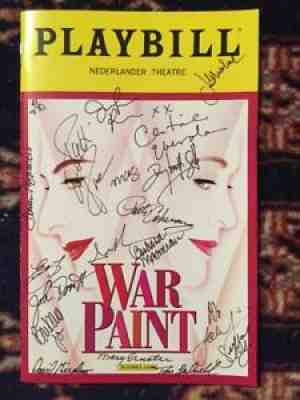
Sold on eBay Oct 18, 2020
Patti Lupone Christine Ebersole And Cast Signed War Paint Playbill
This playbill was signed by Patti LuPone (Helena Rubinstein), Christine Ebersole (Elizabeth Arden), John Dossett (Tommy Lewis), Douglas Sills (Harry Fleming), Mary Ernster (Society Doyenne/Mrs. Levin/Others), Joanna Glushak (Countess Magda Others) Chris Hoch (Mr. Simms/Hal March/Mr. ).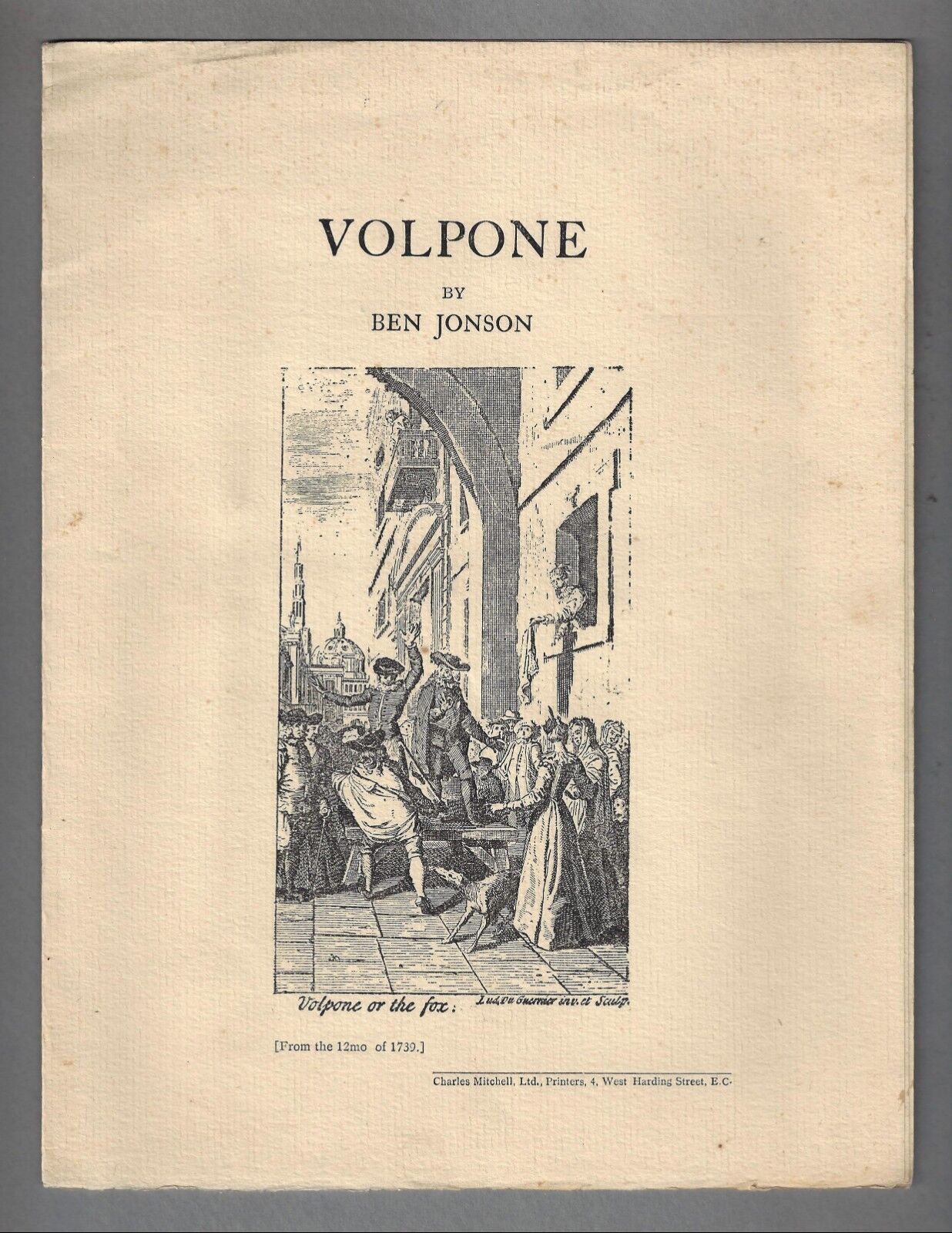
Sold on eBay December 19th, 2024
Baliol Holloway "VOLPONE" Isabel Jeans 1923 London Benefit Performance Program
This is a rare June 29th, 1923 programme (playbill) from a Special Matinee Benefit Performance of the BEN JONSON comedy "VOLPONE" at the Regent Theatre, King's Cross in London. (The production opened April 9th, 1928 and ran for 46 performances.) ..... Presented by the Phoenix Society, the performance was given in aid of the Funds of the Incorporated Stage Society. The play starred BALIOL HOLLOWAY in the title role and featured RUPERT HARVEY, D. LEWIN MANNERING, STANLEY LATHBURY, GEORGE ZUCCO, ROY BYFORD, JOHN H. MOORE, TRISTAN RAWSON, HOWARD ROSE, MATTHEW FORSYTH, EDWARD GARRETT, BRUCE WINSTON, EUGENE LEAHY, CHARLES MAUNSELL, MURRAY KINNELL, MARGARET YARDE, ISABEL JEANS, HENRY WINTER, ALAN EDMISTON, NELL CARTER and CLARE HARRIS ..... CREDITS: Book by BEN JONSON; Sets designed by NORMAN WILKINSON; Costumes arranged by TOM HESLEWOOD; Directed by ALLAN WADE; Produced by THE STAGE SOCIETY by the courtesy of the Directors of the Lyric Theatre, Hammersmith ..... DETAILS: The eight page program measures 7 1/2" X 10" inches, is printed on a textured stock and includes full production credits, cast list, synopsis of scenes, promotional and historical text and program notes, but no cast photos or bios ..... CONDITION: With the exception of light creasing, this program is in excellent condition and will make a wonderful addition to the collection of any theatre aficionado or historian. This item will be carefully packaged in a protective, carded sleeve and backed by stiff cardboard.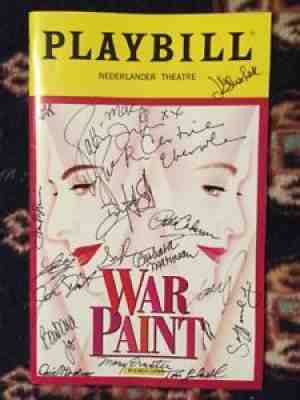
Sold on eBay Mar 07, 2021
Patti Lupone Christine Ebersole And Cast Signed War Paint Playbill
This playbill was signed by Patti LuPone (Helena Rubinstein), Christine Ebersole (Elizabeth Arden), John Dossett (Tommy Lewis), Douglas Sills (Harry Fleming), Mary Ernster (Society Doyenne/Mrs. Levin/Others), Joanna Glushak (Countess Magda Others) Chris Hoch (Mr. Simms/Hal March/Mr. ).
Sold on eBay September 14th, 2024
Concert: PAUL ROBESON Spirituals / Betty Humby 1933 Lowestoft, England Program
This is a rare August 13th, 1933 programme (playbill) from the one-night, concert appearance of the legendary PAUL ROBESON performing a repertoire of Spirituals, Folk Songs and Ballads at the Sparrow's Nest in Lowestoft, England. Mr. Robeson was assisted by Lawrence Brown at the piano. Presented by Harold Holt, the concert's bill also included pianist Betty Humby performing selections by Beethoven and Chopin ..... Biography: Paul Robeson (1898 - 1976) was an African American singer, actor, and political activist. He crusaded for equality and justice for African Americans. Paul Leroy Robeson was born the last of eight children in the Robeson family, on April 9, 1898, in Princeton, New Jersey. His father, William Drew Robeson, was a runaway slave who fought for the North in the Civil War (1861–65), when Northern forces clashed with those of the South over secession, or the South's desire to leave the Union. His father put himself through Lincoln University, received a degree in divinity, and was pastor at a Presbyterian church in Princeton. Paul's mother, Anna Louisa Robeson, was a member of the distinguished Bustill family of Philadelphia, which included patriots in the Revolutionary War (1775–83), when the American colonies fought for independence from Great Britain. She also helped found the Free African Society, and maintained agents in the Underground Railroad, a secret system to help runaway slaves. Paul's mother died when he was six and his father moved the remaining family to Sommerville, New Jersey. There, young Paul spent his childhood under his father's influence, regularly working with him after school and also singing in his father's church. At seventeen Robeson won a scholarship to Rutgers University in New Brunswick, New Jersey. Although he was only the third African American student in the school's history, Robeson was immensely popular and was considered an athlete "without equal." He won an amazing twelve major letters (varsity spots on sports teams) in four years. His academic record was also brilliant. He won first prize (for four consecutive years) in every speaking competition at the college for which he was eligible, and he was elected to Phi Beta Kappa, a scholarship honor society. In addition, he engaged in social work in the local black community and delivered his senior class graduation speech. Rutgers subsequently honored him as the "perfect type of college man." Robeson graduated from the Columbia University Law School in 1923 and took a job with a New York City law firm. In 1921 he married Eslanda Goode Cardozo; they had one child. Robeson's career as a lawyer ended abruptly when others within the firm turned on him because he was African American. He then turned to acting as a career, playing the lead in All God's Chillun Got Wings (1924) and The Emperor Jones (1925). He added to his acting by singing spirituals. He was the first to give an entire program of exclusively African American songs in concert, and he was one of the most popular concert singers of his time. Robeson starred in such stage presentations as Show Boat (1928), Othello, in London (1930), Toussaint L'Ouverture (1934), and Stevedore (1935). His Othello (1943–44) ran for 296 remarkable run for a Shakespearean play on Broadway. While playing opposite white actress Mary Ure, he became the first black actor ever to do the role in England's Shakespeare Memorial Theater. Robeson's most significant films were Emperor Jones (1933), Show Boat, Song of Freedom (both 1936), and Proud Valley (1939). Charles Gilpin and Robeson, as the first African American men to play serious roles on the American stage, opened up this aspect of the theater for African Americans. Robeson used his talents not only to entertain but to gain appreciation for the cultural differences among men. During the 1930's Robeson entertained throughout Europe and the United States. In 1934 he made the first of several trips to the Soviet Union. He spoke out against the Nazis, Adolf Hitler's radical German army, and sang to Loyalist troops during the Spanish Civil War (1936–39), when battles erupted between Spain's traditionalists and reigning Second Spanish Republic. In addition he raised money to fight the Italian invasion of Ethiopia, supported the Committee to Aid China, and became chairman of the Council on African Affairs (which he helped establish in 1937). A spokesman for cultural black nationalism (a radical movement that called for African Americans to set up their own self-governing nation), Robeson also continued to fight racial discrimination. During World War II (1939–45), when the Allies—the United States, England, France, and the Soviet Union—battled German-led Axis forces, he supported the American effort by entertaining soldiers in camps and laborers in war industries. After the war, Robeson worked full-time campaigning for the rights of African Americans around the world. In a period of great paranoia within the nation, the American government and many citizens felt threatened by Robeson's crusade for peace and on behalf of minorities. The fact that for over fifteen years he was America's most popular African American did not prevent Robeson from being banned from American concert and meeting halls and being denied a passport to travel overseas. During the 1950's Robeson performed in black churches and for trade unions. After eight years of denial, he won his passport, gave a concert in Carnegie Hall, and published Here I Stand in 1958. He went abroad on concert, television, and theater engagements. He received numerous honors and awards: the National Association for the Advancement of Colored People's (NAACP) Spingarn Medal, several honorary degrees from colleges, the Diction Award from the American Academy of Arts and Letters, numerous awards from labor unions and civic organizations, and the Stalin Peace Prize. Robeson had used an "unshakable dignity and courage" learned from his father to break stereotypes and limitations throughout his life. He added fifteen spoken languages, a law degree, an international career as singer and actor, and civil rights activist to his long list of accomplishments in his effort to be "the leader of the black race in America." Robeson returned to America in 1963 in poor health and soon retired from public life. Slowly deteriorating and living in seclusion, Robeson died on January 23, 1976, in Philadelphia, Pennsylvania, after suffering a stroke. (Reprinted in part from the World Biography website) ..... DETAILS: The twelve page program measures 6 5/8" X 8 1/2" inches and includes production credits, list of the musical selections, lyrics to Mr. Robeson's songs and wonderful vintage advertising CONDITION: With the exception of a fold across the middle and light soiling to the cover, this rare program is in excellent condition and will make a wonderful addition to the collection of any musical theatre aficionado or historian. This item will be carefully packaged in a protective, carded sleeve and backed by stiff cardboard.
Sold on eBay August 19th, 2024
1894 Walnut St. Threatre Playbill Of Rose Coghlan In A Woman Of No Importance
Walnut Street Theatre playbill for A Woman of No Importance, starring Rose Coghlan, with a start date of March 26, 1894. Approximately 11” x 5”.In good condition, with slight chipping and loss to corners. Includes seat map on rear. General age-related toning to paper, along with periodic foxing and wear. Please see photographs and ask any questions prior to purchasing Rosamond Marie (Rose) Coghlan (1851-1932) was an English actress who made her Broadway debut in 1872. Written by Oscar Wilde as a satire of British high society, a Woman of No Importance was first performed on April 19, 1893 at the Haymerket Theatre in London, and later made its way to Philadelphia, including performances at the Walnut Street Theatre. Built in 1808, the theatre is still in operation, and is additionally the oldest operating theatre in the United States. The theatre is notable for being the first in the country offer air conditioning in 1855, and would switch to electric lights in 1892 FORN SHELF 0545 BB 0824 aj0702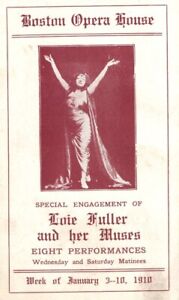
Sold on eBay September 17th, 2023
*LEGENDARY DANCER LOIE FULLER & HER MUSES RARE 1910 DANCE PROGRAM*
A rare large original 1910 dance program for the legendary Loie Fuller and Her Muses at the Boston Opera House. Isadora Duncan. Ten pages. Dimensions nine and a quarter by three and three quarters inches. Light wear otherwise good. See Loie Fuller's extraordinary biography below. Shipping discounts for multiple purchases. Inquiries always welcome. Please visit my other eBay items for more early ballet and dance memorabilia, early theatre, opera, film, magic, and historical autographs, photographs, programs and broadsides, and great actor and actress cabinet photos and CDV's.From Wikipedia:Loie Fuller (/?lo?i/;[1] born Marie Louise Fuller; January 15, 1862 – January 1, 1928), also known as Louie Fuller and Loïe Fuller, was an American dancer and a pioneer modern dance and theatrical lighting techniques Early life and debutMarie Louise Fuller was born on January 15, 1862 in Fullersburg, Illinois, on a remote farm conveniently linked to Chicago by a newly constructed plank road. When Fuller was two, her parents Reuben Fuller and Delilah Eaton moved to Chicago and opened a boarding house. Fuller's parents took her to the Progressive Lyceum, a hub of Freethought, on Sunday mornings [2]Fuller debuted on the stage as a toddler, performing a variety of dramatic and dance roles in Chicago. Her dramatic debut at the age of four was at the Chicago Academy of Music, playing a young boy in Was He Right?.[3] Fuller's career as a child perfomer progressed with little formal training and much variety, as she experimented with dramatic reading, singing, and dance.[4] As a child, Fuller's family moved in and out of Chicago, with Fuller eventually securing a part in Buffalo Bill's touring act at the age of nineteen [2]Marie Louise Fuller changed her name to the more glamorous "Loïe" at the age of sixteen. An early free dance practitioner, Fuller developed her own natural movement and improvisation techniques. In multiple shows she experimented with a long skirt, choreographing its movements and playing with the ways it could reflect light.By 1891, Fuller combined her choreography with silk costumes illuminated by multi-coloured lighting of her own design, and created the Serpentine Dance.[5] After much difficulty finding someone willing to produce her work when she was primarily known as an actress, she was finally hired to perform her piece between acts of a comedy entitled Uncle Celestine, and received rave reviews [6]CareerPortrait of Fuller by Frederick Glasier, 1902Almost immediately, she was replaced by imitators (originally Minnie "Renwood" Bemis). In the hope of receiving serious artistic recognition that she was not getting in America, Fuller left for Europe in June 1892. She became one of the first of many American modern dancers who traveled to Europe to seek recognition. Her warm reception in Paris persuaded Fuller to remain in France, where she became one of the leading revolutionaries in the arts.[4]A regular performer at the Folies Bergère with works such as Fire Dance, Fuller became the embodiment of the Art Nouveau movement and was often identified with symbolism, as her work was seen as the perfect reciprocity between idea and symbol.[2] Fuller began adapting and expanding her costume and lighting, so that they became the principal element in her even more important than the actual choreography, especially as the length of the skirt was increased and became the central focus, while the body became mostly hidden within the depths of the fabric.[7] The choreography of the Serpentine Dance was filmed by multiple early filmmakers, including Auguste and Louis Lumière, but it is unclear whether the recordings depict Fuller herself [8][9]Table lamp: Dance of the Lily (Loie Fuller) - around 1901-Gilt bronze-Museum Wiesbaden-Raoul Larche (1860 1912)Fuller at the Folies Bergère, poster by PAL (Jean de Paléologue)Fuller s pioneering work attracted the attention, respect, and friendship of many French artists and scientists, including Jules Chéret, Henri de Toulouse Lautrec François-Raoul Larche, Henri-Pierre Roché, Auguste Rodin, Jean-Léon Gérôme, Franz von Stuck, Maurice Denis, Thomas Theodor Heine, Paul-Léon Jazet, Koloman Moser, Demétre Chiparus, Stéphane Mallarmé, and Marie Curie. Fuller was also a member of the Société astronomique de France (French Astronomical Society) [citation needed]Fuller patented many of her innovations in stage lighting, including the use of chemical compounds for creating color gel, and the application of chemical salts to luminescent lighting and garments [8]Fuller also sought legal protection for her choreography, but was less successful. Her lawsuit against imitator Minnie Renwood Bemis was decided in Bemis' favor, allowing Bemis' performances at Madison Square Garden to continue. The judge in the case ruled that Fuller's original choreography told no story and therefore could not be copyrighted [10][11] The precedent set by Fuller's case remained in place until the passage of the Copyright Act of 1976, which explicitly extended protection to nondramatic choreographic works.[12][13] Another notorious imitator was Lord Yarmouth, later 7th Marquess of Hertford, who performed the Serpentine Dance under the stage name of ‘Mademoiselle Roze’ [14][15]Fuller supported other pioneering performers, such as fellow United States-born dancer Isadora Duncan. Fuller helped Duncan ignite her European career in 1902 by sponsoring independent concerts in Vienna and Budapest [16]Loie Fuller's original stage name was "Louie". In modern French "L'ouïe" is the word for a sense of hearing. When Fuller reached Paris she gained a nickname which was a pun on Louie L ou e She was renamed "Loïe" - this nickname is a corruption of the early or Medieval French "L'oïe", a precursor to "L'ouïe", which means "receptiveness" or understanding She was also referred to by the nickname "Lo Lo Fuller [citation needed]A dancer (not Fuller) performing Fuller's serpentine dance in a 1902 film directed by Segundo de ChomónPersonal lifeFuller met her romantic partner of over 30 years, Gab Sorère, in the mid-1890s. Sorère was born Gabrielle Bloch, the daughter of wealthy French bankers, in 1870, and eventually took the name Gab Sorère in 1920. Bloch first saw Fuller perform at the age of 14, and by 1898 Fuller and Bloch were living together [17]Fuller and Bloch's relationship initially yattracted some attention in the press, as Bloch dressed exclusively in menswear, and was 8 years Fuller's junior. The press coverage of their relationship declined over time, focusing more on Fuller's mother, and allowing Bloch and Fuller to live a relatively unbothered life.[18]Fuller met Crown Princess Marie of Romania, later to become Queen Marie, in 1902, at a performance in Bucharest. Marie and Fuller became close, and maintained an extensive correspondence as close friends. Their relationship was the subject of scandalous rumors,[19] alleging that Fuller and Queen Marie were lovers.[20] Fuller, through a connection at the United States embassy in Paris, played a role in arranging a United States loan for Romania during World War I.[citation needed]Later, during the period when the future Carol II of Romania was alienated from the Romanian royal family and living in Paris with his mistress Magda Lupescu, she befriended them; they were unaware of her connection to Carol's mother Marie. Fuller initially advocated to Marie on behalf of the couple, but later schemed unsuccessfully with Marie to separate Carol from Lupescu.[21] With Queen Marie and American businessman Samuel Hill, Fuller helped found the Maryhill Museum of Art in rural Washington state, which has permanent exhibits about her career [22]Later life and deathFuller occasionally returned to America to stage performances by her students, the "Fullerets" or Muses, but spent the end of her life in Paris. She died of pneumonia at the age of 65 on January 1, 1928, in Paris, two weeks shy of her 66th birthday. She was cremated and buried in the columbarium of the Père-Lachaise cemetery (site No. 5382) in Paris [23]LegacyFuller depicted by Koloman Moser (1901)Fuller painted by Toulouse LautrecPoster featuring Fuller at the Folies Bergères by Jules ChéretAfter Fuller's death, her romantic partner of thirty years, Gab Sorère inherited the dance troupe as well as the laboratory Fuller had operated [24][17] Sorère took legal action against dancers who wrongfully used Fuller's fame to enhance their own careers[25] and produced both films and theatrical productions to honor Fuller's legacy as a visual effects artist [26]Fuller s work has been experiencing a resurgence of professional and public interest. Rhonda K. Garelick's 2009 study entitled Electric Salome demonstrates her centrality not only to dance, but also modernist performance [27] Sally R. Sommer has written extensively about Fuller's life and times[28] Marcia and Richard Current published a biography entitled Loie Fuller, Goddess of Light in 1997.[29] The philosopher Jacques Rancière devoted a chapter of Aisthesis, his history of modern aesthetics, to Fuller's 1893 performances in Paris, which he considers emblematic of Art Nouveau in their attempt to link artistic and technological invention.[30] Giovanni Lista compiled a 680-page book of Fuller-inspired art work and texts in Loïe Fuller, Danseuse de la Belle Epoque in 1994.[31] In the 1980s, Munich dancer Brygida Ochaim[32] revived Fuller's dances and techniques, also appearing in the Claude Chabrol film The Swindler.In 2016, Stéphanie Di Giusto directed the movie The Dancer about the life of Loïe Fuller, with actresses Soko as Loïe and Lily-Rose Depp as Isadora Duncan. Jody Sperling choreographed Soko's dances for the movie, served as creative consultant and was Soko's dance coach, training her in Fuller technique.[33] The movie premiered at the 2016 Cannes Film Festival [34]Fuller continues to be an influence on contemporary choreographers. Sperling, who re-imagines Fuller's genre from a contemporary perspective, has choreographed dozens of works inspired by Fuller and expanded Fuller's vocabulary and technique into the 21st century. Sperling's company Time Lapse Dance consists of six dancers all versed in Fuller-style technique and performance. Another is Ann Cooper Albright, who collaborated with a lighting designer on a series of works that drew inspiration from Fuller’s original lighting design patents.[35] Shela Xoregos choreographed a tribute, La Lo?e, a solo which shows several of Fuller's special effects [citation needed]Taylor Swift's 2018 Reputation Tour featured a segment dedicated to Fuller. During her performance of "Dress" each night on the tour, several dancers recreated the "Serpentine Dance."[36][37] In the reputation Stadium Tour concert film on Netflix, after “Dress” there is a message showing Taylor’s dedication to Fuller.[38]Into the 2019 film Radioactive Loie Fuller (Drew Jacoby) is a friend of the main character Marie Curie. The scientist envisions Fuller dancing in the green light of radium.[39] The dancer also introduces the Curies to a medium.Written worksFuller's memoir Quinze ans de ma vie was written in English, translated into French by Bojidar Karageorgevitch and published by F. Juven (Paris) in 1908 with an introduction by Anatole France.[40] She drafted her memoirs again in English a few years later, which were published under the title Fifteen Years of a Dancer's Life by H. Jenkins (London) in 1913.[41] The New York Public Library Jerome Robbins Dance Collection holds the nearly complete manuscript to the English edition and materials related to the French edition Fuller s autobiography is a first hand account, and she was known for being very adaptive in her story telling. There are seven highly dramatized versions of how she got her first silk skirt; however, the real story is unknown. As well as writing about inventing the Serpentine Dance, she also wrote extensively about her own theories of modern dance and motion.
Sold on eBay May 5th, 2024